
BINOCULAR DYSFUNCTION REMEDIATION II VERGENCE THERAPY Vergence Dysfunctions
BINOCULAR DYSFUNCTION REMEDIATION II VERGENCE THERAPY
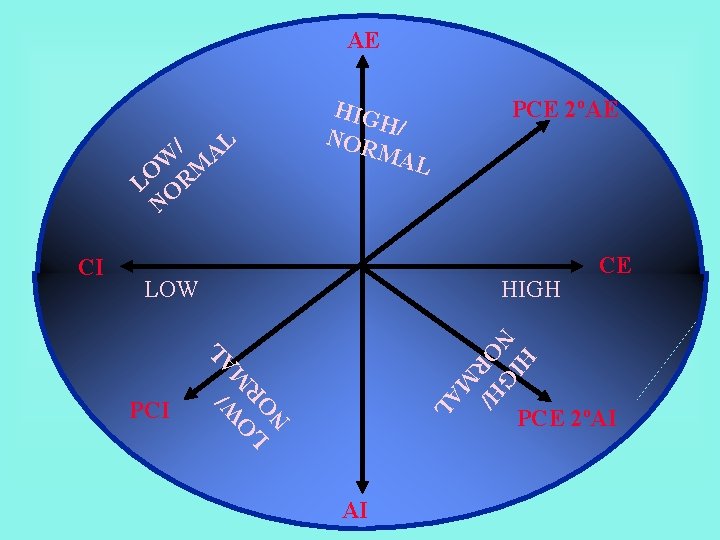
Vergence Dysfunctions • Run along the horizontal axis of the new fangled, BVA ‘O’ MATIC CHART • Less severe: towards center • More severe: towards periphery
AE / AL W M O L OR N LOW W M O L OR N AL H NO IGH RM / AL PCI PCE 2ºAE HIGH / CI HIG H NOR / MAL CE PCE 2ºAI AI
Vergence Dysfunctions • Off horizontal axis: increased accommodative involvement – Lower: • Left: PCI • Right: PCE (2º accommodative insufficiency) – Upper: PCE (2º to accommodative excess)
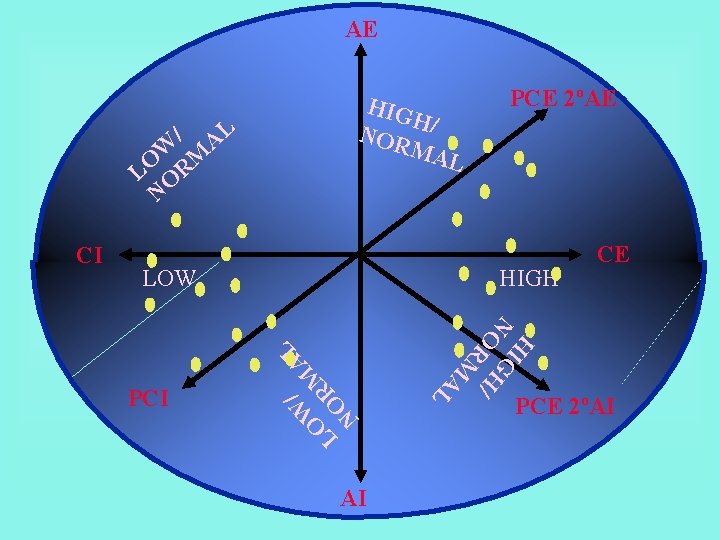
AE HIG H/ NOR MAL L A W M O L OR N / AI H NO IGH RM / AL PCI HIGH L A W M LO OR N LOW / CI PCE 2ºAE CE PCE 2ºAI
Convergence Insufficiency • More severe at left edge • Anti-suppression and accommodation are secondary modalities to address • 3 -4 vergence/1 -2 anti-suppression activities first 1 -3 sessions • Incorporate 2 accommodative activities after 4 th session
Convergence Excess • More severe at right edge • Usually expect smaller “gains” each week of Tx compared with insufficiency • Accommodation is a secondary modality to address • 5 vergence activities first 2 -3 sessions • Incorporate 2 accommodative activities after 3 rd session
Pseudo CI’s • Spread out, away from the horizontal axis – Bottom left: “Classic” Pseudo CI • Usually requires 2. 5 activities of Accomm. and vergence throughout Tx! • Closely monitor for A/S problems • Takes longer to remediate than other vergence Dx
Pseudo CE Secondary to Accommodative Insufficiency • Spread out, away from the horizontal axis – Bottom right: Pseudo CE 2º AI • Usually requires an initial add – may be enough to remediate problem • 3 accommodative activities /2 vergence activities
Pseudo CE Secondary to Accommodative Excess • Spread out, away from the horizontal axis – Top right: Pseudo CE 2º AE • Accommodative excess is usually the most dramatic feature here – Rarely above 2 -3 prism diopters esophoria at near – Accommodative facility (relaxation) significantly affected • 3 accommodative activities/2 vergence expected
General Approach for Vergence Dysfunction: • “Rock” a patient from something they can accomplish with ease to something difficult • This mantra of BV is still applied at the end of therapy (i. e. begin integrated convergence work with minus and BI).
General Approach for Vergence Dysfunction: Vergence Starting Point • Vergence activities usually begun at the transitional level • At times, very basic “walk-towards/away” therapy is necessary for several sessions
General Approach for Vergence Dysfunction: Accommodative Technique Starting Point • A vergence patient with normal skills: – Will have difficulty controlling and adjusting vergence output with binocular level techniques – Would not be able to maintain vergence at a steady state on binocular accommmodative rock – In many cases, only 2 -3 sessions at the trasitional level for vergence skills is required.
General Approach for Vergence Dysfunction: Anti. Suppression Starting Point • Necessary if your therapy grinds to a halt because of suppression • May occur at either the transitional or binocular level, for any modality.
General Approach for Vergence Dysfunction: Anti. Suppression Starting Point • Blinking, flashing a penlight at the suppressing eye or tapping the target being suppressed may be all that is required • When suppression is still preventing progress, the following activities would be called for:
Anti-Suppression Activities • Transitional: – Vis-a-vis – Red/red rock without dioptric lenses – Doell’s Mazes or Litetrac series – Brock BU series/Morgenstern Basic Fusion cards • Binocular: – Cheiroscopic tracings – AN and EC series
General Approach for Vergence Dysfunction: Oculomotor Starting Point • Oculomotility skills may be affected in children with vergence dysfunction. • A relatively high correlation exists between true convergence insufficiency and oculomotor dysfunction. • When necessary, one (out of 5) activity in the orthoptics session will be OM
Cases: True CI (case #. . . ) • Vergence dysfunction • Bad combination of – Low AC/A ration – Insufficient compensating vergence ranges (BO) • DDx from Psuedo CI includes: – Difficulty w/+ on binocular accomm. Facility – No trouble w/ monocular – No plus acceptance/low lag/lead of accommodation
Cases: Pseudo CI (case #. . ) • Accommodation dysfunction w/ vergence “side -effects” • Bad combination of – Poor accommodative control – debilitated vergence ranges (BO) “gives up the nearpoint ship”
Cases: Pseudo CI (case #. . ) Cont. • DDx from true CI includes: – Difficulty clearing MINUS on monocular and binocular +/-2. 00 facility – May have difficulty with plus binoc. facility (if PRC is low enough) – Plus acceptance/high lag – some improvement with plus
- Slides: 20