
BINGO INDUSTRIES Mortdale Recycling Facility Presentation to Planning
BINGO INDUSTRIES Mortdale Recycling Facility Presentation to Planning Assessment Commission 12 DECEMBER 2017
Introduction Strategic Justification Key Issues Community Engagement Draft Conditions Conclusion
CONTENTS 01 INSERT DIVIDER TITLE 3 02 INSERT DIVIDER TITLE 4 03 INSERT DIVIDER TITLE 5 04 INSERT DIVIDER TITLE 6 05 INSERT DIVIDER TITLE 7 06 INSERT DIVIDER TITLE 8 07 INSERT DIVIDER TITLE 9 08 INSERT DIVIDER TITLE 10 09 INSERT DIVIDER TITLE 11 10 INSERT DIVIDER TITLE 12 11 INSERT DIVIDER TITLE 13 12 INSERT DIVIDER TITLE 14 A INSERT DIVIDER TITLE 15 Section 1 Introduction

Overview of Bingo Strategic network of recycling facilities About Bingo Newcastle NEW SOUTH WALES DATS Artarmon Patons Lane RRC and landfill CBD • Bingo is a leading recycling and waste management Company providing end-to-end solutions across the waste management supply chain including: waste collection, processing, separation and recycling • Our vision is to be the leading waste management and environmental solutions provider in Australia • Our strategy is to provide a differentiated approach to waste management by focusing on a high level of service and reliability • Waste collection and processing in the Building and Demolition (B&D) and Commercial and Industrial (C&I) sectors • The Bingo Way – landfill diversion, recycling, and helping to create a circular economy Helensburgh VICTORIA Wollongong DATS Campbellfield Existing recycling centres DATS West Melbourne CBD New recycling centres Employees Fleet (trucks) 775 EMPLOYEES 261 193 NSW 68 VIC Recovery facilities (RRCs) 18 SITES Note: operating figures includes Bingo’s recent acquisitions (National Recycling Group (including DATS) and Paton’s Lane). Page 4
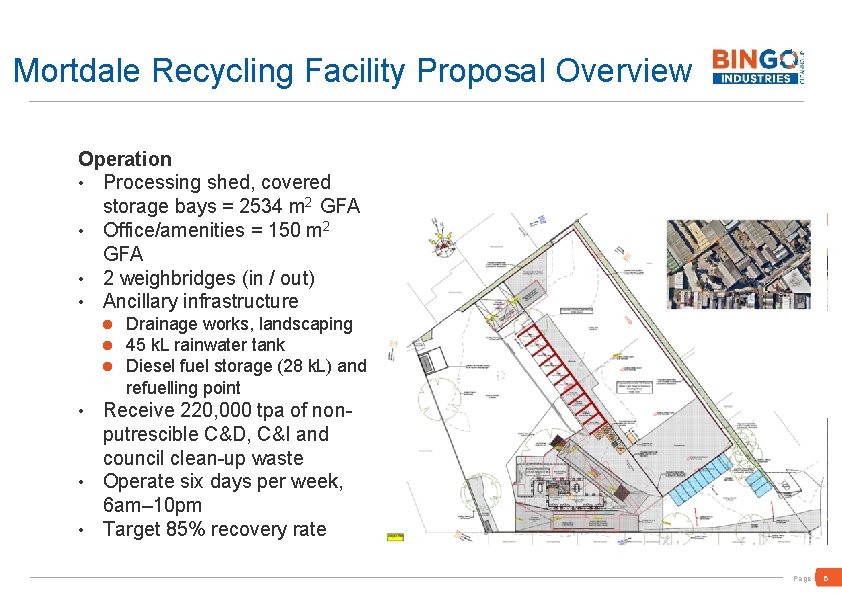
Mortdale Recycling Facility Proposal Overview Operation • Processing shed, covered storage bays = 2534 m 2 GFA • Office/amenities = 150 m 2 GFA • 2 weighbridges (in / out) • Ancillary infrastructure Drainage works, landscaping 45 k. L rainwater tank Diesel fuel storage (28 k. L) and refuelling point Receive 220, 000 tpa of nonputrescible C&D, C&I and council clean-up waste • Operate six days per week, 6 am– 10 pm • Target 85% recovery rate • Page 5
CONTENTS 01 INSERT DIVIDER TITLE 3 02 INSERT DIVIDER TITLE 4 03 INSERT DIVIDER TITLE 5 04 INSERT DIVIDER TITLE 6 05 INSERT DIVIDER TITLE 7 06 INSERT DIVIDER TITLE 8 07 INSERT DIVIDER TITLE 9 08 INSERT DIVIDER TITLE 10 09 INSERT DIVIDER TITLE 11 10 INSERT DIVIDER TITLE 12 11 INSERT DIVIDER TITLE 13 12 INSERT DIVIDER TITLE 14 A INSERT DIVIDER TITLE 15 Section 2 Strategic Justification
Strategic justification Regulatory and policy drivers • 2021 -22 targets of the Waste Avoidance and Resource Recovery Strategy Increase landfill diversion to 75% Recycle 80% of C&D waste (from 72% in 2014 -15) and 70% of C&I (64% in 2014) • The Plan for Growing Sydney (2014) - additional 380, 000 tpa of C&I recycling • Aligns with the objectives of the proposed C&D minimum standards • • Improved recovery rates and management of asbestos / other contamination Improved processes and reporting Reduced waste to Queensland EPA has revised up 2016 -17 estimate by 20%, from 690 ktpa to 830 ktpa Strongly anticipated to be closed / constrained by NSW and Queensland government SE Sydney has limited waste infrastructure Greater Sydney Commission vision to reduce east-west trips, increasing self-sufficiency Page 7
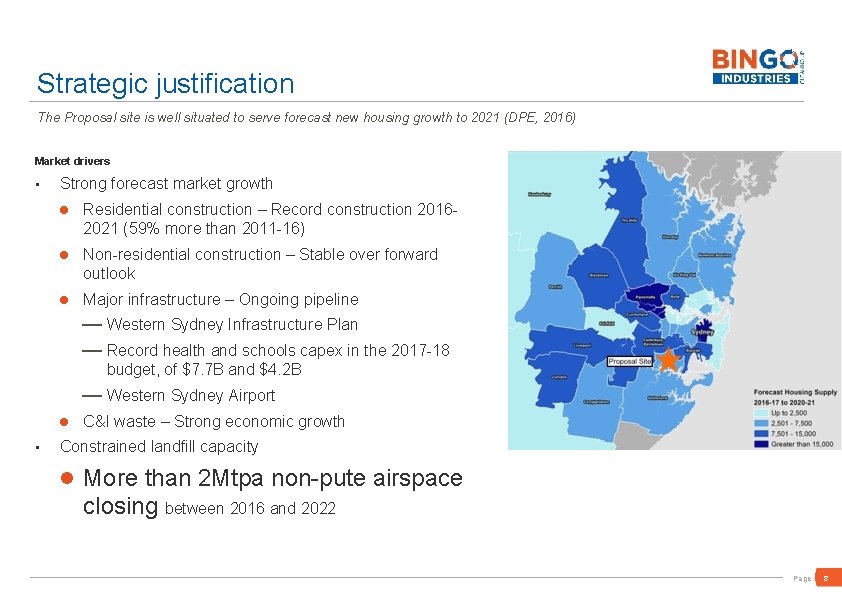
Strategic justification The Proposal site is well situated to serve forecast new housing growth to 2021 (DPE, 2016) Market drivers • Strong forecast market growth Residential construction – Record construction 20162021 (59% more than 2011 -16) Non-residential construction – Stable over forward outlook Major infrastructure – Ongoing pipeline — Western Sydney Infrastructure Plan — Record health and schools capex in the 2017 -18 budget, of $7. 7 B and $4. 2 B — Western Sydney Airport • C&I waste – Strong economic growth Constrained landfill capacity More than 2 Mtpa non-pute airspace closing between 2016 and 2022 Page 8
Section 3 Key Issues
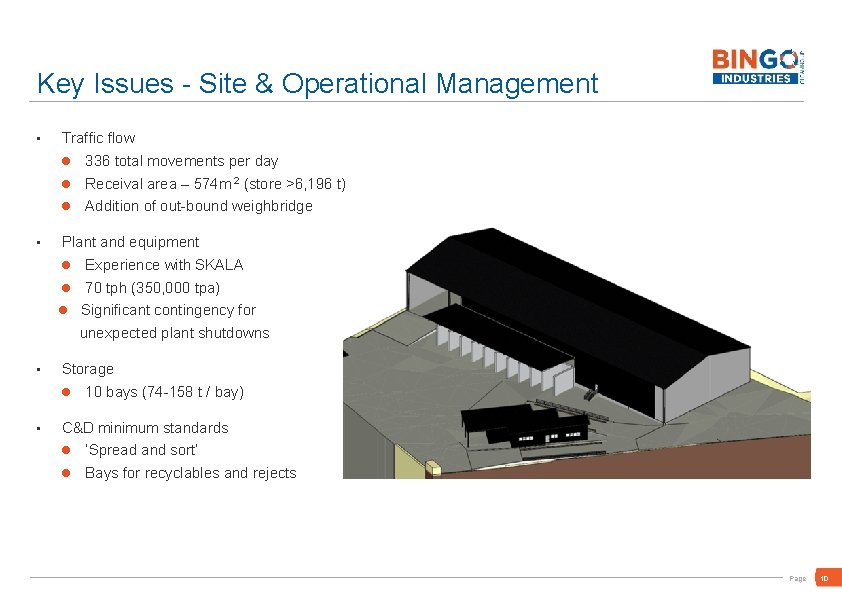
Key Issues - Site & Operational Management • • Traffic flow 336 total movements per day Receival area – 574 m 2 (store >6, 196 t) Addition of out-bound weighbridge Plant and equipment Experience with SKALA 70 tph (350, 000 tpa) Significant contingency for unexpected plant shutdowns • Storage • 10 bays (74 -158 t / bay) C&D minimum standards ‘Spread and sort’ Bays for recyclables and rejects Page 10
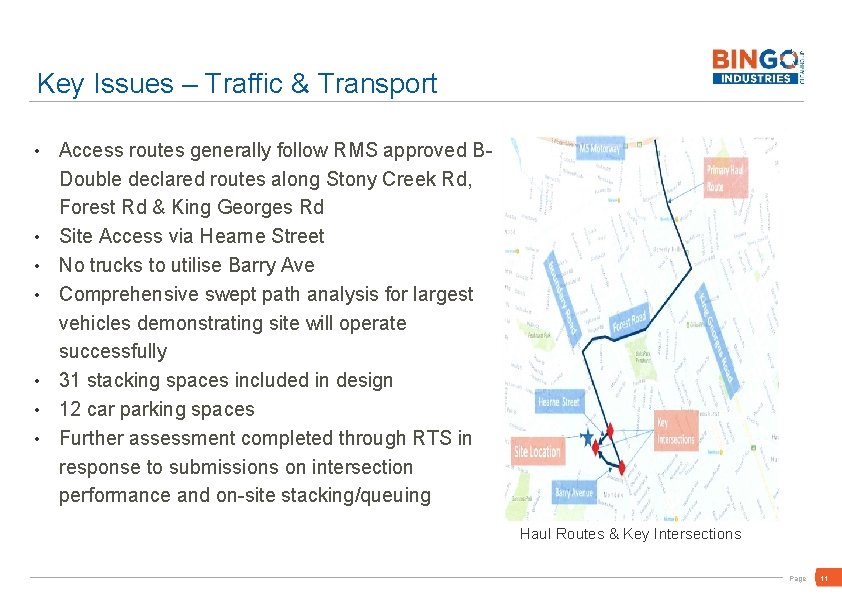
Key Issues – Traffic & Transport • • Access routes generally follow RMS approved BDouble declared routes along Stony Creek Rd, Forest Rd & King Georges Rd Site Access via Hearne Street No trucks to utilise Barry Ave Comprehensive swept path analysis for largest vehicles demonstrating site will operate successfully 31 stacking spaces included in design 12 car parking spaces Further assessment completed through RTS in response to submissions on intersection performance and on-site stacking/queuing Haul Routes & Key Intersections Page 11
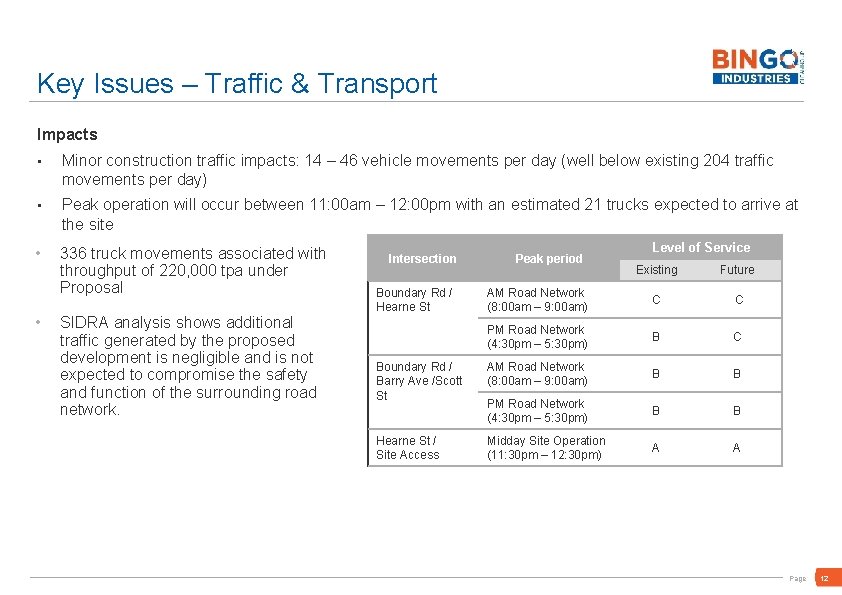
Key Issues – Traffic & Transport Impacts • Minor construction traffic impacts: 14 – 46 vehicle movements per day (well below existing 204 traffic movements per day) • Peak operation will occur between 11: 00 am – 12: 00 pm with an estimated 21 trucks expected to arrive at the site • 336 truck movements associated with throughput of 220, 000 tpa under Proposal • SIDRA analysis shows additional traffic generated by the proposed development is negligible and is not expected to compromise the safety and function of the surrounding road network. Intersection Boundary Rd / Hearne St Boundary Rd / Barry Ave /Scott St Hearne St / Site Access Peak period Level of Service Existing Future AM Road Network (8: 00 am – 9: 00 am) C C PM Road Network (4: 30 pm – 5: 30 pm) B C AM Road Network (8: 00 am – 9: 00 am) B B PM Road Network (4: 30 pm – 5: 30 pm) B B Midday Site Operation (11: 30 pm – 12: 30 pm) A A Page 12
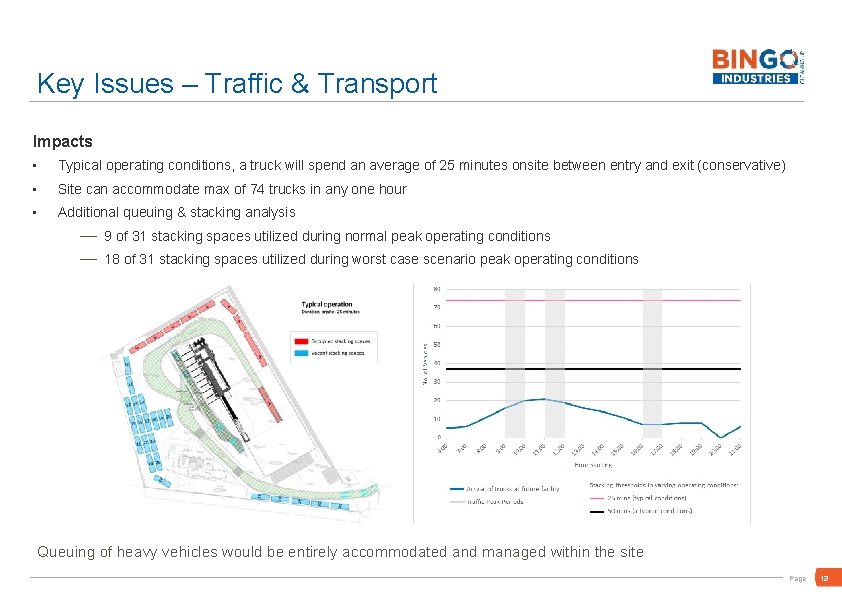
Key Issues – Traffic & Transport Impacts • Typical operating conditions, a truck will spend an average of 25 minutes onsite between entry and exit (conservative) • Site can accommodate max of 74 trucks in any one hour • Additional queuing & stacking analysis — 9 of 31 stacking spaces utilized during normal peak operating conditions — 18 of 31 stacking spaces utilized during worst case scenario peak operating conditions Queuing of heavy vehicles would be entirely accommodated and managed within the site Page 13
Key Issues – Traffic & Transport Mitigation • Construction traffic impacts managed through a CTMP (Conditions B 1 & B 2) • Operational traffic impacts managed through an OTMP (Condition B 5) — — — Forms part of OEMP Includes measures for ensuring road safety and network efficiency Details heavy vehicle routes and access and parking arrangements Driver code of conduct Traffic Control Plan which includes on-site traffic control measures Page 14
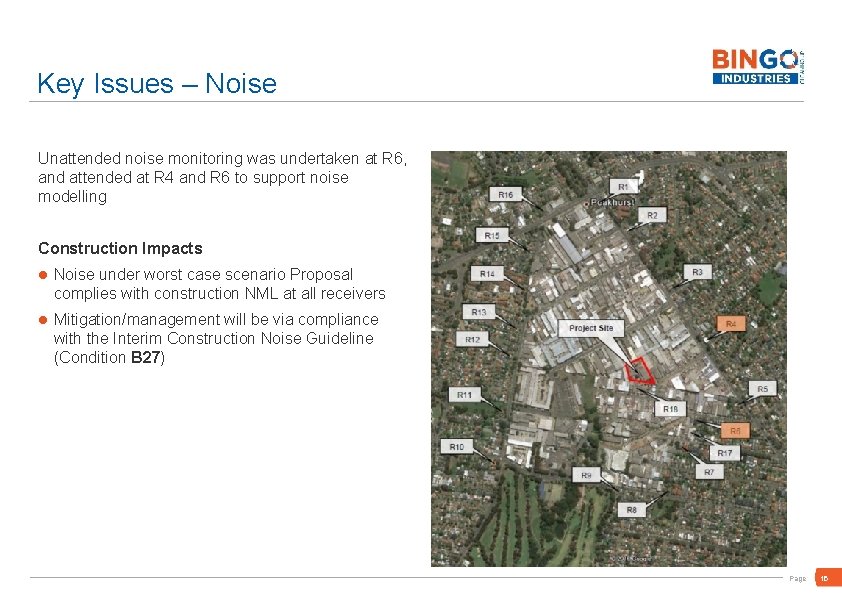
Key Issues – Noise Unattended noise monitoring was undertaken at R 6, and attended at R 4 and R 6 to support noise modelling Construction Impacts Noise under worst case scenario Proposal complies with construction NML at all receivers Mitigation/management will be via compliance with the Interim Construction Noise Guideline (Condition B 27) Page 15
Key Issues – Noise Operation Impacts Intrusiveness • Noise – compliance with INP-based criteria at all receivers, during all weather conditions (day time, evening and night time) • Vibration – compliance with AVTG guideline for all receivers Sleep disturbance • Compliance with screening levels at all receivers Road Noise Impacts (operation and construction) Marginal (<< 2 d. B) increases in road noise during operation i. e. increase from Proposal is only 0. 7 d. Ba Mitigation includes preparation of an Operational Noise and Vibration Management Plan (Condition B 30) as well as operational noise limits (Condition B 28) and other traffic noise and vibration criteria measures (Conditions B 32 and B 33) Page 16
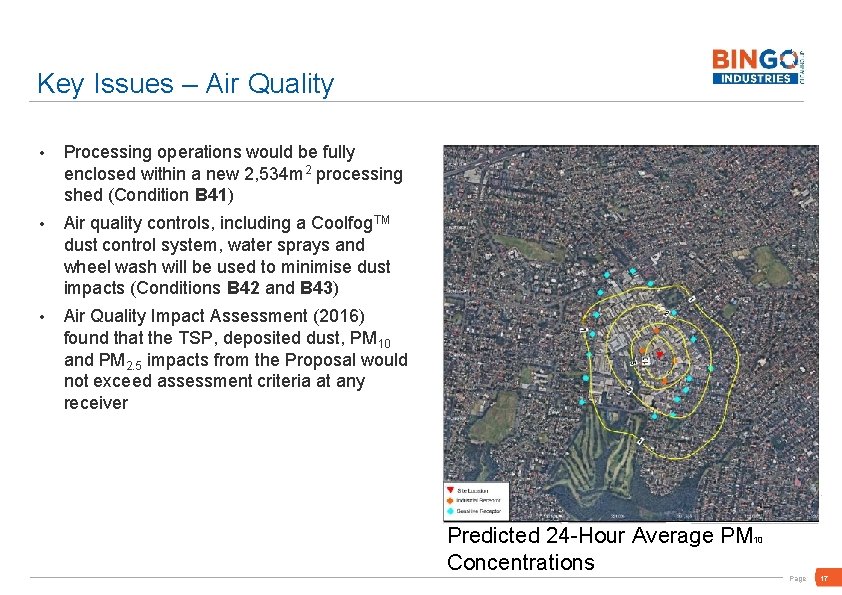
Key Issues – Air Quality • Processing operations would be fully enclosed within a new 2, 534 m 2 processing shed (Condition B 41) • Air quality controls, including a Coolfog. TM dust control system, water sprays and wheel wash will be used to minimise dust impacts (Conditions B 42 and B 43) • Air Quality Impact Assessment (2016) found that the TSP, deposited dust, PM 10 and PM 2. 5 impacts from the Proposal would not exceed assessment criteria at any receiver Predicted 24 -Hour Average PM 10 Concentrations Page 17
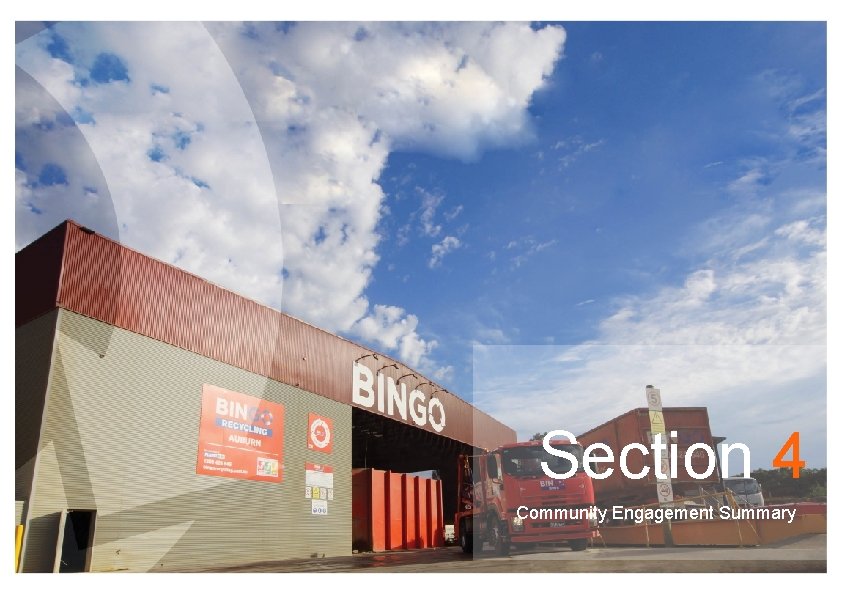
CONTENTS 01 INSERT DIVIDER TITLE 3 02 INSERT DIVIDER TITLE 4 03 INSERT DIVIDER TITLE 5 04 INSERT DIVIDER TITLE 6 05 INSERT DIVIDER TITLE 7 06 INSERT DIVIDER TITLE 8 07 INSERT DIVIDER TITLE 9 08 INSERT DIVIDER TITLE 10 09 INSERT DIVIDER TITLE 11 10 INSERT DIVIDER TITLE 12 11 INSERT DIVIDER TITLE 13 12 INSERT DIVIDER TITLE 14 A INSERT DIVIDER TITLE 15 Section 4 Community Engagement Summary
Community Engagement Summary APP Corporation engaged with the following stakeholders (EIS preparation) Local community in the form written notification of the proposal and face to face meetings with interested parties; Georges River Council The Department of Planning and Environment Protection Authority Roads and Maritime Services Office of Water Department of Primary Industries Four submissions were received from surrounding landowners concerned with: increase traffic volume and road safety impacts; car parking; dust; noise and vibration; and stormwater management Page 19
Cont… EIS Exhibition (22 July -22 August) Key issues raised: • Impacts from traffic, noise, machinery vibration and dust generation • Vehicle movements within and outside the site, road safety and traffic management over the 24 -hour operation • Operational details relating to management of waste streams, stockpiles and justification for 24 -hour operation • Use of Barry Avenue for heavy vehicles • Compliance with the 10 m height limit • Locality of dangerous goods and fire safety management Page 20
Cont… Response to Submissions 1 (December 2016) Relocation of LPG Access, manoeuvring and parking arrangements Machinery and plant alignment No vehicles to use Barry Avenue Dedicated traffic controllers Response to Submissions 2 (April 2017) Reduced throughput to 220, 000 tpa Operational hours from 6 am to 10 pm only Amendments to proposed queuing and bin storage arrangements Additional arrangements to restrict heavy vehicle movements to Hearne Street only Page 21
Cont. Further information to DPE (13 July – 7 November 2017) 13 July 2017 Amended plans to reflect stockpiles High and low-density scenario tabulation Vehicle stacking Timeframe and procedure for waste removal Quality control Glass and plasterboard Non-conforming waste Job creation Matters of Environmental Significance Georges River Council o Traffic and noise impacts to Barry Avenue o Queuing outside the site o Traffic Plan of Management to avoid using Barry Avenue Fire and Rescue NSW Page 22
Cont. 5 October 2017 Timeframes for loading trucks In-bound and out-bound waste Vehicle swept paths Workshop activities Storage of non-conforming waste Processing of waste Updated commitments 1 November 2017 Stormwater quality and quantity SIDRA analysis Storage of Hazardous Chemicals Landowner consent 7 November 2017 Bingo Systems and Procedures Maintenance of SKALA machinery Procedures in handling non-conforming waste New minimum standards for managing construction and demolition waste in NSW Construction and Road Noise Page 23
Section 5 Draft Conditions
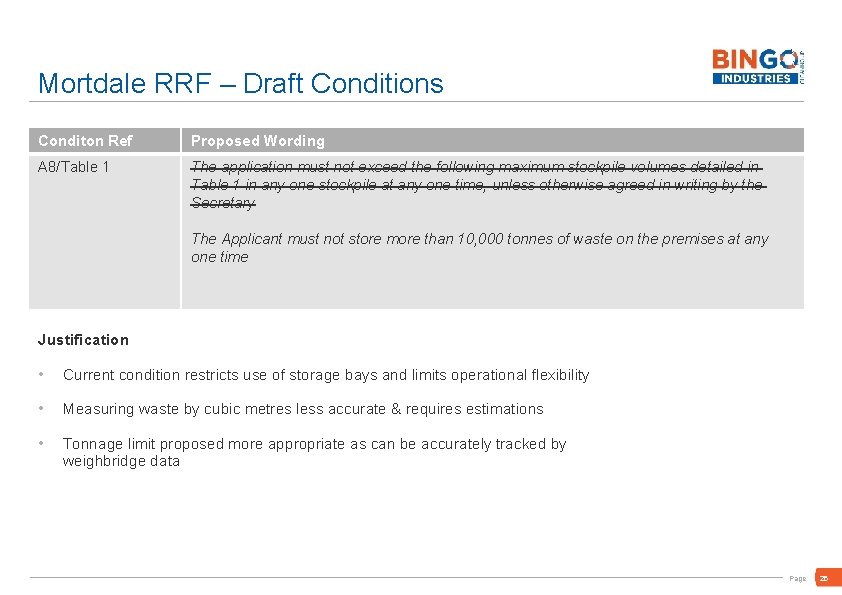
Mortdale RRF – Draft Conditions Conditon Ref Proposed Wording A 8/Table 1 The application must not exceed the following maximum stockpile volumes detailed in Table 1 in any one stockpile at any one time, unless otherwise agreed in writing by the Secretary The Applicant must not store more than 10, 000 tonnes of waste on the premises at any one time Justification • Current condition restricts use of storage bays and limits operational flexibility • Measuring waste by cubic metres less accurate & requires estimations • Tonnage limit proposed more appropriate as can be accurately tracked by weighbridge data Page 25
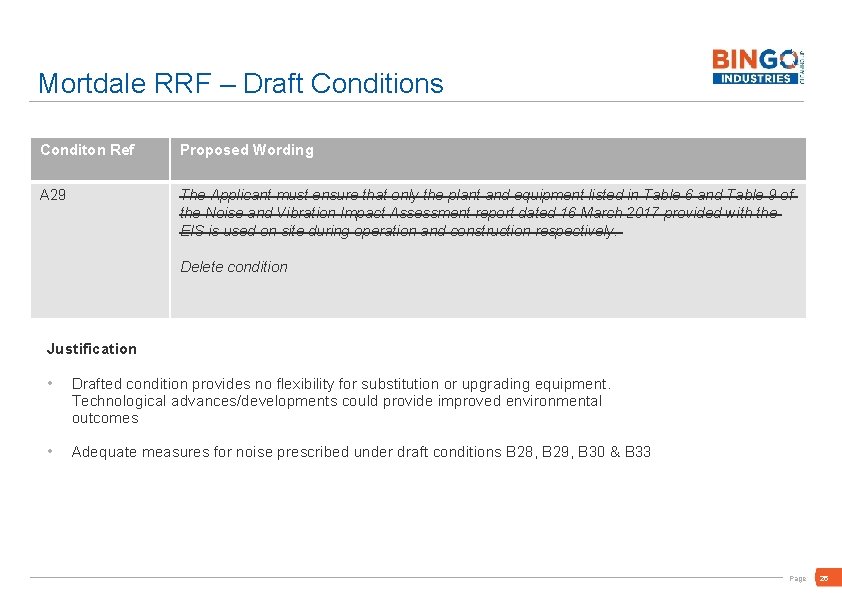
Mortdale RRF – Draft Conditions Conditon Ref Proposed Wording A 29 The Applicant must ensure that only the plant and equipment listed in Table 6 and Table 9 of the Noise and Vibration Impact Assessment report dated 16 March 2017 provided with the EIS is used on site during operation and construction respectively. Delete condition Justification • Drafted condition provides no flexibility for substitution or upgrading equipment. Technological advances/developments could provide improved environmental outcomes • Adequate measures for noise prescribed under draft conditions B 28, B 29, B 30 & B 33 Page 26
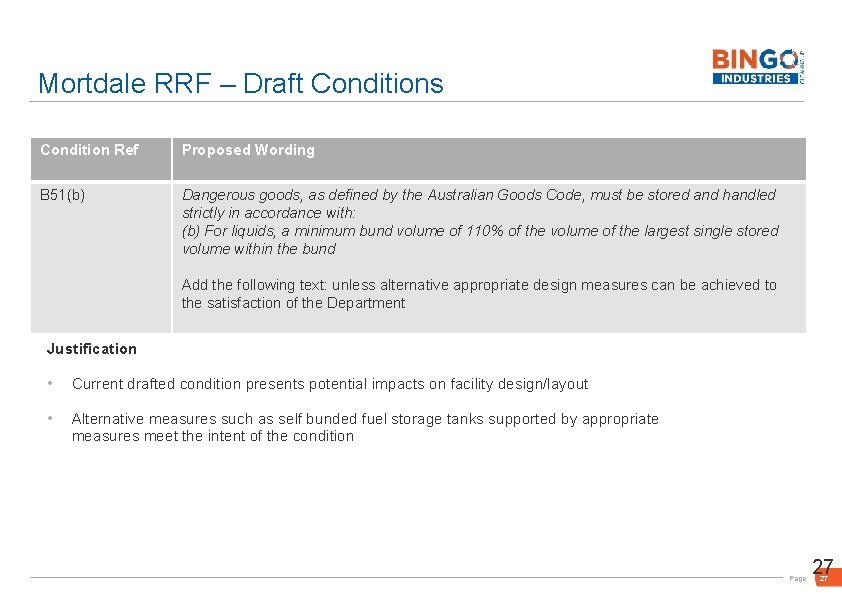
Mortdale RRF – Draft Conditions Condition Ref Proposed Wording B 51(b) Dangerous goods, as defined by the Australian Goods Code, must be stored and handled strictly in accordance with: (b) For liquids, a minimum bund volume of 110% of the volume of the largest single stored volume within the bund Add the following text: unless alternative appropriate design measures can be achieved to the satisfaction of the Department Justification • Current drafted condition presents potential impacts on facility design/layout • Alternative measures such as self bunded fuel storage tanks supported by appropriate measures meet the intent of the condition 27 Page 27
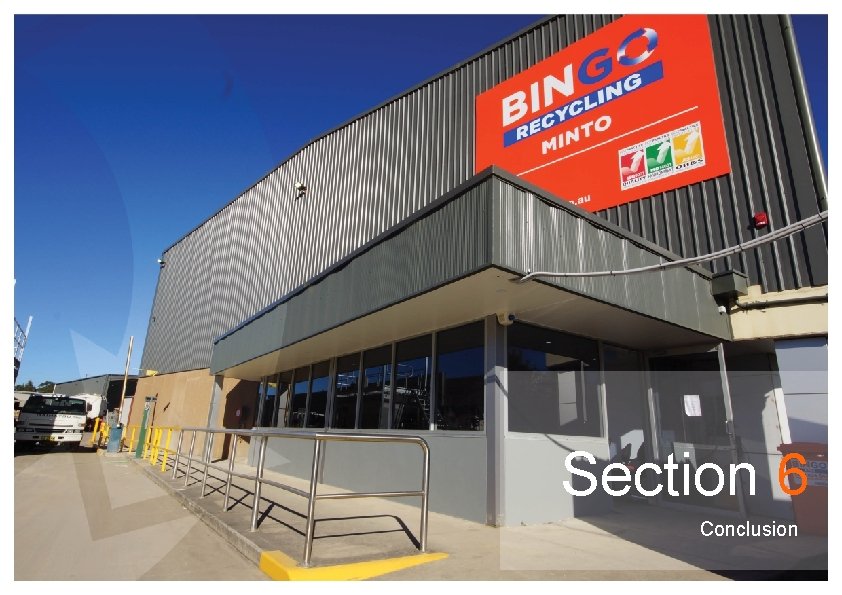
Section 6 Conclusion
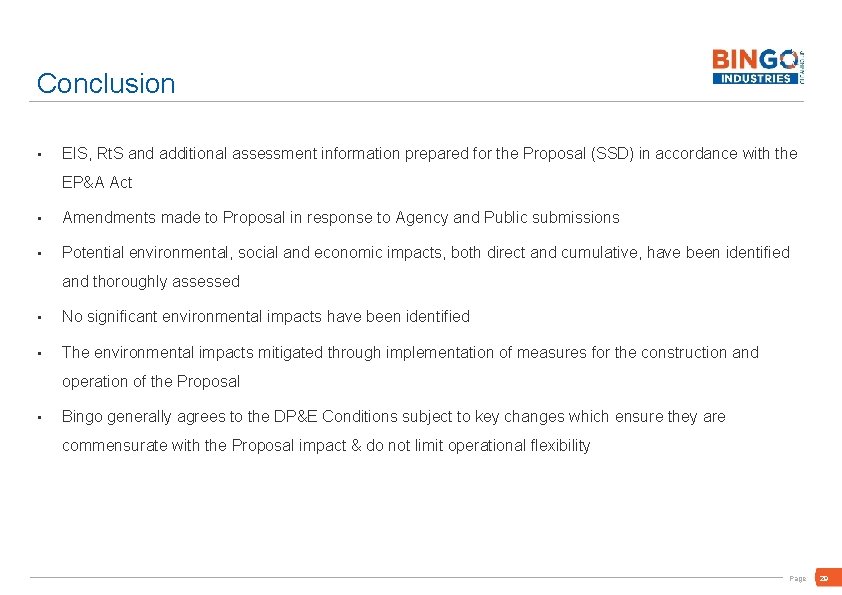
Conclusion • EIS, Rt. S and additional assessment information prepared for the Proposal (SSD) in accordance with the EP&A Act • Amendments made to Proposal in response to Agency and Public submissions • Potential environmental, social and economic impacts, both direct and cumulative, have been identified and thoroughly assessed • No significant environmental impacts have been identified • The environmental impacts mitigated through implementation of measures for the construction and operation of the Proposal • Bingo generally agrees to the DP&E Conditions subject to key changes which ensure they are commensurate with the Proposal impact & do not limit operational flexibility Page 29
- Slides: 29