
Binder A logic based security language John De
Binder: A logic based security language • John De. Treville, Microsoft • What has this to do with building secure software? • I think we need many collaborating small languages that are security specific. Binder is an example: we learn about design issues behind security languages and other languages.
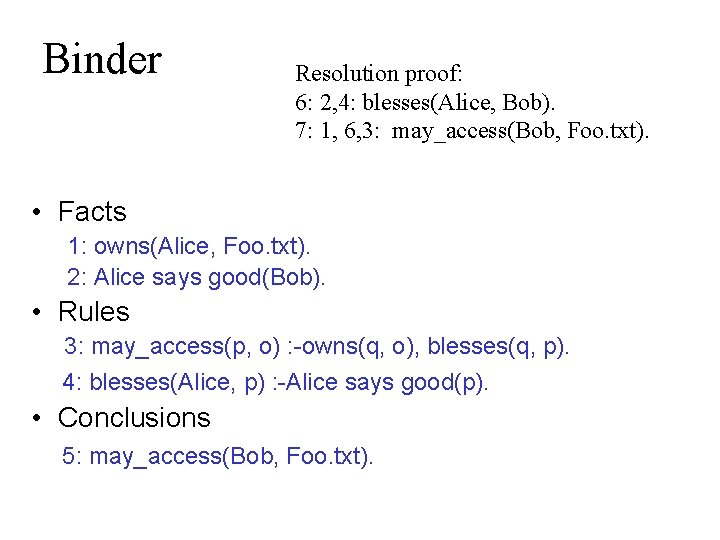
Binder Resolution proof: 6: 2, 4: blesses(Alice, Bob). 7: 1, 6, 3: may_access(Bob, Foo. txt). • Facts 1: owns(Alice, Foo. txt). 2: Alice says good(Bob). • Rules 3: may_access(p, o) : -owns(q, o), blesses(q, p). 4: blesses(Alice, p) : -Alice says good(p). • Conclusions 5: may_access(Bob, Foo. txt).
Binder • However these security statements are encoded, they must necessarily obey some formal schema. We can say that this schema and its accompanying decision procedure define a security language, and that our certificates, policies, ACLs, etc. , are formed from security statements written in our security language and interpreted by its decision procedure.
Datalog for authorization • Binder is an extension of the datalog logic programming language, which can be decided in polynomial time. • Datalog is a restricted subset of the well known Prolog logic programming language. • Binder extends Datalog with constructs for communicating securely across a distributed environment.

Datalog program can(X, read, resource_r) : employee(X, bigco), boss(Y, X), approves(Y, X, read, resource_r). employee(john_smith, bigco). boss(fred_jones, john_smith). approves(fred_jones, john_smith, read, resource_r).

Communicating contexts • Each component has its own Binder context with its own Binder program. • Binder provides extensions to datalog for these distributed contexts to work together. • Binder contexts communicate via signed certificates, as shown in Figure 2.
Communicating contexts • Each Binder context has its own cryptographic key pair; the exporting context uses the private key (which it keeps secret) to sign statements, and the corresponding public key—used to verify the signature at the importing context—also serves to name the context.
Export Import • A statement from one Binder context—fact, rule, or derivable atom—may be exported into a signed certificate, and later imported from the certificate into another context. • Imported statements are automatically quoted using says to distinguish them from local assertions.
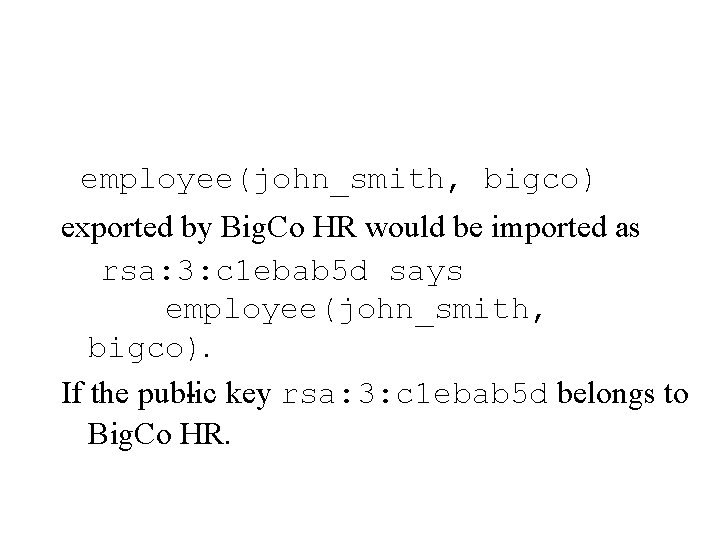
employee(john_smith, bigco) exported by Big. Co HR would be imported as rsa: 3: c 1 ebab 5 d says employee(john_smith, bigco). If the pub lic key rsa: 3: c 1 ebab 5 d belongs to Big. Co HR.
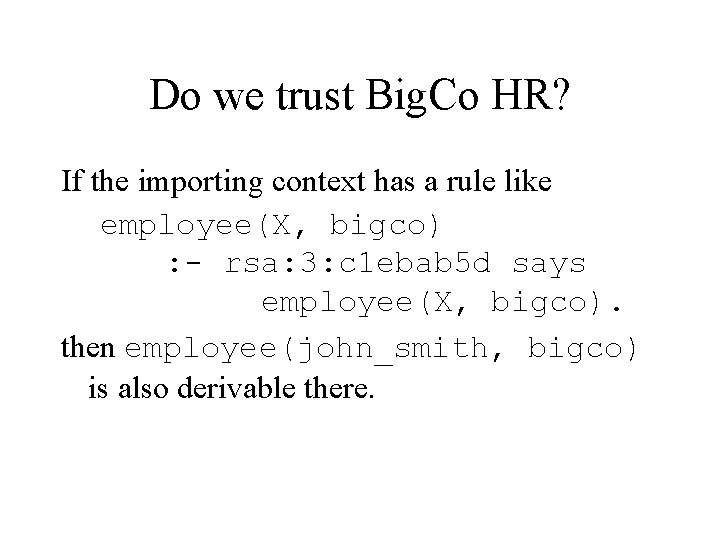
Do we trust Big. Co HR? If the importing context has a rule like employee(X, bigco) : - rsa: 3: c 1 ebab 5 d says employee(X, bigco). then employee(john_smith, bigco) is also derivable there.
Delegation and trust • The con trolled importation of signed statements is Binder’s mechanism for “trust” (as in, “Service S trusts Big. Co HR”) or “delegation” (“Service S delegates the identification of Big. Co employees to Big. Co HR”) or “speaks for” (“Big. Co HR speaks for service S”); Binder lets us implement an unambiguous logic based policy with the same effect.
Extended Example • We model a traditional “chain of trust”: service S trusts Big. Co HR to establish a policy, while Big. Co HR trusts BCL HR. • Figure 1 and Figure 3 in Binder.
Proofs, monotonicity and revocation • A service grants access to a resource in Binder only when it can derive an atom saying it should; otherwise, by de fault, access is denied. The derivation steps form a proof that access should be granted.
Proof: Service or client • A proof can be generated at the service—as traditionally—or we can require that the client generate the proof and transmit it with the request. If so, the service need only check the proof; this optimization can offload work from a heavily loaded service onto its less busy clients, while also helping avoid denial of service attacks.
Pass back information to client • Since the service’s policy is stored as a Binder program, and since Binder statements can be passed in certificates, the service can pass its policy to the client in preparation for the construction of such a proof.
Monotonic • Binder is monotonic—if an atom is derivable, it’s still derivable if we add more statements [15]. Monotonicity is appropriate in a distributed environment, since withholding some statements from a service will not cause it to grant greater access rights. Moreover, a proof generated on a client with little information available will still check on a ser vice with more information.
Support for revocation • One consequence of monotonicity is that tradi tional cer tificate revocation cannot be modeled from inside Binder; it requires additional mechanism. We have studied three ways to extend Binder to support revocation reliably.
First • One is through short-lived statements. We can attach va lidity intervals to each Binder statement, as with tradi tional certificates, and con strain the validity intervals of derived atoms accord ingly. Once a statement expires, it can be removed from all contexts, along with all atoms that cannot be de rived without it.
Second • A second approach is through a language extension al lowing freshness constraints on statements. If a deriva tion rule depends on fresh P(X, Y), say, instead of just P(X, Y), then a new P(X, Y) must be derived for each use. This may involve contacting the exporters of old certifi cates to obtain fresher ones. A generalization of this mechanism is to allow each use of a certificate to specify how fresh it must be.
Third • The final approach is to reference distributed state. For exam ple, a statement could have an associated Boo lean state “valid” that turns from true to false if it is re voked. This state could be explicitly referenced from Binder, perhaps with a freshness constraint.
4 key properties • • English New predicates Arbitrary statements in certificates Decidable in polynomial time.
- Slides: 21