
Binary Trees Computer Science and Engineering 12112021 1
Binary Trees Computer Science and Engineering 12/11/2021 1
Introduction We studied linked list is a dynamic linear data structure. n n It is dynamic since it supports efficient addition and deletion of items. It is linear since it is sequential and each element in it has exactly one successor. A tree is nonlinear data structure. n n Each element may have more than one successor. Can be static or dynamic. 12/11/2021 2
Topics for Discussion Elements of a tree Examples of trees Binary Tree Definition Types of binary trees Contiguous (static) representation Dynamic representation 12/11/2021 3
Terminology Trees are used to represent relationships: items in a tree are referred to as nodes and the lines connecting the nodes that express the hierarchical relationship are referred to as edges. The edges in a tree are directed. Trees are hierarchical which means that a parent-child relationship exist between the nodes in the tree. Each node has at most one parent. The node with no parents is the root node. The nodes that have no successors (no children nodes) are known as leaf nodes. Lets look at some examples and identify the various elements. 12/11/2021 4
Examples Family ancestor tree Directory of files organization in your computer system Parse tree n n n Languages are defined using grammar Grammars are specified using rules or syntax Syntax is expressed using a notation called Backaus-Naur Form (BNF) (John Backus and Peter Naur) Expression trees Game trees 12/11/2021 5
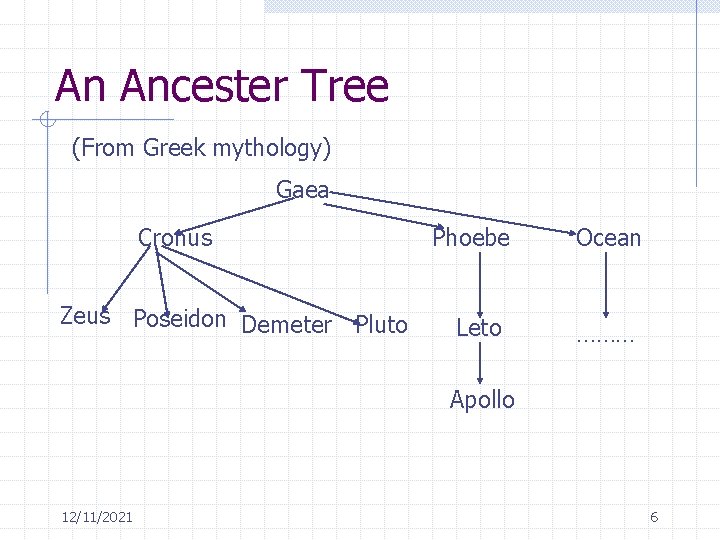
An Ancester Tree (From Greek mythology) Gaea Cronus Zeus Poseidon Demeter Pluto Phoebe Leto Ocean ……… Apollo 12/11/2021 6
BNF for a Language BNF notation includes nonterminals and terminals. n n n Terminals are literals or particular symbols. Nonterminals are general expressions that can be substituted with terminals and nonterminals. Grammar rules specify the definition of a nonterminal. Nonterminals are enclosed with angle brackets <nonterminal> Symbols used in construction include : : = (defines), | (or) and other common operators. 12/11/2021 7
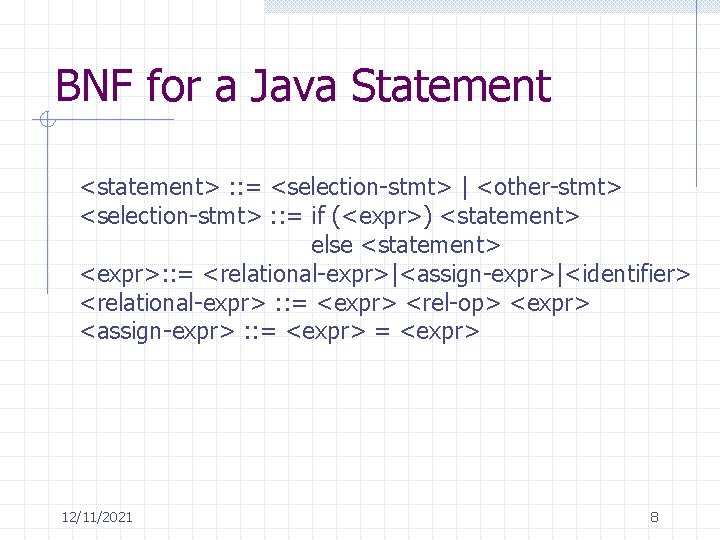
BNF for a Java Statement <statement> : : = <selection-stmt> | <other-stmt> <selection-stmt> : : = if (<expr>) <statement> else <statement> <expr>: : = <relational-expr>|<assign-expr>|<identifier> <relational-expr> : : = <expr> <rel-op> <expr> <assign-expr> : : = <expr> 12/11/2021 8
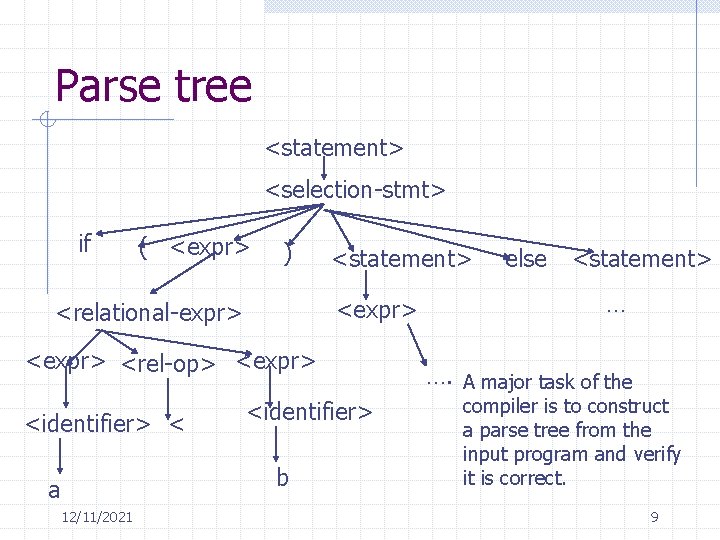
Parse tree <statement> <selection-stmt> if ( <expr> ) <statement> <expr> <relational-expr> <rel-op> <expr> <identifier> < <identifier> b a 12/11/2021 else <statement> … …. A major task of the compiler is to construct a parse tree from the input program and verify it is correct. 9
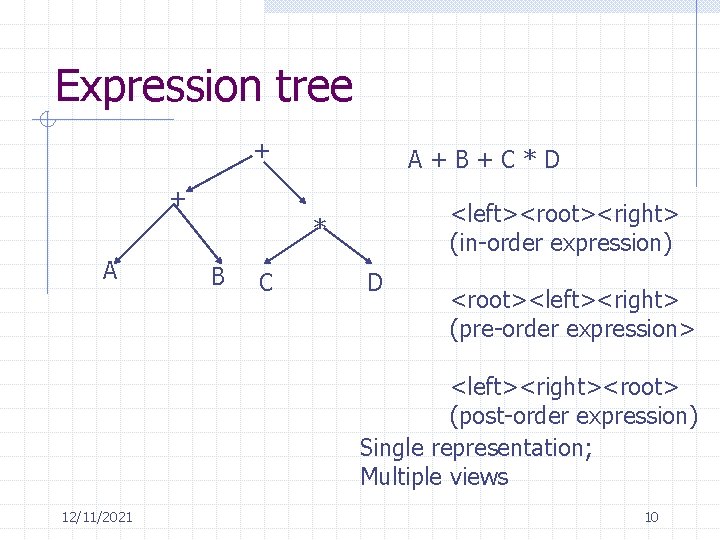
Expression tree + A+B+C*D + <left><root><right> (in-order expression) * A B C D <root><left><right> (pre-order expression> <left><right><root> (post-order expression) Single representation; Multiple views 12/11/2021 10

Game Tree X X X X X …… …. … X X 12/11/2021 X X X X 11

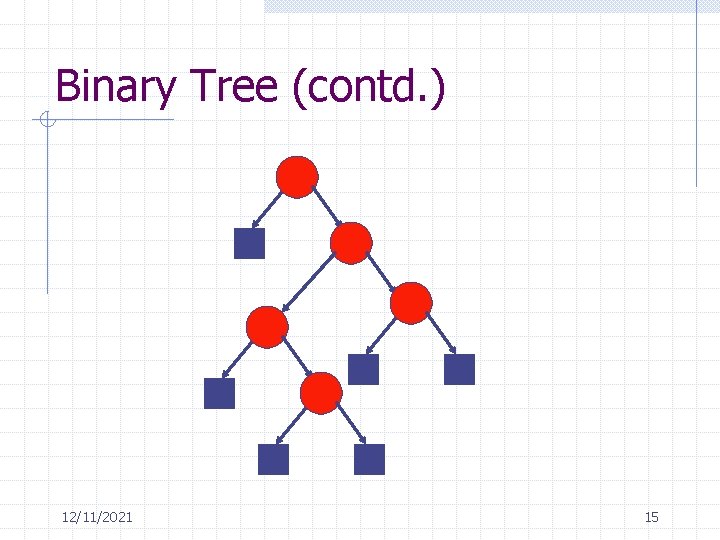
Binary Tree A binary tree can be defined recursively as follows. It is either n n empty, or consists of a root node together with left and right trees, both of which are binary trees. 12/11/2021 12

Binary Tree Empty Non. Empty Null. Object (pattern) Singleton (pattern) 12/11/2021 13

Binary Tree (contd. ) 12/11/2021 14
Binary Tree (contd. ) 12/11/2021 15
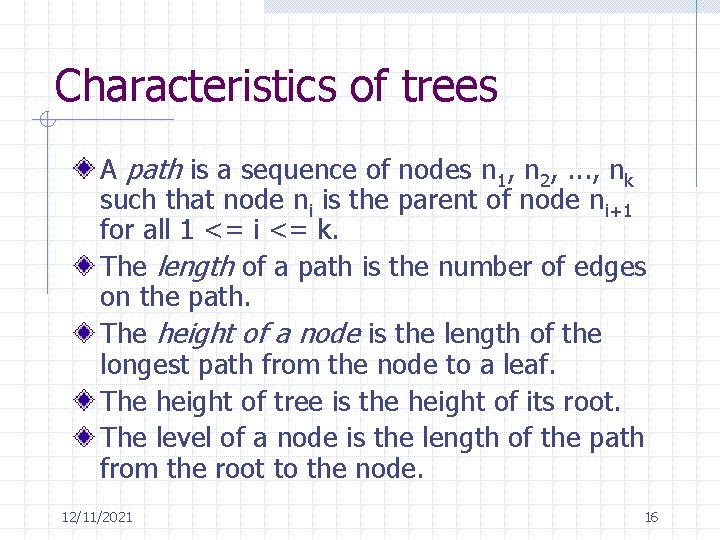
Characteristics of trees A path is a sequence of nodes n 1, n 2, . . . , nk such that node ni is the parent of node ni+1 for all 1 <= i <= k. The length of a path is the number of edges on the path. The height of a node is the length of the longest path from the node to a leaf. The height of tree is the height of its root. The level of a node is the length of the path from the root to the node. 12/11/2021 16

Full Binary Tree A full binary tree is a tree in which each node has exactly zero or two non-empty children. All leaves are at the same level. A complete binary tree in which all the leaf nodes are in level n or n-1 and all leaves on the level n are filled from left to right. n There are some interesting properties that arise out of this definition. Lets look at some examples to illustrate the various definitions. 12/11/2021 17
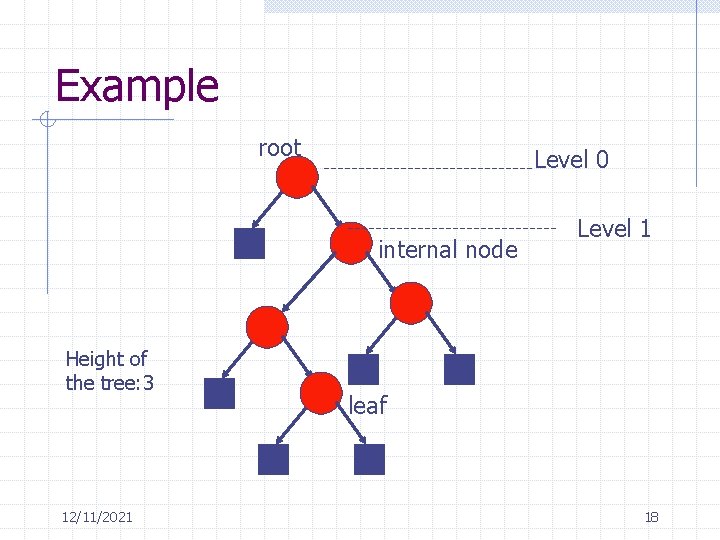
Example root Level 0 internal node Height of the tree: 3 12/11/2021 Level 1 leaf 18
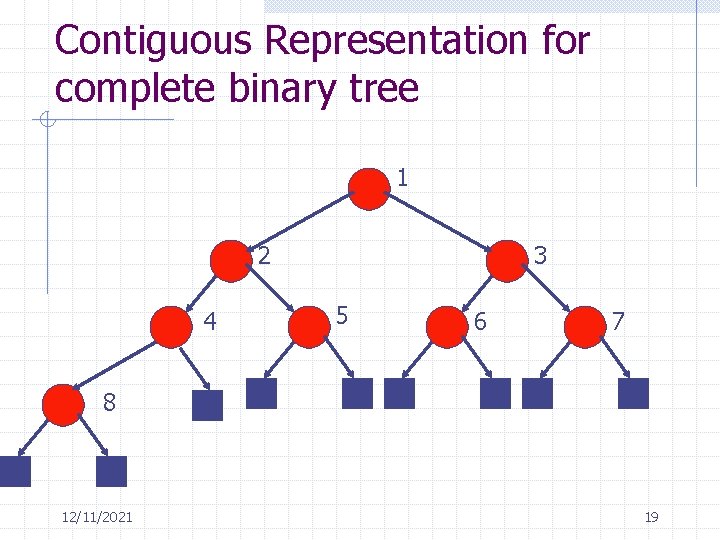
Contiguous Representation for complete binary tree 1 2 4 3 5 6 7 8 12/11/2021 19
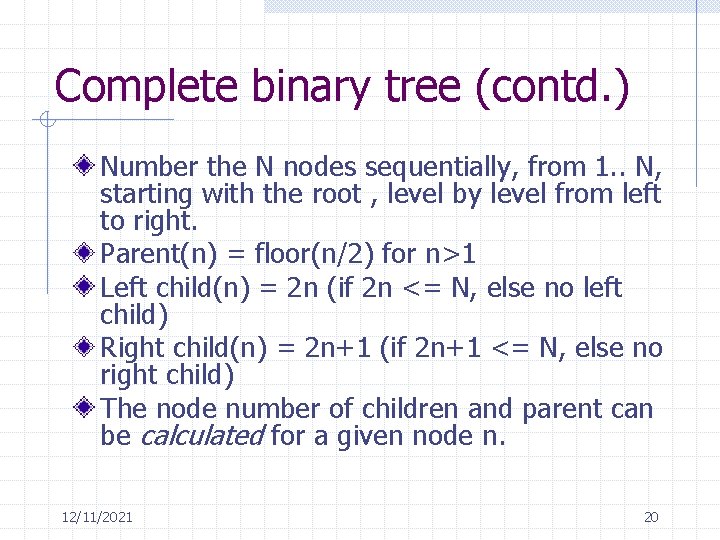
Complete binary tree (contd. ) Number the N nodes sequentially, from 1. . N, starting with the root , level by level from left to right. Parent(n) = floor(n/2) for n>1 Left child(n) = 2 n (if 2 n <= N, else no left child) Right child(n) = 2 n+1 (if 2 n+1 <= N, else no right child) The node number of children and parent can be calculated for a given node n. 12/11/2021 20

Contiguous representation By placing the N nodes in a contiguous sequence we can use simple arithmetic relationships to process the nodes. This will eliminate storage for the pointers to sub trees. Root object 0 1 12/11/2021 2 3 4 5 6 7 8 21
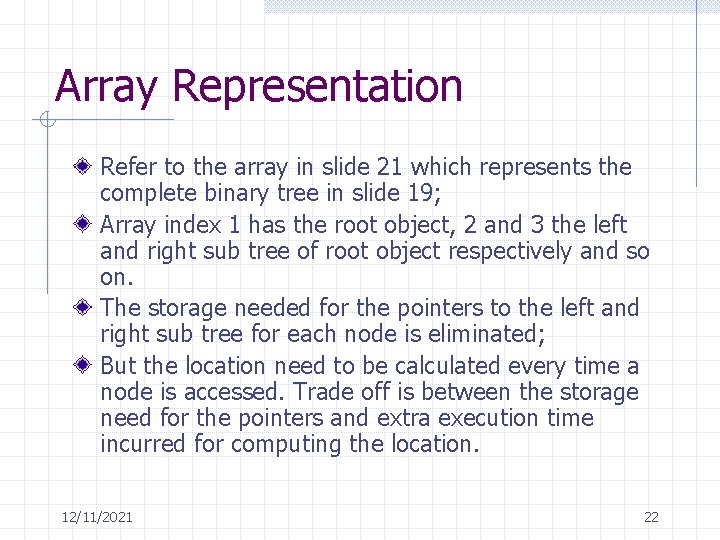
Array Representation Refer to the array in slide 21 which represents the complete binary tree in slide 19; Array index 1 has the root object, 2 and 3 the left and right sub tree of root object respectively and so on. The storage needed for the pointers to the left and right sub tree for each node is eliminated; But the location need to be calculated every time a node is accessed. Trade off is between the storage need for the pointers and extra execution time incurred for computing the location. 12/11/2021 22
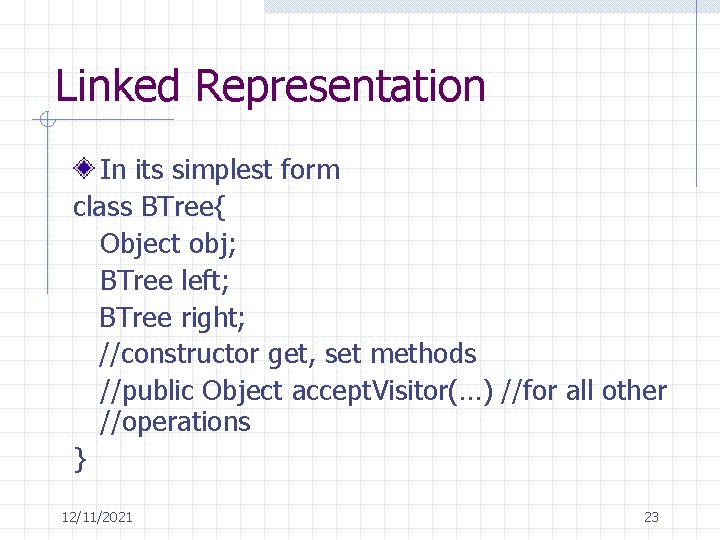
Linked Representation In its simplest form class BTree{ Object obj; BTree left; BTree right; //constructor get, set methods //public Object accept. Visitor(…) //for all other //operations } 12/11/2021 23
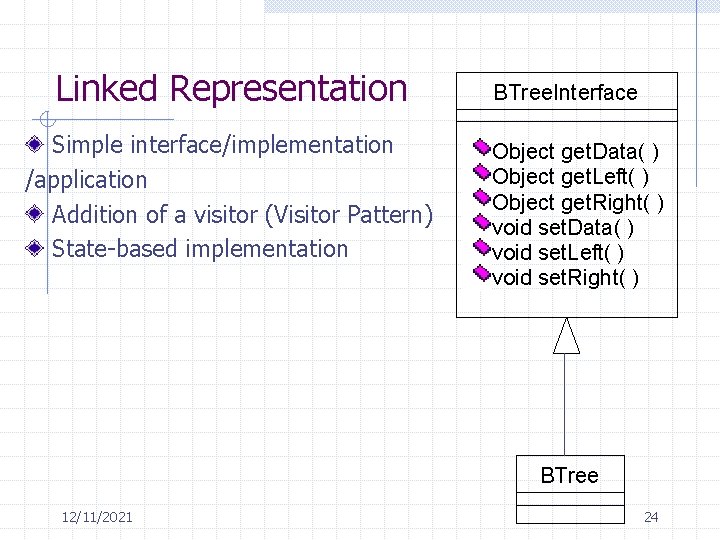
Linked Representation Simple interface/implementation /application Addition of a visitor (Visitor Pattern) State-based implementation BTree. Interface Object get. Data( ) Object get. Left( ) Object get. Right( ) void set. Data( ) void set. Left( ) void set. Right( ) BTree 12/11/2021 24
Methods for Tree class Trees are very widely used in many applications. It is simply impossible and impractical to think of all the applications to decide the operations to implement in a tree class. Many may not be known apriori. Even if you implement all possible operations you can think of, only a small subset may be used by a given application. For example, preorder traversal may not be needed for game tree application. Solution: add operations to the tree class depending on the application. n This requires recompilation. Another solution is to use a Visitor pattern. 12/11/2021 25

Visitor Pattern: elegant solution that allows for future addition of an operation to a class. The operation need not be known to a class at the time of its implementation. Requirements: n Class (say, AClass) should have a method to accept visitors (say, accept. Visitor). That is, AClass and its subclasses receive visitors thru’ this method. n Visitor super class (say, interface Visitor) that specifies the signatures for the methods (operations) to be implemented by concrete visitors, one operation per concrete subclass of AClass. n accept. Visitor method should be passed an object reference to the visitor and place holders for input and output data (objects). This method is independent of implementation/name of the concrete visitors. n Concrete visitor has implementations of the operations specified in the interface Visitor. 12/11/2021 26

Using a Visitor In an application: n Instantiate an object, say host, of concrete class of AClass. w Btree host = new Btree(); n Instantiate an object, a. Visitor, of concrete visitor class. w Visitor a. Visitor = new Weight. Visitor(); n To carry out the operation defined in the visitor, make the “host” class “accept” the “visitor” through the accept. Visitor method. w Object result = host. accept. Visitor(a. Visitor, input. Obj); 12/11/2021 27
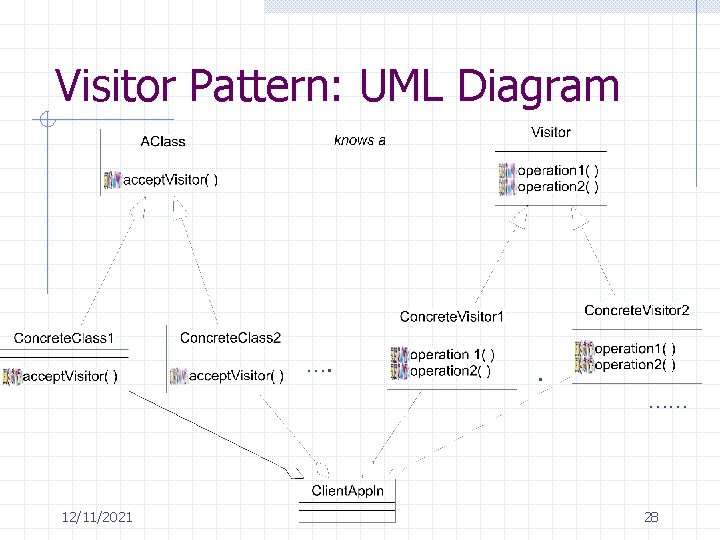
Visitor Pattern: UML Diagram …. 12/11/2021 . …… 28
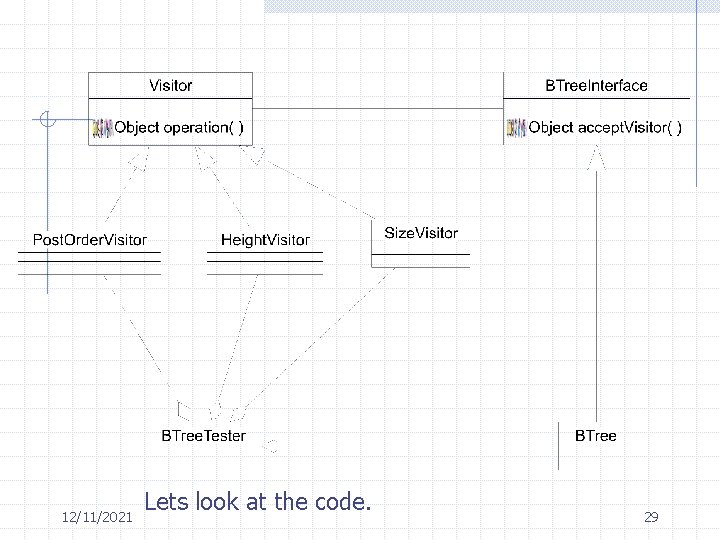
12/11/2021 Lets look at the code. 29
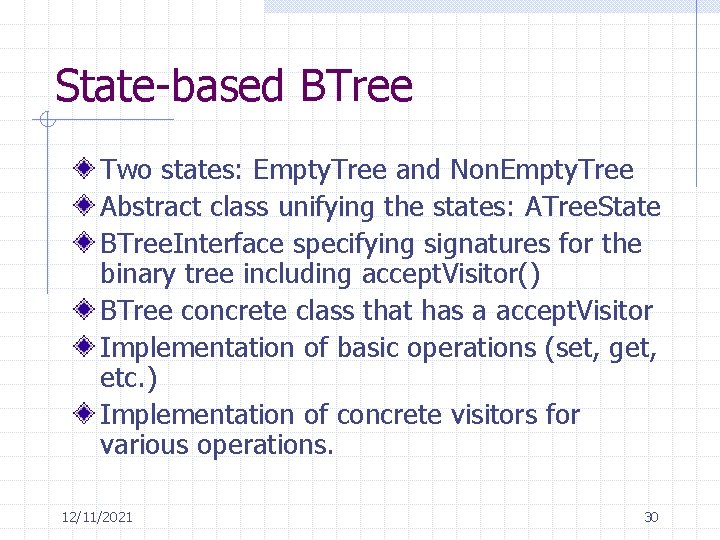
State-based BTree Two states: Empty. Tree and Non. Empty. Tree Abstract class unifying the states: ATree. State BTree. Interface specifying signatures for the binary tree including accept. Visitor() BTree concrete class that has a accept. Visitor Implementation of basic operations (set, get, etc. ) Implementation of concrete visitors for various operations. 12/11/2021 30
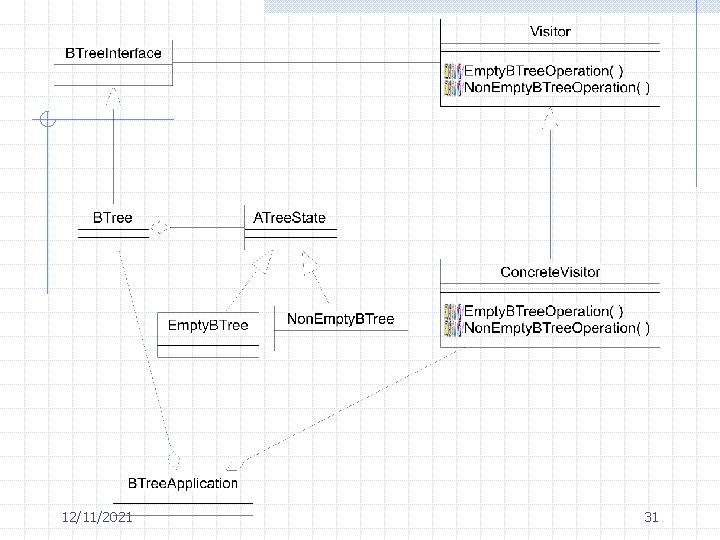
12/11/2021 31
- Slides: 31