
Binary Search Trees PART II Computer Science Engineering

Binary Search Trees (PART II) Computer Science Engineering Otterbein University COMP 2100 Otterbein University
Ordered Symbol Tables Computer Science Otterbein University o One of the benefits of the BST as an implementation for Symbol Tables is that BSTs support ordered keys. o You can iterate over the elements of a BST Symbol Table using this order by performing an in-order traversal of the tree Traverse left subtree Enqueue key Traverse right subtree

In-Order Traversal Computer Science Otterbein University public Iterable<Key> keys() { Queue<Key> q = new Queue<Key>(); inorder(root, q); return q; } private void inorder(Node x, Queue<Key> queue) { if (x == null) return; inorder(x. left, q); q. enqueue(x. key); inorder(x. right, q); }
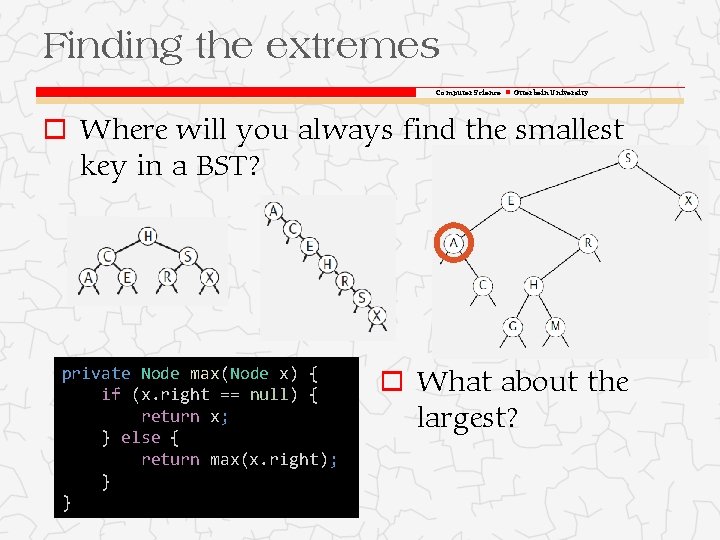
Finding the extremes Computer Science Otterbein University o Where will you always find the smallest key in a BST? private Node max(Node min(Node x) { if (x. right (x. left == null) { return x; } else { return max(x. right); min(x. left); } } o What about the largest?
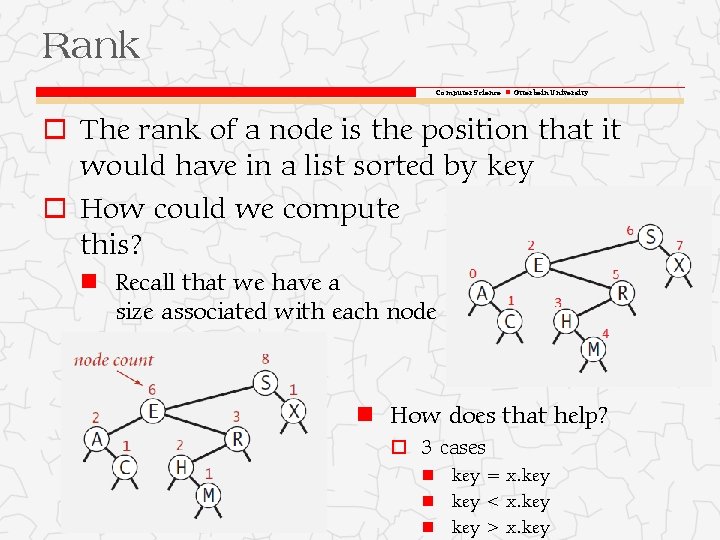
Rank Computer Science Otterbein University o The rank of a node is the position that it would have in a list sorted by key o How could we compute this? Recall that we have a size associated with each node How does that help? o 3 cases key = x. key < x. key > x. key
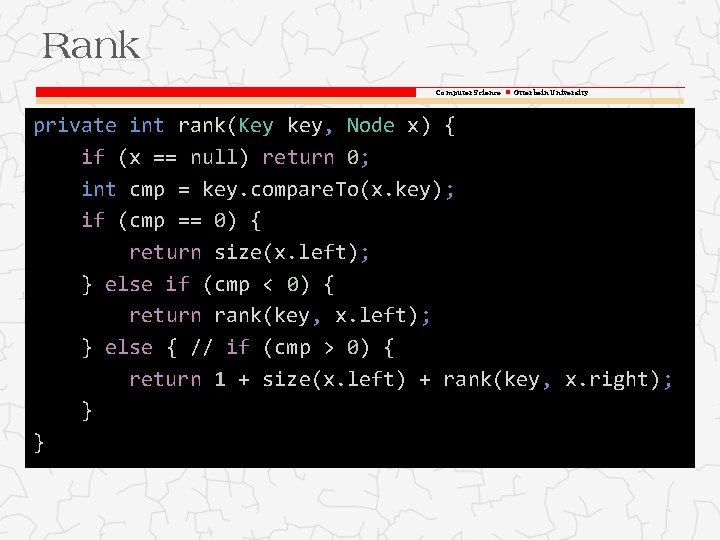
Rank Computer Science Otterbein University private int rank(Key key, Node x) { if (x == null) return 0; int cmp = key. compare. To(x. key); if (cmp == 0) { return size(x. left); } else if (cmp < 0) { return rank(key, x. left); } else { // if (cmp > 0) { return 1 + size(x. left) + rank(key, x. right); } }
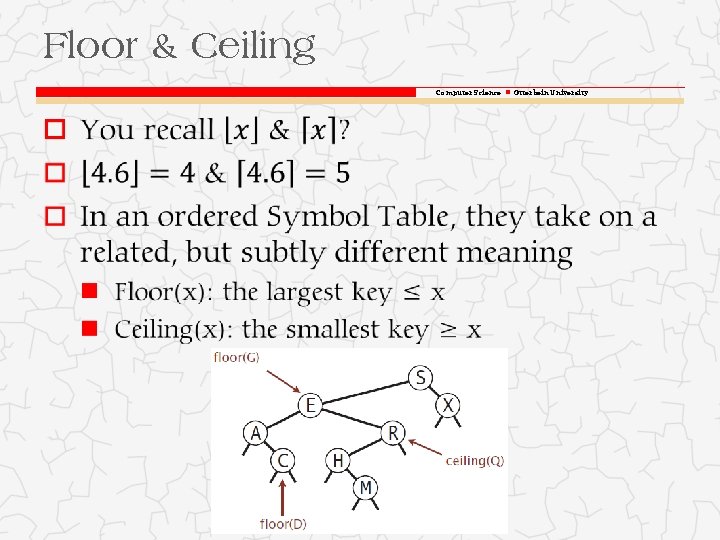
Floor & Ceiling Computer Science Otterbein University o
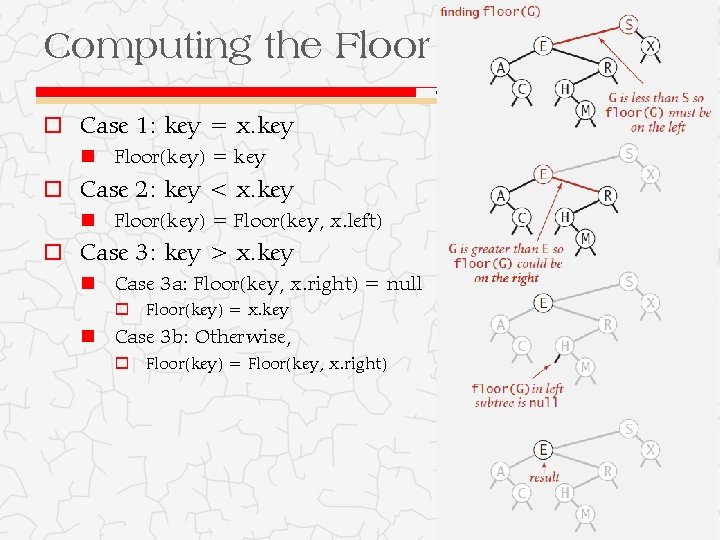
Computing the Floor Computer Science Otterbein University o Case 1: key = x. key Floor(key) = key o Case 2: key < x. key Floor(key) = Floor(key, x. left) o Case 3: key > x. key Case 3 a: Floor(key, x. right) = null o Floor(key) = x. key Case 3 b: Otherwise, o Floor(key) = Floor(key, x. right)
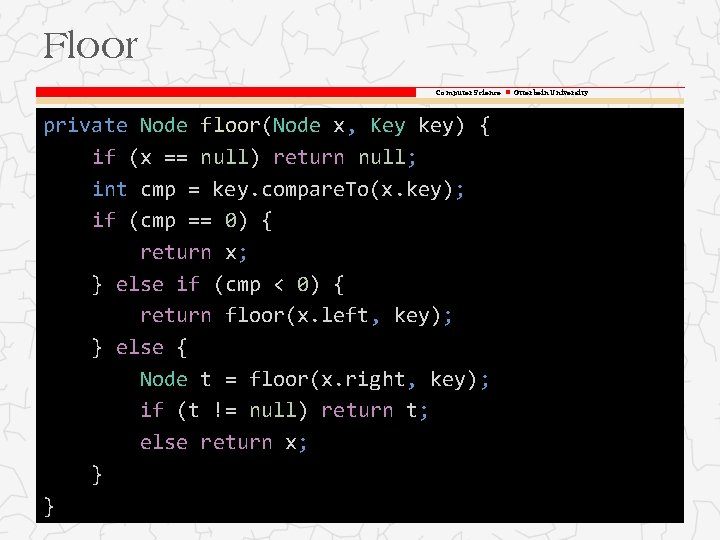
Floor Computer Science Otterbein University private Node floor(Node x, Key key) { if (x == null) return null; int cmp = key. compare. To(x. key); if (cmp == 0) { return x; } else if (cmp < 0) { return floor(x. left, key); } else { Node t = floor(x. right, key); if (t != null) return t; else return x; } }
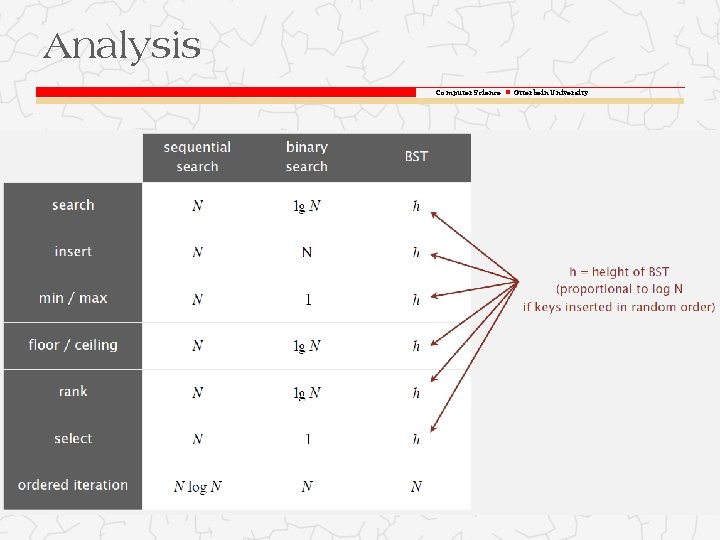
Analysis Computer Science Otterbein University
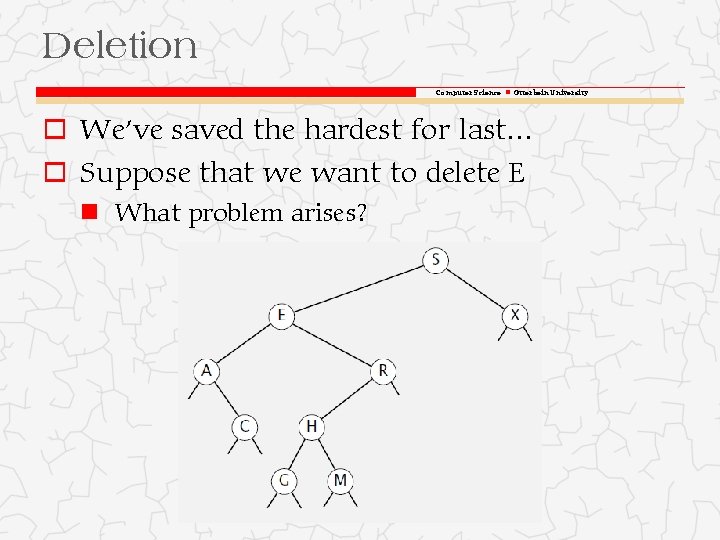
Deletion Computer Science Otterbein University o We’ve saved the hardest for last. . . o Suppose that we want to delete E What problem arises?
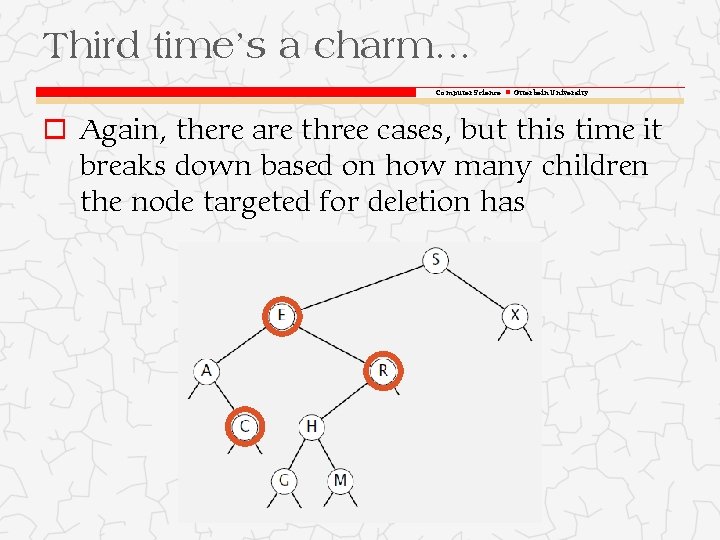
Third time’s a charm. . . Computer Science Otterbein University o Again, there are three cases, but this time it breaks down based on how many children the node targeted for deletion has
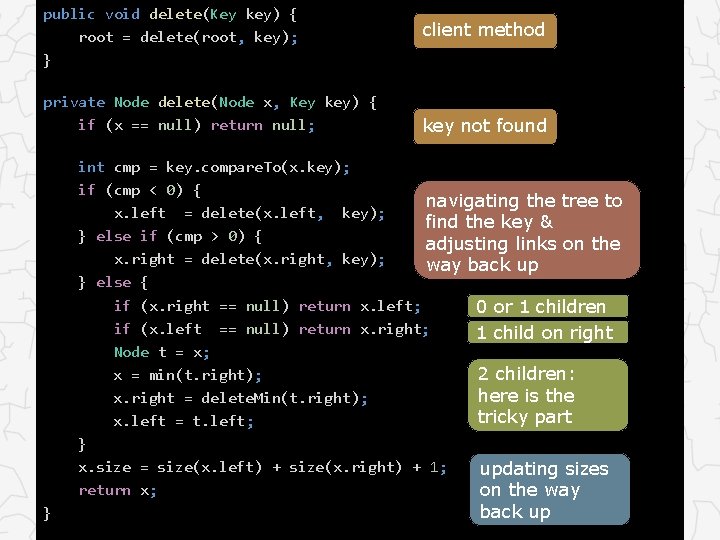
public void delete(Key key) { root = delete(root, key); } private Node delete(Node x, Key key) { if (x == null) return null; client method Computer Science Otterbein University key not found int cmp = key. compare. To(x. key); if (cmp < 0) { navigating the tree to x. left = delete(x. left, key); find the key & } else if (cmp > 0) { adjusting links on the x. right = delete(x. right, key); way back up } else { if (x. right == null) return x. left; 0 or 1 children if (x. left == null) return x. right; 1 child on right Node t = x; x = min(t. right); 2 children: here is the x. right = delete. Min(t. right); tricky part x. left = t. left; } x. size = size(x. left) + size(x. right) + 1; updating sizes return x; on the way } back up
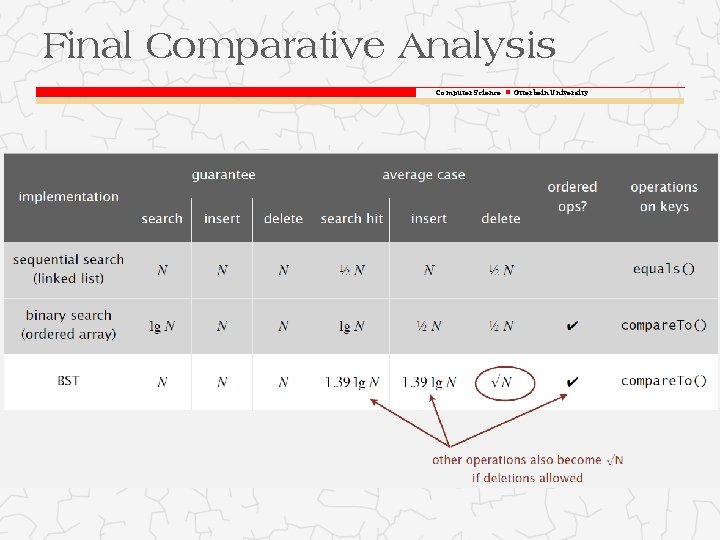
Final Comparative Analysis Computer Science Otterbein University
- Slides: 14