
Binary Number System The two states of the
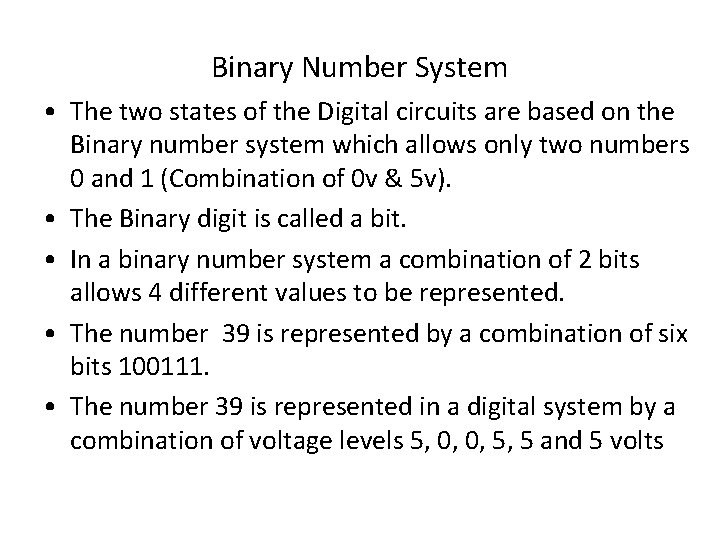
Binary Number System • The two states of the Digital circuits are based on the Binary number system which allows only two numbers 0 and 1 (Combination of 0 v & 5 v). • The Binary digit is called a bit. • In a binary number system a combination of 2 bits allows 4 different values to be represented. • The number 39 is represented by a combination of six bits 100111. • The number 39 is represented in a digital system by a combination of voltage levels 5, 0, 0, 5, 5 and 5 volts
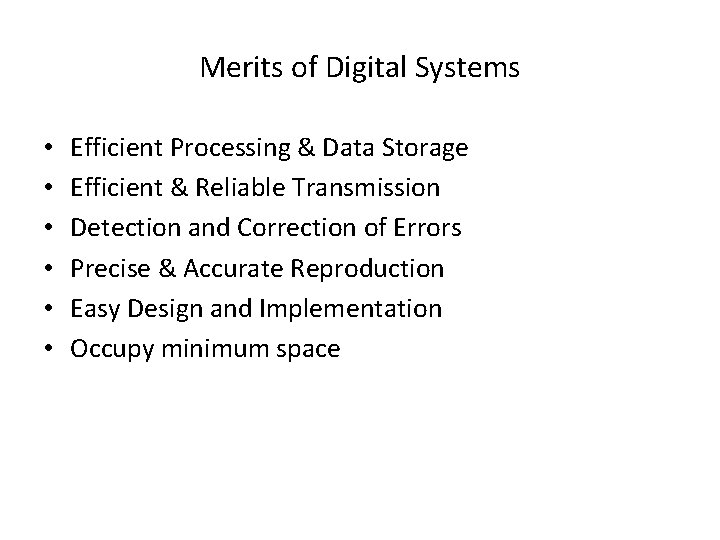
Merits of Digital Systems • • • Efficient Processing & Data Storage Efficient & Reliable Transmission Detection and Correction of Errors Precise & Accurate Reproduction Easy Design and Implementation Occupy minimum space
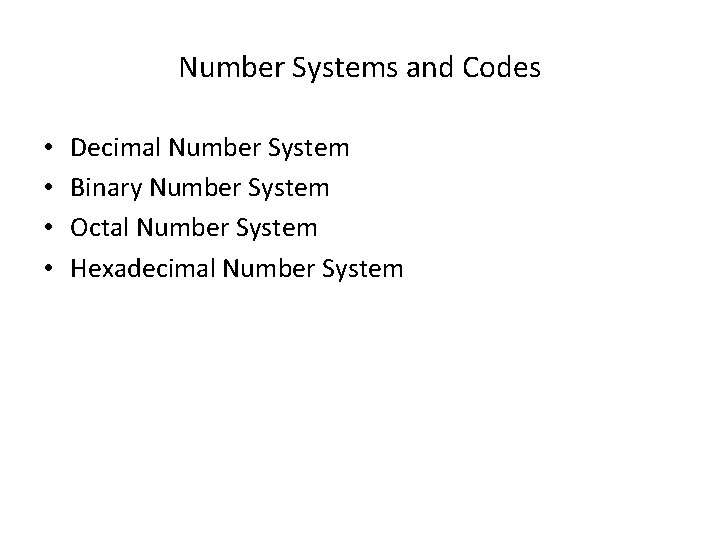
Number Systems and Codes • • Decimal Number System Binary Number System Octal Number System Hexadecimal Number System
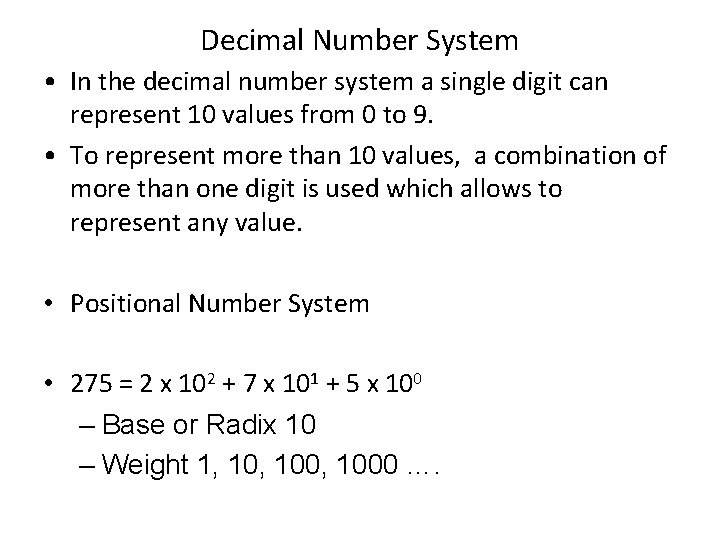
Decimal Number System • In the decimal number system a single digit can represent 10 values from 0 to 9. • To represent more than 10 values, a combination of more than one digit is used which allows to represent any value. • Positional Number System • 275 = 2 x 10² + 7 x 101 + 5 x 100 – Base or Radix 10 – Weight 1, 100, 1000 ….
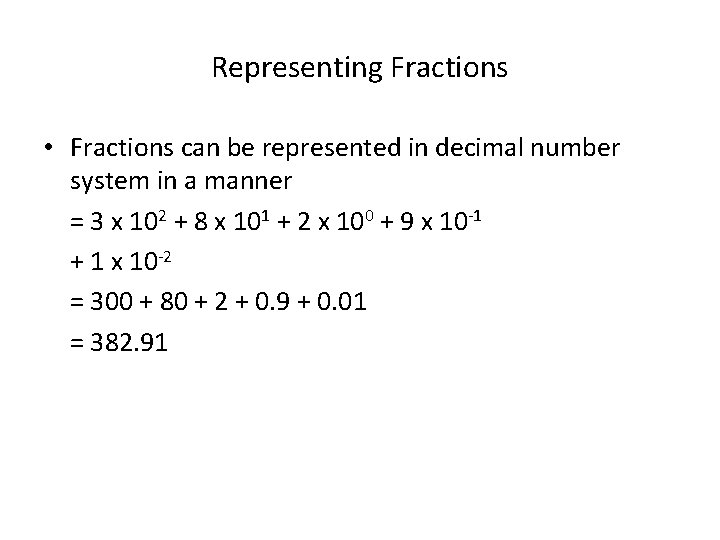
Representing Fractions • Fractions can be represented in decimal number system in a manner = 3 x 10² + 8 x 101 + 2 x 100 + 9 x 10 -1 + 1 x 10 -2 = 300 + 80 + 2 + 0. 9 + 0. 01 = 382. 91
Binary Number System • • Two unique numbers 0 and 1 Base – 2 A binary digit is a bit Combination of bits to represent larger values
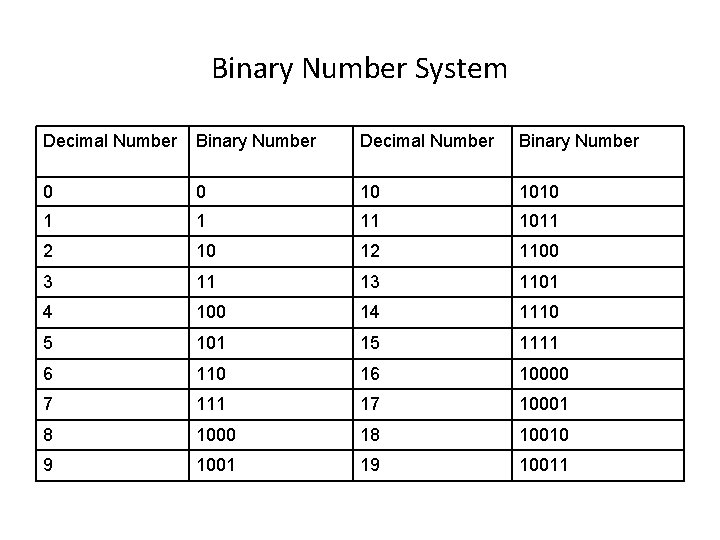
Binary Number System Decimal Number Binary Number 0 0 10 1010 1 1 11 1011 2 10 12 1100 3 11 13 1101 4 100 14 1110 5 101 15 1111 6 110 16 10000 7 111 17 10001 8 1000 18 10010 9 1001 19 10011
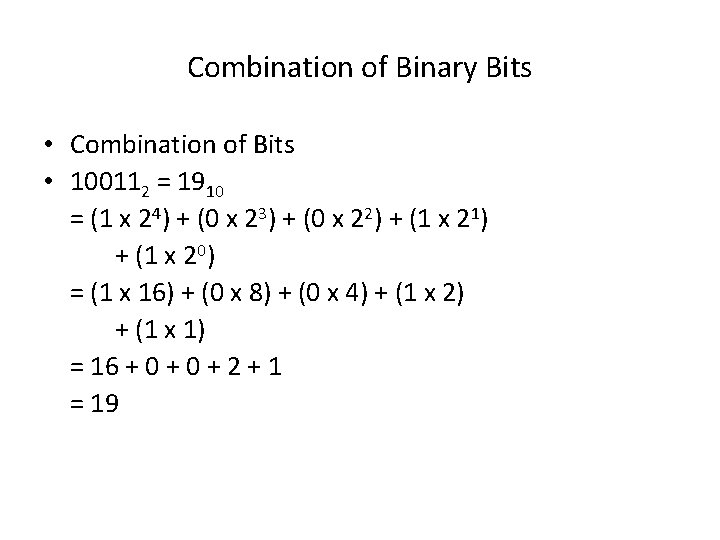
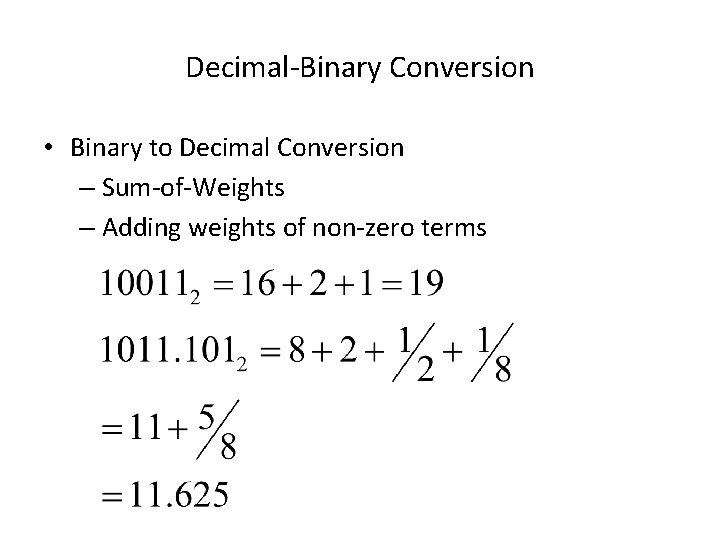
Combination of Binary Bits • Combination of Bits • 100112 = 1910 = (1 x 24) + (0 x 23) + (0 x 22) + (1 x 21) + (1 x 20) = (1 x 16) + (0 x 8) + (0 x 4) + (1 x 2) + (1 x 1) = 16 + 0 + 2 + 1 = 19
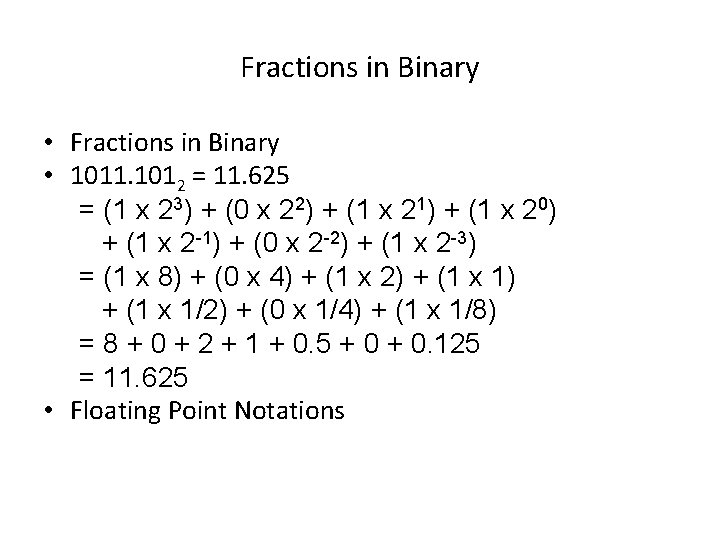
Fractions in Binary • 1011. 1012 = 11. 625 = (1 x 23) + (0 x 22) + (1 x 21) + (1 x 20) + (1 x 2 -1) + (0 x 2 -2) + (1 x 2 -3) = (1 x 8) + (0 x 4) + (1 x 2) + (1 x 1/2) + (0 x 1/4) + (1 x 1/8) = 8 + 0 + 2 + 1 + 0. 5 + 0. 125 = 11. 625 • Floating Point Notations
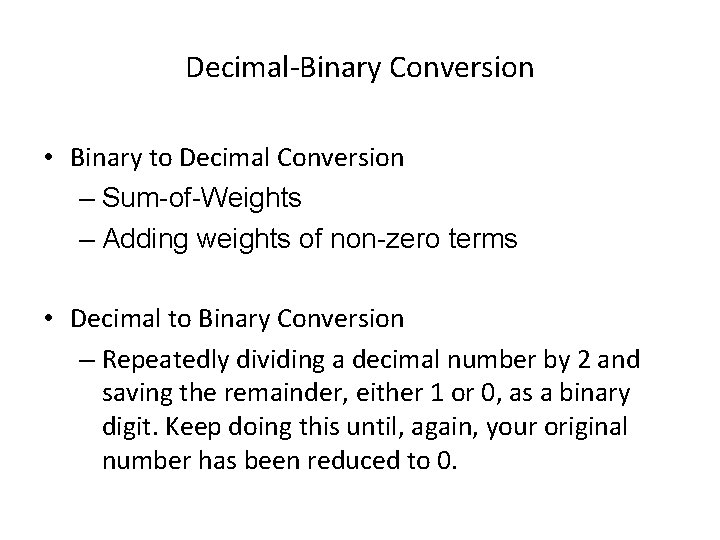
Decimal-Binary Conversion • Binary to Decimal Conversion – Sum-of-Weights – Adding weights of non-zero terms • Decimal to Binary Conversion – Repeatedly dividing a decimal number by 2 and saving the remainder, either 1 or 0, as a binary digit. Keep doing this until, again, your original number has been reduced to 0.
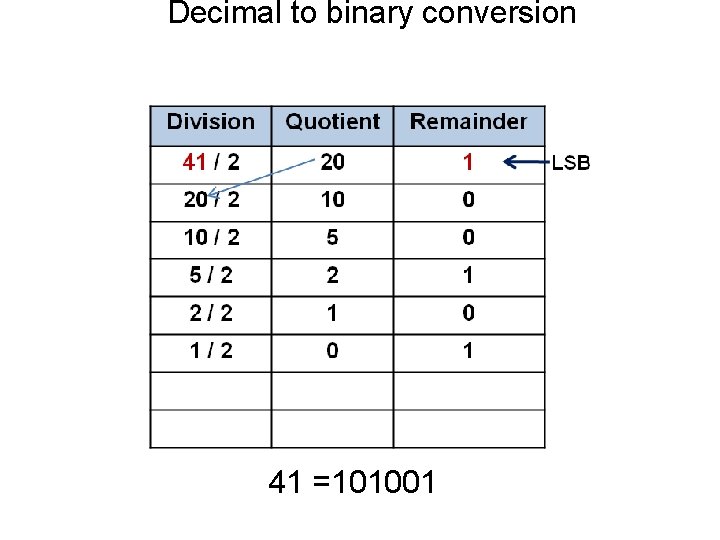
Decimal to binary conversion 41 =101001
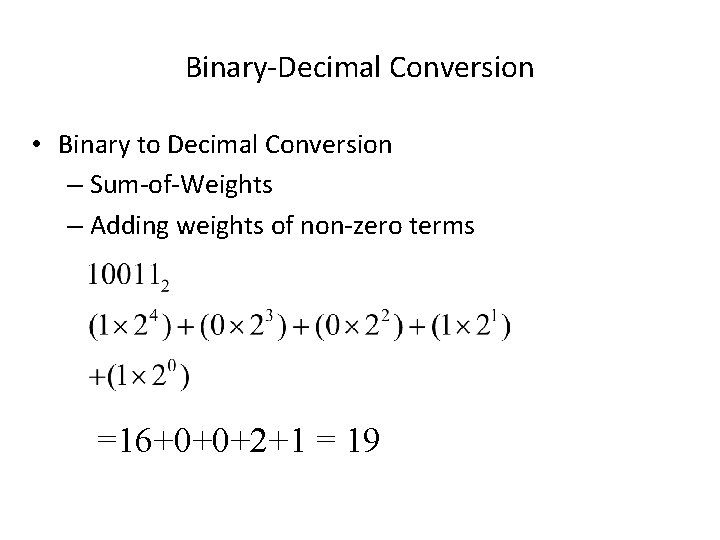
Binary-Decimal Conversion • Binary to Decimal Conversion – Sum-of-Weights – Adding weights of non-zero terms =16+0+0+2+1 = 19
Decimal-Binary Conversion • Binary to Decimal Conversion – Sum-of-Weights – Adding weights of non-zero terms
Decimal-Binary Conversion • Binary to Decimal Conversion – Sum-of-Weights – Adding weights of non-zero terms
- Slides: 14