
Binary Multipliers The key trick of multiplication is
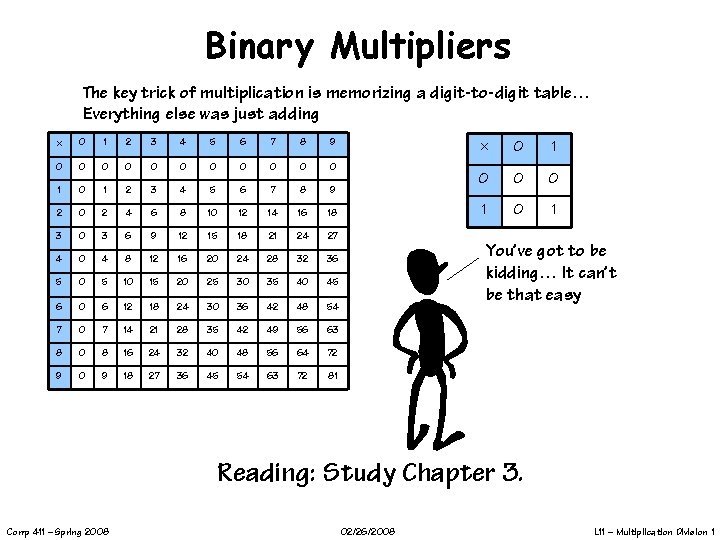
Binary Multipliers The key trick of multiplication is memorizing a digit-to-digit table… Everything else was just adding × 0 1 2 3 4 5 6 7 8 9 0 0 0 1 2 3 4 5 6 7 8 9 2 0 2 4 6 8 10 12 14 16 18 3 0 3 6 9 12 15 18 21 24 27 4 0 4 8 12 16 20 24 28 32 36 5 0 5 10 15 20 25 30 35 40 45 6 0 6 12 18 24 30 36 42 48 54 7 0 7 14 21 28 35 42 49 56 63 8 0 8 16 24 32 40 48 56 64 72 9 0 9 18 27 36 45 54 63 72 81 × 0 1 0 0 0 1 You’ve got to be kidding… It can’t be that easy Reading: Study Chapter 3. Comp 411 – Spring 2008 02/26/2008 L 11 – Multiplication Division 1

Binary Multiplication The “Binary” Multiplication Table X 0 Hey, that looks like an AND gate 1 0 0 0 1 0 Binary multiplication is implemented using the same basic longhand algorithm that you learned in grade school. A 3 x B 3 1 Aj. Bi is a “partial product” A 3 B 2 A 2 B 2 A 1 B 1 A 0 B 0 A 3 B 0 A 2 B 0 A 1 B 0 A 0 B 0 A 3 B 1 A 2 B 1 A 1 B 1 A 0 B 1 A 2 B 2 A 1 B 2 A 0 B 2 + A 3 B 3 A 2 B 3 A 1 B 3 A 0 B 3 Multiplying N-digit number by M-digit number gives (N+M)-digit result Easy part: forming partial products (just an AND gate since B I is either 0 or 1) Hard part: adding M, N-bit partial products Comp 411 – Spring 2008 02/26/2008 L 11 – Multiplication Division 2

Multiplication: Implementation Start Multiplier 0 = 1 Multiplier 0 = 0 1. Test Multiplier 0 1 a. Add multiplicand to product and place the result in Product register 2. Shift the Multiplicand register left 1 bit 3. Shift the Multiplier register right 1 bit 32 nd repetition? No: < 32 repetitions Yes: 32 repetitions Done Comp 411 – Spring 2008 02/26/2008 L 11 – Multiplication Division 3
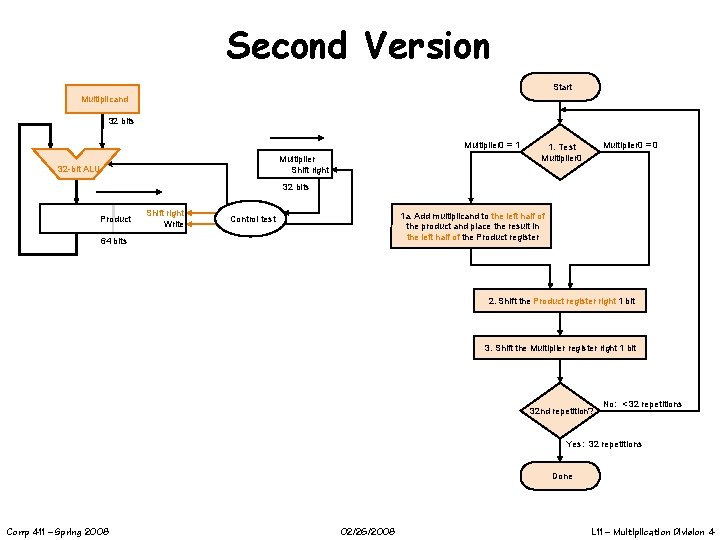
Second Version Start Multiplicand 32 bits Multiplier 0 = 1 Multiplier Shift right 32 -bit ALU Multiplier 0 = 0 1. Test Multiplier 0 32 bits Product Shift right Write 1 a. Add multiplicand to the left half of the product and place the result in the left half of the Product register Control test 64 bits 2. Shift the Product register right 1 bit 3. Shift the Multiplier register right 1 bit 32 nd repetition? No: < 32 repetitions Yes: 32 repetitions Done Comp 411 – Spring 2008 02/26/2008 L 11 – Multiplication Division 4

Example for second version Iteration Step Multiplier Multiplicand Product 0 Initial 1011 0010 0000 1 Test true shift right 1011 0101 0010 0000 0001 0000 2 Test true shift right 0101 0010 0011 0000 0001 1000 3 Test false shift right 0010 0001 1000 0000 1100 4 Test true shift right 0001 0000 0010 1100 0001 0110 Comp 411 – Spring 2008 02/26/2008 L 11 – Multiplication Division 5
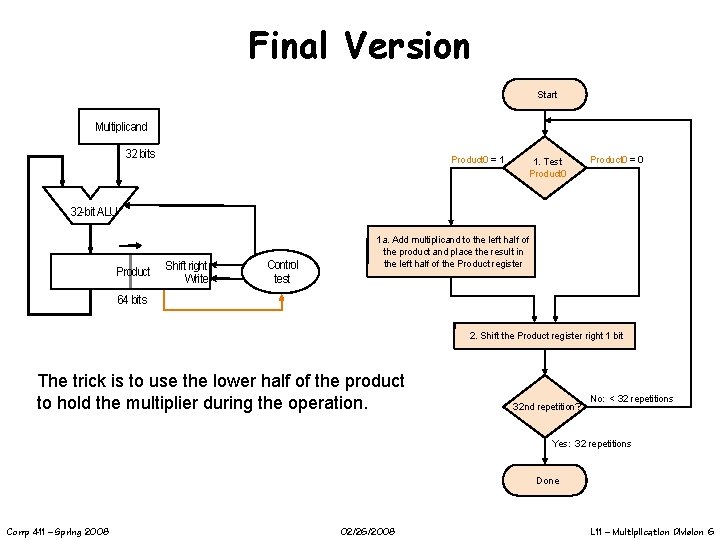
Final Version Start Multiplicand 32 bits Product 0 = 1 1. Test Product 0 = 0 32 -bit ALU Product Shift right Write Control test 1 a. Add multiplicand to the left half of the product and place the result in the left half of the Product register 64 bits 2. Shift the Product register right 1 bit The trick is to use the lower half of the product to hold the multiplier during the operation. 32 nd repetition? No: < 32 repetitions Yes: 32 repetitions Done Comp 411 – Spring 2008 02/26/2008 L 11 – Multiplication Division 6

What about the sign? Positive numbers are easy. How about negative numbers? (see Booth coding in textbook) Comp 411 – Spring 2008 02/26/2008 L 11 – Multiplication Division 7
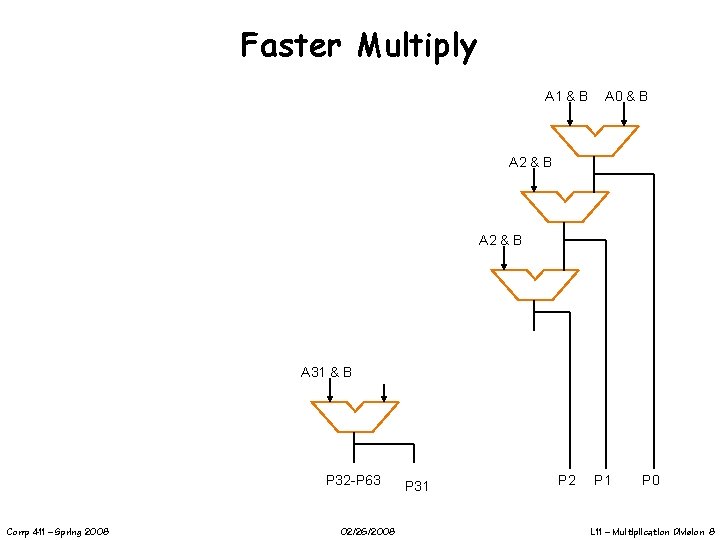
Faster Multiply A 1 & B A 0 & B A 2 & B A 31 & B P 32 -P 63 Comp 411 – Spring 2008 02/26/2008 P 31 P 2 P 1 P 0 L 11 – Multiplication Division 8
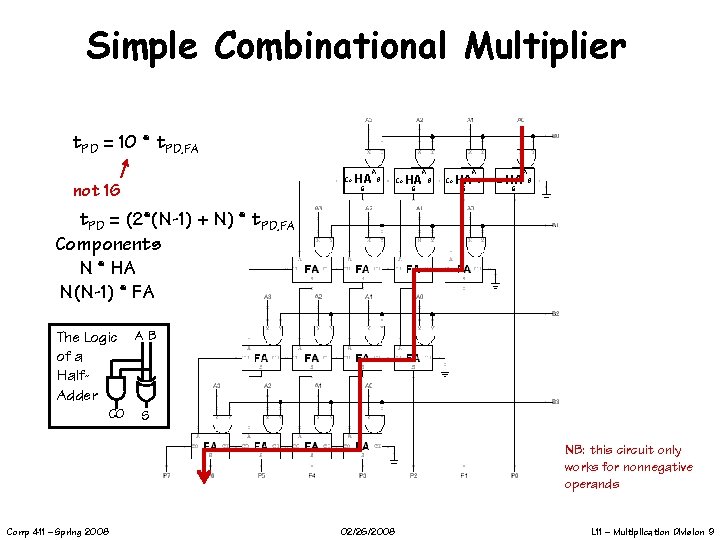
Simple Combinational Multiplier t. PD = 10 * t. PD, FA A Co not 16 HA A B S Co HA S A B Co HA B S t. PD = (2*(N-1) + N) * t. PD, FA Components N * HA N(N-1) * FA The Logic of a Half. Adder CO AB S NB: this circuit only works for nonnegative operands Comp 411 – Spring 2008 02/26/2008 L 11 – Multiplication Division 9
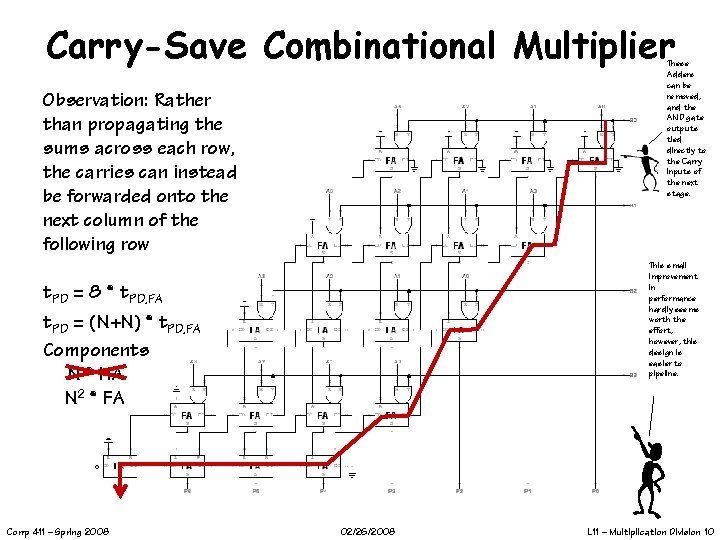
Carry-Save Combinational Multiplier These Adders can be removed, and the AND gate outputs tied directly to the Carry inputs of the next stage. Observation: Rather than propagating the sums across each row, the carries can instead be forwarded onto the next column of the following row This small improvement in performance hardly seems worth the effort, however, this design is easier to pipeline. t. PD = 8 * t. PD, FA t. PD = (N+N) * t. PD, FA Components N * HA N 2 * FA Comp 411 – Spring 2008 02/26/2008 L 11 – Multiplication Division 10
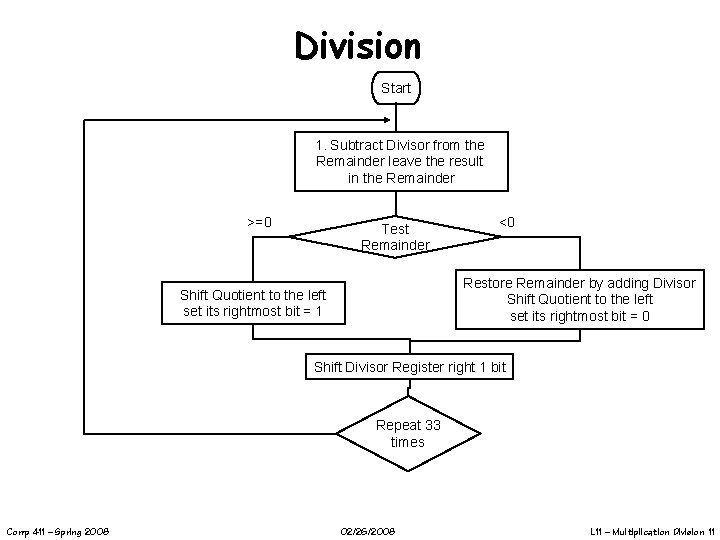
Division Start 1. Subtract Divisor from the Remainder leave the result in the Remainder >=0 Test Remainder <0 Restore Remainder by adding Divisor Shift Quotient to the left set its rightmost bit = 0 Shift Quotient to the left set its rightmost bit = 1 Shift Divisor Register right 1 bit Repeat 33 times Comp 411 – Spring 2008 02/26/2008 L 11 – Multiplication Division 11
- Slides: 11