
Binary Image Analysis Part 2 Readings Chapter 3
Binary Image Analysis: Part 2 Readings: Chapter 3: 3. 5 -3. 7 • mathematical morphology • region properties • region adjacency 1
Mathematical Morphology Binary mathematical morphology consists of two basic operations dilation and erosion and several composite relations closing and opening conditional dilation. . . 2
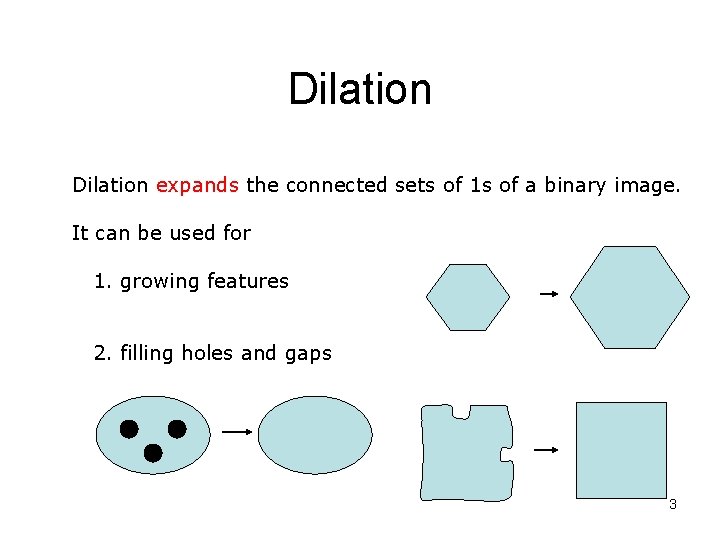
Dilation expands the connected sets of 1 s of a binary image. It can be used for 1. growing features 2. filling holes and gaps 3
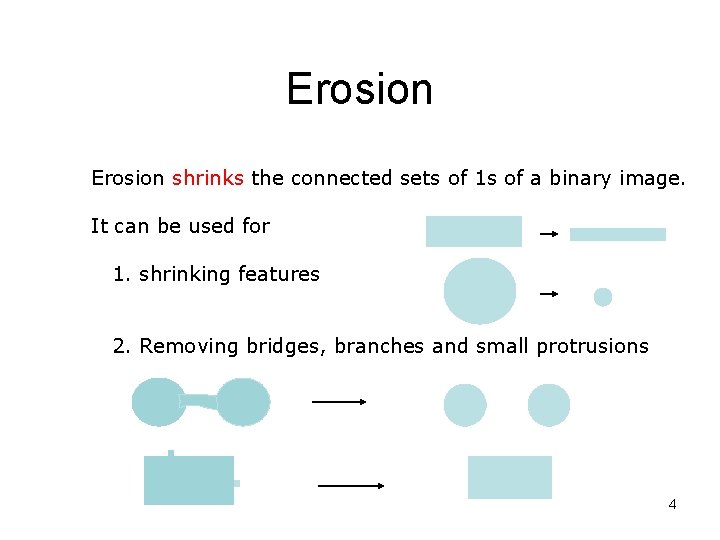
Erosion shrinks the connected sets of 1 s of a binary image. It can be used for 1. shrinking features 2. Removing bridges, branches and small protrusions 4
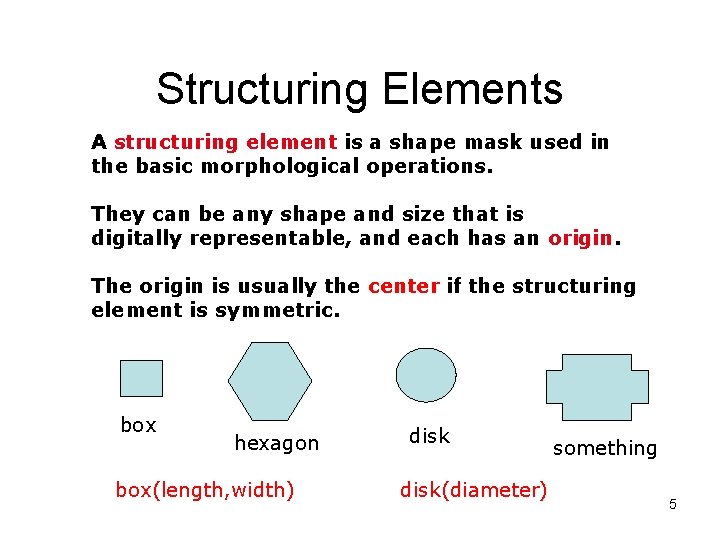
Structuring Elements A structuring element is a shape mask used in the basic morphological operations. They can be any shape and size that is digitally representable, and each has an origin. The origin is usually the center if the structuring element is symmetric. box hexagon box(length, width) disk(diameter) something 5
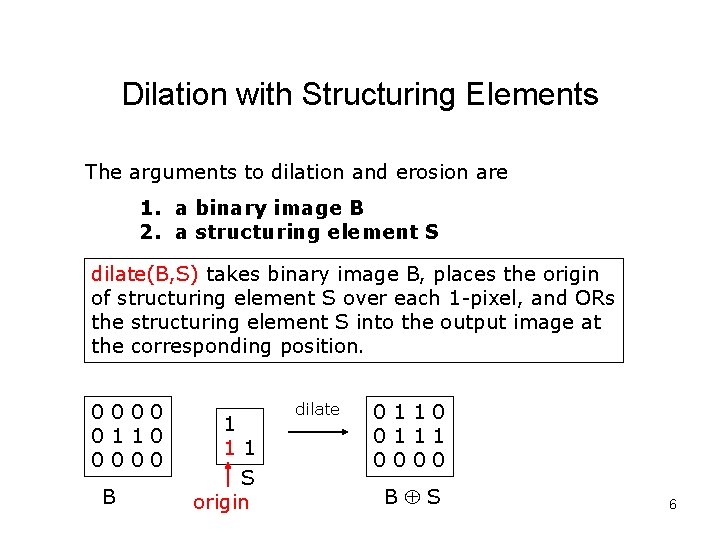
Dilation with Structuring Elements The arguments to dilation and erosion are 1. a binary image B 2. a structuring element S dilate(B, S) takes binary image B, places the origin of structuring element S over each 1 -pixel, and ORs the structuring element S into the output image at the corresponding position. 0000 0110 0000 B 1 11 S origin dilate 0110 0111 0000 B S 6
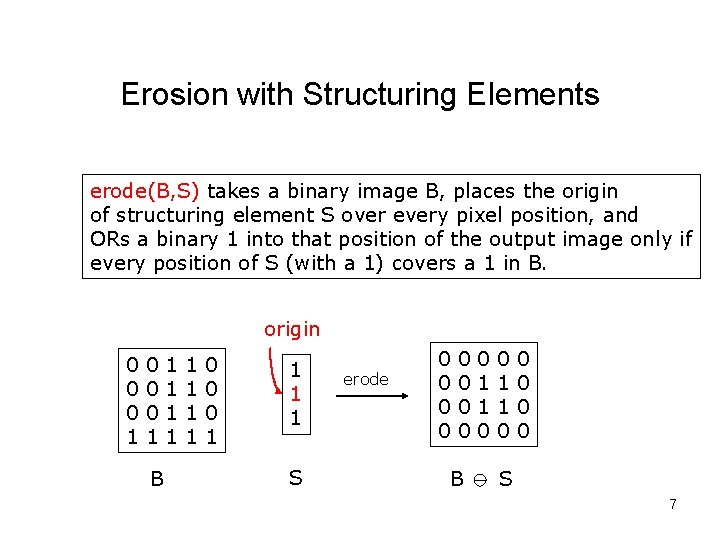
Erosion with Structuring Elements erode(B, S) takes a binary image B, places the origin of structuring element S over every pixel position, and ORs a binary 1 into that position of the output image only if every position of S (with a 1) covers a 1 in B. origin 0 0 0 1 B 1 1 1 1 0 0 0 1 1 S erode 0 0 0 0 B 0 1 1 0 0 0 S 7
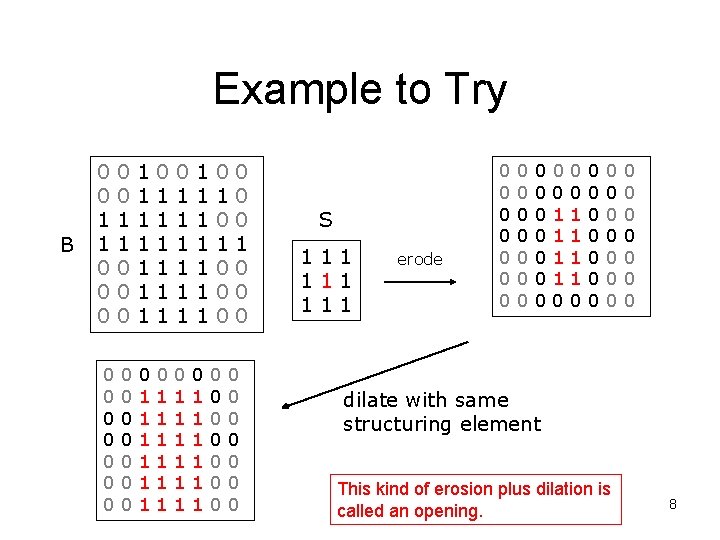
Example to Try B 0 0 1 1 0 0 0 1 1 1 1 1 1 1 1 1 0 0 0 0 1 1 1 1 1 1 0 1 0 0 0 0 1 0 0 0 0 0 S 111 111 erode 0 0 0 0 0 0 1 1 1 1 0 0 0 0 0 0 dilate with same structuring element This kind of erosion plus dilation is called an opening. 8
Opening and Closing • Closing is the compound operation of dilation followed by erosion (with the same structuring element) • Opening is the compound operation of erosion followed by dilation (with the same structuring element) 9
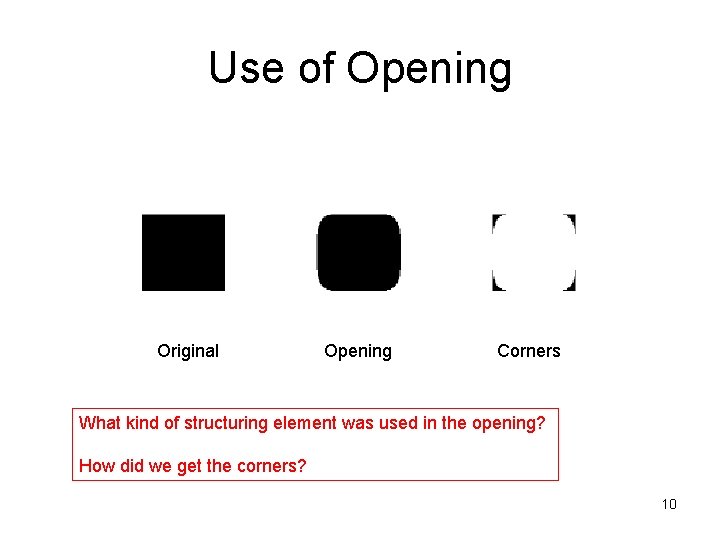
Use of Opening Original Opening Corners What kind of structuring element was used in the opening? How did we get the corners? 10
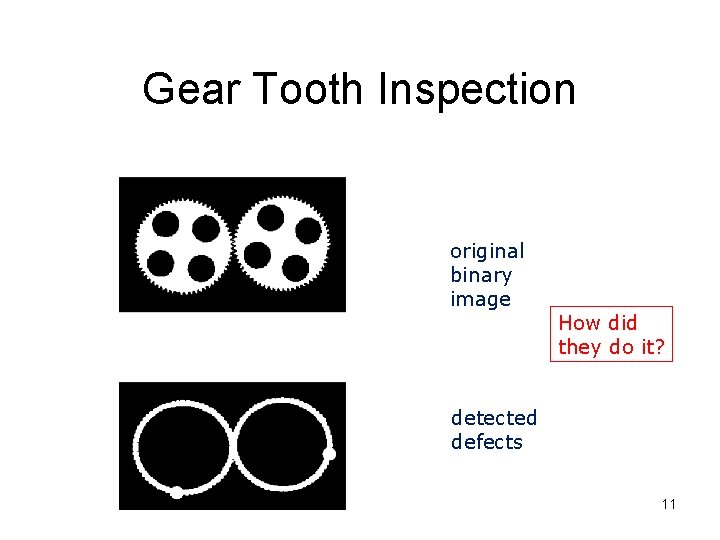
Gear Tooth Inspection original binary image How did they do it? detected defects 11
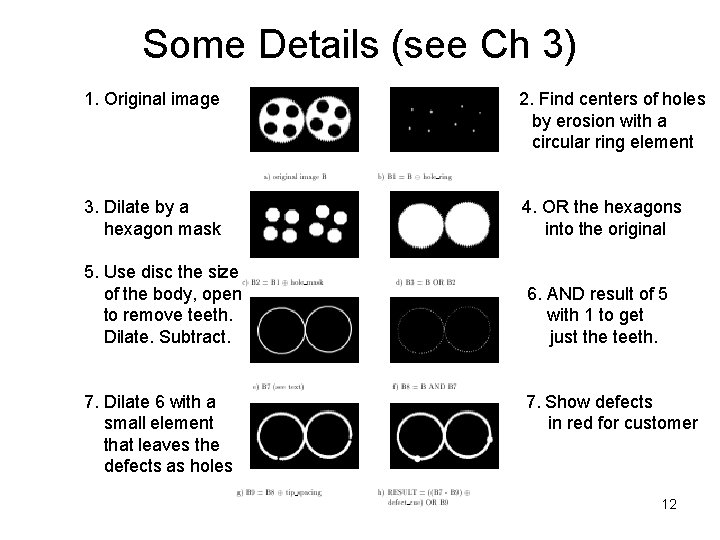
Some Details (see Ch 3) 1. Original image 2. Find centers of holes by erosion with a circular ring element 3. Dilate by a hexagon mask 4. OR the hexagons into the original 5. Use disc the size of the body, open to remove teeth. Dilate. Subtract. 6. AND result of 5 with 1 to get just the teeth. 7. Dilate 6 with a small element that leaves the defects as holes 7. Show defects in red for customer 12
Region Properties of the regions can be used to recognize objects. • geometric properties (Ch 3) • gray-tone properties • color properties • texture properties • shape properties (a few in Ch 3) • motion properties • relationship properties (1 in Ch 3) 13
Geometric and Shape Properties • • • area centroid perimeter length circularity elongation mean and standard deviation of radial distance bounding box extremal axis length from bounding box second order moments (row, column, mixed) lengths and orientations of axes of best-fit ellipse 14
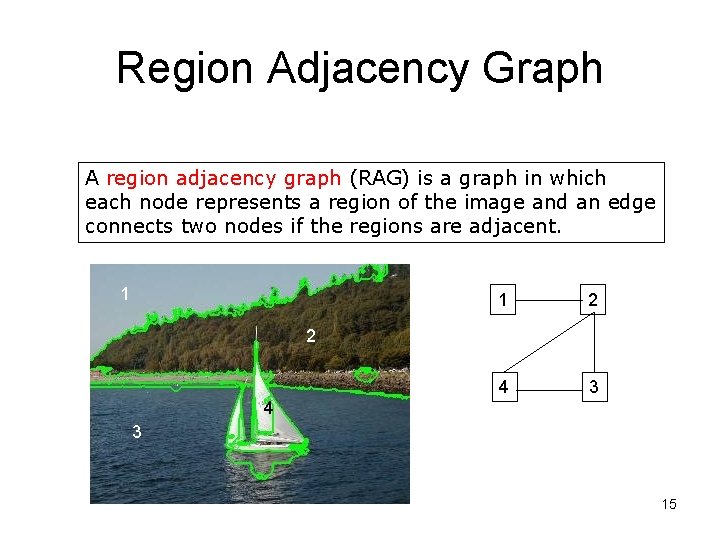
Region Adjacency Graph A region adjacency graph (RAG) is a graph in which each node represents a region of the image and an edge connects two nodes if the regions are adjacent. 1 1 2 4 3 15
What’s all this for? Once regions are identified and their properties and relationships computed, we can start using them for higher-level tasks such as: • inspection • object recognition • image matching • classification in general 16
- Slides: 16