
Binary Heaps Priority Queues Computer Science Department University

Binary Heaps & Priority Queues Computer Science Department University of Central Florida COP 3502 – Computer Science I
Binary Heaps n Heap: n A heap is an Abstract Data Type n n n So what is a heap? n n Just like stacks and queues are ADTs Meaning, we will define certain behaviors that dictate whether or not a certain data structure is a heap More specifically, what does it do or how do they work? A heap looks similar to a tree n But a heap has a specific property/invariant that each node in the tree MUST follow Binary Heaps & Priority Queues page 2
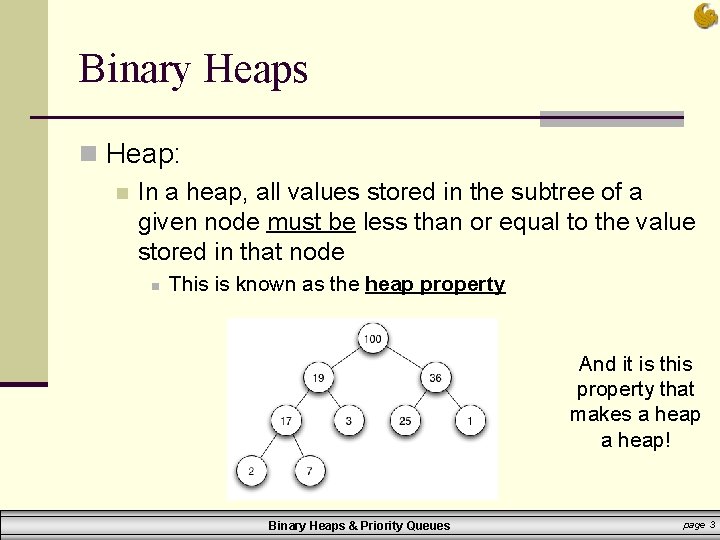
Binary Heaps n Heap: n In a heap, all values stored in the subtree of a given node must be less than or equal to the value stored in that node n This is known as the heap property And it is this property that makes a heap! Binary Heaps & Priority Queues page 3
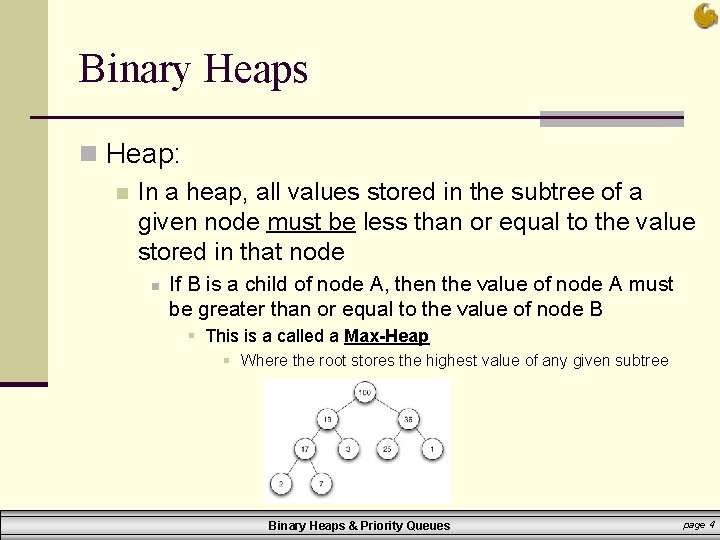
Binary Heaps n Heap: n In a heap, all values stored in the subtree of a given node must be less than or equal to the value stored in that node n If B is a child of node A, then the value of node A must be greater than or equal to the value of node B § This is a called a Max-Heap § Where the root stores the highest value of any given subtree Binary Heaps & Priority Queues page 4
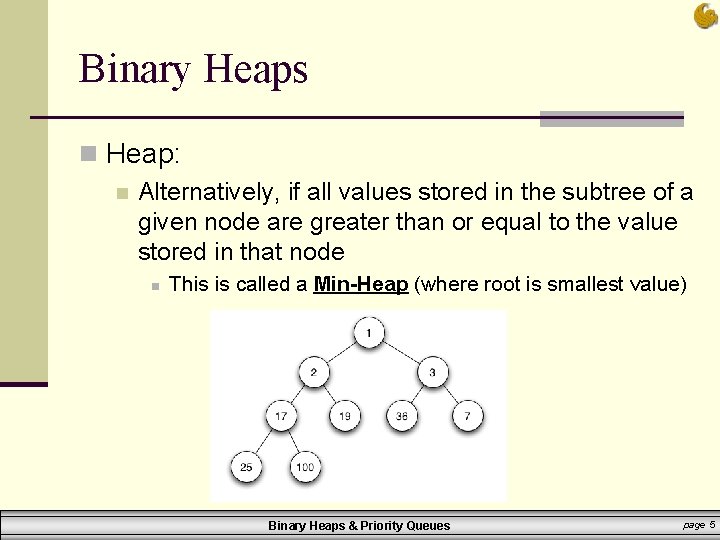
Binary Heaps n Heap: n Alternatively, if all values stored in the subtree of a given node are greater than or equal to the value stored in that node n This is called a Min-Heap (where root is smallest value) Binary Heaps & Priority Queues page 5
Binary Heaps n Binary Heap: n What we just described was a basic Heap n Now for a heap to be Binary Heap, it must adhere to one other property: n The Shape Property: n n n The heap must be a complete binary tree Meaning, all levels of the tree, except possibly the last one, must be fully filled And if the last level is not complete, the nodes of the level are filled from left to right § ***And it just so happens that the previous pictures shown were all examples of binary heaps Binary Heaps & Priority Queues page 6
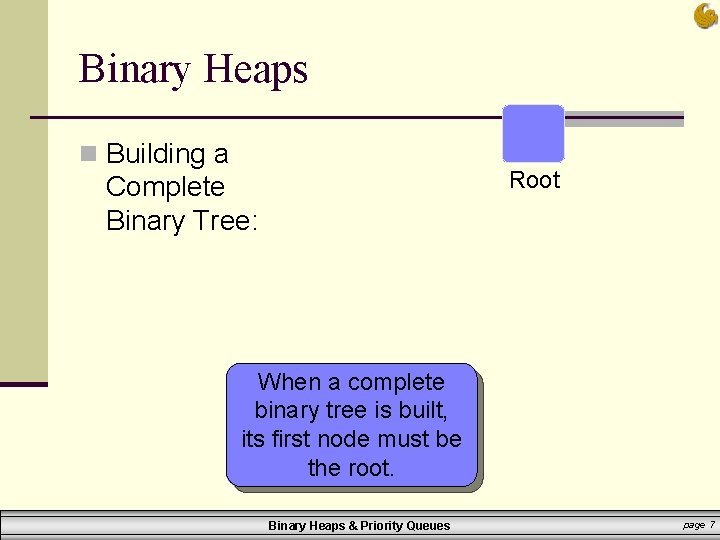
Binary Heaps n Building a Root Complete Binary Tree: When a complete binary tree is built, its first node must be the root. Binary Heaps & Priority Queues page 7
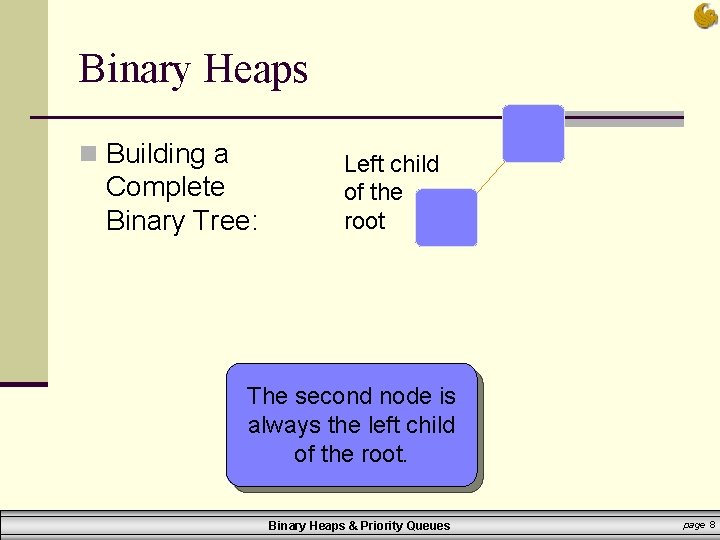
Binary Heaps n Building a Complete Binary Tree: Left child of the root The second node is always the left child of the root. Binary Heaps & Priority Queues page 8
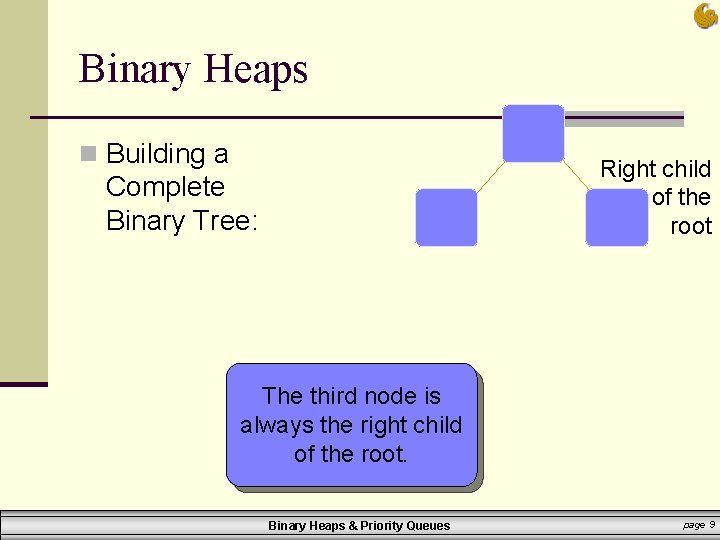
Binary Heaps n Building a Right child of the root Complete Binary Tree: The third node is always the right child of the root. Binary Heaps & Priority Queues page 9
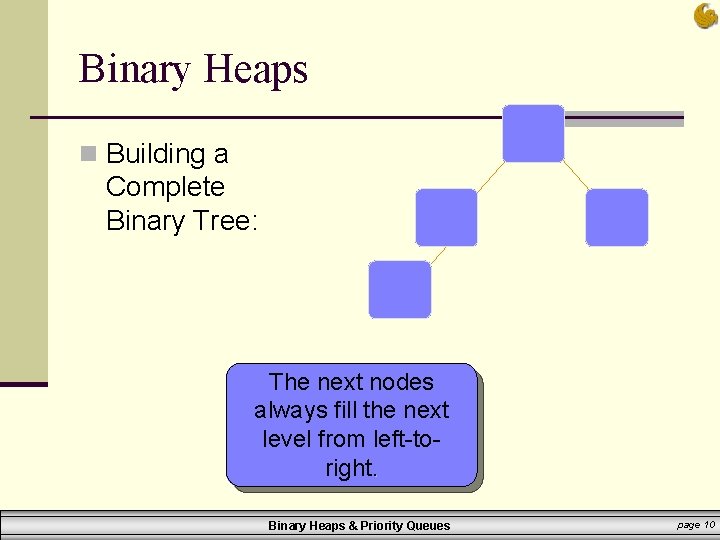
Binary Heaps n Building a Complete Binary Tree: The next nodes always fill the next level from left-toright. Binary Heaps & Priority Queues page 10
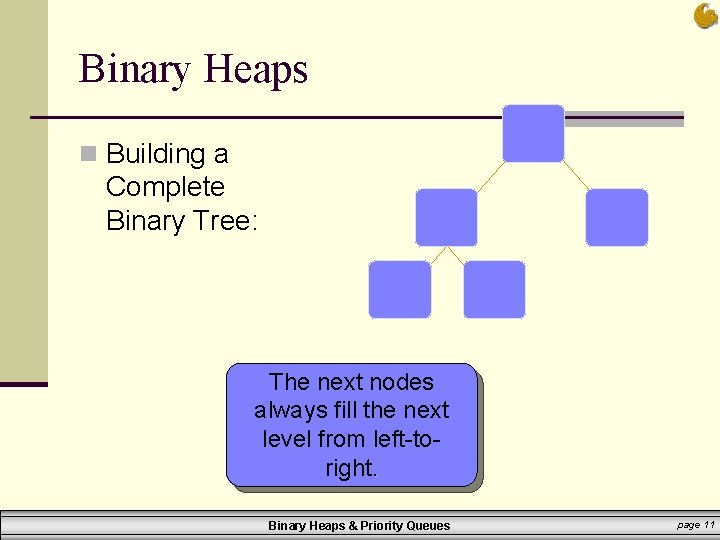
Binary Heaps n Building a Complete Binary Tree: The next nodes always fill the next level from left-toright. Binary Heaps & Priority Queues page 11
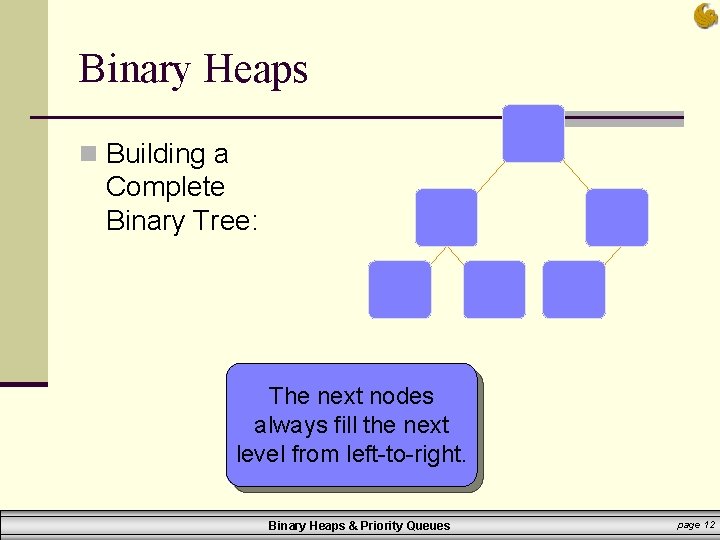
Binary Heaps n Building a Complete Binary Tree: The next nodes always fill the next level from left-to-right. Binary Heaps & Priority Queues page 12
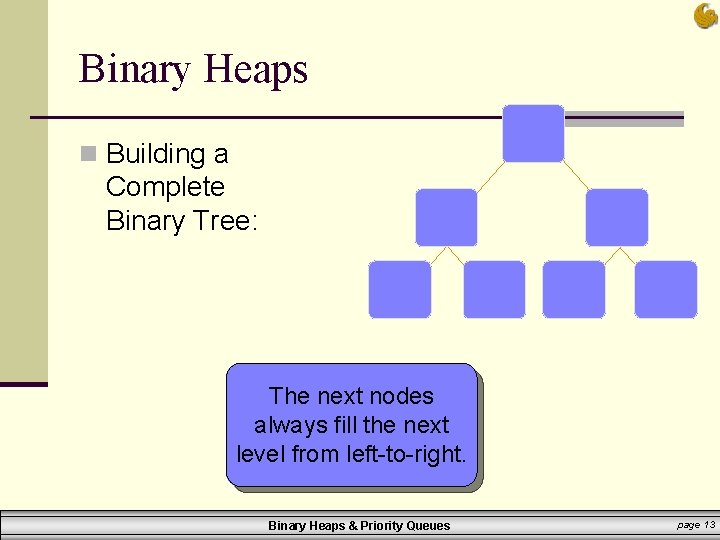
Binary Heaps n Building a Complete Binary Tree: The next nodes always fill the next level from left-to-right. Binary Heaps & Priority Queues page 13
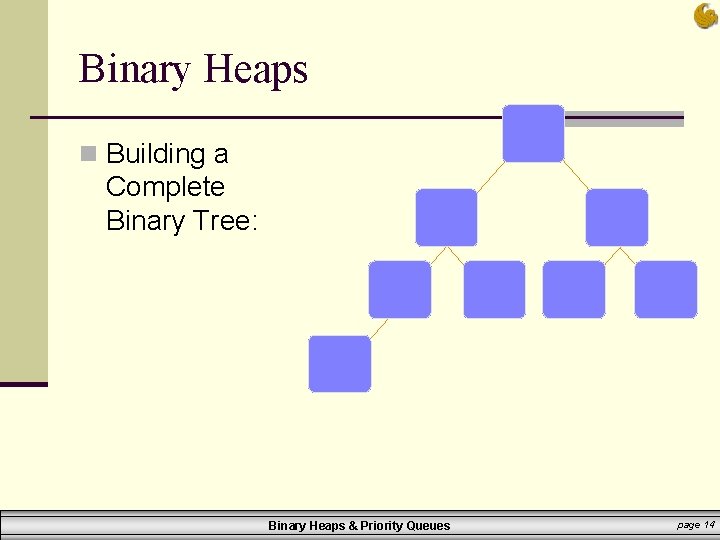
Binary Heaps n Building a Complete Binary Tree: Binary Heaps & Priority Queues page 14
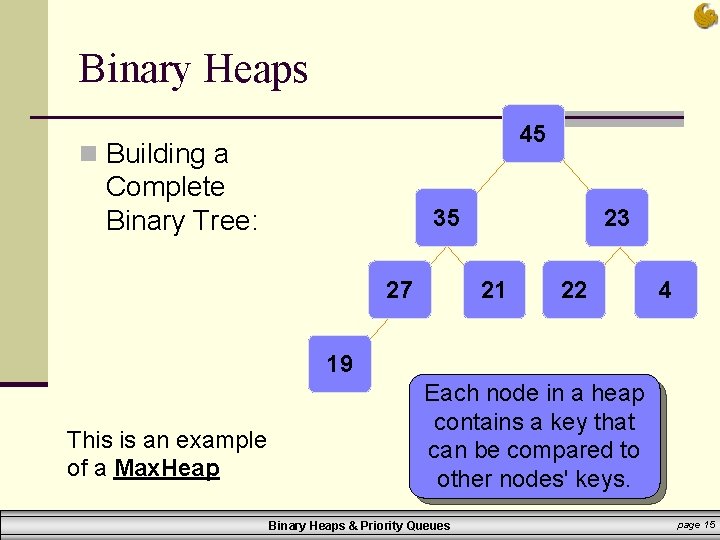
Binary Heaps 45 n Building a Complete Binary Tree: 35 27 23 21 22 4 19 This is an example of a Max. Heap Each node in a heap contains a key that can be compared to other nodes' keys. Binary Heaps & Priority Queues page 15
Binary Heaps n Binary Heap: n New nodes are always added at the lowest level n n There is no particular relationship among the data items in nodes on any given level n n n And are inserted from left to right Even if the nodes have the same parent Example: the right node does not necessarily have to be larger than the left node (as in BSTs) The only ordering property for heaps is the one already defined n Root of any given subtree is either largest or smallest element in that tree…either a max-heap or a min-heap Binary Heaps & Priority Queues page 16
Binary Heaps n Binary Heap: n The tree never becomes unbalanced n A heap is not a sorted structure n But it can be regarded as partially ordered § Since the minimum value is always at the root n A given set of data can be formed into many different heaps n Depending on the order in which the data arrives Binary Heaps & Priority Queues page 17
Binary Heaps n Binary Heap: n “Okay, great…whupdedoo” n Yeah, we now know what a binary heap is n But how does it help us? n What is its purpose? n Binary heaps are usually used to implement another abstract data type: n A priority queue Binary Heaps & Priority Queues page 18
Binary Heaps n Priority Queues: n A priority queue is basically what it sounds like n n n it is a queue Which means that we will have a line But the first person in line is not necessarily the first person out of line Rather, the queuing order is based on a priority Meaning, if one person has a higher priority, that person goes right to the front Examples: n Emergency room: § Higher priority injuries are taken first Binary Heaps & Priority Queues page 19
Binary Heaps n Priority Queues: n The model: n n Requests are inserted in the order of arrival The request with the highest priority is processed first § Meaning, it is removed from the queue n Priority can be indicated by a number § But you have to determine what has most priority § Maybe your application results in smallest number having the highest priority § Maybe the largest number has the highest priority § This really isn’t important and is an implementation detail Binary Heaps & Priority Queues page 20
Binary Heaps n Priority Queues: n So how could we implement a priority queue? n Sorted Linked List § Higher priority items are ALWAYS at the front of the list § Example: a check out line in a supermarket § But people who are more important can cut in line § Running Time: § O(n) insertion time: you have to search through, potentially, n nodes to find the correct spot (based on priority) § O(1) deletion time (finding the node with the highest priority) since the highest priority node is first node of the list Binary Heaps & Priority Queues page 21
Binary Heaps n Priority Queues: n So how could we implement a priority queue? n Unsorted Linked List § Keep a list of elements as a queue § To add an element, append it to the end § To remove an element, search through all the elements for the one with the highest priority § Running Time: § O(1) insertion time: you simple add to the end of the list § O(n) deletion time: you have to, potentially, search through all n nodes to find the correct node to delete Binary Heaps & Priority Queues page 22
Binary Heaps n Priority Queues: n So how could we implement a priority queue? n n Correct Method: Binary Heap! We use a binary heap to implement a priority queue § So we are using one abstract data type to implement another abstract data type n n Running time ends up being O(logn) for both insertion and deletion into a Heap Find. Min (finding the minimum) ends up being O(1) § cuz we just find (look at) the root, which is O(1) n So now we look at how to maintain a heap/priority queue § How to insert into and delete from a heap § And how to build a heap Binary Heaps & Priority Queues page 23

Brief Interlude: FAIL Picture JACUZZI Binary Heaps & Priority Queues page 24
Binary Heaps n Adding Nodes to a Binary Heap n Assume the existence of a current heap n Remember: n The binary heap MUST follow the Shape property § The tree must be balanced n Insertions will be made in the next available spot n n n Meaning, at the last level and at the next spot, going from left to right But what will most likely happen when you do this? n The Heap property will NOT be maintained Binary Heaps & Priority Queues page 25

Binary Heaps n Adding Nodes to a Binary Heap n Given this Binary Heap: n 45 And it is a Max-heap n We now add a new node n With data value 42 35 n We add at the last position n But this voids the 27 Heap Property n 42 is greater than both 27 and 35 n So we must fix this! 19 Binary Heaps & Priority Queues 23 21 22 4 42 page 26
Binary Heaps n Adding Nodes to a Binary Heap n Percolate Up procedure n In order to fix the out of place node, we must follow the following “Percolate Up” procedure § If the parent of the newly inserted node is less than the newly inserted node (this is clearly for a “max heap”) § Then SWAP them § This counts as one “Percolate Up” step § Continue this process until the new node finds the correct spot § Continue SWAPPING until the parent of the new node has a value that is greater than the new node § Or if the new node reaches all the way to the root § This is now the new “home” for this node Binary Heaps & Priority Queues page 27
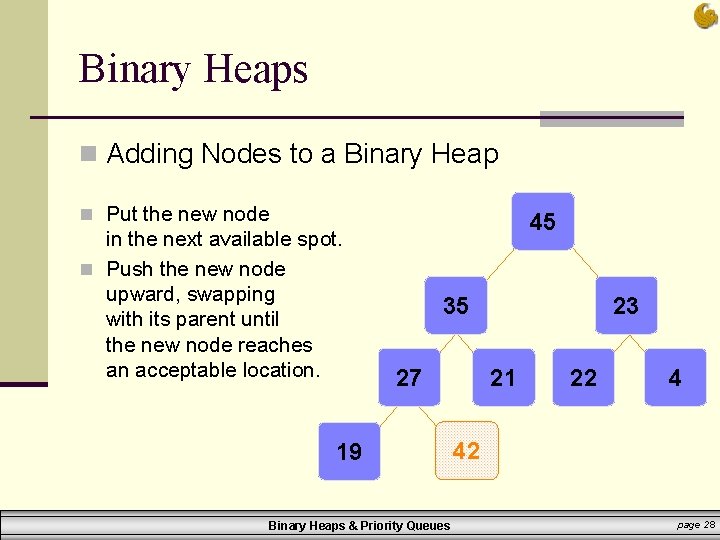
Binary Heaps n Adding Nodes to a Binary Heap n Put the new node in the next available spot. n Push the new node upward, swapping with its parent until the new node reaches an acceptable location. 45 35 27 19 Binary Heaps & Priority Queues 23 21 22 4 42 page 28
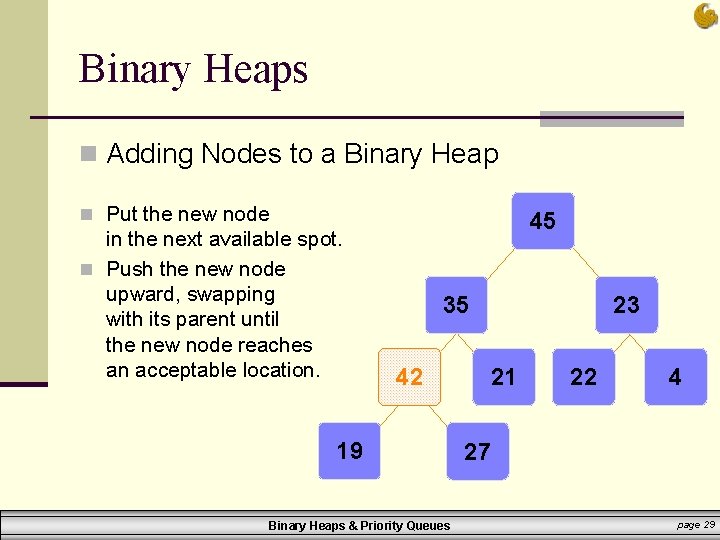
Binary Heaps n Adding Nodes to a Binary Heap n Put the new node in the next available spot. n Push the new node upward, swapping with its parent until the new node reaches an acceptable location. 45 35 42 19 Binary Heaps & Priority Queues 23 21 22 4 27 page 29
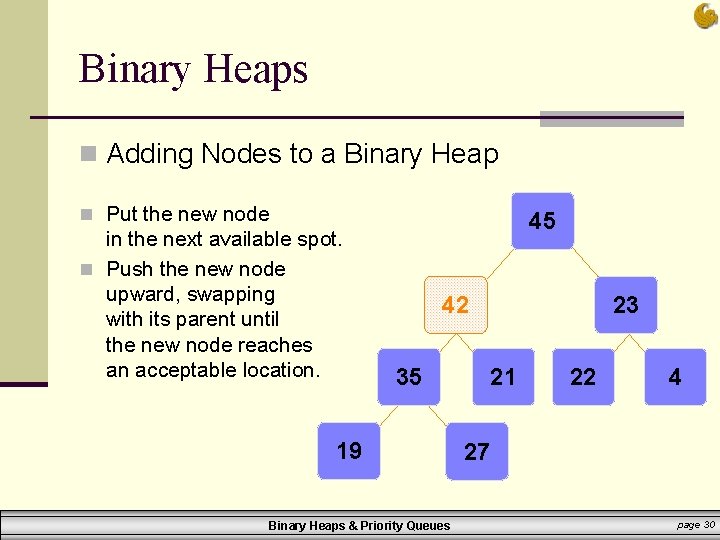
Binary Heaps n Adding Nodes to a Binary Heap n Put the new node in the next available spot. n Push the new node upward, swapping with its parent until the new node reaches an acceptable location. 45 42 35 19 Binary Heaps & Priority Queues 23 21 22 4 27 page 30
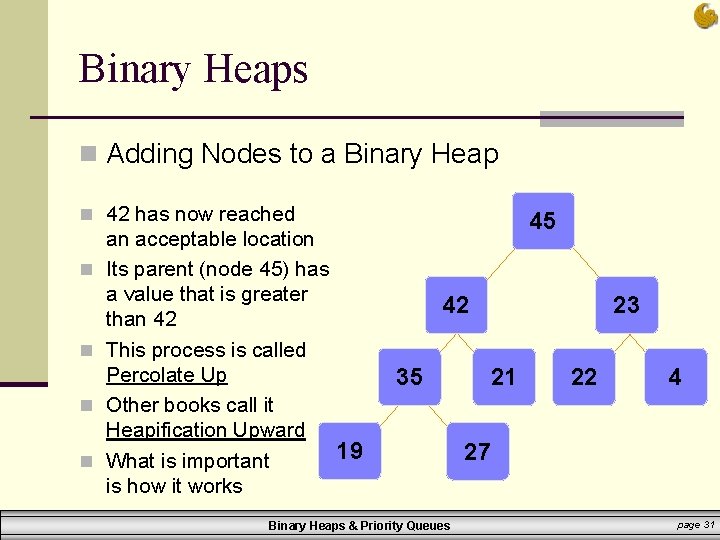
Binary Heaps n Adding Nodes to a Binary Heap n 42 has now reached n n an acceptable location Its parent (node 45) has a value that is greater than 42 This process is called Percolate Up Other books call it Heapification Upward 19 What is important is how it works 45 42 35 Binary Heaps & Priority Queues 23 21 22 4 27 page 31
Binary Heaps n Adding Nodes to a Binary Heap n Percolate Up procedure n n What is the Big-O running time of insertion into a heap? The actual insertion is simply O(1) § We simply insert at the last position § And you will see (in a bit) how we quick access to this position n But when we do this, § We need to fix the tree to maintain the Heap Property n Percolate Up takes O(logn) time § Why? § Because the height of the tree is log n § Worst case scenario is having to SWAP all the way to the root n So the overall running time of an insertion is O(logn) Binary Heaps & Priority Queues page 32
Binary Heaps n Deleting Nodes from a Binary Heap n We will write a function called delete. Min (or delete. Max) n Which node will we ALWAYS be deleting? n Remember: n We are using a Heap to implement a priority queue! § And in a priority queue, we always delete the first element § The one with the highest priority n So we will ALWAYS be deleting the ROOT of the tree n n So this is quite easy! delete. Min (or delete. Max for a Max Heap) simply deletes the root and returns its value to main Binary Heaps & Priority Queues page 33
Binary Heaps n Deleting Nodes from a Binary Heap n We will write a function called delete. Min n n But what will happen when we delete the root? n n n delete. Min simply deletes the root and returns its value to main We will have a tree with no root! The root will be missing So clearly this needs to be fixed Binary Heaps & Priority Queues page 34
Binary Heaps This process is for a Max-heap n Deleting Nodes from a Binary Heap n Fixing the tree after deleting the root: Copy the last node of the tree into the position of the root 2) Then remove that last node (to avoid duplicates) 1) § Note: The new root is almost assuredly out of place § Most likely, one, or both, of its children will have a greater value than it § If so: 3) Swap the new root node with the greater of its child nodes § This is considered one “Percolate Down” step n Continue this process until the “last node” ends up in a spot where its children have values smaller than it § Neither child can have a value greater than it Binary Heaps & Priority Queues page 35
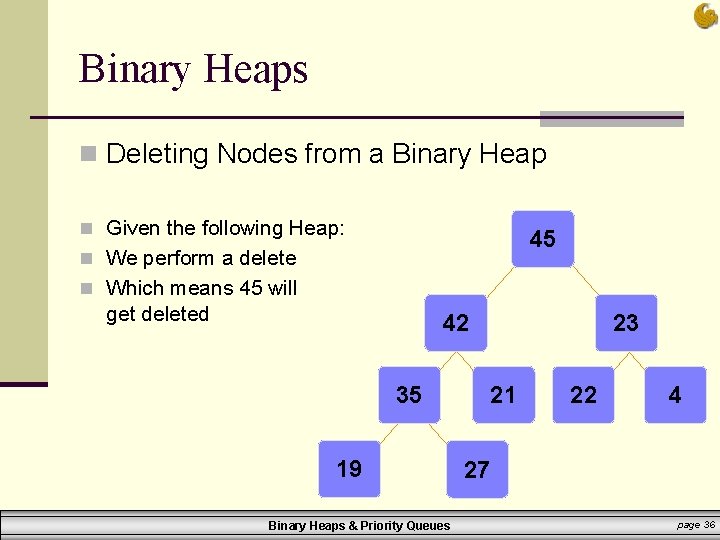
Binary Heaps n Deleting Nodes from a Binary Heap n Given the following Heap: 45 n We perform a delete n Which means 45 will get deleted 42 35 19 Binary Heaps & Priority Queues 23 21 22 4 27 page 36
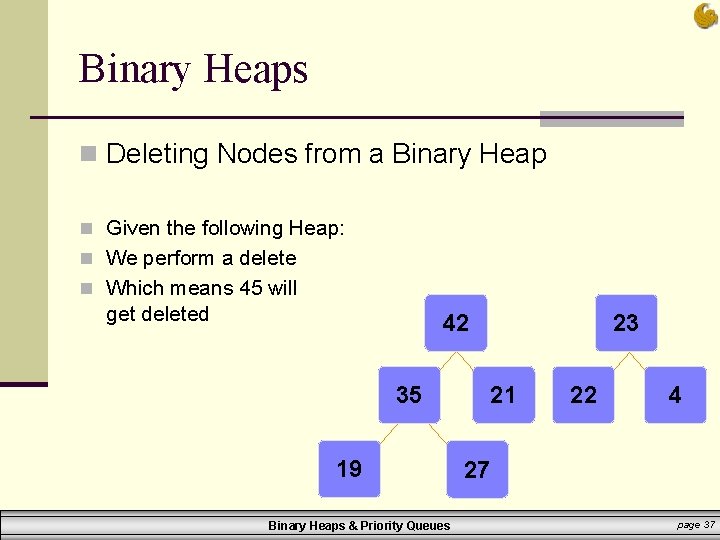
Binary Heaps n Deleting Nodes from a Binary Heap n Given the following Heap: n We perform a delete n Which means 45 will get deleted 42 35 19 Binary Heaps & Priority Queues 23 21 22 4 27 page 37

Binary Heaps n Deleting Nodes from a Binary Heap n The last node now gets moved to the root n So 27 goes to the root 42 35 19 Binary Heaps & Priority Queues 23 21 22 4 27 page 38
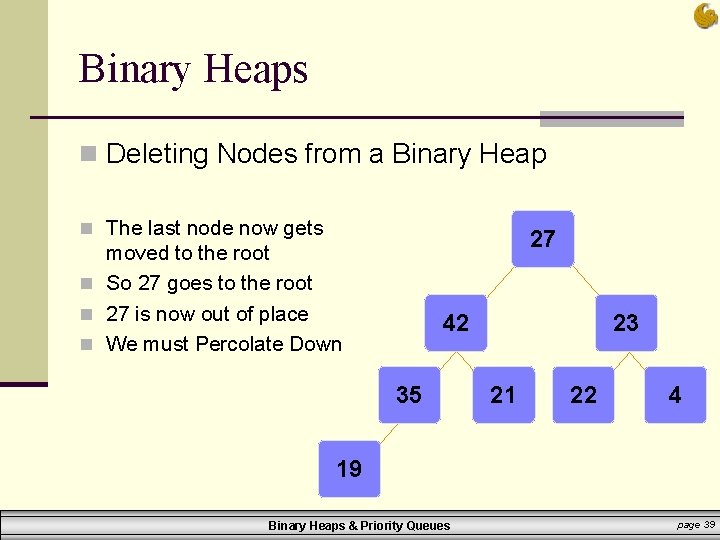
Binary Heaps n Deleting Nodes from a Binary Heap n The last node now gets 27 moved to the root n So 27 goes to the root n 27 is now out of place n We must Percolate Down 42 35 23 21 22 4 19 Binary Heaps & Priority Queues page 39

Binary Heaps n Deleting Nodes from a Binary Heap n Percolate Down: 27 n Push the out-of-place node downward, n swapping with its larger child n until the out-of-place node reaches an acceptable location 42 35 23 21 22 4 19 Binary Heaps & Priority Queues page 40
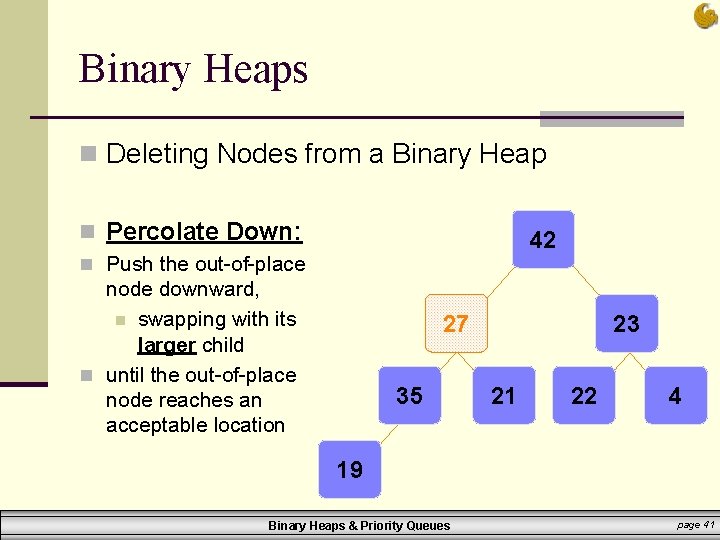
Binary Heaps n Deleting Nodes from a Binary Heap n Percolate Down: 42 n Push the out-of-place node downward, n swapping with its larger child n until the out-of-place node reaches an acceptable location 27 35 23 21 22 4 19 Binary Heaps & Priority Queues page 41
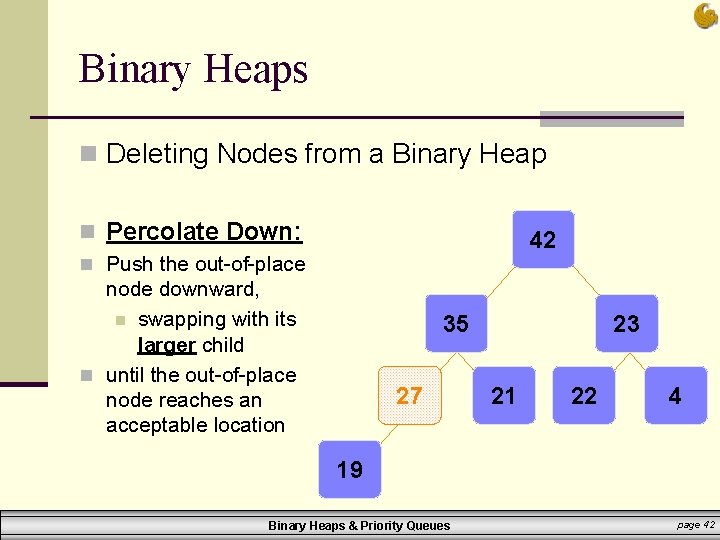
Binary Heaps n Deleting Nodes from a Binary Heap n Percolate Down: 42 n Push the out-of-place node downward, n swapping with its larger child n until the out-of-place node reaches an acceptable location 35 27 23 21 22 4 19 Binary Heaps & Priority Queues page 42
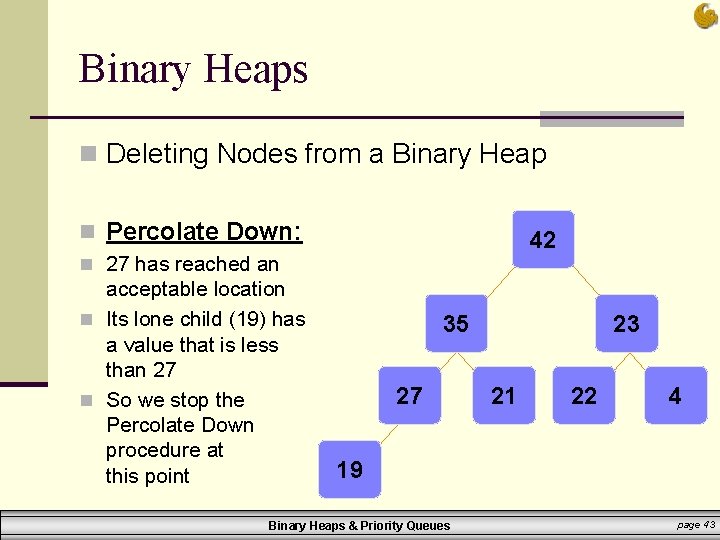
Binary Heaps n Deleting Nodes from a Binary Heap n Percolate Down: 42 n 27 has reached an acceptable location n Its lone child (19) has a value that is less than 27 n So we stop the Percolate Down procedure at this point 35 27 23 21 22 4 19 Binary Heaps & Priority Queues page 43
Binary Heaps n Deleting Nodes from a Binary Heap n n What is the Big-O running time of deletion from a heap? The actual deletion itself is O(1) § cause the minimum value is at the root § and we can delete the root of a tree in O(1) time n But now we need to fix the tree § Moving the last node to the root is an O(1) step § But then we need to Percolate Down n Percolate Down takes O(logn) § Why? § Because the height of the tree is log n § And the worst case scenario is having to SWAP all the way to the farthest leaf n So the overall running time of a deletion is O(logn) Binary Heaps & Priority Queues page 44

Daily Demotivator Binary Heaps & Priority Queues page 45
- Slides: 45