
Binary Covalent Compounds Composed of two elements not
Binary Covalent Compounds • Composed of two elements – not necessarily 2 atoms – two nonmetals

Two naming systems • Stock system: – learned for ionic compounds – “official” • Traditional: – what you hear on the news – what see on ingredient lists
Both Traditional & Stock • Least electronegative of the two elements goes first • REMINDER: – electronegativity values in table S
Stock System • 1 st element must have Roman Numeral • Have to figure out its oxidation number

Stock System & Oxidation Number • Molecular substances do NOT contain ions • use the concept of oxidation number for electron bookkeeping & pretend all shared electrons go to atom with higher electronegativity value – The oxidation number would be: – atom with higher electronegativity value has the (-) oxidation number – atom with lower electronegativity value is (+)
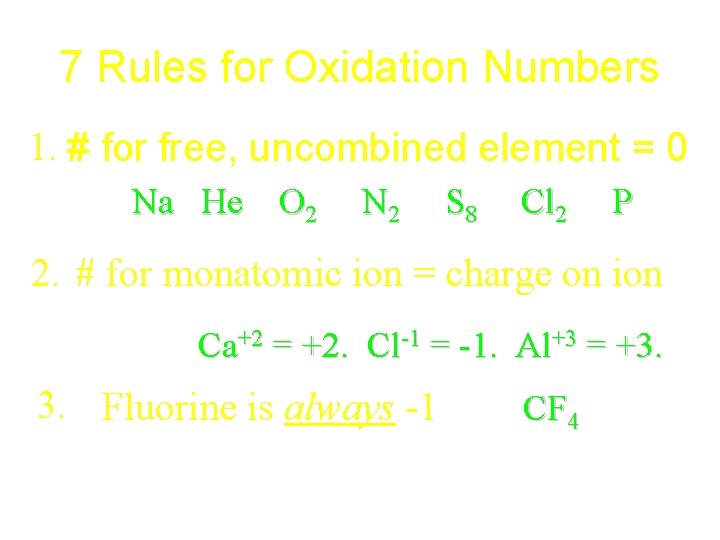
7 Rules for Oxidation Numbers 1. # for free, uncombined element = 0 Na He O 2 N 2 S 8 Cl 2 P 2. # for monatomic ion = charge on ion Ca+2 = +2. Cl-1 = -1. Al+3 = +3. 3. Fluorine is always -1 CF 4
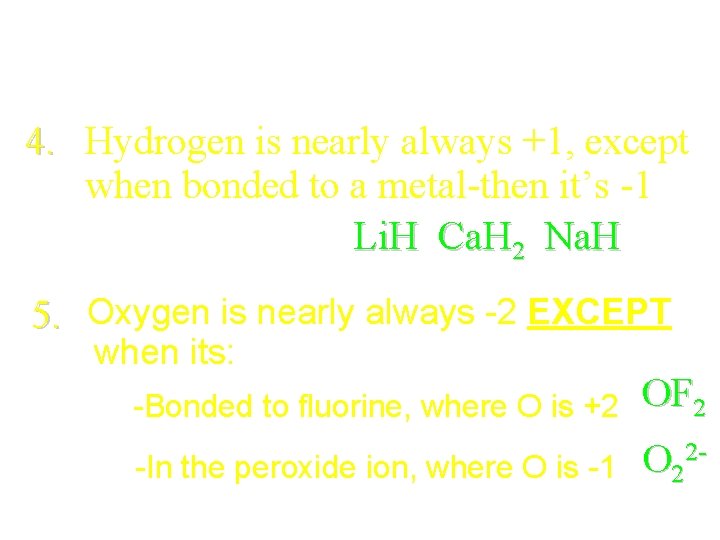
4. Hydrogen is nearly always +1, except when bonded to a metal-then it’s -1 Li. H Ca. H 2 Na. H 5. Oxygen is nearly always -2 EXCEPT when its: -Bonded to fluorine, where O is +2 OF 2 -In the peroxide ion, where O is -1 O 22 -
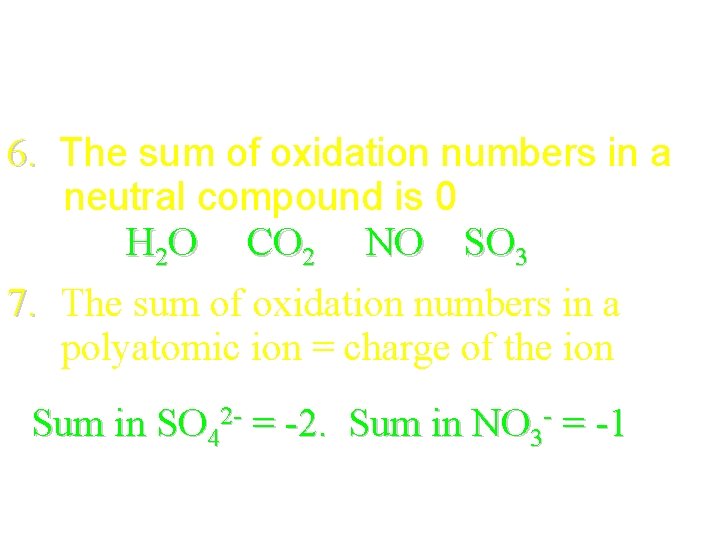
6. The sum of oxidation numbers in a neutral compound is 0 H 2 O CO 2 NO SO 3 7. The sum of oxidation numbers in a polyatomic ion = charge of the ion Sum in SO 42 - = -2. Sum in NO 3 - = -1

Naming Binary Covalent Compounds With The Stock System
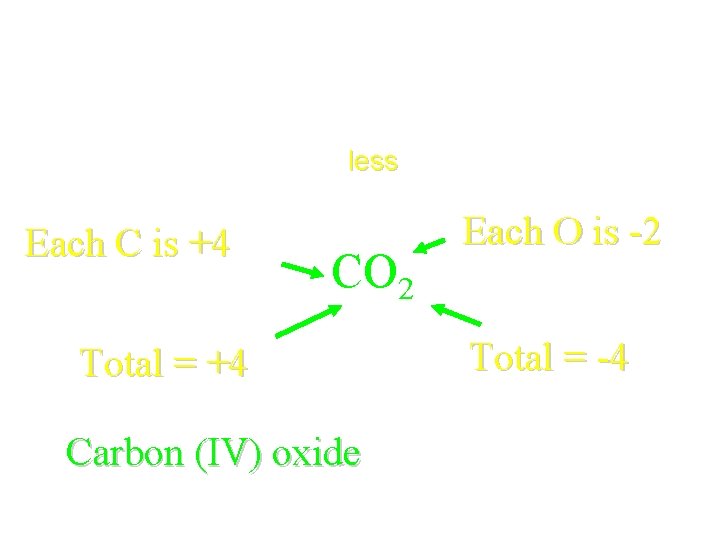
CO 2: C goes first because it’s less electronegative than O Each C is +4 CO 2 Total = +4 Carbon (IV) oxide Each O is -2 Total = -4
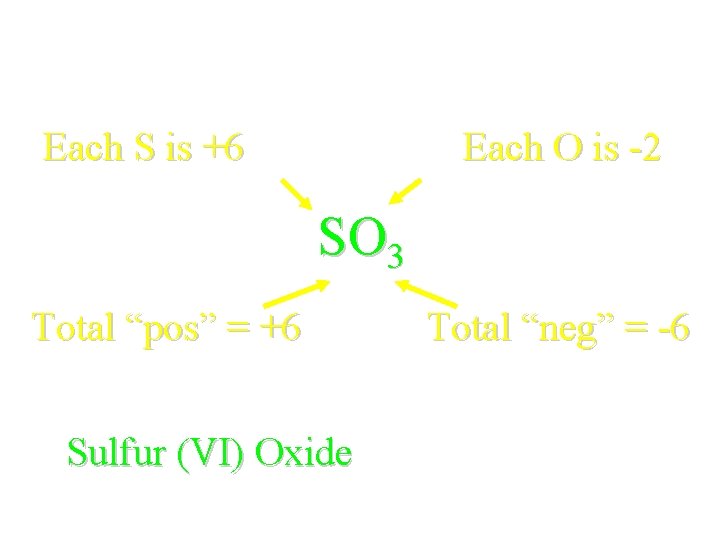
Try SO 3 Each S is +6 Each O is -2 SO 3 Total “pos” = +6 Sulfur (VI) Oxide Total “neg” = -6
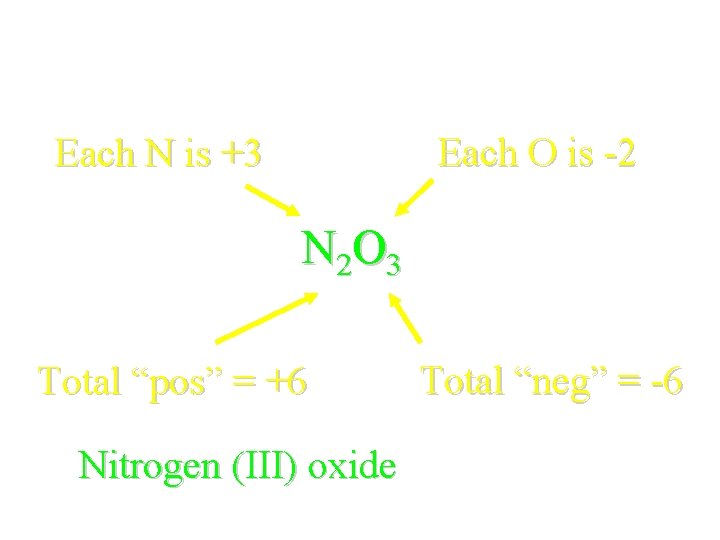
Try N 2 O 3 Each O is -2 Each N is +3 N 2 O 3 Total “pos” = +6 Nitrogen (III) oxide Total “neg” = -6
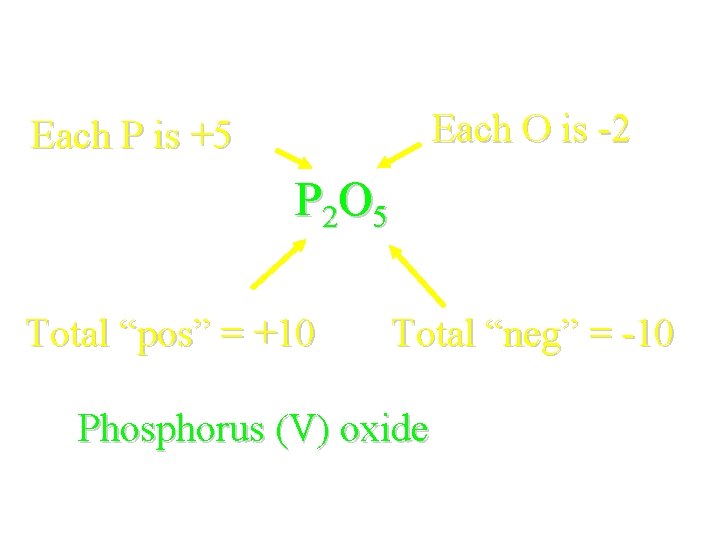
Try P 2 O 5 Each O is -2 Each P is +5 P 2 O 5 Total “pos” = +10 Total “neg” = -10 Phosphorus (V) oxide

Naming Binary Covalent Compounds With The Traditional Naming System
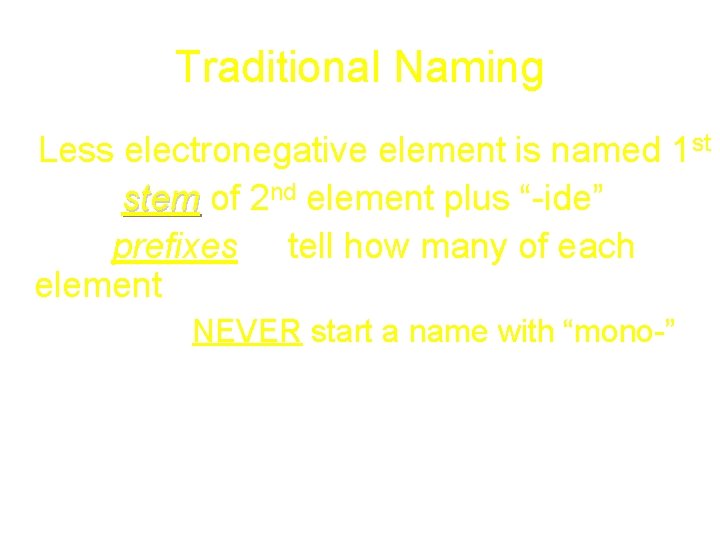
Traditional Naming 1. Less electronegative element is named 1 st 2. Give stem of 2 nd element plus “-ide” 3. Use prefixes to tell how many of each element Exception: NEVER start a name with “mono-”

Prefixes: Traditional System # of Atoms Prefix 1 mono 6 hexa 2 di 7 hepta 3 tri 8 octa 4 tetra 9 nona 5 penta 10 deca

Stems: just a reminder H = hydr C = carb N = nitr O = ox F = fluor Si = silic P= phosph S = sulf Cl = chlor As = arsen Se = selen Br = brom Te = tellur I = iod
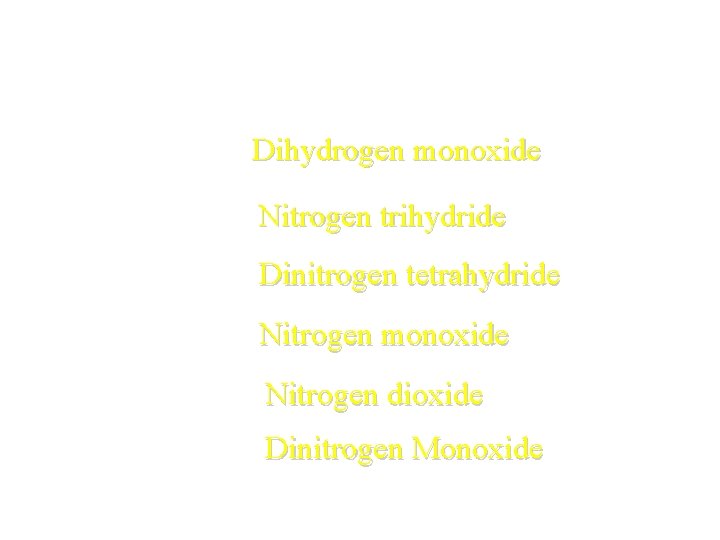
Traditional Naming H 2 O Dihydrogen monoxide NH 3 Nitrogen trihydride N 2 H 4 Dinitrogen tetrahydride NO Nitrogen monoxide NO 2 Nitrogen dioxide N 2 O Dinitrogen Monoxide
- Slides: 19