
BIMETALLIC CONTACT CONNECTIONS FOR OPERATION AT ELEVATED TEMPERATURES
BIMETALLIC CONTACT CONNECTIONS FOR OPERATION AT ELEVATED TEMPERATURES A. Z. Bogunov, A. A. Kuzovnikov, S. I. Fomin JSC « Pulse technologies » 660036, Krasnoyarsk, Russia, POB 26780, e-mail: limom 1@yandex. ru 1
JSC «Pulse technologies» • Developed technology of explosive welding with dovetail type bond of connection. • Fabrication of the steel-aluminum transition inserts for anode holder of aluminum electrolyzer. • About 140 000 steel-aluminum inserts were manufactured and delivered for aluminum industry. 2
Research Problem and Objectives • Problems: The voltage drop on the electrolysis of aluminum at an operating current of 200 -300 k. A is 4. 6 V, about 30 m. V of which drop on contact connections. The voltage drop at the contacts will depend on many factors: the contact material, size, condition of the surface (the presence of oxides, flatness, roughness), pressure load, temperature, etc. Theoretical analysis and numerical calculations of processes at the contacts do not give the exact values. • Objectives: Experimental study of the voltage drop at the contacts in the proceeding current densities depends on: pressure load of materials, the presence of oxides, the heating temperature. Selection of contact materials with high reliability to thermal effects. 3
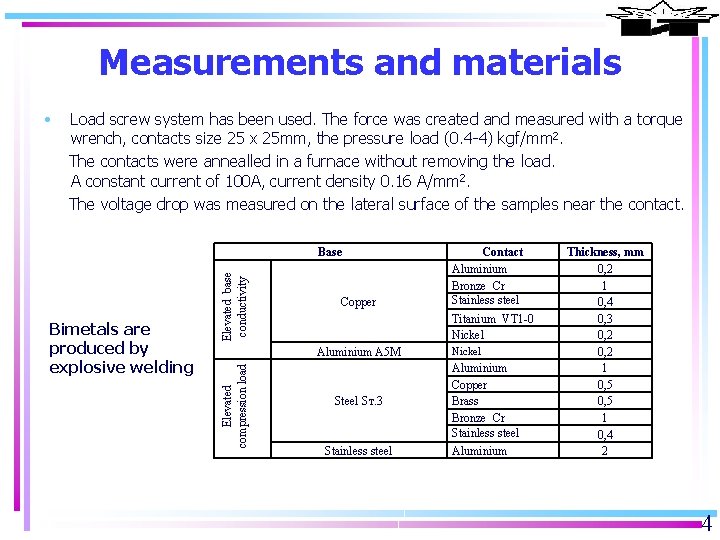
Measurements and materials • Load screw system has been used. The force was created and measured with a torque wrench, contacts size 25 x 25 mm, the pressure load (0. 4 -4) kgf/mm 2. The contacts were annealled in a furnace without removing the load. A constant current of 100 A, current density 0. 16 A/mm 2. The voltage drop was measured on the lateral surface of the samples near the contact. Copper Contact Aluminium Bronze Cr Stainless steel Titanium VТ 1 -0 Nickel Aluminium А 5 М Elevated compression load Bimetals are produced by explosive welding Elevated base conductivity Base Steel Sт. 3 Stainless steel Nickel Aluminium Copper Brass Bronze Cr Stainless steel Aluminium Thickness, mm 0, 2 1 0, 4 0, 3 0, 2 1 0, 5 1 0, 4 2 4
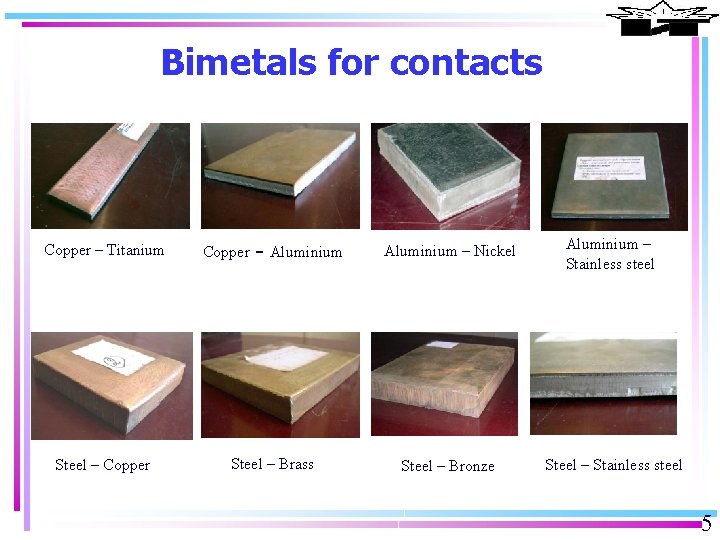
Bimetals for contacts Copper – Titanium Steel – Copper - Aluminium Steel – Brass Aluminium – Nickel Aluminium – Stainless steel Steel – Bronze Steel – Stainless steel 5
Al as a contact material The contacts voltage drop depending on the specific load. One of the contacts was aluminium and other: copper, titanium, nickel, aluminium, and stainless steel The best results can be obtained for the Al-Cu and Al-Ni contacts. The sharp rise in the voltage drop is observed at lower pressures for Al-Al and Al-Ti contacts. It is connected with the presence of the solid oxide films on both materials. 6
Ti as a contact material The contacts voltage drop depending on the specific load. One of the contacts was titanium and the other: aluminium, copper and low carbon steel. Contacts with Ti behave like contacts with Al, but the load level is a little higher. 7
Cu as a contact material The contacts voltage drop depending on the specific load. One of the contacts was annealed copper and other: nickel, titanium, low carbon steel, aluminium, annealed copper and stainless steel. The best results were obtained for Cu-Cu and Cu-Ni contacts. The sharp rise in voltage drop in the low-pressure region indicates that the soft annealed copper, apparently, is unable to destroy the oxide films on more solid materials 8
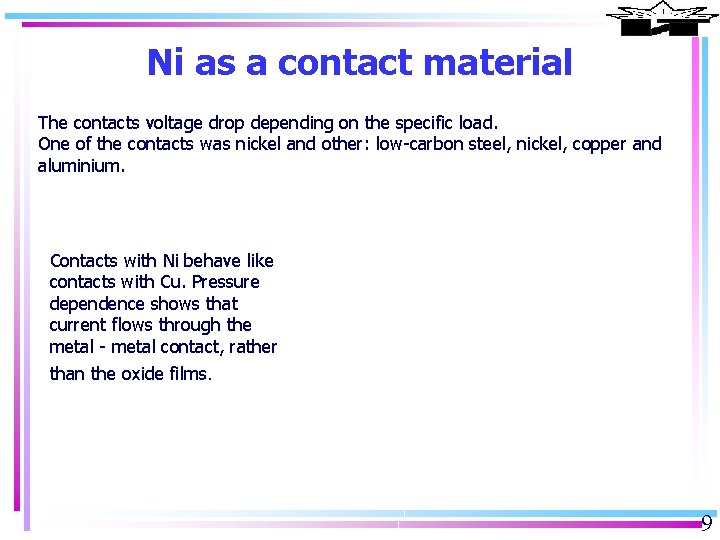
Ni as a contact material The contacts voltage drop depending on the specific load. One of the contacts was nickel and other: low-carbon steel, nickel, copper and aluminium. Contacts with Ni behave like contacts with Cu. Pressure dependence shows that current flows through the metal - metal contact, rather than the oxide films. 9
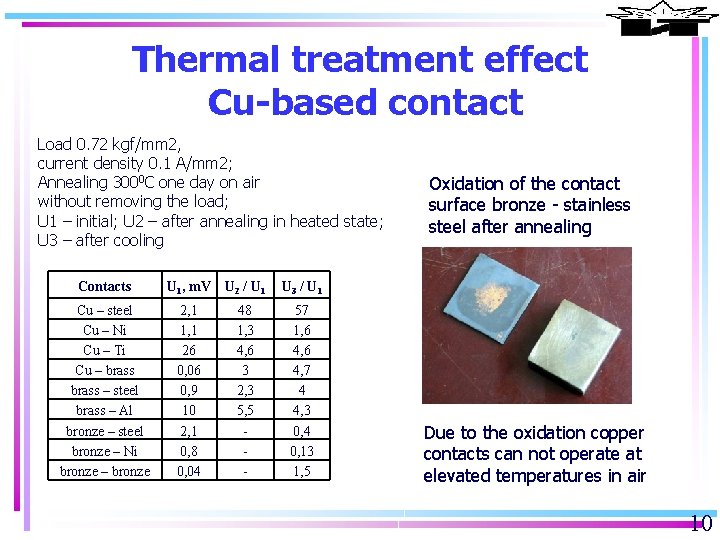
Thermal treatment effect Cu-based contact Load 0. 72 kgf/mm 2, current density 0. 1 A/mm 2; Annealing 3000 C one day on air without removing the load; U 1 – initial; U 2 – after annealing in heated state; U 3 – after cooling Contacts U 1, m. V U 2 / U 1 U 3 / U 1 Cu – steel Cu – Ni Cu – Ti Cu – brass – steel brass – Al bronze – steel bronze – Ni bronze – bronze 2, 1 1, 1 26 0, 06 0, 9 10 2, 1 0, 8 0, 04 48 1, 3 4, 6 3 2, 3 5, 5 - 57 1, 6 4, 7 4 4, 3 0, 4 0, 13 1, 5 Oxidation of the contact surface bronze - stainless steel after annealing Due to the oxidation copper contacts can not operate at elevated temperatures in air 10
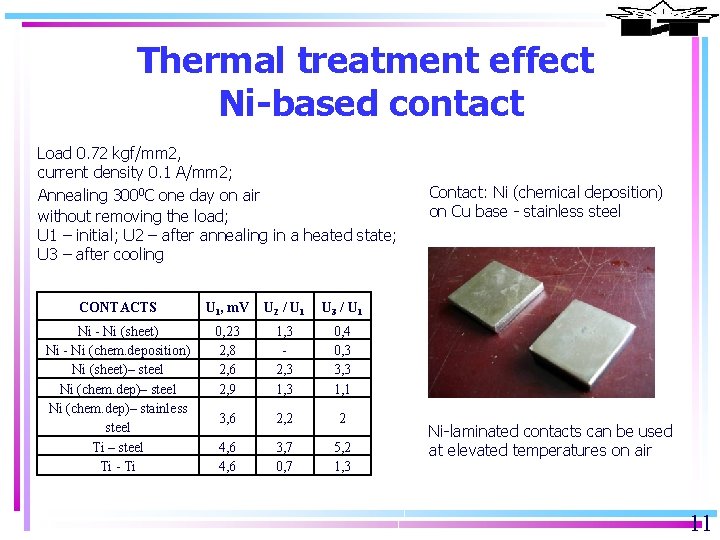
Thermal treatment effect Ni-based contact Load 0. 72 kgf/mm 2, current density 0. 1 A/mm 2; Annealing 3000 C one day on air without removing the load; U 1 – initial; U 2 – after annealing in a heated state; U 3 – after cooling CONTACTS U 1, m. V U 2 / U 1 U 3 / U 1 Ni - Ni (sheet) Ni - Ni (chem. deposition) Ni (sheet)– steel Ni (chem. dep)– stainless steel Ti – steel Ti - Ti 0, 23 2, 8 2, 6 2, 9 1, 3 2, 3 1, 3 0, 4 0, 3 3, 3 1, 1 3, 6 2, 2 2 4, 6 3, 7 0, 7 5, 2 1, 3 Contact: Ni (chemical deposition) on Cu base - stainless steel Ni-laminated contacts can be used at elevated temperatures on air 11
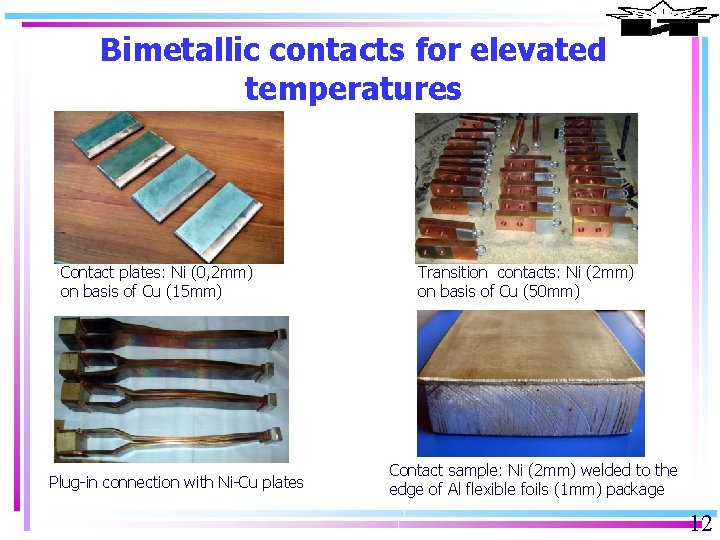
Bimetallic contacts for elevated temperatures Contact plates: Ni (0, 2 mm) on basis of Cu (15 mm) Plug-in connection with Ni-Cu plates Transition contacts: Ni (2 mm) on basis of Cu (50 mm) Contact sample: Ni (2 mm) welded to the edge of Al flexible foils (1 mm) package 12
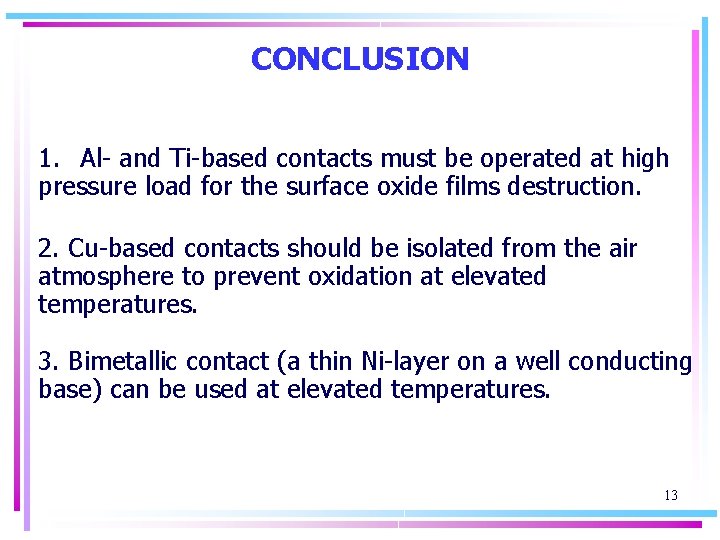
CONCLUSION 1. Al- and Ti-based contacts must be operated at high pressure load for the surface oxide films destruction. 2. Cu-based contacts should be isolated from the air atmosphere to prevent oxidation at elevated temperatures. 3. Bimetallic contact (a thin Ni-layer on a well conducting base) can be used at elevated temperatures. 13

THANK YOU FOR YOUR ATTENTION 14
- Slides: 14