
BILL Outline why the transparency of water is
BILL Outline why the transparency of water is important to living in aquatic habitat. Sunlight is required for photosynthesis, and many plants such as algae are the base of all food chains in aquatic habitats. Transparency allows plants to carry out photosynthesis under water and supplies energy to the environment. It also allows for organisms to find and interact with one another 1
FINISH PROPERTIES OF WATER LAB • Those who have finished, make sure that you have graphed data and written conclusion in lab notebooks • 10 minutes to check/review graphs and conclusion • Turn notebooks into shelf by my desk labeled with your period • Complete the properties of water worksheet. 2
POP QUIZ On properties of water and some chemical elements May use your notes to help answer questions Pay attention to the number of points the short answer/essay questions are You have 15 minutes 3
BILL MACROMOLECULES Why is carbon one of the most essential elements to living organisms? Carbon atoms can form up to four covalent bonds with various elements. This allows for a diversity of stable elements to be formed and makes carbon the base of all organic molecules 4
CARBON (C) • Carbon has 4 electrons in outer shell. • Carbon can form up to 4 covalent bonds with 4 other atoms (elements). • Usually with C, H, O or N. • Allows for a diversity of stable compounds to form • Example: CH 4(methane), C 6 H 12 O 6 (Glucose) 5
ORGANIC COMPOUNDS Organic Compounds – Compounds that contain carbon and are found in living organisms Life is based on Macromolecules, Macromolecules or large organic molecules. 6
MACROMOLECULES Large organic molecules. Also called POLYMERS. Made up of smaller “building blocks” called MONOMERS. Examples: 1. Carbohydrates 2. Lipids 3. Proteins 4. Nucleic acids (DNA and RNA) 7
MACROMOLECULES • Each Macromolecule (polymer) is composed of smaller subunits (monomer) that can be viewed individually • Carbohydrates (polysaccharides) monosaccharides • Proteins Amino Acids • Lipids Fatty Acids & Glycerol • Nucleic Acids Nucleotides 8
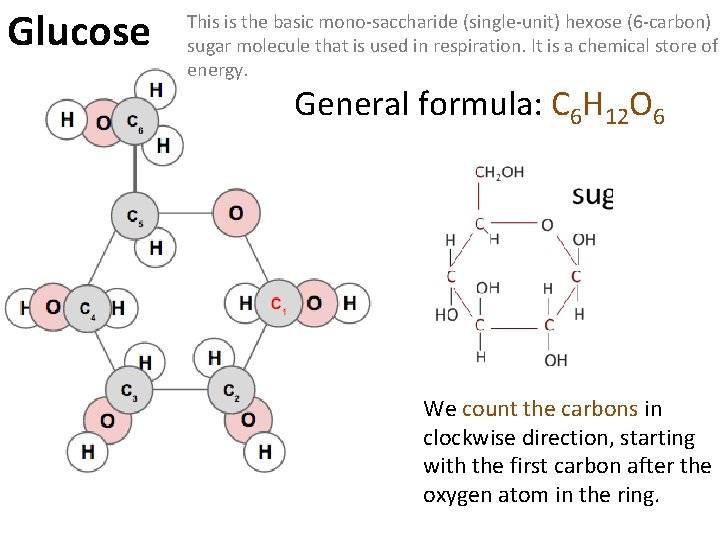
Glucose This is the basic mono-saccharide (single-unit) hexose (6 -carbon) sugar molecule that is used in respiration. It is a chemical store of energy. General formula: C 6 H 12 O 6 We count the carbons in clockwise direction, starting with the first carbon after the oxygen atom in the ring.
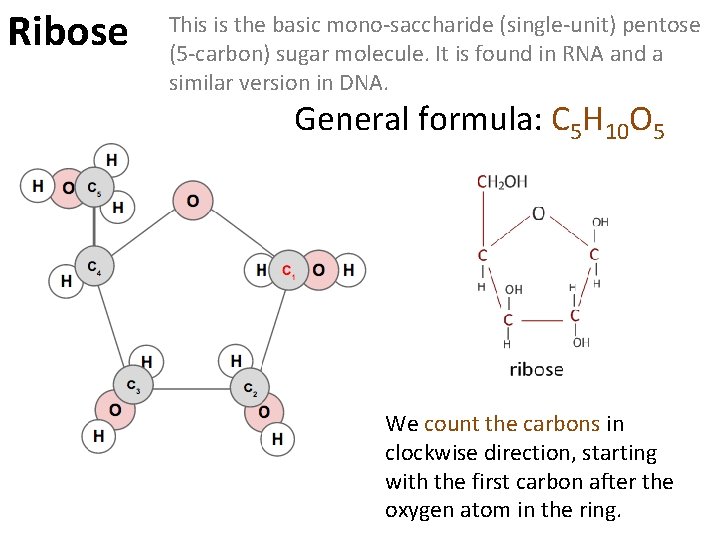
Ribose This is the basic mono-saccharide (single-unit) pentose (5 -carbon) sugar molecule. It is found in RNA and a similar version in DNA. General formula: C 5 H 10 O 5 We count the carbons in clockwise direction, starting with the first carbon after the oxygen atom in the ring.
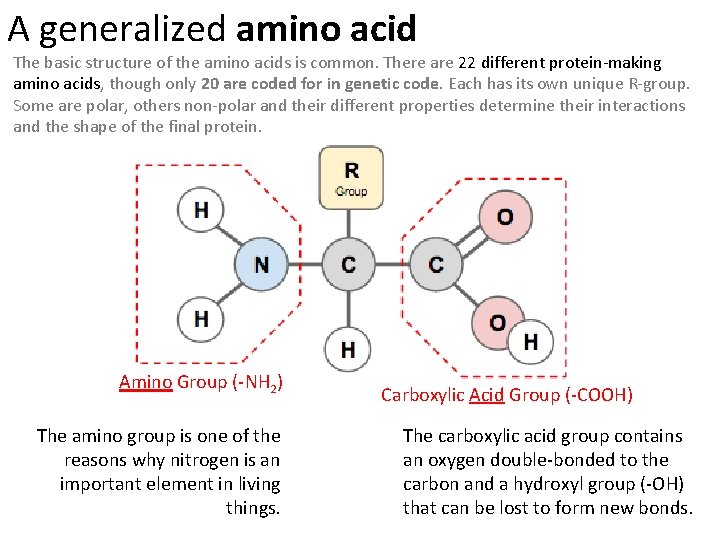
A generalized amino acid The basic structure of the amino acids is common. There are 22 different protein-making amino acids, though only 20 are coded for in genetic code. Each has its own unique R-group. Some are polar, others non-polar and their different properties determine their interactions and the shape of the final protein. Amino Group (-NH 2) The amino group is one of the reasons why nitrogen is an important element in living things. Carboxylic Acid Group (-COOH) The carboxylic acid group contains an oxygen double-bonded to the carbon and a hydroxyl group (-OH) that can be lost to form new bonds.
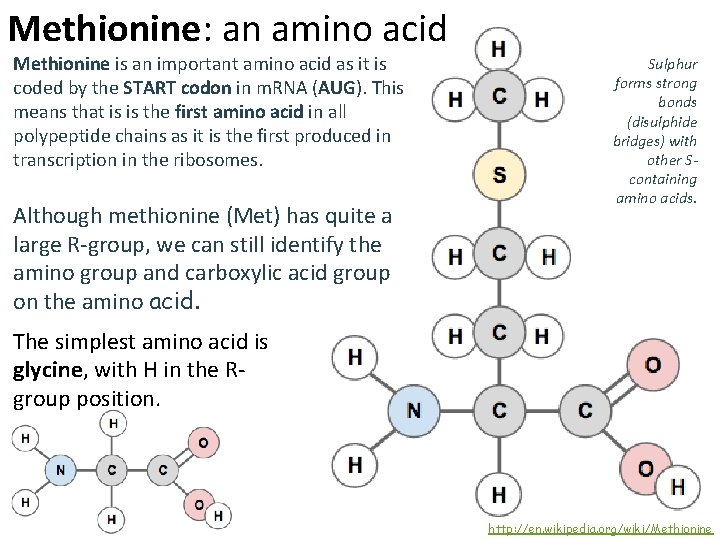
Methionine: an amino acid Methionine is an important amino acid as it is coded by the START codon in m. RNA (AUG). This means that is is the first amino acid in all polypeptide chains as it is the first produced in transcription in the ribosomes. Although methionine (Met) has quite a large R-group, we can still identify the amino group and carboxylic acid group on the amino acid. Sulphur forms strong bonds (disulphide bridges) with other Scontaining amino acids. The simplest amino acid is glycine, with H in the Rgroup position. http: //en. wikipedia. org/wiki/Methionine
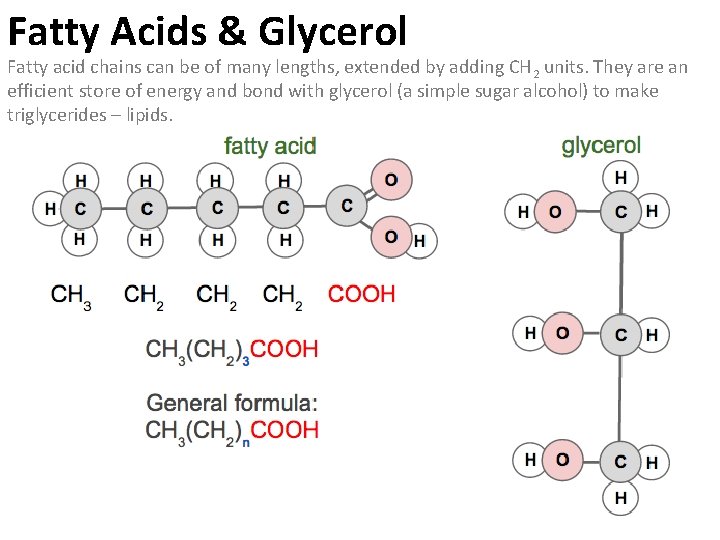
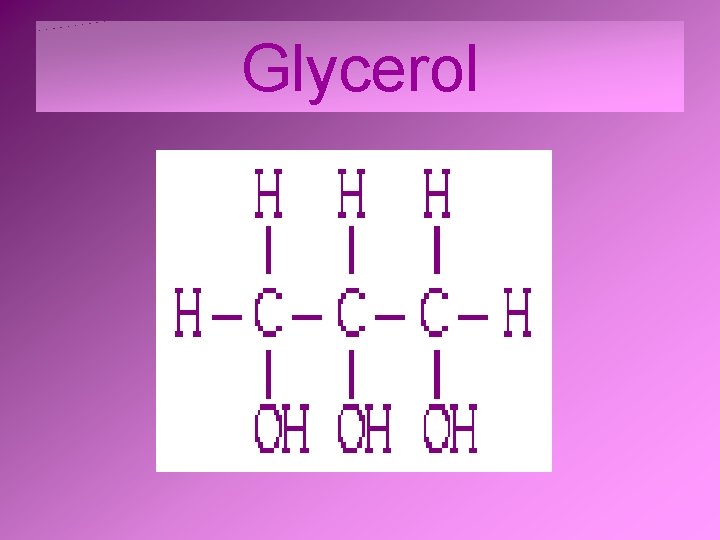
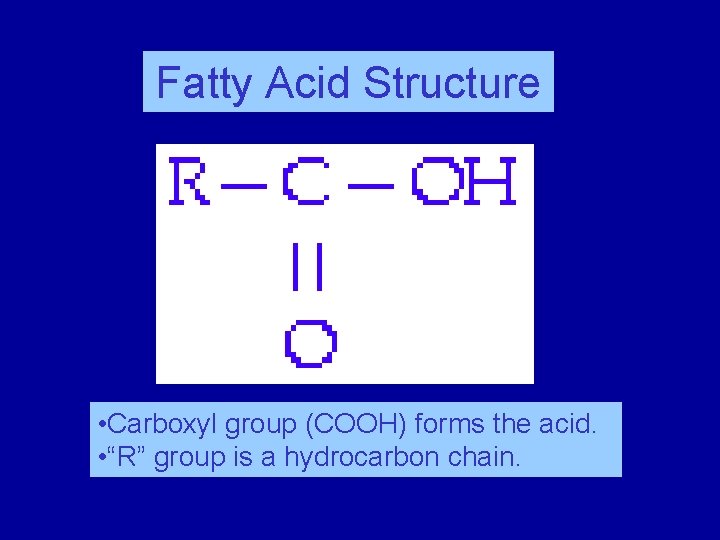
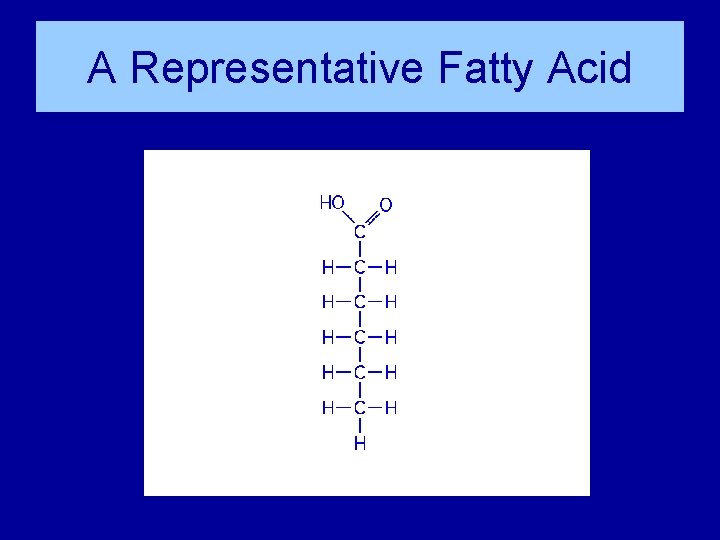
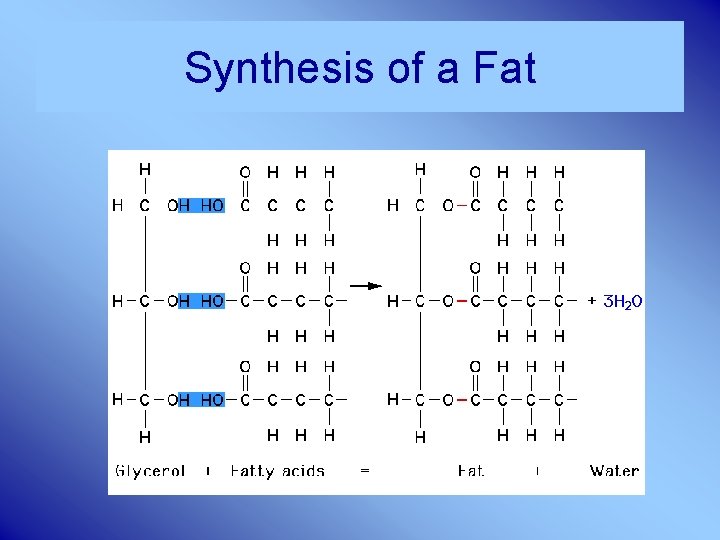
Fatty Acids & Glycerol Fatty acid chains can be of many lengths, extended by adding CH 2 units. They are an efficient store of energy and bond with glycerol (a simple sugar alcohol) to make triglycerides – lipids.
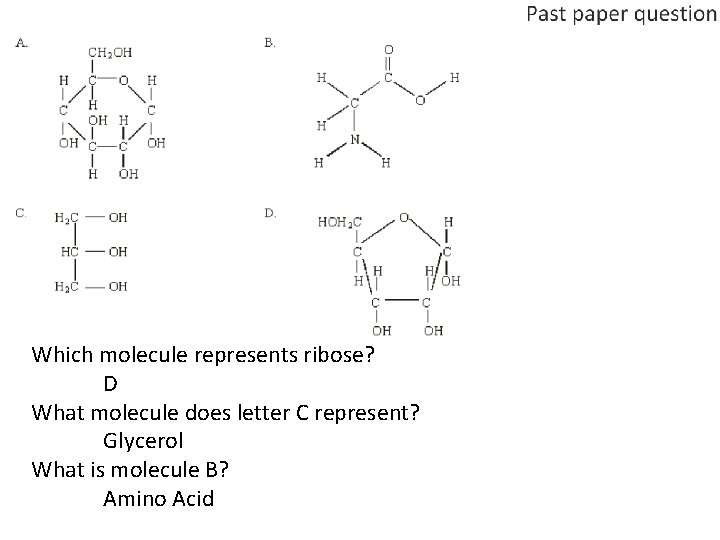
Which molecule represents ribose? D What molecule does letter C represent? Glycerol What is molecule B? Amino Acid
WHAT DO ORGANISMS DO WITH THESE MACROMOLECULES? o. Use the energy carry out various chemical reactions in the body o. Metabolism – All of an organism’s or cell’s chemical reactions o Various metabolic pathways are used to breakdown/form molecules in the body o. Two Types: o. Catabolism o. Anabolism 15

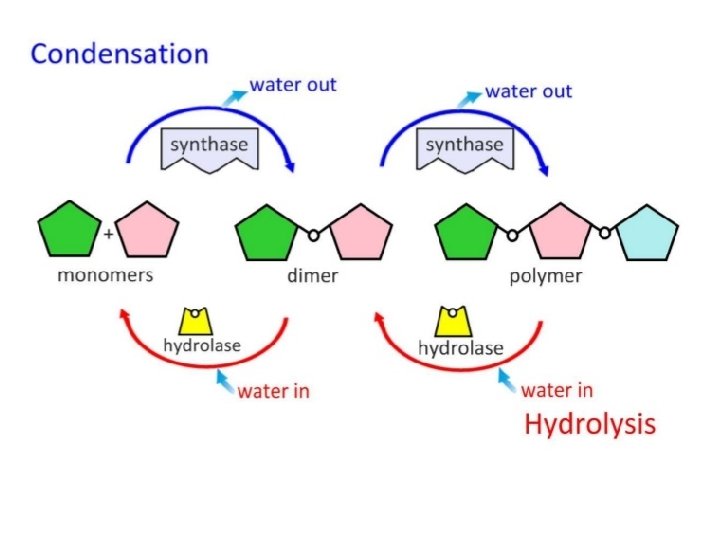
METABOLISM Catabolism Anabolism Chemical pathways that release energy by breaking down complex molecules to simpler compound Consume energy to build complicated molecules from simpler ones Occurs by hydrolysis reactions of macromolecules into monomers Reactions requires water molecules as a reactant Occurs by condensation reactions of monomers into polymers Water is a product 16
BILL What is metabolism? Describe the two types of metabolism. Metabolism is the totality of an organism’s, or a cell’s, chemical reactions. There are two types of metabolic reactions. The first is catabolism, in which molecules are broken down from complex versions to simpler ones and release energy in the process. The second is anabolism, in which complex molecules are built from simpler ones and energy is consumed. 17
QUESTION: HOW ARE MACROMOLECU LES FORMED? 18
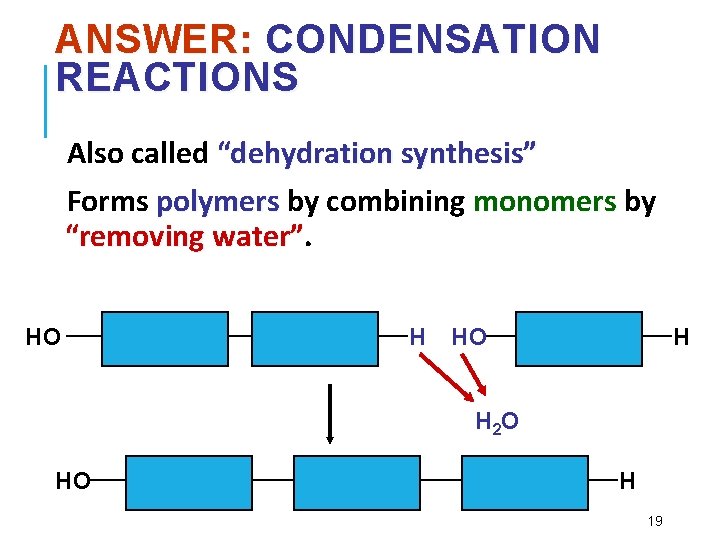
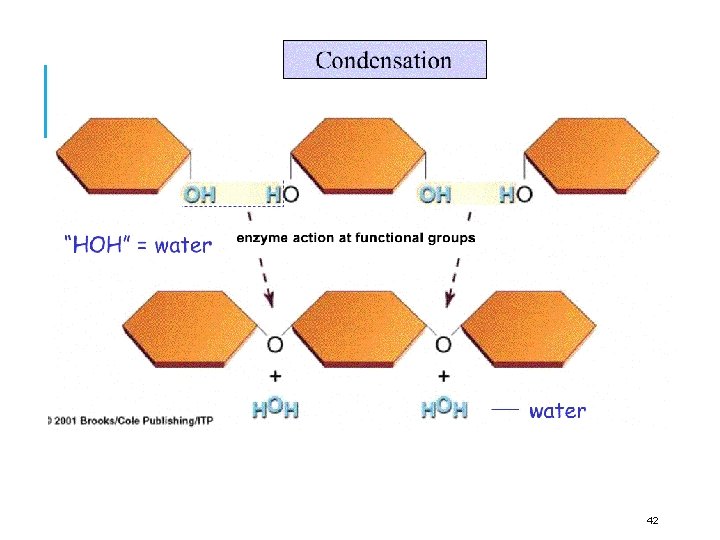
ANSWER: CONDENSATION REACTIONS Also called “dehydration synthesis” Forms polymers by combining monomers by “removing water” HO H H 2 O HO H 19
QUESTION: HOW ARE MACROMOLECULE S SEPARATED OR DIGESTED? 20
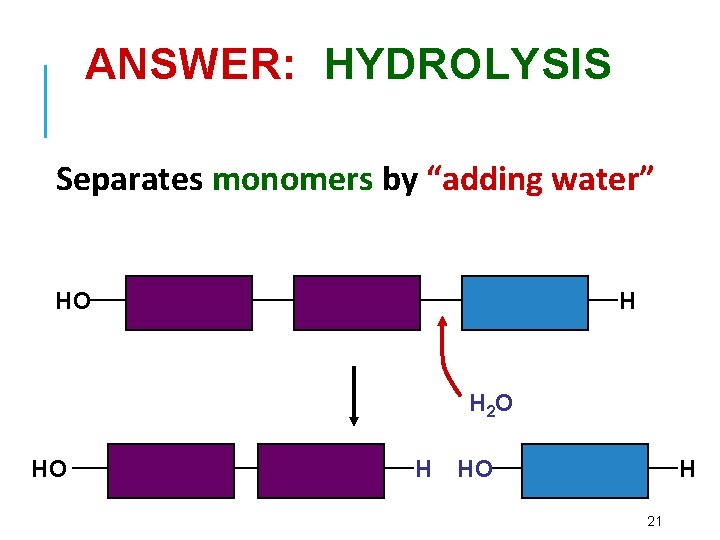
ANSWER: HYDROLYSIS Separates monomers by “adding water” HO H H 2 O HO H 21
22
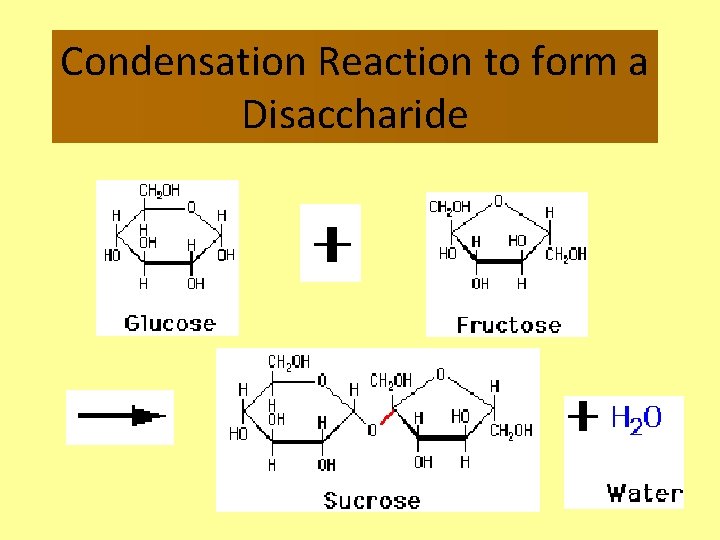
BILL What macromolecules did you build yesterday? Were these polymers or monomers? What type of reaction did you model yesterday and what happened? Carbohydrates, possibly proteins if made it far enough Monomers, or the building blocks of the macromolecules Condensation reaction, combined glucose and fructose by “removing” a water molecule 23
BILL What are the 4 types of macromolecules? What are the monomers of each macromolecule? • Carbohydrates (polysaccharides) monosaccharides • Proteins Amino Acids • Lipids Fatty Acids & Glycerol • Nucleic Acids Nucleotides 24
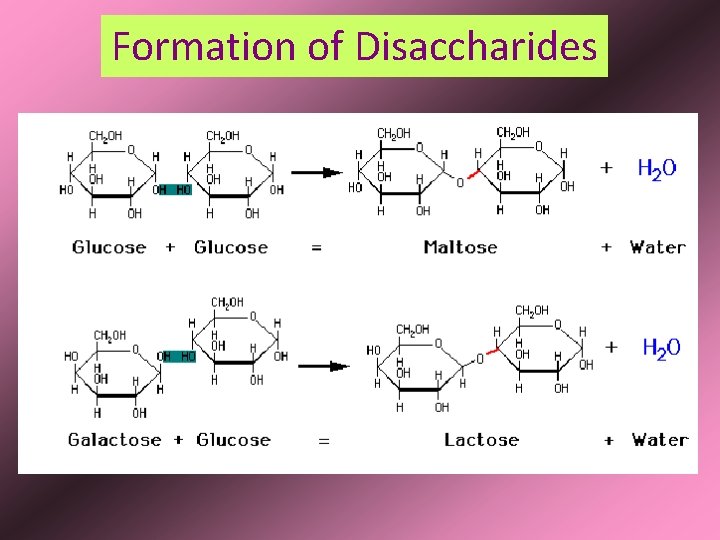
BILL What is the molecular formula for glucose? How would two glucose molecules combine to form a disaccharide? C 6 H 12 O 6 A condensation reaction would occur, removing water from two molecules and allowing them to bond together. 25
CARBOHYDRATES
CARBOHYDRATES Class of molecules ranging from small sugar molecules (monosaccharides) to large sugar molecules (polysaccharides). Examples: A. monosaccharide B. disaccharide C. polysaccharide 27
CHARACTERISTICS OF CARBOHYDRATES Consist of carbon, hydrogen, & oxygen Energy containing molecules Some provide structure Basic building block is a monosaccharide (CH 2 O)n ; n = 3, 5, 6 Two monosaccharides form a disaccharide by condensation reaction
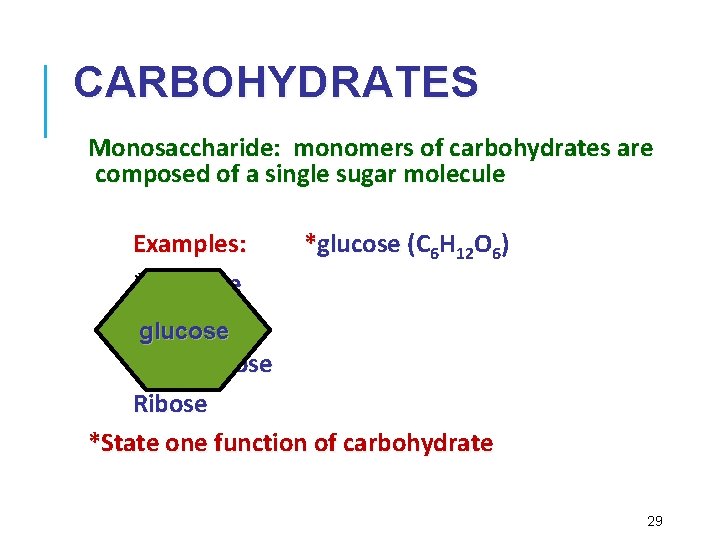
CARBOHYDRATES Monosaccharide: monomers of carbohydrates are composed of a single sugar molecule Examples: *glucose (C ( 6 H 12 O 6) *Fructose Galactose glucose Deoxyribose Ribose *State one function of carbohydrate 29
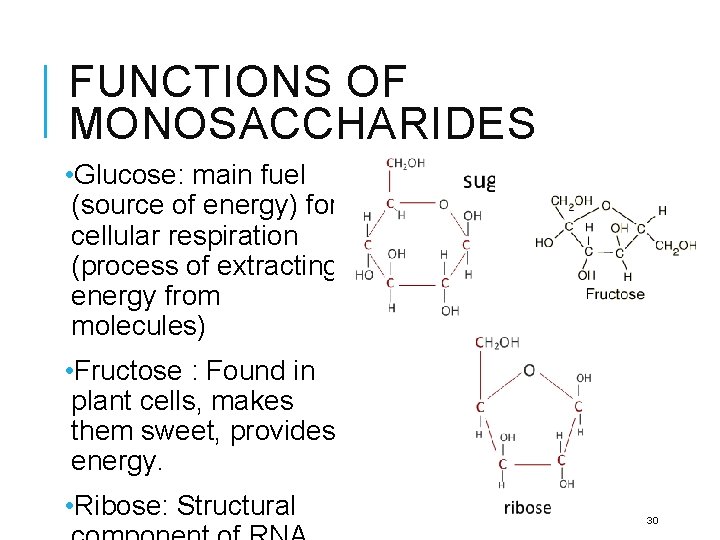
FUNCTIONS OF MONOSACCHARIDES • Glucose: main fuel (source of energy) for cellular respiration (process of extracting energy from molecules) • Fructose : Found in plant cells, makes them sweet, provides energy. • Ribose: Structural 30
TWO MINUTE CONVO Why is it beneficial for fruits to produce fructose, which is a sweet tasting monosaccharide? 31
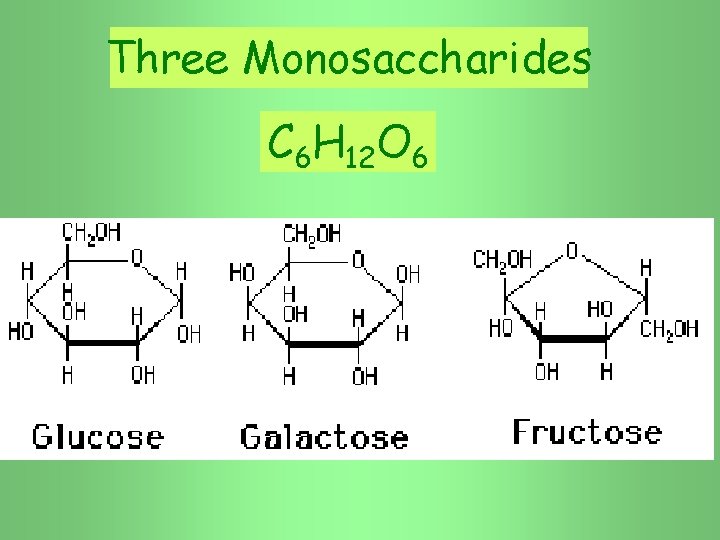
Three Monosaccharides C 6 H 12 O 6
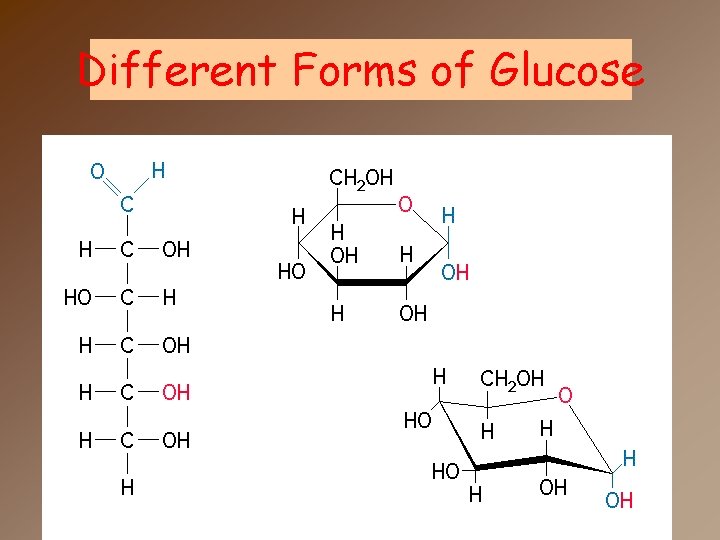
Different Forms of Glucose
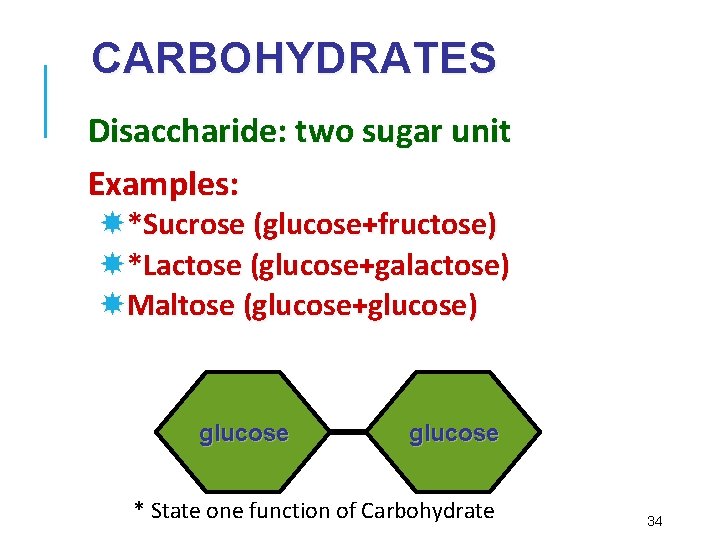
CARBOHYDRATES Disaccharide: two sugar unit Examples: *Sucrose (glucose+fructose) *Lactose (glucose+galactose) Maltose (glucose+glucose) glucose * State one function of Carbohydrate 34
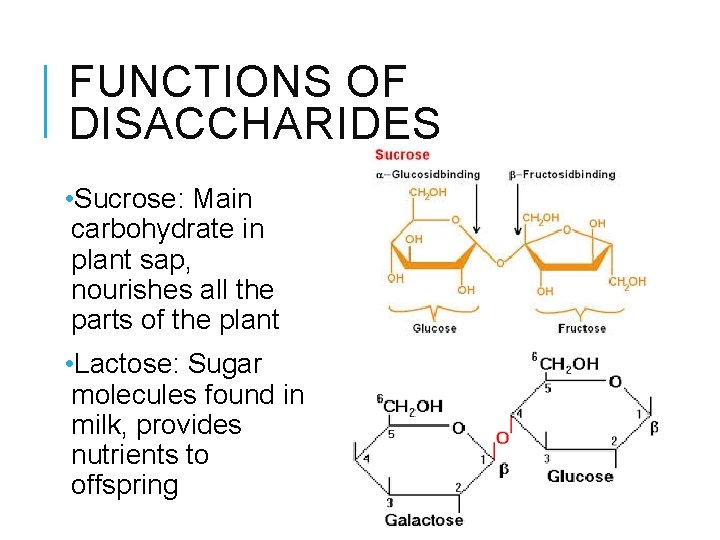
FUNCTIONS OF DISACCHARIDES • Sucrose: Main carbohydrate in plant sap, nourishes all the parts of the plant • Lactose: Sugar molecules found in milk, provides nutrients to offspring 35
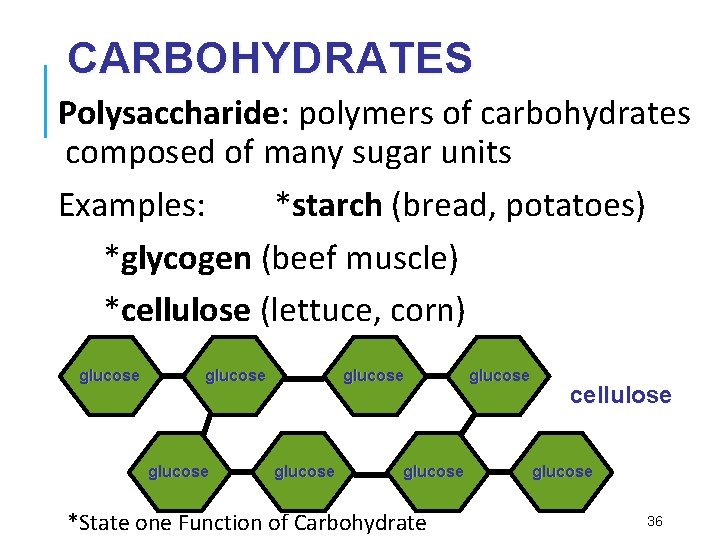
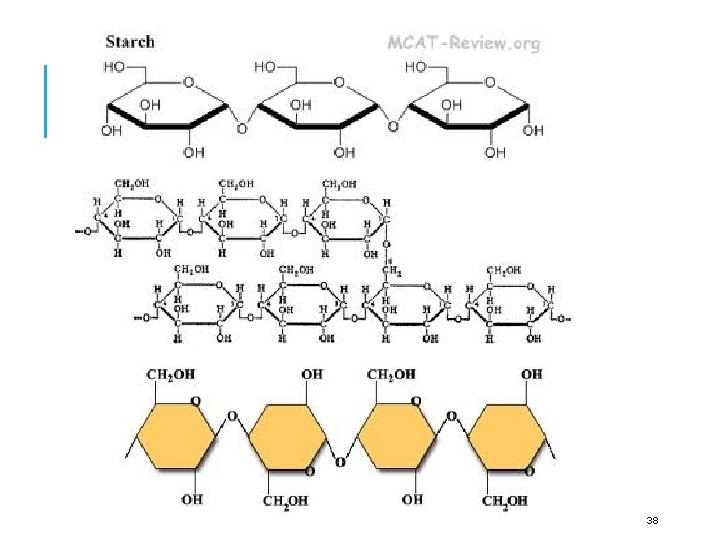
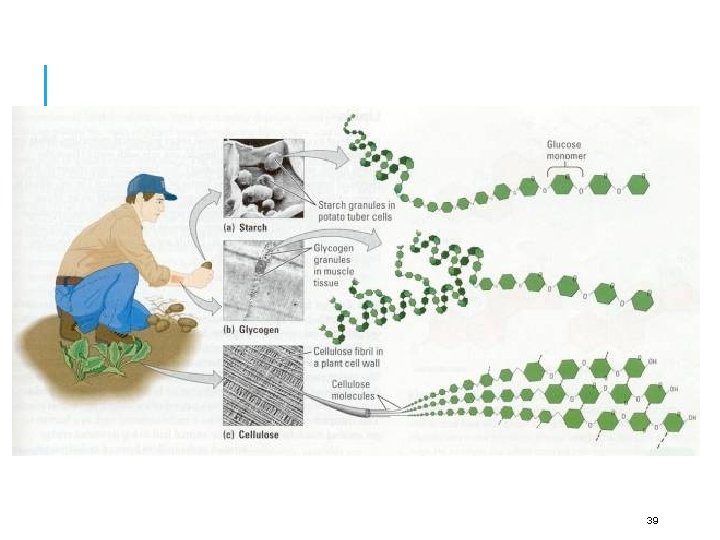
CARBOHYDRATES Polysaccharide: polymers of carbohydrates composed of many sugar units Examples: *starch (bread, potatoes) *glycogen (beef muscle) *cellulose (lettuce, corn) glucose glucose *State one Function of Carbohydrate glucose cellulose glucose 36
FUNCTIONS OF POLYSACCHARIDES • Starch: storage of glucose in the roots and other tissues of plants. Consists entirely of glucose. • Glycogen: storage of glucose in liver and muscle cells. Consists entirely of glucose, more branched than starch • Cellulose: Forms cable-like fibrils in the tough walls that enclose plant cells, known as cell wall. Composed of glucose, but monomers are linked in different orientation 37
38
39
BILL - CARBOHYDRATES Discuss the properties (structure and function) of monosaccharides, disaccharides, and polysaccharide. Monosaccharides – single sugar units, the monomers of carbohydrates. Primary source of energy for cells, some can be structural Disaccharides – two sugar units. Nutritional molecules for plants and in milk for offspring Polysaccharides – Multiple sugar units. Storage of glucose in plants and animals, also structural component of cell wall. 40
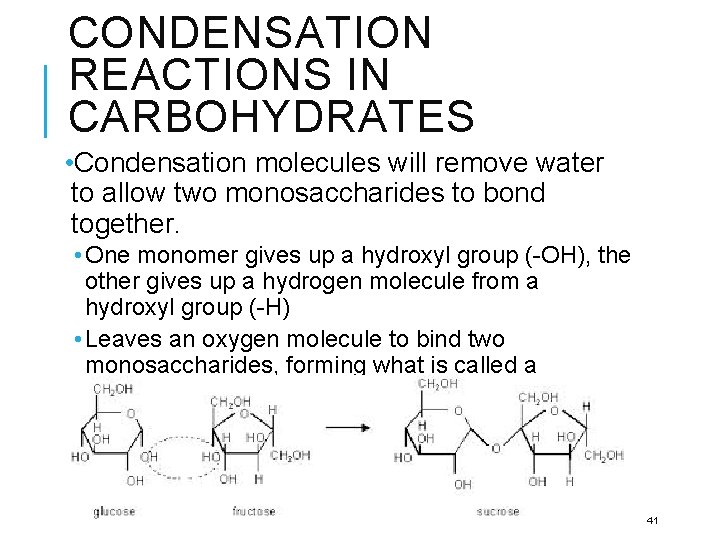
CONDENSATION REACTIONS IN CARBOHYDRATES • Condensation molecules will remove water to allow two monosaccharides to bond together. • One monomer gives up a hydroxyl group (-OH), the other gives up a hydrogen molecule from a hydroxyl group (-H) • Leaves an oxygen molecule to bind two monosaccharides, forming what is called a glycosidic bond 41
42
Condensation Reaction to form a Disaccharide
Formation of Disaccharides
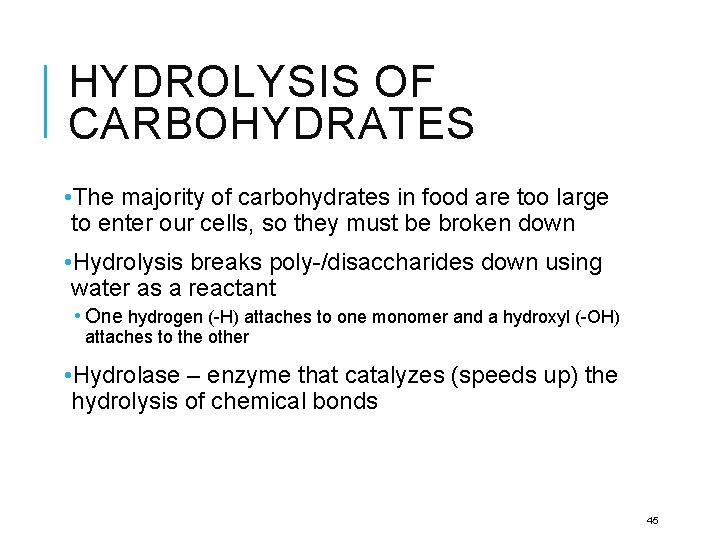
HYDROLYSIS OF CARBOHYDRATES • The majority of carbohydrates in food are too large to enter our cells, so they must be broken down • Hydrolysis breaks poly-/disaccharides down using water as a reactant • One hydrogen (-H) attaches to one monomer and a hydroxyl (-OH) attaches to the other • Hydrolase – enzyme that catalyzes (speeds up) the hydrolysis of chemical bonds 45
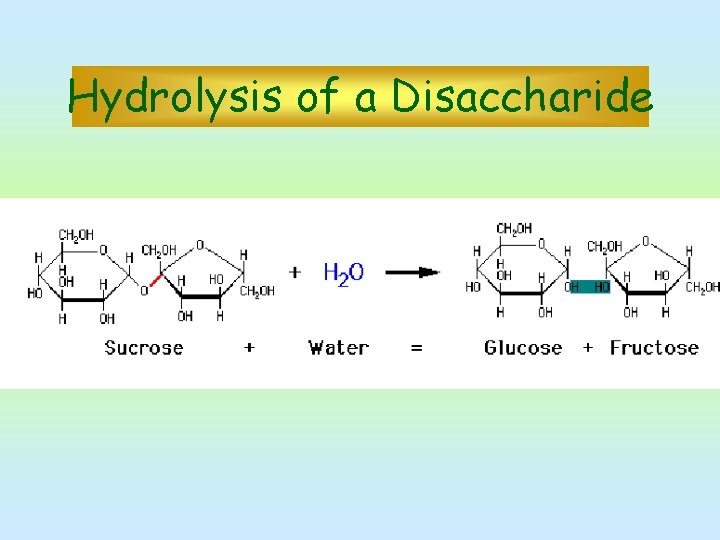
Hydrolysis of a Disaccharide
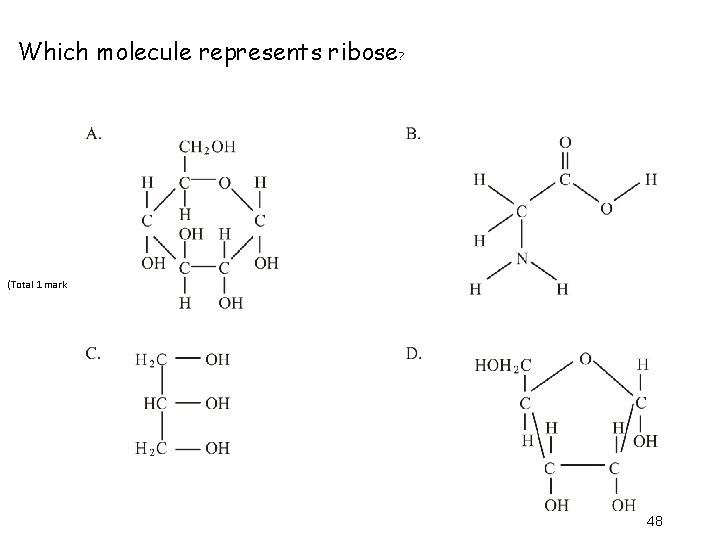
. Which molecule represents ribose? (Total 1 mark 48

BILL So far in this class. What have you liked? What have you not liked? What would you change if you could? 49
CARBOHYDRATE LAB Part I – Test known Saccharides Test Mono-, Di-, & Polysaccharides using Benedict’s Solution and Iodine Pay attention to what happens with indicators so you know what to look for in parts II & III Use 1 pipette full of each solution (about 5 ml) 50
CARBOHYDRATE LAB Part II – Test Unknown Saccharides Test 6 solutions to see what type of saccharides are present Use indicator’s to find out Part III – Test Unknown Solution Test an unknown solution for the different saccharides. Hypothesize what the unknown solution is based on tests 51
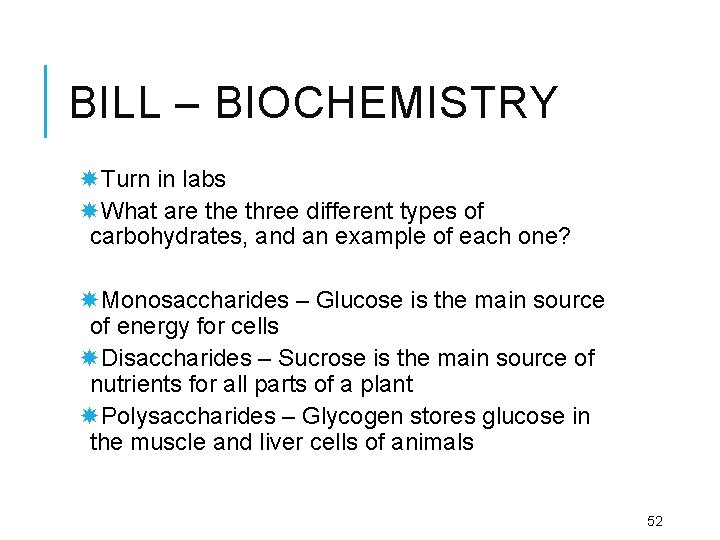
BILL – BIOCHEMISTRY Turn in labs What are three different types of carbohydrates, and an example of each one? Monosaccharides – Glucose is the main source of energy for cells Disaccharides – Sucrose is the main source of nutrients for all parts of a plant Polysaccharides – Glycogen stores glucose in the muscle and liver cells of animals 52
LIPIDS
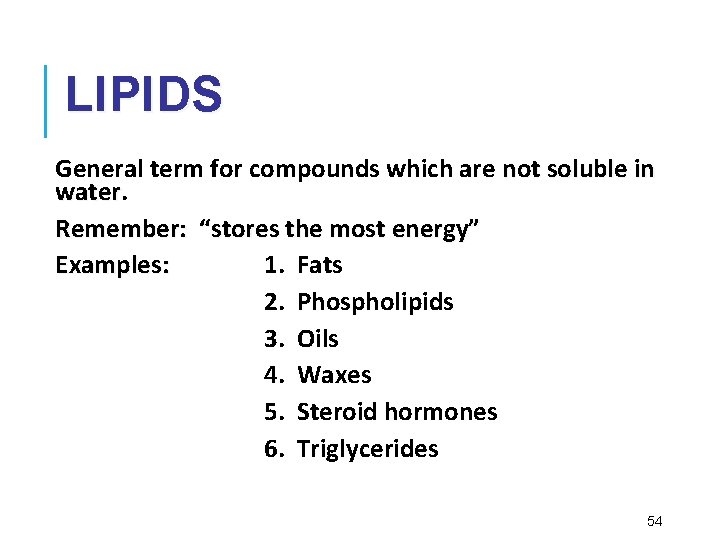
LIPIDS General term for compounds which are not soluble in water Remember: “stores the most energy” Examples: 1. Fats 2. Phospholipids 3. Oils 4. Waxes 5. Steroid hormones 6. Triglycerides 54
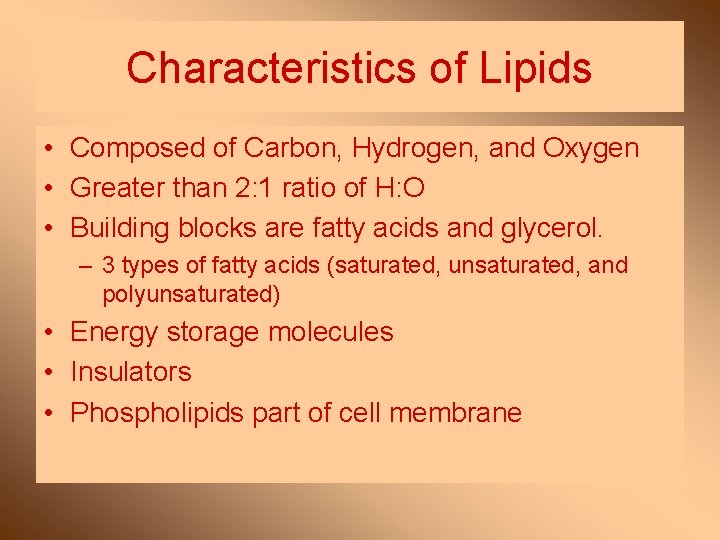
Characteristics of Lipids • Composed of Carbon, Hydrogen, and Oxygen • Greater than 2: 1 ratio of H: O • Building blocks are fatty acids and glycerol. – 3 types of fatty acids (saturated, unsaturated, and polyunsaturated) • Energy storage molecules • Insulators • Phospholipids part of cell membrane
Glycerol
Fatty Acid Structure • Carboxyl group (COOH) forms the acid. • “R” group is a hydrocarbon chain.
A Representative Fatty Acid
Synthesis of a Fat
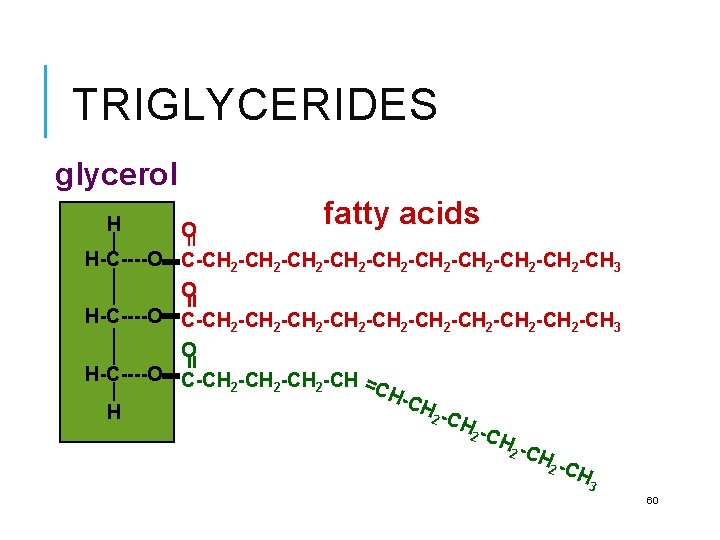
TRIGLYCERIDES glycerol H fatty acids = O H-C----O C-CH 2 -CH 2 -CH 2 -CH 2 -CH 2 -CH 3 O H-C----O C-CH -CH = 2 2 2 CH -CH H 2 -C H 2 C H = = 3 60
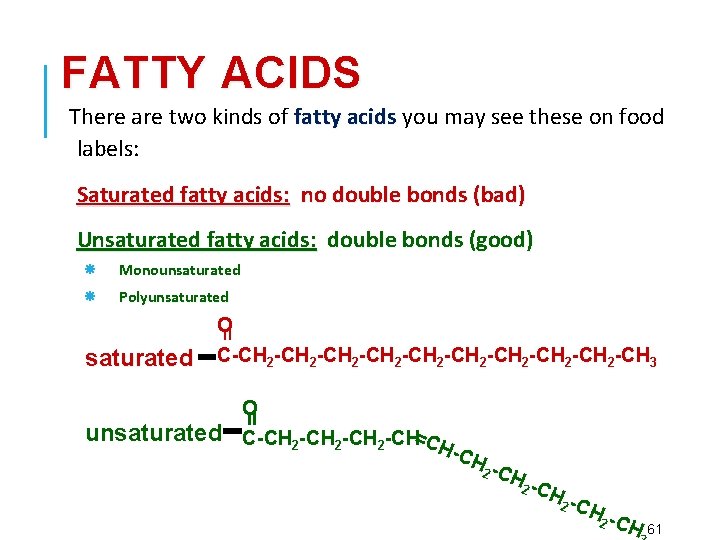
FATTY ACIDS There are two kinds of fatty acids you may see these on food labels: Saturated fatty acids: no double bonds (bad) Unsaturated fatty acids: double bonds (good) Monounsaturated Polyunsaturated = O C-CH 2 -CH 2 -CH 2 -CH 3 saturated = unsaturated O C-CH 2 -CH=CH -CH 2 -C H 2 C H 61
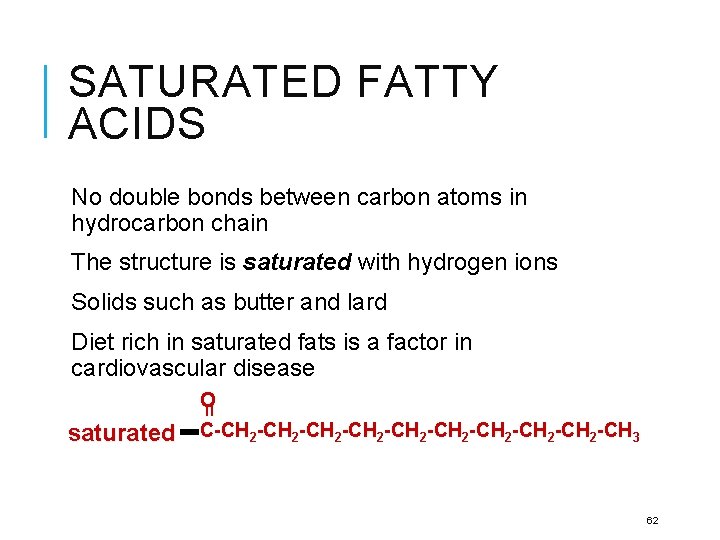
SATURATED FATTY ACIDS No double bonds between carbon atoms in hydrocarbon chain The structure is saturated with hydrogen ions Solids such as butter and lard Diet rich in saturated fats is a factor in cardiovascular disease = O C-CH 2 -CH 2 -CH 2 -CH 3 saturated 62
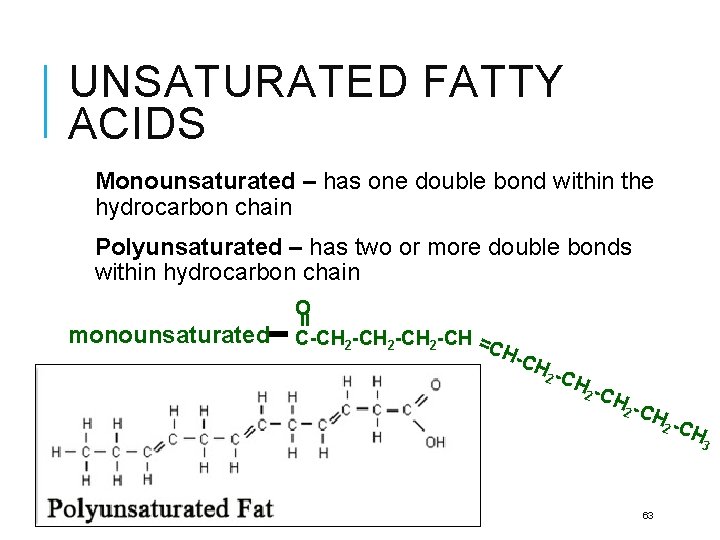
UNSATURATED FATTY ACIDS Monounsaturated – has one double bond within the hydrocarbon chain Polyunsaturated – has two or more double bonds within hydrocarbon chain = monounsaturated O C-CH 2 -CH =C H-C H 2 C H 3 63
BILL What is the difference between saturated and unsaturated fatty acids? • Saturated fatty acids have no double bonds between carbon molecules in the hydrocarbon chain and are said to be saturated with hydrogen atoms. Typically solids • Unsaturated fatty acids have double bonds between carbon molecules in the hydrocarbon chain. There are two types, monounsaturated (1 double bond) and polyunsaturated (2 or more double bonds). Typically liquids. 64
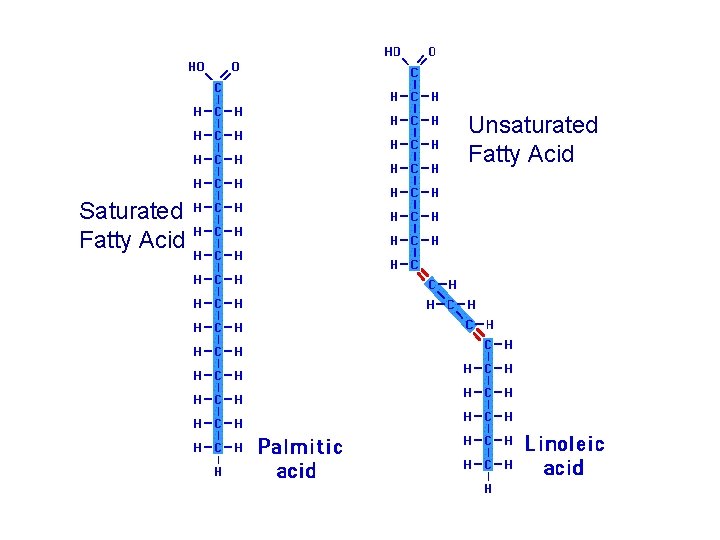
Unsaturated Fatty Acid Saturated Fatty Acid
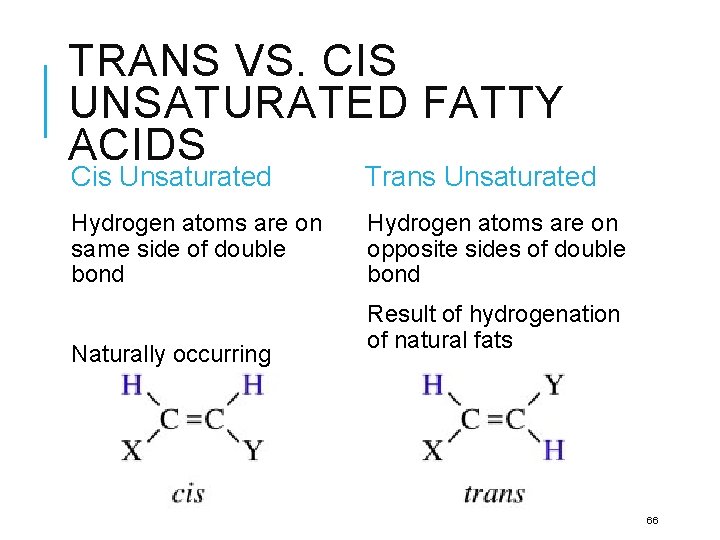
TRANS VS. CIS UNSATURATED FATTY ACIDS Cis Unsaturated Trans Unsaturated Hydrogen atoms are on same side of double bond Hydrogen atoms are on opposite sides of double bond Naturally occurring Result of hydrogenation of natural fats 66
TRANS VS. CIS UNSATURATED FATTY ACIDS Affects the shape of the fatty acid molecules Cis Unsaturated Trans Unsaturated Double bonds result in a kink in hydrocarbon chain No kink in hydrocarbon chain Typically liquid and more flexible Typically solid (like saturated) and less flexible Healthier Less healthy 67
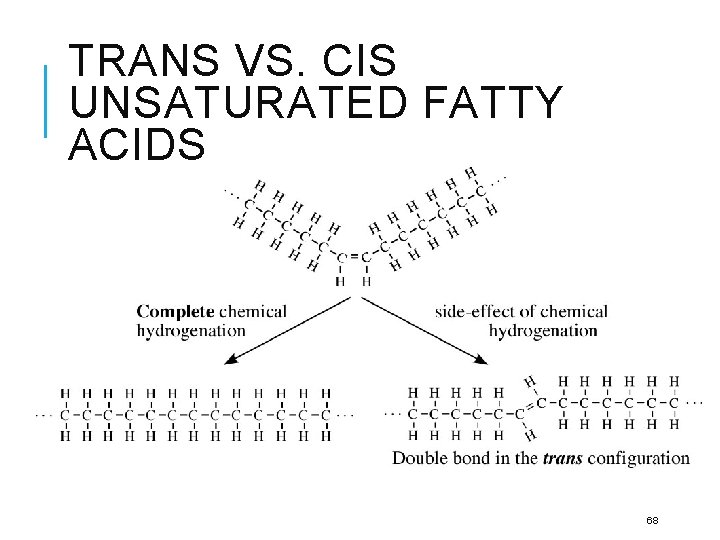
TRANS VS. CIS UNSATURATED FATTY ACIDS 68
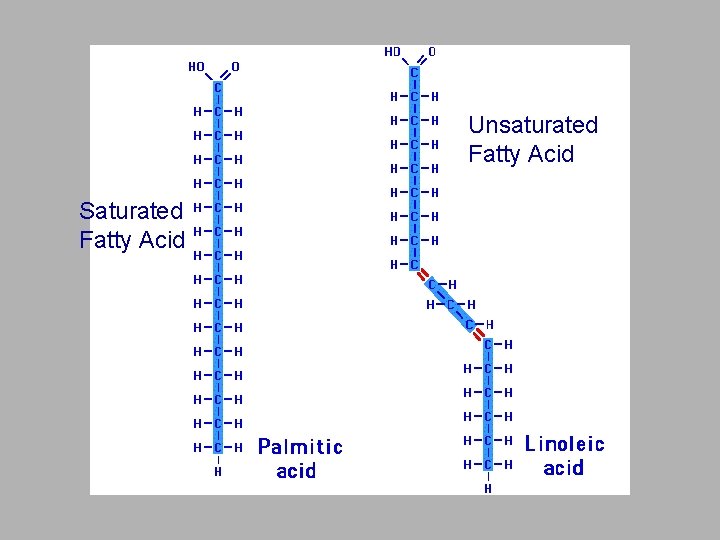
Unsaturated Fatty Acid Saturated Fatty Acid
2 minute Convo • Have you heard of Omega-3, and Omega-6 Fatty acids? Do you think they are saturated or unsaturated? Cis- or Trans. Conservation? 70
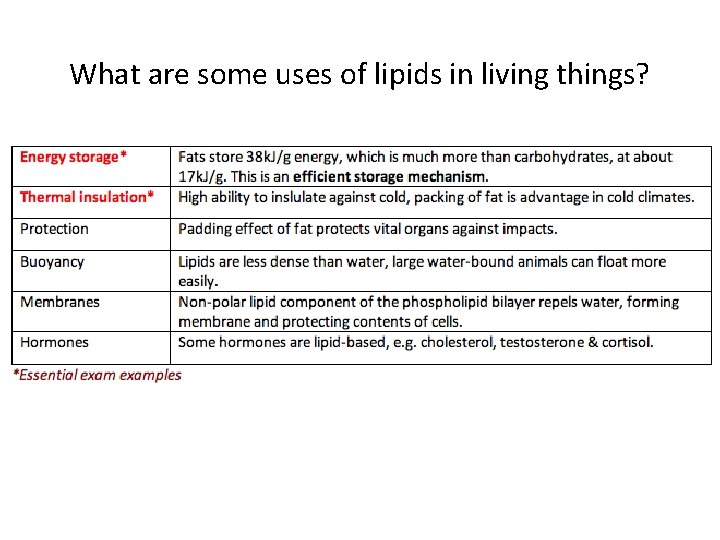
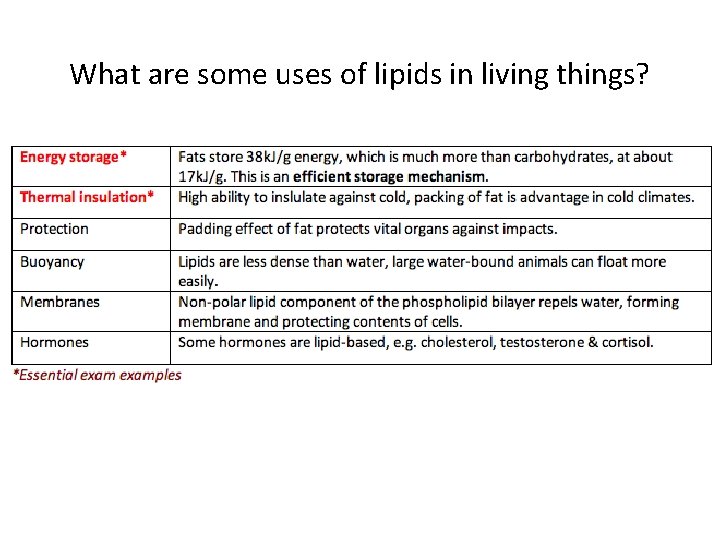
LIPIDS Six functions of lipids: 1. Long term energy storage 2. Protection against heat loss (insulation) 3. Protection against physical shock 4. Protection against water loss 5. Chemical messengers (hormones) 6. Major component of membranes (phospholipids) 71
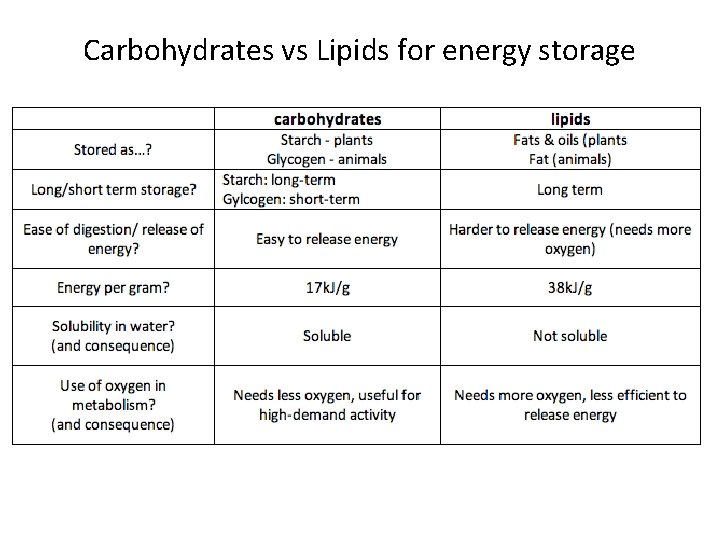
LIPIDS Triglycerides (fats): composed of 1 glycerol and 3 fatty acids. Formed by condensation reaction Body stores excess food as fat in adipose tissue Very efficient energy storage molecule Stores approximately twice as much energy as carbohydrate 72
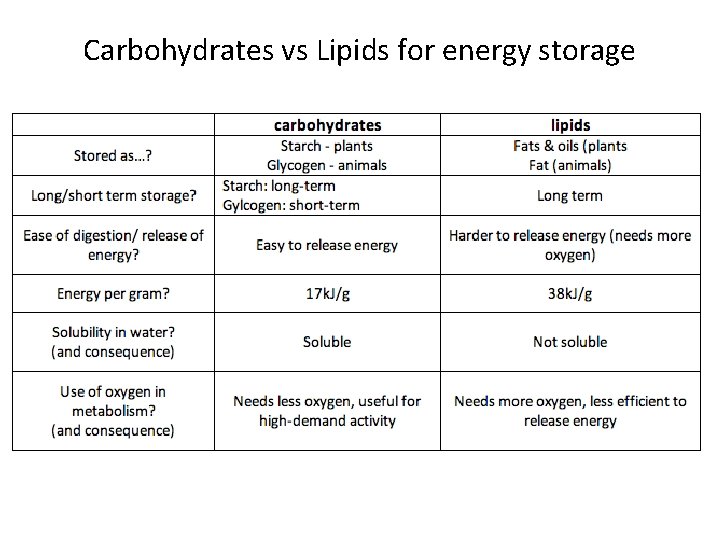
Carbohydrates vs Lipids for energy storage
2 MINUTE CONVO Which macromolecule would be more suitable for long term energy storage and why? 74
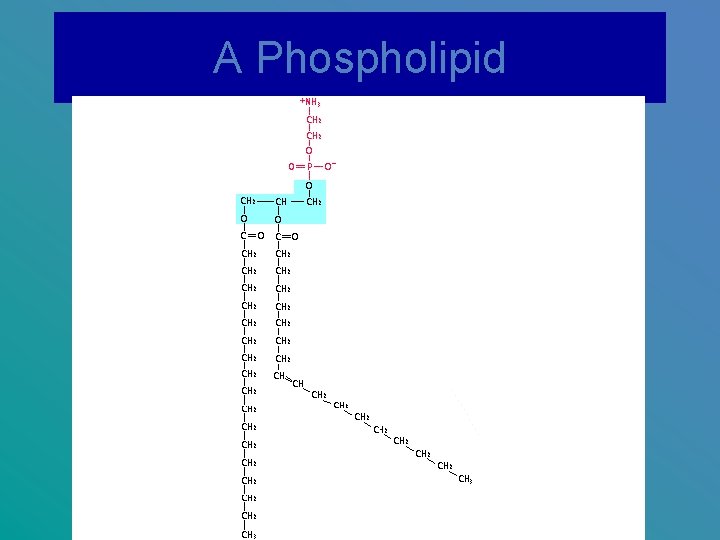
A Phospholipid
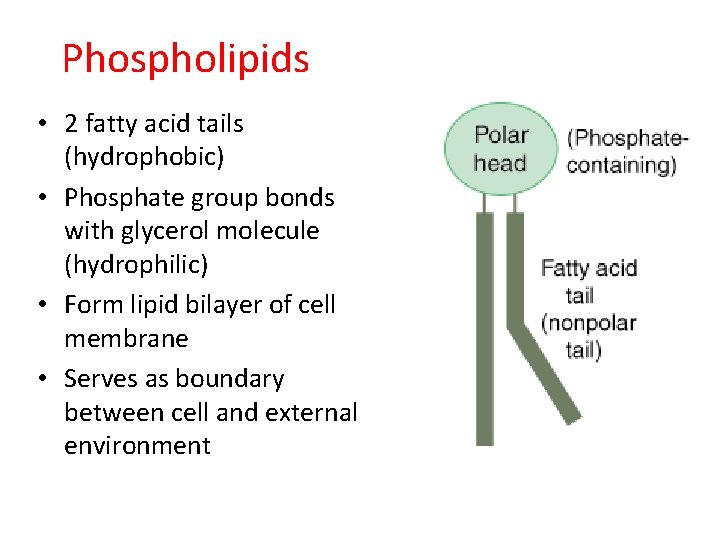
Phospholipids • 2 fatty acid tails (hydrophobic) • Phosphate group bonds with glycerol molecule (hydrophilic) • Form lipid bilayer of cell membrane • Serves as boundary between cell and external environment
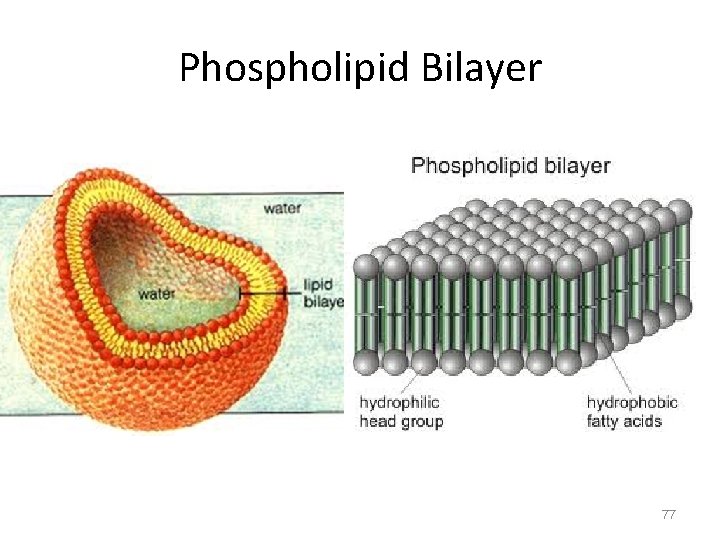
Phospholipid Bilayer 77
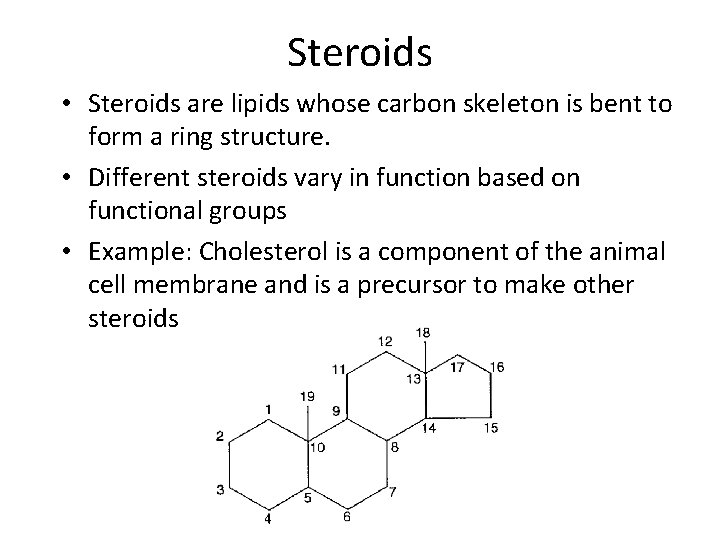
Steroids • Steroids are lipids whose carbon skeleton is bent to form a ring structure. • Different steroids vary in function based on functional groups • Example: Cholesterol is a component of the animal cell membrane and is a precursor to make other steroids
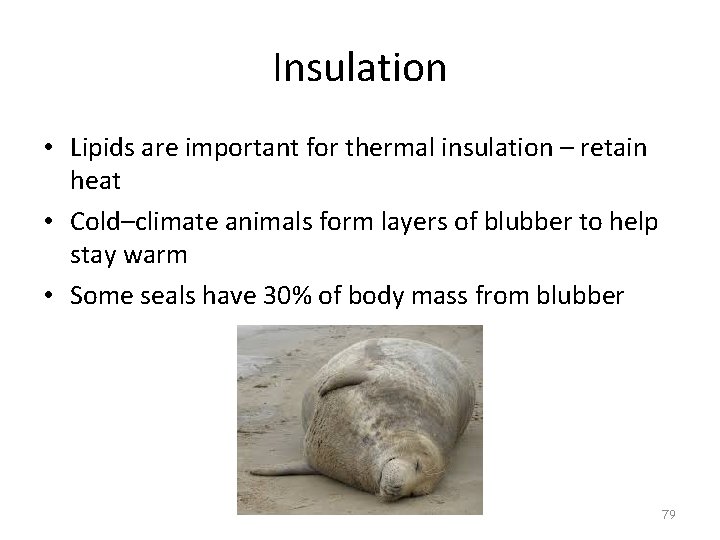
Insulation • Lipids are important for thermal insulation – retain heat • Cold–climate animals form layers of blubber to help stay warm • Some seals have 30% of body mass from blubber 79
What are some uses of lipids in living things?
2 minute convo • Discuss 3 different types of functions of lipids 81
IB BIO I • Lipids Worksheet • Can Use green textbook (page 40 -41) • May use mobile devices however, No GOOGLING the answer, use them to access Power. Point sides! • We will go over worksheet at end of class and it will be a grade! 82
What are some uses of lipids in living things?
Carbohydrates vs Lipids for energy storage
BIO BALL • In groups of 4, you will answer questions off of the review sheet at random. • Answers will be submitted at m. socrative. com or using the socrative app. Room 625580 • Must type answer in mobile device and submit. Be sure to include group name on answer or no points will be given • One mobile device per group. 85
BIO BALL - Scoring • The first group to submit the correct answer gets to choose the place where everyone will shoot from. • Can shoot from 1, 2, 3 points with handmade paper ball • May be times when referee (that’s me) decides there is a free choice round • Most points at end of the period wins (extra credit, or cookies) 86
BIO BALL - Guidelines • Must be calm and collected at all times, more like golf than basketball • Each person in the group must shoot before one person can shoot again • Make your own ball using one piece of paper and your body 87
Test Revisions/Corrections • Work with partners to answer the questions you missed correctly. (Assigned by me) • Must write out question you missed • Write correct answer completely • If partial points were given, still must rewrite entire answer to account for all points. 88
- Slides: 87