
BILL OF RIGHTS AMENDMENTS 1 10 AMENDMENT 1
BILL OF RIGHTS AMENDMENTS 1 -10
AMENDMENT 1 -FREEDOM OF RELIGION, ASSEMBLY, PRESS, PETITION, SPEECH. The 1 st Amendment sets out five basic liberties: The guarantees of freedom of religion is both a protection of religious thought and practice and a command of separation of church and state. The guarantees of freedom of speech and press assure to all persons a right to speak, publish and otherwise express their views. The guarantees of the rights of assembly and petition protect the right to join with others in public meetings, political parties, interest groups , and other associations to discuss public affairs and influence public policy. None of these rights is guaranteed in absolute terms, however; like all other civil rights guarantees, each of them may be exercised only with regard to the rights of all other persons.

AMENDMENT 2 – THE RIGHT TO BEAR ARMS. A well-regulated militia being necessary to the security of a free State, the right of the people to keep and bear Arms, shall not be infringed. Why do you think it was important for this amendment to be created? The right of the people to keep and bear arms was insured by the 2 nd Amendment.

AMENDMENT 3 – QUARTERING OF TROOPS No soldier shall, in time of peace be quartered in any house without the consent of the Owner, nor, in time of war, bit in a manner to be prescribed by law. This amendment was intended to prevent what had been common British practice in the colonial period; This provision is of virtually no importance today.
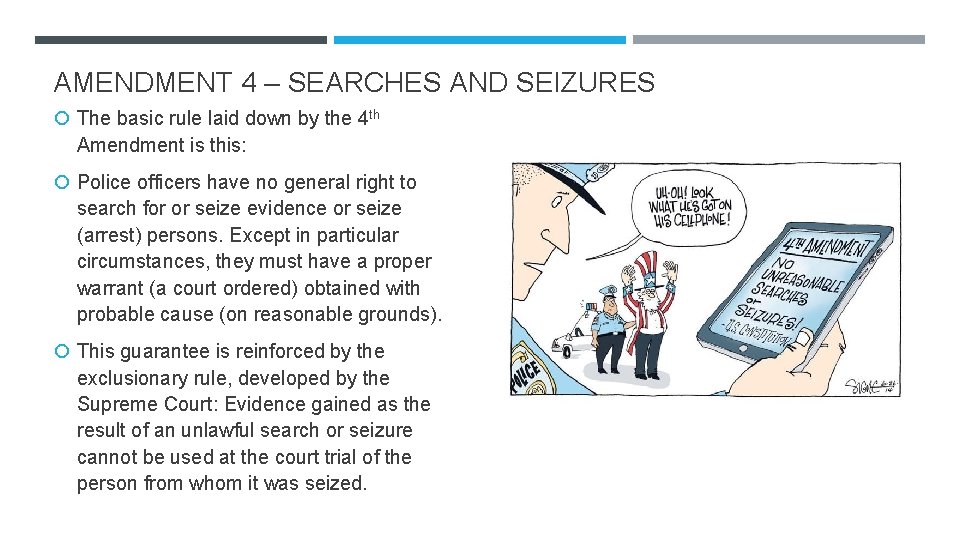
AMENDMENT 4 – SEARCHES AND SEIZURES The basic rule laid down by the 4 th Amendment is this: Police officers have no general right to search for or seize evidence or seize (arrest) persons. Except in particular circumstances, they must have a proper warrant (a court ordered) obtained with probable cause (on reasonable grounds). This guarantee is reinforced by the exclusionary rule, developed by the Supreme Court: Evidence gained as the result of an unlawful search or seizure cannot be used at the court trial of the person from whom it was seized.

AMENDMENT 5 CRIMINAL PROCEEDINGS; DUE PROCESS; EMINENT DOMAIN A person can be tried for a serious federal crime only if he or she has been indicted (charged, accused of that crime) by a grand jury. No one may be subjected to double jeopardy- that is , tried twice for the same crime. All persons are protected against self – incrimination; no person can be legally compelled to answer any question in any governmental proceeding if that answer could lead to that person’s prosecution. The 5 th Amendment’s Due Process Clause prohibits unfair, arbitrary actions by the Federal Government; a like prohibition is set out against the States in the 14 th Amendment. Government may take private property for a legitimate public purpose; but when it exercises that power of eminent domain, it must pay a fair price for the property seized.
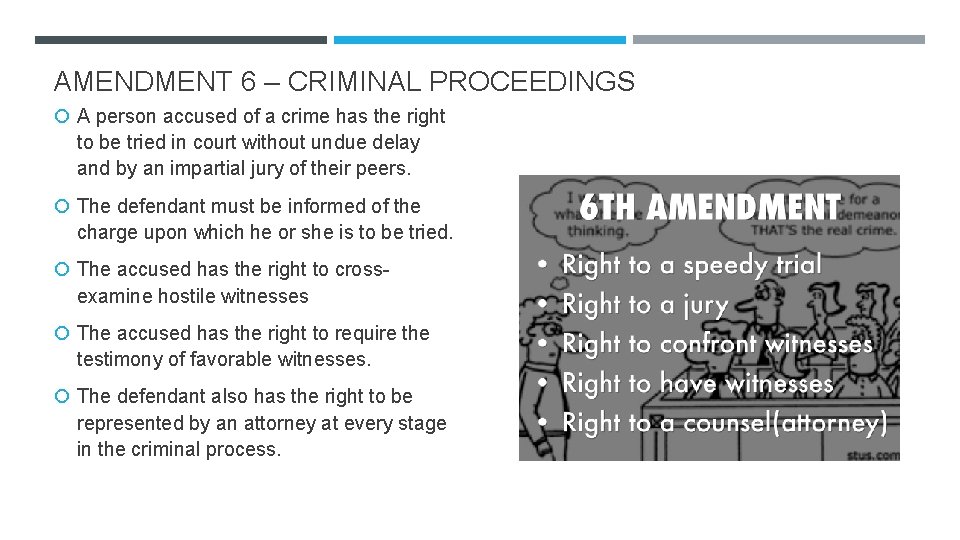
AMENDMENT 6 – CRIMINAL PROCEEDINGS A person accused of a crime has the right to be tried in court without undue delay and by an impartial jury of their peers. The defendant must be informed of the charge upon which he or she is to be tried. The accused has the right to cross- examine hostile witnesses The accused has the right to require the testimony of favorable witnesses. The defendant also has the right to be represented by an attorney at every stage in the criminal process.

AMENDMENT 7 – CIVIL TRIALS This amendment applies only to civil cases heard in federal courts. A civil case does not involve criminal matters; it is a dispute between private parties or between the government and a private party. The right to trial by jury is guaranteed in any civil case in a federal court if the amount of money involved in that case exceeds $20 (most cases today involve a mush larger sum); that right may be waived (relinquished, put aside) if both parties agree to a bench trial (a trial by a judge, without a jury). Examples of civil cases include: People suing for damages due to faulty products. They may have been injured and want payment for their medical bills and lost wages. To settle an argument over who owns a plot of land. A business suing another business to get money they owe. Workers who sue their employers for unsafe working conditions. Discrimination lawsuits. To determine damages and who was at fault in a car accident.
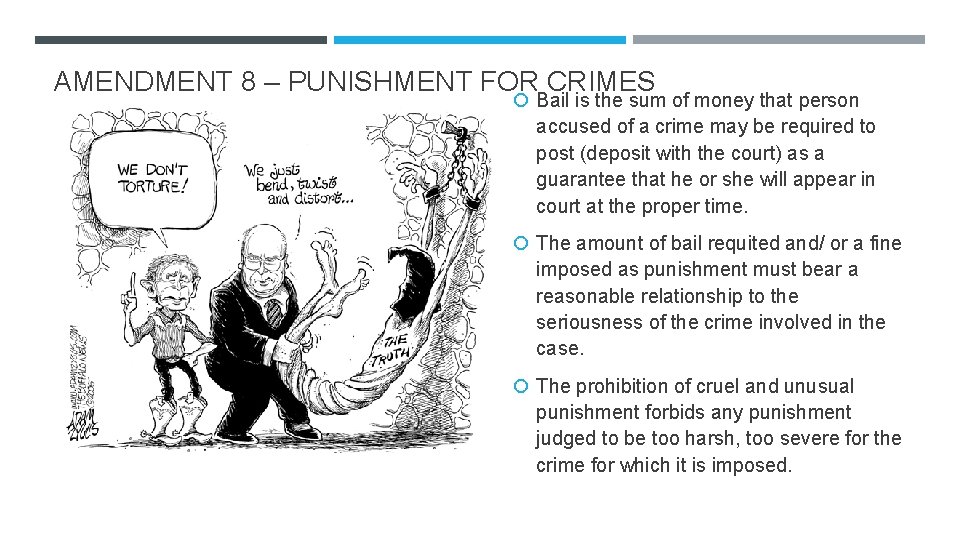
AMENDMENT 8 – PUNISHMENT FOR CRIMES Bail is the sum of money that person accused of a crime may be required to post (deposit with the court) as a guarantee that he or she will appear in court at the proper time. The amount of bail requited and/ or a fine imposed as punishment must bear a reasonable relationship to the seriousness of the crime involved in the case. The prohibition of cruel and unusual punishment forbids any punishment judged to be too harsh, too severe for the crime for which it is imposed.

AMENDMENT 9 – UNENUMERATED RIGHTS “deny or disparage others retained by the people" The enumeration in the Constitution, of certain rights, shall not be construed to deny or disparage others retained by the people. The fact that the Constitution sets out many civil rights guarantees, expressly provides for many protections against government, does not mean that there are not other rights also held by the people. The wording used in the Ninth Amendment can be confusing. Let's go through a few of the phrases: "enumeration in the Constitution, of certain rights" The word "enumeration" means an ordered or numbered list. So here they are referring to a "list of rights" in the Constitution. "shall not be construed" - The word "construed" means to "interpret the meaning of something". So this means something like "don't take this to mean. " This means that the government can't take away (deny or disparage) other rights of the people. If you put this together you get: Just because there is a list of rights in the Constitution, it doesn't mean that the government can take away other rights of the people that are not listed. The Ninth Amendment never lists exactly what rights are "retained by the people. " That's sort of the whole point of the amendment. Different people have different ideas as to what these rights may be. Can you think of some "rights" you think are still held by the people? Here a few examples: The right to eat junk food The right to a job The right to dye your hair green The right to clean drinking water
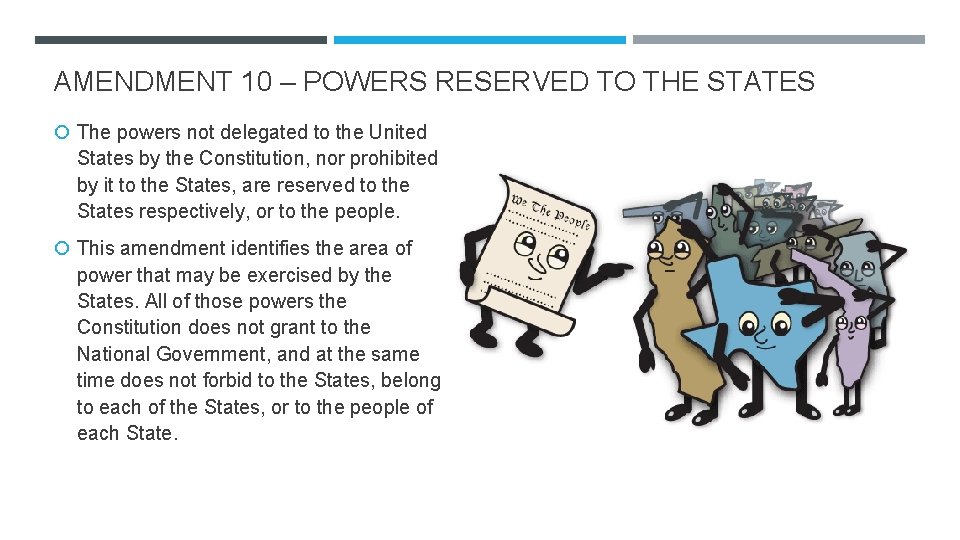
AMENDMENT 10 – POWERS RESERVED TO THE STATES The powers not delegated to the United States by the Constitution, nor prohibited by it to the States, are reserved to the States respectively, or to the people. This amendment identifies the area of power that may be exercised by the States. All of those powers the Constitution does not grant to the National Government, and at the same time does not forbid to the States, belong to each of the States, or to the people of each State.
Powers of the State Governments Powers of the Federal Government Some examples of powers of the federal government include: Some examples of state powers include: Traffic laws Raising and maintaining the armed forces Collecting local taxes Declaring war Issuing licenses such as driver's licenses Collecting taxes and marriage licenses Regulating commerce between the states Holding elections Coining and regulating money Regulating commerce within the state Setting standards of weights and measures Building and maintaining roads and Establishing a national bank Implied powers that are considered "necessary and proper" to carry out the laws in the Constitution. schools Police and fire departments Local business laws Regulating property use, ownership, and sales
- Slides: 12