
Bilinguals gestures Elena Nicoladis University of Alberta Speechgesture
Bilinguals’ gestures Elena Nicoladis University of Alberta
Speech-gesture system • Mc. Neill (1992) argued that “speech” should be called the speech-gesture system • Evidence: – Gestures mean the same things as co-occurring speech – Gestures are usually timed with similar meaning words – Aphasia affects gestures
Why gesture? • Maybe to organize our own thoughts – People remember more words when free to gesture than when not – Children gesture more when a task is difficult – Problem-solving can emerge earlier on the hands than in speech for children – People gesture when talking on the phone and to themselves
Why gesture? • Maybe to help the listener understand – People tend to gesture more with low frequency word combinations than high • Maybe both for ourselves and our listeners – Gesture may have as many functions as speech
Bilinguals’ gestures • Bilinguals often speak one language better – Gestures might compensate for weak proficiency (so, be for the listener) – Gestures might correspond to level of proficiency • Bilinguals might activate both languages at once all the time – Gesture rate might not be suppressed
Bilingual gestures: compensation? • Do bilinguals use more gestures with their weaker language to compensate for their weak proficiency? • One study with 4 French-English bilingual children showed that children did not gesture more in their weaker language (Nicoladis & Genesee, 1996)
But, there are different kinds of gestures • Iconic gestures – Symbolic, e. g. , walking or bird • Deictic gestures – Pointing, even abstractly • Conventional gestures – Culture-specific gestures like number gestures
Iconic gestures-speech • Mc. Neill’s studies refer exclusively to iconic gestures • Children start using deictic and conventional gestures before they speak but iconic gestures only after they speak • Maybe iconic gestures are more closely related to speech than deictic or conventional
First preschool study • Study with five French-English bilingual boys, videotaped every six months, once in French and once in English, at 2; 0, 2; 6, 3; 0 and 3; 6 • We transcribed their speech and coded their gestures
First preschool study • We found that: – The more iconic gestures they used, the longer their utterances in each language – This was not true for deictic and conventional gestures • Conclusion: iconic gestures strongly related to language development
Other evidence for kinds of gestures • Other studies of aphasia have shown that iconic gestures are lost but not necessarily deictic or conventional • As language loss occurs with aging, iconic gestures tend to get used less (no studies on conventional or deictic)
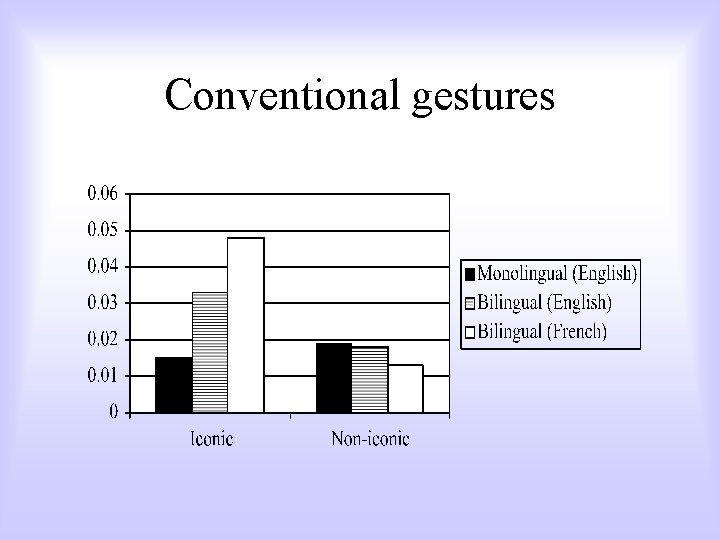
Second preschool study • 8 French-English bilingual children between 3 and 5 years • 4 were French-dominant and 4 were English -dominant • Videotaped once in French and once in English
Conventional gestures
Deictic gestures

Iconic gestures

Second preschool study • Children used more iconic gestures in their dominant language than their non-dominant language • Not true for conventional or deictic gestures • Children were more likely to use conventional or deictic gestures without speech when communicating in their weaker language
What about adults? • One study with French-Swedish intermediate L 2 learners showed that they used more iconic gestures in their L 1 and more deictic gestures in their L 2 (Gullberg, 1999)
Adult study • 13 Spanish-English bilinguals and 13 English-Spanish bilinguals; all late learners • All advanced bilinguals • Watched a cartoon and told back the story • Once in Spanish and once in English • We coded iconic and deictic gestures
Iconic gestures

Deictic gestures

Adult summary • Advanced bilinguals showed no difference in their two languages with iconic gestures • They did use more deictic gestures in their L 2
Interim conclusion • Different kinds of gestures relate to language differently – Iconic gestures strongly related to language – Deictic conventional gestures can compensate for weak proficiency • Maybe the iconic gestures help people to create longer utterances
Bilingual mode • Some researchers argue that bilinguals have both languages activated all the time (Grosjean, 2000) • This can explain how code-switching happens – As well as results of studies on language processing • To speak one language (“monolinugal” mode), the other language is suppressed
Gesturing in bilingual mode • What happens if a bilingual knows a high gesture language (like French or Spanish) and a low gesture language (like English)? • If they are in bilingual mode all the time, bilinguals might use a higher rate of gestures than English monolinguals • Because there is no need to suppress a high gesture rate
Adult study • • 10 English-Spanish bilinguals 10 French-English bilinguals 10 English monolinguals All watched a cartoon and told the story back • The bilinguals did this twice, once in each language
Results in English

L 1 vs L 2

Summary of results • Both French-English and English-Spanish bilinguals gesture more than English monolinguals in English • Here there was no difference between the rate of gestures in L 1 and L 2 • Maybe bilinguals do not suppress the high gesture rate of a high gesture language, even when speaking a low gesture language
Bilingual mode for preschoolers? • Even bilingual children are thought to be in bilingual mode all the time (Grosjean, 2000) so these same results should hold for children • This study: 10 French-English simultaneous bilinguals between 4 and 6 years and 10 English monolinguals of the same age
Results

Bilingual mode conclusions • These results support the idea that bilinguals do not suppress a high gesture rate when speaking English • Note that we cannot rule out an alternative explanation – Bilinguals gesture more than monolinguals because they have more word finding difficulty • We need other monolingual comparisons
Conclusions • Bilinguals’ gesture use shows that iconic gestures and speech are strongly related – They are used more often with greater proficiency – They are borrowed from a high gesture language • Other kinds of gestures may compensate for weak proficiency
Conclusions • Language is not just the spoken component • Gesturing appropriately for a culture is part of one’s linguistic knowledge: – Conventional counting gestures – Gender differences in Chinese L 1 learners of English AND gesture differences
Acknowledgements • • Paula Marentette Simone Pika Jody Sherman Natasha Tuck
- Slides: 42