
Bilingualism and Multilingualism JOCELYN MARZAN UNIVERSITY OF THE

Bilingualism (and Multilingualism) JOCELYN MARZAN UNIVERSITY OF THE PHILIPPINES - MANILA
OUTLINE (53 slides) 2016 -07 -24 of Bilingualism Parameters of Language Affected by Bilingualism Bilingual Processing and Language Learning Thinking Through Clinical Issues in the Philippine Setting JCBMarzan _ Bilingualism _ PASP National Convention: Beyond Borders Characteristics 2
General Comments 2016 -07 -24 of the world is in some way bilingual Every language reflects a culture Flexibility derived from bilingualism JCBMarzan _ Bilingualism _ PASP National Convention: Beyond Borders 2/3 3
General Comments = variations of a language; “ 80 -90%” comprehensible to speakers of other varieties of the same language (Singaporean English, Australian English, American English, Filipino English) Languages = mutually incomprehensible, perhaps despite similar roots (e. g. French/Spanish/Portuguese/Italian, Tagalog/Ilocano/Cebuano, Mandarin/Hookien/Tae Chew, etc. ) 2016 -07 -24 Dialect vs dialects JCBMarzan _ Bilingualism _ PASP National Convention: Beyond Borders Languages 4
5 2016 -07 -24 JCBMarzan _ Bilingualism _ PASP National Convention: Beyond Borders Characteristics of Bilingualism
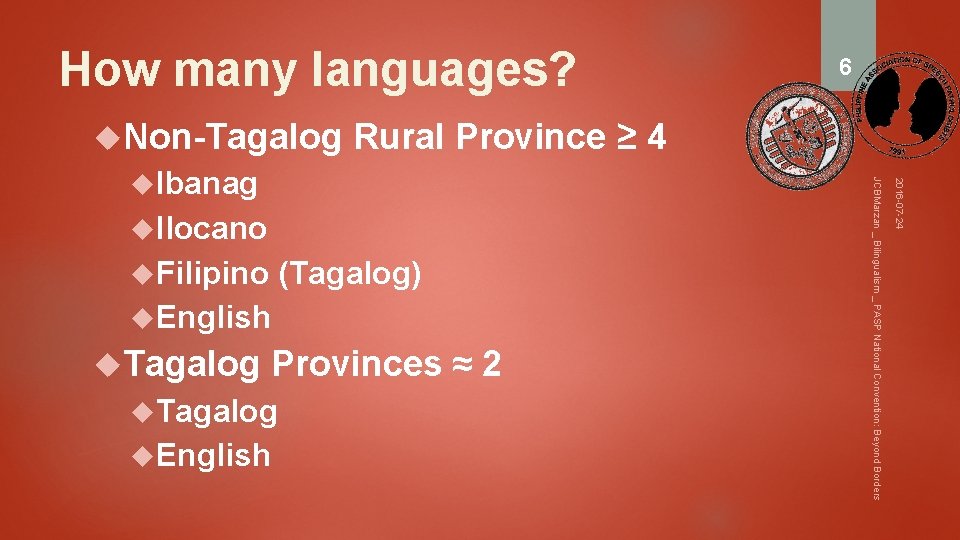
How many languages? Non-Tagalog Rural Province ≥ 4 (Tagalog) English Tagalog Provinces ≈ 2 Tagalog English 2016 -07 -24 Ilocano JCBMarzan _ Bilingualism _ PASP National Convention: Beyond Borders Ibanag Filipino 6
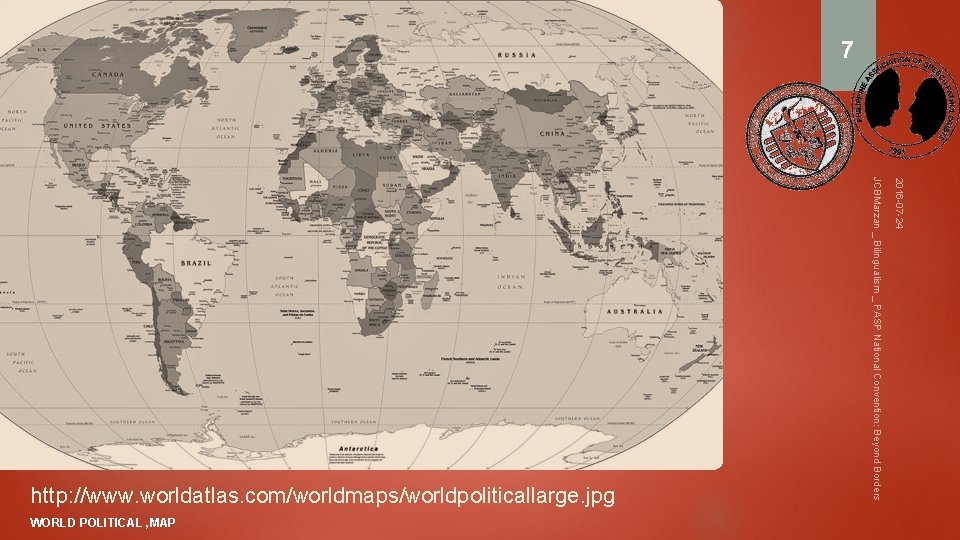
7 2016 -07 -24 WORLD POLITICAL , MAP JCBMarzan _ Bilingualism _ PASP National Convention: Beyond Borders http: //www. worldatlas. com/worldmaps/worldpoliticallarge. jpg
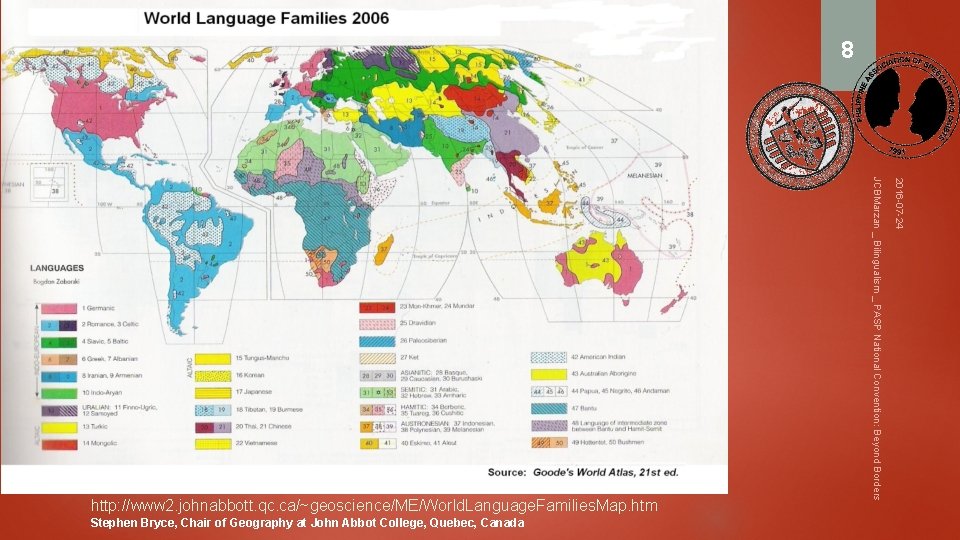
8 2016 -07 -24 Stephen Bryce, Chair of Geography at John Abbot College, Quebec, Canada JCBMarzan _ Bilingualism _ PASP National Convention: Beyond Borders http: //www 2. johnabbott. qc. ca/~geoscience/ME/World. Language. Families. Map. htm
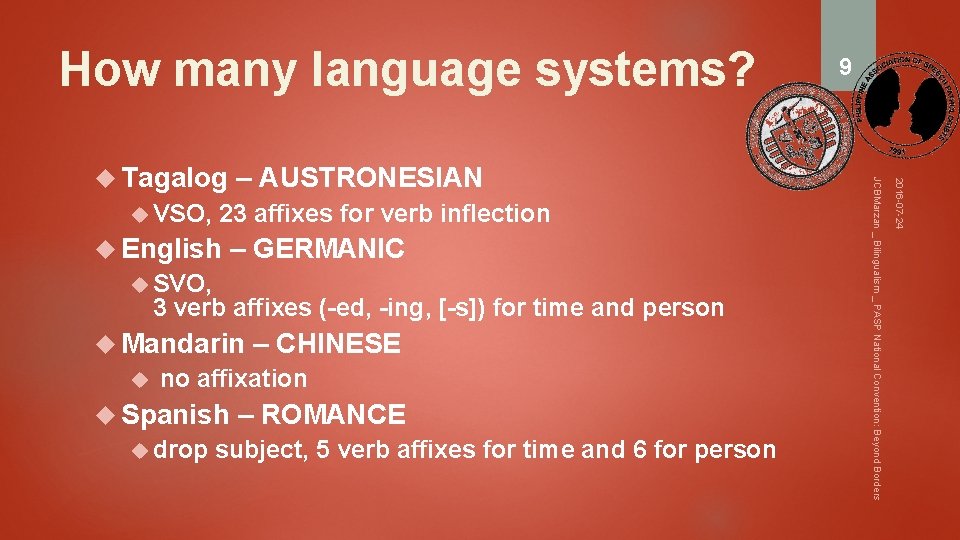
How many language systems? 23 affixes for verb inflection English – GERMANIC SVO, 3 verb affixes (-ed, -ing, [-s]) for time and person Mandarin – CHINESE no affixation Spanish drop – ROMANCE subject, 5 verb affixes for time and 6 for person 2016 -07 -24 VSO, – AUSTRONESIAN JCBMarzan _ Bilingualism _ PASP National Convention: Beyond Borders Tagalog 9
Learned when and where? Temporal order – both before 3 yo = BFLA [cities] Contexts – both learned in same contexts? Coordinate bilingualism – yes; translational equivalents Compound bilingualism – no; distinct lexicon and function of bilingual education policies 2016 -07 -24 Simultaneous JCBMarzan _ Bilingualism _ PASP National Convention: Beyond Borders Sequential = L 1, l 2 [provinces] Impact 10
Potential Impact on Code Mixing 2016 -07 -24 & Coordinate constant code mixing for optimal expressions Simultaneous & Compound code mixing due to lack of equivalent lexicon JCBMarzan _ Bilingualism _ PASP National Convention: Beyond Borders Simultaneous 11
How learned? 12 MODE OF ACQUISITION Formal learning of rules instruction Explicit learning of rules Language interference (interlanguage) 2016 -07 -24 Implicit (usually prior to puberty) JCBMarzan _ Bilingualism _ PASP National Convention: Beyond Borders Immersion
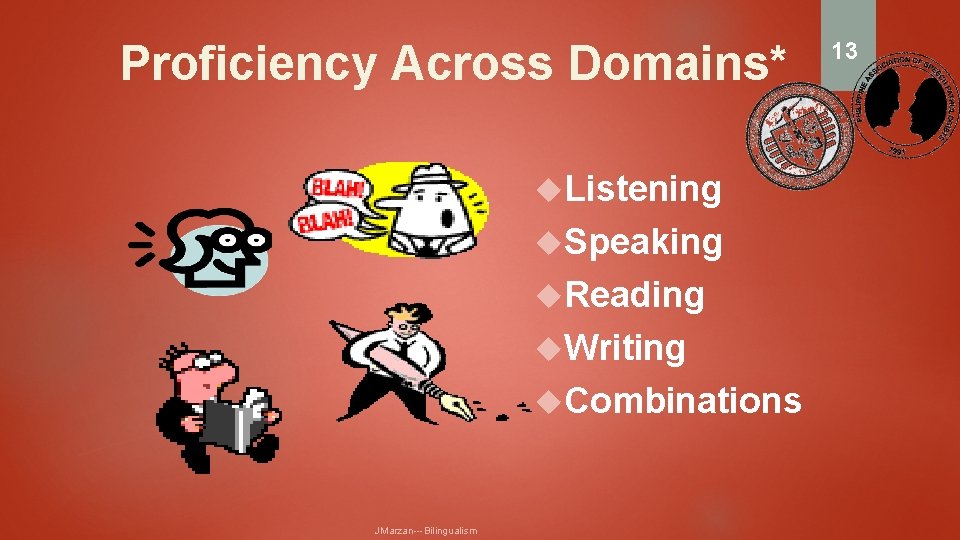
Proficiency Across Domains* Listening Speaking Reading Writing Combinations JMarzan---Bilingualism 13
Relative Proficiency* 2012 07 06 JMarzan---Bilingualism Passive Dominant Balanced Equi- or Ambilingual 14
Language Dominance Measure Frequency of use Context of use, etc 2016 -07 -24 Priming JCBMarzan _ Bilingualism _ PASP National Convention: Beyond Borders of relative proficiency in a language, capturing how much one knows about one language relative to the other (Anaya et al 2016) VS Function of current situation 15
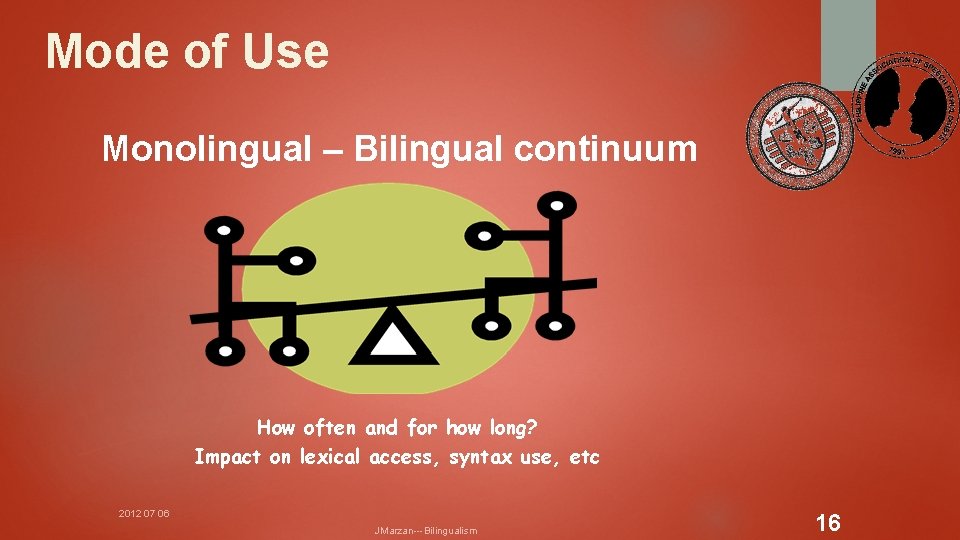
Mode of Use Monolingual – Bilingual continuum How often and for how long? Impact on lexical access, syntax use, etc 2012 07 06 JMarzan---Bilingualism 16
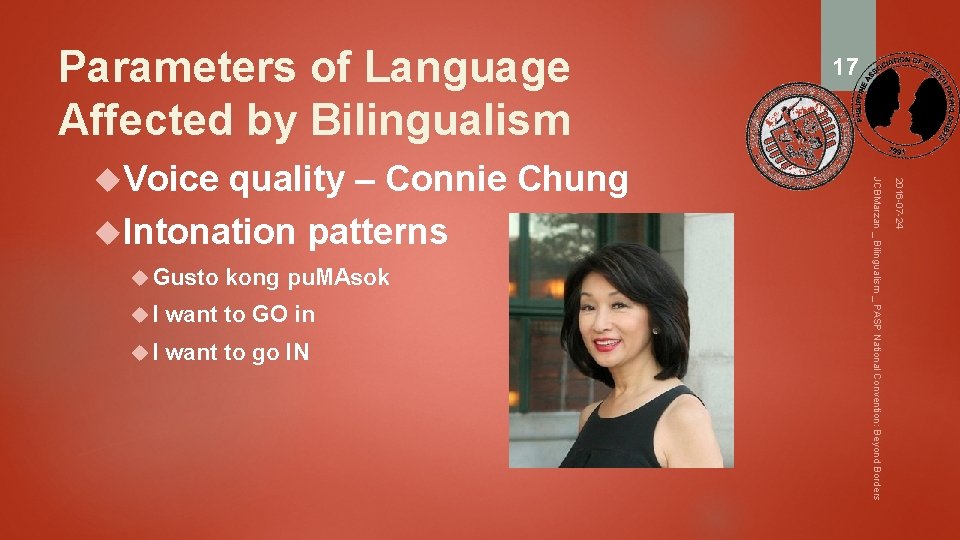
Parameters of Language Affected by Bilingualism Gusto kong pu. MAsok I want to GO in I want to go IN 2016 -07 -24 quality – Connie Chung Intonation patterns JCBMarzan _ Bilingualism _ PASP National Convention: Beyond Borders Voice 17
Parameters of Language Affected by Bilingualism space Treatment of clusters Peruvian Korean Presence of fricatives – f p 2016 -07 -24 Vowel JCBMarzan _ Bilingualism _ PASP National Convention: Beyond Borders Phonology 18
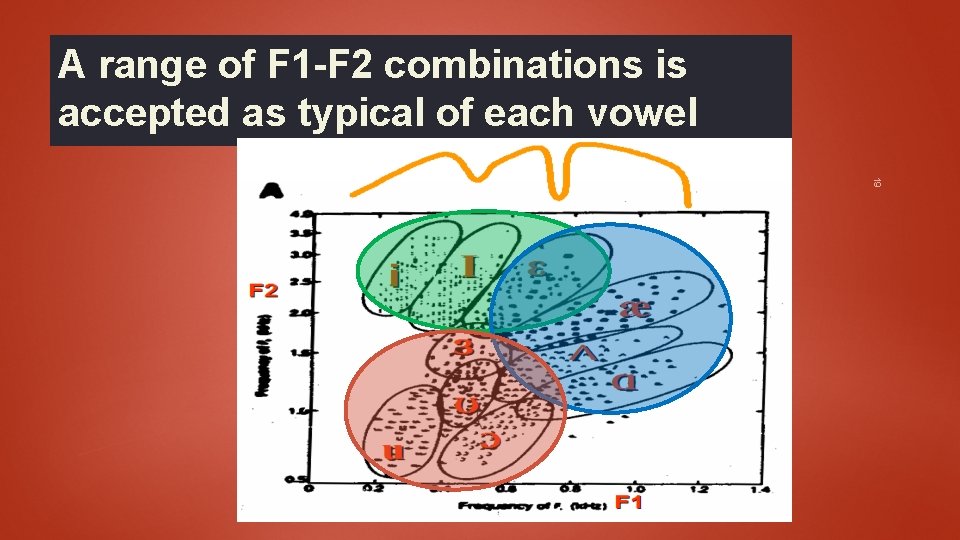
A range of F 1 -F 2 combinations is accepted as typical of each vowel 19
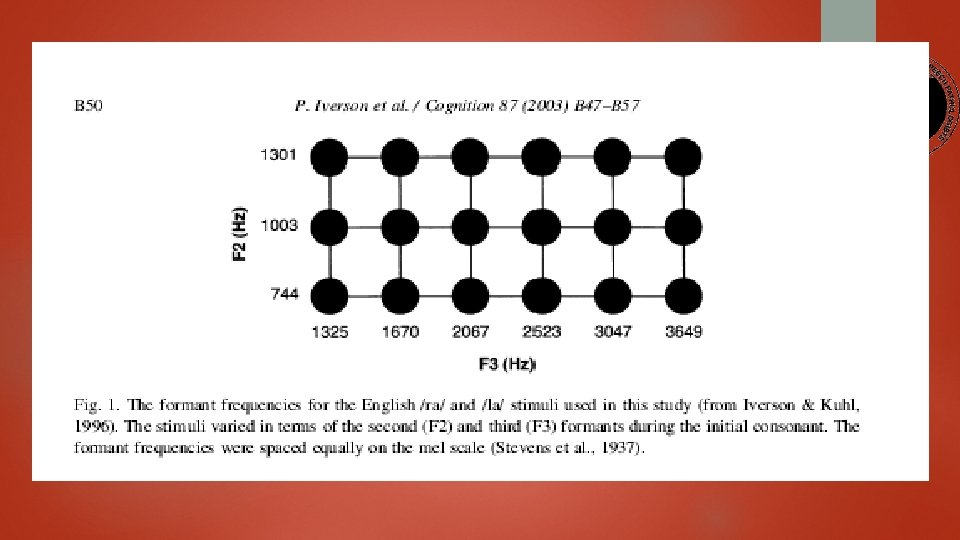
20 16 Oct 2003 Iverson et al 2003 JM
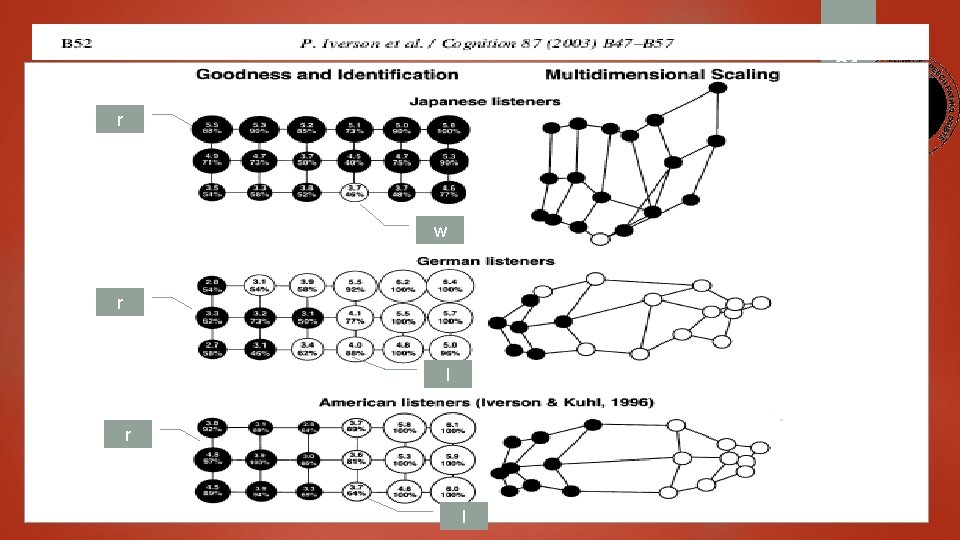
21 r 16 Oct 2003 Iverson et al 2003 JM w r l
Parameters of Language Affected by Bilingualism Idioms Syntax – word order, affixation, etc. Pragmatics – Ma’am, wait for prompt before making comment 2016 -07 -24 Lexicon JCBMarzan _ Bilingualism _ PASP National Convention: Beyond Borders Semantics 22
23 2016 -07 -24 JCBMarzan _ Bilingualism _ PASP National Convention: Beyond Borders Bilingual Processing and Language Learning
Mother Language Education Some 24 evidence, but not rigorous Learning how to learn in the language that they know (with educational materials and support) Learning the future medium of instruction Using the new medium 2016 -07 -24 Decker – madrasa schools Dina Ocampo – impact on reading JCBMarzan _ Bilingualism _ PASP National Convention: Beyond Borders Diane
Language Tagging 2016 -07 -24 word then per language vs per language then per word Mommy in French, Daddy in English vs simultaneous code mixing “Ano ito [kutsara] sa English? ” JCBMarzan _ Bilingualism _ PASP National Convention: Beyond Borders Per 25
Code Switching and Mixing Intra sentential – Kakain ako ng ice cream Intra word – mag-i-ice cream ako (nagcollege, gumraduate) Rules of code mixing Base language of code mixing 2016 -07 -24 Switch – between sentences, or to different persons Code mixing JCBMarzan _ Bilingualism _ PASP National Convention: Beyond Borders Code 26
http: //www. gov. ph/2013/05/15/republic-act-no-10533/ 27 Basic education shall be delivered in languages understood by the learners as the language plays a strategic role in shaping the formative years of learners. 2016 -07 -24 For purposes of this Act, mother language or first Language (LI) refers to language or languages first learned by a child, which he/she identifies with, is identified as a native language user of by others, which he/she knows best, or uses most. This includes Filipino sign language used by individuals with pertinent disabilities. The regional or native language refers to the traditional speech variety or variety of Filipino sign language existing in a region, area or place. JCBMarzan _ Bilingualism _ PASP National Convention: Beyond Borders For kindergarten and the first three (3) years of elementary education, instruction, teaching materials and assessment shall be in the regional or native language of the learners. The Department of Education (Dep. ED) shall formulate a mother language transition program from Grade 4 to Grade 6 so that Filipino and English shall be gradually introduced as languages of instruction until such time when these two (2) languages can become the primary languages of instruction at the secondary level.
BUILDING PROFICIENCY THROUGH LANGUAGE (MOTHER TONGUE-BASED MULTILINGUAL EDUCATION) 28 HTTP: //WWW. GOV. PH/K-12/ Aside from the Mother Tongue, English and Filipino are taught as subjects starting Grade 1, with a focus on oral fluency. From Grades 4 to 6, English and Filipino are gradually introduced as languages of instruction. Both will become primary languages of instruction in Junior High School (JHS) and Senior High School (SHS). After Grade 1, every student can read in his or her Mother Tongue. Learning in Mother Tongue also serves as the foundation for students to learn Filipino and English easily. 2016 -07 -24 Students are able to learn best through their first language, their Mother Tongue (MT). Twelve (12) MT languages have been introduced for SY 2012 -2013: Bahasa Sug, Bikol, Cebuano, Chabacano, Hiligaynon, Iloko, Kapampangan, Maguindanaoan, Meranao, Pangasinense, Tagalog, and Waray. Other local languages will be added in succeeding school years. JCBMarzan _ Bilingualism _ PASP National Convention: Beyond Borders
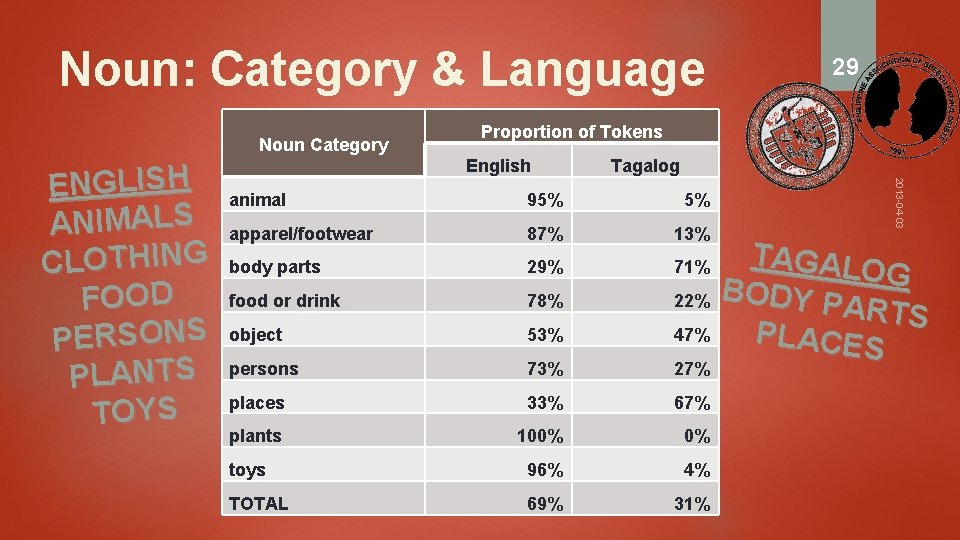
Noun: Category & Language Noun Category Proportion of Tokens English Tagalog animal 95% 5% apparel/footwear 87% 13% body parts 29% 71% food or drink 78% 22% object 53% 47% persons 73% 27% places 33% 67% plants 100% 0% toys 96% 4% TOTAL 69% 31% 2013 -04 -03 ENGLISH ANIMALS CLOTHING FOOD PERSONS PLANTS TOYS 29 TAGALO G BODY P ARTS PLACES
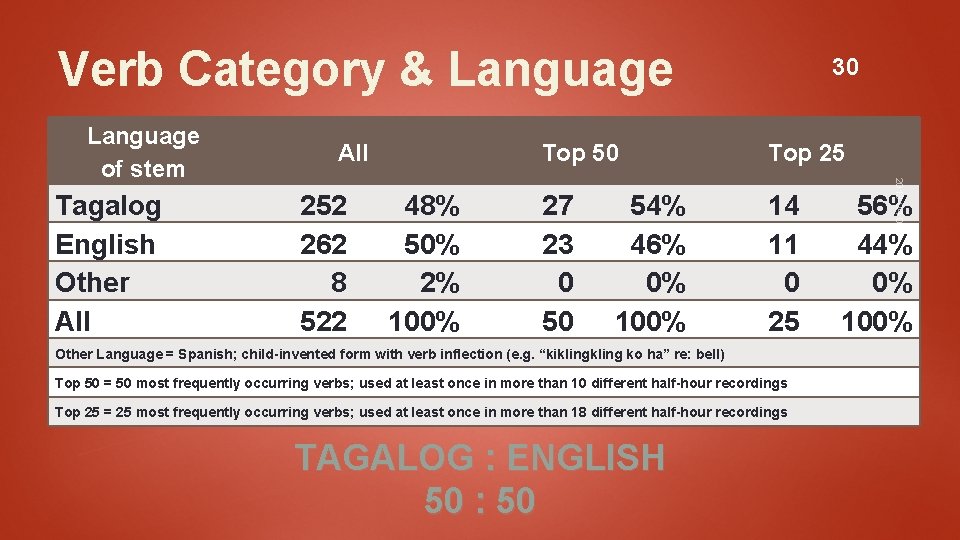
Verb Category & Language Tagalog English Other All 252 262 8 522 48% 50% 2% 100% Top 50 Top 25 27 23 0 50 14 11 0 25 54% 46% 0% 100% Other Language = Spanish; child-invented form with verb inflection (e. g. “kikling ko ha” re: bell) Top 50 = 50 most frequently occurring verbs; used at least once in more than 10 different half-hour recordings Top 25 = 25 most frequently occurring verbs; used at least once in more than 18 different half-hour recordings TAGALOG : ENGLISH 50 : 50 2013 -04 -03 Language of stem 30 56% 44% 0% 100%
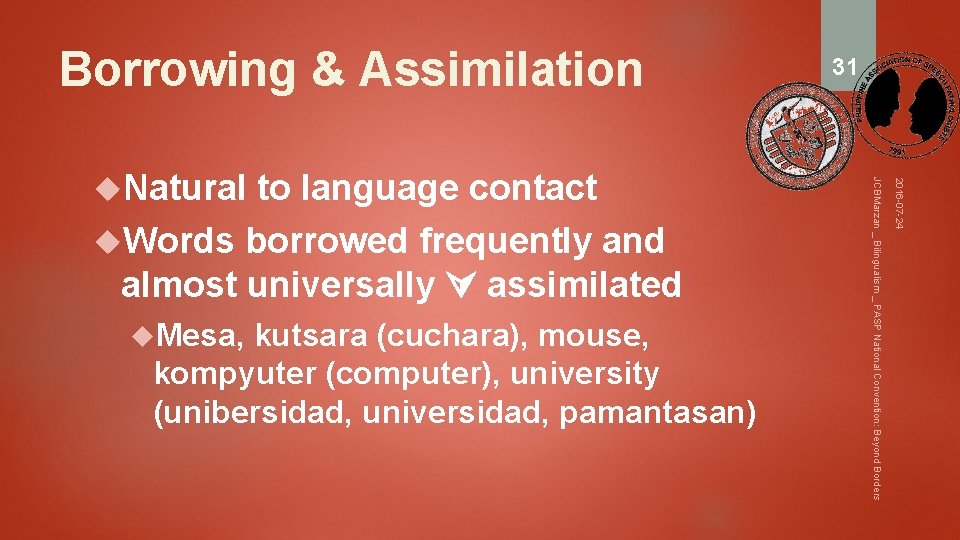
Borrowing & Assimilation Mesa, kutsara (cuchara), mouse, kompyuter (computer), university (unibersidad, universidad, pamantasan) 2016 -07 -24 to language contact Words borrowed frequently and almost universally assimilated JCBMarzan _ Bilingualism _ PASP National Convention: Beyond Borders Natural 31

32 2016 -07 -24 JCBMarzan _ Bilingualism _ PASP National Convention: Beyond Borders Thinking Through Clinical Issues in the Philippine Setting

Psychometrics Notion of pakikipagkapwa (personality) Notion of tolerance of variability in verbal expression? 2016 -07 -24 of test development and test adaptation NOT translation For example: JCBMarzan _ Bilingualism _ PASP National Convention: Beyond Borders Notions 33
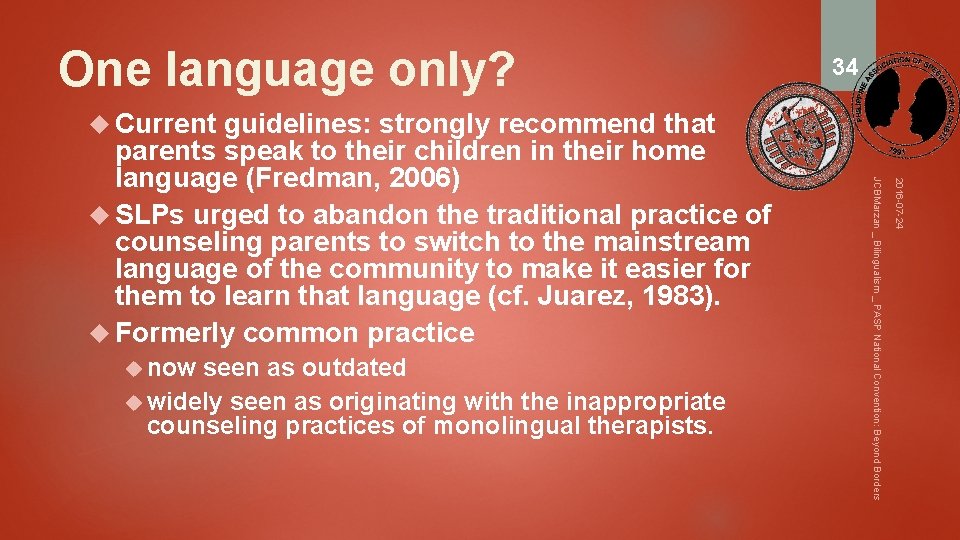
One language only? Current seen as outdated widely seen as originating with the inappropriate counseling practices of monolingual therapists. 2016 -07 -24 now JCBMarzan _ Bilingualism _ PASP National Convention: Beyond Borders guidelines: strongly recommend that parents speak to their children in their home language (Fredman, 2006) SLPs urged to abandon the traditional practice of counseling parents to switch to the mainstream language of the community to make it easier for them to learn that language (cf. Juarez, 1983). Formerly common practice 34
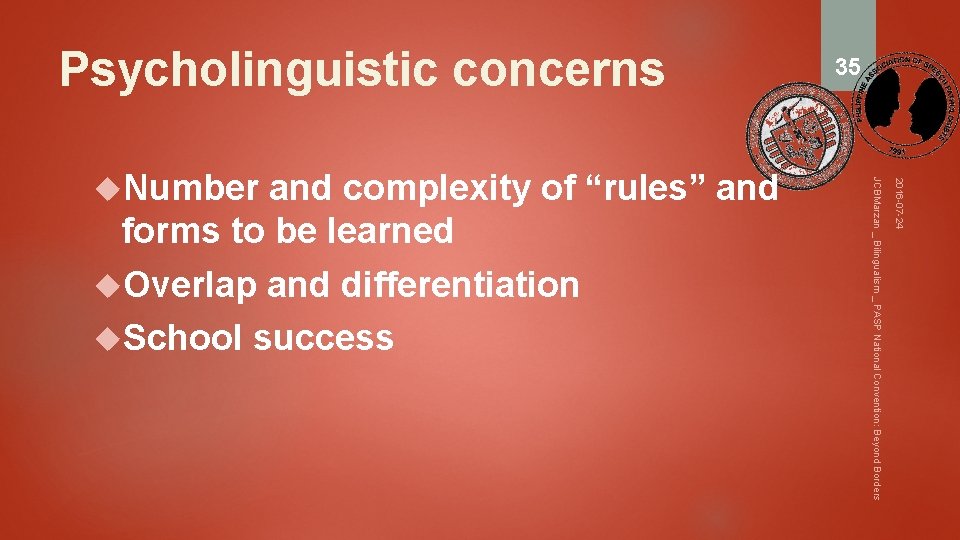
Psycholinguistic concerns 2016 -07 -24 and complexity of “rules” and forms to be learned Overlap and differentiation School success JCBMarzan _ Bilingualism _ PASP National Convention: Beyond Borders Number 35
Sociolinguistic Considerations 2016 -07 -24 by bilingualism – making it possible for them to rise to this challenge Use of mother tongue for personal relationships Loss of contact with relatives who do not speak a language JCBMarzan _ Bilingualism _ PASP National Convention: Beyond Borders Surrounded 36
37 MCGILL UNIVERSITY, MONTRÉAL, QUÉBEC, CANADA 2016 -07 -24 Mono- or Bilingual Intervention for Primary Language Impairment (PLI) JCBMarzan _ Bilingualism _ PASP National Convention: Beyond Borders Thordardottir et al 2015
Careful experimental controls Pre and post vocabulary & MLUw Reliability measures transcription, coding of MLUw, etc 2016 -07 -24 assignment to treatment conditions A no-treatment control group Blinded assessment JCBMarzan _ Bilingualism _ PASP National Convention: Beyond Borders Random 38
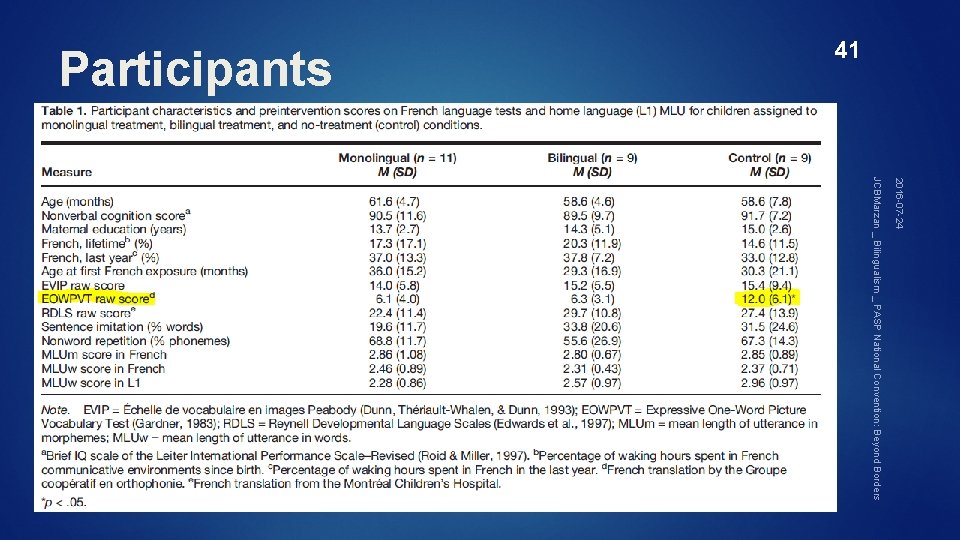
Participants Arabic =1 Bangla = 1 Bengali = 3 Chinese = 2 Dutch =1 English - 1 Japanese = 1 Kabyl = 1 Punjabi/Urdu = 8 Russian = 2 Sinhalese = 1 Spanish = 4 Tamil + 3 2016 -07 -24 primary language impairment (PLI aka SLI) as diagnoses by SLP speak a minority native language JCBMarzan _ Bilingualism _ PASP National Convention: Beyond Borders have 39
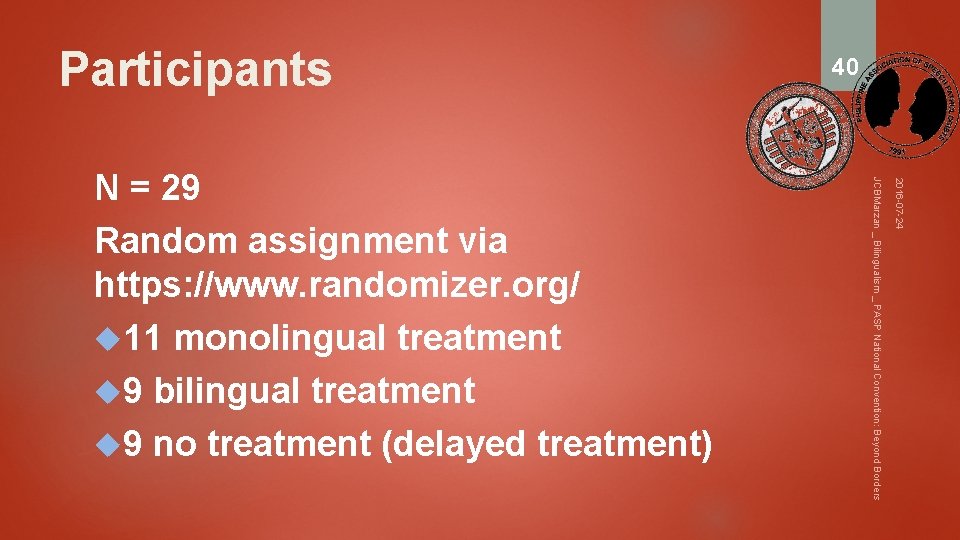
Participants 2016 -07 -24 JCBMarzan _ Bilingualism _ PASP National Convention: Beyond Borders N = 29 Random assignment via https: //www. randomizer. org/ 11 monolingual treatment 9 bilingual treatment 9 no treatment (delayed treatment) 40
Participants 41 2016 -07 -24 JCBMarzan _ Bilingualism _ PASP National Convention: Beyond Borders
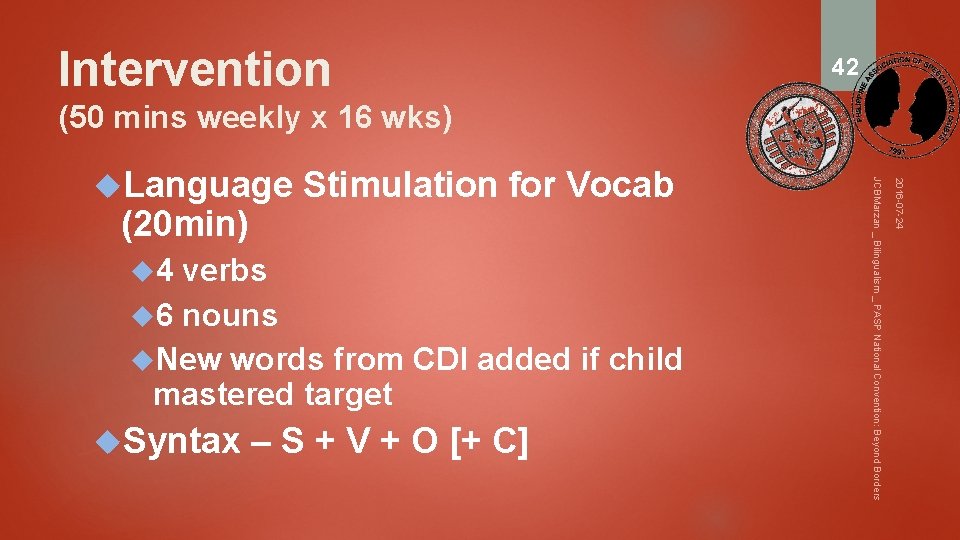
Intervention 42 (50 mins weekly x 16 wks) 4 verbs 6 nouns New words from CDI added if child mastered target Syntax – S + V + O [+ C] 2016 -07 -24 (20 min) Stimulation for Vocab JCBMarzan _ Bilingualism _ PASP National Convention: Beyond Borders Language
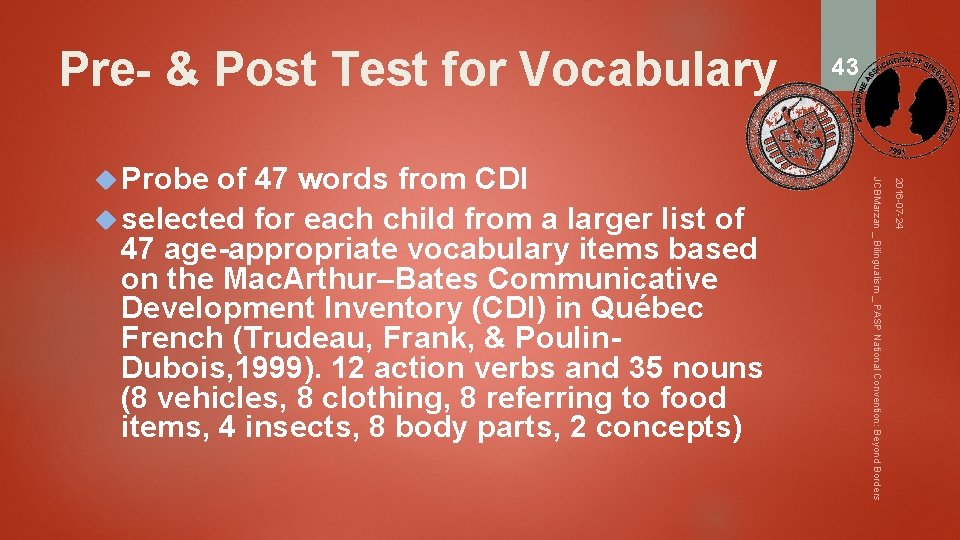
Pre- & Post Test for Vocabulary 2016 -07 -24 of 47 words from CDI selected for each child from a larger list of 47 age-appropriate vocabulary items based on the Mac. Arthur–Bates Communicative Development Inventory (CDI) in Québec French (Trudeau, Frank, & Poulin. Dubois, 1999). 12 action verbs and 35 nouns (8 vehicles, 8 clothing, 8 referring to food items, 4 insects, 8 body parts, 2 concepts) JCBMarzan _ Bilingualism _ PASP National Convention: Beyond Borders Probe 43
Pre & Post-test for Syntax 2016 -07 -24 JCBMarzan _ Bilingualism _ PASP National Convention: Beyond Borders Story retell – 2 equivalent stories 21 sentences (existence, action, locative action (bringing), locative state (being somewhere), possession, and quantity ( plural). Each sentence = 2 -4 constituents (reference, subject, verb, direct object, indirect object, location adverbial). Wordless picture books (Man’s Work and Baby Sitter, both by Annie Kubler, 1999 a, 1999 b) 44
Pre & Post-test for Syntax Not = Claire verse du lait pour Marie (Claire pours milk for Marie) Response = Claire met du lait (Claire puts milk) 2016 -07 -24 Target JCBMarzan _ Bilingualism _ PASP National Convention: Beyond Borders sentence imitation, hence gave 1 point for each sentence constituent that they included (e. g. , agent, action), even if paraphrasing occurred Ignored as morphological errors if the meaning was still clear. E. g. 3 out of 4 possible points 45
Intervention only (L 2); parent watch Bilingual French and L 1; parent taught to provide stimulation, joined in session with SP No therapy delayed until completed 16 weeks 2016 -07 -24 French JCBMarzan _ Bilingualism _ PASP National Convention: Beyond Borders Monolingual 46
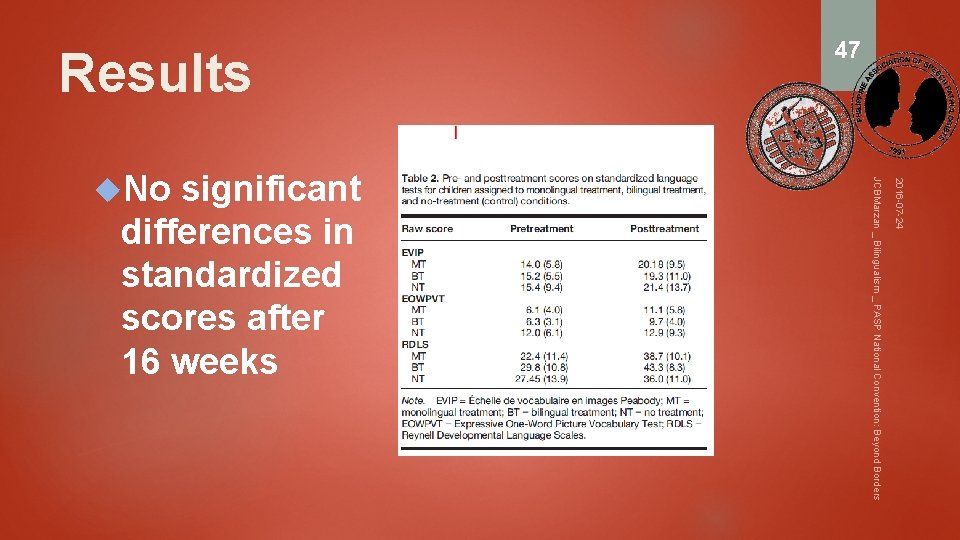
Results 2016 -07 -24 JCBMarzan _ Bilingualism _ PASP National Convention: Beyond Borders significant differences in standardized scores after 16 weeks No 47
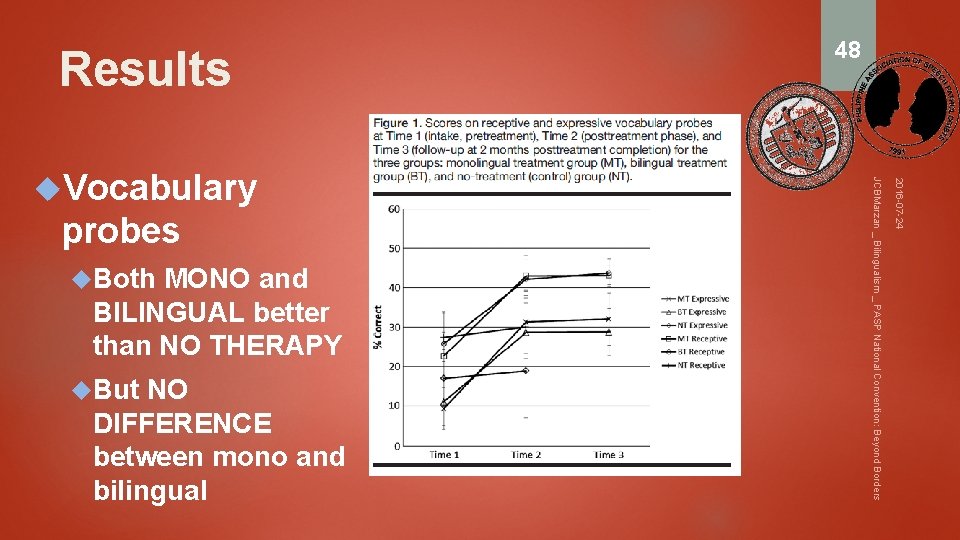
Results Both MONO and BILINGUAL better than NO THERAPY But NO DIFFERENCE between mono and bilingual 2016 -07 -24 probes JCBMarzan _ Bilingualism _ PASP National Convention: Beyond Borders Vocabulary 48
References Fredman, M. (2006). Recommendations for working with bilingual children—Prepared by the Multilingual Affairs Committee of IALP. Folia Phoniatrica et Logopaedica, 58, 458– 464. Grosjean F (1998) Studying bilinguals: Methodological and conceptual issues. Bilingualism: Language and Cognition. 1, 131 -149. Hakuta, K (1998? ). Paper presented at a working conference convened by the Centro de Estudios sobre Bilinguismo in San Juan, Puerto Rico, May 4&5, 2001. Holowka S, Brosseau-Lapre, F and LA Petitto (2002). Semantic and conceptual knowledge underlying bilingual babies’ first signs and words. Language and Learning. 52 (2), 205 -262. Nakada, . Yukihiko F and I Kwee (2001). Brain strategies for reading in the second language are determined by the first language. Neuroscience Research. 40, 351 -358. Sadlak, J (2000). Address at the opening of the UNESCO-European Centre for Higher Education. Summer Institute of Linguistics (SIL) International. Ethnologue report for the Philippines. Accessed at http: //www. ethnologue. com Von Hapsburg D and Pena ED (2002). Understanding bilingualism and its impact on speech audiometry. JSLHR. 45, 202 -213 2012 07 06 Flege JE, Yeni-Komshian GH and S Liu (1999). Age constraints on second-language acquisition. Journal of Memory and Language. 41, 78 -104. JMarzan---Bilingualism Dijkstra T and Van Heuven WJB (2002). The architecture of the bilingual word recognition system: From identification to decision. Bilingualism: Language and Cognition. 5 (3), 175 -197. 49
Baker, Colin (2001) Foundations of Bilingual Education and Bilingualism (3 rd ed). Buffalo: Multilingual Matters Ltd. Carson, Arthur Leroy (1978). The Story of Philippine Education. Quezon City: New Day Publishers. Central Intelligence Agency. Asia Maps. Perry Catañeda Library Map Collection. The University of Texas at Austin. Accessed at http: //www. lib. utexas. edu/maps/middle_east_and_asia/asia_ref 01. pdf on 12/2/2002. Cheng, Winston, Tricia Olea and Jocelyn Marzan (2002) Speech-Language Pathology in the Philippines: Reflections on the Past and Present, Perspectives for the Future. Folia Phoniatrica at Logopedica 54: 79 -82. Dekker, p. Gregory (1999). First language component literacy: a bridge over troubled waters. Paper presented to the Centennial Congress in Bilingualism. Manila, January 1999. Department of Education, Culture and Sports [DECS of the Republic of the Philippines] (1974) Department Order No. 25, s. 1974: Implementing Guidelines for the Policy on Bilingual Education. Department of Education, Culture and Sports [DECS of the Republic of the Philippines] (1987) Order No. 52, s. 1987: The 1987 Policy on Bilingual Education. Gonzales, Andres and Sibayan, Bonifacio P (Eds. )(1988). Evaluating Bilingual Education in the Philippines (1974 -1985). Manila: Linguistic Society of the Philippines. Gonzales, Andrew (1999) The language planning situation in the Philippines. In Robert B. Kaplan and Richard B. Baldauf, Jr. (eds. ), Language Planning in Malawi, Mozambique and the Philippines. Philadelphia: Multilingual Matters Ltd. Gonzales, Andrew (2001). Notes on the Philippine and Puerto Rican Languages Situations. Paper presented at a Language Planning Meeting in Puerto Rico (May 3 -5, 2001) Grimes Barbara F and Grimes, Joseph E (2002) Ethnologue: Languages of the World, 14 th Edition. SIL International. Accessed at http: //www. ethnologue. com/show_map. asp? name=Philippines last updated July 2002. accessed on 12/2/2002. Isidro, Antonio Santos (1949). The Philippine Educational System. Manila: Bookman, Inc Ministri ng Edukasyon at Kultura or Ministry of Education and Culture [MEC of the Republic of the Philippines] (1978) MEC Order No. 22, s. 1978: Pilipino as Curricular Requirement in the Tertiary Level. National Statistics Office [NSO of the Republic of the Philippines] (2002) Quickstat – November 2002. last updated November 2002. accessed at http: //www. census. gov. ph/index/html on 30 Nov 2002. Sibayan, Bonifacio P (1999) The Intelllectualization of Filipino and Other Sociolinguistic and Educational Essays. Manila: The Linguistic Society of the Philippines. United Nations Educational, Scientific and Cultural Organization [UNESCO] (1984). Towards Universalization of Promary Education in Asia and the Pacific. Country Studies. Philippines. Bangkok: UNESCO Regional Office for Education in Asia and the Pacific. Villanueva, Charles (1990). Educational Mangaement Information Systems (EMIS) in the Philippines. Bangkok: UNESCO.
Comeau, L. , Genesee, F. , Lapaquette, L. (2003). The modeling hypothesis and child bilingual code-mixing. The International Journal of Bilingualism, 7 (2), 113 -126. Davidson, D. , Jergovic, D. , Imami, Z. , & Theodos, V. (1997). Monolingual and bilingual children’s use of the mutual exclusivity constraint. Journal of Child Language, 24, 3 -24. De Houwer, A. (in press). Early bilingual acquisition: Focus on morphosyntax and the separate development hypothesis. In J. F. Kroll & A. M. B. de Groot (Eds. ), Handbook of bilingualism: Psycholinguistic approaches. Oxford: Oxford University Press. De Keyser, R. & Larson-Hall, J. (in press). What does the critical period really mean? In J. F. Kroll & A. M. B. de Groot (Eds. ), Handbook of bilingualism: Psycholinguistic approaches. Oxford: Oxford University Press. Deuchar, M. (1999). Are function words non-language-specific in early two-word utterances? Bilingualism: Language and Cognition, 2 (1), 23 -34. Dijkstra, T. & Van Heuven, W. (2002). The architecture of the bilingual word recognition system: from identification to decision. Bilingualism: Language and Cognition, 5 (3), 175 -197. Döpke, S. (2000). Generation of and retraction from cross-linguistically motivated structures in bilingual first language acquisition. Bilingualism: Language and Cognition, 3 (3), 209 -226. Frank, I. , & Poulin-Dubois, D. (2002). Young monolingual and bilingual children’s responses to violation of the mutual exclusivity principle. The International Journal of Bilingualism, 6, 125 -148. Gass, S. & Selinker, L. (2001). Second language acquisition: An introductory course. NJ: Hillsdale. Juan-Garau, M. & Perez-Vidal, C. (2001). Mixing and pragmatic parental strategies in early bilingual acquisition. Journal of Child Language, 28, 59 -86. Kohnert, K. J. , Bates, E. , & Hernandez, A. E. (1999). Balancing bilinguals: Lexical-semantic production and cognitive processing in children learning Spanish and English. Journal of Speech, Language and Hearing Research, 42, 1400 -1413. Luce, P. A. & Pisoni, D. B. (1998). Recognizing spoken words: The neighborhood activation model. Ear and Hearing, 19 (1), 1 -36. Nicoladis, E. & Genesee, F. (1996). A longitudinal study of pragmatic differentiation in young bilingual children. Language Learning, 46 (3), 439464. Paradis, J. , Nicoladis, E. & Genesee, F. (2000). Early emergence of structural constraints on code-mixing: Evidence from French-English bilingual children. Bilingualism: Language and Cognition 3(3), 486 -512. Quay, S. (1993) Bilingual evidence against the principle of contrast. Paper presented at the Annual Meeting of the Linguistic Society of America (67 th, Los Angeles, CA, January 7 -10, 1993). [abstract only; accessed via OVID] Quinn, C. (2001). The developmental acquisition of English grammar as an additional language. International Journal of Language and Communication Disorders, 36 (supplement), 309 -314. [abstract only; accessed via OVID] Schelletter, C. (2002). The effect of form similarity on bilingual children’s lexical development. Bilingualism: Language and Cognition, 5 (2), 93107. Whong-Barr, M. , & Schwartz, B. (2002). Morphological and syntactic transfer in child L 2 acquisition of the English dative alternation. Studies in Second Language Acquisition, 24, 579 -616.
Bautista, L (1999) An analysis of the functions of Tagalog-English code-switching: Data from one case. The Filipino Bilingual: A Multidisciplinary Perspective. Manila: Linguistic Society of the Philippines. Clark EV and JB Grossman (1998) Pragmatics directions and children’s word learning. Journal of Child Language. 25: 1 -18. Comeau L, Genesee F and L Lapaquette (2003) The Modeling Hypothesis and child bilingual codemixing. The International Journal of Bilingualism. 7(2): 113 -126. De Houwer, A (in press) Early bilingual acquisition: Focus on morphosyntax and the separate development hypothesis. In JF Kroll and AMB de Groot (eds. ), Handbook of Bilingualism: Psycholinguistic Approaches. Oxford: Oxford University Press. De Keyser R and J Larson-Hall (in press). What does the critical period really mean? In JF Kroll and AMB de Groot (eds. ), Handbook of Bilingualism: Psycholinguistic Approaches. Oxford: Oxford University Press. Deuchar M (1999) Are function words non-language-specific in early bilingual two-word utterances? Bilingualism: Language and Cognition. 2(1): 23 -34. Ellis N (2002) Frequency effects in language processing. Studies in Second Language Acquisition. 24: 143 -188. Gass SM and L Selinker (2001). Second Language Acquisition. NJ: Lawrence Earlbaum. Associates. Gonzales, A (1999) The language planning situation in the Philippines. In RB Kaplan and RB Baldauf, Jr. (eds. ), Language Planning in Malawi, Mozambique and the Philippines. Philadelphia: Multilingual Matters Ltd. Hall DG, Burns TC and JL Pawluski (2003) Input and word learning: caregiver’s sensitivity to lexical category distinctions. Journal of Child Language. 30: 71 -729. Holowka S, Brosseau-Lapre F, Petitto LA (2002) Semantic and conceptual knowledge underlying bilingual babies’ first signs and words. Language Learning. 52(2): 205 -262. Kim M, Mc. Gregor KK, and CK Thompson (2000). Early lexical development in English- and Korean-speaking children: Language-general and language specific patterns. Journal of Child Language. 27: 225 -254. Lahey M (1988) Language Disorders and Language Development. NY: Macmillan Publishing Company. Masataka N (1998) Perception of motherese in Japanese sign language by 6 -month-old hearing infants. Developmental Psychology. 34(2): 241246. Naigles LR and E Hoff-Ginsberg (1998) Why are some verbs learned before other verbs? Effects of input frequency and structure on children’s early verb use. Journal of Child Language. 25: 95 -120. Paradis J and S Navarro (2003) Subject realization and crosslinguistic interference in the bilingual acquisition of Spanish and English: what is the role of input? Journal of Child Language. 30: 371 -393. Paradis J, Nicoladis E and Genesee F (2000). Early emergence of structural constraints on code-mixing: Evidence from French-English bilingual children. Bilingualism: Language and Cognition. 3(3): 486 -512. Pascasio E (1981) Book Review - The Filipino bilingual’s competence: A model based on analysis of Tagalog-English code switching. Philippine Journal of Linguistics. 12(1): 85 -87. Petitto LA, Katerelos M, Levy BG, Gauna K, Tetreault K and Ferraro V (2001) Bilingual signed and spoken language acquisition from birth: Implications for the mechanisms underlying early bilingual acquisition. Journal of Child Language. 28: 453 -496.
Dijkstra, T and Van Heuven WJB (2002) The architecture of the bilingual word recognition system: From identification to decision. Bilingualism: Language and Cognition. 5(3), 175 -197. Elman, JL, EA Bates, MH Johnson, a Karmiloff-Smith, D Parisi and K Plunkett (1996). Why connectionism? In Rethinking Innateness: a connectionist perspective on development. MA: MIT Press Grosjean, F. (1998). Studying bilinguals: Methodological and conceptual issues. Bilingualism: Language and Cognition 1, 131 -149. Luce, P. and Pisoni, D. (1998). Recognizing spoken words: The neighborhood activation model. Ear and Hearing. 19 (1), 1 -36. Mc. Clelland, J. and Elman, J. (1986) The TRACE model of speech perception. Cognitive Psychology 18, 1 -86.
- Slides: 53