
Bilingual inhibitory control in connected speech Kyle Wolff

Bilingual inhibitory control in connected speech Kyle Wolff and Ivanova University of Texas at El Paso
Introduction • Bilinguals rarely make wrong-language intrusions. • According to Green’s (1998) Inhibitory Control Model, bilinguals inhibit the non-target language to prevent interference during target -language production. • Such inhibition can be local (individual lexical representations) or global (whole language). • The most robust index of inhibitory control is a naming delay of previously inhibited words from the non-target language when this language becomes target, attributed to recovery from inhibition. • Despite a great amount of evidence for these effects in single word production, the effects of inhibitory control in connected speech are unknown.
Research Question What are the effects of bilingual inhibitory control in connected speech?
Hypothesis • The Inhibitory Control Model predicts that retrieval of the lexical representations of a previously inhibited (dominant) language will be delayed until they recover from the inhibition (and such recovery may last for at least ten minutes: Christoffels et al. , 2016). • In connected speech, lexical retrieval delays may manifest as: • • reduced speech rate more filled and unfilled pauses the use of easier-to-retrieve words such as higher-frequency words and fewer unique words.
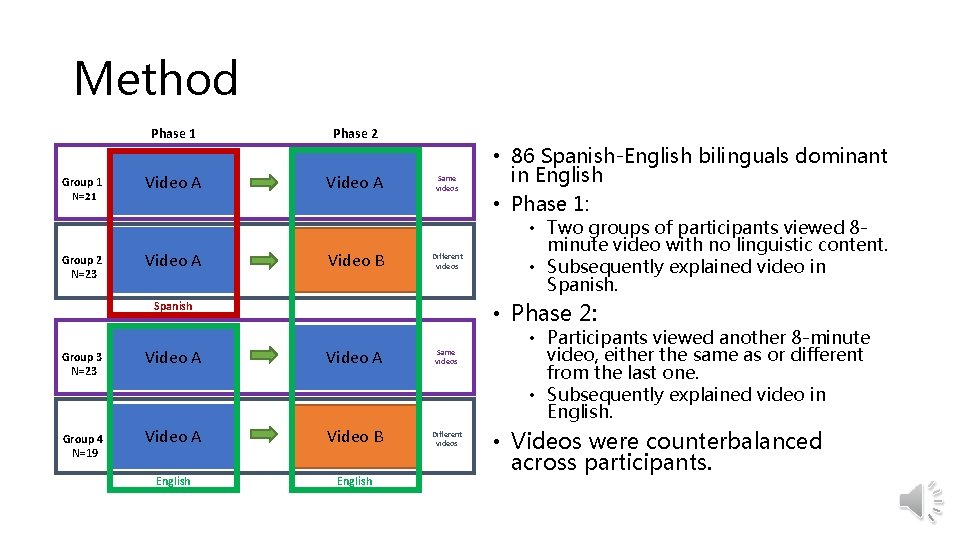
Method Phase 1 Group 1 N=21 Group 2 N=23 Video A Phase 2 Video A Video B Same videos Different videos • 86 Spanish-English bilinguals dominant in English • Phase 1: • Two groups of participants viewed 8 minute video with no linguistic content. • Subsequently explained video in Spanish. • Phase 2: Spanish Group 3 N=23 Video A Same videos Group 4 N=19 Video A Video B Different videos English • Participants viewed another 8 -minute video, either the same as or different from the last one. • Subsequently explained video in English. • Videos were counterbalanced across participants.
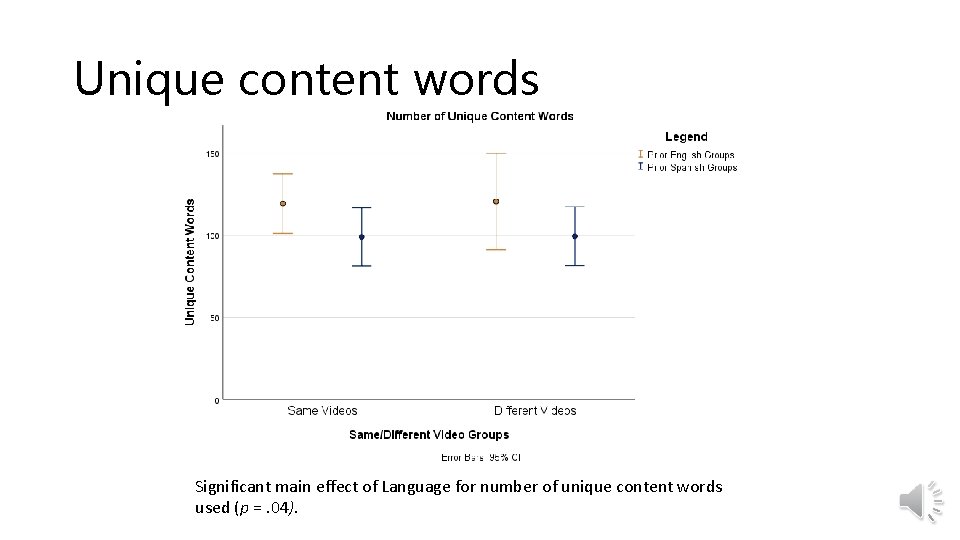
Unique content words Significant main effect of Language for number of unique content words used (p =. 04).
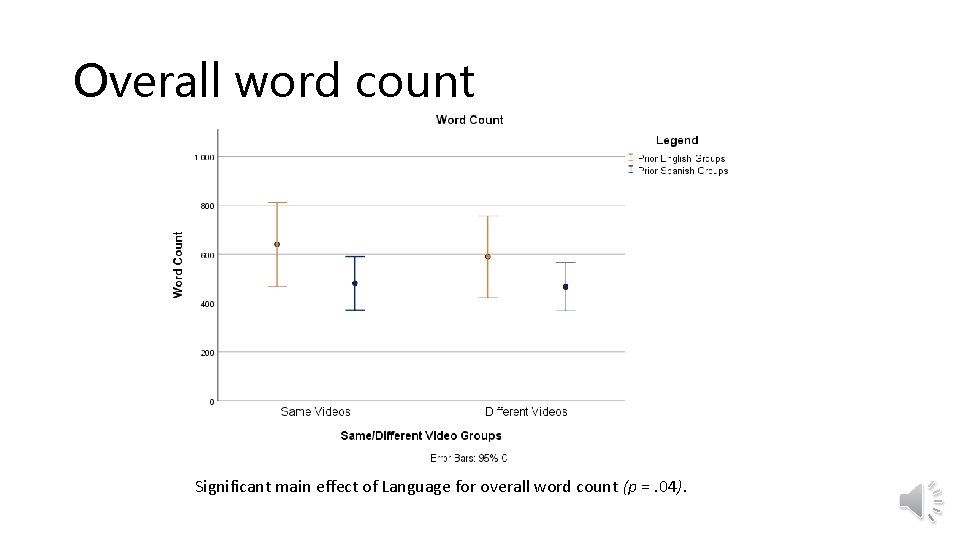
Overall word count Significant main effect of Language for overall word count (p =. 04).
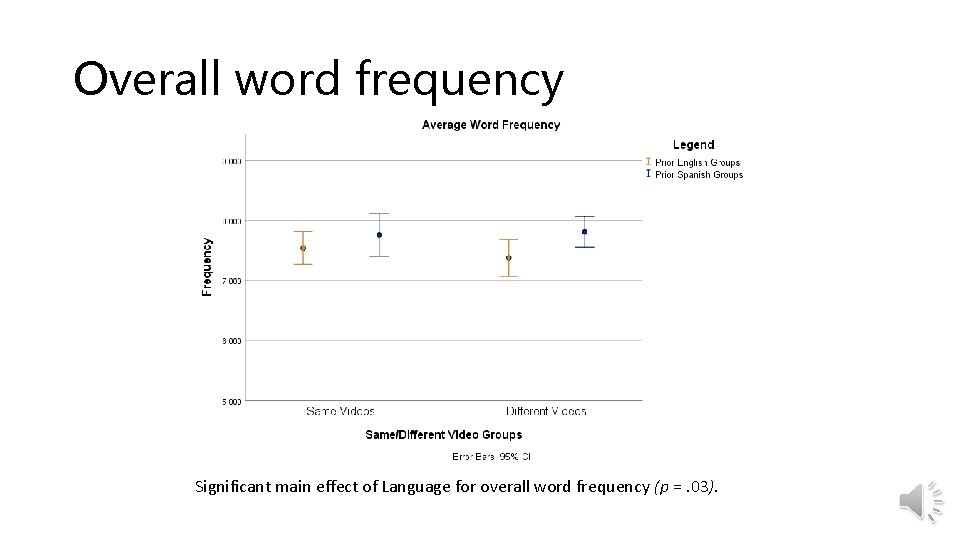
Overall word frequency Significant main effect of Language for overall word frequency (p =. 03).
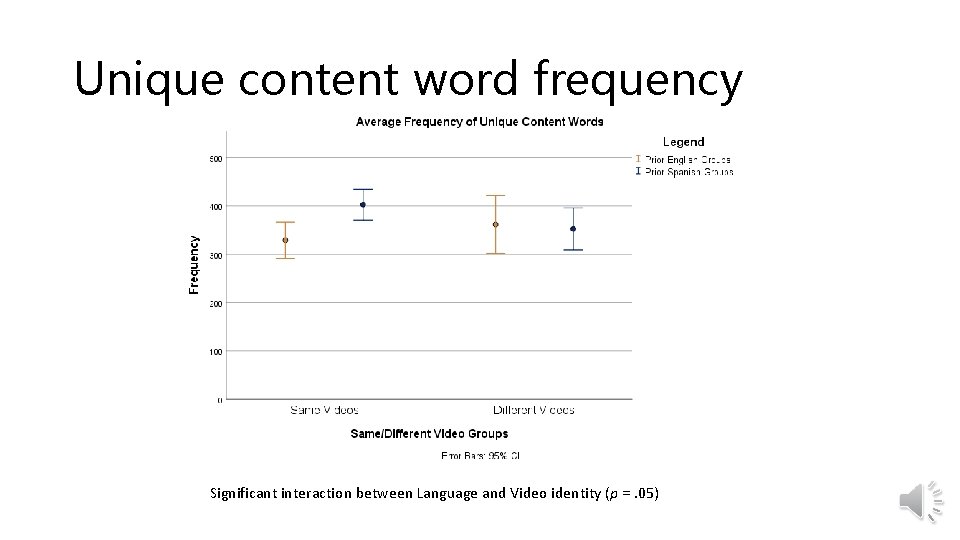
Unique content word frequency Significant interaction between Language and Video identity (p =. 05)
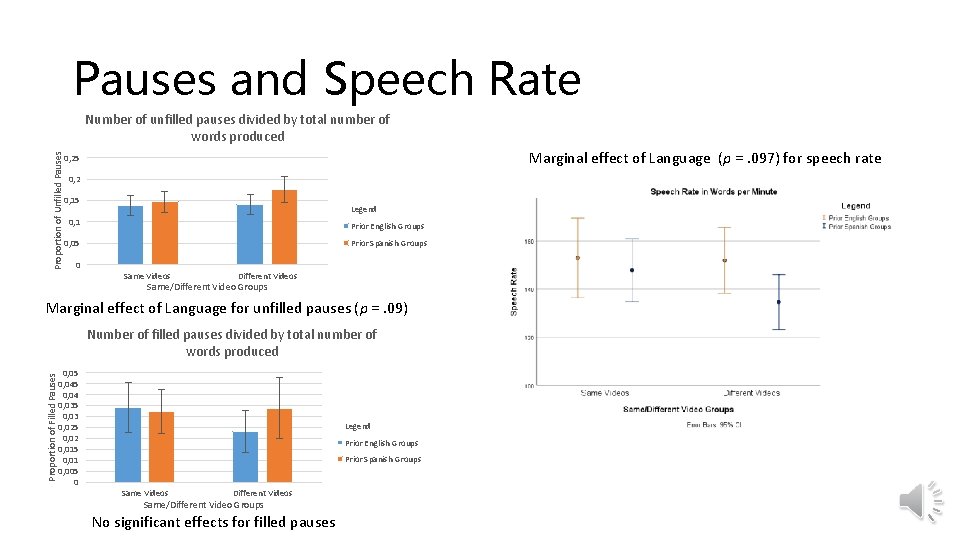
Pauses and Speech Rate Proportion of Unfilled Pauses Number of unfilled pauses divided by total number of words produced Marginal effect of Language (p =. 097) for speech rate 0, 25 0, 2 0, 15 Legend 0, 1 Prior English Groups 0, 05 Prior Spanish Groups 0 Same Videos Different Videos Same/Different Video Groups Marginal effect of Language for unfilled pauses (p =. 09) Proportion of Filled Pauses Number of filled pauses divided by total number of words produced 0, 05 0, 04 0, 035 0, 03 0, 025 0, 02 0, 015 0, 01 0, 005 0 Legend Prior English Groups Prior Spanish Groups Same Videos Different Videos Same/Different Video Groups No significant effects for filled pauses
Discussion There are effects of bilingual inhibitory control in connected speech After using their non-dominant language, reverting to their dominant language caused our participants to show these effects: • say fewer unique content words • say fewer words overall • resort to greater amount of high-frequency words • Frequency of unique content words was also affected by local inhibition. • Our results may suggest that bilinguals possess compensatory measures to maintain speech fluency and quality – they used easier words instead of producing more pauses or compromising lexical diversity.
- Slides: 11