
Bile Acids Salts Objectives Structure of primary bile
Bile Acids & Salts Objectives : Structure of primary bile acids and salts Enterohepatic circulation Structure of secondary bile acids and salts Malabsorption syndrome Functions of bile salts Cholelithiasis Color Index: ● Main Topic ● Main content ● Important ● Drs’ notes ● Extra info Biochemistry teamwork 438 - Gastrointestinal & Nutrition Block Editing File
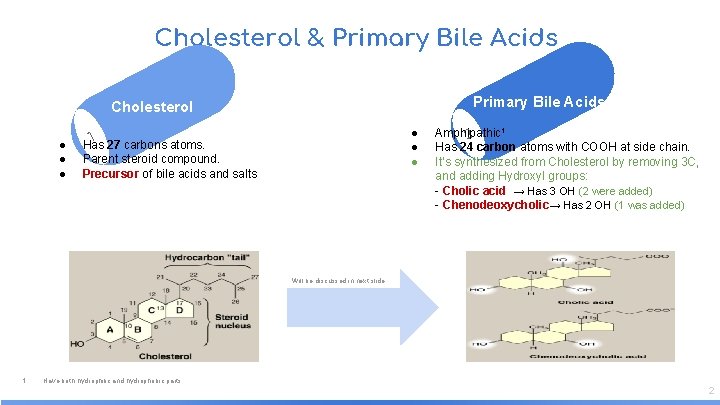
Cholesterol & Primary Bile Acids Cholesterol ● ● ● 1 ● ● ● Has 27 carbons atoms. Parent steroid compound. Precursor of bile acids and salts 1 Amphipathic 2 Has 24 carbon atoms with COOH at side chain. It’s synthesized from Cholesterol by removing 3 C, and adding Hydroxyl groups: - Cholic acid → Has 3 OH (2 were added) - Chenodeoxycholic→ Has 2 OH (1 was added) Will be discussed in next slide 1. Have both hydrophilic and hydrophobic parts. 2
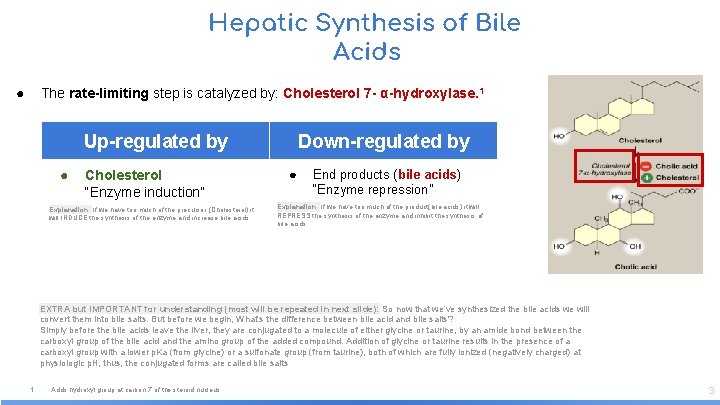
Hepatic Synthesis of Bile Acids ● The rate-limiting step is catalyzed by: Cholesterol 7 - α-hydroxylase. 1 Up-regulated by ● Cholesterol “Enzyme induction” Explanation: If we have too much of the precursor (Cholesterol) it will INDUCE the synthesis of the enzyme and increase bile acids Down-regulated by ● End products (bile acids) “Enzyme repression” Explanation: If we have too much of the product(bile acids) it will REPRESS the synthesis of the enzyme and inhibit the synthesis of bile acids. EXTRA but IMPORTANT for understanding (most will be repeated in next slide): So now that we’ve synthesized the bile acids we will convert them into bile salts. But before we begin, What’s the difference between bile acid and bile salts? Simply before the bile acids leave the liver, they are conjugated to a molecule of either glycine or taurine, by an amide bond between the carboxyl group of the bile acid and the amino group of the added compound. Addition of glycine or taurine results in the presence of a carboxyl group with a lower p. Ka (from glycine) or a sulfonate group (from taurine), both of which are fully ionized (negatively charged) at physiologic p. H, thus, the conjugated forms are called bile salts 1. Adds hydroxyl group at carbon 7 of the steroid nucleus. 3

Primary Bile Acids & Salts BILE ACIDS Cholic acid BILE SALTS Conjugated with glycine or taurine Chenodeoxycholic acid Glycocholic & Taurocholic Conjugated with glycine or taurine Glycochenodeoxycholic & Taurochenodeoxycholic Bile Salts (Conjugated bile acids) ● ● 3 Addition of glycine or taurine forming an amide bond between them and the bile acids, results in the presence of fully ionized groups at p. H 7. 0: ○ COOH of glycine ○ SO 3 of taurine ( Hence, its name as bile salts e. g. , Sodium or potassium glycocholate ) The ratio of glycine to taurine forms in the bile is 3: 1 Bile salts are more effective detergent than bile acids Only bile salts, but not acids, found in bile After the addition of glycine or taurine they will now form bile salts in combination with Na or K resulting in Sodium or Potassium Glycocholate, Sodium or Potassium Taurochenodeoxycholate 4

Secondary bile acids & Enterohepatic circulation: Secondary bile acids: Bile salts Glyco- or Tauro-cholate - Chenodeoxycholate Glycine Intestinal bacteria Deconjugation 1 o Bile acids Cholic acid Explanation: Bile salts secreted into the intestine are efficiently reabsorbed and reused. The liver converts both primary and secondary bile acids into bile salts by conjugation with glycine or taurine, and secretes them into the bile. The mixture of bile acids and bile salts is absorbed primarily in the ileum via a Na+ -bile salt cotransporter. They are actively transported out of the ileal mucosal cells into the portal blood, and are efficiently taken up by the hepatocytes via an isoform of the cotransporter. The continuous process of secretion of bile salts into the bile, their passage through the duodenum where some are converted to bile acids, their uptake in the ileum, and subsequent return to the liver as a mixture of bile acids and salts is termed the enterohepatic circulation Taurine - Chenodeoxycholic Intestinal bacteria OH Bacterial 7α-dehydroxylation 2 o Bile acids Deoxycholic acid - Lithocholic Cholestyramine: ● ● ● 1 - Because the removal of bile acids relieves the inhibition on bile acid synthesis in the liver, thereby diverting additional cholesterol into that pathway. Bile acid sequestrants. Binds to bile acids in the gut, prevent their reabsorption, and so promote their excretion. It is used in the treatment of hypercholesterolemia 1 Dietary fibers: ● It binds to bile acids, increasing their excretion. 5

Hormonal Control of Bile Secretion Bile 1 secretion: Stimulus Undigested lipids and partially digested proteins in duodenum. Hormone from gut cells Cholecystokinin (CCK) Responses Explanation: Cells in the mucosa of the lower duodenum and jejunum produce a small peptide hormone, cholecystokinin (CCK), in response to the presence of lipids and partially digested proteins entering these regions of the upper small intestine. CCK acts on the gallbladder (causing it to contract and release bile), and on the exocrine cells of the pancreas (causing them to release digestive enzymes). It also decreases gastric motility, resulting in a slower release of gastric contents into the small intestine. Other intestinal cells produce another small peptide hormone, secretin, in response to the low p. H of the chyme entering the intestine. Secretin causes the pancreas and the liver to release a solution rich in bicarbonate that helps neutralize the p. H of the intestinal contents, bringing them to the appropriate p. H for digestive activity by pancreatic enzymes. 1 - Secretion of pancreatic enzymes 2 - Bile secretion 3 - Slow release of gastric contents Hormonal control of lipid digestion in the small intestine. Functions of Bile Salts: 01 03 1. Important for cholesterol excretion: 1 - As metabolic products of cholesterol. 2 - Solubilizer of cholesterol in bile. Cofactor for pancreatic lipase and PLA 2 Don’t mix it with bile salts which is a COMPONENT of Bile, so we can say that Bile is a mixture of bile salts, phospholipids, and free cholesterol. 02 04 Emulsifying factors for dietary lipids, a prerequisite step for efficient lipid digestion. Facilitate intestinal lipid absorption by formation of mixed micelle Emulsification and Absorption Will be explained in next slide. . 6
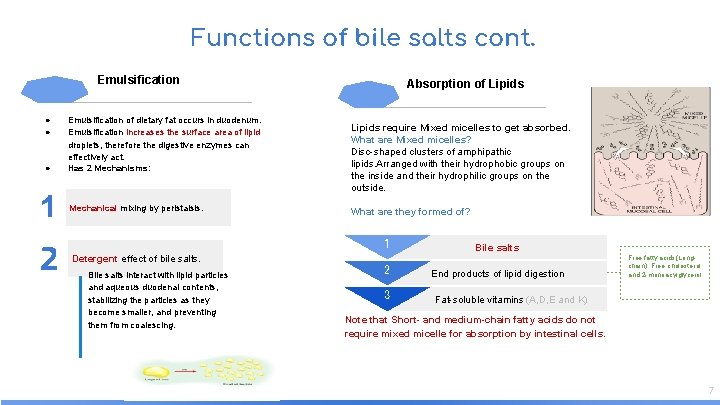
Functions of bile salts cont. Emulsification ● ● ● 1 2 Emulsification of dietary fat occurs in duodenum. Emulsification increases the surface area of lipid droplets, therefore the digestive enzymes can effectively act. Has 2 Mechanisms: Mechanical mixing by peristalsis. Absorption of Lipids require Mixed micelles to get absorbed. What are Mixed micelles? Disc-shaped clusters of amphipathic lipids. Arranged with their hydrophobic groups on the inside and their hydrophilic groups on the outside. What are they formed of? 1 Detergent effect of bile salts. Bile salts interact with lipid particles and aqueous duodenal contents, stabilizing the particles as they become smaller, and preventing them from coalescing. 2 3 Bile salts End products of lipid digestion Free fatty acids(Longchain), Free cholesterol and 2 -monoacylglycerol. Fat-soluble vitamins (A, D, E and K) Note that Short- and medium-chain fatty acids do not require mixed micelle for absorption by intestinal cells. 7
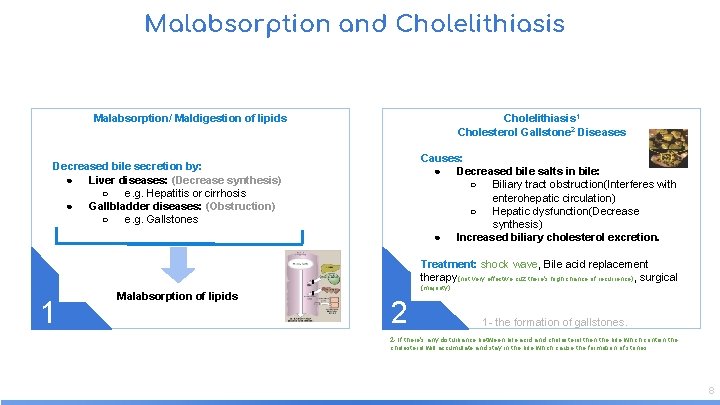
Malabsorption and Cholelithiasis Malabsorption/ Maldigestion of lipids Cholelithiasis 1 Cholesterol Gallstone 2 Diseases Causes: ● Decreased bile salts in bile: ○ Biliary tract obstruction(Interferes with enterohepatic circulation) ○ Hepatic dysfunction(Decrease synthesis) ● Increased biliary cholesterol excretion. Decreased bile secretion by: ● Liver diseases: (Decrease synthesis) ○ e. g. Hepatitis or cirrhosis ● Gallbladder diseases: (Obstruction) ○ e. g. Gallstones Treatment: shock wave, Bile acid replacement therapy(not very effective cuz there's high chance of recurrence) , surgical 1 Malabsorption of lipids (majority) 2 1 - the formation of gallstones. 2 - If there's any disturbance between bile acid and cholesterol then the bile which contain the cholesterol will accumulate and stay in the bile which cause the formation of stones 8
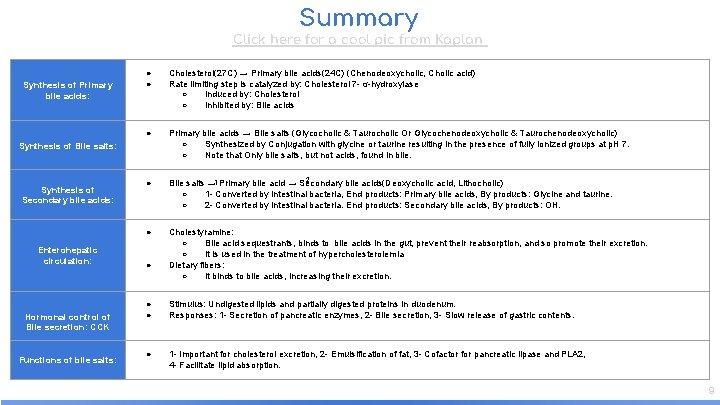
Summary Click here for a cool pic from Kaplan Synthesis of Primary bile acids: ● ● Cholesterol(27 C) → Primary bile acids(24 C) (Chenodeoxycholic, Cholic acid) Rate limiting step is catalyzed by: Cholesterol 7 - α-hydroxylase ○ Induced by: Cholesterol ○ Inhibited by: Bile acids ● Primary bile acids → Bile salts (Glycocholic & Taurocholic Or Glycochenodeoxycholic & Taurochenodeoxycholic) ○ Synthesized by Conjugation with glycine or taurine resulting in the presence of fully ionized groups at p. H 7. ○ Note that Only bile salts, but not acids, found in bile. Synthesis of Bile salts: Synthesis of Secondary bile acids: ● ● Enterohepatic circulation: Hormonal control of Bile secretion: CCK Functions of bile salts: ● 2 Bile salts → 1 Primary bile acid → Secondary bile acids(Deoxycholic acid, Lithocholic) ○ 1 - Converted by intestinal bacteria, End products: Primary bile acids, By products: Glycine and taurine. ○ 2 - Converted by intestinal bacteria. End products: Secondary bile acids, By products: OH. Cholestyramine: ○ Bile acid sequestrants, binds to bile acids in the gut, prevent their reabsorption, and so promote their excretion. ○ It is used in the treatment of hypercholesterolemia Dietary fibers: ○ It binds to bile acids, increasing their excretion. ● ● Stimulus: Undigested lipids and partially digested proteins in duodenum. Responses: 1 - Secretion of pancreatic enzymes, 2 - Bile secretion, 3 - Slow release of gastric contents. ● 1 - Important for cholesterol excretion, 2 - Emulsification of fat, 3 - Cofactor for pancreatic lipase and PLA 2, 4 - Facilitate lipid absorption. 9
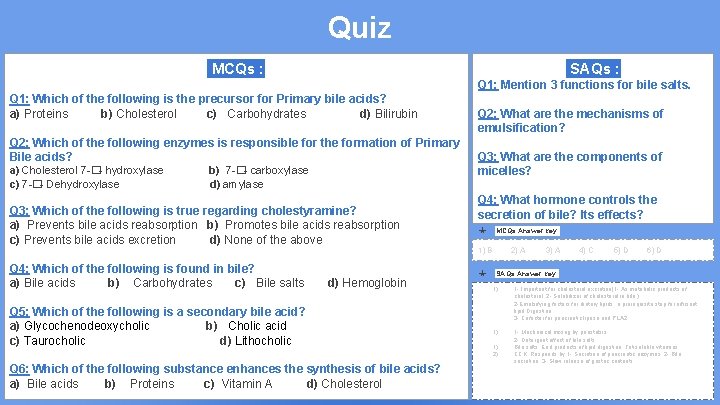
Quiz SAQs : MCQs : Q 1: Mention 3 functions for bile salts. Q 1: Which of the following is the precursor for Primary bile acids? a) Proteins b) Cholesterol c) Carbohydrates d) Bilirubin Q 2: Which of the following enzymes is responsible for the formation of Primary Bile acids? a) Cholesterol 7 -�- hydroxylase c) 7 -�- Dehydroxylase b) 7 -�- carboxylase d) amylase Q 3: Which of the following is true regarding cholestyramine? a) Prevents bile acids reabsorption b) Promotes bile acids reabsorption c) Prevents bile acids excretion d) None of the above Q 4: Which of the following is found in bile? a) Bile acids b) Carbohydrates c) Bile salts d) Hemoglobin Q 5: Which of the following is a secondary bile acid? a) Glycochenodeoxycholic b) Cholic acid c) Taurocholic d) Lithocholic Q 6: Which of the following substance enhances the synthesis of bile acids? a) Bile acids b) Proteins c) Vitamin A d) Cholesterol Q 2: What are the mechanisms of emulsification? Q 3: What are the components of micelles? Q 4: What hormone controls the secretion of bile? Its effects? ★ MCQs Answer key: 1) B ★ 2) A 3) A 4) C 5) D 6) D SAQs Answer key: 1) 1 - Important for cholesterol excretion(1 - As metabolic products of cholesterol. 2 - Solubilizer of cholesterol in bile. ) 2 -Emulsifying factors for dietary lipids, a prerequisite step for efficient lipid Digestion. 3 - Cofactor for pancreatic lipase and PLA 2 1) 1 - Mechanical mixing by peristalsis. 2 - Detergent effect of bile salts. Bile salts, End products of lipid digestion, Fat-soluble vitamins. CCK, Responds by 1 - Secretion of pancreatic enzymes, 2 - Bile secretion, 3 - Slow release of gastric contents. 1) 2)
Team members Girls Team: ● ● ● ● Boys Team: Ajeed Al-Rashoud Alwateen Albalawi Amira Al. Dakhilallah Arwa Al Emam Deema Almaziad Ghaliah Alnufaei Haifa Alwaily Leena Alnassar Lama Aldakhil Lamiss Alzahrani Nouf Alhumaidhi Noura Alturki Sarah Alkhalife Shahd Alsalamah Taif Alotaibi ● ● ● ● ● ★ A Bird in the Hand is Worth Two in the Bush. Abdulrahman Bedaiwi Alkassem Binobaid Khayyal Alderaan Mashal Abaalkhail Naif Alsolais Omar Alyabis Omar Saeed Omar Odeh Rayyan Almousa Yazen Bajeaifer We hear you Team Leaders Lina Alosaimi Mohannad Alqarni
- Slides: 11