
Bihavioural Finance Rational man Vs Behaviourally biased man
Bihavioural Finance • Rational man Vs Behaviourally biased man • Anomalies • Behavioral finance • Decision making biases: causes • Biases • Overcoming biases?

Rational economic man Vs behaviourly biased man: • Homo-Economicus: • Perfect rationality • Perfect self interest/control • Perfect information • Criticism: • Rationality is not the sole driver of human behavior • Ppl are not perfectly self interested • Impossible to enjoy perfect information
Anomalies: • Fundamental anomalies: irregularities that emerge when a stock’s performance is considered in light of fundamental assessment of the stock’s value (supply/demand). • Technical anomalies: debate wether past prices of securities can be used to predict future prices. Forecast the future using the past. • Calender anomalies: January anomaly, stocks in general and small stocks in particular have delivered abnormally high returns in january/in the last and first 4 days of the month, due to the cash flows of the month.
Behavioural finance: • Is defined as the application of psychology to finance. • Attempts to identify and learn from the influence of human psychological phenomena in the financial markets and within individual investors. • The purpose of classification of behavioural finance is to help understand why people make certain financial choices and how those choices can affect markets.
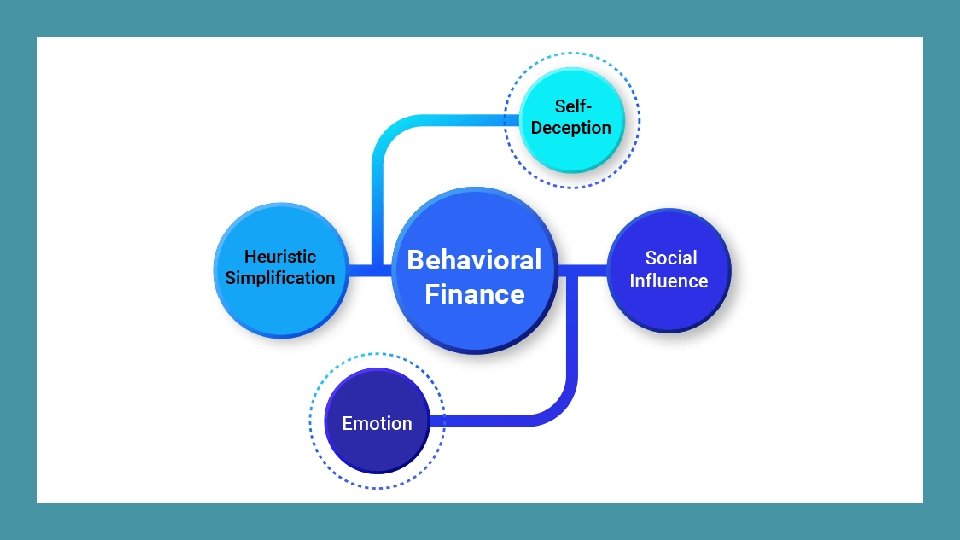
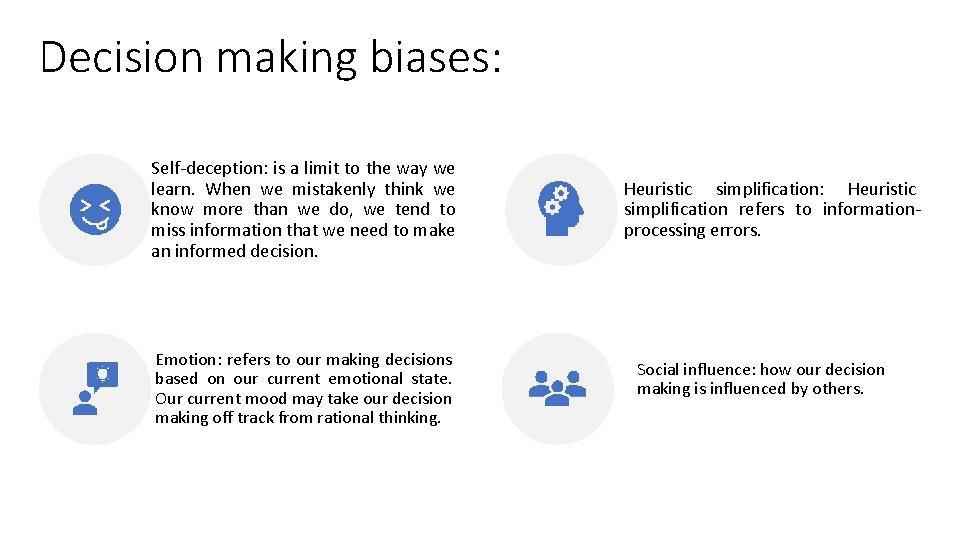
Decision making biases: Self-deception: is a limit to the way we learn. When we mistakenly think we know more than we do, we tend to miss information that we need to make an informed decision. Emotion: refers to our making decisions based on our current emotional state. Our current mood may take our decision making off track from rational thinking. Heuristic simplification: Heuristic simplification refers to informationprocessing errors. Social influence: how our decision making is influenced by others.
Over-confidence Bias: • Type: Cognitive • General discription: unwarranted faith in one’s intuitive reasoning, judgement and cognitive abilities. • Technical description: • confidence intervals tend to be nerrow. • Certainty over-confidence. • Potential behaviour: • Trade excessively • Under-estimate downside risks • Undiversified portfolio

Representativeness bias: • Type: cognitive • General description: people have developped an innate prospensity for classifying objects or thoughts. The classification reflex leads to deception producing an uncorrect understanding of new elements. • Technical description: • base rate neglect • Sample size neglect • Potential behaviour: • Over-confidence • Over-reaction
Anchoring and adjustment bias: • Type: Cognitive • General description: when estimating unknown magnature value people genrally begin by envisioning a default initial number “ANCHOR”, then adjust it up or down. • Technical description: Investors are often influenced by purchase points or arbitrary price levels/indexes. • Potential behavior: • Investors pecieve information through an essencially wrapped lens. • Buying an undervalued investment • Selling an overvalued investment
Cognitive Dissonance bias: • Type: cognitive • General description: newly acquired information conflicts with a pre-existing understanding people experience discomfort. • Technical description: • selective perception • selective decision making • Potential behavior: • Hold losing securities • Invest in securities they already hold after it has gone down
Self attribution bias: • Type: Cognitive • General description: refers to the tendency of individuals to attribute their success to innate aspects and their faliure to outside infuence (success to dispositional factors and failure to situational factors). • Technical description: • Self enhancing bias • Self protecting bias • Potential behavior: • Trade too much • Hold or purchase stocks they should not

Illusion of control bias: • Type: Cognitive • General description: the tendency of human beings to believe that they can control or at least influence outcomes when infact they cannot. • Technical description: expectation of a personal success probability inapproprietly higher than the object probability would warrant. • Potential behavior: • Trade more than it’s prudent • Maintain undiversified portfolio • Over-confidence
Conservatism bias: • Type: cognitive • General description: is a mental process in which people cling to their prior views or forecasts at the expence of akcnowledging new information. • Technical description: investors too often give more attention to forecast outcomes than to new data describing emerging outcomes. • Potential behavior: • Behave too inflexibly • Too slow reactions
Ambiguity aversion bias: • Type: cognitive • General description: people do not like to gamble when probability distribution is uncertain and hesitate in situations of ambiguity. • P. S: Risk VS Uncertainty. • Potential behavior: • Hold conservative investments. • Restricted to their national indexes • Favor investments that are geographically close
Endowment bias: • Type: Emotional • General description: people who exhibit endowment bias value an asset more when they hold it than when they don’t. • Technical description: the value of an object depends on its possessivity. • Potential behavior: • Inherited securities • Commission aversion • Desire for familiarity
Self-control bias: • Type: Emotional • General description: consume today at the expense of saving for tomorrow. • Technical description: the foundation of the model is the saving decision. • (Income= consumption+saving). • Potential behavior: • Fail to plan for retirement • Asset allocation imbalance
Optimism bias: • Type: Emotional • General description: Investors tend to be overly optimistic. • Technical description: The optimism bias is defined as the difference between a person's expectation and the outcome that follows. If expectations are better than reality, the bias is optimistic; if reality is better than expected, the bias is pessimistic. • Potential behavior: • Overload their portfolio of one company’s stocks • Read too much into rosy forecasts • Think they are above average investors
Loss aversion bias • Type: Emotional • General description: is a part of the prospect theory. Poeple generally feel a strong impulse to avoid losses than to acquire a gain. • Technical description: S shape utility representative value function • Potential behavior: • Hold loosing investments too long • Excessive trade • Unknowingly take more risk • Unbalanced portfolio
Narrative Fallacy • Typically, stories have emotional content which appeals to our subconscious or reflexive reasoning. Because stories have that emotional component, they are easier to remember and tend to influence our behaviour. • Some investors tend to abandon evidence in favour of a good story. • Stockbrokers have taken advantage of the narrative fallacy for years, convincing clients to invest in a stock by telling them a great story about the company.
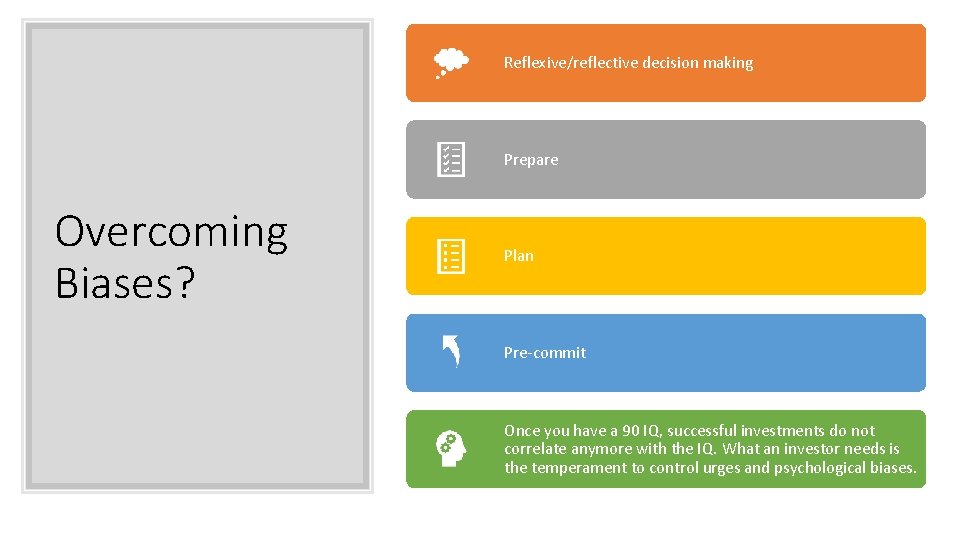
Reflexive/reflective decision making Prepare Overcoming Biases? Plan Pre-commit Once you have a 90 IQ, successful investments do not correlate anymore with the IQ. What an investor needs is the temperament to control urges and psychological biases.

Time for games

2 -4 -8 -10 -12 Guess my choice rule? ? ?
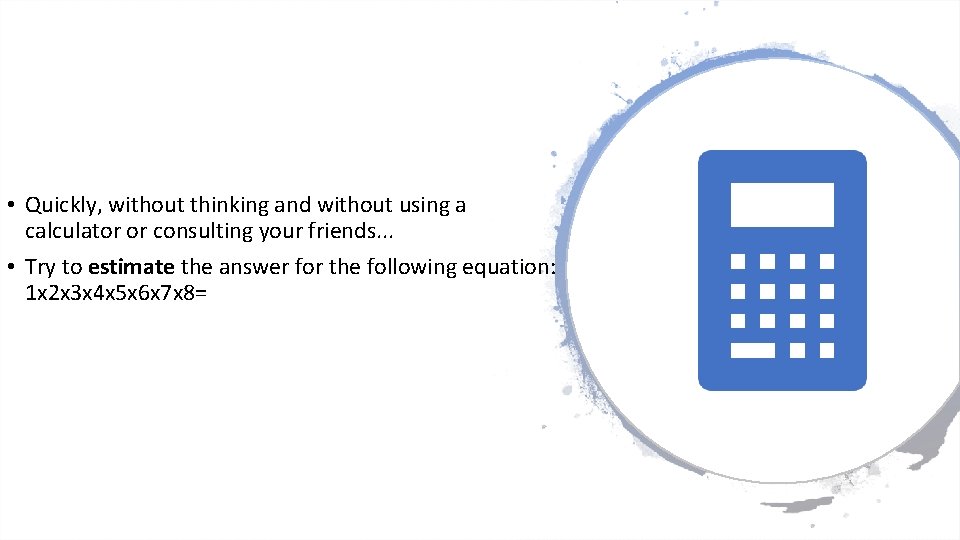
• Quickly, without thinking and without using a calculator or consulting your friends. . . • Try to estimate the answer for the following equation: 1 x 2 x 3 x 4 x 5 x 6 x 7 x 8=
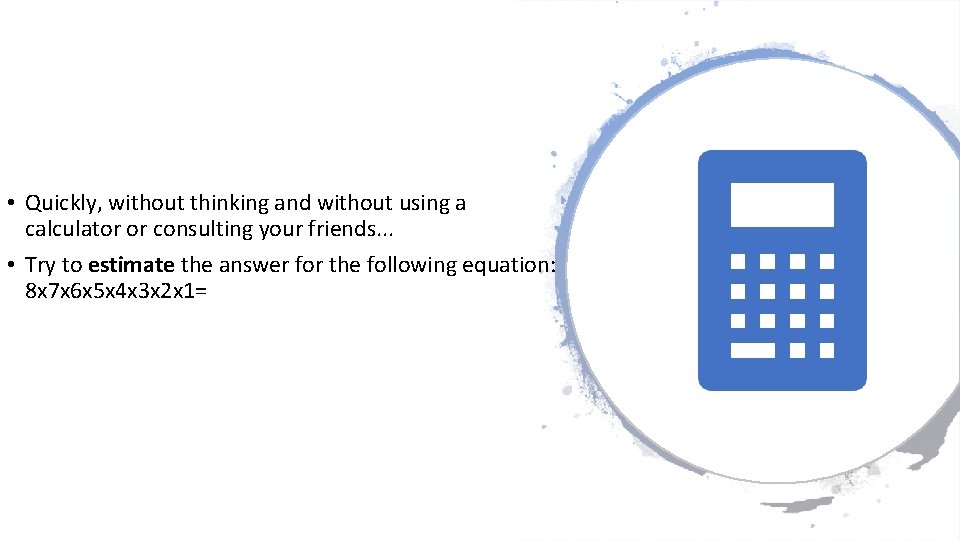
• Quickly, without thinking and without using a calculator or consulting your friends. . . • Try to estimate the answer for the following equation: 8 x 7 x 6 x 5 x 4 x 3 x 2 x 1=
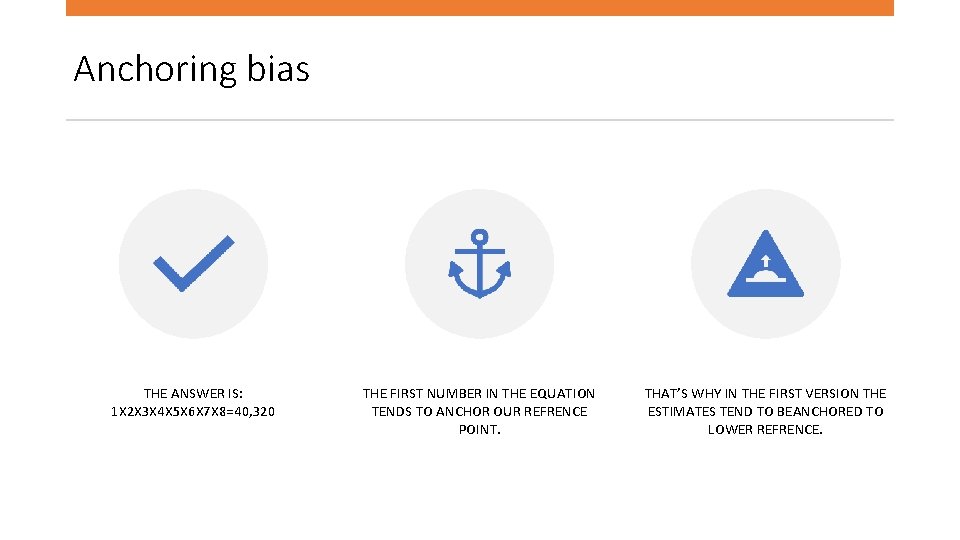
Anchoring bias THE ANSWER IS: 1 X 2 X 3 X 4 X 5 X 6 X 7 X 8=40, 320 THE FIRST NUMBER IN THE EQUATION TENDS TO ANCHOR OUR REFRENCE POINT. THAT’S WHY IN THE FIRST VERSION THE ESTIMATES TEND TO BEANCHORED TO LOWER REFRENCE.
• THE WORLD is facing COVID-19 OUTBREAK it is estimated to kill 600, 000 people in the coming days. Two alternatives programs to combat the disease have been proposed. • Assume that the scientific estimates or the consequences of the programs are as follows: • Program A: If Program A is adopted, 200, 000 people will be saved • Program B: If Program B is adopted, there is a one-third probability that 600, 000 people will be saved and a two-thirds probability that no people will be saved • Which of the two programs would you favour?
Same situation but with 2 different propositions Which of the two programs would you favour? • Program C: If Program C is adopted; 400, 000 people will die • Program D: If Program D is adopted, there is a one-third probability that no one will die and a two-thirds probability that 600, 000 people will die
Prospect theory: Framing effect • People generally try to avoid risk. • Positive framing: risk-averse (avoid risk) • Negative framing: risk-seeking • But, we are sensitive to context. Same situation, under framing of loss people become risk takers
- Slides: 28