
BigO Analysis Asymptotics 1 Order of magnitude analysis
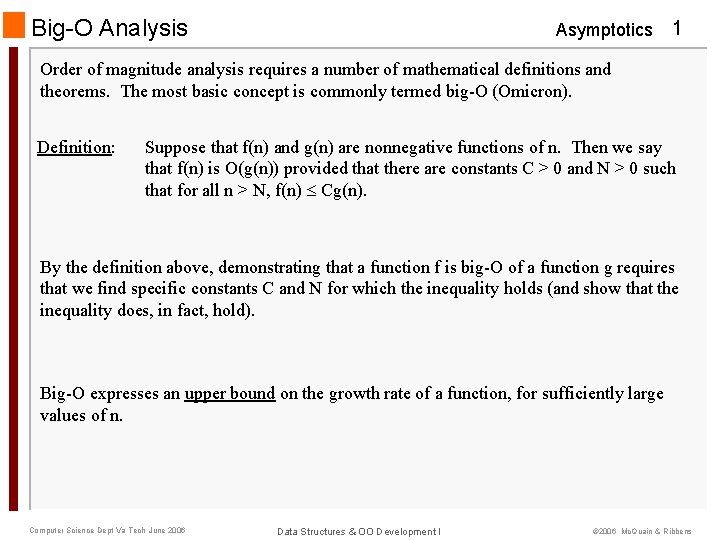
Big-O Analysis Asymptotics 1 Order of magnitude analysis requires a number of mathematical definitions and theorems. The most basic concept is commonly termed big-O (Omicron). Definition: Suppose that f(n) and g(n) are nonnegative functions of n. Then we say that f(n) is O(g(n)) provided that there are constants C > 0 and N > 0 such that for all n > N, f(n) Cg(n). By the definition above, demonstrating that a function f is big-O of a function g requires that we find specific constants C and N for which the inequality holds (and show that the inequality does, in fact, hold). Big-O expresses an upper bound on the growth rate of a function, for sufficiently large values of n. Computer Science Dept Va Tech June 2006 Data Structures & OO Development I © 2006 Mc. Quain & Ribbens
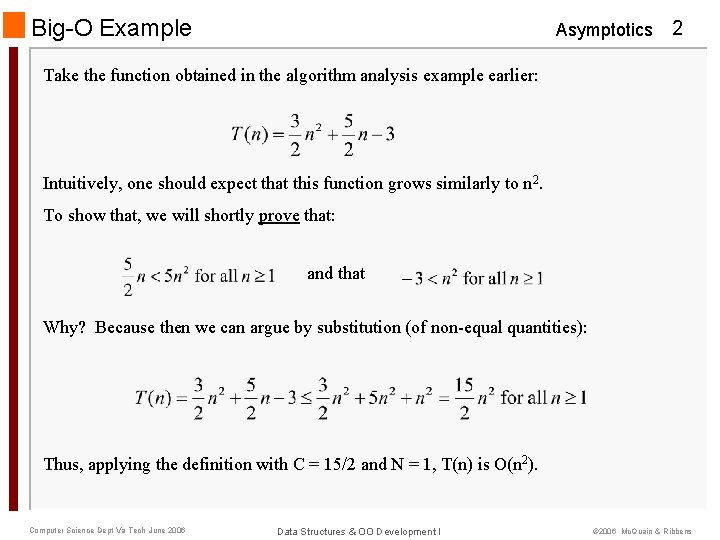
Big-O Example Asymptotics 2 Take the function obtained in the algorithm analysis example earlier: Intuitively, one should expect that this function grows similarly to n 2. To show that, we will shortly prove that: and that Why? Because then we can argue by substitution (of non-equal quantities): Thus, applying the definition with C = 15/2 and N = 1, T(n) is O(n 2). Computer Science Dept Va Tech June 2006 Data Structures & OO Development I © 2006 Mc. Quain & Ribbens
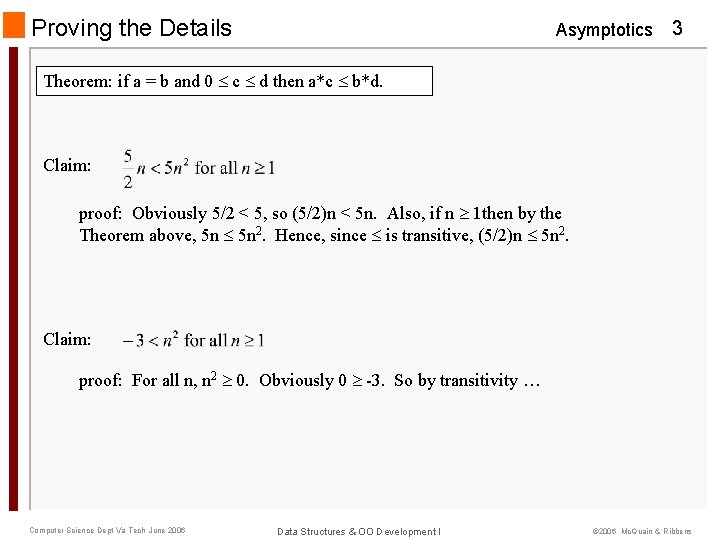
Proving the Details Asymptotics 3 Theorem: if a = b and 0 c d then a*c b*d. Claim: proof: Obviously 5/2 < 5, so (5/2)n < 5 n. Also, if n 1 then by the Theorem above, 5 n 2. Hence, since is transitive, (5/2)n 5 n 2. Claim: proof: For all n, n 2 0. Obviously 0 -3. So by transitivity … Computer Science Dept Va Tech June 2006 Data Structures & OO Development I © 2006 Mc. Quain & Ribbens
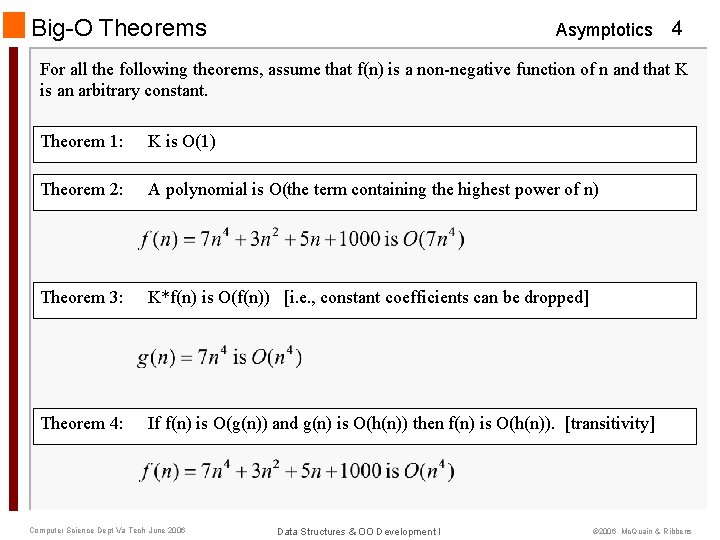
Big-O Theorems Asymptotics 4 For all the following theorems, assume that f(n) is a non-negative function of n and that K is an arbitrary constant. Theorem 1: K is O(1) Theorem 2: A polynomial is O(the term containing the highest power of n) Theorem 3: K*f(n) is O(f(n)) [i. e. , constant coefficients can be dropped] Theorem 4: If f(n) is O(g(n)) and g(n) is O(h(n)) then f(n) is O(h(n)). [transitivity] Computer Science Dept Va Tech June 2006 Data Structures & OO Development I © 2006 Mc. Quain & Ribbens

Big-O Theorems Theorem 5: Asymptotics 5 Each of the following functions is strictly big-O of its successors: K [constant] smaller logb(n) [always log base 2 if no base is shown] n n logb(n) n 2 n to higher powers 2 n 3 n larger constants to the n-th power n! [n factorial] nn larger Computer Science Dept Va Tech June 2006 Data Structures & OO Development I © 2006 Mc. Quain & Ribbens
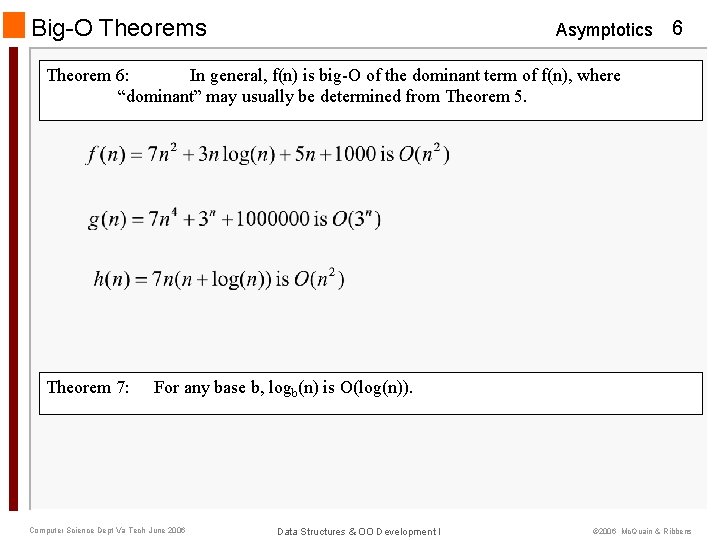
Big-O Theorems Asymptotics 6 Theorem 6: In general, f(n) is big-O of the dominant term of f(n), where “dominant” may usually be determined from Theorem 5. Theorem 7: For any base b, logb(n) is O(log(n)). Computer Science Dept Va Tech June 2006 Data Structures & OO Development I © 2006 Mc. Quain & Ribbens
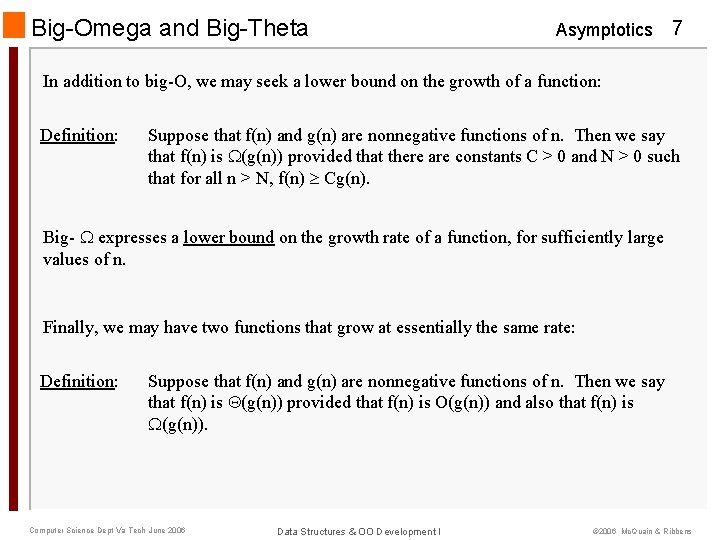
Big-Omega and Big-Theta Asymptotics 7 In addition to big-O, we may seek a lower bound on the growth of a function: Definition: Suppose that f(n) and g(n) are nonnegative functions of n. Then we say that f(n) is (g(n)) provided that there are constants C > 0 and N > 0 such that for all n > N, f(n) Cg(n). Big- expresses a lower bound on the growth rate of a function, for sufficiently large values of n. Finally, we may have two functions that grow at essentially the same rate: Definition: Suppose that f(n) and g(n) are nonnegative functions of n. Then we say that f(n) is (g(n)) provided that f(n) is O(g(n)) and also that f(n) is (g(n)). Computer Science Dept Va Tech June 2006 Data Structures & OO Development I © 2006 Mc. Quain & Ribbens
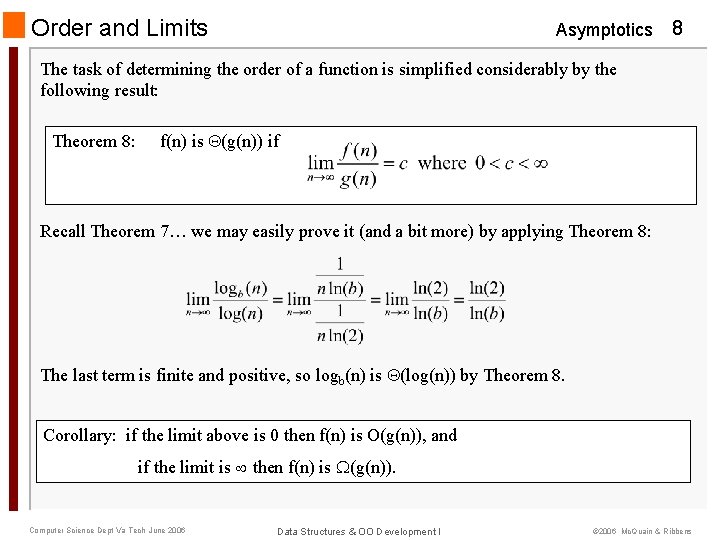
Order and Limits Asymptotics 8 The task of determining the order of a function is simplified considerably by the following result: Theorem 8: f(n) is (g(n)) if Recall Theorem 7… we may easily prove it (and a bit more) by applying Theorem 8: The last term is finite and positive, so logb(n) is (log(n)) by Theorem 8. Corollary: if the limit above is 0 then f(n) is O(g(n)), and if the limit is then f(n) is (g(n)). Computer Science Dept Va Tech June 2006 Data Structures & OO Development I © 2006 Mc. Quain & Ribbens
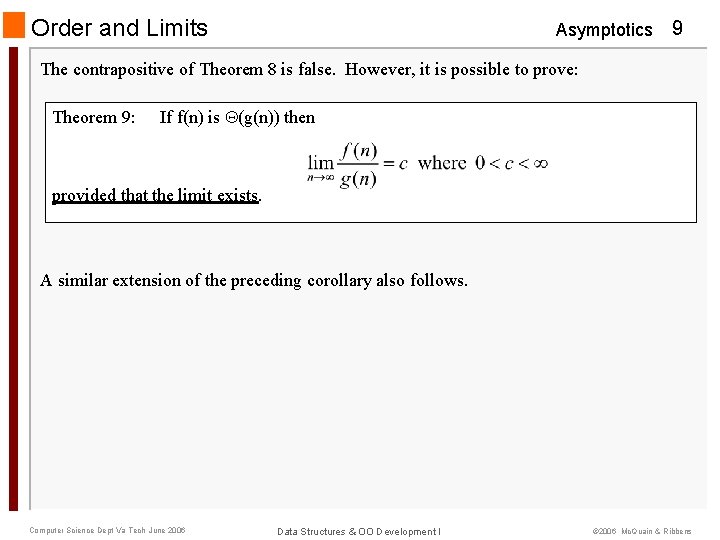
Order and Limits Asymptotics 9 The contrapositive of Theorem 8 is false. However, it is possible to prove: Theorem 9: If f(n) is (g(n)) then provided that the limit exists. A similar extension of the preceding corollary also follows. Computer Science Dept Va Tech June 2006 Data Structures & OO Development I © 2006 Mc. Quain & Ribbens
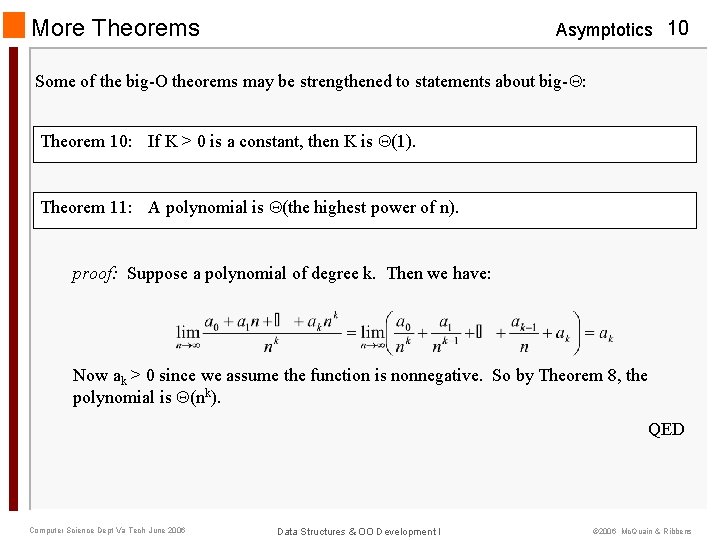
More Theorems Asymptotics 10 Some of the big-O theorems may be strengthened to statements about big- : Theorem 10: If K > 0 is a constant, then K is (1). Theorem 11: A polynomial is (the highest power of n). proof: Suppose a polynomial of degree k. Then we have: Now ak > 0 since we assume the function is nonnegative. So by Theorem 8, the polynomial is (nk). QED Computer Science Dept Va Tech June 2006 Data Structures & OO Development I © 2006 Mc. Quain & Ribbens
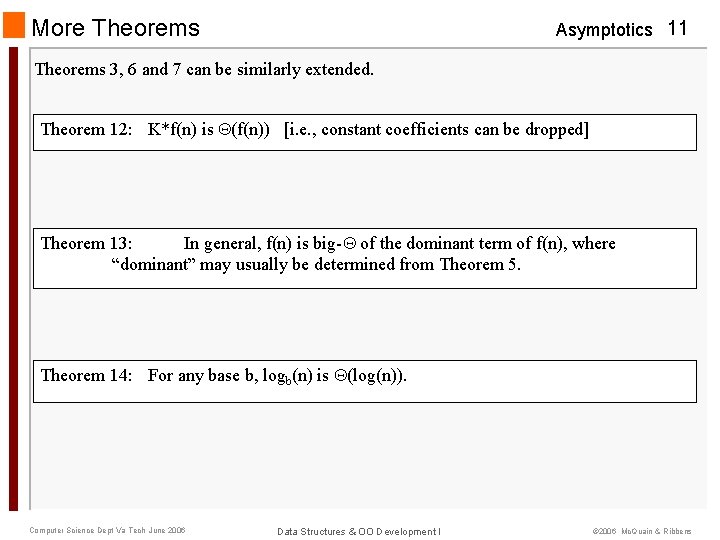
More Theorems Asymptotics 11 Theorems 3, 6 and 7 can be similarly extended. Theorem 12: K*f(n) is (f(n)) [i. e. , constant coefficients can be dropped] Theorem 13: In general, f(n) is big- of the dominant term of f(n), where “dominant” may usually be determined from Theorem 5. Theorem 14: For any base b, logb(n) is (log(n)). Computer Science Dept Va Tech June 2006 Data Structures & OO Development I © 2006 Mc. Quain & Ribbens
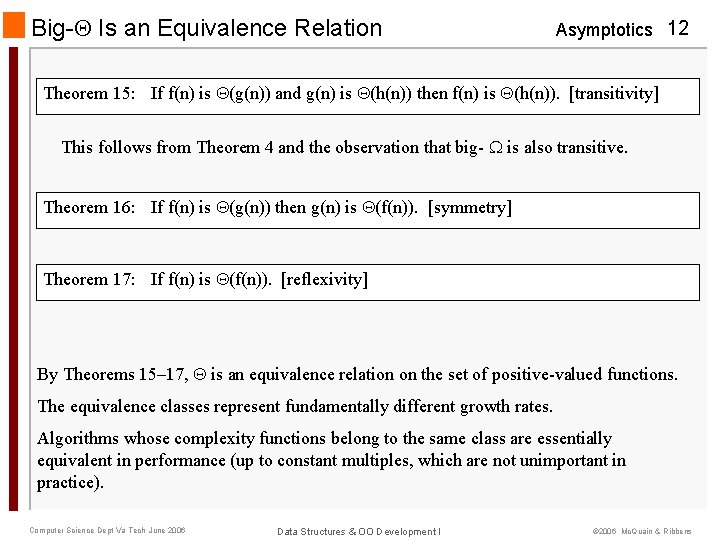
Big- Is an Equivalence Relation Asymptotics 12 Theorem 15: If f(n) is (g(n)) and g(n) is (h(n)) then f(n) is (h(n)). [transitivity] This follows from Theorem 4 and the observation that big- is also transitive. Theorem 16: If f(n) is (g(n)) then g(n) is (f(n)). [symmetry] Theorem 17: If f(n) is (f(n)). [reflexivity] By Theorems 15– 17, is an equivalence relation on the set of positive-valued functions. The equivalence classes represent fundamentally different growth rates. Algorithms whose complexity functions belong to the same class are essentially equivalent in performance (up to constant multiples, which are not unimportant in practice). Computer Science Dept Va Tech June 2006 Data Structures & OO Development I © 2006 Mc. Quain & Ribbens
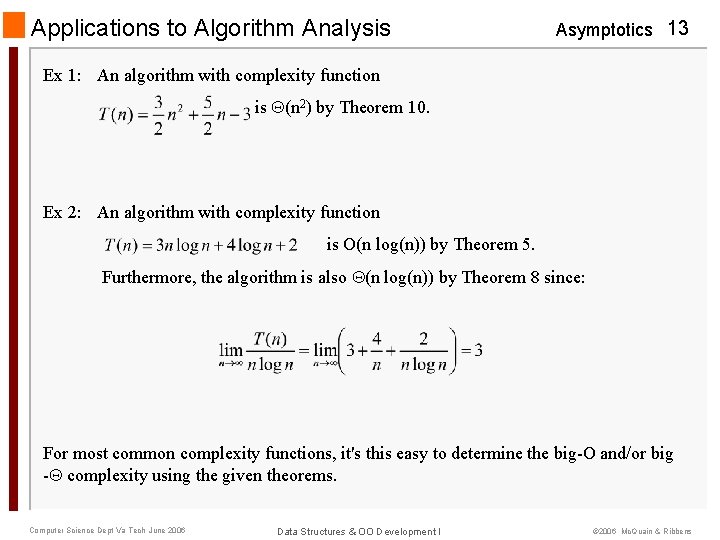
Applications to Algorithm Analysis Asymptotics 13 Ex 1: An algorithm with complexity function is (n 2) by Theorem 10. Ex 2: An algorithm with complexity function is O(n log(n)) by Theorem 5. Furthermore, the algorithm is also (n log(n)) by Theorem 8 since: For most common complexity functions, it's this easy to determine the big-O and/or big - complexity using the given theorems. Computer Science Dept Va Tech June 2006 Data Structures & OO Development I © 2006 Mc. Quain & Ribbens
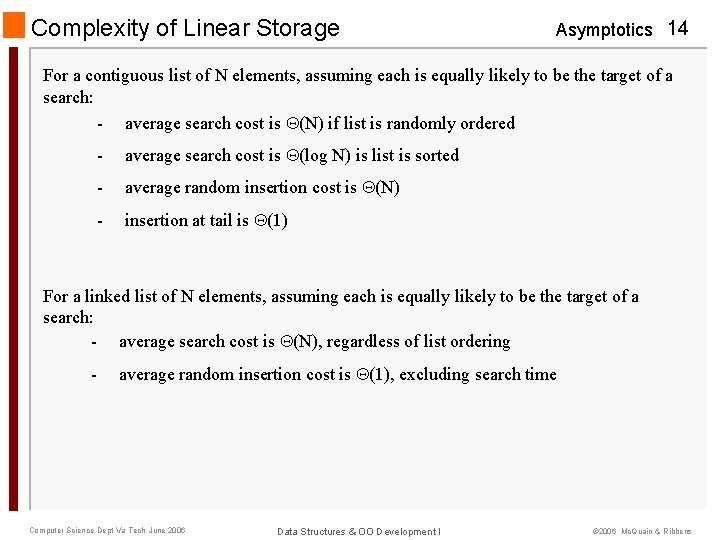
Complexity of Linear Storage Asymptotics 14 For a contiguous list of N elements, assuming each is equally likely to be the target of a search: - average search cost is (N) if list is randomly ordered - average search cost is (log N) is list is sorted - average random insertion cost is (N) - insertion at tail is (1) For a linked list of N elements, assuming each is equally likely to be the target of a search: - average search cost is (N), regardless of list ordering - average random insertion cost is (1), excluding search time Computer Science Dept Va Tech June 2006 Data Structures & OO Development I © 2006 Mc. Quain & Ribbens
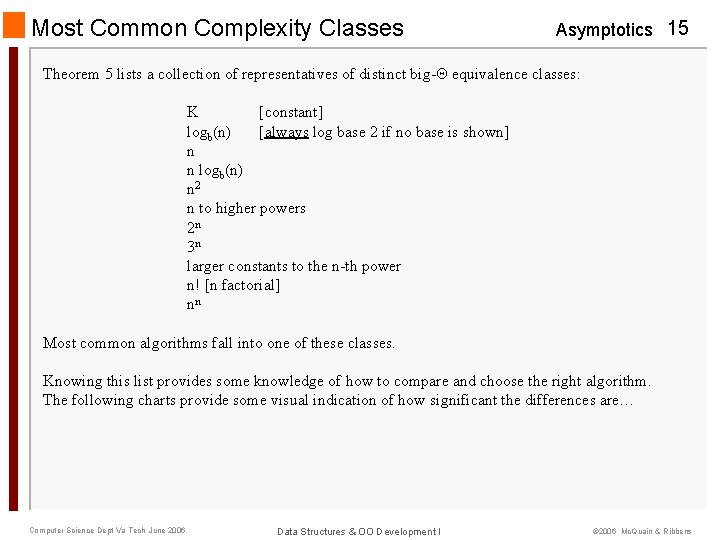
Most Common Complexity Classes Asymptotics 15 Theorem 5 lists a collection of representatives of distinct big-Θ equivalence classes: K [constant] logb(n) [always log base 2 if no base is shown] n n logb(n) n 2 n to higher powers 2 n 3 n larger constants to the n-th power n! [n factorial] nn Most common algorithms fall into one of these classes. Knowing this list provides some knowledge of how to compare and choose the right algorithm. The following charts provide some visual indication of how significant the differences are… Computer Science Dept Va Tech June 2006 Data Structures & OO Development I © 2006 Mc. Quain & Ribbens
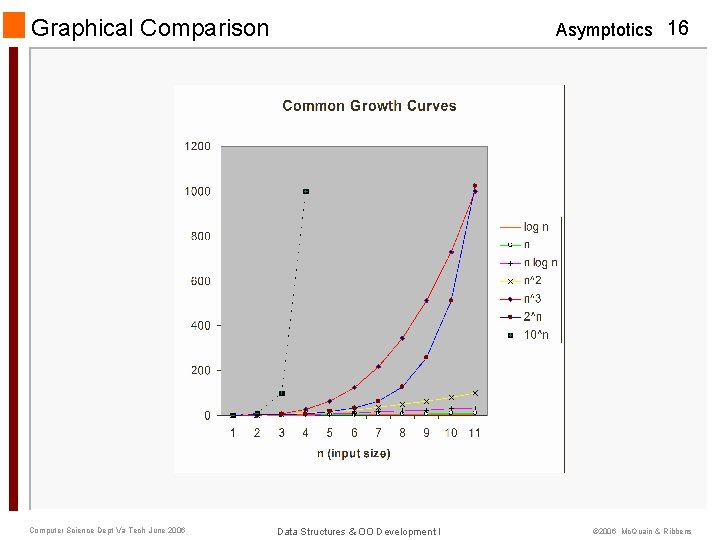
Graphical Comparison Computer Science Dept Va Tech June 2006 Asymptotics 16 Data Structures & OO Development I © 2006 Mc. Quain & Ribbens
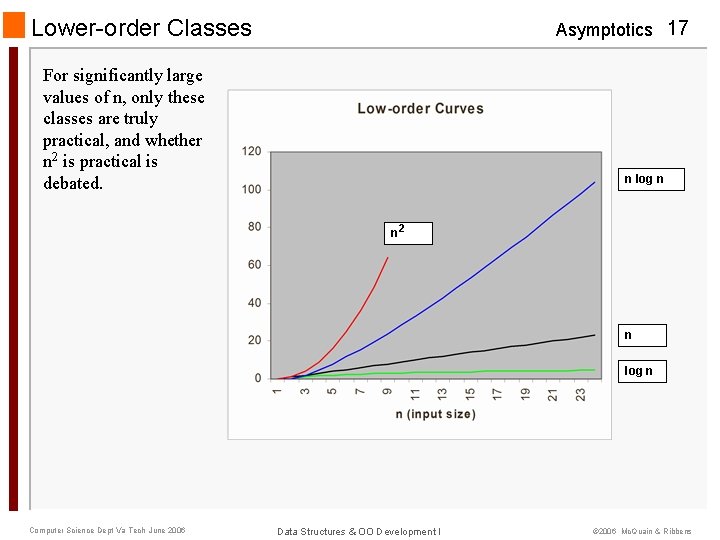
Lower-order Classes Asymptotics 17 For significantly large values of n, only these classes are truly practical, and whether n 2 is practical is debated. n log n n 2 n log n Computer Science Dept Va Tech June 2006 Data Structures & OO Development I © 2006 Mc. Quain & Ribbens
- Slides: 17