
Big Science at a Small College Fusion Experiments
Big Science at a Small College: Fusion Experiments at the World's Largest Laser David Cohen Department of Physics and Astronomy with Dave Conners (’ 03), Kate Penrose (’ 04), Nate Shupe (’ 05)
Outline 1. Fusion A. What is it? B. Laser/inertial confinement fusion 2. Our experiments A. Spectral measurement of X-ray burnthrough B. Doing experiments at the OMEGA laser (deferred to the end) 3. Spectroscopy 4. Modeling and Results
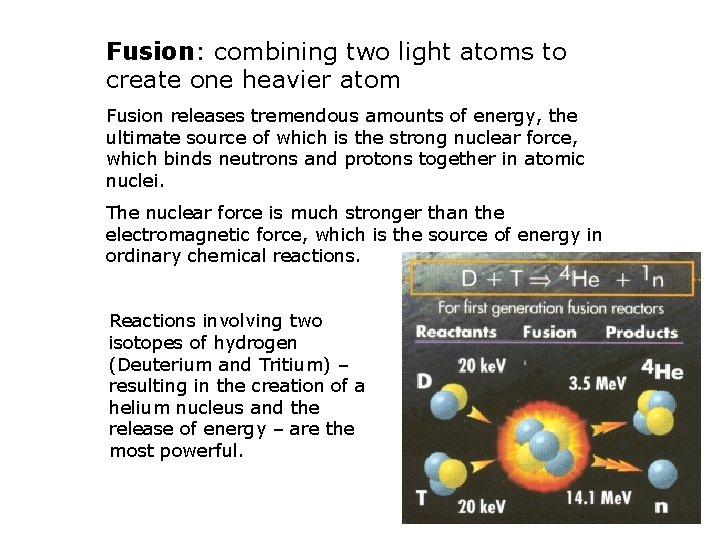
Fusion: combining two light atoms to create one heavier atom Fusion releases tremendous amounts of energy, the ultimate source of which is the strong nuclear force, which binds neutrons and protons together in atomic nuclei. The nuclear force is much stronger than the electromagnetic force, which is the source of energy in ordinary chemical reactions. Reactions involving two isotopes of hydrogen (Deuterium and Tritium) – resulting in the creation of a helium nucleus and the release of energy – are the most powerful.
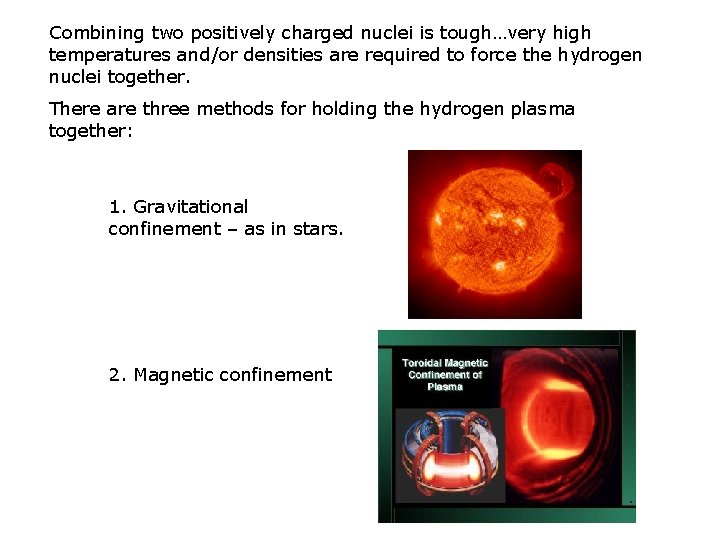
Combining two positively charged nuclei is tough…very high temperatures and/or densities are required to force the hydrogen nuclei together. There are three methods for holding the hydrogen plasma together: 1. Gravitational confinement – as in stars. 2. Magnetic confinement

3. Inertial confinement – heat and compress the hydrogen fuel with lasers or X-rays The fuel’s own mass and its inward-directed momentum keeps it held together…for a few nanoseconds (billionths of a second) The target chamber at the OMEGA laser
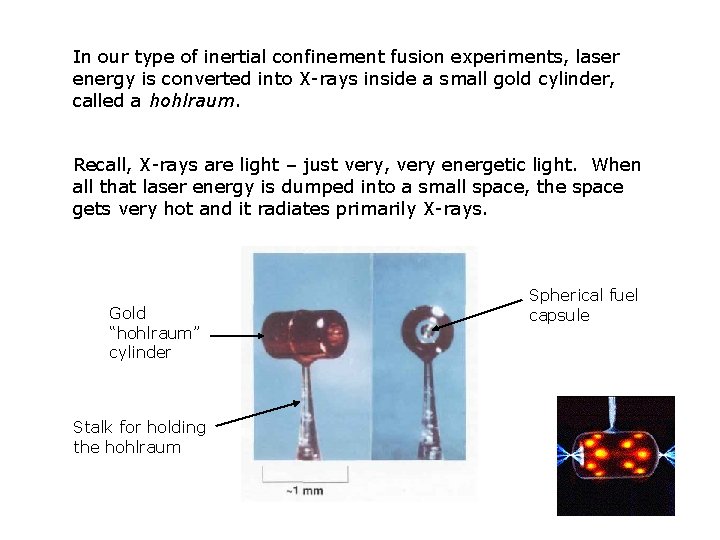
In our type of inertial confinement fusion experiments, laser energy is converted into X-rays inside a small gold cylinder, called a hohlraum. Recall, X-rays are light – just very, very energetic light. When all that laser energy is dumped into a small space, the space gets very hot and it radiates primarily X-rays. Gold “hohlraum” cylinder Stalk for holding the hohlraum Spherical fuel capsule
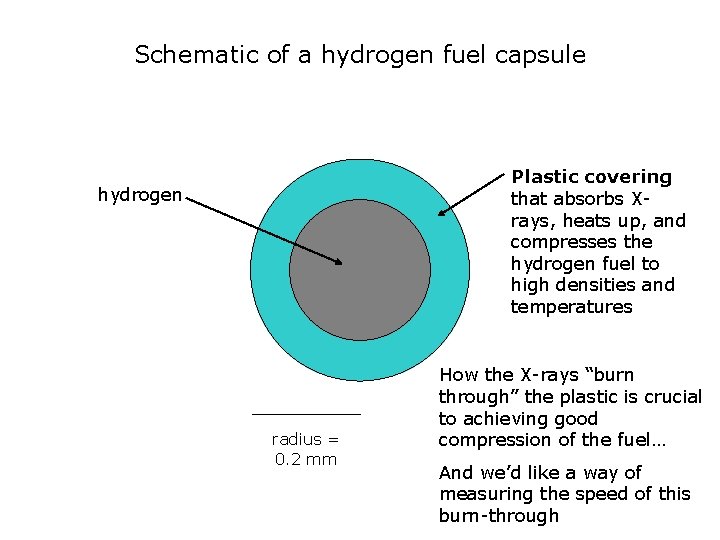
Schematic of a hydrogen fuel capsule Plastic covering that absorbs Xrays, heats up, and compresses the hydrogen fuel to high densities and temperatures hydrogen radius = 0. 2 mm How the X-rays “burn through” the plastic is crucial to achieving good compression of the fuel… And we’d like a way of measuring the speed of this burn-through
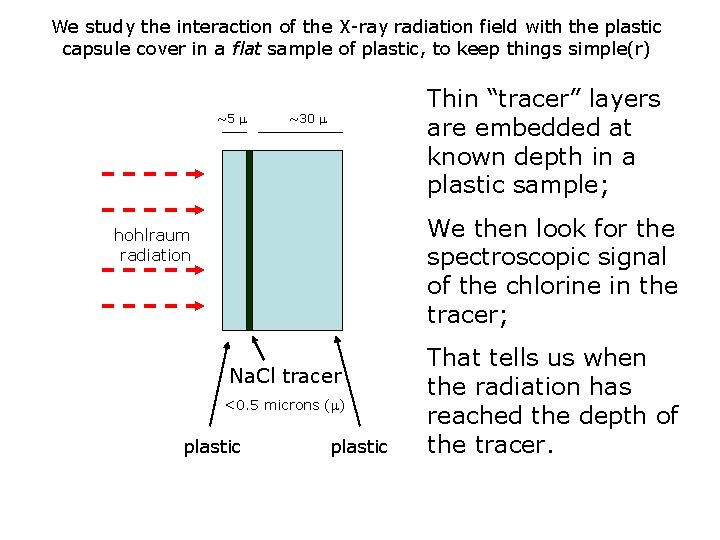
We study the interaction of the X-ray radiation field with the plastic capsule cover in a flat sample of plastic, to keep things simple(r) ~5 m Thin “tracer” layers are embedded at known depth in a plastic sample; ~30 m We then look for the spectroscopic signal of the chlorine in the tracer; hohlraum radiation Na. Cl tracer <0. 5 microns (m) plastic That tells us when the radiation has reached the depth of the tracer.
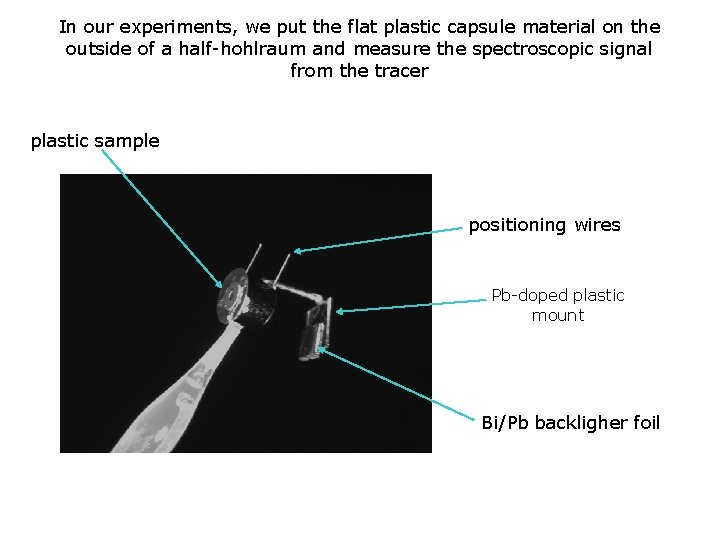
In our experiments, we put the flat plastic capsule material on the outside of a half-hohlraum and measure the spectroscopic signal from the tracer plastic sample positioning wires Pb-doped plastic mount Bi/Pb backligher foil
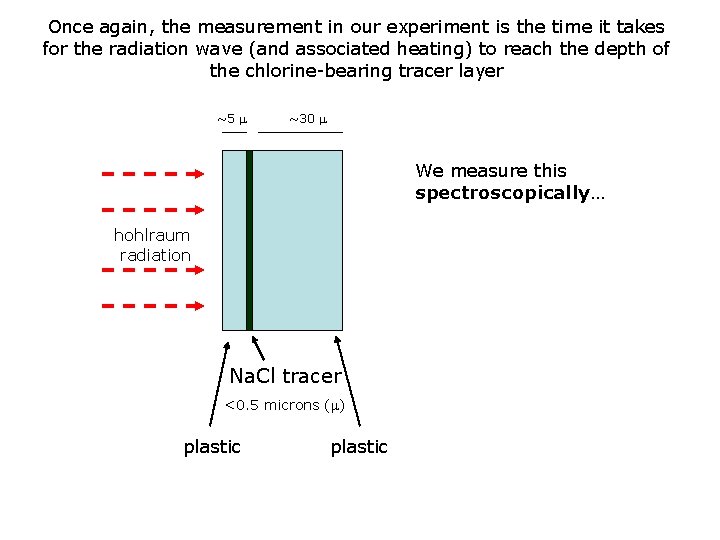
Once again, the measurement in our experiment is the time it takes for the radiation wave (and associated heating) to reach the depth of the chlorine-bearing tracer layer ~5 m ~30 m We measure this spectroscopically… hohlraum radiation Na. Cl tracer <0. 5 microns (m) plastic
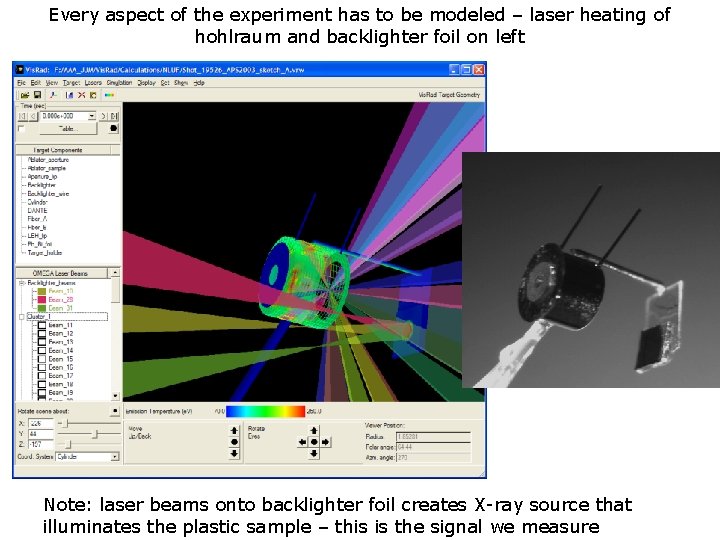
Every aspect of the experiment has to be modeled – laser heating of hohlraum and backlighter foil on left Note: laser beams onto backlighter foil creates X-ray source that illuminates the plastic sample – this is the signal we measure
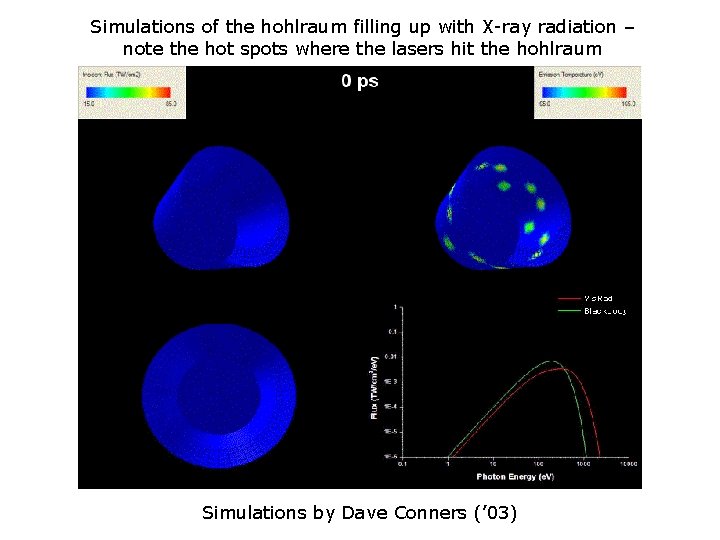
Simulations of the hohlraum filling up with X-ray radiation – note the hot spots where the lasers hit the hohlraum Simulations by Dave Conners (’ 03)
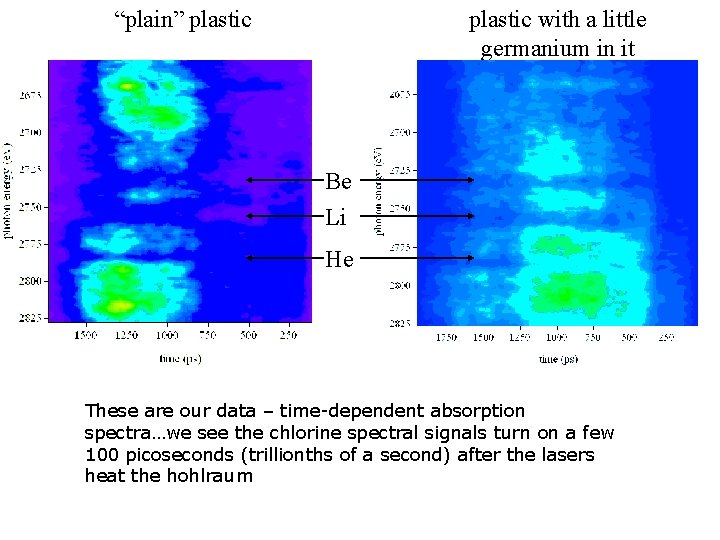
“plain” plastic with a little germanium in it Be Li He These are our data – time-dependent absorption spectra…we see the chlorine spectral signals turn on a few 100 picoseconds (trillionths of a second) after the lasers heat the hohlraum
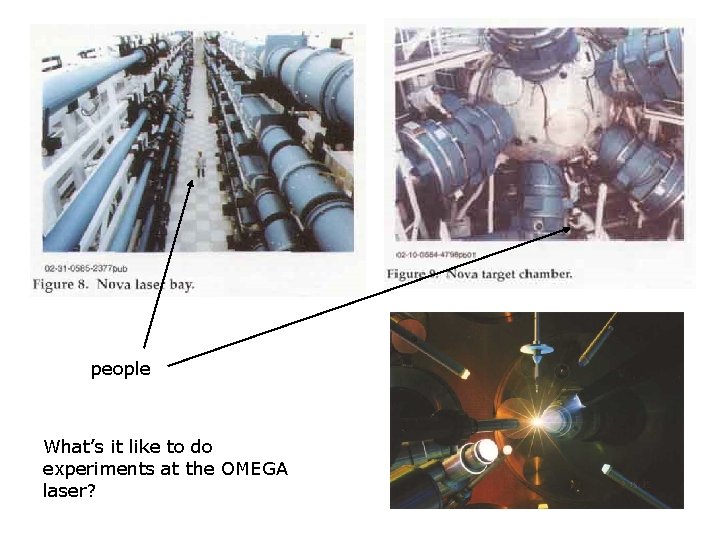
people What’s it like to do experiments at the OMEGA laser?
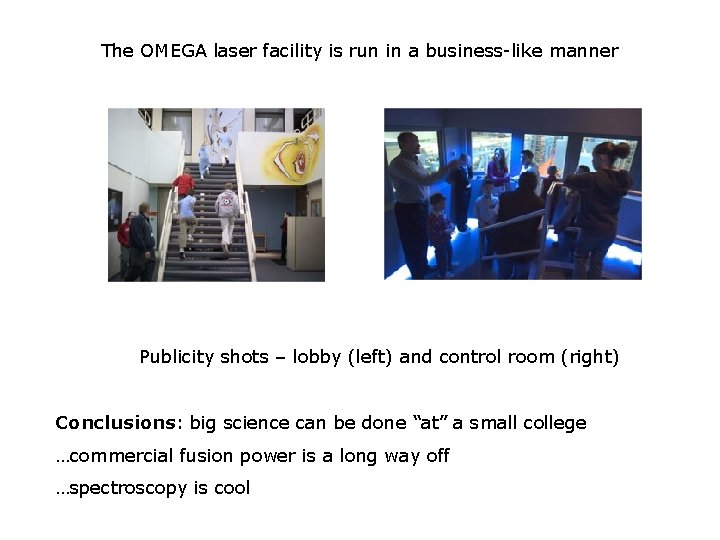
The OMEGA laser facility is run in a business-like manner Publicity shots – lobby (left) and control room (right) Conclusions: big science can be done “at” a small college …commercial fusion power is a long way off …spectroscopy is cool
- Slides: 15