
Big Questions Titanic By Emily Woitas 7 boh
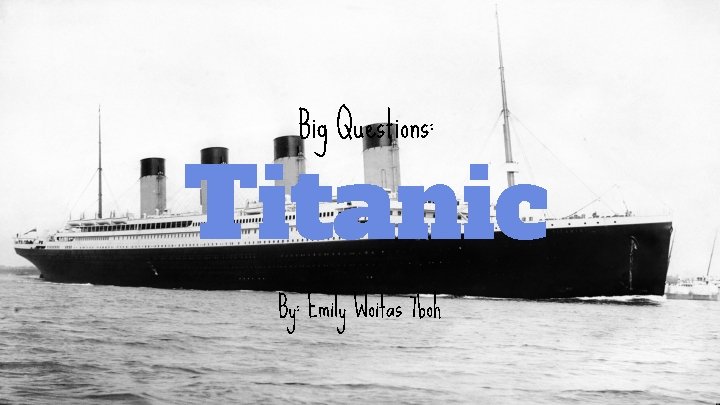
Big Questions: Titanic By: Emily Woitas 7 boh
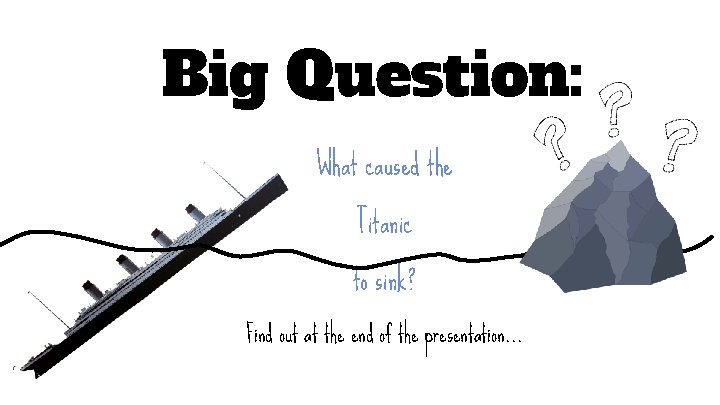
Big Question: What caused the Titanic to sink? Find out at the end of the presentation…
Is it a Manufactured or Natural structure? The Titanic is a manufactured structure, it took approximately 3 years to build. The Titanic is a manufactured structure because it was manmade, so it didn't occur naturally in the world. A natural structure is either worn down over time to create its standing form, or created by wildlife. A manufactured structure is something made with many different materials and it can sometimes copy the look of natural structures.
Is it a mass, frame or shell structure? I think the Titanic is both a mass, frame and shell structure. I think it’s a mass structure because it is made of many types of materials used to create its shape. I think it's a shell structure because of the watertight compartments at the bottom of the vessel, they were used to keep water out. If the ship struck something, only a few of the compartments would fill up and the other ones would be sectioned off from the water. The compartments were one of the reasons the ship was considered “unsinkable”. And lastly I think it's a frame structure because when building the Titanic, they had to build a frame first in order to support the heavier materials.

The Titanic is a hybrid of all three. Venn Diagram it s a. I aining l a i ure mater cont t c a ru t le st weigh ed as l s sh t A ly ligh be u l. n a l sua nd ca ateri u w, a m oh llo costly is a less lot Shell and frame Shell and mass Titanic struc A mass ture made structure m shap e or aterials by combi is a ni d i be h esign. M nto a cer ng simila eavie a r tha ss struc ain tu n oth er st res tend ructu t res. o Mass and frame A frame structure is a skeleton of strong materials used to support the weight of the covering materials. Some frames cannot be seen as they are used as load bearing structures.
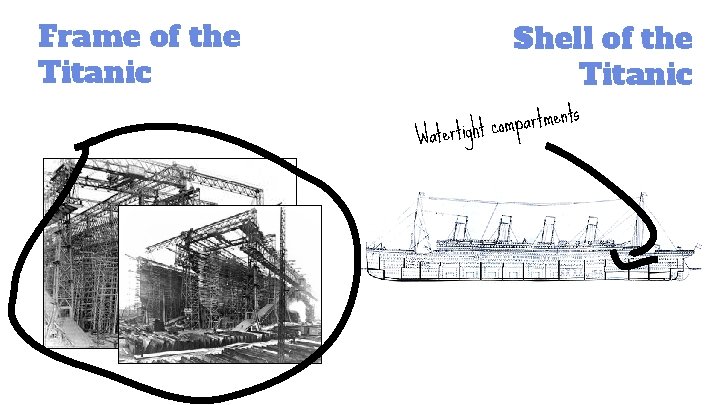
Frame of the Titanic Shell of the Titanic nts rtme a p m o c t h g i t Water
Functions What are the functions of the Titanic? First of all what is a function? A function is basically the main purpose of something, like what it was built for or what it is intended to do. Sometimes an object can have other functions, which may not be what the object was built for but other additional things it can do. The Titanic's main purpose was as a british passenger liner. It was designed to travel efficiently and safely across the ocean. The things that made this possible were two giant engines, three propellers weighing 60 tons and 29 boilers burning around 825 tons of coal a day. Another one of the titanic's functions was to entertain the passengers, that meant they had to have many amenities on board like a swimming pool, gymnasium, many restaurants and cafes, a squash court, etc.
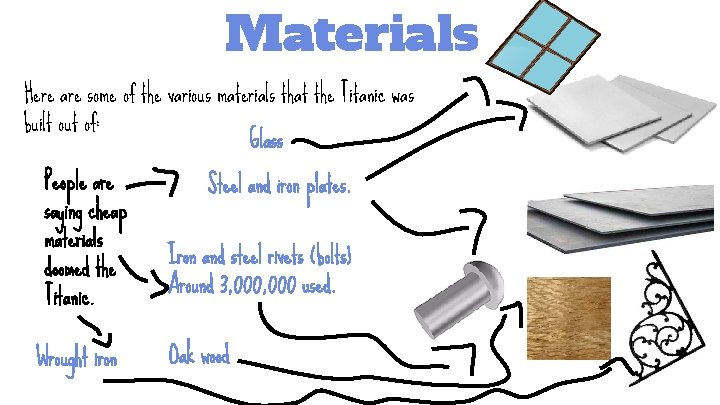
Materials Here are some of the various materials that the Titanic was built out of: Glass People are saying cheap materials doomed the Titanic. Wrought iron Steel and iron plates. Iron and steel rivets (bolts) Around 3, 000 used. Oak wood
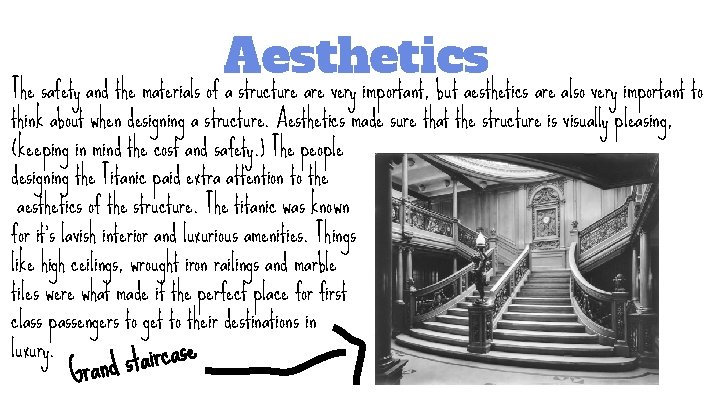
Aesthetics The safety and the materials of a structure are very important, but aesthetics are also very important to think about when designing a structure. Aesthetics made sure that the structure is visually pleasing, (keeping in mind the cost and safety. ) The people designing the Titanic paid extra attention to the aesthetics of the structure. The titanic was known for it's lavish interior and luxurious amenities. Things like high ceilings, wrought iron railings and marble tiles were what made it the perfect place for first class passengers to get to their destinations in luxury. aircase Grand st
Cost With the Titanic being the largest ship of that time and taking three years to build, you can expect the titanic to cost quite a bit of money, for that time anyway. The total cost of the Titanic added up to 7. 5 million dollars , you may not think that's a lot but in today's day and age 7. 5 million is equivalent to 174 million dollars, still even the movie Titanic cost more than that. If you look at the cost of the materials used, one steel plate today would cost around $15. 00, but back then it would have been a lot cheaper. Same with the iron rivets they used, today the cost of one iron rivet is around $1 -$3 but again, the materials were probably cheaper. And also the weekly pay for the workers who built the Titanic was only $2, which probably helped with the overall cost. Do you think that the workers should have been paid more?
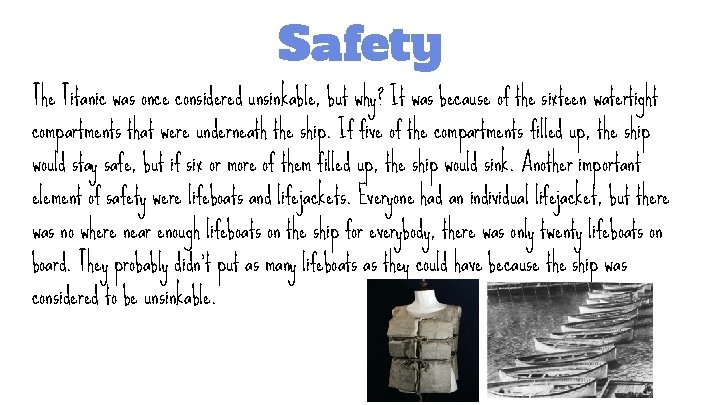
Safety The Titanic was once considered unsinkable, but why? It was because of the sixteen watertight compartments that were underneath the ship. If five of the compartments filled up, the ship would stay safe, but if six or more of them filled up, the ship would sink. Another important element of safety were lifeboats and lifejackets. Everyone had an individual lifejacket, but there was no where near enough lifeboats on the ship for everybody, there was only twenty lifeboats on board. They probably didn't put as many lifeboats as they could have because the ship was considered to be unsinkable.
Forces and Failure There are two main types of forces, internal and external. External forces are forces acting against the structure. There are two main types, dead and live load. Dead load is a permanent force acting against the structure, like if you think of the leaning tower of Pisa, it's buckling under the weight of itself. And then there's live loads. That is a temporary force acting against a structure, like a bird on a branch or someone sitting on a stool. Internal forces are produced from external forces. There are four different types, torsion (twisting), tension (pulling), compression (pushing), and shear (ripping). They are the effects of external forces. All these forces were what acted on the Titanic. Compression was when the titanic rammed into the iceberg, and shear was when the Titanic broke into two. Just as there are forces, there is also strength, which measures how much the structure can take before it collapses. Watch the video to find out more……
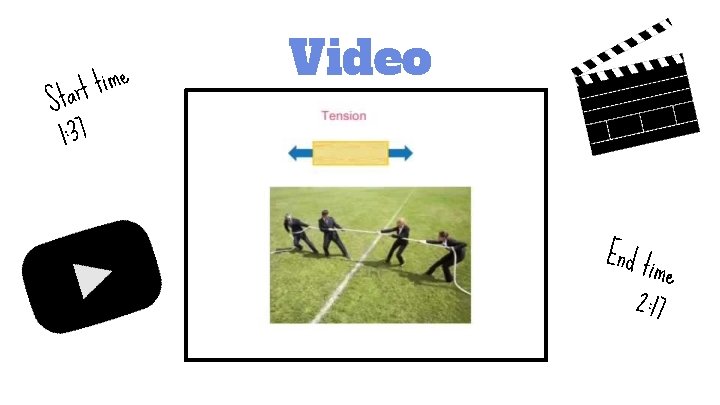
e m i t t Star 1: 37 Video End t ime 2: 17

Use of foundation I am not doing this one.
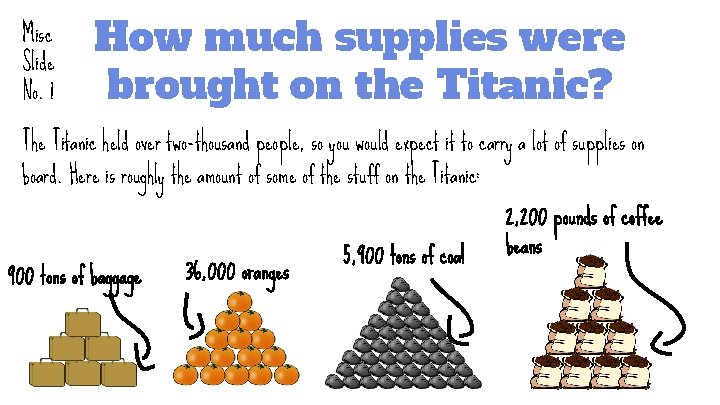
Misc Slide No. 1 How much supplies were brought on the Titanic? The Titanic held over two-thousand people, so you would expect it to carry a lot of supplies on board. Here is roughly the amount of some of the stuff on the Titanic: 900 tons of baggage 36, 000 oranges 5, 900 tons of coal 2, 200 pounds of coffee beans
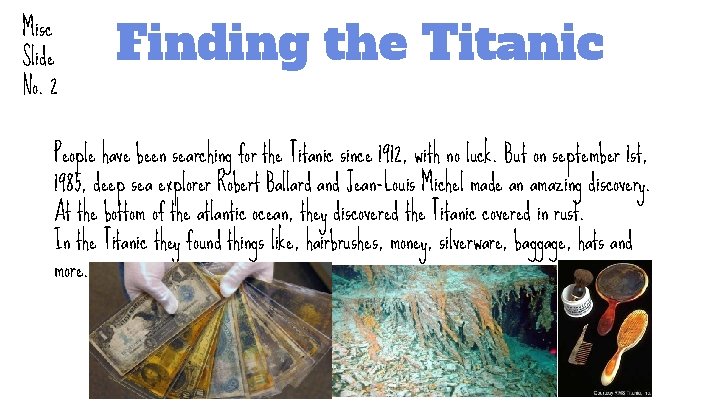
Misc Slide No. 2 Finding the Titanic People have been searching for the Titanic since 1912, with no luck. But on september 1 st, 1985, deep sea explorer Robert Ballard and Jean-Louis Michel made an amazing discovery. At the bottom of the atlantic ocean, they discovered the Titanic covered in rust. In the Titanic they found things like, hairbrushes, money, silverware, baggage, hats and more.
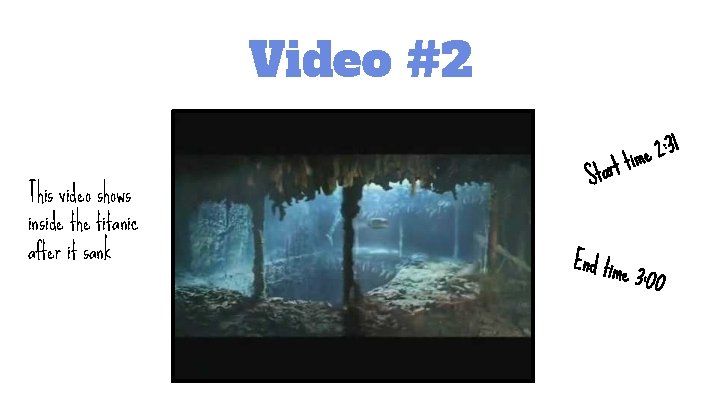
Video #2 This video shows inside the titanic after it sank 1 2: 3 e m i art t St End tim e 3: 00
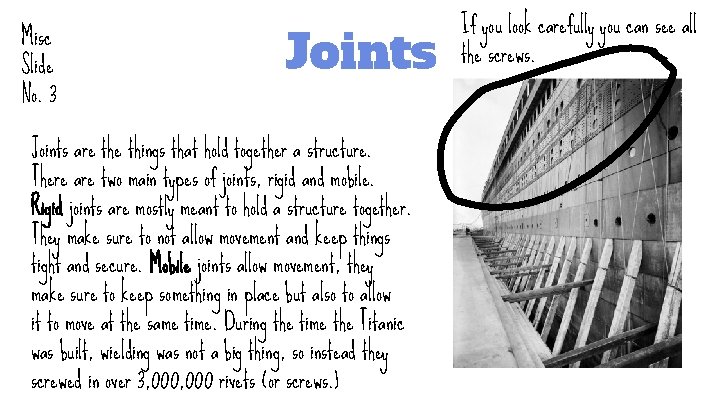
Misc Slide No. 3 Joints are things that hold together a structure. There are two main types of joints, rigid and mobile. Rigid joints are mostly meant to hold a structure together. They make sure to not allow movement and keep things tight and secure. Mobile joints allow movement, they make sure to keep something in place but also to allow it to move at the same time. During the time the Titanic was built, wielding was not a big thing, so instead they screwed in over 3, 000 rivets (or screws. ) If you look carefully you can see all the screws.
Conclusion Now it's time to answer the question, what caused the titanic to sink? There are many factors that contributed to it sinking, the ship was going to fast, the iceberg ran into the ship in the wrong place and they were ignoring the ice warnings but the most important thing was that they were not prepared for if disaster struck. Things like them using iron rivets instead of steel rivets caused bigger impact when the ship hit the iceberg, they didn’t have nearly enough lifeboats and nobody took the ship sinking seriously until it was too late. All these contributing factors made the disaster even more grief.
1 -MANDATORY Title page: name, homeroom, big question (one item missing = no points) · 1 - Is this a manufactured structure or a natural structure? Explain why! (if your question does not suit either type of structure, explain why, demonstrating you know what manufactured and natural structures are) · 1 - Is this a mass, frame, or shell structure, or hybrid? Explain why! (again, if your question does not suit this explanation, explain why, demonstrating that you know what mass, frame, shell, and hybrid structures are) · 1 - What is the function of your building/device/tool…? · 1 - What are the materials used? · 1 - What aesthetic qualities does your item have? · 1 - Describe relevant safety information pertaining to your question · 1 - Describe forces applicable to your question
Explain how structural or material failure might be a factor Marked Done Not Doing · Describe requirements for use of foundations, center of gravity · 1 -Other category 1: this one must be approved by Mrs. Bohaychuk, and have a specific title · 1 -Other category 2: again, must be approved · Other category 3: must be approved · MANDATORY Video: use a video clip from youtube, tell us when to start and stop watching the clip (time) You will be deducted half a point for not giving us the time to start and finish. 1 minute maximum · MANDATORY: minimum 10 high quality, relevant images · MANDATORY: Answer the question as a summary paragraph · 1 -MANDATORY: last slide has some conclusion, like “thanks for watching” or “the end” etc.
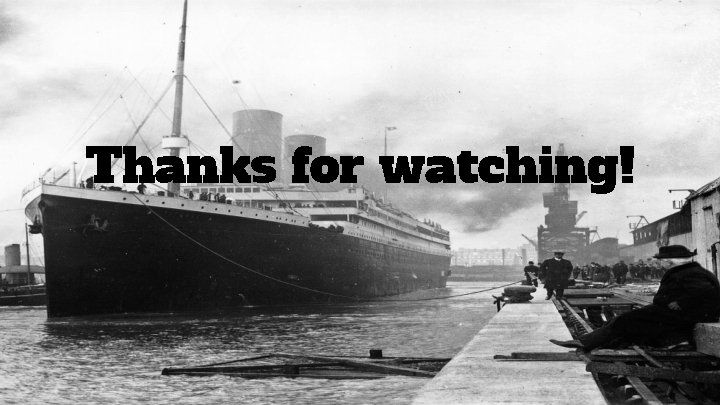
Thanks for watching!
- Slides: 22