
Big Question How do people adapt to difficult
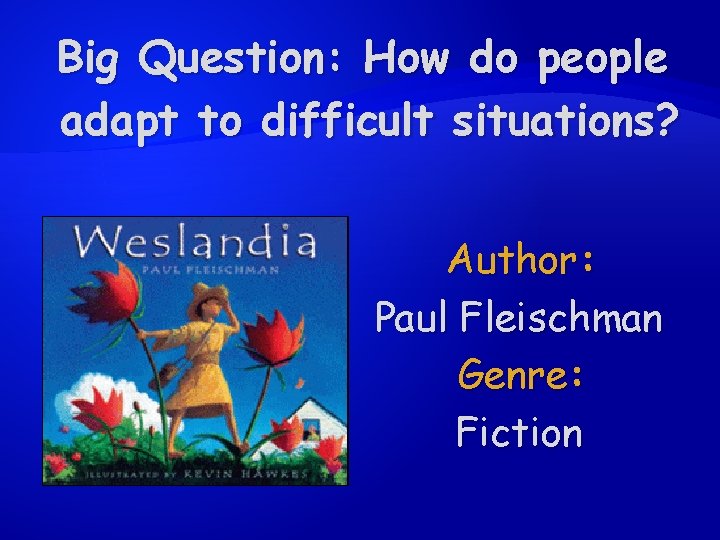
Big Question: How do people adapt to difficult situations? Author: Paul Fleischman Genre: Fiction
Small Group Timer
Review Games Story Sort Vocabulary Words: Words Arcade Games Study Stack Spelling City: Vocabulary Spelling City: Spelling Words
Spelling Words from Many Cultures
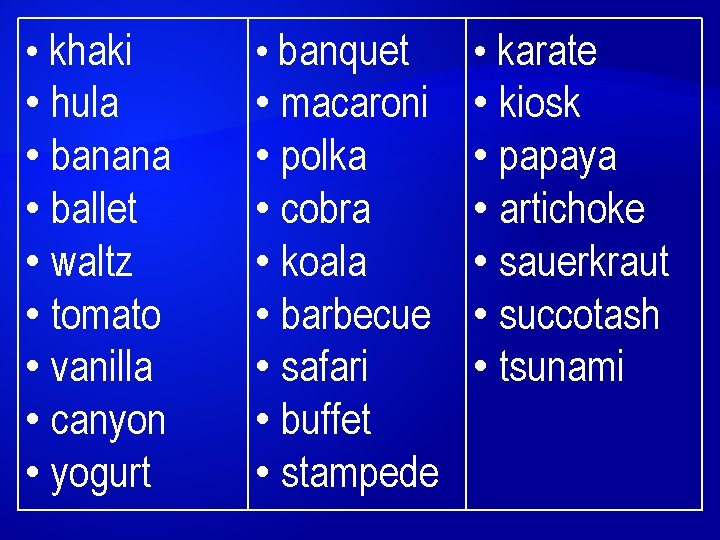
• khaki • banquet • karate • hula • banana • ballet • waltz • tomato • vanilla • canyon • yogurt • macaroni • polka • cobra • koala • barbecue • safari • buffet • stampede • kiosk • papaya • artichoke • sauerkraut • succotash • tsunami
Big Question: How do people adapt to difficult situations? Monday Tuesday Wednesday Thursday Friday
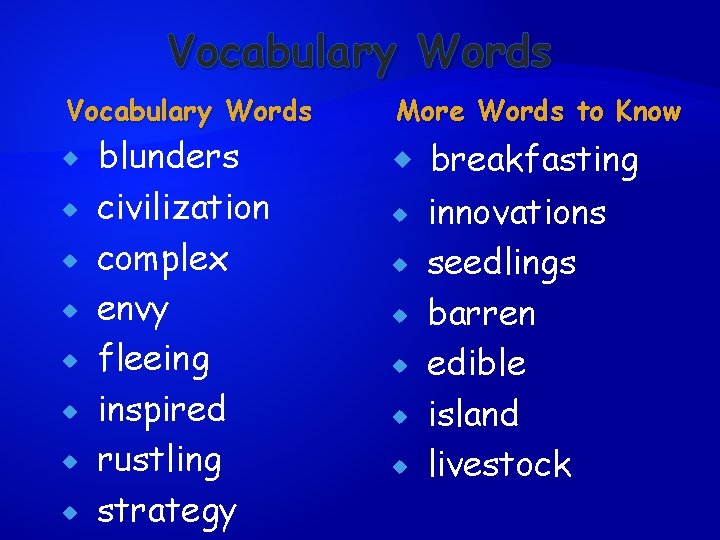
Vocabulary Words More Words to Know breakfasting blunders civilization complex envy fleeing inspired rustling strategy innovations seedlings barren edible island livestock
Monday Question of the Day How do people adapt to difficult situations?
Today we will learn about: Build Concepts Draw Conclusions Answer Questions Build Background Vocabulary Fluency: Model Punctuation Clues Grammar: Subject and Object Pronouns Spelling: Words from Many Cultures People Adapting
Fluency Model Punctuation Clues
Fluency: Model Punctuation Clues Listen as I read “The Black Stallion. ” As I read, notice how I pause for commas or periods or raise my voice at the end of a question. Be ready to answer questions after I finish.
Fluency: Model Punctuation Clues How is Alec feeling in paragraph 1? Do you think Alec will survive? Why or why not?
Concept Vocabulary barren – not able to produce much edible – fit to eat island – body of land smaller than a continent and completely surrounded by water livestock – farm animals (next slide)
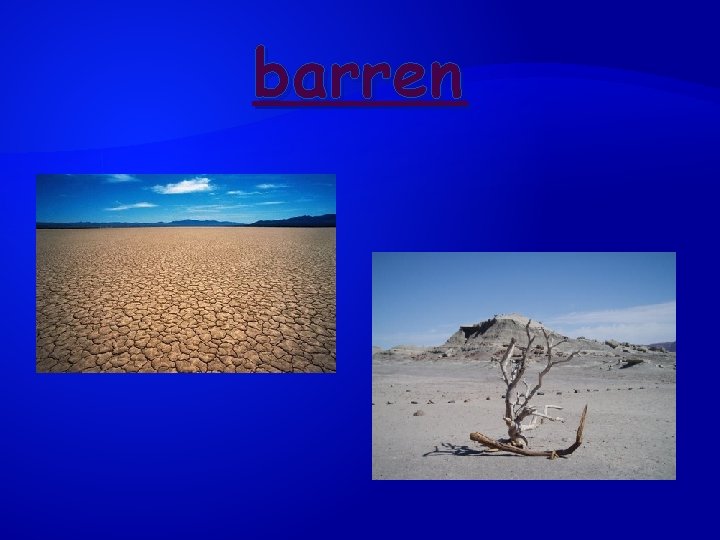
barren

island
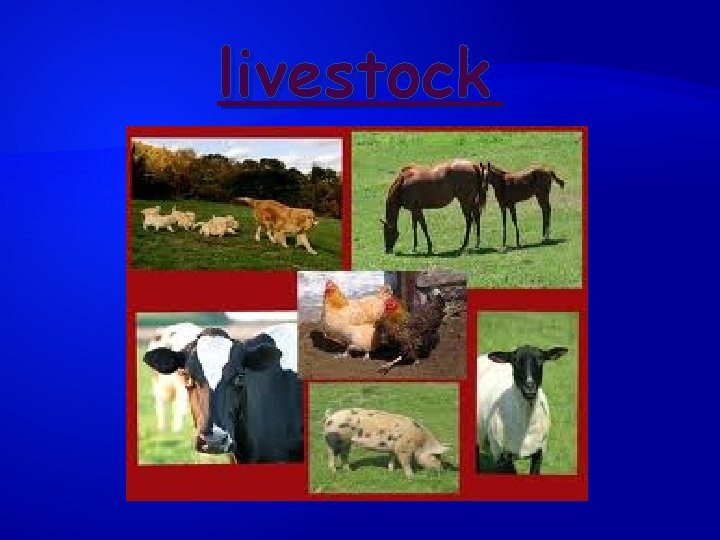
livestock
Concept Vocabulary (To add information to the graphic organizer, click on end show, type in your new information, and save your changes. )
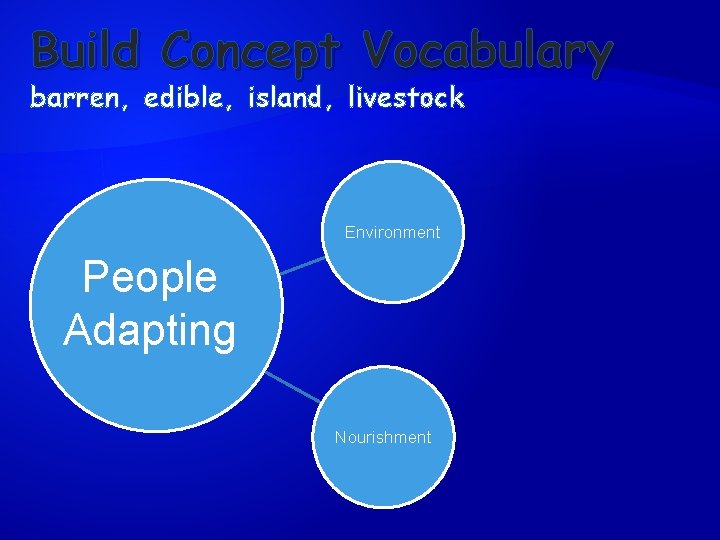
Build Concept Vocabulary barren, edible, island, livestock Environment People Adapting Nourishment
Draw Conclusions, Answer Questions Turn to page 392 – 393.
Prior Knowledge Name as many plant parts as you can. Plant Parts
Prior Knowledge This week’s audio explores gardening with children. After we listen, we will discuss challenges and rewards gardening with children might bring. What did you find most surprising?
Vocabulary Words
Vocabulary Words blunders – stupid mistakes civilization – the ways of living of a people or nation complex – made up of a number of parts; hard to understand envy – feeling of discontent, dislike, or desire because another person has what you want fleeing – running away
Vocabulary Words inspired – filled with a thought or feeling; influenced rustling – causing a light, soft sound of things gently rubbing together strategy – the skillful planning and management of anything
More Words to Know breakfasting – eating the first meal of the day innovations – changes made in the established way of doing things seedlings – young plants grown from seeds (Next Slide )
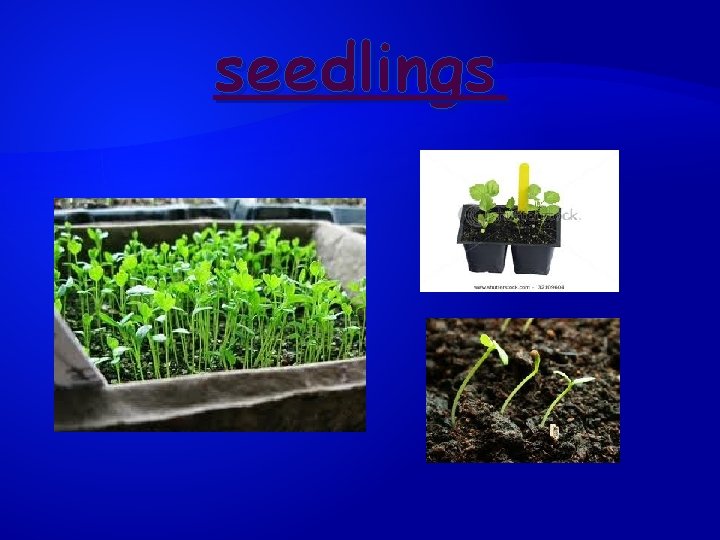
seedlings
Grammar Subject and Object Pronouns
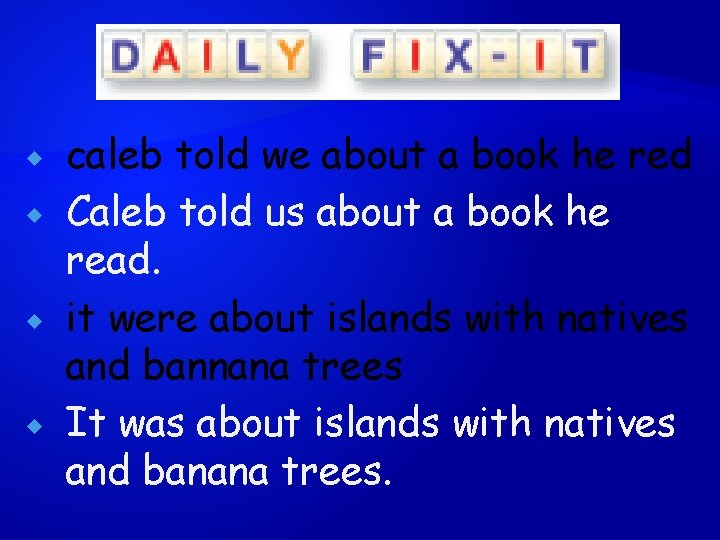
caleb told we about a book he red Caleb told us about a book he read. it were about islands with natives and bannana trees It was about islands with natives and banana trees.
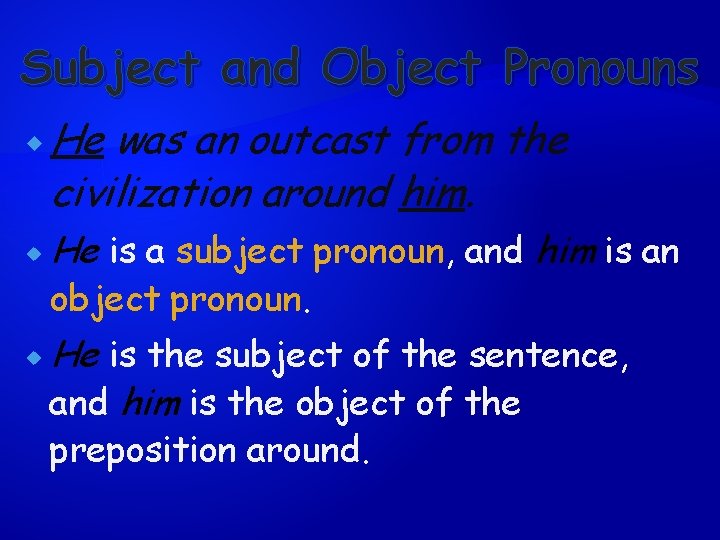
Subject and Object Pronouns He was an outcast from the civilization around him. He is a subject pronoun, and him is an object pronoun. He is the subject of the sentence, and him is the object of the preposition around.
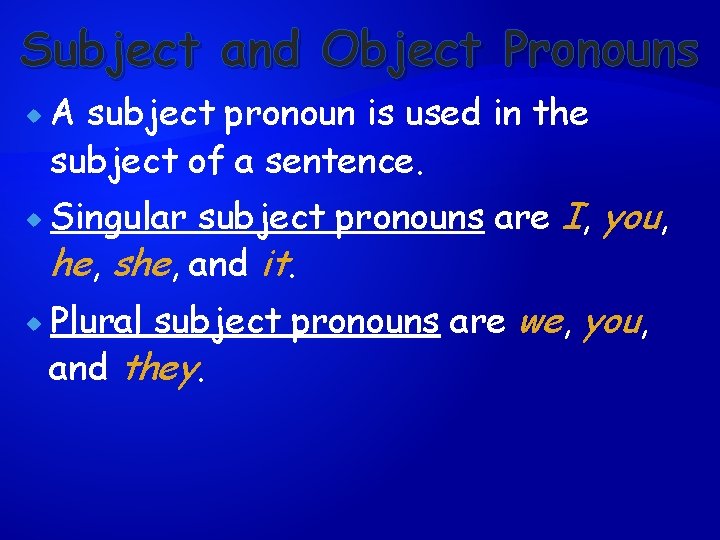
Subject and Object Pronouns A subject pronoun is used in the subject of a sentence. subject pronouns are I, you, he, she, and it. Singular subject pronouns are we, you, and they. Plural
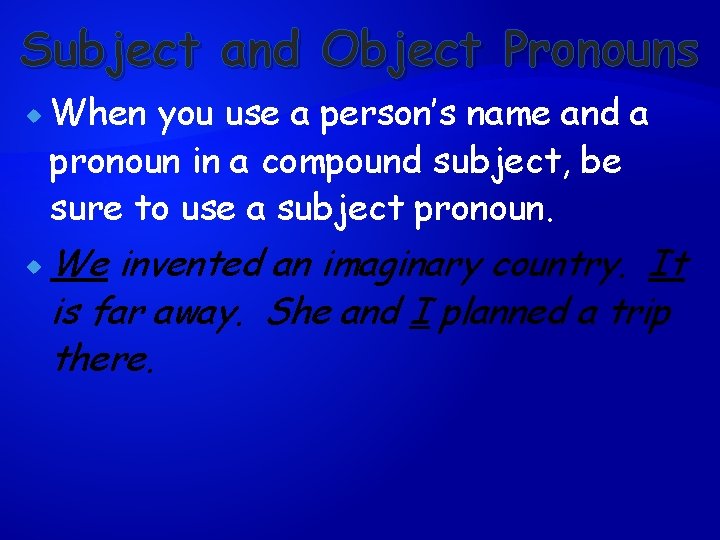
Subject and Object Pronouns When you use a person’s name and a pronoun in a compound subject, be sure to use a subject pronoun. We invented an imaginary country. It is far away. She and I planned a trip there.
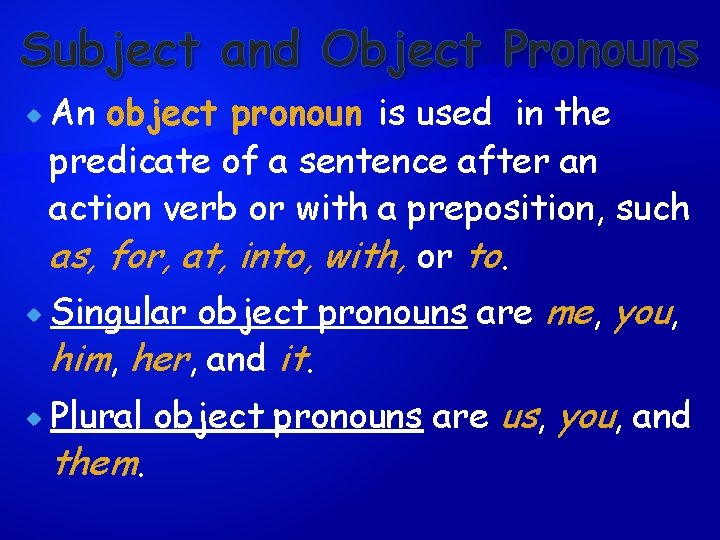
Subject and Object Pronouns An object pronoun is used in the predicate of a sentence after an action verb or with a preposition, such as, for, at, into, with, or to. object pronouns are me, you, him, her, and it. Singular Plural them. object pronouns are us, you, and
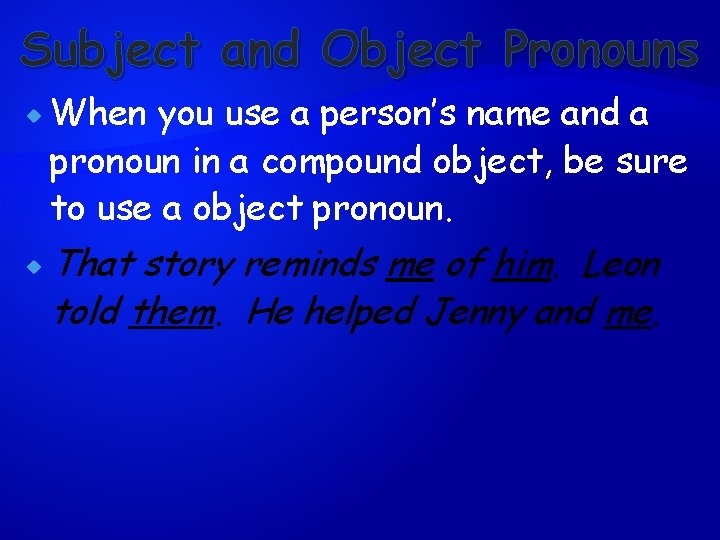
Subject and Object Pronouns When you use a person’s name and a pronoun in a compound object, be sure to use a object pronoun. That story reminds me of him. Leon told them. He helped Jenny and me.
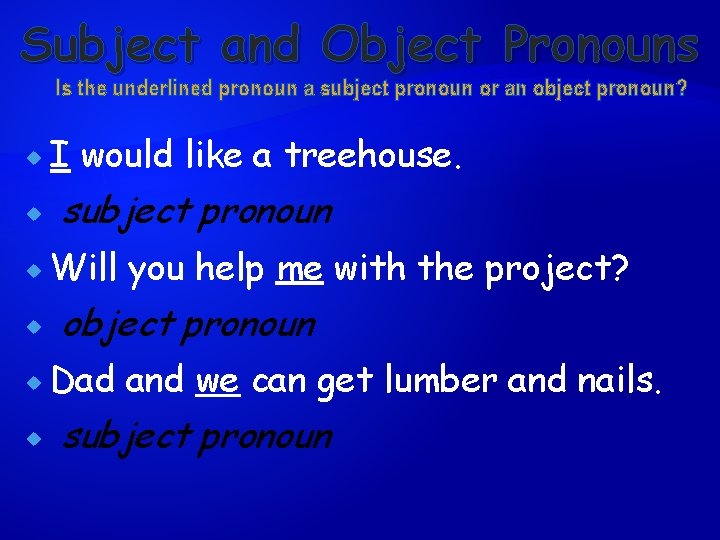
Subject and Object Pronouns Is the underlined pronoun a subject pronoun or an object pronoun? I would like a treehouse. subject pronoun Will object pronoun Dad you help me with the project? and we can get lumber and nails. subject pronoun
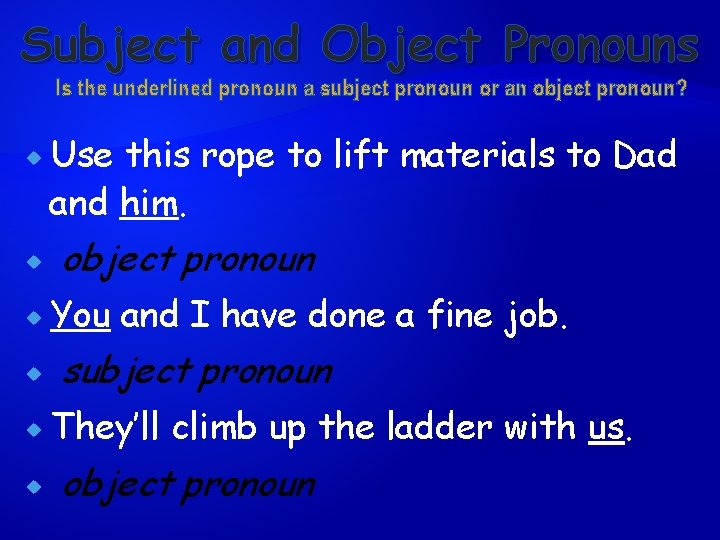
Subject and Object Pronouns Is the underlined pronoun a subject pronoun or an object pronoun? Use this rope to lift materials to Dad and him. object pronoun You and I have done a fine job. subject pronoun They’ll climb up the ladder with us. object pronoun
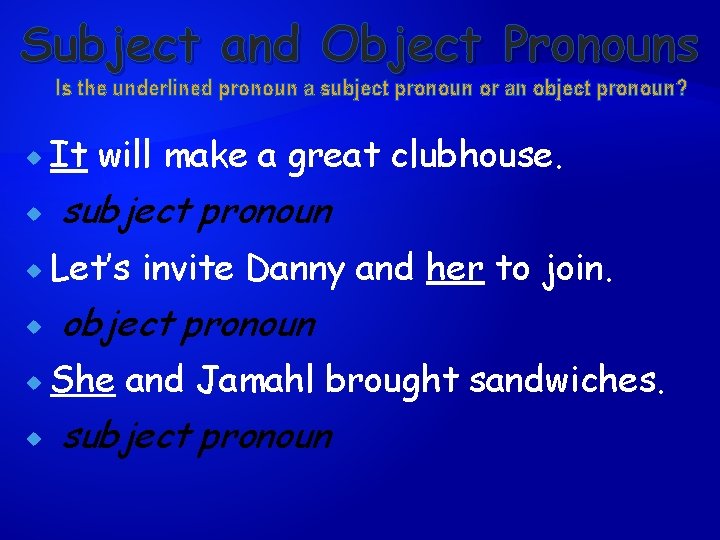
Subject and Object Pronouns Is the underlined pronoun a subject pronoun or an object pronoun? It will make a great clubhouse. subject pronoun Let’s object pronoun She invite Danny and her to join. and Jamahl brought sandwiches. subject pronoun
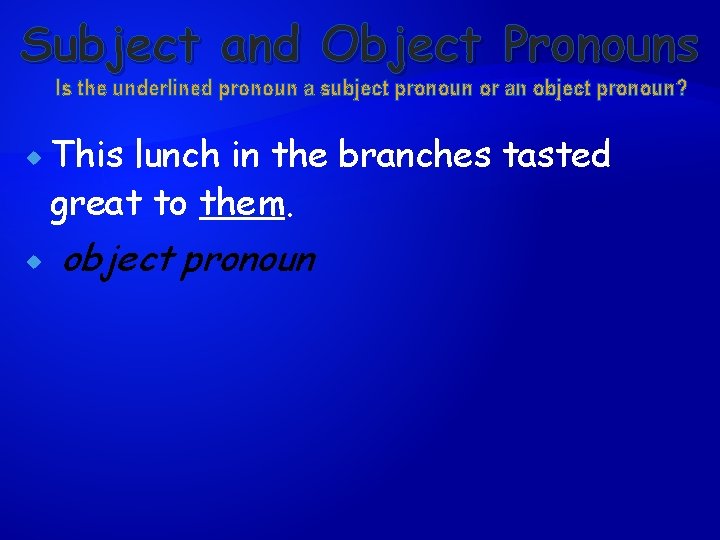
Subject and Object Pronouns Is the underlined pronoun a subject pronoun or an object pronoun? This lunch in the branches tasted great to them. object pronoun
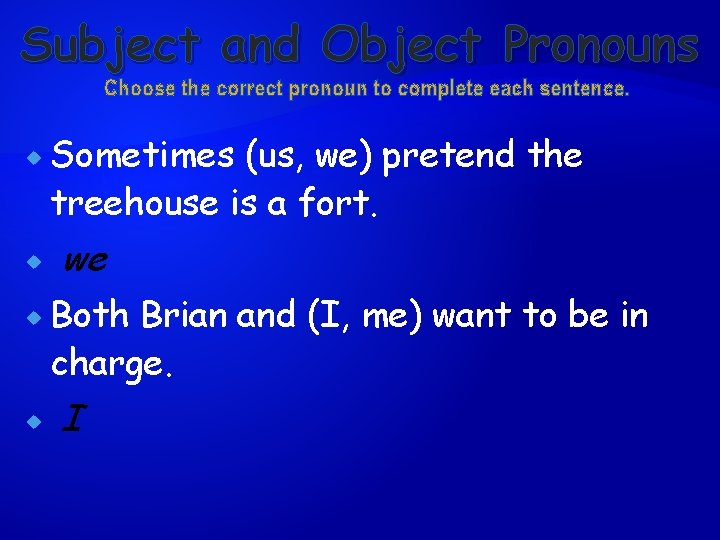
Subject and Object Pronouns Choose the correct pronoun to complete each sentence. Sometimes (us, we) pretend the treehouse is a fort. we Both Brian and (I, me) want to be in charge. I
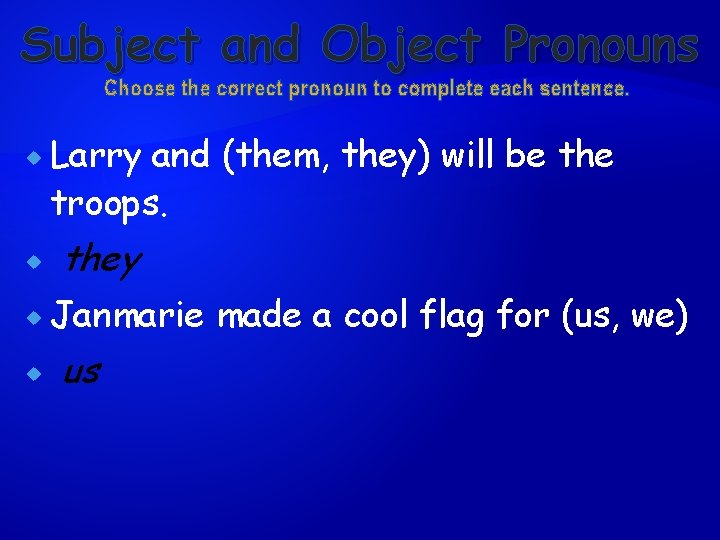
Subject and Object Pronouns Choose the correct pronoun to complete each sentence. Larry and (them, they) will be the troops. they Janmarie us made a cool flag for (us, we)
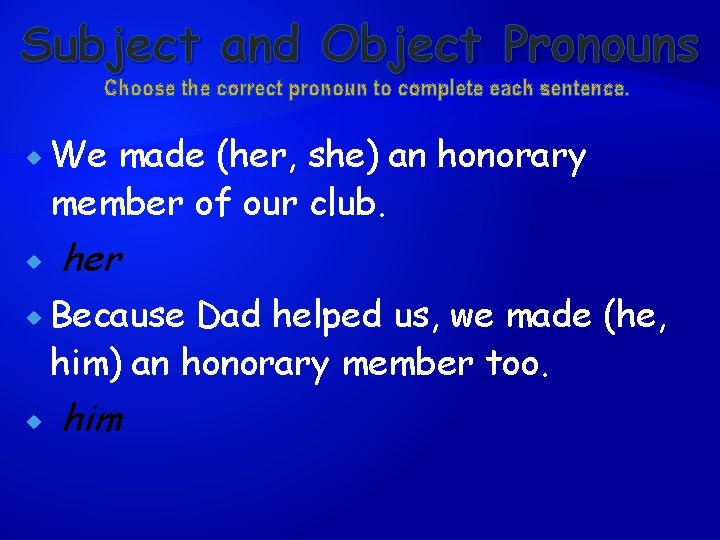
Subject and Object Pronouns Choose the correct pronoun to complete each sentence. We made (her, she) an honorary member of our club. her Because Dad helped us, we made (he, him) an honorary member too. him
Spelling Words from Many Cultures
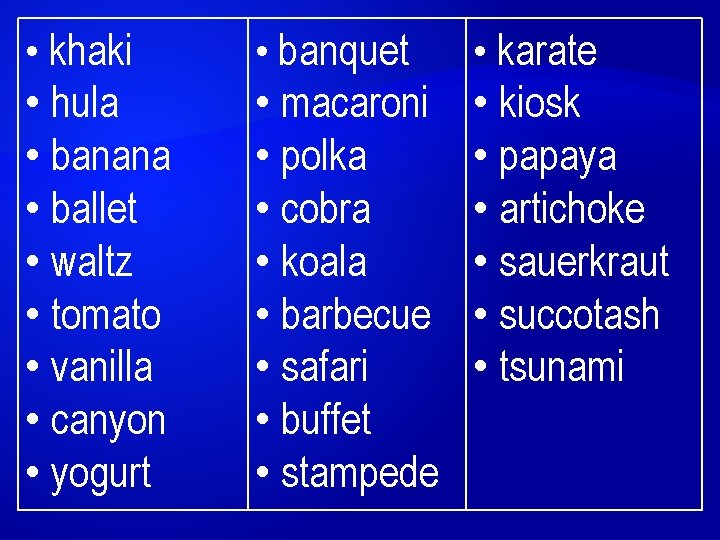
• khaki • banquet • karate • hula • banana • ballet • waltz • tomato • vanilla • canyon • yogurt • macaroni • polka • cobra • koala • barbecue • safari • buffet • stampede • kiosk • papaya • artichoke • sauerkraut • succotash • tsunami
Tuesday Question of the Day Why do you think Wesley was such an outcast at school?
Today we will learn about: Word Structure: Endings Draw Conclusions Main Idea Vocabulary Fluency: Choral Reading Grammar: Subject and Object Pronouns Spelling: Words from Many Cultures Time for Science: Declaration of Independence People Adapting
Vocabulary Strategy: Endings Turn to page 394 – 395.

Weslandia Pages 396 - 403.
Fluency Choral Reading
Fluency: Choral Reading Turn to page 400. As I read, notice how I use an excited tone of voice when reading sentences that end with exclamation points and pause at the dash. We will practice as a class doing three choral readings of this paragraph.
Grammar Subject and Object Pronouns
the natives had lived on the iland for centurys The natives had lived on the island for centuries. them ate the roots leaves, and fruits of a plant that growed there They ate the roots, leaves, and fruits of a plant that grew there.
Subject and Object Pronouns When a pronoun is used as the subject of a sentence, it is called a subject pronoun. I, you, she, it, we, and they are subject pronouns. Pronouns that are used after action verbs or as objects of prepositions are called object pronouns. Me, you, him, her, it, us, and them are object pronouns.
Spelling Words from Many Cultures
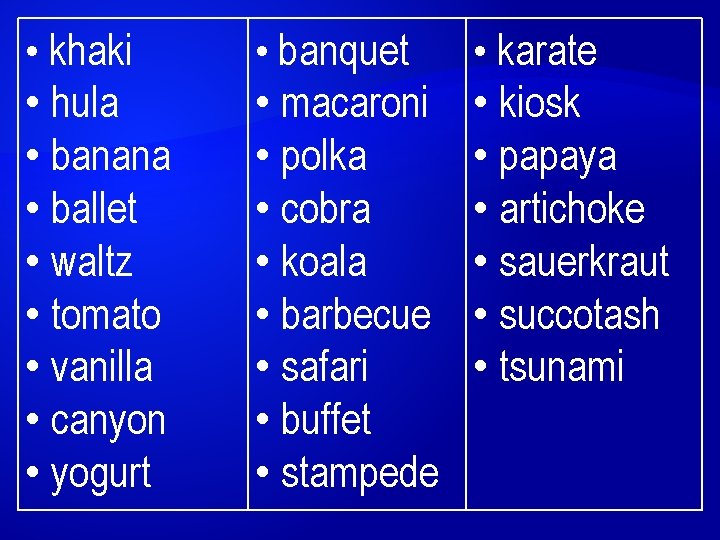
• khaki • banquet • karate • hula • banana • ballet • waltz • tomato • vanilla • canyon • yogurt • macaroni • polka • cobra • koala • barbecue • safari • buffet • stampede • kiosk • papaya • artichoke • sauerkraut • succotash • tsunami
Wednesday Question of the Day Would you like to be Wesley’s friend? Why or why not?
Today we will learn about: Draw Conclusions Answer Questions Vocabulary Fluency: Model Punctuation Clues Grammar: Subject and Object Pronouns Spelling: Words from Many Cultures Time for Social Studies: Amish Culture People Adapting

Weslandia Pages 404 - 408.
Fluency Model Punctuation Clues
Fluency: Punctuation Clues Turn to page 402. As I read, notice how I pause for commas and periods, and how my voice changes when reading the question. Now we will practice together as a class by doing three choral readings.
Grammar Subject and Object Pronouns
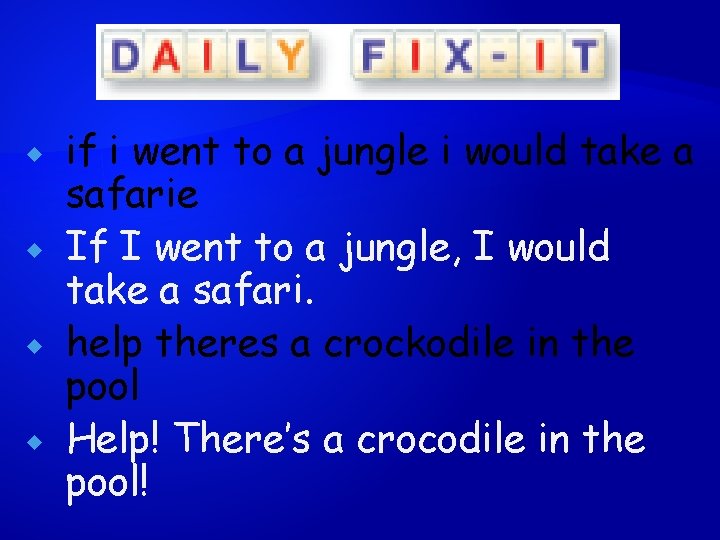
if i went to a jungle i would take a safarie If I went to a jungle, I would take a safari. help theres a crockodile in the pool Help! There’s a crocodile in the pool!
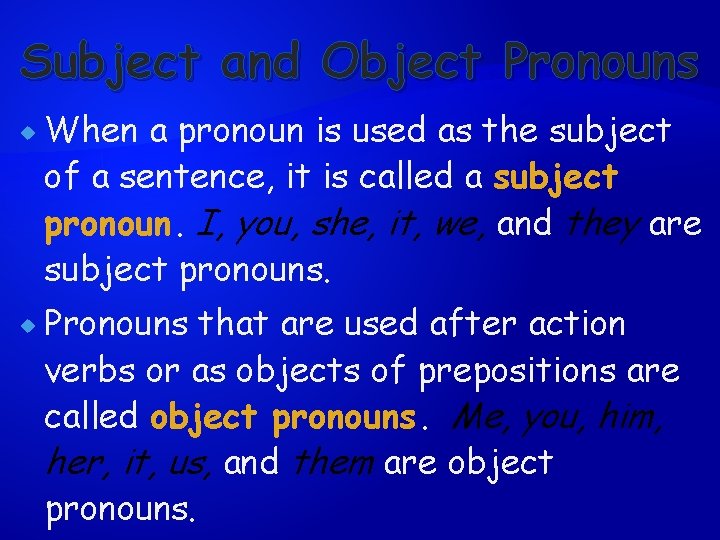
Subject and Object Pronouns When a pronoun is used as the subject of a sentence, it is called a subject pronoun. I, you, she, it, we, and they are subject pronouns. Pronouns that are used after action verbs or as objects of prepositions are called object pronouns. Me, you, him, her, it, us, and them are object pronouns.
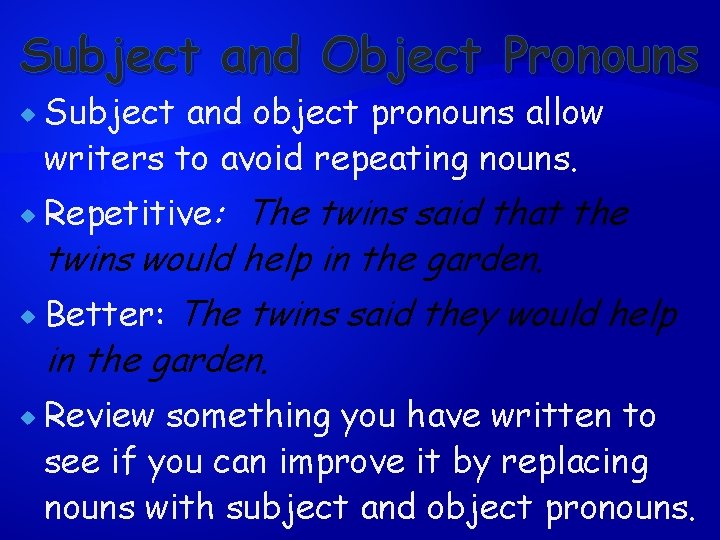
Subject and Object Pronouns Subject and object pronouns allow writers to avoid repeating nouns. Repetitive: The twins said that the twins would help in the garden. Better: The twins said they would help in the garden. Review something you have written to see if you can improve it by replacing nouns with subject and object pronouns.
Spelling Words from Many Cultures
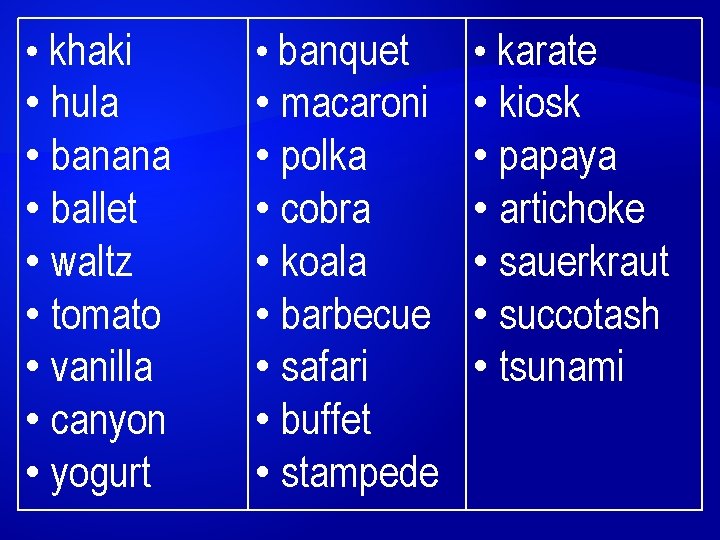
• khaki • banquet • karate • hula • banana • ballet • waltz • tomato • vanilla • canyon • yogurt • macaroni • polka • cobra • koala • barbecue • safari • buffet • stampede • kiosk • papaya • artichoke • sauerkraut • succotash • tsunami
Thursday Question of the Day Where is a special, safe place you like to go when you want to be alone?
Today we will learn about: Poetry Reading Across Texts Fluency: Partner Reading Grammar: Subject and Object Pronouns Spelling: Words from Many Cultures Time for Social Studies: African American Authors

“Under the Back Porch” Page 410

“Keziah” Page 411
Fluency Partner Reading
Fluency: Partner Reading Turn to page 402. Read these paragraphs three times with a partner. Be sure to read with pauses and expression, using punctuation as a guide. Offer each other feedback.
Grammar Subject and Object Pronouns
paul and him wrote a book on finding food in the wild Paul and he wrote a book on finding food in the wild. the section on edible Flowers are interesting The section on edible flowers is interesting.
Subject and Object Pronouns When a pronoun is used as the subject of a sentence, it is called a subject pronoun. I, you, she, it, we, and they are subject pronouns. Pronouns that are used after action verbs or as objects of prepositions are called object pronouns. Me, you, him, her, it, us, and them are object pronouns.
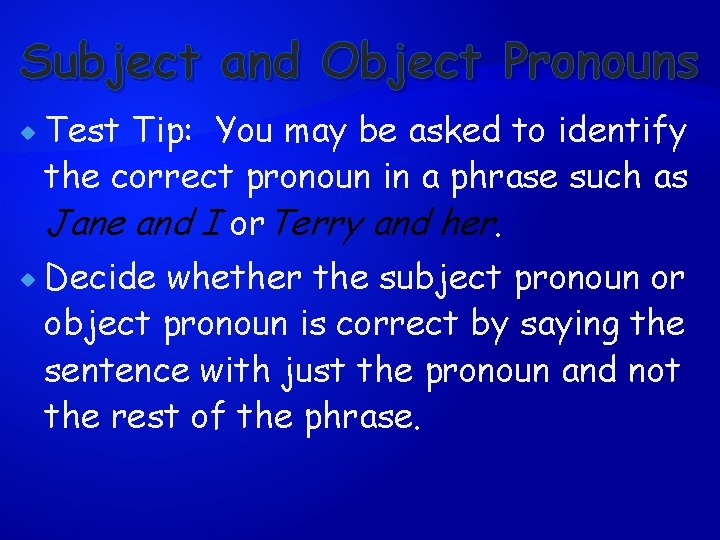
Subject and Object Pronouns Test Tip: You may be asked to identify the correct pronoun in a phrase such as Jane and I or. Terry and her. Decide whether the subject pronoun or object pronoun is correct by saying the sentence with just the pronoun and not the rest of the phrase.
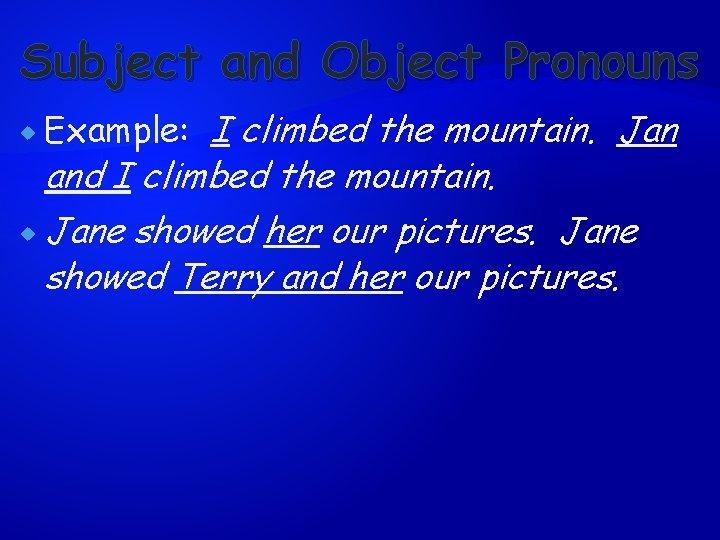
Subject and Object Pronouns I climbed the mountain. Jan and I climbed the mountain. Jane showed her our pictures. Jane showed Terry and her our pictures. Example:
Spelling Words from Many Cultures
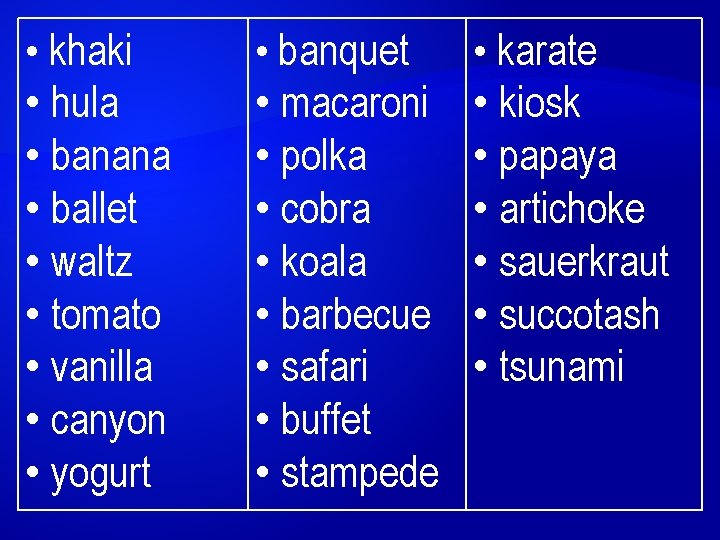
• khaki • banquet • karate • hula • banana • ballet • waltz • tomato • vanilla • canyon • yogurt • macaroni • polka • cobra • koala • barbecue • safari • buffet • stampede • kiosk • papaya • artichoke • sauerkraut • succotash • tsunami
Friday Question of the Day How do people adapt to difficult situations?
Today we will learn about: Draw Conclusions Idiom Word Structure: Endings Grammar: Subject and Object Pronouns Spelling: Words from Many Cultures Instruction Manual People Adapting
Draw Conclusions A conclusion is a decision you make after thinking about the details in what you read. Often your prior knowledge can help you draw, or make, a conclusion. When you draw a conclusion, be sure it makes sense and is supported by what you have read.
An Idiom is a group of words that cannot be understood by the ordinary meaning of the words. Examples include “pulling your leg” or “bury the hatchet. ” In idioms, words take on non-literal meanings. Often the meaning of idioms can be understood by figuring out what makes sense in context.
Word Structure: Endings endings –ed, -ing, and –s maybe added to verbs to change the tense. The endings can also be used to help determine the meaning of an unfamiliar word. Examine words with these endings from Weslandia. Identify the base words and meanings and see if you can make new words with the other two endings. The
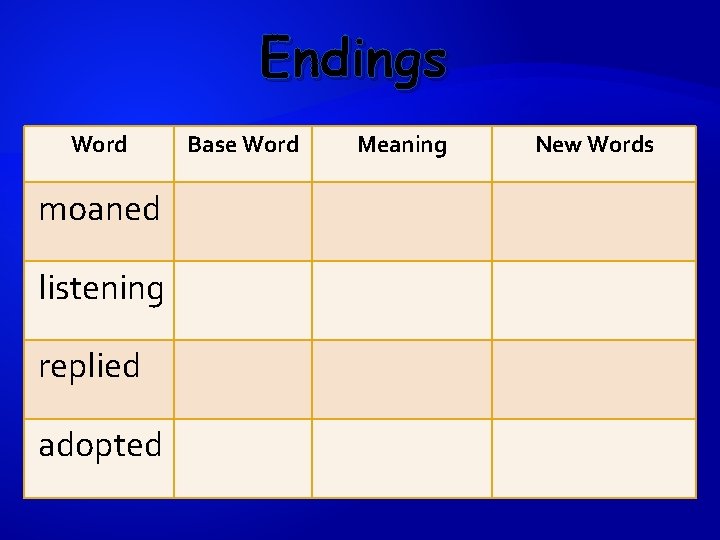
Endings Word moaned listening replied adopted Base Word Meaning New Words
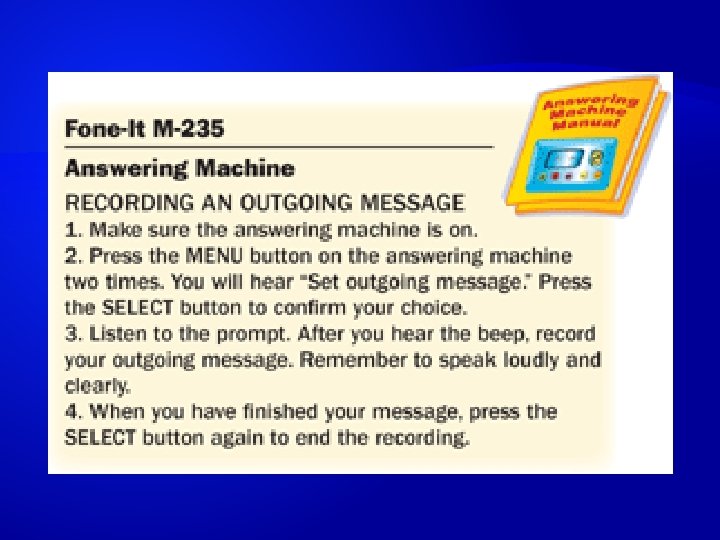
Instruction Manual How can you find out how to bake a cake, or how to program a new cell phone? A manual is a book that contains instructions on how to do something. Instructions tell how to do something, usually in the form of a numbered list.
Instruction Manual Instructions also tell how to follow a procedure , or method of doing something. The instructions should be read completely before you begin. To follow the instructions, read the first step, do what it says, then go onto the next step. Try to visualize each step as you go.
Instruction Manuals often contain warnings about a procedure, explaining any danger involved. These are marked with an exclamation mark, or the word WARNING or CAUTION.
Grammar Subject and Object Pronouns
the tamato was an early food of south american natives The tomato was an early food of South American natives. chocolate also comed to us, from Native americans Chocolate also came to us from Native Americans.
Subject and Object Pronouns When a pronoun is used as the subject of a sentence, it is called a subject pronoun. I, you, she, it, we, and they are subject pronouns. Pronouns that are used after action verbs or as objects of prepositions are called object pronouns. Me, you, him, her, it, us, and them are object pronouns.
Spelling Words from Many Cultures
• khaki • banquet • karate • hula • banana • ballet • waltz • tomato • vanilla • canyon • yogurt • macaroni • polka • cobra • koala • barbecue • safari • buffet • stampede • kiosk • papaya • artichoke • sauerkraut • succotash • tsunami
We are now ready to take our story tests. Story test Classroom webpage, Reading Test AR Other Reading Quizzes Quiz #
- Slides: 93