
Big Ideas Problem Solving in the Junior Classroom
“Big Ideas” & Problem Solving in the Junior Classroom By: Kerri Messerschmidt
What are “Big Ideas”? � Coined by Schifter and Fosnot, “Big Ideas” is defined as the “central, organizing ideas of mathematics” (From A Guide to Effective Instruction in Mathematics, Volume 2, 19) � “Big Ideas” are the key concepts of mathematics Example: In the K to Grade 3 Number Sense and Numeration strand of the Ontario curriculum, the “Big Ideas” are counting, operational sense, quantity, relationships, and representation
Why are “Big Ideas” Important? Focusing on the “Big Ideas” allows teachers to: � Make instructional decisions � Assess prior learning � Make note of the strategies a student uses when working with mathematical concepts � Provide feedback � Determine next steps Students are able to make connections to see that mathematics is an integrated whole. Through practice and continued focus on the “Big Ideas”, students will gain a more thorough understanding of these ideas!
What is the “Problem Solving Approach”? � � Problem solving is used as a platform to engage all students as they explore new mathematical concepts New concepts are taught through the presentation of a problem Students work in groups or individually to tackle the problem through various mathematical strategies while the teacher circulates to support The method of the solution is determined by the students
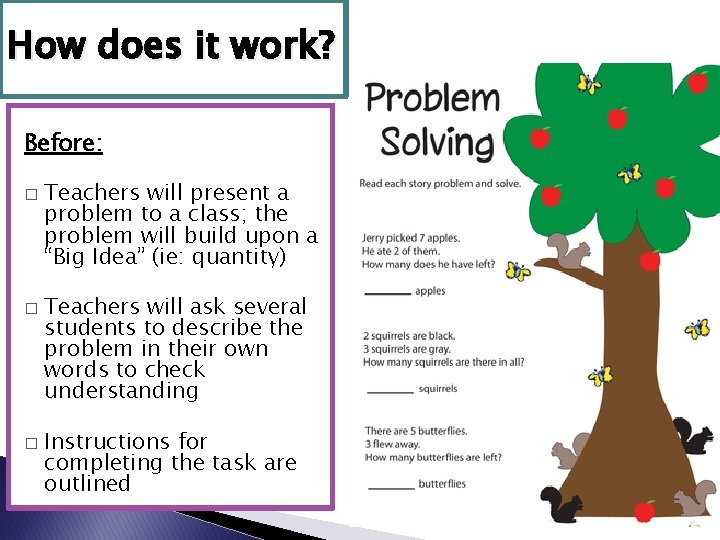
How does it work? Before: � � � Teachers will present a problem to a class; the problem will build upon a “Big Idea” (ie: quantity) Teachers will ask several students to describe the problem in their own words to check understanding Instructions for completing the task are outlined
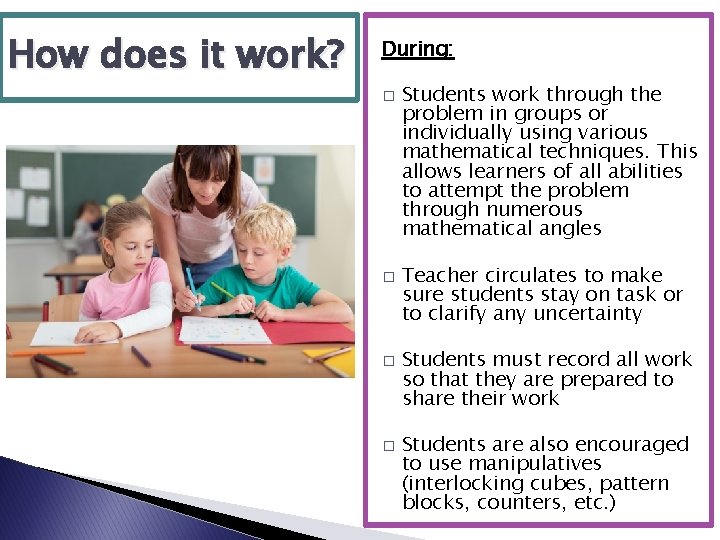
How does it work? During: � � Students work through the problem in groups or individually using various mathematical techniques. This allows learners of all abilities to attempt the problem through numerous mathematical angles Teacher circulates to make sure students stay on task or to clarify any uncertainty Students must record all work so that they are prepared to share their work Students are also encouraged to use manipulatives (interlocking cubes, pattern blocks, counters, etc. )
How does it work? After: � At the end, the whole class gathers to share their strategies and reflect on the problem � The teacher uses questioning to stimulate discussion, validate strategies, and uncover the one that makes the most sense

Why is the “Problem Solving” Approach important to the development of “Big Ideas”? � Teaching has evolved over time and now focuses more on “learning by doing” as opposed to “traditional teaching” � Students are learning the importance of taking steps to solve a problem Teaching through Problem Solving allows instructors to focus on “Big Ideas” which is fundamental to learning mathematics!
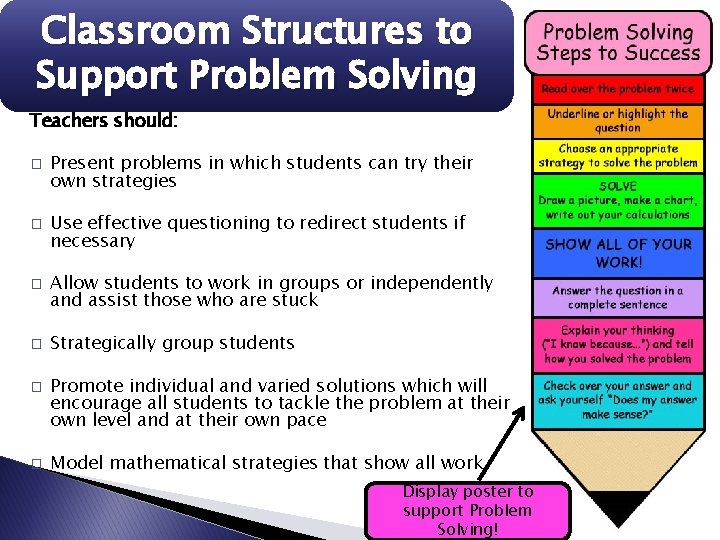
Classroom Structures to Support Problem Solving Teachers should: � � � Present problems in which students can try their own strategies Use effective questioning to redirect students if necessary Allow students to work in groups or independently and assist those who are stuck Strategically group students Promote individual and varied solutions which will encourage all students to tackle the problem at their own level and at their own pace Model mathematical strategies that show all work Display poster to support Problem Solving!

Classroom Structures to Support Problem Solving Bansho: � Japanese process of organizing, displaying, annotating, and discussing solutions to a mathematical problem � Students work in groups to solve a problem � Teacher selects work and displays their solutions to make explicit the goals of the lesson task (ie: organized from least to most mathematically rich)
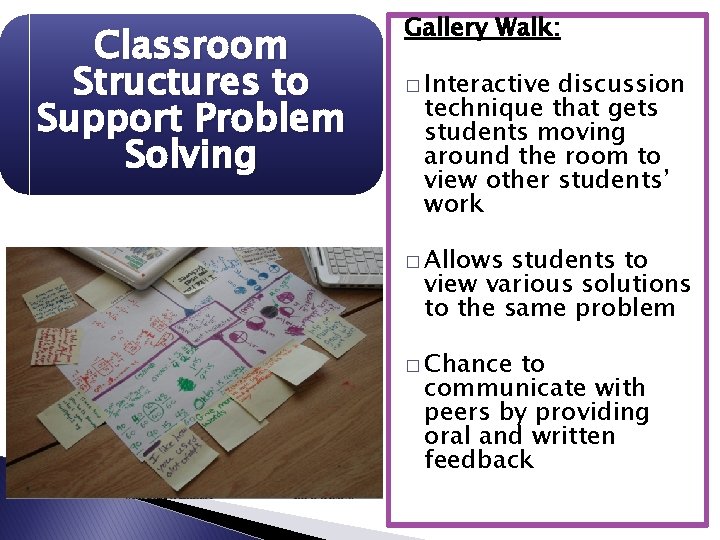
Classroom Structures to Support Problem Solving Gallery Walk: � Interactive discussion technique that gets students moving around the room to view other students’ work � Allows students to view various solutions to the same problem � Chance to communicate with peers by providing oral and written feedback
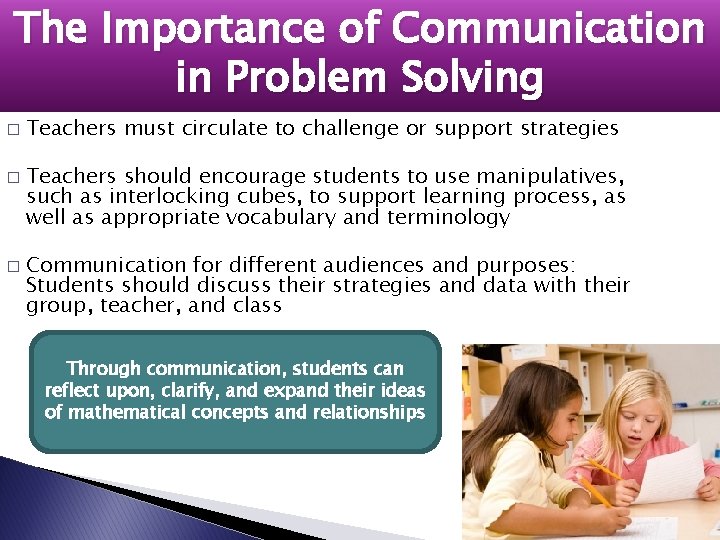
The Importance of Communication in Problem Solving � � � Teachers must circulate to challenge or support strategies Teachers should encourage students to use manipulatives, such as interlocking cubes, to support learning process, as well as appropriate vocabulary and terminology Communication for different audiences and purposes: Students should discuss their strategies and data with their group, teacher, and class Through communication, students can reflect upon, clarify, and expand their ideas of mathematical concepts and relationships

Resources/Strategies for Teachers � � � Teaching and Learning Mathematics http: //eworkshop. on. ca/edu/resources/guides/Exp. Panel_456_Numeracy. pdf A Guide to Effective Instruction in Mathematics K – 6, Volume 1 http: //eworkshop. on. ca/edu/resources/guides/Guide_Math_K_6_Volum e_1. pdf A Guide to Effective Instruction in Mathematics K - 6, Volume 2 http: //eworkshop. on. ca/edu/resources/guides/Guide_Math_K_6_Volum e_2. pdf What is Bansho? http: //professionallyspeaking. oct. ca/march_2010/features/lesson_study /bansho. aspx Communication in the Mathematics Classroom http: //www. edu. gov. on. ca/eng/literacynumeracy/inspire/research/CBS_ Communication_Mathematics. pdf
- Slides: 13