
BIG IDEAS in Reading Phonemic Awareness Phonics Fluency
BIG IDEAS in Reading Phonemic Awareness Phonics Fluency Vocabulary Comprehension 1

Content Objective • Condition-behavior-criteria format: • Given a narrative text, teacher candidates will design and ask comprehension questions that help students identify the story grammar elements. • Student friendly language: • Today we’re going to learn about story grammar structure and how to ask comprehension questions to elicit story grammar elements during a narrative read aloud. • Ask story grammar questions 2
Language Objective • Condition-behavior-criteria format: • Given a comprehension question about text, teacher candidates will identify whether the question is literal or inferential, and say the QAR (Question-Answer-Relationship: right there, think and search, author and me, or on my own). • Student friendly language: • Today we’re going to learn about literal and inferential questions and their QAR (Question. Answer-Relationship) to help your students answer comprehension questions better. • Question-Answer Relationship 3
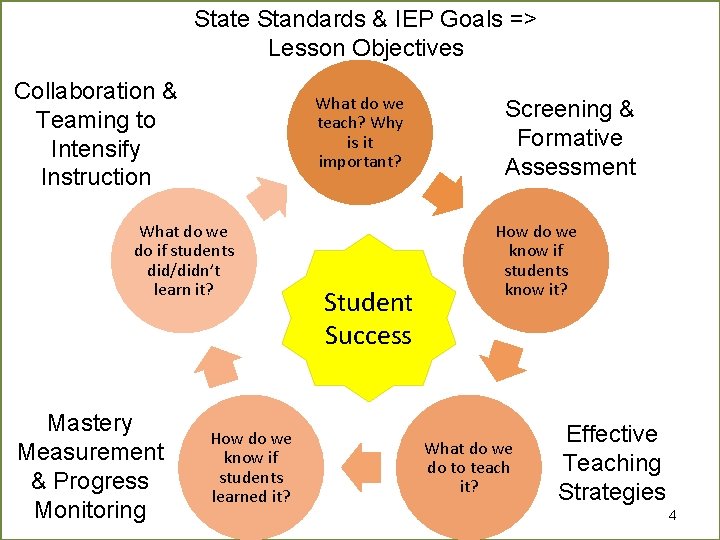
State Standards & IEP Goals => Lesson Objectives Collaboration & Teaming to Intensify Instruction What do we teach? Why is it important? What do we do if students did/didn’t learn it? Mastery Measurement & Progress Monitoring How do we know if students learned it? Student Success Screening & Formative Assessment How do we know if students know it? What do we do to teach it? Effective Teaching Strategies 4
Common Core State Standards • What do the state standards say it is important for students to know and be able to do with respect to narrative reading comprehension? 5
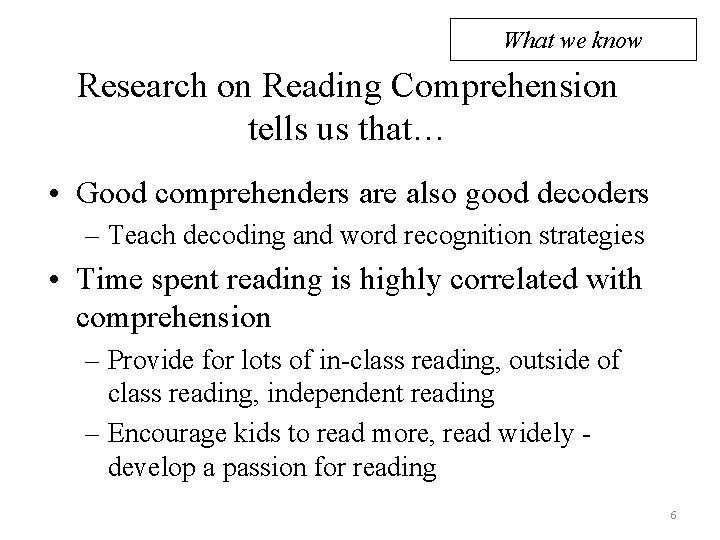
What we know Research on Reading Comprehension tells us that… • Good comprehenders are also good decoders – Teach decoding and word recognition strategies • Time spent reading is highly correlated with comprehension – Provide for lots of in-class reading, outside of class reading, independent reading – Encourage kids to read more, read widely develop a passion for reading 6
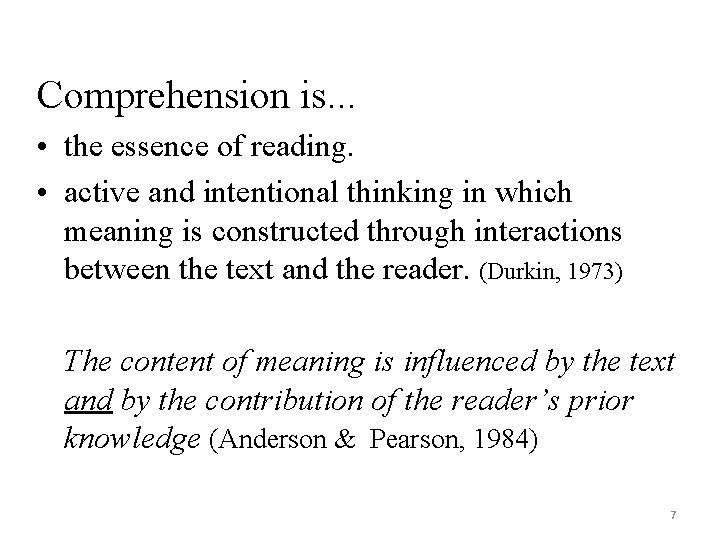
Comprehension is. . . • the essence of reading. • active and intentional thinking in which meaning is constructed through interactions between the text and the reader. (Durkin, 1973) The content of meaning is influenced by the text and by the contribution of the reader’s prior knowledge (Anderson & Pearson, 1984) 7
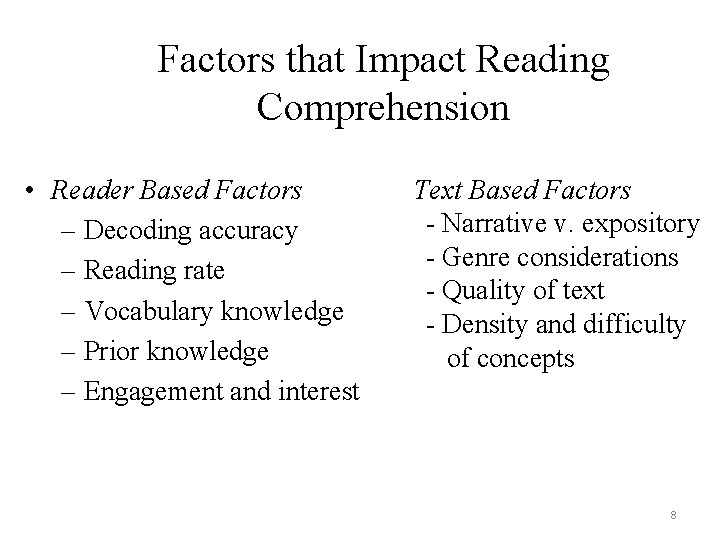
Factors that Impact Reading Comprehension • Reader Based Factors – Decoding accuracy – Reading rate – Vocabulary knowledge – Prior knowledge – Engagement and interest • Text Based Factors - Narrative v. expository - Genre considerations - Quality of text - Density and difficulty of concepts 8
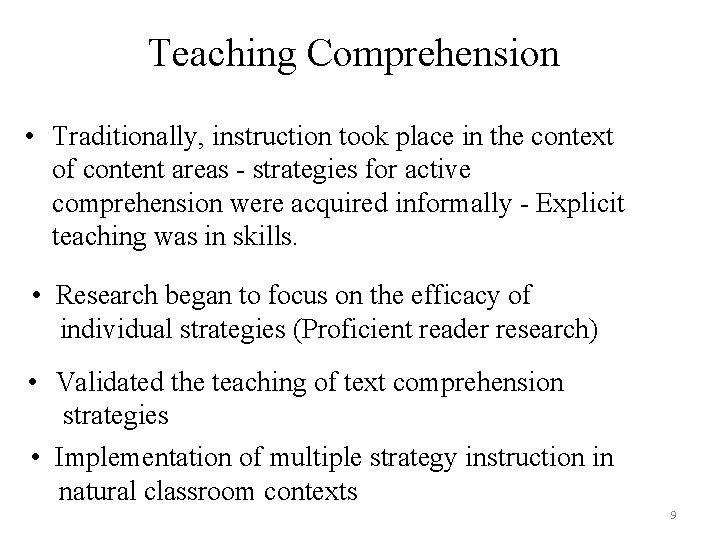
Teaching Comprehension • Traditionally, instruction took place in the context of content areas - strategies for active comprehension were acquired informally - Explicit teaching was in skills. • Research began to focus on the efficacy of individual strategies (Proficient reader research) • Validated the teaching of text comprehension strategies • Implementation of multiple strategy instruction in natural classroom contexts 9
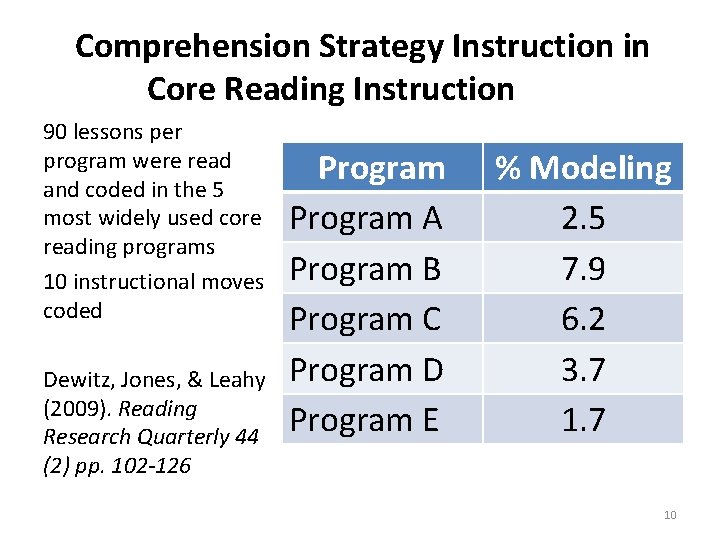
Comprehension Strategy Instruction in Core Reading Instruction 90 lessons per program were read and coded in the 5 most widely used core reading programs 10 instructional moves coded Dewitz, Jones, & Leahy (2009). Reading Research Quarterly 44 (2) pp. 102 -126 Program A Program B Program C Program D Program E % Modeling 2. 5 7. 9 6. 2 3. 7 10
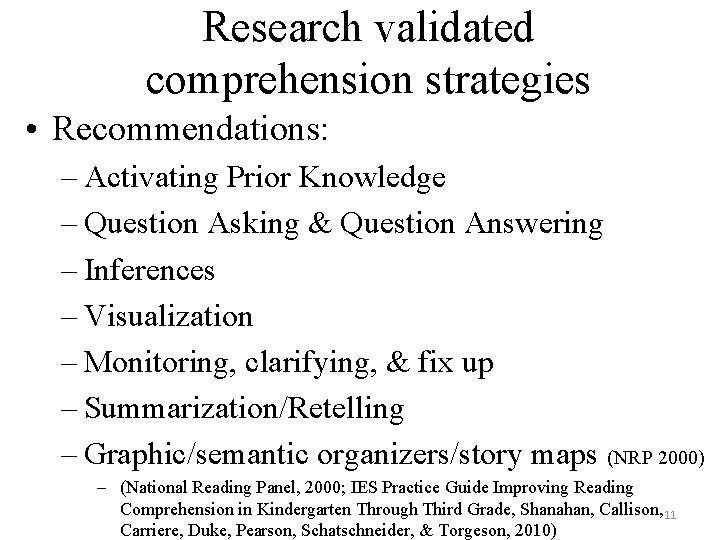
Research validated comprehension strategies • Recommendations: – Activating Prior Knowledge – Question Asking & Question Answering – Inferences – Visualization – Monitoring, clarifying, & fix up – Summarization/Retelling – Graphic/semantic organizers/story maps (NRP 2000) – (National Reading Panel, 2000; IES Practice Guide Improving Reading Comprehension in Kindergarten Through Third Grade, Shanahan, Callison, 11 Carriere, Duke, Pearson, Schatschneider, & Torgeson, 2010)
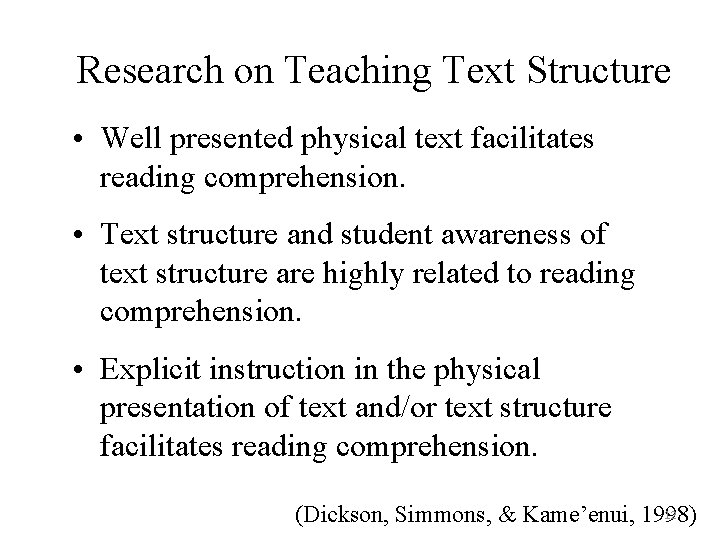
Research on Teaching Text Structure • Well presented physical text facilitates reading comprehension. • Text structure and student awareness of text structure are highly related to reading comprehension. • Explicit instruction in the physical presentation of text and/or text structure facilitates reading comprehension. 12 (Dickson, Simmons, & Kame’enui, 1998)
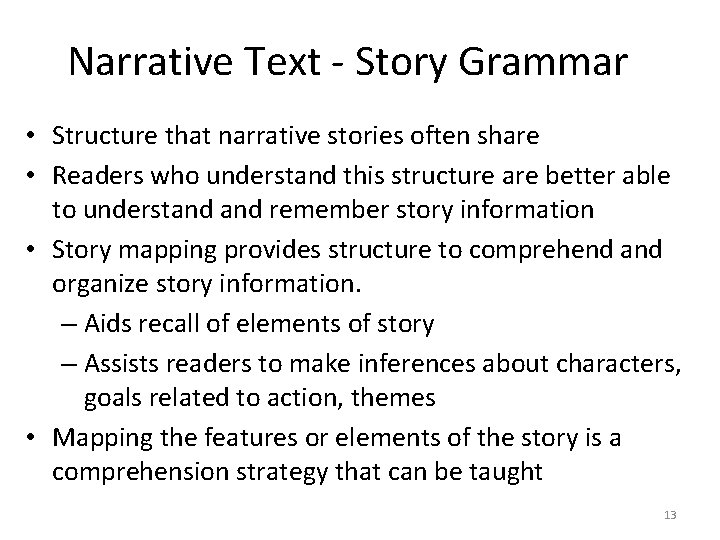
Narrative Text - Story Grammar • Structure that narrative stories often share • Readers who understand this structure are better able to understand remember story information • Story mapping provides structure to comprehend and organize story information. – Aids recall of elements of story – Assists readers to make inferences about characters, goals related to action, themes • Mapping the features or elements of the story is a comprehension strategy that can be taught 13
Differential strategies for narrative text • Prereading: – context of story, purpose • Active reading strategies: – Structured comprehension questions about story events – Read to find out where story takes place, who are characters; problems, solution, outcomes • Materials support: – story grammar notesheets 14
What are elements of Simple Story Grammar? • Who and Where or Characters and Setting • What happens first, next, last? • What did you learn? 15
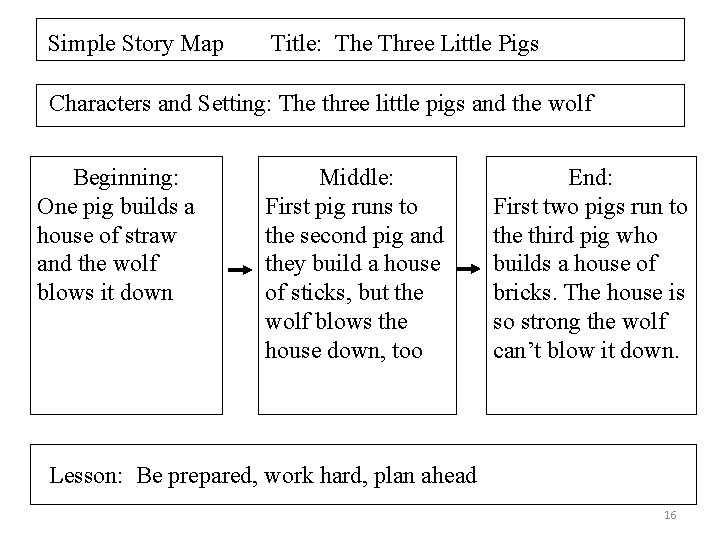
Simple Story Map Title: The Three Little Pigs Characters and Setting: The three little pigs and the wolf Beginning: One pig builds a house of straw and the wolf blows it down Middle: First pig runs to the second pig and they build a house of sticks, but the wolf blows the house down, too End: First two pigs run to the third pig who builds a house of bricks. The house is so strong the wolf can’t blow it down. Lesson: Be prepared, work hard, plan ahead 16
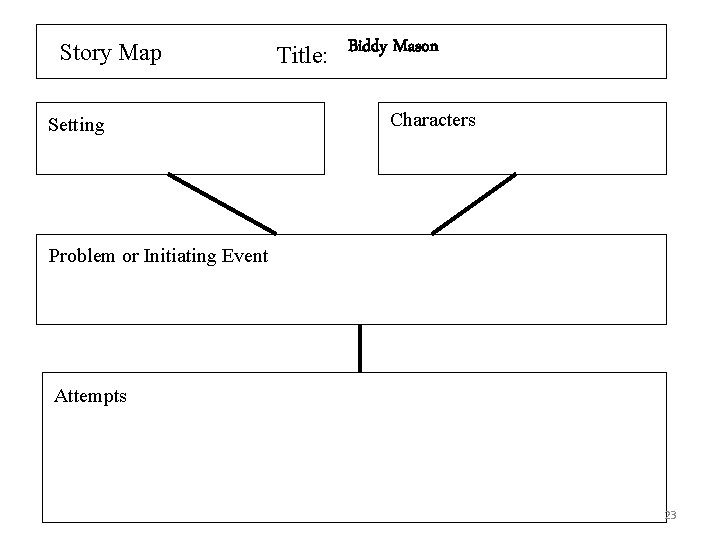
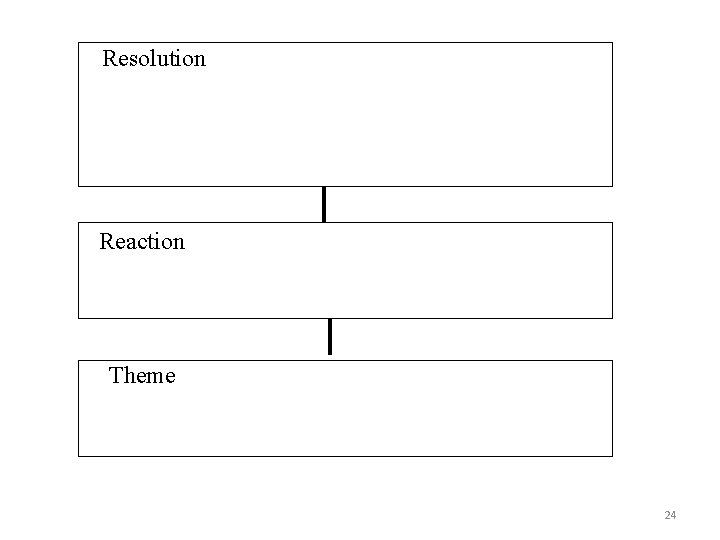
What are Advanced Story Grammar Elements? • Setting (time and place) • Characters (and character clues) • Problem (initiating event or conflict) • Attempt(s) to solve the problem • Outcome (resolution and effects) • Reaction (to outcomes) • Theme (author’s message) 17

Stories with multiple events/episodes • Setting (time and place) • Characters • Main Problem – Problem Attempt Outcome • Resolution • Character Reactions • Theme (message) Events 18
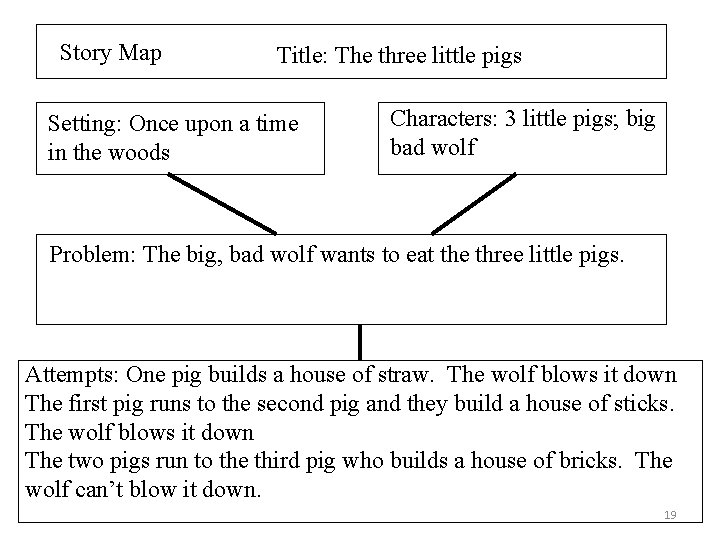
Story Map Title: The three little pigs Setting: Once upon a time in the woods Characters: 3 little pigs; big bad wolf Problem: The big, bad wolf wants to eat the three little pigs. Attempts: One pig builds a house of straw. The wolf blows it down The first pig runs to the second pig and they build a house of sticks. The wolf blows it down The two pigs run to the third pig who builds a house of bricks. The wolf can’t blow it down. 19
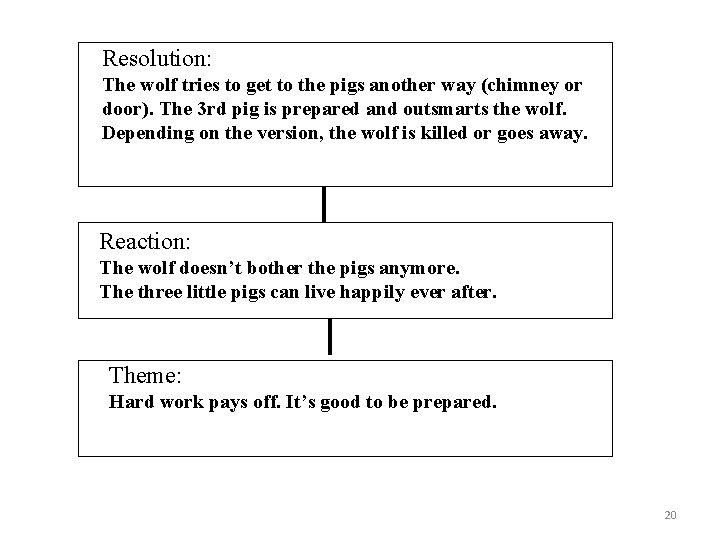
Resolution: The wolf tries to get to the pigs another way (chimney or door). The 3 rd pig is prepared and outsmarts the wolf. Depending on the version, the wolf is killed or goes away. Reaction: The wolf doesn’t bother the pigs anymore. The three little pigs can live happily ever after. Theme: Hard work pays off. It’s good to be prepared. 20
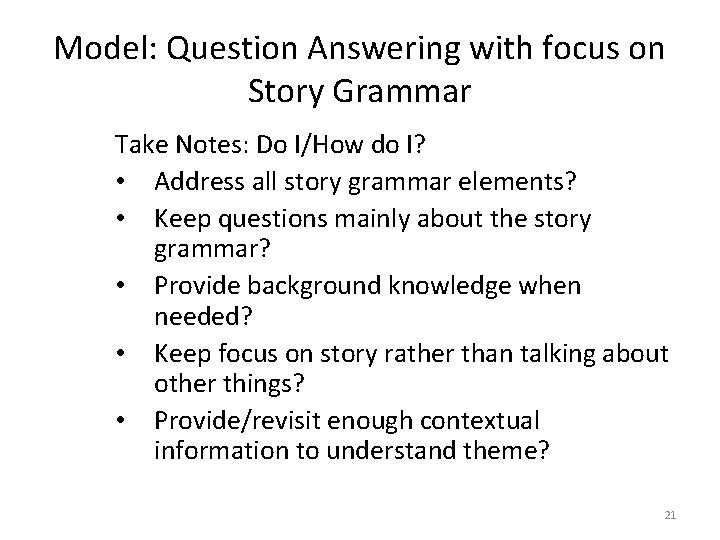
Model: Question Answering with focus on Story Grammar Take Notes: Do I/How do I? • Address all story grammar elements? • Keep questions mainly about the story grammar? • Provide background knowledge when needed? • Keep focus on story rather than talking about other things? • Provide/revisit enough contextual information to understand theme? 21
22
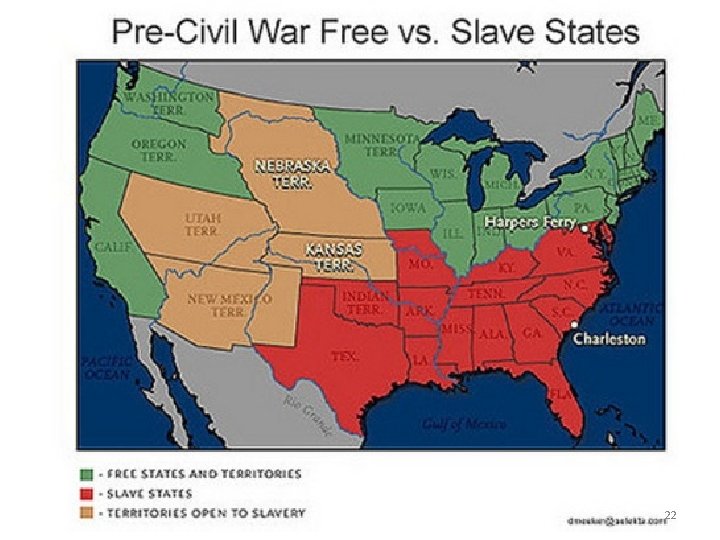
Story Map Setting Title: Biddy Mason Characters Problem or Initiating Event Attempts 23
Resolution Reaction Theme 24
Debrief • What active engagement strategies were used during the lesson model? – To engage students with a range of disabilities? – To engage English Learners? • How did I scaffold comprehension questions to facilitate better understanding of the story? • Could this strategy be used as a read aloud? • How would you make this more explicit for a struggling learner? 25
Lucy was kayaking down the Snake River. She was approaching the treacherous rapids. All of a sudden, she found herself in the cold swirling water. 26
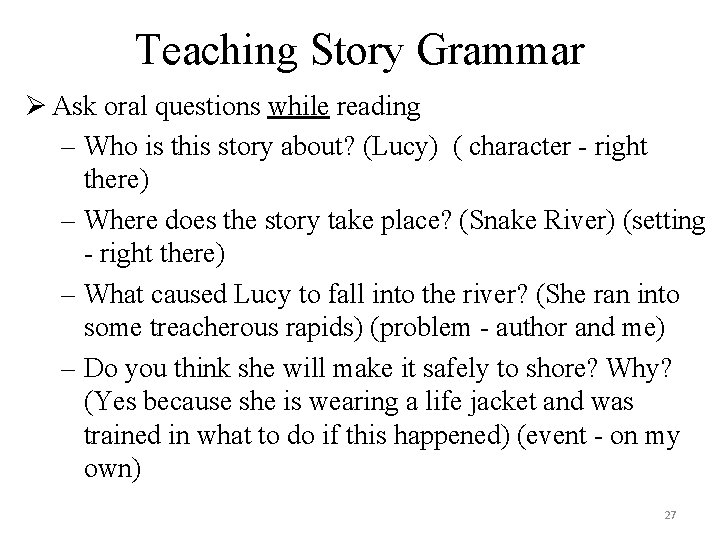
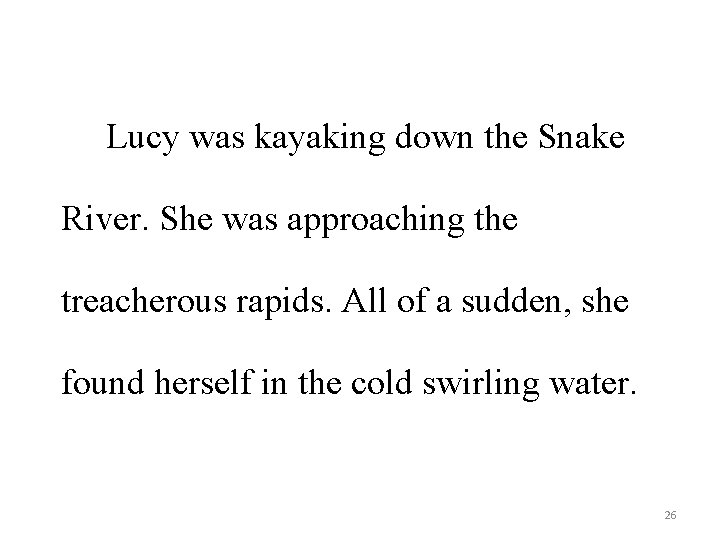
Teaching Story Grammar Ø Ask oral questions while reading – Who is this story about? (Lucy) ( character - right there) – Where does the story take place? (Snake River) (setting - right there) – What caused Lucy to fall into the river? (She ran into some treacherous rapids) (problem - author and me) – Do you think she will make it safely to shore? Why? (Yes because she is wearing a life jacket and was trained in what to do if this happened) (event - on my own) 27
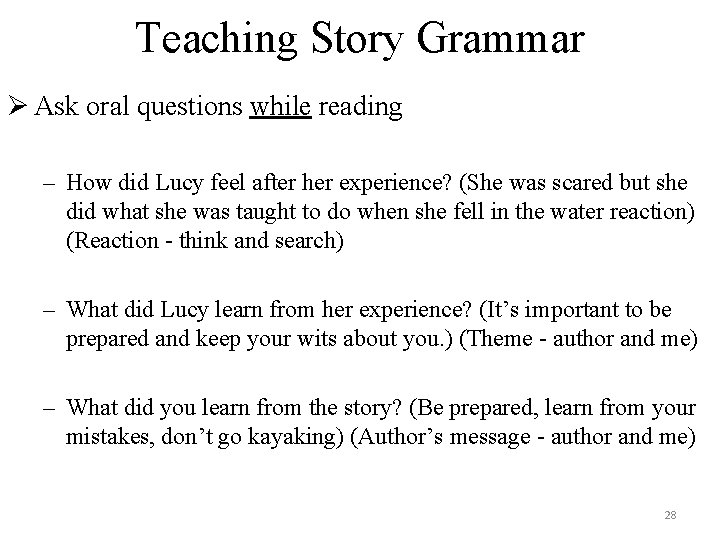
Teaching Story Grammar Ø Ask oral questions while reading – How did Lucy feel after her experience? (She was scared but she did what she was taught to do when she fell in the water reaction) (Reaction - think and search) – What did Lucy learn from her experience? (It’s important to be prepared and keep your wits about you. ) (Theme - author and me) – What did you learn from the story? (Be prepared, learn from your mistakes, don’t go kayaking) (Author’s message - author and me) 28
Multiple Comp Strategies Ø Summarize - Retell the story orally at end – Use the story map and tell about the story For continuing stories, have students recap story grammar events prior to reading Ø Fill in story grammar notesheet (GO) – with teacher as story is read – with teacher at end of story – independently 29
Integrate into writing plan an alternate endings to stories create new stories add episodes to stories book report book review summarize chapters compare and contrast other works written retell 30
Question Answering • Allows the teacher to – Assess student comprehension of text during reading – Gives students a purpose for reading and focuses attention on what they are to learn – Helps students think actively as they read – Encourages student to monitor their comprehension – Helps students relate what they have learned to what they already know • Can be used before, during, and after reading 31
Video: Anita Archer, “Wolf!” • Instructional Routines • Active Engagement 32
Literal and Inferential Questions • Literal questions are directly stated in the text • Inferential questions are not directly stated • Induced • Other knowledge is needed 33
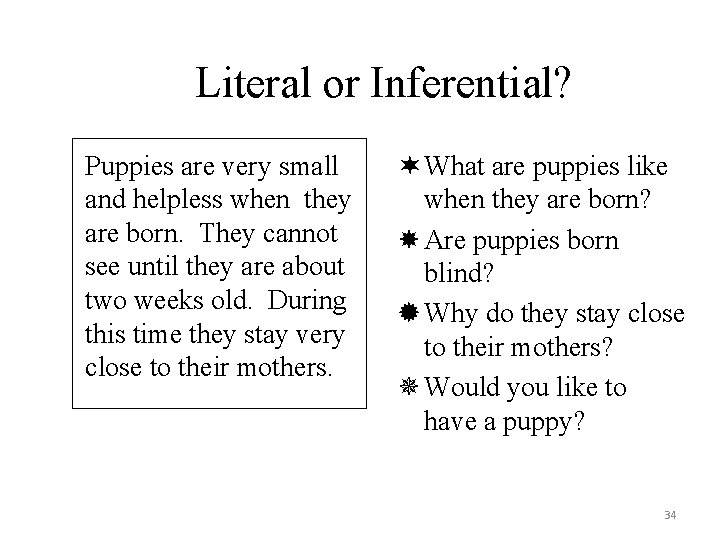
Literal or Inferential? Puppies are very small and helpless when they are born. They cannot see until they are about two weeks old. During this time they stay very close to their mothers. ¬ What are puppies like when they are born? Are puppies born blind? ® Why do they stay close to their mothers? ¯ Would you like to have a puppy? 34
Activity • Groups of 3 -4 • Read the following passage and… • Write 2 literal questions • Write 2 inferential questions 35
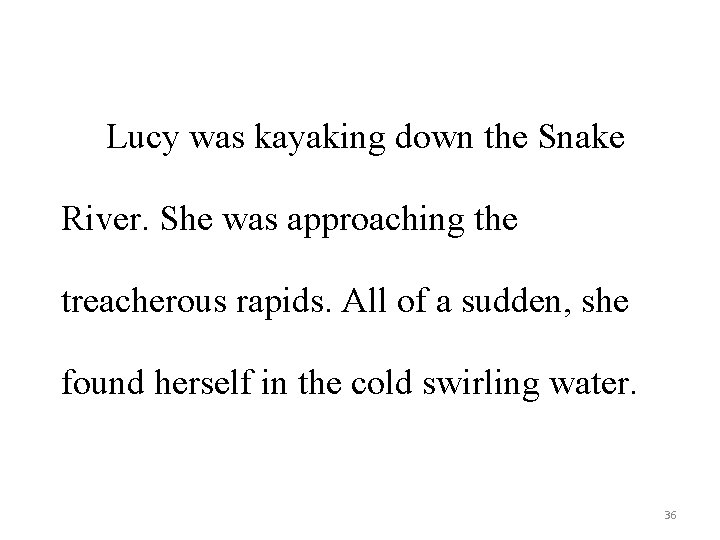
Lucy was kayaking down the Snake River. She was approaching the treacherous rapids. All of a sudden, she found herself in the cold swirling water. 36
Debrief • Literal questions • Inferential questions 37
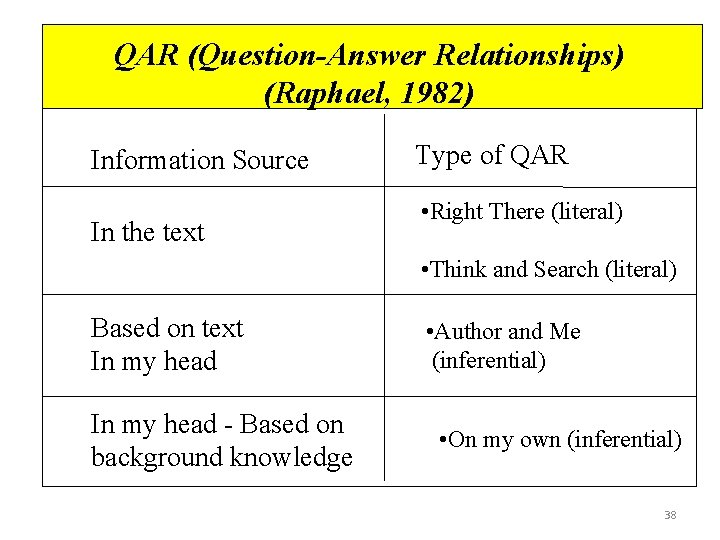
QAR (Question-Answer Relationships) (Raphael, 1982) Information Source In the text Type of QAR • Right There (literal) • Think and Search (literal) Based on text In my head - Based on background knowledge • Author and Me (inferential) • On my own (inferential) 38
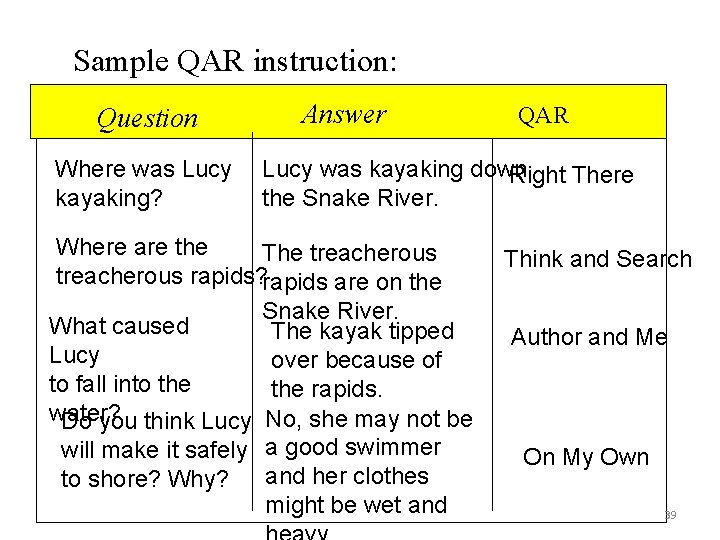
Sample QAR instruction: Question Where was Lucy kayaking? Answer QAR Lucy was kayaking down Right There the Snake River. Where are the The treacherous rapids? rapids are on the Snake River. What caused The kayak tipped Lucy over because of to fall into the rapids. water? Do you think Lucy No, she may not be will make it safely a good swimmer and her clothes to shore? Why? might be wet and Think and Search Author and Me On My Own 39
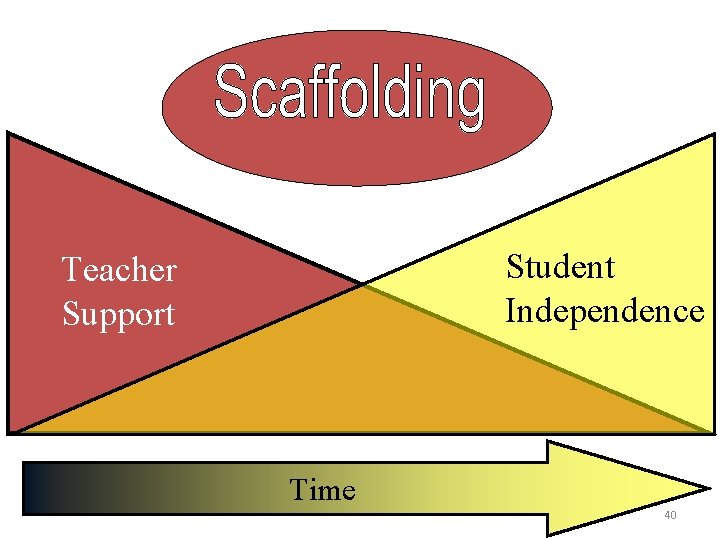
Student Independence Teacher Support Time 40
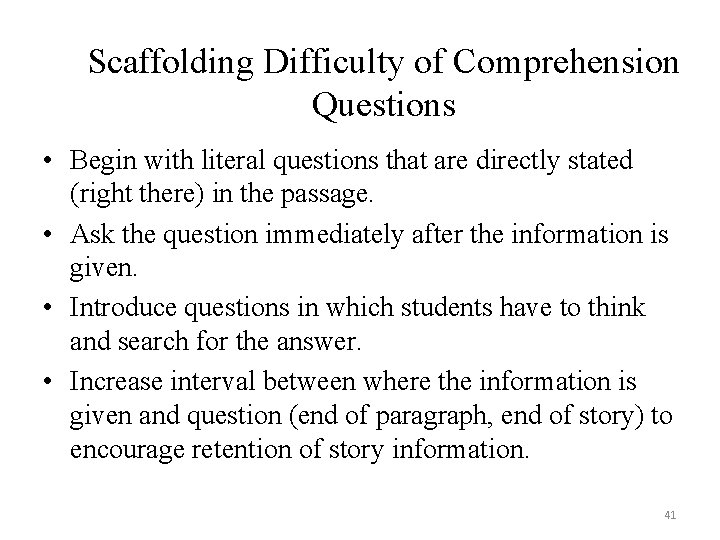
Scaffolding Difficulty of Comprehension Questions • Begin with literal questions that are directly stated (right there) in the passage. • Ask the question immediately after the information is given. • Introduce questions in which students have to think and search for the answer. • Increase interval between where the information is given and question (end of paragraph, end of story) to encourage retention of story information. 41
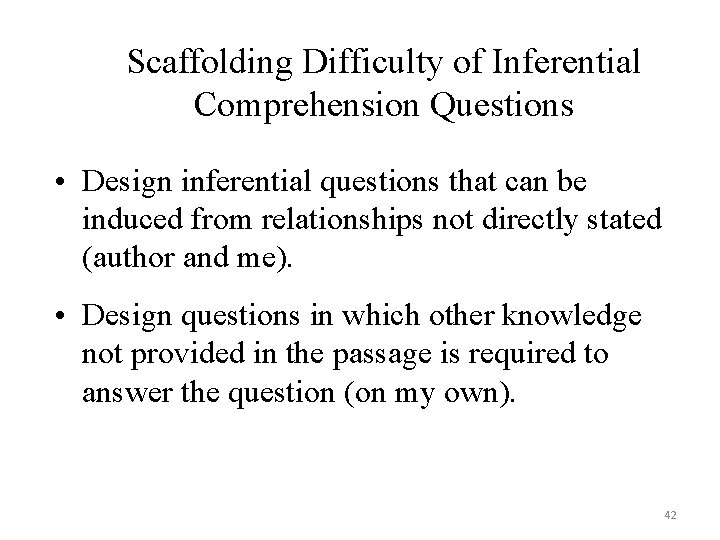
Scaffolding Difficulty of Inferential Comprehension Questions • Design inferential questions that can be induced from relationships not directly stated (author and me). • Design questions in which other knowledge not provided in the passage is required to answer the question (on my own). 42
Corrections for Literal Questions • Tell the answer, reread the sentence, ask the question again. or use QAR strategy • Tell the child that the answer is ‘right there’ (or they have to ‘think and search’). • Reread sentence(s) that provides the answer. Ask the question again. – Teacher reads or directs students to the part to reread 43
Corrections for Inferential Questions • Use QAR strategy (‘author and me’ or ‘on my own’) • Model and guide using “think alouds” – restating information needed to answer the question, – asking a series of questions leading up to the original question, – asking the original question again. 44
Corrections for Inferential Questions What caused Lucy to fall into the water? • Model and guide using “think alouds” – restating information needed to answer the question and asking a series of questions leading up to the original question, • Lucy was kayaking in treacherous rapids. Who remembers what treacherous means? • So what would treacherous rapids be like? – then asking the original question again. • So what could have caused Lucy to fall into the water? 45
Corrections for Inferential Questions • Exercise: For your inferential questions… – Decide if the answer is • On my own • Author and me – Design the think aloud statements or questions you would use to teach the strategy of answering this inferential questions 46
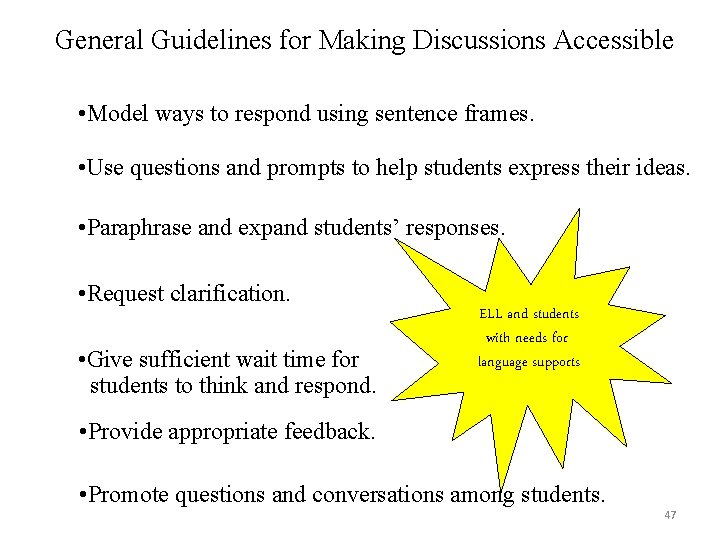
General Guidelines for Making Discussions Accessible • Model ways to respond using sentence frames. • Use questions and prompts to help students express their ideas. • Paraphrase and expand students’ responses. • Request clarification. • Give sufficient wait time for students to think and respond. ELL and students with needs for language supports • Provide appropriate feedback. • Promote questions and conversations among students. 47
Reflection • Identify 3 key ideas from today’s class that you want to remember to improve your practice • What questions do you still have? 48
- Slides: 48