
Big Idea 6 Earth Structures Grade 5 PSELL

Big Idea 6: Earth Structures Grade 5 PSELL Big Idea 6: Earth Structures Connection Part 1 Student Booklet pp. 140 – 158 Part 2 Student Booklet pp. 159 – 165 Department of Mathematics and Science

Part One: Identification of the Three Types of Rocks: Sedimentary, Igneous, Metamorphic Minerals Gr. 5 Essential Lab # 8 Physical Properties of Minerals Weathering and Erosion Gr. 5 Essential Lab # 9 Weathering and Erosion Part Two: Earth’s: Resources : Department of Mathematics and Science

Big Idea 6: Earth Structures Part One Benchmarks SC. 4. E. 6. 1 Identify the three categories of rocks: igneous, (formed from molten rock); sedimentary (pieces of other rocks and fossilized organisms); and metamorphic (formed from heat and pressure. (assessed as SC. 4. E. 6. 2) SC. 4. E. 6. 2 - Identify the physical properties of common earthforming minerals, including hardness, color, luster, cleavage, and streak color, and recognize the role of minerals in the formation of rocks. SC. 4. E. 6. 4 Describe the basic differences between physical weathering (breaking down of rock by wind, water, ice, temperature change, and plants) and erosion (movement of rock by gravity, wind, water, and ice). Department of Mathematics and Science

What are Rocks? Rocks are … • Nonliving, solid earth materials • Make up the crust of the Earth • Mixture of one or more minerals • Range in size from giant mountains to grains of sand • Can be smooth or rough, shiny or dull, one color or many colors More about Rocks from Discovery Student Booklet p. 141 Department of Mathematics and Science

Essential Question: What are the Three main types of rocks? 1. Sedimentary Rock 1. Igneous Rock 3. Metamorphic Rock Student Booklet p. 141 -142 Rock Type Photographs and more: http: //geology. com/rocks/ Department of Mathematics and Science
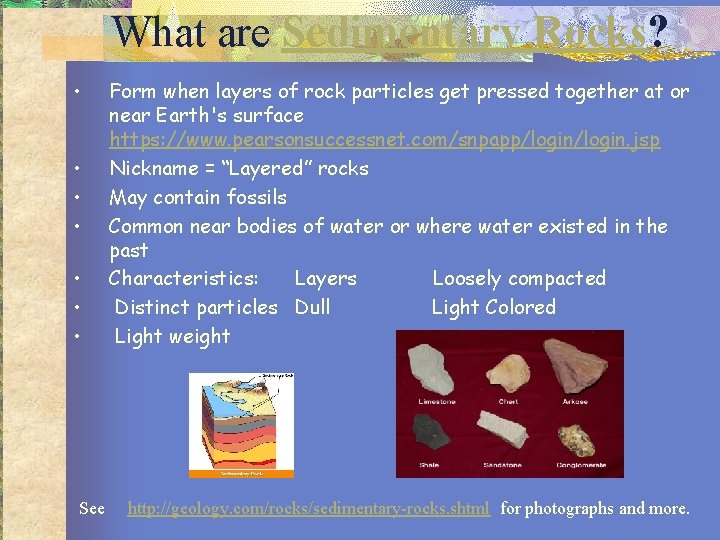
• • What are Sedimentary Rocks? Form when layers of rock particles get pressed together at or near Earth's surface https: //www. pearsonsuccessnet. com/snpapp/login. jsp Nickname = “Layered” rocks May contain fossils Common near bodies of water or where water existed in the past Characteristics: Layers Loosely compacted Distinct particles Dull Light Colored Light weight See http: //geology. com/rocks/sedimentary-rocks. shtml for photographs and more.

What are Igneous Rocks? • • • Form when magma (hot liquid rock) cools and hardens Cools very fast = glassy with holes Cools fast = glassy Cools slow = small crystals Cools very slow = large crystals • Nickname= “Fire formed” rocks: http: //geology. com/rocks/metamorphic-rocks. shtml 2 3 Pumice is a gas-charged igneous rock. Can you identify some others? granite scoria 1 obsidian 4 5 pumice

What are Metamorphic Rocks? • • Form when underground rocks are changed due to high pressure Nickname = “Changed” rocks Common in mountains Characteristics: Thick layers Blended colors Tightly compacted Blurred particles Shiny See http: //geology. com/rocks/metamorphic-rocks. shtml for photographs and more.

How Rocks Formed Song Adapted from Utah Elem. CORE Academy 2006 (Sing to the tune of “Row, Row Your Boat”) Sedimentary rock Has been formed in layers Often found near water sources With fossils from decayers Then there’s igneous rock Here since Earth was born Molten lava, cooled and hardened That’s how it formed These two types of rocks, Can also be transformed With pressure, heat, and chemicals Metamorphic they’ll become http: //geology. com/rocks/

How do the three types of rocks form? • Igneous rocks form when magma cools underground or lava from volcanic eruptions cools on Earth’s surface. • Sedimentary rocks form when bits of different rocks pile up. Over a long time, the rock bits are buried and squeezed together to form sedimentary rocks. • Metamorphic rocks form when igneous or sedimentary rocks are changed by heat and pressure. Department of Mathematics and Science

What’s the Rock: Reference Sheet 1. Igneous: Form when magma cools and hardens. • • Cools very fast = glassy with holes Cools fast = glassy Cools slow = small crystals Cools very slow = large crystals 2. Sedimentary: Form when layers of rock particles • get pressed together Loosely compacted layers Light Colored Distinct particles Dull 3. Metamorphic: Form when underground rocks are • • changed due to high pressure Thick layers Tightly compacted Blended colors Blurred particles Shiny (Adapted from Utah Elem. CORE Academy 2006)

Sample FCAT 2. 0 Question 1. Eddy is examining two igneous rocks. He observes that one rock is light-colored and one is dark-colored. Both rocks have very large crystals and are very coarse. How can two rocks made by the same process be so different in color? A. They contain different minerals. B. They were made at different times. C. They were worn down at different rates. D. They cooled at different rates. Florida Achieves Department of Mathematics and Science
Sample FCAT 2. 0 Question 2. What type rock is formed when grains of sand other sediments that have eroded from mountains and have been washed down to sea are pressed and cemented together? A. Igneous B. Metamorphic C. Oceanic D. Sedimentary Discovery Education Department of Mathematics and Science

Sample FCAT 2. 0 Question 3. Dr. Gonzalez is searching for recentlyformed igneous rocks for her collection. Where would this type of rock most likely be found? A. in a deep cavern B. on a sandy beach C. near a volcano D. at the mouth of a river Florida Achieves Department of Mathematics and Science

Sample FCAT 2. 0 Question 4. Metamorphic rocks are formed under great pressure or temperature. Which geologic process would make a metamorphic rock? A. the sliding of a valley glacier B. the deposition of sand by wind C. the movement of Earth's crust D. the removal of surface rock by water Florida Achieves Department of Mathematics and Science

Sample FCAT 2. 0 Question 5. While hiking in the Everglades, Melissa finds the fossil of clam in a rock. In which type of rock would you most likely find a fossil? A. Igneous B. Metamorphic C. Oceanic D. Sedimentary Florida Achieves Department of Mathematics and Science
Minerals and You Every solid material made from nature that’s neither plant or animal--not a living thing is a mineral or made from minerals. Minerals touch our lives in hundreds of ways each day. Life as we know it would not exist without them. What are some minerals that touch your lives? Click here for minerals in your house. player. discoveryeducation. com/? bln. P review. Only=1&guid. Asset. Id=15519 e Department of Mathematics and Science
What are the Five Characteristics That Minerals Share? To help you remember try this mnemonic device: N I C S - Naturally Occurring – Not made by humans - Inorganic – Was never alive - Crystalline (crystals) – The atoms form a pattern and repeat themselves in all directions. - Solid Diner -Definite Chemical Composition – Example: Salt aka halite has a chemical composition of Na. Cl throughout Department of Mathematics and Science

What is a Mineral? Student Booklet p. 142 http: //library. thinkquest. org/J 002289/index. html A mineral is a Natural, Inorganic (nonliving), Crystalline (crystal pattern), Solid with a Definite chemical structure. A Mineral is a material that has its own set of properties: (Discovery) How are minerals identified? (free Brain. Pop) http: //glencoe. mcgraw-hill. com/sites/dl/free/0078778026/164213/00044674. html • • color luster streak color breakage: cleavage Minerals by Name Department of Mathematics and Science or hardness fracture

Minerals Review 1. Rocks are made of _____, which are natural, nonliving solid crystals. 2. The way a mineral’s surface reflects light is called its _____. 3. The way a mineral can tend to break along lines or smooth surfaces when hit sharply is its ______. 4. _____ is the color of a mineral when it is powdered. It is often different from the color of the whole mineral. 5. The measure of the mineral’s resistance to scratching is its _______. A. Cleavage B. Hardness C. Luster D. Minerals E. Streak Color Department of Mathematics and Science

Sample FCAT 2. 0 Question SC. 4. E. 6. 2 1. Eddy is trying to identify a mineral by observing its luster. This means that he is doing which of the following? A. observing the way the mineral reflects light B. scratching the mineral with other objects or minerals C. examining the color the mineral makes when rubbed across porcelain D. feeling the mineral to determine if it is rough, smooth, greasy, or glassy Florida Achieves Department of Mathematics and Science

Sample FCAT 2. 0 Question SC. 4. E. 6. 2 2. Tanya is trying to identify an unknown mineral. To identify the mineral, Tanya breaks it and observes the planes and patterns formed along the break. Which property of minerals is Tanya testing? A. cleavage B. hardness C. luster D. texture Florida Achieves Department of Mathematics and Science
Sample FCAT 2. 0 Question SC. 4. E. 6. 2 3. Samantha is identifying different minerals she found on vacation. Which property of the minerals will Samantha be LEAST able to determine by using only her eyes? A. color B. hardness C. luster D. texture Florida Achieves Department of Mathematics and Science

PSELL BOOKLET P. 145 Physical. Weathering http: //geomaps. wr. usgs. gov/parks/project/index. html 1. 3. 2. Department of Mathematics and Science 4.

PSELL Student Booklet pp. 145 -146 What is Erosion? • Erosion is the movement of sediments from one place to another. Water is the primary agent of erosion, though wind and glacier ice also contribute. Create a definition of erosion In your notebook. Department of Mathematics and Science

FCAT 2. 0 Question 1) The agents of erosion include all except _______. A) rock and rock fragments under the influence of gravity B) currents such as wind, water, or ice flow C) the breaking down of rock through processes where no movement is involved D) poor land uses such as deforestation and unmanaged construction Department of Mathematics and Science

FCAT 2. 0 Question 2. What occurs when gravity pulls loose material down to the bottom of a slope in a sudden motion? A) tsunami B) flood C) landslide D) earthquake Department of Mathematics and Science

FCAT 2. 0 Question 3. Weathering can be caused by __________. A) canyons, caves, and landslides B) rain, wind, and plant roots C) rivers, mountains, and currents D) tides, mice, and glaciers Department of Mathematics and Science

FCAT 2. 0 Question 4. How did weathering and erosion form the Grand Canyon? A) Flooding caused landslides many years ago, and the canyon was formed very quickly. B) A great earthquake caused the a giant crack in the earth, and the canyon was formed. C) Many volcanoes in that area erupted, and the lava caused the rocks to melt away. D) Rain, wind, and the river cut into the rock and soil, removed it, and slowly formed the canyon. Department of Mathematics and Science
Part Two: Earth’s Resources Benchmarks SC. 4. E. 6. 3 Recognize that humans need resources found on Earth and that these are either renewable or nonrenewable. SC. 4. E. 6. 6 Identify resources available in Florida (water, phosphate, oil, limestone, silicon, wind, and solar energy). Department of Mathematics and Science

What are natural resources? natural resources What are some of Earth’s natural resources? Water Plants Sun Air Wind Minerals rocks Land Soil Oil Coal Animals PSELL Big Idea 6 Part 2 Student Book p. 160 Department of Mathematics and Science

What resources are found in Florida ? Florida has many natural resources: Beaches Oil Citrus Pine Forests Cattle Phosphate Water Limestone Solar Energy Reefs
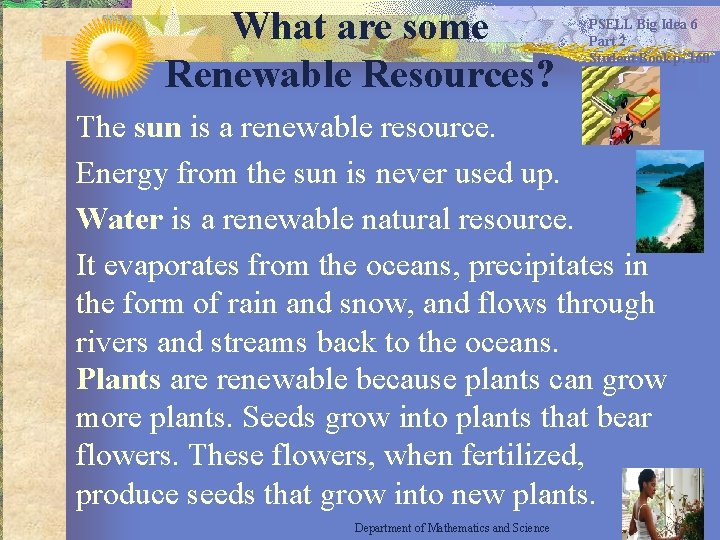
What are some Renewable Resources? PSELL Big Idea 6 Part 2 Student Book p. 160 The sun is a renewable resource. Energy from the sun is never used up. Water is a renewable natural resource. It evaporates from the oceans, precipitates in the form of rain and snow, and flows through rivers and streams back to the oceans. Plants are renewable because plants can grow more plants. Seeds grow into plants that bear flowers. These flowers, when fertilized, produce seeds that grow into new plants. Department of Mathematics and Science
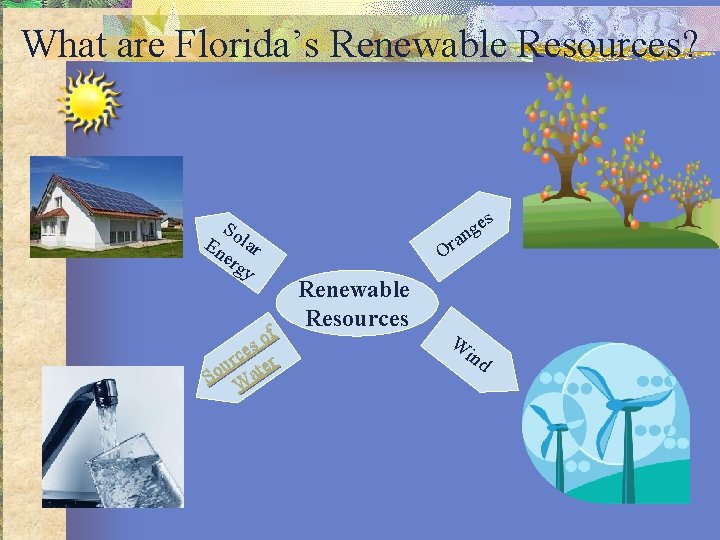
What are Florida’s Renewable Resources? So En lar erg y Renewable Resources f s o e rc ter u So Wa s e ng a Or W ind
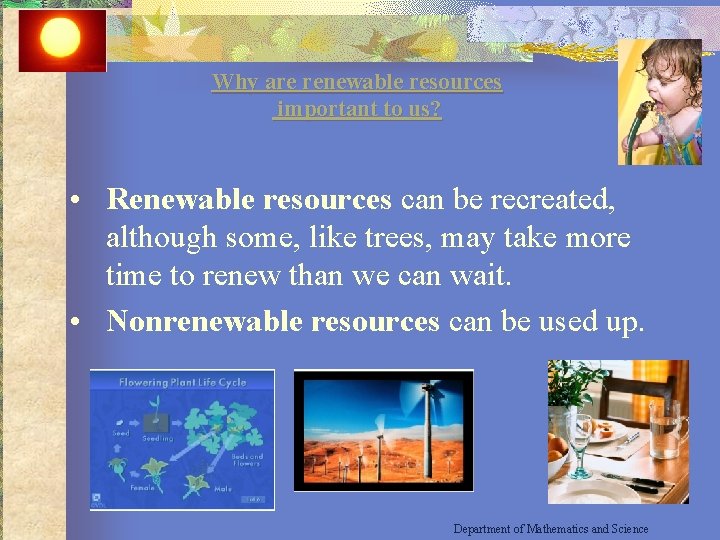
Why are renewable resources important to us? • Renewable resources can be recreated, although some, like trees, may take more time to renew than we can wait. • Nonrenewable resources can be used up. Department of Mathematics and Science
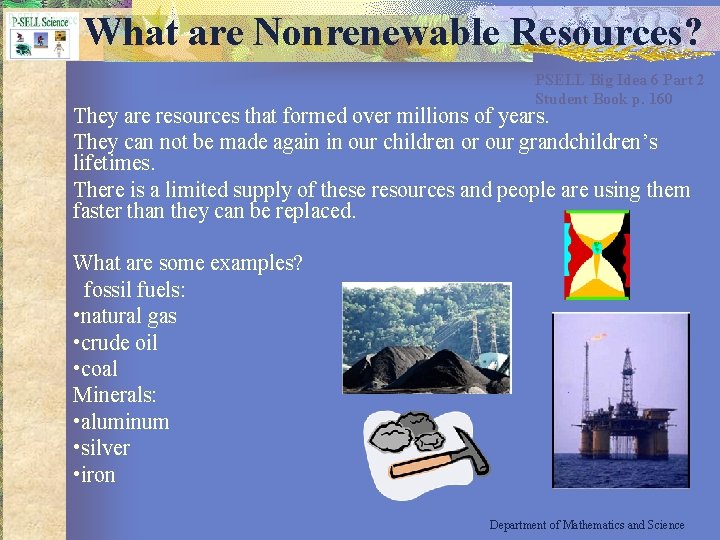
What are Nonrenewable Resources? PSELL Big Idea 6 Part 2 Student Book p. 160 They are resources that formed over millions of years. They can not be made again in our children or our grandchildren’s lifetimes. There is a limited supply of these resources and people are using them faster than they can be replaced. What are some examples? fossil fuels: • natural gas • crude oil • coal Minerals: • aluminum • silver • iron Department of Mathematics and Science
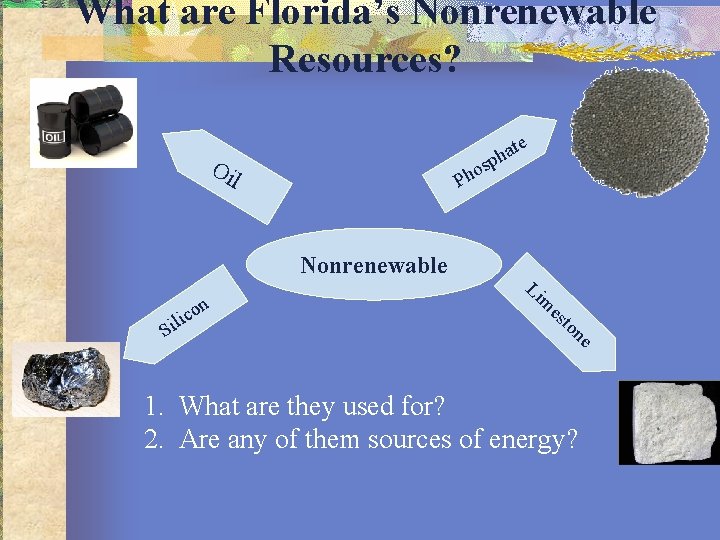
What are Florida’s Nonrenewable Resources? Oi e Ph l Nonrenewable n o c ili S at h p s o Li m es to ne 1. What are they used for? 2. Are any of them sources of energy?
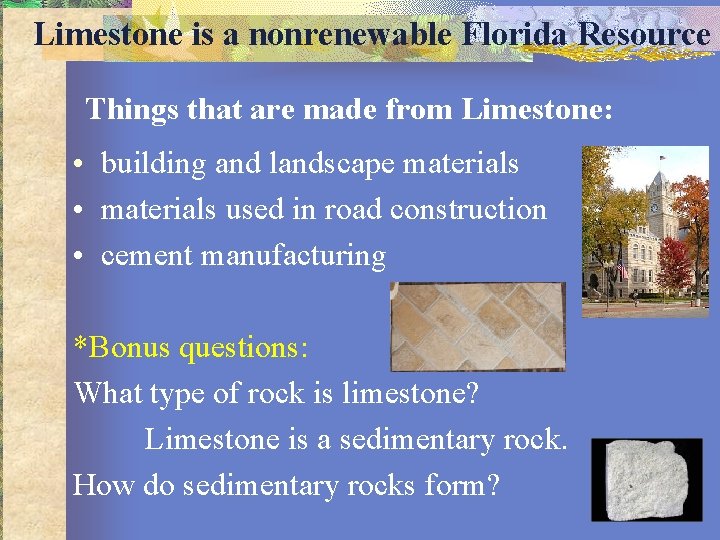
Limestone is a nonrenewable Florida Resource Things that are made from Limestone: • building and landscape materials • materials used in road construction • cement manufacturing *Bonus questions: What type of rock is limestone? Limestone is a sedimentary rock. How do sedimentary rocks form?
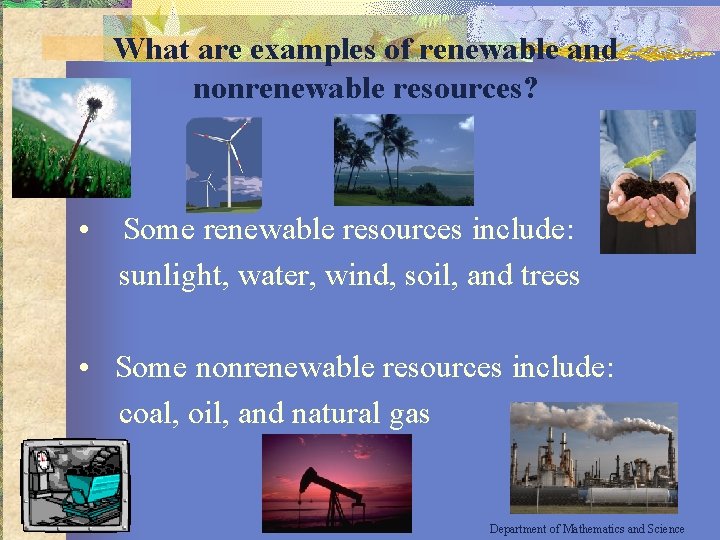
What are examples of renewable and nonrenewable resources? • Some renewable resources include: sunlight, water, wind, soil, and trees • Some nonrenewable resources include: coal, oil, and natural gas Department of Mathematics and Science
What are the differences between renewable and nonrenewable resources? • Nonrenewable resources are resources that cannot be replaced in a short amount of time. • Unlike renewable resources, it is possible for humans to use up all of the nonrenewable resources in the world. • A renewable resource is a resource that humans are not likely to run out of. • Wind is a renewable resource because the wind will always continue to blow on Earth. • Trees are a renewable resource because they can be planted and grown in a short amount of time. Department of Mathematics and Science
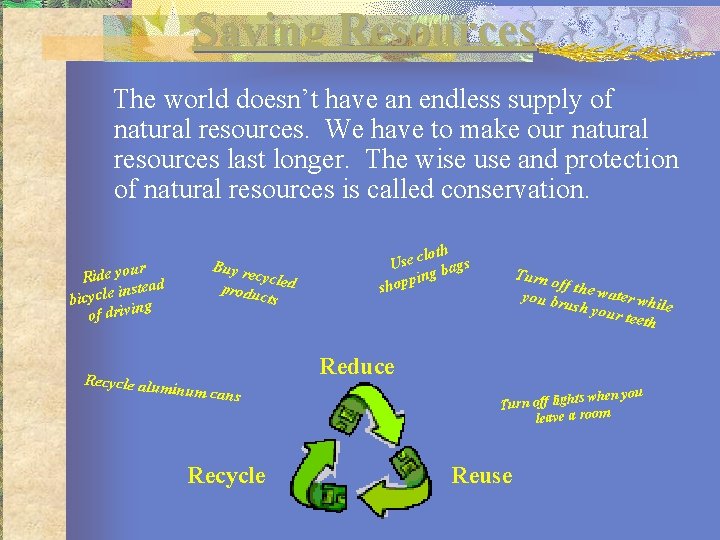
Saving Resources The world doesn’t have an endless supply of natural resources. We have to make our natural resources last longer. The wise use and protection of natural resources is called conservation. ur Ride yo ad inste bicycle ng of drivi Buy re cyc produ led cts Recycle alu minum cans Recycle cloth s e s U bag g n i p shop Turn o ff th you br e water wh il ush yo ur teet e h Reduce when you Turn off lights leave a room Reuse
Energy Conservation What can we do? • We can use resources wisely. • We can reduce, reuse, an recycle. Department of Mathematics and Science
FCAT Review 1. Earth will eventually run out of certain kinds of energy resources. These are called nonrenewable energy resources. Which answer lists ONLY nonrenewable energy resources? A. B. C. D. solar, geothermal, and hydroelectric natural gas, wind, and water gasoline, solar, and nuclear coal, oil, and natural gas Florida Achieves Department of Mathematics and Science
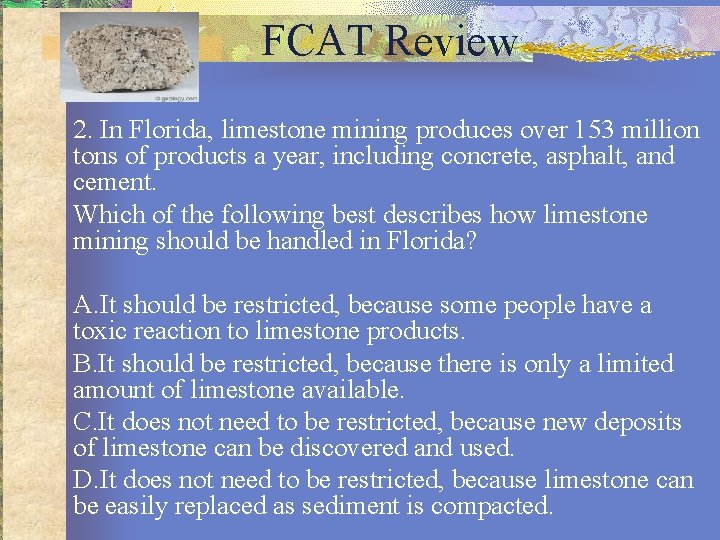
FCAT Review 2. In Florida, limestone mining produces over 153 million tons of products a year, including concrete, asphalt, and cement. Which of the following best describes how limestone mining should be handled in Florida? A. It should be restricted, because some people have a toxic reaction to limestone products. B. It should be restricted, because there is only a limited amount of limestone available. C. It does not need to be restricted, because new deposits of limestone can be discovered and used. D. It does not need to be restricted, because limestone can be easily replaced as sediment is compacted.
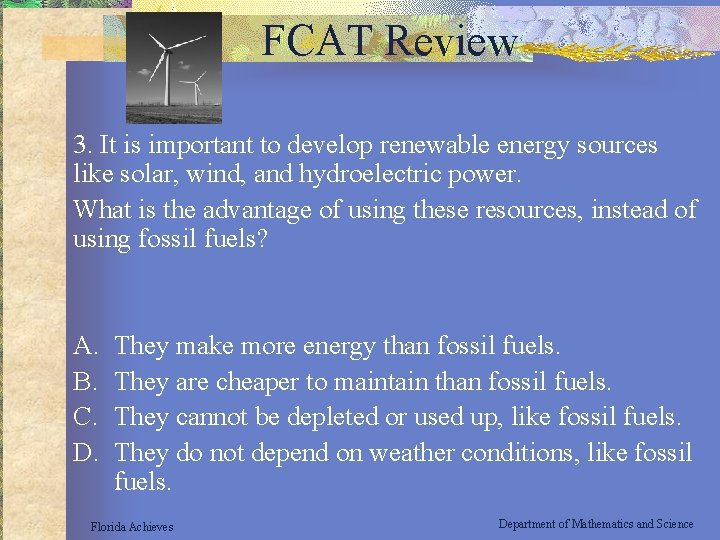
FCAT Review 3. It is important to develop renewable energy sources like solar, wind, and hydroelectric power. What is the advantage of using these resources, instead of using fossil fuels? A. B. C. D. They make more energy than fossil fuels. They are cheaper to maintain than fossil fuels. They cannot be depleted or used up, like fossil fuels. They do not depend on weather conditions, like fossil fuels. Florida Achieves Department of Mathematics and Science
- Slides: 45