
Big Idea 6 Earth Structures Grade 5 Ms
Big Idea 6: Earth Structures Grade 5 Ms. Solernou
Minerals and You Every solid material made from nature that’s neither plant or animal--not a living thing is a mineral or made from minerals. Minerals touch our lives in hundreds of ways each day. Life as we know it would not exist without them. What are some minerals that touch your lives? What are minerals? (Discovery) Department of Mathematics and Science
A mineral is… A solid material that is formed by nature in or on Earth’s crust. A material that has a crystal form. A material that has its own set of properties. A material that is not formed by a living thing. Department of Mathematics and Science
What are the Five Characteristics That Minerals Share? N - Naturally Occurring – Not made by humans I - Inorganic – Was never alive C - Crystalline (crystals) – ‘ S The atoms form a pattern and repeat themselves in all directions. - Solid Diner -Definite Chemical Composition – Example: Salt (aka halite) has a chemical composition of Na. Cl throughout. Department of Mathematics and Department of. Science Mathematics and Science
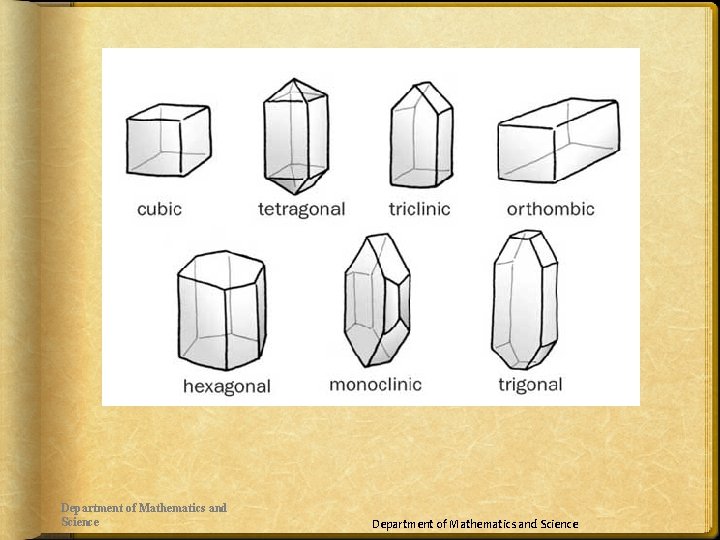
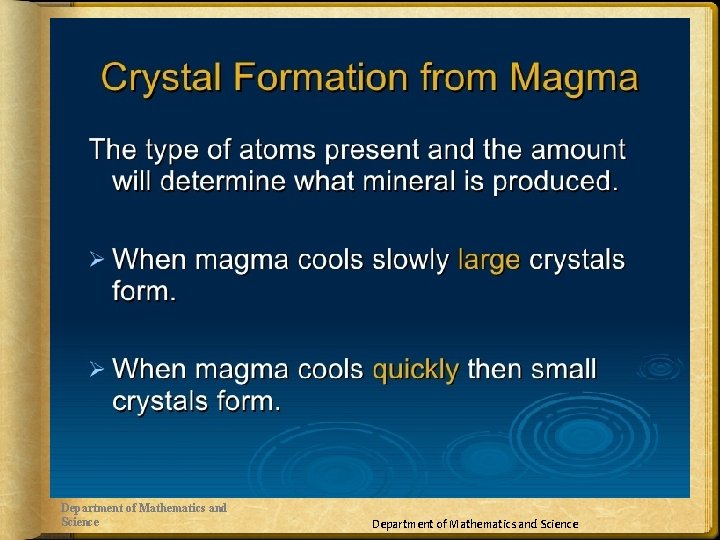
Crystals… Minerals generally are formed with a crystal structure. A crystal is a solid material found in nature that has straight edges and flat sides or that breaks into pieces with straight edges and flat sides. Only if a mineral is allowed to grow without interference from other minerals will it form crystals. Minerals "grow, " or crystallize, from many types of solutions. They may precipitate from evaporating sea water or crystallize from magmas when lava cools. While growing, minerals may develop a distinct crystal form with smooth, flat planes called crystal faces. The geometric pattern of the crystal faces reflects the internal atomic arrangement of the crystal structure. This is one of the most important things about a mineral.
Department of Mathematics and Science
Department of Mathematics and Science
Halite Department of Mathematics and Science
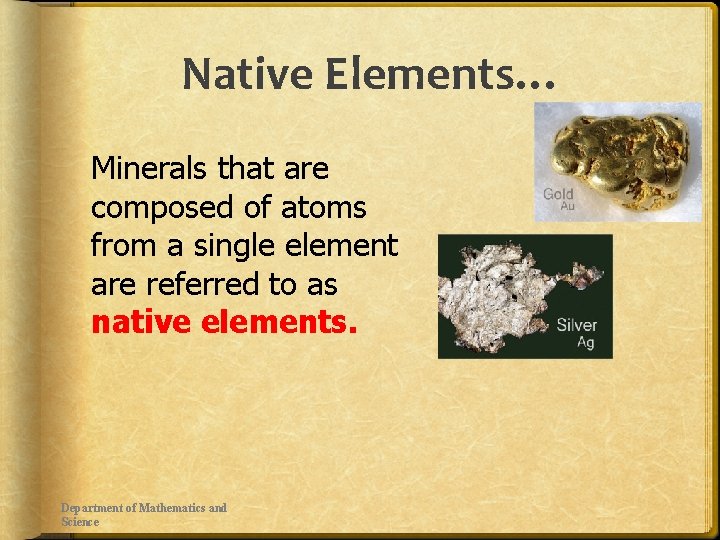
Native Elements… Minerals that are composed of atoms from a single element are referred to as native elements. Department of Mathematics and Science
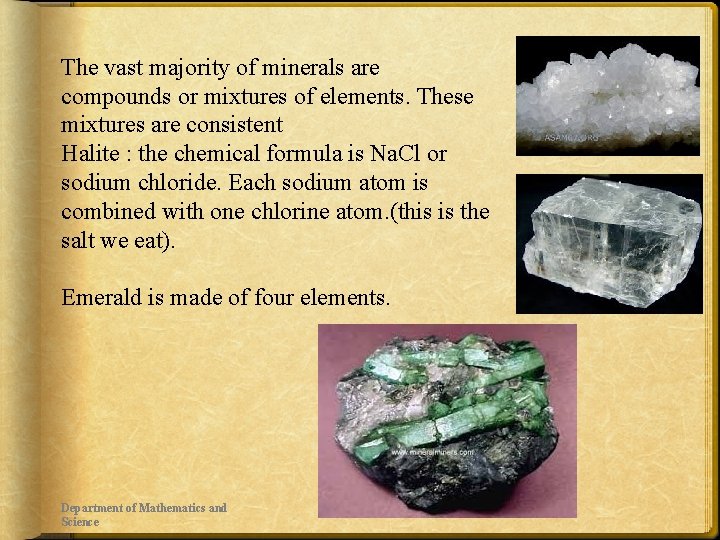
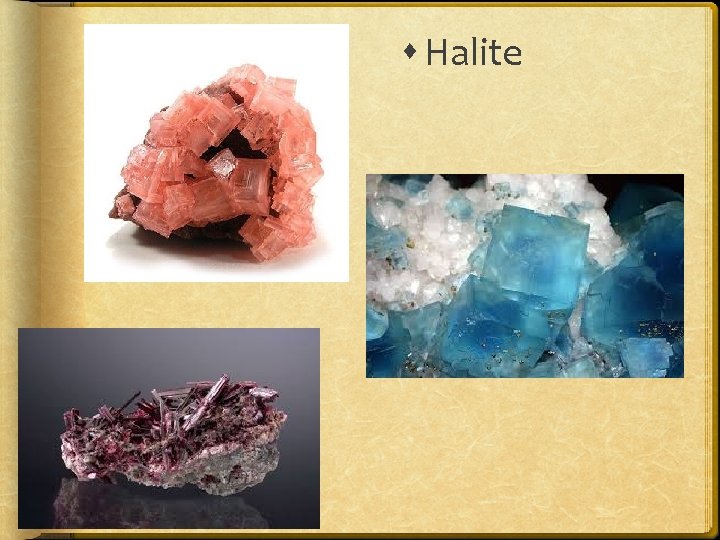
The vast majority of minerals are compounds or mixtures of elements. These mixtures are consistent Halite : the chemical formula is Na. Cl or sodium chloride. Each sodium atom is combined with one chlorine atom. (this is the salt we eat). Emerald is made of four elements. Department of Mathematics and Science
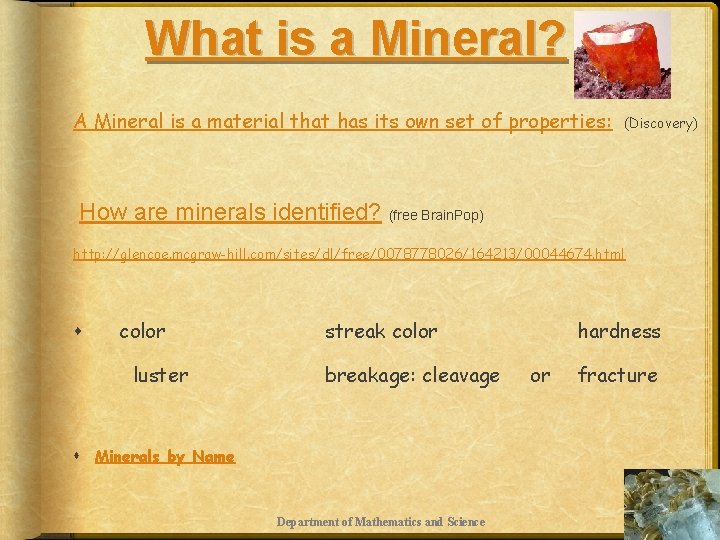
What is a Mineral? A Mineral is a material that has its own set of properties: (Discovery) How are minerals identified? (free Brain. Pop) http: //glencoe. mcgraw-hill. com/sites/dl/free/0078778026/164213/00044674. html color luster streak color breakage: cleavage Minerals by Name Department of Mathematics and Science hardness or fracture
Department of Mathematics and Science
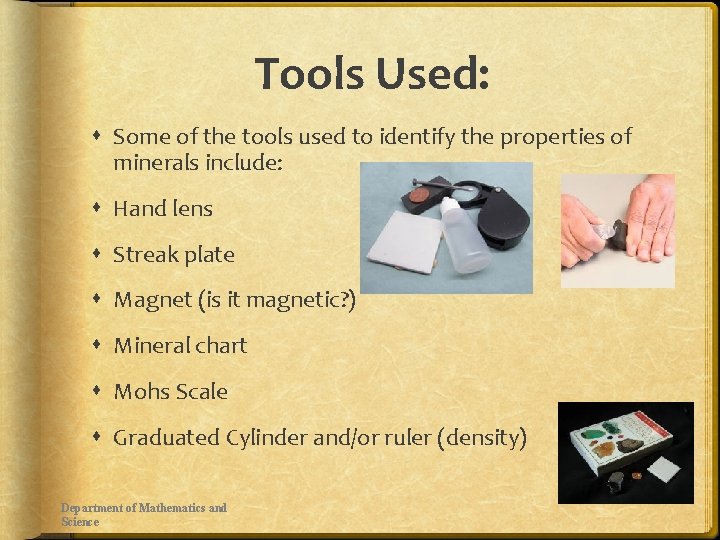
Tools Used: Some of the tools used to identify the properties of minerals include: Hand lens Streak plate Magnet (is it magnetic? ) Mineral chart Mohs Scale Graduated Cylinder and/or ruler (density) Department of Mathematics and Science
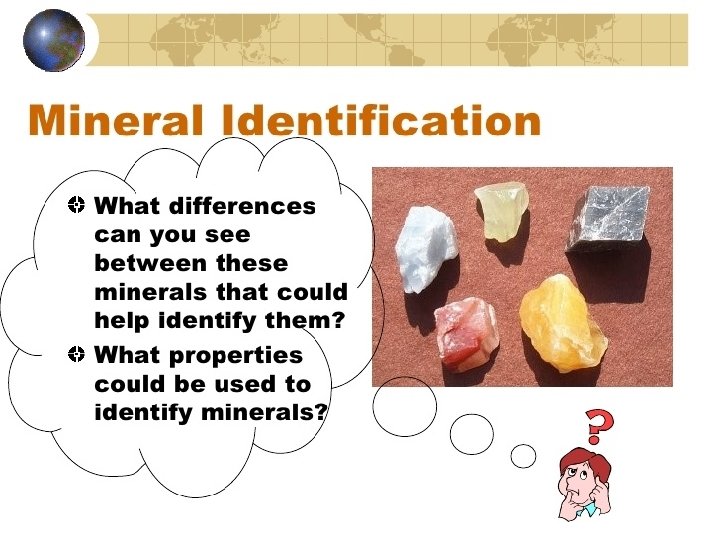
Department of Mathematics and Science
Properties of Minerals… Each mineral has its own set of properties. No two minerals have the same set of properties. How can we distinguish between the different minerals? Department of Mathematics and Science
Characteristics… There are 6 main characteristics that we use to identify minerals: Color Crystals (shape) Hardness Streak Cleavage and fracture Luster Department of Mathematics and Science
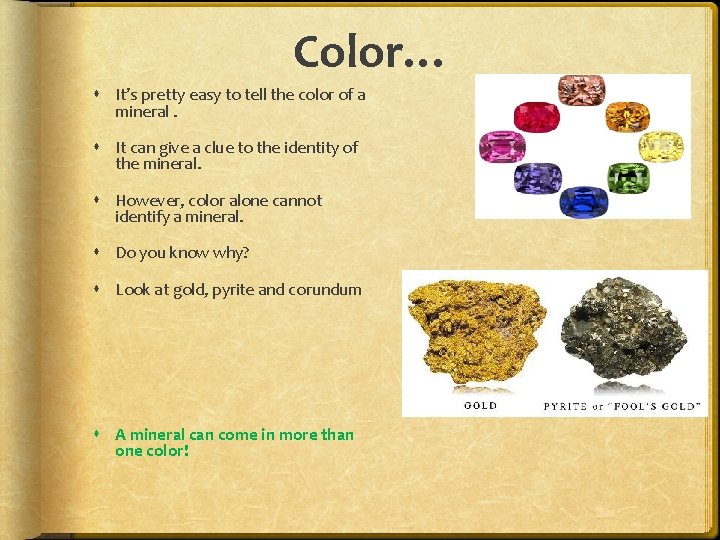
Color… It’s pretty easy to tell the color of a mineral. It can give a clue to the identity of the mineral. However, color alone cannot identify a mineral. Do you know why? Look at gold, pyrite and corundum A mineral can come in more than one color!
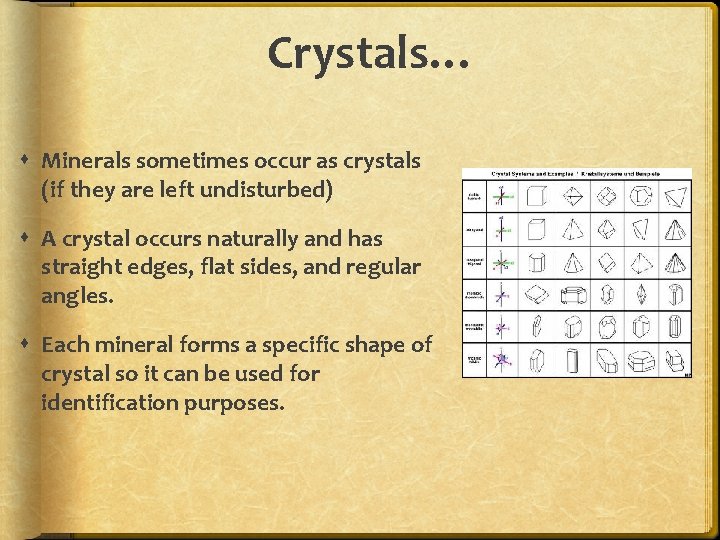
Crystals… Minerals sometimes occur as crystals (if they are left undisturbed) A crystal occurs naturally and has straight edges, flat sides, and regular angles. Each mineral forms a specific shape of crystal so it can be used for identification purposes.
Department of Mathematics and Science
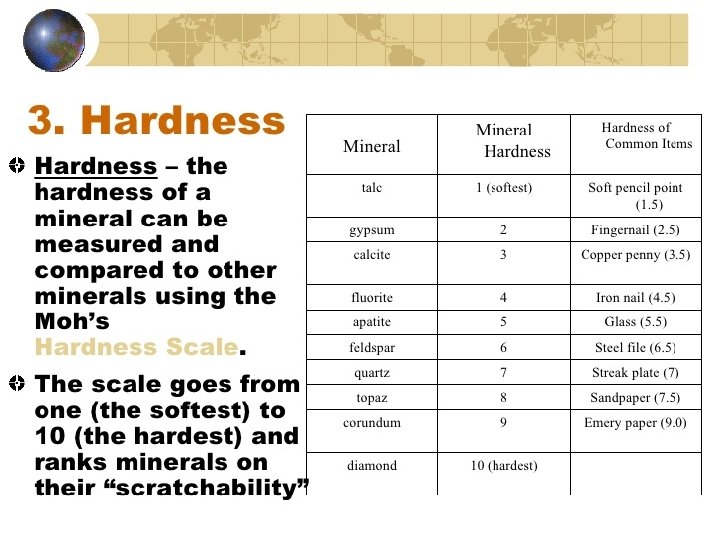
Hardness (continued) Harder minerals can scratch softer ones. To begin identifying your mineral, you would try to scratch it with the minerals in the Mohs scale that might be close to it. Example: I have mineral sample A. Fluorite didn’t scratch it (Fluorite has a hardness of 4) Apatite did scratch it (Apatite has a hardness of 5) Then this mineral would have a hardness of between 4 and 5 http: //www. kidsloverocks. com/html/mineral_hardness. htm l
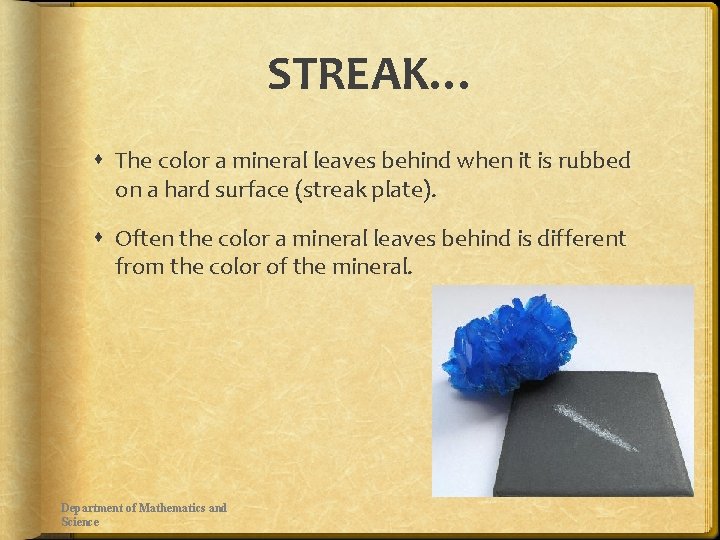
STREAK… The color a mineral leaves behind when it is rubbed on a hard surface (streak plate). Often the color a mineral leaves behind is different from the color of the mineral. Department of Mathematics and Science
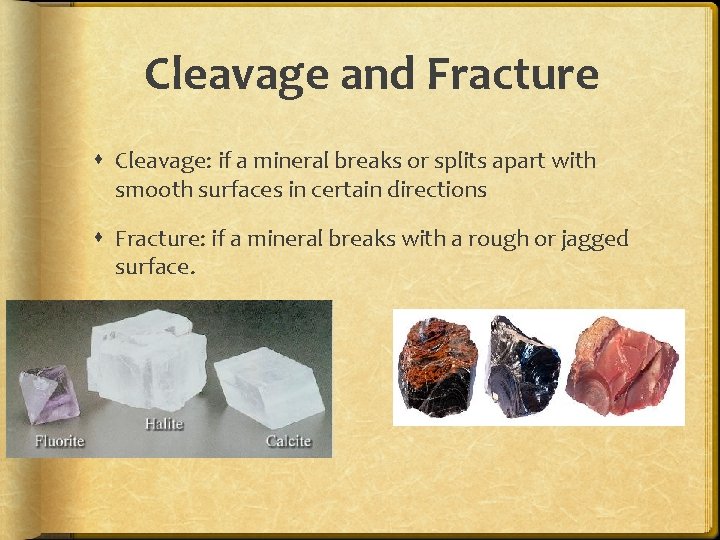
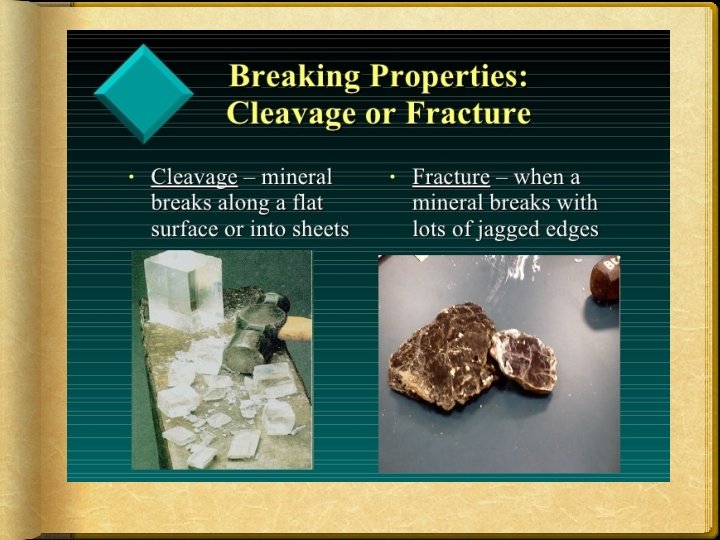
Cleavage and Fracture Cleavage: if a mineral breaks or splits apart with smooth surfaces in certain directions Fracture: if a mineral breaks with a rough or jagged surface.
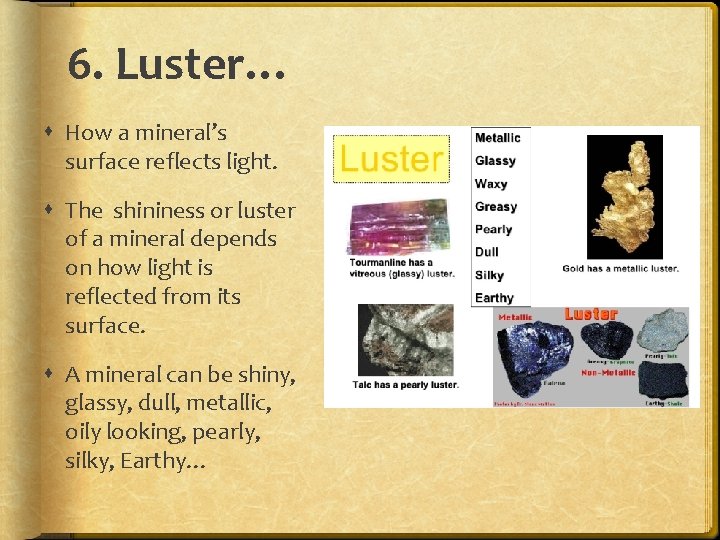
6. Luster… How a mineral’s surface reflects light. The shininess or luster of a mineral depends on how light is reflected from its surface. A mineral can be shiny, glassy, dull, metallic, oily looking, pearly, silky, Earthy…
Some Common Minerals! Department of Mathematics and Science
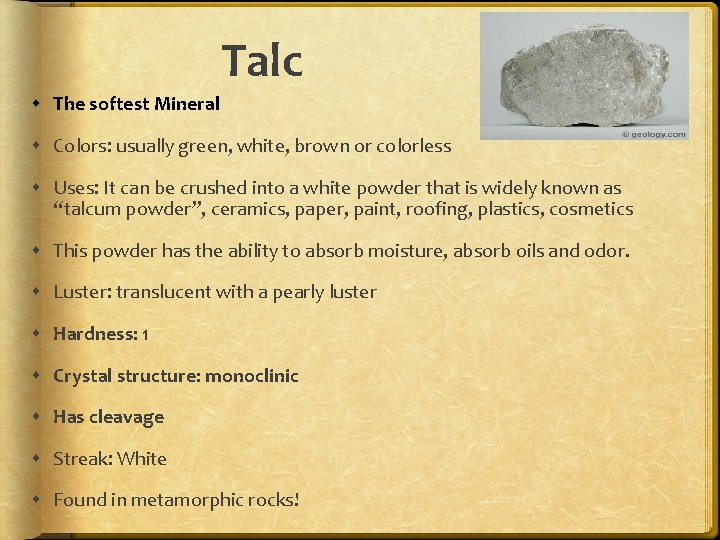
Talc The softest Mineral Colors: usually green, white, brown or colorless Uses: It can be crushed into a white powder that is widely known as “talcum powder”, ceramics, paper, paint, roofing, plastics, cosmetics This powder has the ability to absorb moisture, absorb oils and odor. Luster: translucent with a pearly luster Hardness: 1 Crystal structure: monoclinic Has cleavage Streak: White Found in metamorphic rocks!
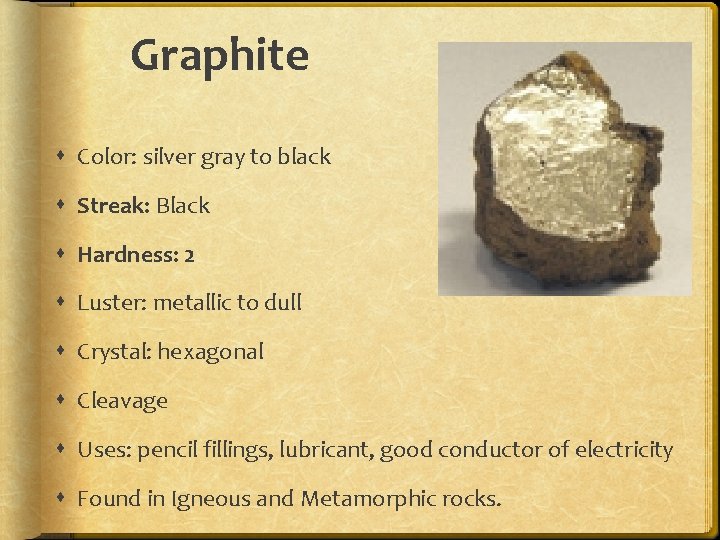
Graphite Color: silver gray to black Streak: Black Hardness: 2 Luster: metallic to dull Crystal: hexagonal Cleavage Uses: pencil fillings, lubricant, good conductor of electricity Found in Igneous and Metamorphic rocks.
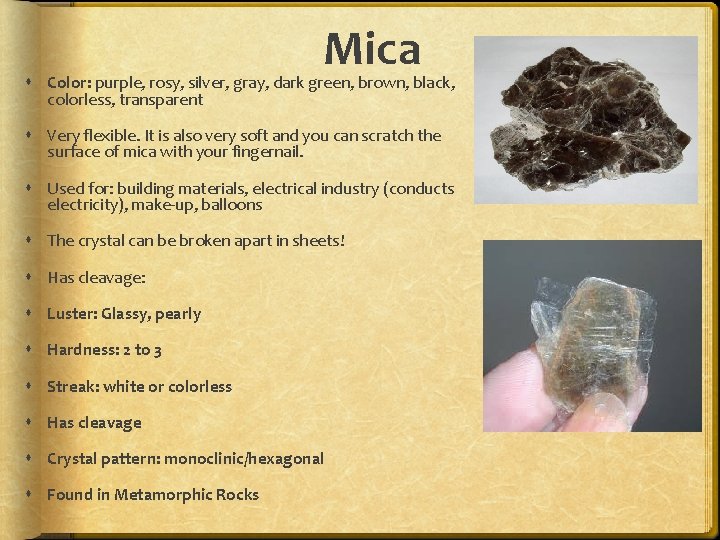
Mica Color: purple, rosy, silver, gray, dark green, brown, black, colorless, transparent Very flexible. It is also very soft and you can scratch the surface of mica with your fingernail. Used for: building materials, electrical industry (conducts electricity), make-up, balloons The crystal can be broken apart in sheets! Has cleavage: Luster: Glassy, pearly Hardness: 2 to 3 Streak: white or colorless Has cleavage Crystal pattern: monoclinic/hexagonal Found in Metamorphic Rocks
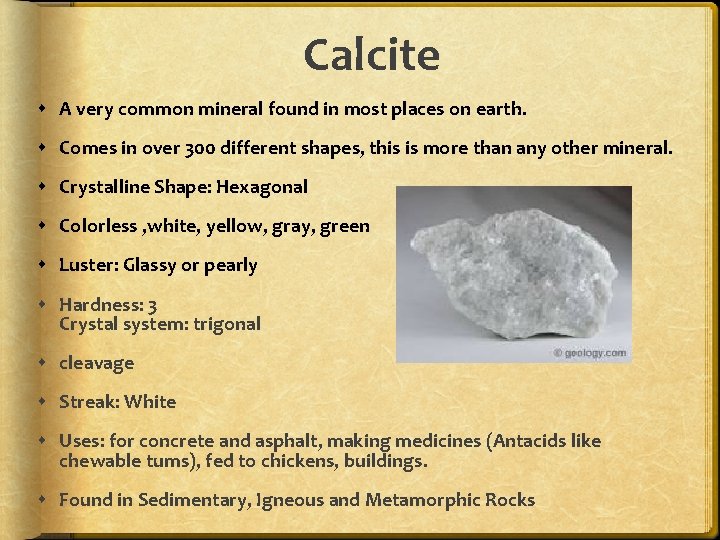
Calcite A very common mineral found in most places on earth. Comes in over 300 different shapes, this is more than any other mineral. Crystalline Shape: Hexagonal Colorless , white, yellow, gray, green Luster: Glassy or pearly Hardness: 3 Crystal system: trigonal cleavage Streak: White Uses: for concrete and asphalt, making medicines (Antacids like chewable tums), fed to chickens, buildings. Found in Sedimentary, Igneous and Metamorphic Rocks
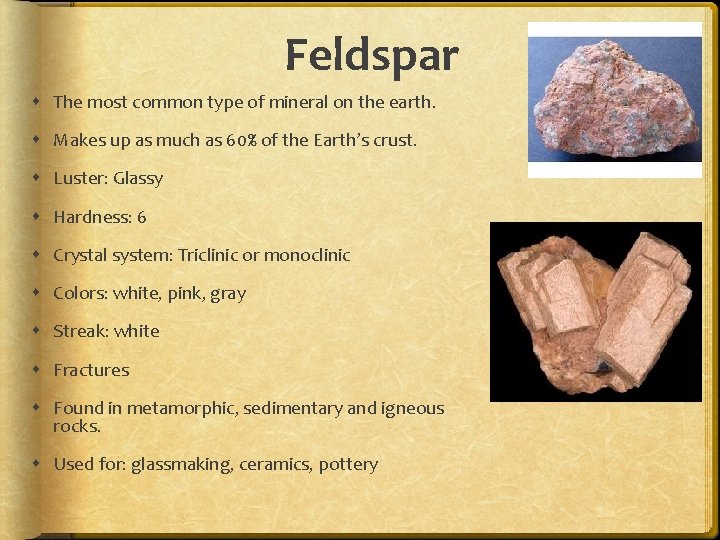
Feldspar The most common type of mineral on the earth. Makes up as much as 60% of the Earth’s crust. Luster: Glassy Hardness: 6 Crystal system: Triclinic or monoclinic Colors: white, pink, gray Streak: white Fractures Found in metamorphic, sedimentary and igneous rocks. Used for: glassmaking, ceramics, pottery
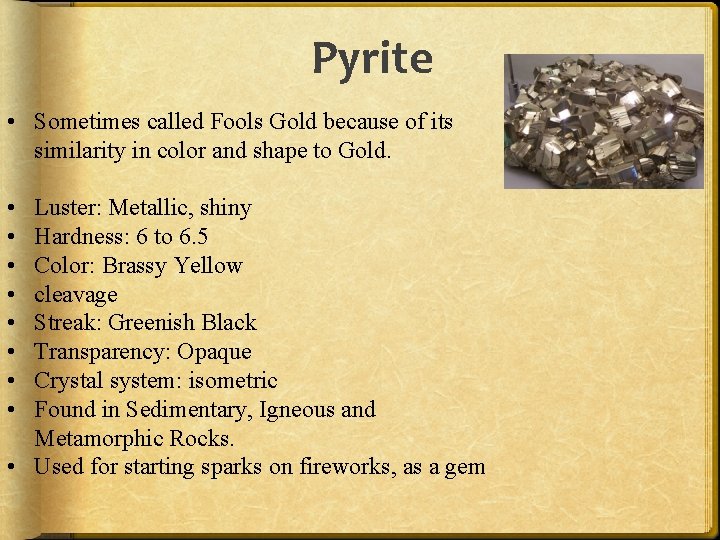
Pyrite • Sometimes called Fools Gold because of its similarity in color and shape to Gold. • • Luster: Metallic, shiny Hardness: 6 to 6. 5 Color: Brassy Yellow cleavage Streak: Greenish Black Transparency: Opaque Crystal system: isometric Found in Sedimentary, Igneous and Metamorphic Rocks. • Used for starting sparks on fireworks, as a gem
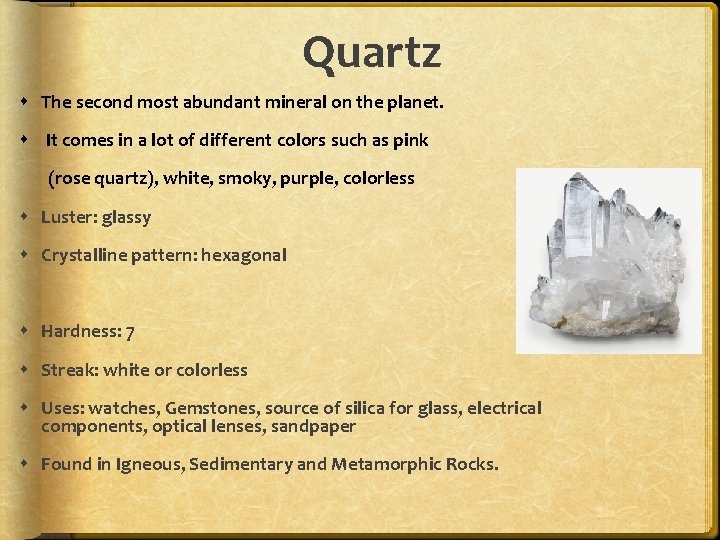
Quartz The second most abundant mineral on the planet. It comes in a lot of different colors such as pink (rose quartz), white, smoky, purple, colorless Luster: glassy Crystalline pattern: hexagonal Hardness: 7 Streak: white or colorless Uses: watches, Gemstones, source of silica for glass, electrical components, optical lenses, sandpaper Found in Igneous, Sedimentary and Metamorphic Rocks.
Diamonds are a girls best friend! Diamonds have a hardness of 10 on the Mohs Scale. Can only be scratched by other diamonds. Most of the Earth’s natural Diamond deposits are found in Africa. Very rare to find. It is the world’s most popular and sought after gemstone. They are valued according to their cut, color, carat, and clarity. Naturally occurring diamonds are formed over billions of years under intense pressure and heat. They are often brought to the Earth’s surface by deep volcanic eruptions. Department of Mathematics and Science
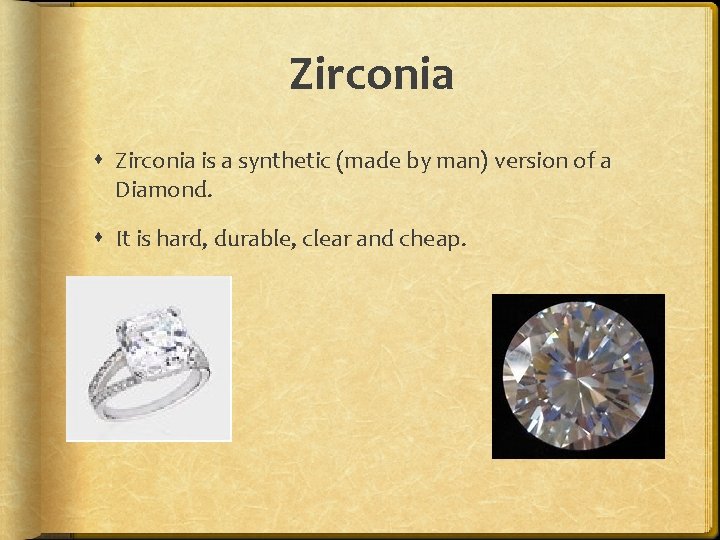
Zirconia is a synthetic (made by man) version of a Diamond. It is hard, durable, clear and cheap.
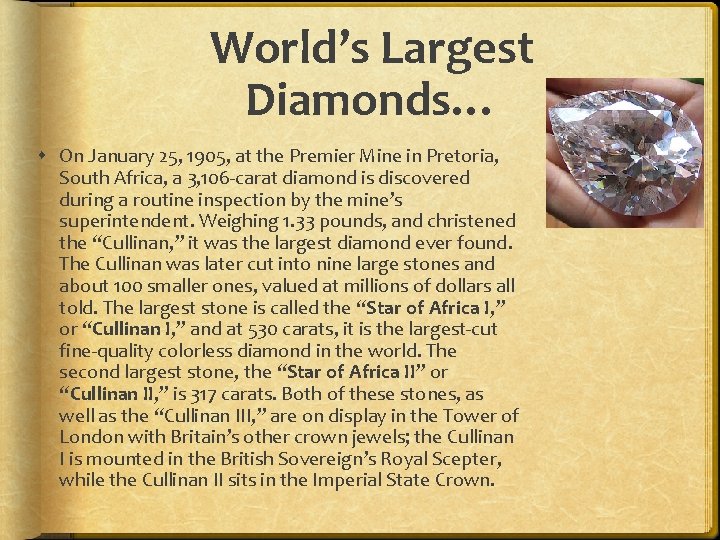
World’s Largest Diamonds… On January 25, 1905, at the Premier Mine in Pretoria, South Africa, a 3, 106 -carat diamond is discovered during a routine inspection by the mine’s superintendent. Weighing 1. 33 pounds, and christened the “Cullinan, ” it was the largest diamond ever found. The Cullinan was later cut into nine large stones and about 100 smaller ones, valued at millions of dollars all told. The largest stone is called the “Star of Africa I, ” or “Cullinan I, ” and at 530 carats, it is the largest-cut fine-quality colorless diamond in the world. The second largest stone, the “Star of Africa II” or “Cullinan II, ” is 317 carats. Both of these stones, as well as the “Cullinan III, ” are on display in the Tower of London with Britain’s other crown jewels; the Cullinan I is mounted in the British Sovereign’s Royal Scepter, while the Cullinan II sits in the Imperial State Crown.
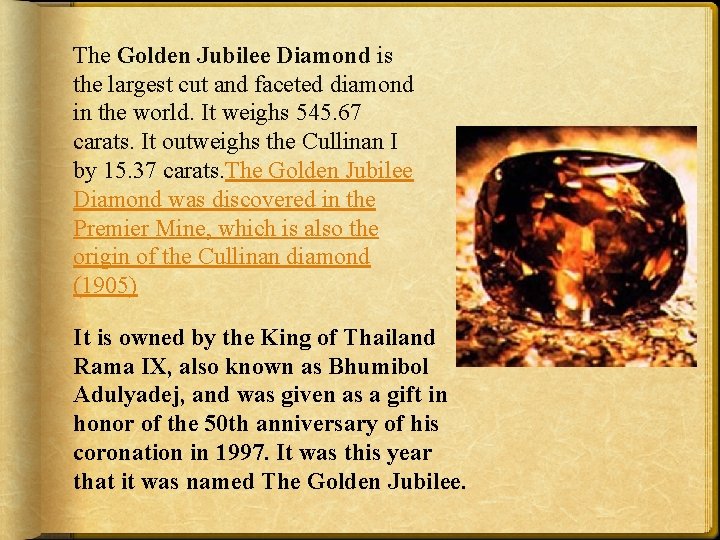
The Golden Jubilee Diamond is the largest cut and faceted diamond in the world. It weighs 545. 67 carats. It outweighs the Cullinan I by 15. 37 carats. The Golden Jubilee Diamond was discovered in the Premier Mine, which is also the origin of the Cullinan diamond (1905) It is owned by the King of Thailand Rama IX, also known as Bhumibol Adulyadej, and was given as a gift in honor of the 50 th anniversary of his coronation in 1997. It was this year that it was named The Golden Jubilee.
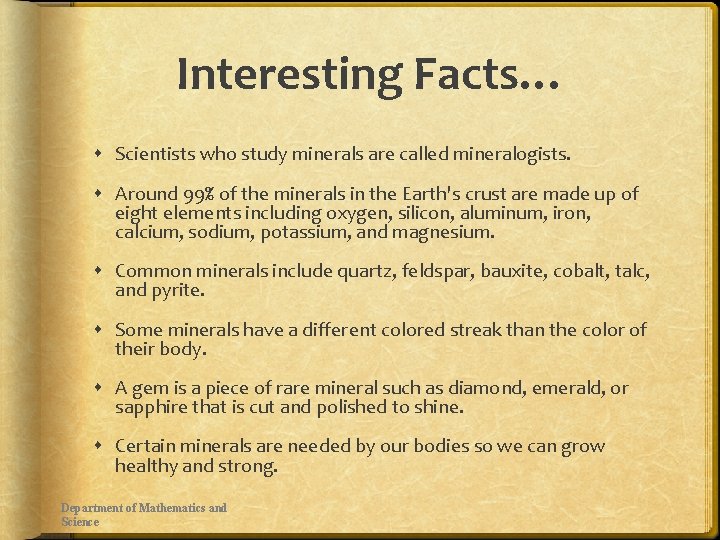
Interesting Facts… Scientists who study minerals are called mineralogists. Around 99% of the minerals in the Earth's crust are made up of eight elements including oxygen, silicon, aluminum, iron, calcium, sodium, potassium, and magnesium. Common minerals include quartz, feldspar, bauxite, cobalt, talc, and pyrite. Some minerals have a different colored streak than the color of their body. A gem is a piece of rare mineral such as diamond, emerald, or sapphire that is cut and polished to shine. Certain minerals are needed by our bodies so we can grow healthy and strong. Department of Mathematics and Science
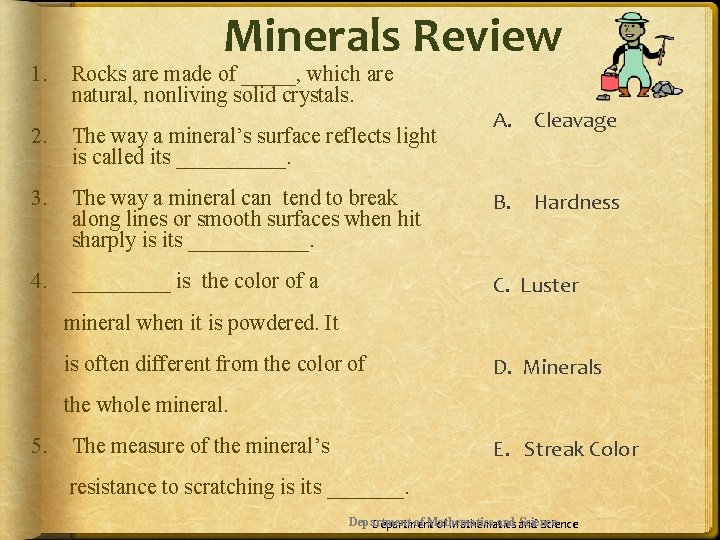
1. Minerals Review Rocks are made of _____, which are natural, nonliving solid crystals. A. Cleavage 2. The way a mineral’s surface reflects light is called its _____. 3. The way a mineral can tend to break along lines or smooth surfaces when hit sharply is its ______. B. Hardness 4. _____ is the color of a C. Luster mineral when it is powdered. It is often different from the color of D. Minerals the whole mineral. 5. The measure of the mineral’s E. Streak Color resistance to scratching is its _______. Department of Mathematics and Science Department of Mathematics Science
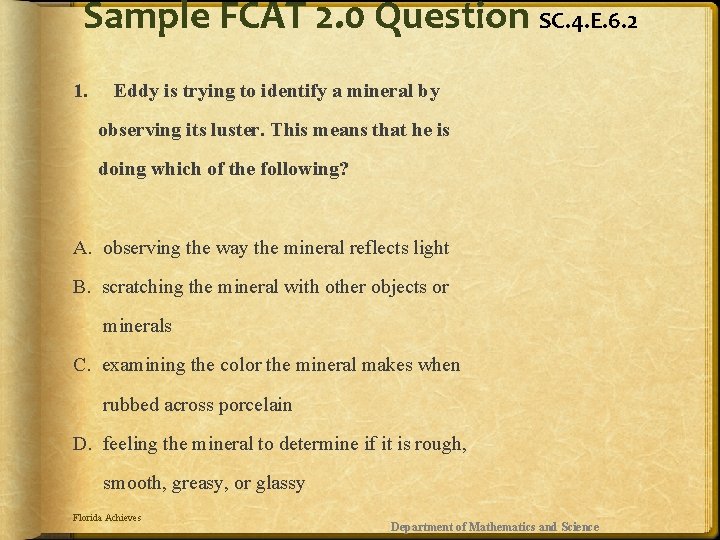
Sample FCAT 2. 0 Question SC. 4. E. 6. 2 1. Eddy is trying to identify a mineral by observing its luster. This means that he is doing which of the following? A. observing the way the mineral reflects light B. scratching the mineral with other objects or minerals C. examining the color the mineral makes when rubbed across porcelain D. feeling the mineral to determine if it is rough, smooth, greasy, or glassy Florida Achieves Department of Mathematics and Science
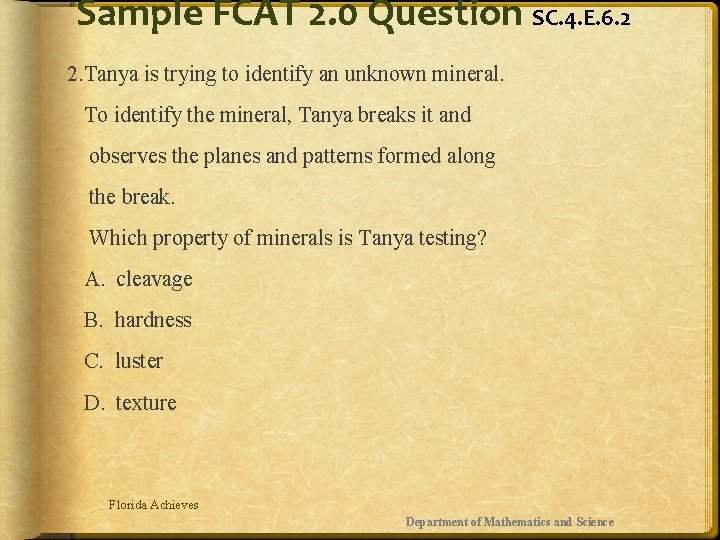
Sample FCAT 2. 0 Question SC. 4. E. 6. 2 2. Tanya is trying to identify an unknown mineral. To identify the mineral, Tanya breaks it and observes the planes and patterns formed along the break. Which property of minerals is Tanya testing? A. cleavage B. hardness C. luster D. texture Florida Achieves Department of Mathematics and Science
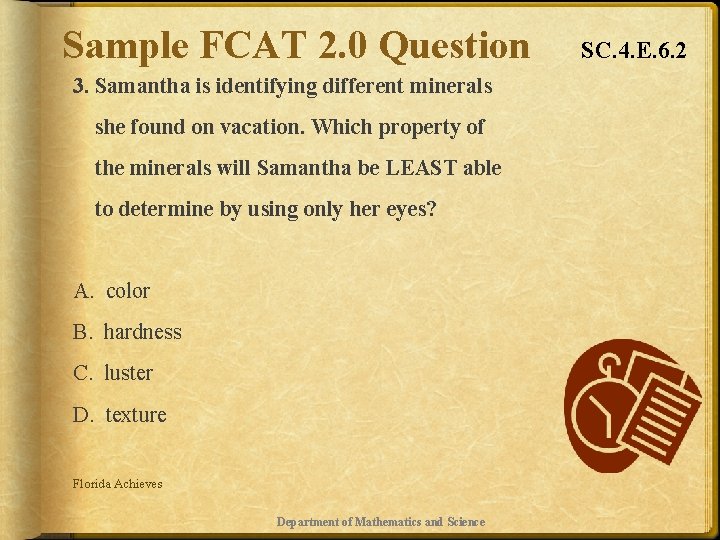
Sample FCAT 2. 0 Question 3. Samantha is identifying different minerals she found on vacation. Which property of the minerals will Samantha be LEAST able to determine by using only her eyes? A. color B. hardness C. luster D. texture Florida Achieves Department of Mathematics and Science SC. 4. E. 6. 2
- Slides: 41