
Big Idea 4 Kinetics Factors Affecting Reaction Rate
+ Big Idea #4 Kinetics
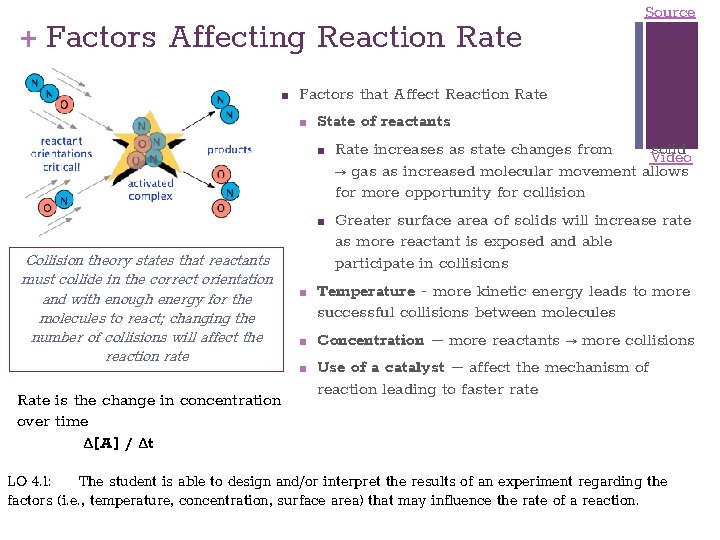
+ Factors Affecting Reaction Rate ■ Factors that Affect Reaction Rate ■ State of reactants ■ ■ Collision theory states that reactants must collide in the correct orientation and with enough energy for the molecules to react; changing the number of collisions will affect the reaction rate Rate is the change in concentration over time Δ[A] / Δt Source ■ ■ ■ Rate increases as state changes from solid Video → gas as increased molecular movement allows for more opportunity for collision Greater surface area of solids will increase rate as more reactant is exposed and able participate in collisions Temperature - more kinetic energy leads to more successful collisions between molecules Concentration – more reactants → more collisions Use of a catalyst – affect the mechanism of reaction leading to faster rate LO 4. 1: The student is able to design and/or interpret the results of an experiment regarding the factors (i. e. , temperature, concentration, surface area) that may influence the rate of a reaction.
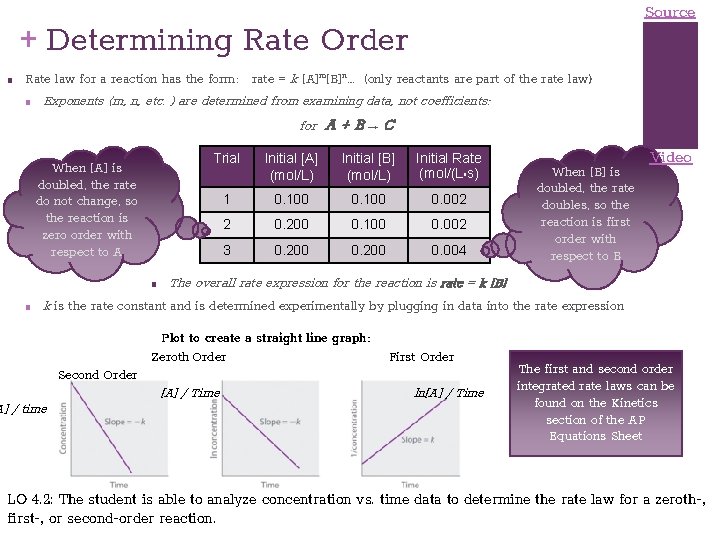
Source + Determining Rate Order ■ Rate law for a reaction has the form: rate = k [A]m[B]n… (only reactants are part of the rate law) ■ Exponents (m, n, etc. ) are determined from examining data, not coefficients: for A + B → C When [A] is doubled, the rate do not change, so the reaction is zero order with respect to A ■ ■ Trial Initial [A] (mol/L) Initial [B] (mol/L) Initial Rate (mol/(L • s) 1 0. 100 0. 002 2 0. 200 0. 100 0. 002 3 0. 200 0. 004 When [B] is doubled, the rate doubles, so the reaction is first order with respect to B Video The overall rate expression for the reaction is rate = k [B] k is the rate constant and is determined experimentally by plugging in data into the rate expression Second Order A] / time Plot to create a straight line graph: Zeroth Order [A] / Time First Order ln[A] / Time The first and second order integrated rate laws can be found on the Kinetics section of the AP Equations Sheet LO 4. 2: The student is able to analyze concentration vs. time data to determine the rate law for a zeroth-, first-, or second-order reaction.
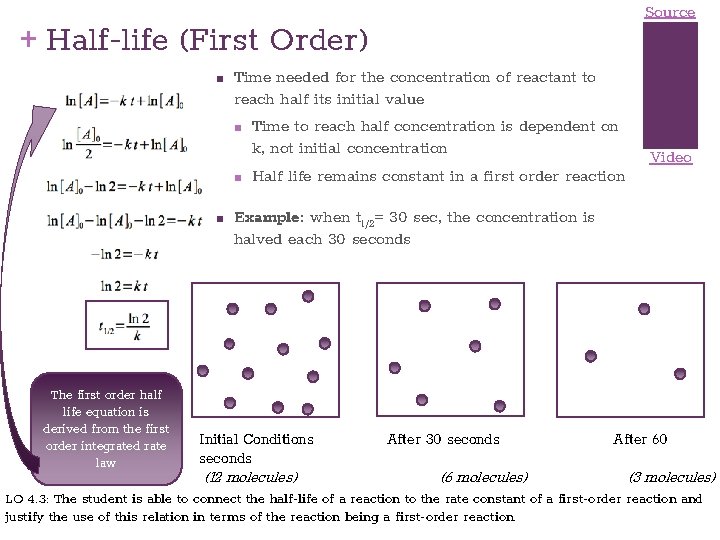
Source + Half-life (First Order) ■ Time needed for the concentration of reactant to reach half its initial value ■ ■ ■ The first order half life equation is derived from the first order integrated rate law Time to reach half concentration is dependent on k, not initial concentration Half life remains constant in a first order reaction Video Example: when t 1/2= 30 sec, the concentration is halved each 30 seconds Initial Conditions seconds (12 molecules) After 30 seconds (6 molecules) After 60 (3 molecules) LO 4. 3: The student is able to connect the half-life of a reaction to the rate constant of a first-order reaction and justify the use of this relation in terms of the reaction being a first-order reaction.
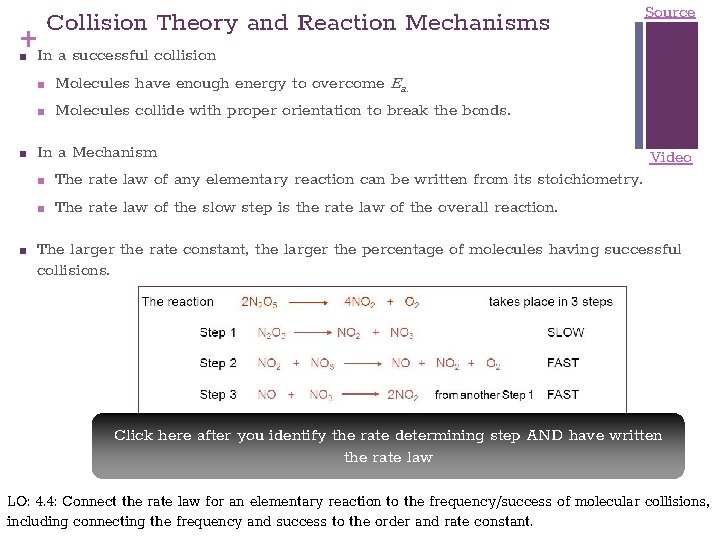
Collision Theory and Reaction Mechanisms +In a successful collision Source ■ ■ ■ Molecules have enough energy to overcome Ea. Molecules collide with proper orientation to break the bonds. In a Mechanism ■ The rate law of any elementary reaction can be written from its stoichiometry. ■ The rate law of the slow step is the rate law of the overall reaction. Video The larger the rate constant, the larger the percentage of molecules having successful collisions. Click here after you identify the rate determining step AND have written the rate law LO: 4. 4: Connect the rate law for an elementary reaction to the frequency/success of molecular collisions, including connecting the frequency and success to the order and rate constant.
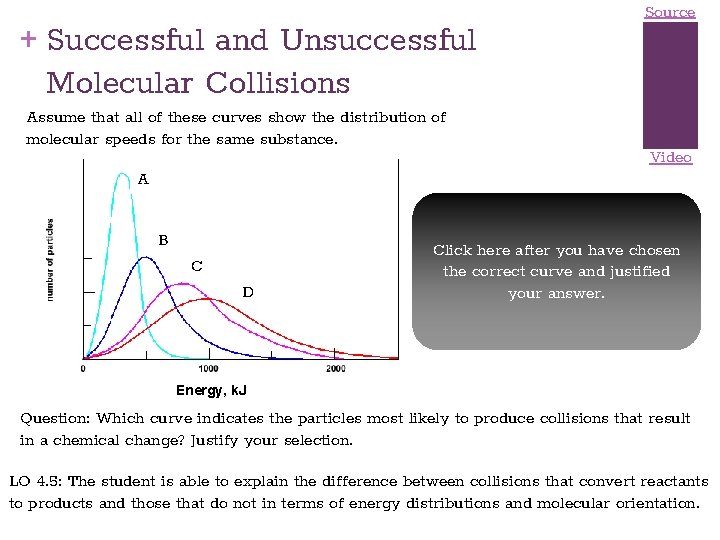
+ Successful and Unsuccessful Molecular Collisions Assume that all of these curves show the distribution of molecular speeds for the same substance. A B C D Source Video Curve D because a larger number of its particles have higherhere kinetic so Click afterenergies, you haveand chosen are likely to overcome themore correct curve and justified the activation yourenergy answer. barrier when they collide. Energy, k. J Question: Which curve indicates the particles most likely to produce collisions that result in a chemical change? Justify your selection. LO 4. 5: The student is able to explain the difference between collisions that convert reactants to products and those that do not in terms of energy distributions and molecular orientation.
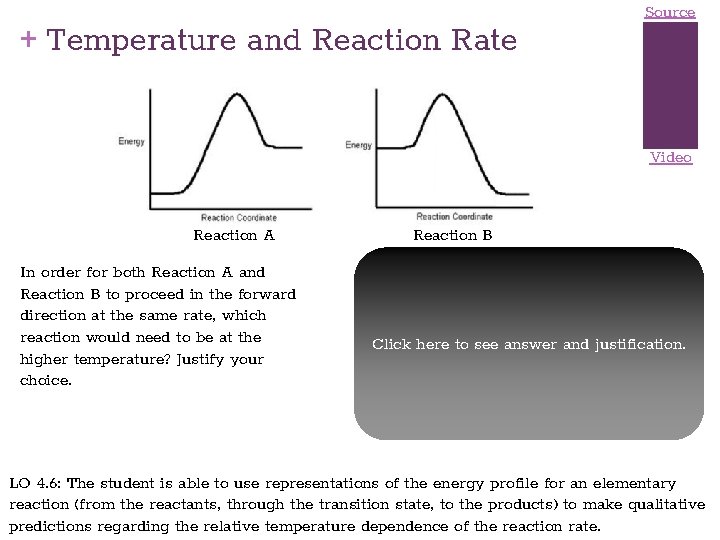
+ Temperature and Reaction Rate Source Video Reaction A In order for both Reaction A and Reaction B to proceed in the forward direction at the same rate, which reaction would need to be at the higher temperature? Justify your choice. Reaction B The greater the activation energy, the slower the reaction. Since Reaction A has a greater activation energy, it should be slower than Reaction B at the same temperature. To bring its Click toofsee answer and justification. rate uphere to that Reaction B would require increasing its temperature. Important note: It does not matter at all, in answering this question, that Reaction A is endothermic and Reaction B is exothermic. LO 4. 6: The student is able to use representations of the energy profile for an elementary reaction (from the reactants, through the transition state, to the products) to make qualitative predictions regarding the relative temperature dependence of the reaction rate.
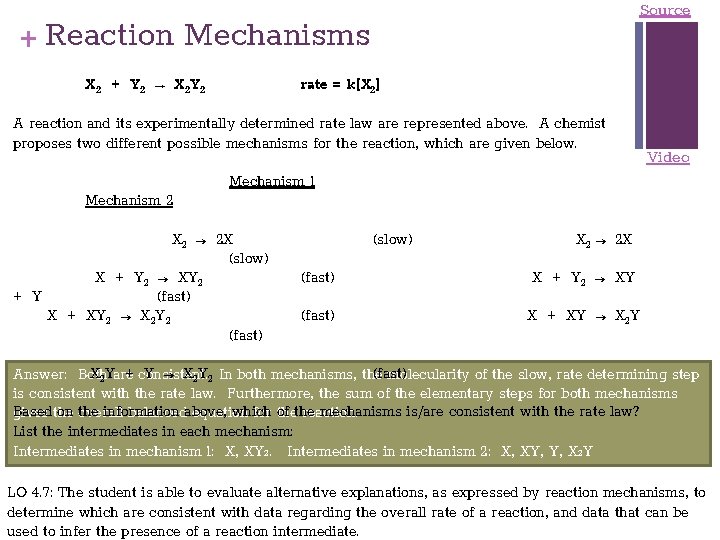
Source + Reaction Mechanisms X 2 + Y 2 → X 2 Y 2 rate = k[X 2] A reaction and its experimentally determined rate law are represented above. A chemist proposes two different possible mechanisms for the reaction, which are given below. Mechanism 2 Video Mechanism 1 X 2 → 2 X (slow) X + Y 2 → XY 2 + Y (fast) X + XY 2 → X 2 Y 2 (fast) (slow) X 2 → 2 X (fast) X + Y 2 → XY (fast) X + XY → X 2 Yare + consistent. Y → X 2 Y 2 In both mechanisms, the (fast) Answer: Both molecularity of the slow, rate determining step is consistent with the rate law. Furthermore, the sum of the elementary steps for both mechanisms Based on the information which of the mechanisms is/are consistent with the rate law? gives the overall balancedabove, equation for the reaction. List the intermediates in each mechanism: Intermediates in mechanism 1: X, XY 2. Intermediates in mechanism 2: X, XY, Y, X 2 Y LO 4. 7: The student is able to evaluate alternative explanations, as expressed by reaction mechanisms, to determine which are consistent with data regarding the overall rate of a reaction, and data that can be used to infer the presence of a reaction intermediate.
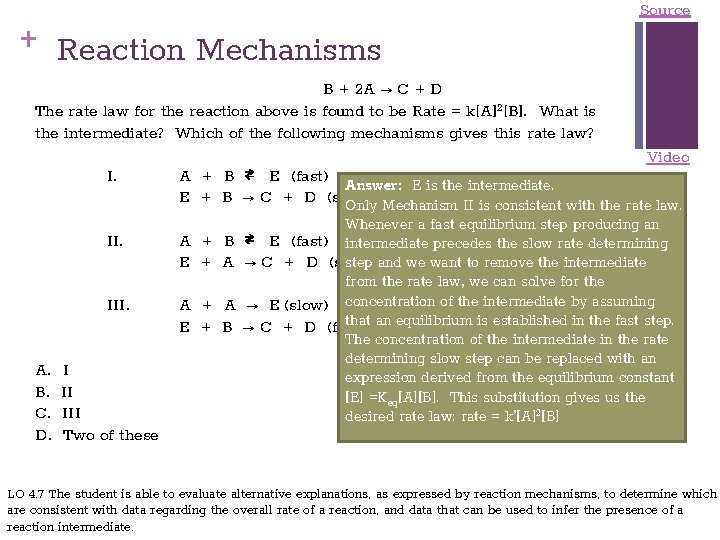
+ Reaction Mechanisms B + 2 A → C + D The rate law for the reaction above is found to be Rate = k[A]2[B]. What is the intermediate? Which of the following mechanisms gives this rate law? I. A. B. C. D. Video A + B ⇄ E (fast) Answer: E is the intermediate. E + B → C + D (slow) Only Mechanism II is consistent with the rate law. II. A + B E + A III. A + A E + B I II III Two of these Source Whenever a fast equilibrium step producing an ⇄ E (fast) intermediate precedes the slow rate determining → C + D (slow) step and we want to remove the intermediate from the rate law, we can solve for the → E (slow) concentration of the intermediate by assuming that an equilibrium is established in the fast step. → C + D (fast) The concentration of the intermediate in the rate determining slow step can be replaced with an expression derived from the equilibrium constant [E] =Keq[A][B]. This substitution gives us the desired rate law: rate = k’[A]2[B] LO 4. 7 The student is able to evaluate alternative explanations, as expressed by reaction mechanisms, to determine which are consistent with data regarding the overall rate of a reaction, and data that can be used to infer the presence of a reaction intermediate.
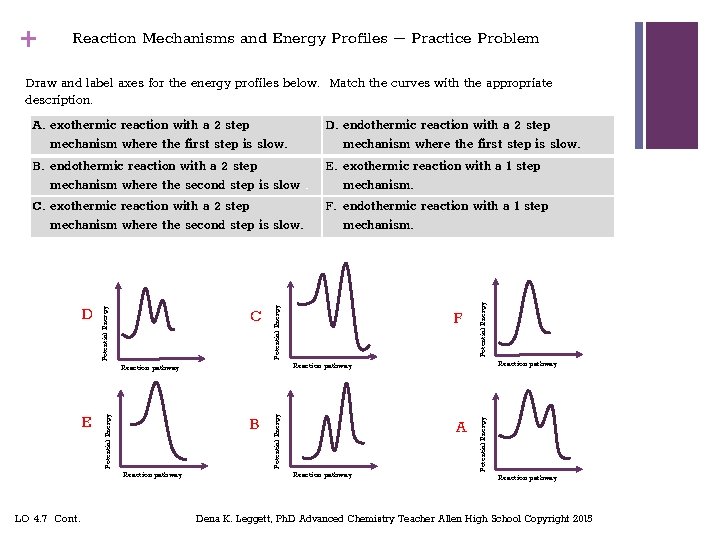
+ Reaction Mechanisms and Energy Profiles – Practice Problem Draw and label axes for the energy profiles below. Match the curves with the appropriate description. E. exothermic reaction with a 1 step mechanism. F. endothermic reaction with a 1 step mechanism. LO 4. 7 Cont. Reaction pathway B Reaction pathway F Reaction pathway A Reaction pathway Potential Energy C Potential Energy E Potential Energy D Potential Energy B. endothermic reaction with a 2 step mechanism where the second step is slow. C. exothermic reaction with a 2 step mechanism where the second step is slow. Potential Energy D. endothermic reaction with a 2 step mechanism where the first step is slow. Potential Energy A. exothermic reaction with a 2 step mechanism where the first step is slow. Reaction pathway Dena K. Leggett, Ph. D Advanced Chemistry Teacher Allen High School Copyright 2015
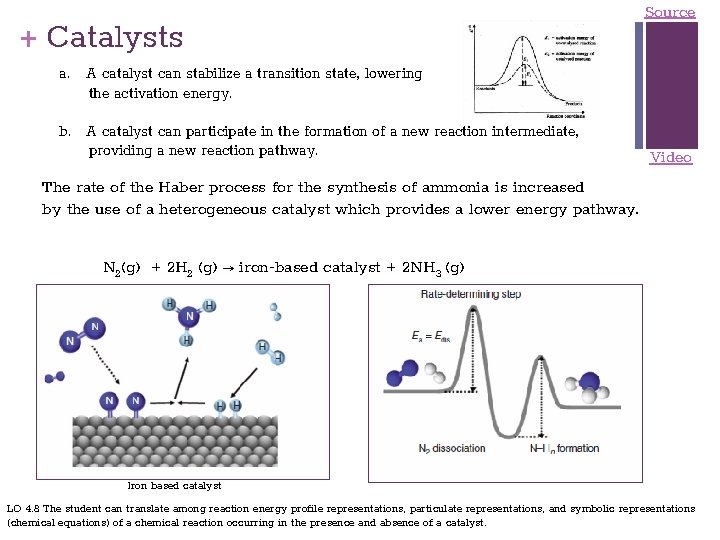
+ Catalysts Source a. A catalyst can stabilize a transition state, lowering the activation energy. b. A catalyst can participate in the formation of a new reaction intermediate, providing a new reaction pathway. Video The rate of the Haber process for the synthesis of ammonia is increased by the use of a heterogeneous catalyst which provides a lower energy pathway. N 2(g) + 2 H 2 (g) → iron-based catalyst + 2 NH 3 (g) Iron based catalyst LO 4. 8 The student can translate among reaction energy profile representations, particulate representations, and symbolic representations (chemical equations) of a chemical reaction occurring in the presence and absence of a catalyst.
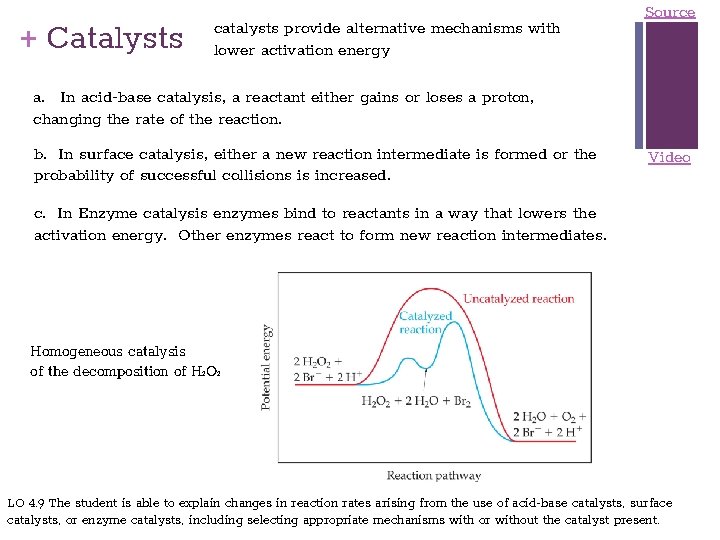
+ Catalysts catalysts provide alternative mechanisms with lower activation energy Source a. In acid-base catalysis, a reactant either gains or loses a proton, changing the rate of the reaction. b. In surface catalysis, either a new reaction intermediate is formed or the probability of successful collisions is increased. Video c. In Enzyme catalysis enzymes bind to reactants in a way that lowers the activation energy. Other enzymes react to form new reaction intermediates. Homogeneous catalysis of the decomposition of H 2 O 2 LO 4. 9 The student is able to explain changes in reaction rates arising from the use of acid-base catalysts, surface catalysts, or enzyme catalysts, including selecting appropriate mechanisms with or without the catalyst present.
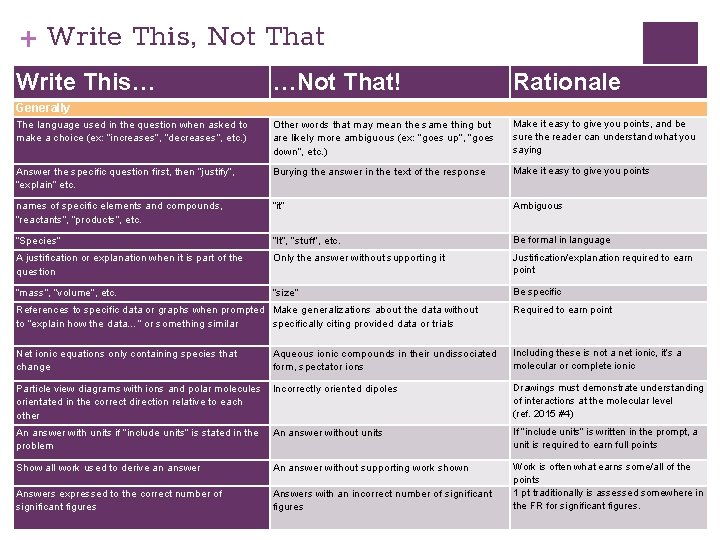
+ Write This, Not That Write This… …Not That! Rationale The language used in the question when asked to make a choice (ex: “increases”, “decreases”, etc. ) Other words that may mean the same thing but are likely more ambiguous (ex: “goes up”, “goes down”, etc. ) Make it easy to give you points, and be sure the reader can understand what you saying Answer the specific question first, then “justify”, “explain” etc. Burying the answer in the text of the response Make it easy to give you points names of specific elements and compounds, “reactants”, “products”, etc. “it” Ambiguous “Species” “It”, “stuff”, etc. Be formal in language A justification or explanation when it is part of the question Only the answer without supporting it Justification/explanation required to earn point “mass”, “volume”, etc. “size” Be specific Generally References to specific data or graphs when prompted Make generalizations about the data without to “explain how the data…” or something similar specifically citing provided data or trials Required to earn point Net ionic equations only containing species that change Aqueous ionic compounds in their undissociated form, spectator ions Including these is not a net ionic, it’s a molecular or complete ionic Particle view diagrams with ions and polar molecules orientated in the correct direction relative to each other Incorrectly oriented dipoles Drawings must demonstrate understanding of interactions at the molecular level (ref. 2015 #4) An answer with units if “include units” is stated in the problem An answer without units If “include units” is written in the prompt, a unit is required to earn full points Show all work used to derive an answer An answer without supporting work shown Answers expressed to the correct number of significant figures Answers with an incorrect number of significant figures Work is often what earns some/all of the points 1 pt traditionally is assessed somewhere in the FR for significant figures.
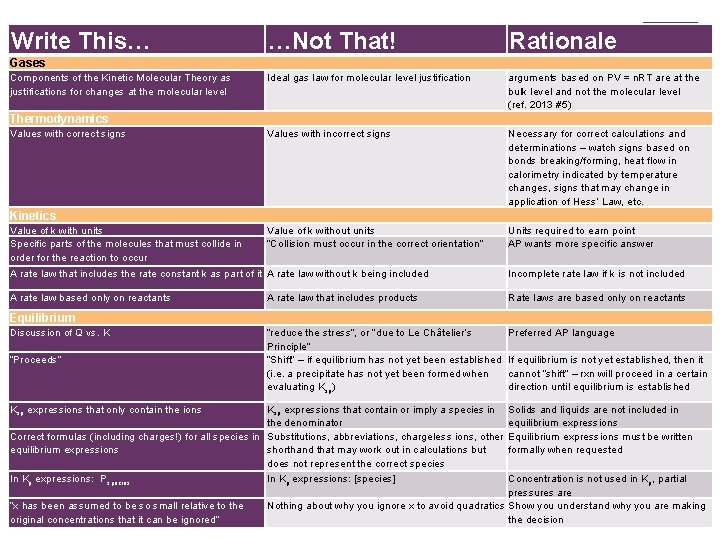
Write + This… …Not That! Rationale Ideal gas law for molecular level justification arguments based on PV = n. RT are at the bulk level and not the molecular level (ref. 2013 #5) Values with incorrect signs Necessary for correct calculations and determinations – watch signs based on bonds breaking/forming, heat flow in calorimetry indicated by temperature changes, signs that may change in application of Hess’ Law, etc. Value of k without units “Collision must occur in the correct orientation” Units required to earn point AP wants more specific answer Gases Components of the Kinetic Molecular Theory as justifications for changes at the molecular level Thermodynamics Values with correct signs Kinetics Value of k with units Specific parts of the molecules that must collide in order for the reaction to occur A rate law that includes the rate constant k as part of it A rate law without k being included Incomplete rate law if k is not included A rate law based only on reactants A rate law that includes products Rate laws are based only on reactants “reduce the stress”, or “due to Le Châtelier’s Principle” “Shift” – if equilibrium has not yet been established (i. e. a precipitate has not yet been formed when evaluating Ksp) Preferred AP language Equilibrium Discussion of Q vs. K “Proceeds” Ksp expressions that only contain the ions Ksp expressions that contain or imply a species in the denominator Correct formulas (including charges!) for all species in Substitutions, abbreviations, chargeless ions, other equilibrium expressions shorthand that may work out in calculations but does not represent the correct species In Kp expressions: Pspecies In Kp expressions: [species] “x has been assumed to be so small relative to the original concentrations that it can be ignored” If equilibrium is not yet established, then it cannot “shift” – rxn will proceed in a certain direction until equilibrium is established Solids and liquids are not included in equilibrium expressions Equilibrium expressions must be written formally when requested Concentration is not used in K p, partial pressures are Nothing about why you ignore x to avoid quadratics Show you understand why you are making the decision
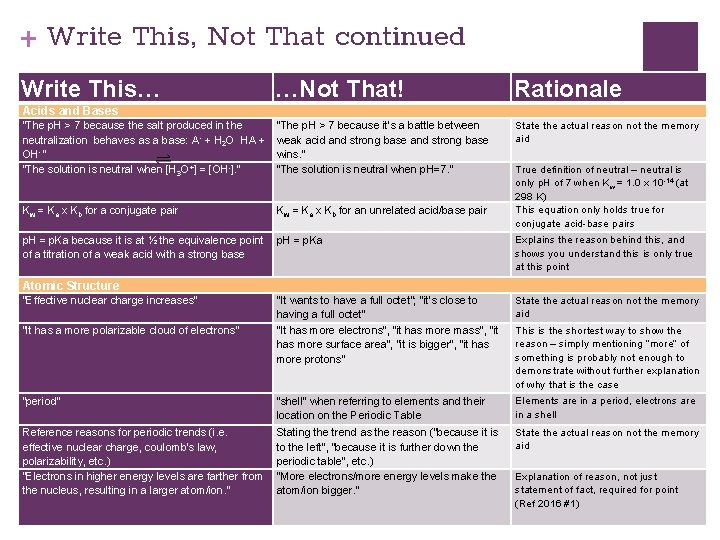
+ Write This, Not That continued Write This… …Not That! Rationale “The p. H > 7 because the salt produced in the neutralization behaves as a base: A- + H 2 O HA + OH- ” “The solution is neutral when [H 3 O+] = [OH-]. ” “The p. H > 7 because it’s a battle between weak acid and strong base wins. ” “The solution is neutral when p. H=7. ” State the actual reason not the memory aid Kw = Ka x Kb for a conjugate pair Kw = Ka x Kb for an unrelated acid/base pair p. H = p. Ka because it is at ½ the equivalence point of a titration of a weak acid with a strong base p. H = p. Ka Explains the reason behind this, and shows you understand this is only true at this point “It wants to have a full octet”; “it’s close to having a full octet” “It has more electrons”, “it has more mass”, “it has more surface area”, “it is bigger”, “it has more protons” State the actual reason not the memory aid “period” “shell” when referring to elements and their location on the Periodic Table Elements are in a period, electrons are in a shell Reference reasons for periodic trends (i. e. effective nuclear charge, coulomb’s law, polarizability, etc. ) “Electrons in higher energy levels are farther from the nucleus, resulting in a larger atom/ion. ” Stating the trend as the reason (“because it is to the left”, “because it is further down the periodic table”, etc. ) “More electrons/more energy levels make the atom/ion bigger. ” State the actual reason not the memory aid Acids and Bases True definition of neutral – neutral is only p. H of 7 when Kw = 1. 0 x 10 -14 (at 298 K) This equation only holds true for conjugate acid-base pairs Atomic Structure “Effective nuclear charge increases” “It has a more polarizable cloud of electrons” This is the shortest way to show the reason – simply mentioning “more” of something is probably not enough to demonstrate without further explanation of why that is the case Explanation of reason, not just statement of fact, required for point (Ref 2016 #1)
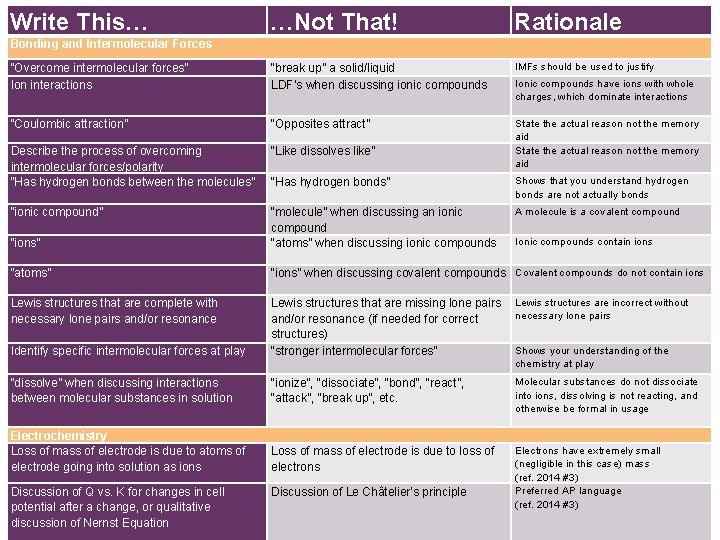
Write This… …Not That! Rationale “Overcome intermolecular forces” Ion interactions “break up” a solid/liquid LDF’s when discussing ionic compounds IMFs should be used to justify “Coulombic attraction” “Opposites attract” Describe the process of overcoming intermolecular forces/polarity “Has hydrogen bonds between the molecules” “Like dissolves like” State the actual reason not the memory aid “Has hydrogen bonds” Shows that you understand hydrogen bonds are not actually bonds “ionic compound” A molecule is a covalent compound “ions” “molecule” when discussing an ionic compound “atoms” when discussing ionic compounds “atoms” “ions” when discussing covalent compounds Covalent compounds do not contain ions Lewis structures that are complete with necessary lone pairs and/or resonance Lewis structures are incorrect without necessary lone pairs Identify specific intermolecular forces at play Lewis structures that are missing lone pairs and/or resonance (if needed for correct structures) “stronger intermolecular forces” “dissolve” when discussing interactions between molecular substances in solution “ionize”, “dissociate”, “bond”, “react”, “attack”, “break up”, etc. Molecular substances do not dissociate into ions, dissolving is not reacting, and otherwise be formal in usage Electrochemistry Loss of mass of electrode is due to atoms of electrode going into solution as ions Loss of mass of electrode is due to loss of electrons Electrons have extremely small (negligible in this case) mass (ref. 2014 #3) Preferred AP language (ref. 2014 #3) + Bonding and Intermolecular Forces Discussion of Q vs. K for changes in cell potential after a change, or qualitative discussion of Nernst Equation Discussion of Le Châtelier’s principle Ionic compounds have ions with whole charges, which dominate interactions Ionic compounds contain ions Shows your understanding of the chemistry at play
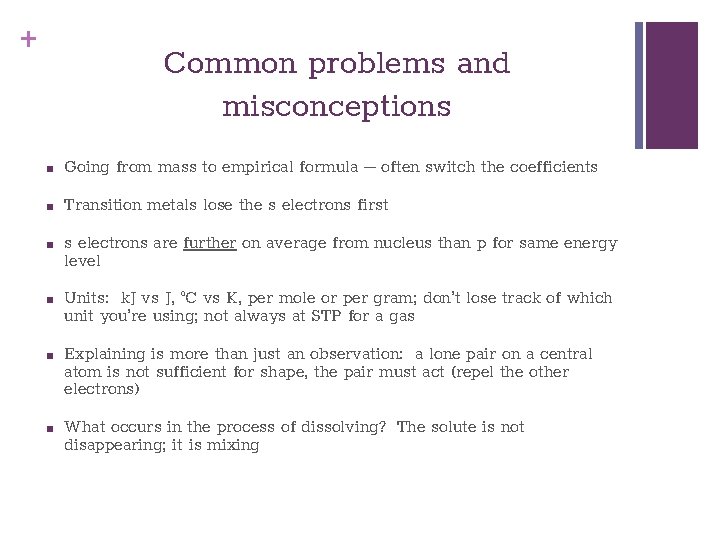
+ Common problems and misconceptions ■ Going from mass to empirical formula – often switch the coefficients ■ Transition metals lose the s electrons first ■ s electrons are further on average from nucleus than p for same energy level ■ Units: k. J vs J, °C vs K, per mole or per gram; don’t lose track of which unit you’re using; not always at STP for a gas ■ ■ Explaining is more than just an observation: a lone pair on a central atom is not sufficient for shape, the pair must act (repel the other electrons) What occurs in the process of dissolving? The solute is not disappearing; it is mixing
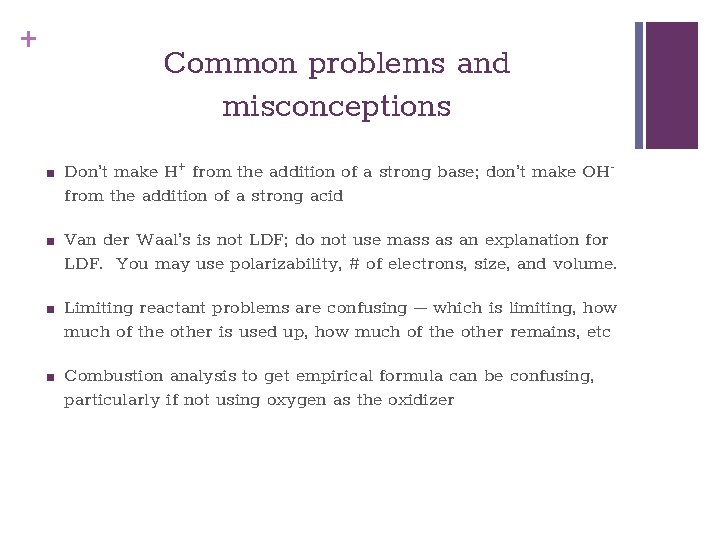
+ Common problems and misconceptions ■ ■ Don’t make H+ from the addition of a strong base; don’t make OHfrom the addition of a strong acid Van der Waal’s is not LDF; do not use mass as an explanation for LDF. You may use polarizability, # of electrons, size, and volume. Limiting reactant problems are confusing – which is limiting, how much of the other is used up, how much of the other remains, etc Combustion analysis to get empirical formula can be confusing, particularly if not using oxygen as the oxidizer
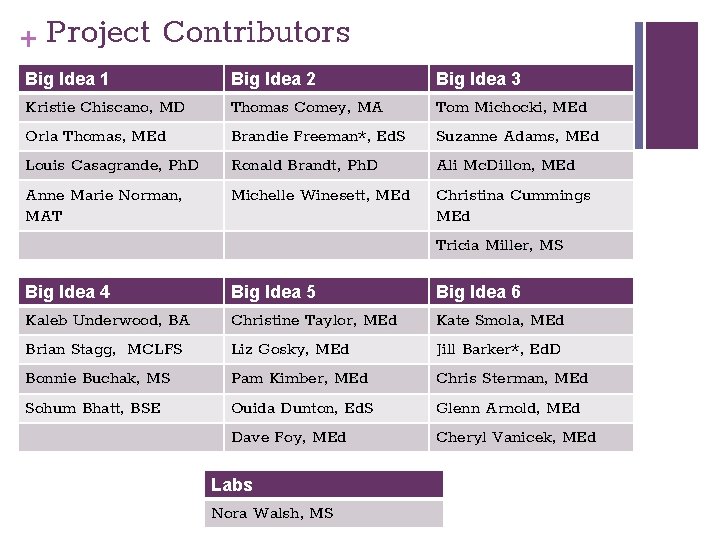
+ Project Contributors Big Idea 1 Big Idea 2 Big Idea 3 Kristie Chiscano, MD Thomas Comey, MA Tom Michocki, MEd Orla Thomas, MEd Brandie Freeman*, Ed. S Suzanne Adams, MEd Louis Casagrande, Ph. D Ronald Brandt, Ph. D Ali Mc. Dillon, MEd Anne Marie Norman, MAT Michelle Winesett, MEd Christina Cummings MEd Tricia Miller, MS Big Idea 4 Big Idea 5 Big Idea 6 Kaleb Underwood, BA Christine Taylor, MEd Kate Smola, MEd Brian Stagg, MCLFS Liz Gosky, MEd Jill Barker*, Ed. D Bonnie Buchak, MS Pam Kimber, MEd Chris Sterman, MEd Sohum Bhatt, BSE Ouida Dunton, Ed. S Glenn Arnold, MEd Dave Foy, MEd Cheryl Vanicek, MEd Labs Nora Walsh, MS
+ Project Contributors, Continued Final Editors Paul Cohen*^+, MA Russ Maurer, Ph. D Bridget Adkins*, MEd Russ Kohnken*, Ph. D Matthew Kennedy*, Ph. D Dena Leggett*, Ph. D Project Coordinator Brandie Freeman, Ed. S Questions or Comments? Contact Brandie. Freeman@Bartow. k 12. ga. us *- AP Reader, ^ - Table Leader, + -Question Writer
+ AP Chemistry Exam Review
- Slides: 21