
Big Data Stream Processing Algorithms Supun Kamburugamuve For
Big Data, Stream Processing & Algorithms Supun Kamburugamuve For the Ph. D Qualifying Exam 12 -19 -2013 Advisory Committee Prof. Geoffrey Fox Prof. David Leake Prof. Judy Qiu
Outline • Big Data Analytics Stack • Stream Processing – – Stream Processing Model Fault Tolerance Distributed Stream Processing Engines Comparison of DSPEs • Streaming Data Algorithms – – Clustering Algorithms Classification Quantile Computation Frequent Item Sets Mining • Discussion and Q/A
Apache Software Foundation • • • Started with Apache Web Server Official staring date June 1, 1999 Apache License Version 2. 0 The access right were given based on Meritocracy Roles – User | developer | committer | PMC member | PMC Chair | ASF member • Lazy Consensus based approach for decision making – +1 Positive, 0 No Opinion, -1 Negative • New projects enter the organization through Incubator
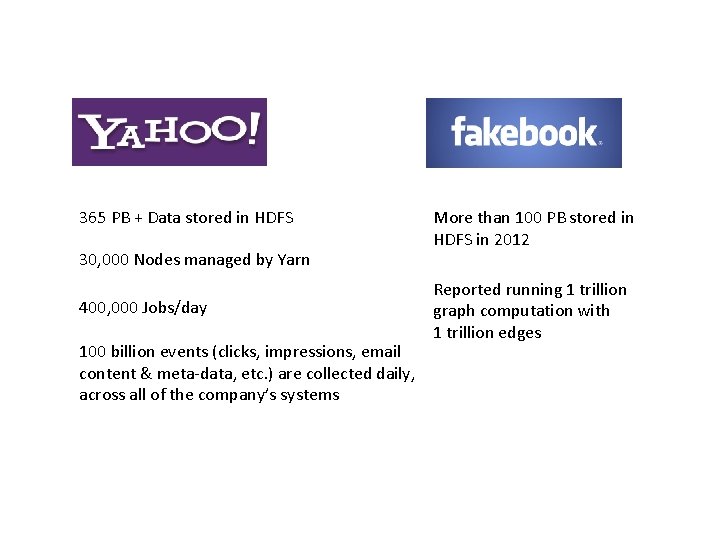
365 PB + Data stored in HDFS 30, 000 Nodes managed by Yarn 400, 000 Jobs/day 100 billion events (clicks, impressions, email content & meta-data, etc. ) are collected daily, across all of the company’s systems More than 100 PB stored in HDFS in 2012 Reported running 1 trillion graph computation with 1 trillion edges
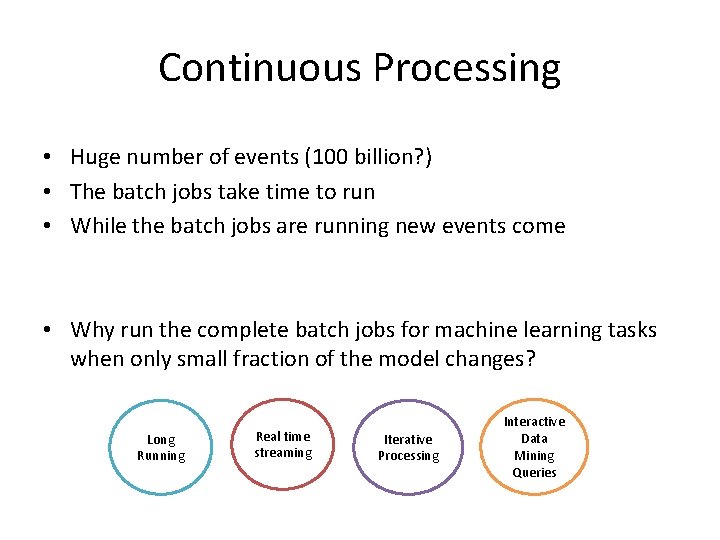
Continuous Processing • Huge number of events (100 billion? ) • The batch jobs take time to run • While the batch jobs are running new events come • Why run the complete batch jobs for machine learning tasks when only small fraction of the model changes? Long Running Real time streaming Iterative Processing Interactive Data Mining Queries
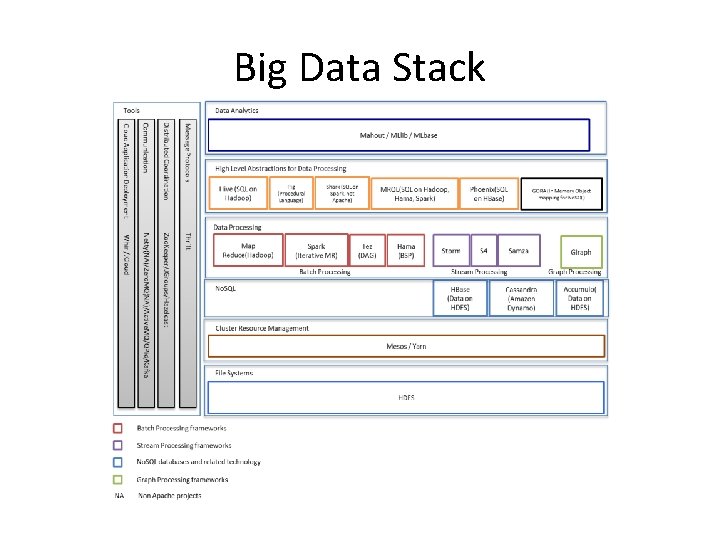
Big Data Stack
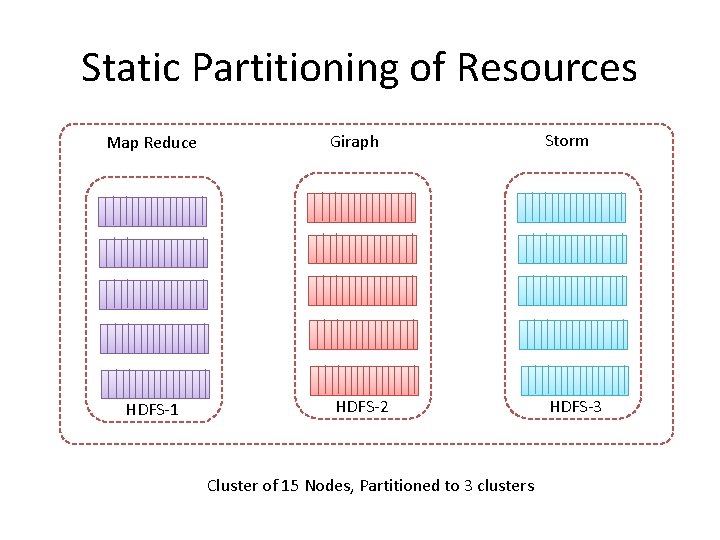
Static Partitioning of Resources Map Reduce HDFS-1 Giraph HDFS-2 Cluster of 15 Nodes, Partitioned to 3 clusters Storm HDFS-3
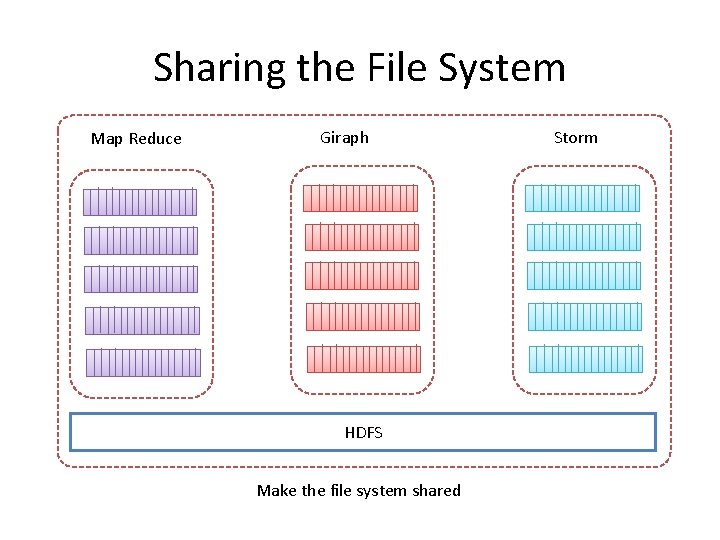
Sharing the File System Map Reduce Giraph HDFS Make the file system shared Storm
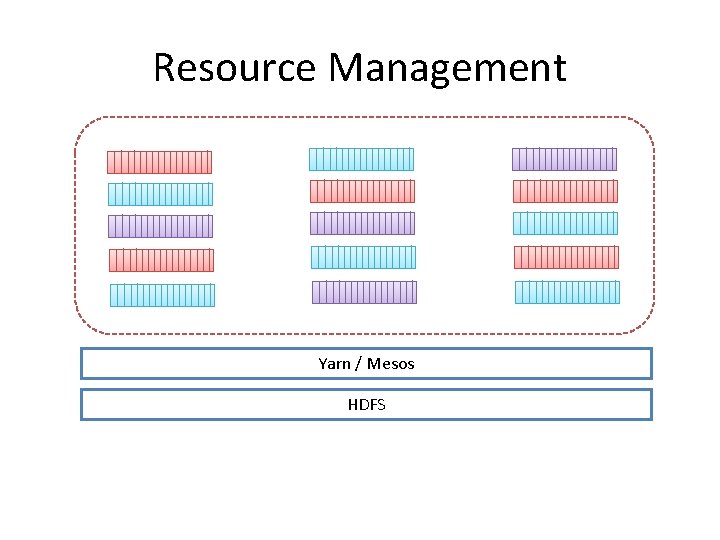
Resource Management Yarn / Mesos HDFS
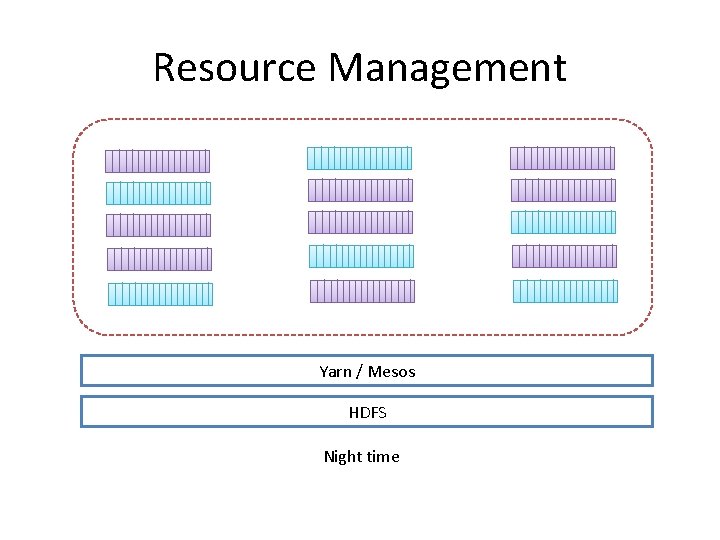
Resource Management Yarn / Mesos HDFS Night time
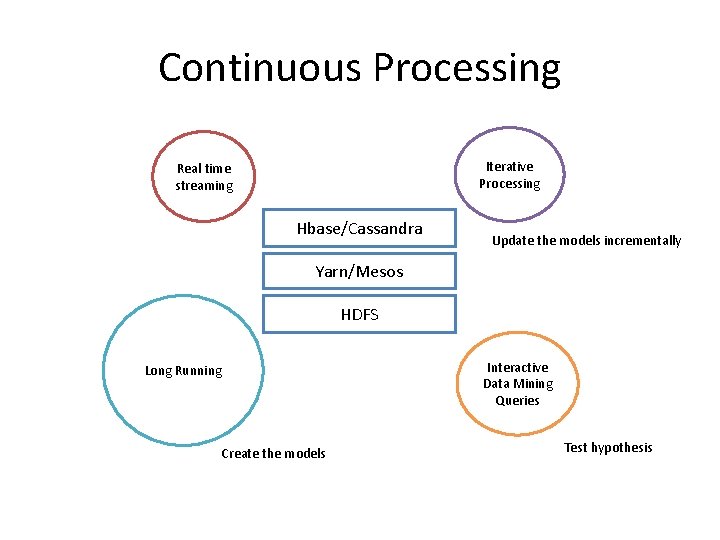
Continuous Processing Iterative Processing Real time streaming Hbase/Cassandra Update the models incrementally Yarn/Mesos HDFS Long Running Create the models Interactive Data Mining Queries Test hypothesis

HDFS 2. 0 Namenode FS Namespace Block Management Data. Node Block Storage • Automated failover with hot standby • NFS
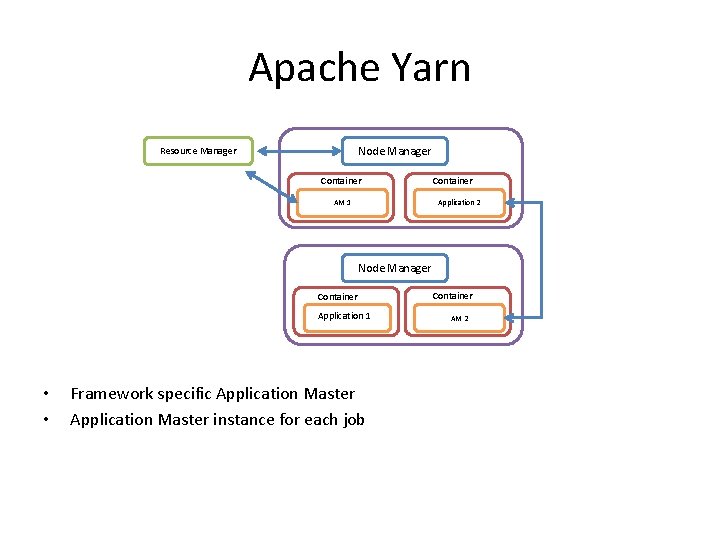
Apache Yarn Node Manager Resource Manager Container AM 1 Container Application 2 Node Manager Container Application 1 • • Framework specific Application Master instance for each job Container AM 2
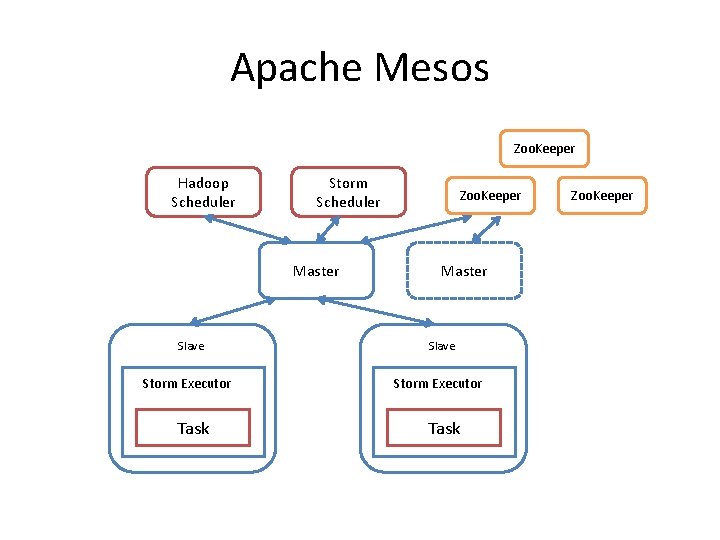
Apache Mesos Zoo. Keeper Hadoop Scheduler Storm Scheduler Master Slave Storm Executor Task Zoo. Keeper
Moab, Torque, Slurm vs Yarn, Mesos • Both allocate resources • Big data clusters – x 86 based commodity clusters – Data locality is important • HPC Clusters – Specialized hardware – NFS – Diskless nodes, data stored in separate servers • Yarn & Mesos scheduling – Data locality – Fault tolerance of the applications?
No. SQL • Semi Structured data storage • HBase – – Big table data model & architecture HDFS as the data storage Tight integration with Hadoop Hive for HBase • Accumulo – Same as HBase, only less popular • Cassandra – Big. Table data model & Dynamo architecture – CQL – Cassandra File System for interfacing with Hadoop
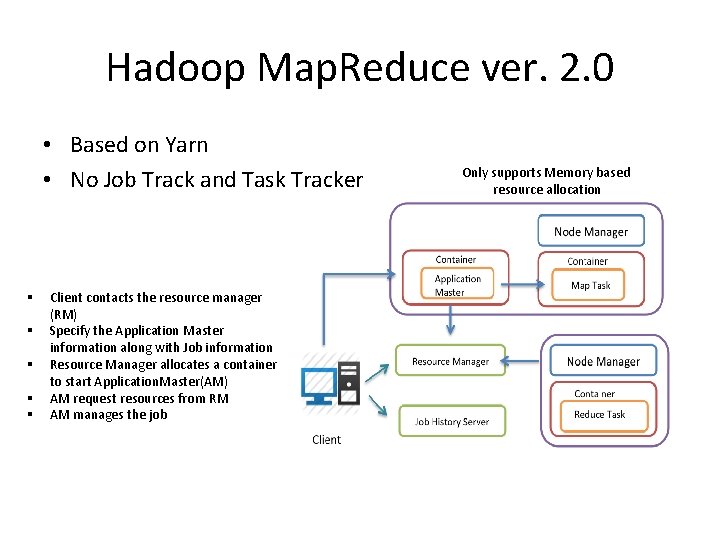
Hadoop Map. Reduce ver. 2. 0 • Based on Yarn • No Job Track and Task Tracker § § § Client contacts the resource manager (RM) Specify the Application Master information along with Job information Resource Manager allocates a container to start Application. Master(AM) AM request resources from RM AM manages the job Only supports Memory based resource allocation
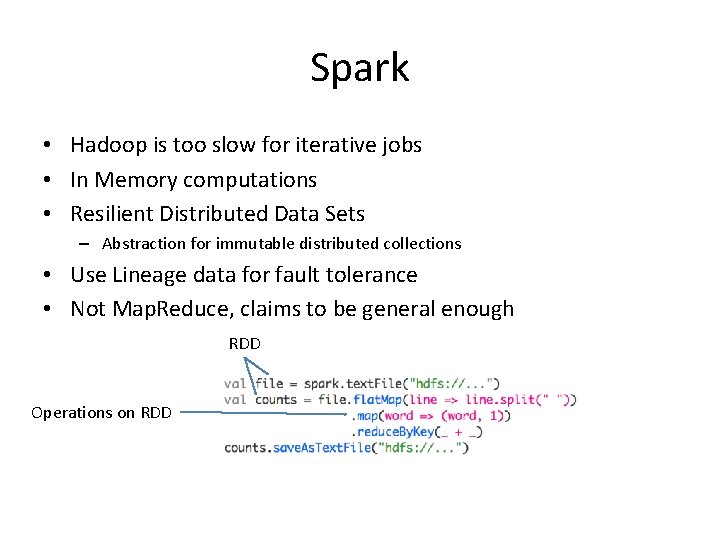
Spark • Hadoop is too slow for iterative jobs • In Memory computations • Resilient Distributed Data Sets – Abstraction for immutable distributed collections • Use Lineage data for fault tolerance • Not Map. Reduce, claims to be general enough RDD Operations on RDD
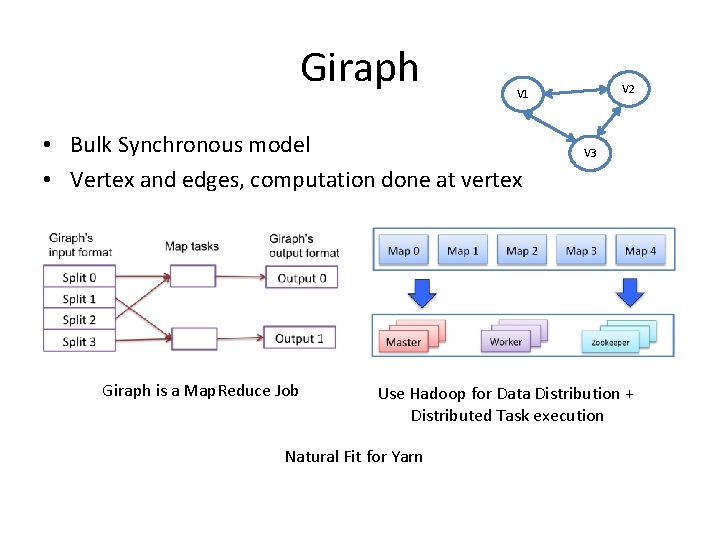
Giraph • Bulk Synchronous model • Vertex and edges, computation done at vertex Giraph is a Map. Reduce Job V 2 V 1 V 3 Use Hadoop for Data Distribution + Distributed Task execution Natural Fit for Yarn
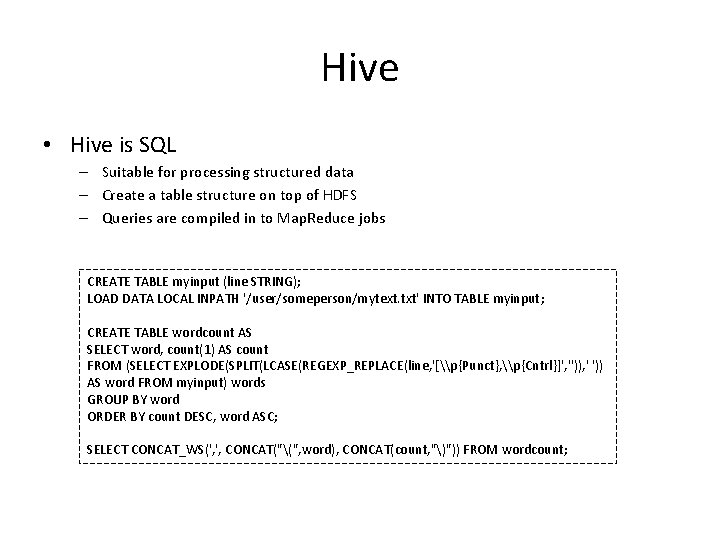
Hive • Hive is SQL – Suitable for processing structured data – Create a table structure on top of HDFS – Queries are compiled in to Map. Reduce jobs CREATE TABLE myinput (line STRING); LOAD DATA LOCAL INPATH '/user/someperson/mytext. txt' INTO TABLE myinput; CREATE TABLE wordcount AS SELECT word, count(1) AS count FROM (SELECT EXPLODE(SPLIT(LCASE(REGEXP_REPLACE(line, '[\p{Punct}, \p{Cntrl}]', '')), ' ')) AS word FROM myinput) words GROUP BY word ORDER BY count DESC, word ASC; SELECT CONCAT_WS(', ', CONCAT("(", word), CONCAT(count, ")")) FROM wordcount;
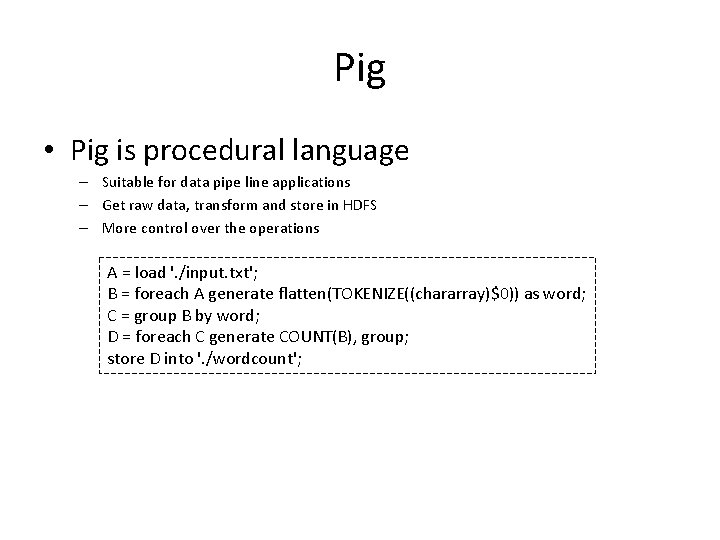
Pig • Pig is procedural language – Suitable for data pipe line applications – Get raw data, transform and store in HDFS – More control over the operations A = load '. /input. txt'; B = foreach A generate flatten(TOKENIZE((chararray)$0)) as word; C = group B by word; D = foreach C generate COUNT(B), group; store D into '. /wordcount';
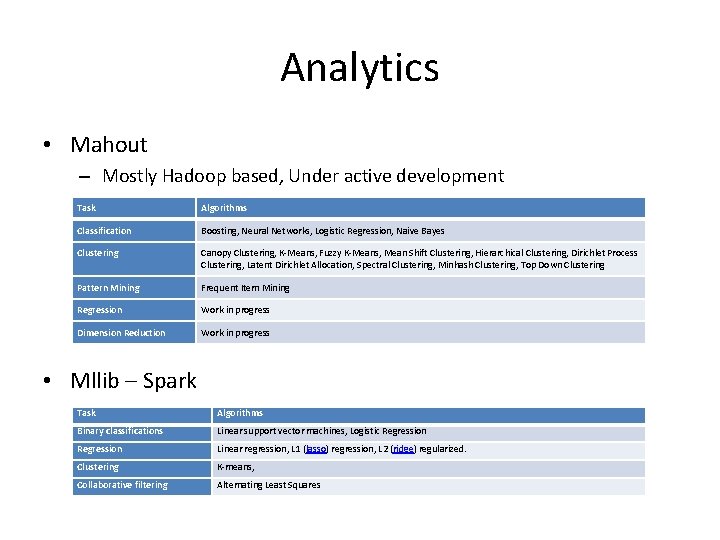
Analytics • Mahout – Mostly Hadoop based, Under active development Task Algorithms Classification Boosting, Neural Networks, Logistic Regression, Naive Bayes Clustering Canopy Clustering, K-Means, Fuzzy K-Means, Mean Shift Clustering, Hierarchical Clustering, Dirichlet Process Clustering, Latent Dirichlet Allocation, Spectral Clustering, Minhash Clustering, Top Down Clustering Pattern Mining Frequent Item Mining Regression Work in progress Dimension Reduction Work in progress • Mllib – Spark Task Algorithms Binary classifications Linear support vector machines, Logistic Regression Linear regression, L 1 (lasso) regression, L 2 (ridge) regularized. Clustering K-means, Collaborative filtering Alternating Least Squares
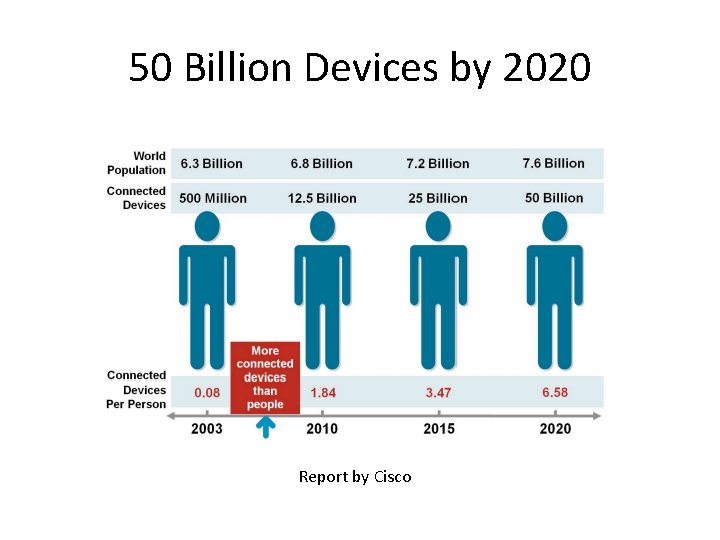
50 Billion Devices by 2020 Report by Cisco
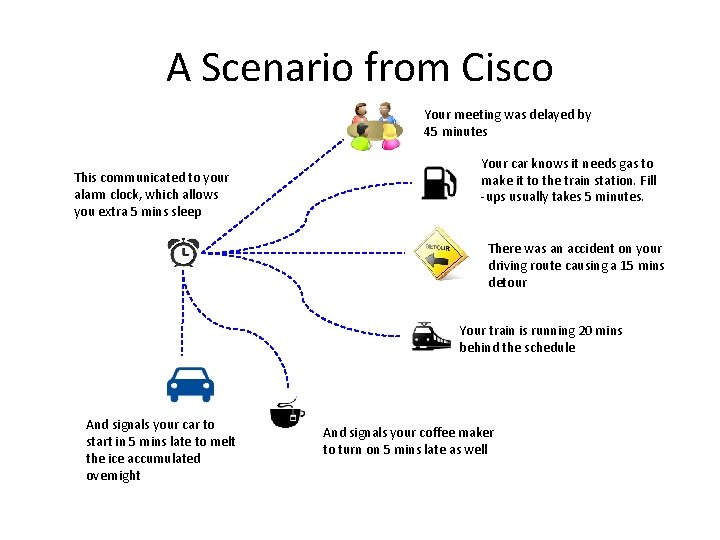
A Scenario from Cisco Your meeting was delayed by 45 minutes This communicated to your alarm clock, which allows you extra 5 mins sleep Your car knows it needs gas to make it to the train station. Fill -ups usually takes 5 minutes. There was an accident on your driving route causing a 15 mins detour Your train is running 20 mins behind the schedule And signals your car to start in 5 mins late to melt the ice accumulated overnight And signals your coffee maker to turn on 5 mins late as well
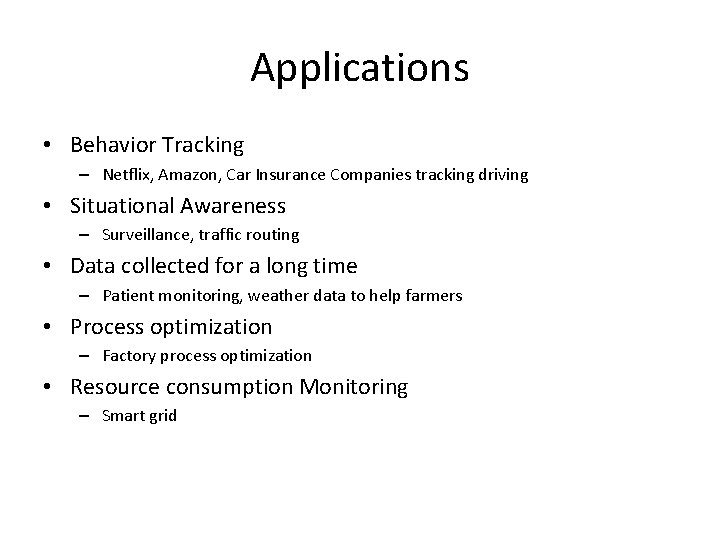
Applications • Behavior Tracking – Netflix, Amazon, Car Insurance Companies tracking driving • Situational Awareness – Surveillance, traffic routing • Data collected for a long time – Patient monitoring, weather data to help farmers • Process optimization – Factory process optimization • Resource consumption Monitoring – Smart grid
Attributes • • Data Mobility High Availability & Data processing guarantees Stream partitioning Data Querying Deterministic or Non-Deterministic processing Data storage Handling Stream Imperfections
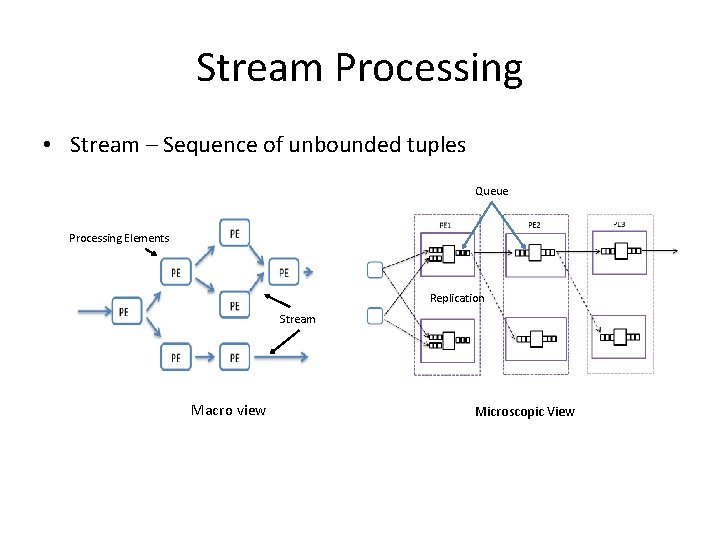
Stream Processing • Stream – Sequence of unbounded tuples Queue Processing Elements Replication Stream Macro view Microscopic View
Fault Tolerance • 3 Strategies – Upstream backup – Active backup – Passive backup • 3 Recovery guarantees – Gap Recovery – Rollback Recovery • Divergent recovery – Precise Recovery
Distributed Stream Processing Engines • • • Aurora Borealis Apache Storm Apache S 4 Apache Samza
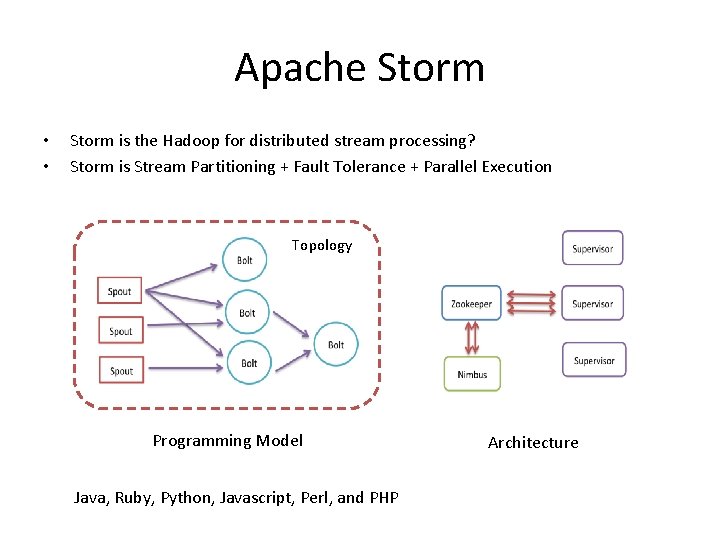
Apache Storm • • Storm is the Hadoop for distributed stream processing? Storm is Stream Partitioning + Fault Tolerance + Parallel Execution Topology Programming Model Java, Ruby, Python, Javascript, Perl, and PHP Architecture
Apache Storm • Data Mobility – No blocking operations, Zero. MQ and Netty Based communication • Fault Tolerance – Rollback Recovery with Upstream backup – The messages are saved in out queue of Spout until acknowledged • Stream Partition – User defined, based on the grouping • Storm Query Model – Trident, A Java library providing high level abstraction
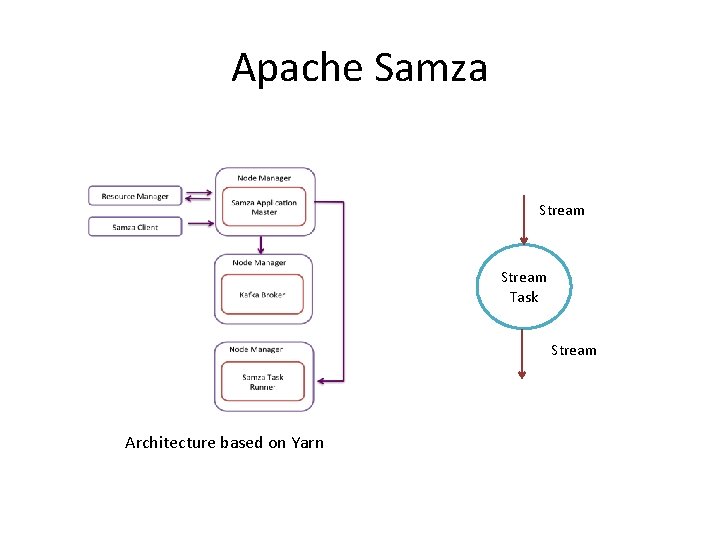
Apache Samza Stream Task Stream Architecture based on Yarn
Apache Samza • Data Mobility – Brokers at the middle • Fault Tolerance – For now Gap recovery, because a faulty broker node can loose messages, targeting Rollback recovery • Stream partitioning – Based on key attributes in messages • Data storage – Kafka stores the messages in the file system
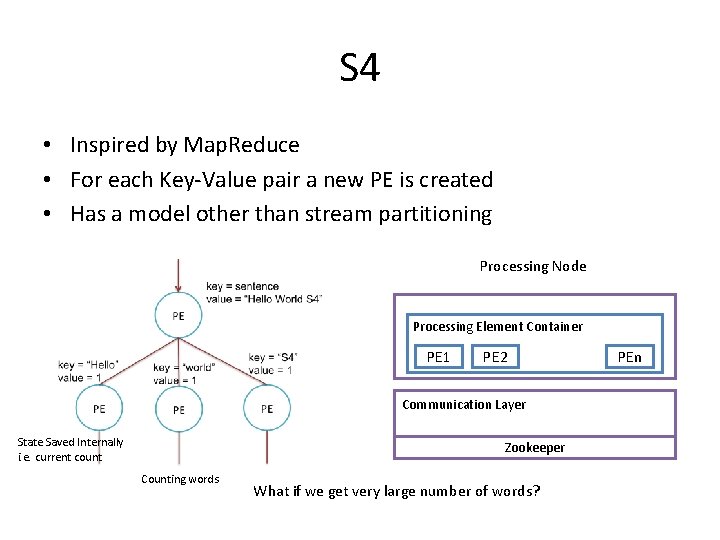
S 4 • Inspired by Map. Reduce • For each Key-Value pair a new PE is created • Has a model other than stream partitioning Processing Node Processing Element Container PE 1 PE 2 Communication Layer State Saved Internally i. e. current count Zookeeper Counting words What if we get very large number of words? PEn
S 4 • Data mobility – Push based • Fault Tolerance – Gap recovery, data lost at processing nodes due to overload • Stream partitioning – Based on key value pairs
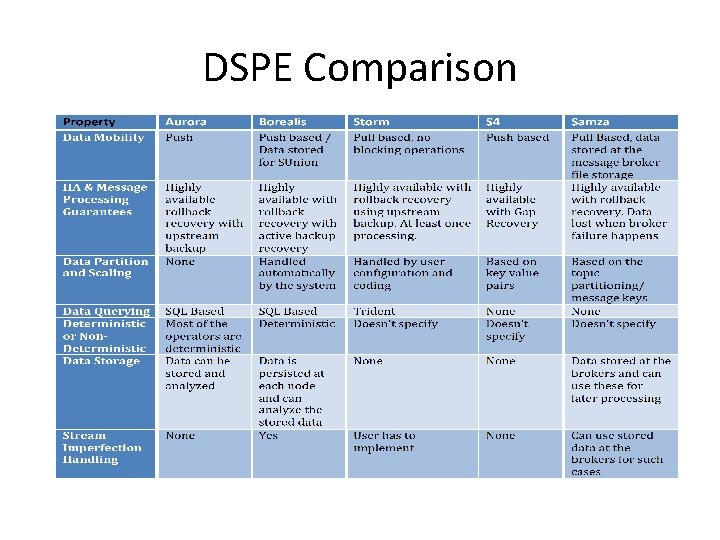
DSPE Comparison
Streaming Data Algorithms • Characteristics of Stream Processing Algorithms – – The data is processed continuously in single items or small batches of data Single pass over the data Memory and time bounded The results of the processing available continuously • 3 Processing models – Landmark model – Damping model – Sliding window
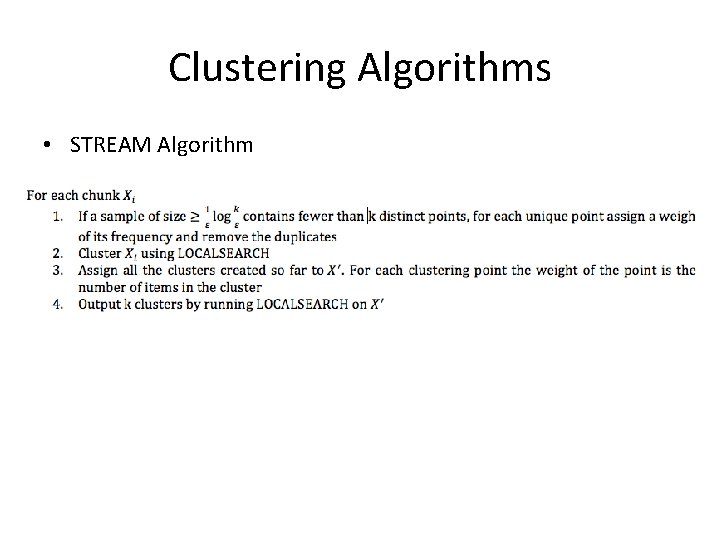
Clustering Algorithms • STREAM Algorithm
Clustering Algorithms • Evolving Data Streams – Start by running K-Means on some initial data – When new data arrives create micro cluster • Add them to existing clusters or create new clusters • Delete existing clusters or merge existing clusters – Save the cluster to disk – Run K-Means on these clusters to create a Macro view
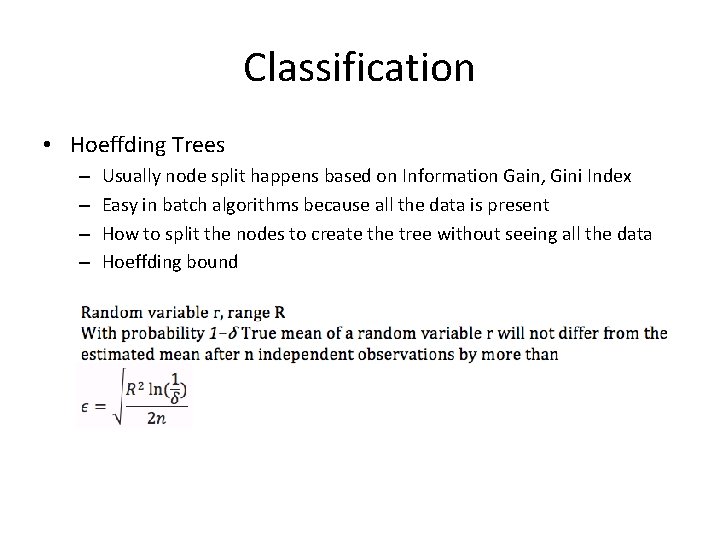
Classification • Hoeffding Trees – – Usually node split happens based on Information Gain, Gini Index Easy in batch algorithms because all the data is present How to split the nodes to create the tree without seeing all the data Hoeffding bound
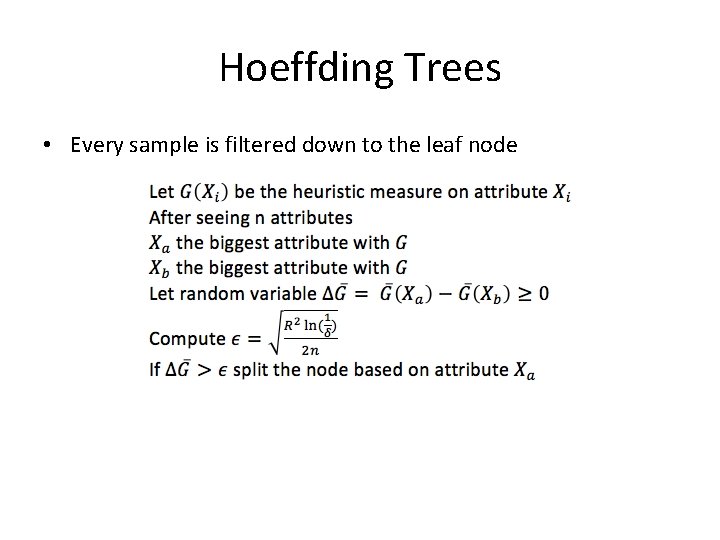
Hoeffding Trees • Every sample is filtered down to the leaf node
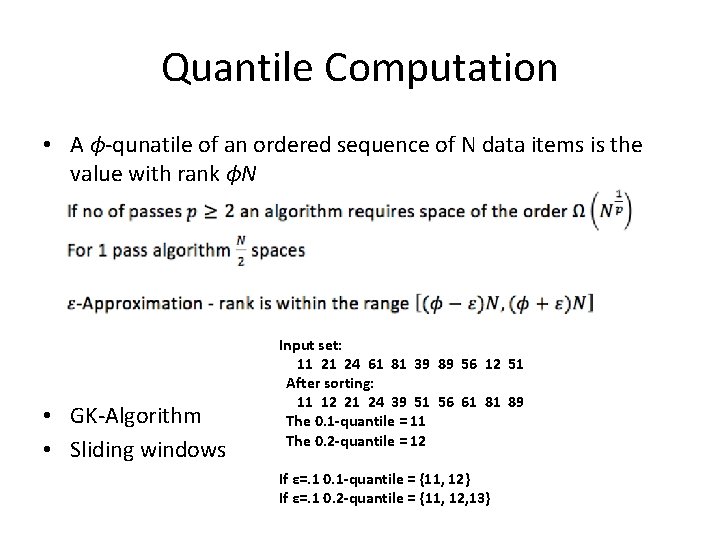
Quantile Computation • A ϕ-qunatile of an ordered sequence of N data items is the value with rank ϕN • GK-Algorithm • Sliding windows Input set: 11 21 24 61 81 39 89 56 12 51 After sorting: 11 12 21 24 39 51 56 61 81 89 The 0. 1 -quantile = 11 The 0. 2 -quantile = 12 If ε=. 1 0. 1 -quantile = {11, 12} If ε=. 1 0. 2 -quantile = {11, 12, 13}
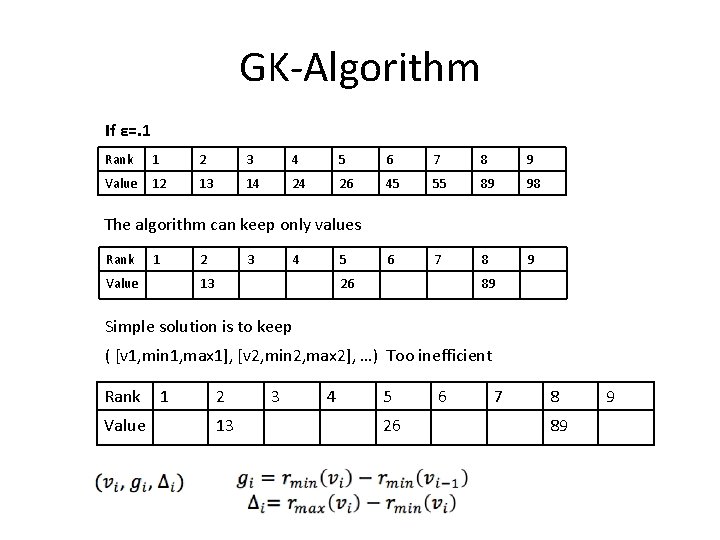
GK-Algorithm If ε=. 1 Rank 1 2 3 4 5 6 7 8 9 Value 12 13 14 24 26 45 55 89 98 6 7 8 9 The algorithm can keep only values Rank 1 Value 2 3 4 5 13 26 89 Simple solution is to keep ( [v 1, min 1, max 1], [v 2, min 2, max 2], …) Too inefficient Rank Value 1 2 13 3 4 5 26 6 7 8 89 9
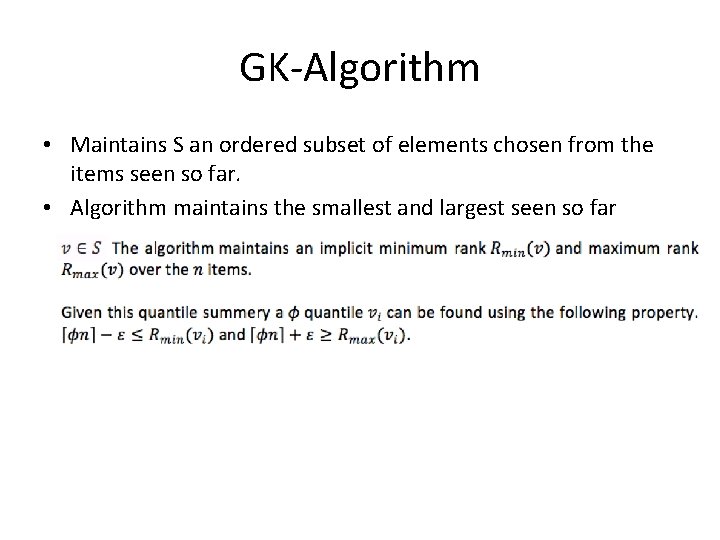
GK-Algorithm • Maintains S an ordered subset of elements chosen from the items seen so far. • Algorithm maintains the smallest and largest seen so far
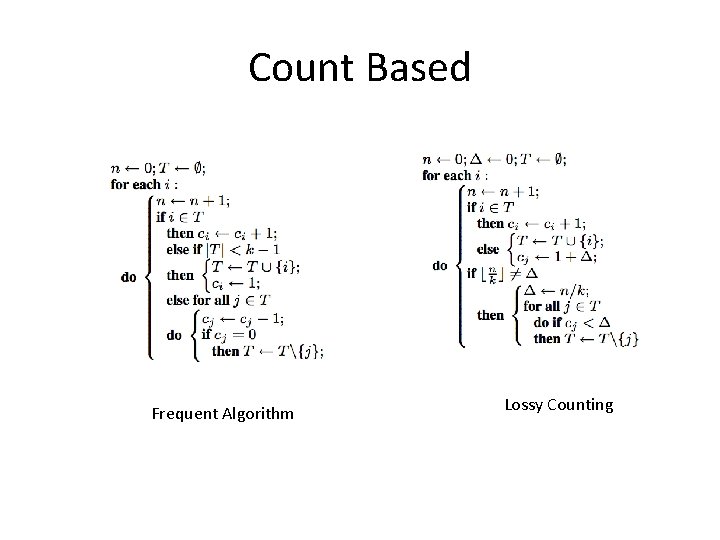
Frequent Item Sets Mining • Exact Frequent Items • The ε-approximate frequent items problem • Count based algorithms – Frequent Algorithm – Lossy Counting • Sketch Algorithms – Count. S-Sketch – Count. Min Sketch • Sliding Windows
Count Based Frequent Algorithm Lossy Counting
Summary • Apache Software Foundation is attracting more and more big data projects • The computation is moving from batch processing to a hybrid model • Yarn and Mesos are solidifying the big data analytics stack • Different models for Distributed Stream Processing
Q/A
- Slides: 48