
Big Data II Stream Processing and Coordination CS
Big Data II: Stream Processing and Coordination CS 240: Computing Systems and Concurrency Lecture 22 Marco Canini Credits: Michael Freedman and Kyle Jamieson developed much of the original material. Selected content adapted from A. Haeberlen.
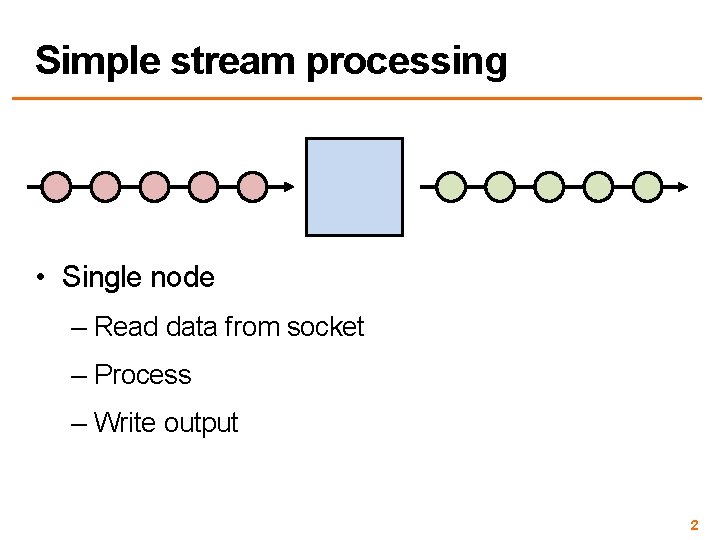
Simple stream processing • Single node – Read data from socket – Process – Write output 2

Examples: Stateless conversion Cto. F • Convert Celsius temperature to Fahrenheit – Stateless operation: emit (input * 9 / 5) + 32 3
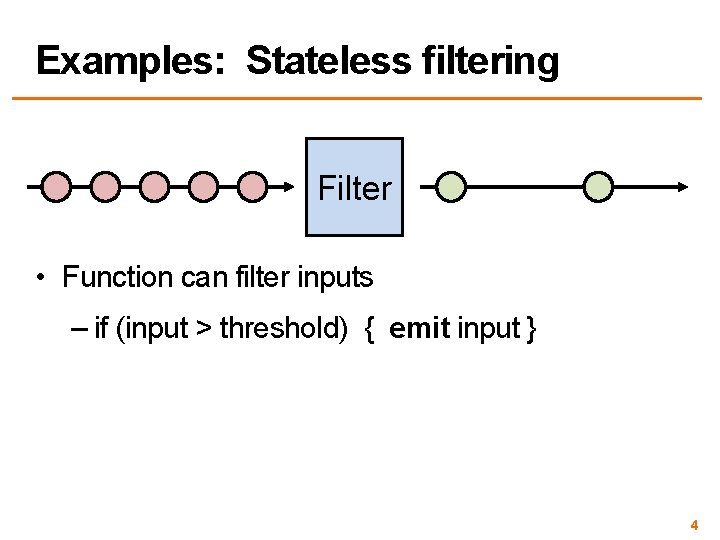
Examples: Stateless filtering Filter • Function can filter inputs – if (input > threshold) { emit input } 4
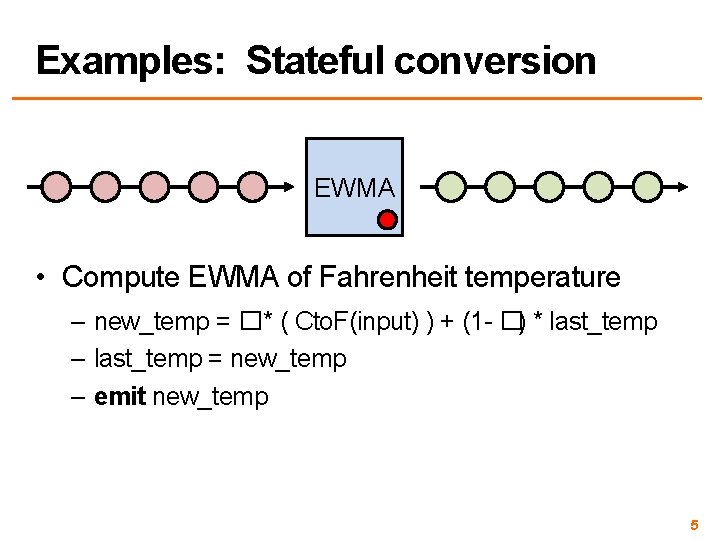
Examples: Stateful conversion EWMA • Compute EWMA of Fahrenheit temperature – new_temp = � * ( Cto. F(input) ) + (1 - �) * last_temp – last_temp = new_temp – emit new_temp 5
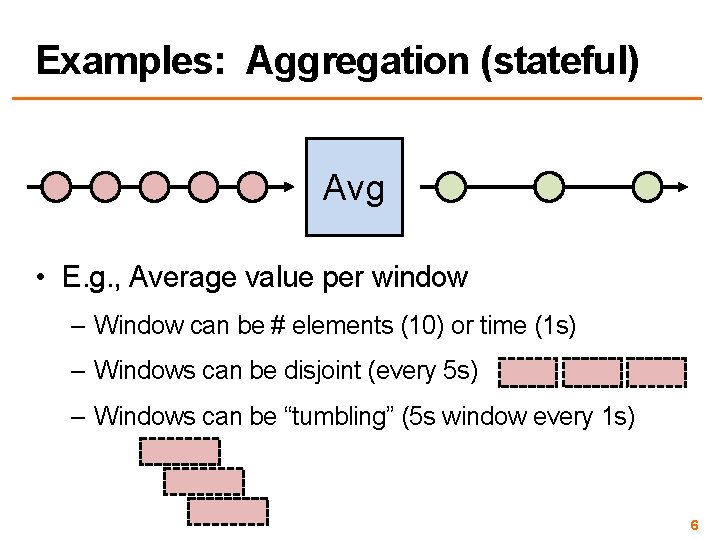
Examples: Aggregation (stateful) Avg • E. g. , Average value per window – Window can be # elements (10) or time (1 s) – Windows can be disjoint (every 5 s) – Windows can be “tumbling” (5 s window every 1 s) 6
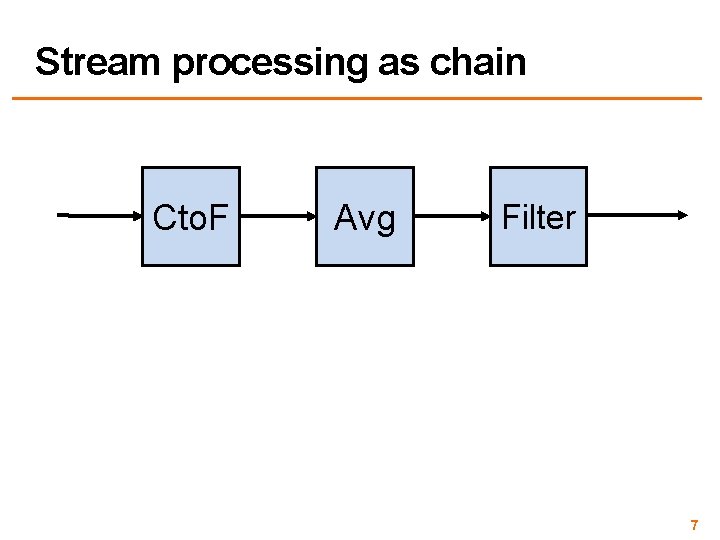
Stream processing as chain Cto. F Avg Filter 7
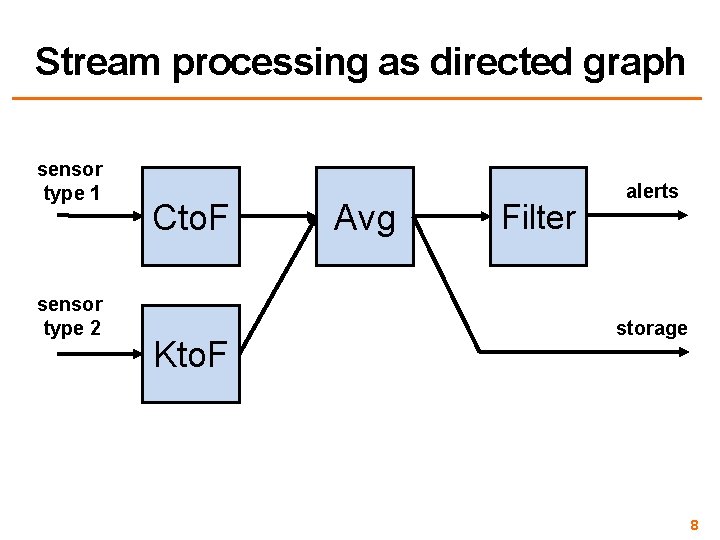
Stream processing as directed graph sensor type 1 sensor type 2 Cto. F Kto. F Avg Filter alerts storage 8
Enter “BIG DATA” 9
The challenge of stream processing • Large amounts of data to process in real time • Examples – Social network trends (#trending) – Intrusion detection systems (networks, datacenters) – Sensors: Detect earthquakes by correlating vibrations of millions of smartphones – Fraud detection • Visa: 2000 txn / sec on average, peak ~47, 000 / sec 10
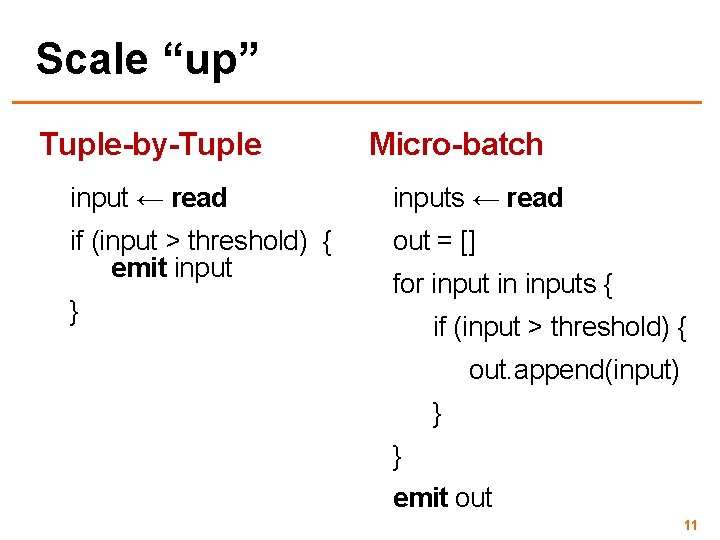
Scale “up” Tuple-by-Tuple Micro-batch input ← read inputs ← read if (input > threshold) { emit input out = [] } for input in inputs { if (input > threshold) { out. append(input) } } emit out 11
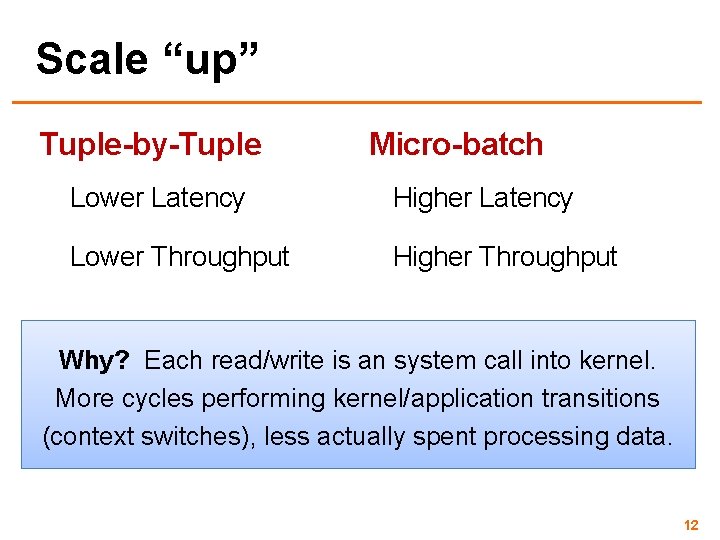
Scale “up” Tuple-by-Tuple Micro-batch Lower Latency Higher Latency Lower Throughput Higher Throughput Why? Each read/write is an system call into kernel. More cycles performing kernel/application transitions (context switches), less actually spent processing data. 12
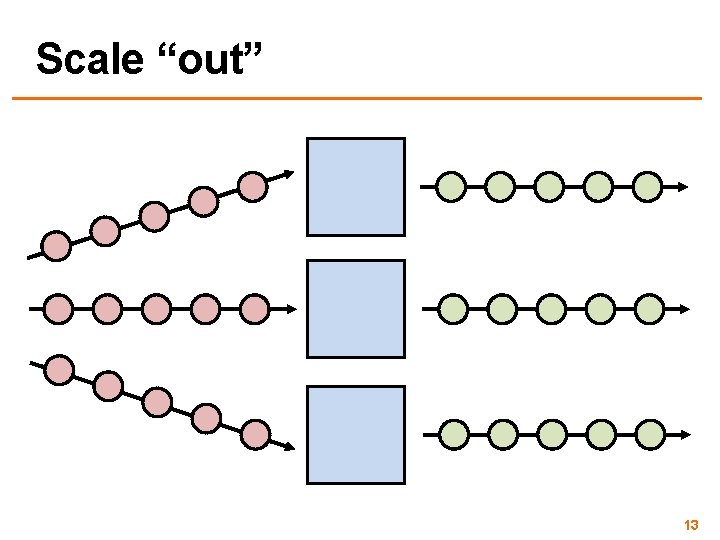
Scale “out” 13
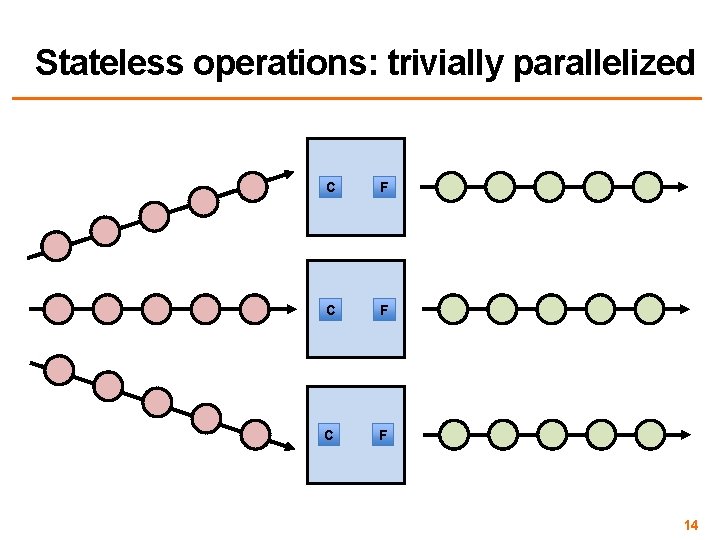
Stateless operations: trivially parallelized C F C F 14
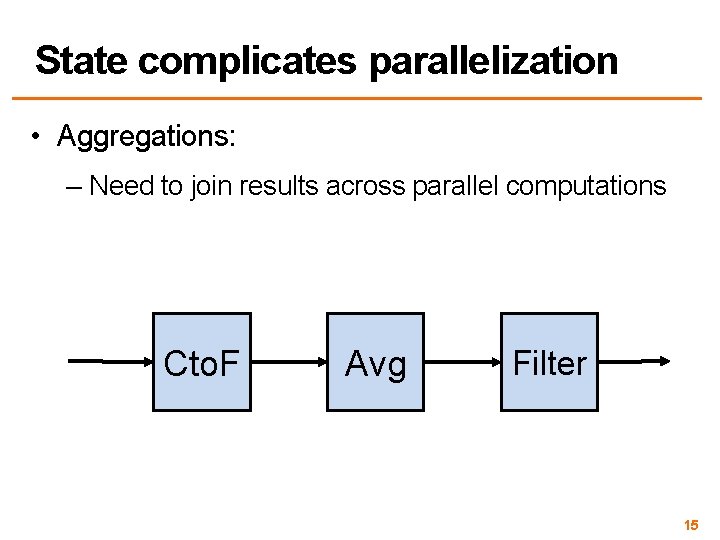
State complicates parallelization • Aggregations: – Need to join results across parallel computations Cto. F Avg Filter 15
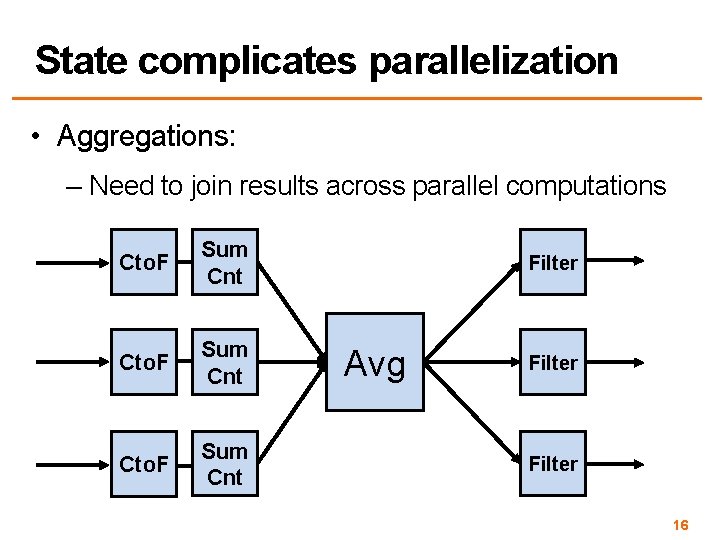
State complicates parallelization • Aggregations: – Need to join results across parallel computations Cto. F Sum Cnt Filter Avg Filter 16
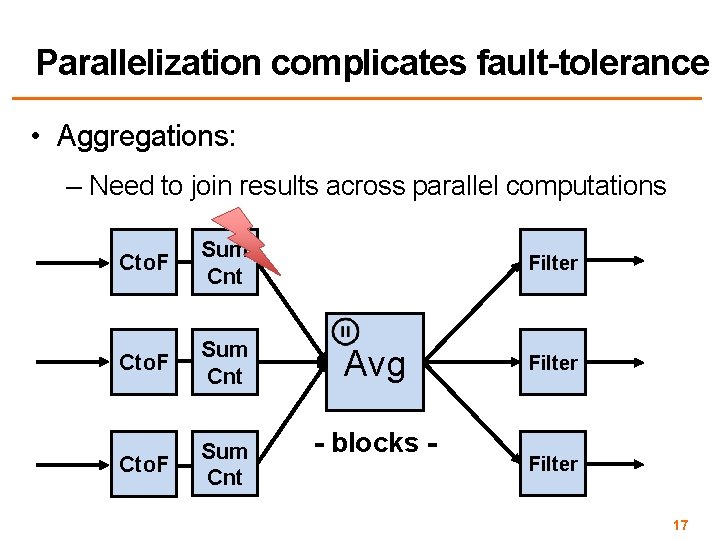
Parallelization complicates fault-tolerance • Aggregations: – Need to join results across parallel computations Cto. F Sum Cnt Filter Avg - blocks - Filter 17
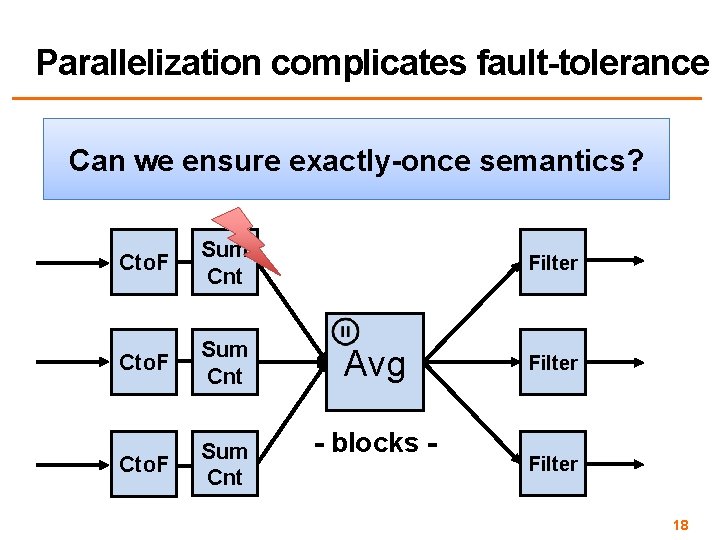
Parallelization complicates fault-tolerance Can we ensure exactly-once semantics? Cto. F Sum Cnt Filter Avg - blocks - Filter 18
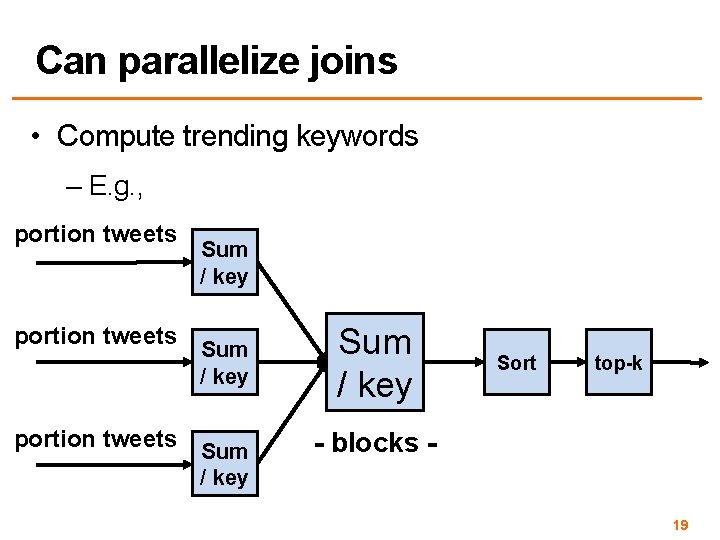
Can parallelize joins • Compute trending keywords – E. g. , portion tweets Sum / key Sort top-k - blocks - / key 19
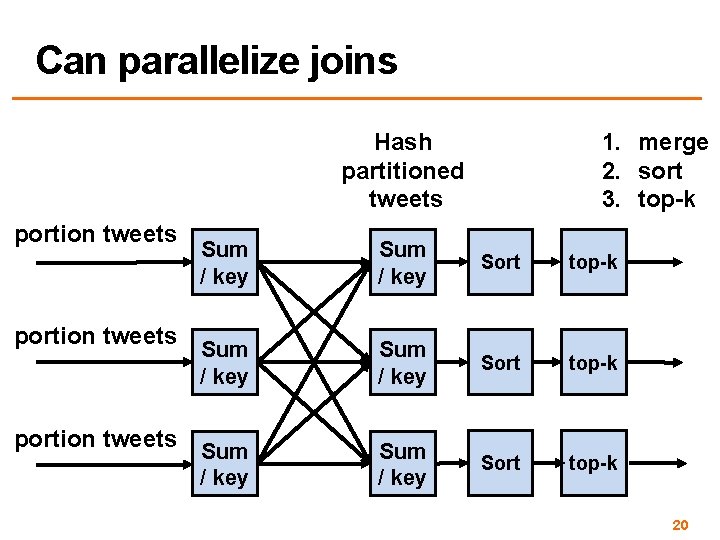
Can parallelize joins 1. merge 2. sort 3. top-k Hash partitioned tweets portion tweets Sum / key Sort top-k Sum / key Sort top-k portion tweets Sum / key 20
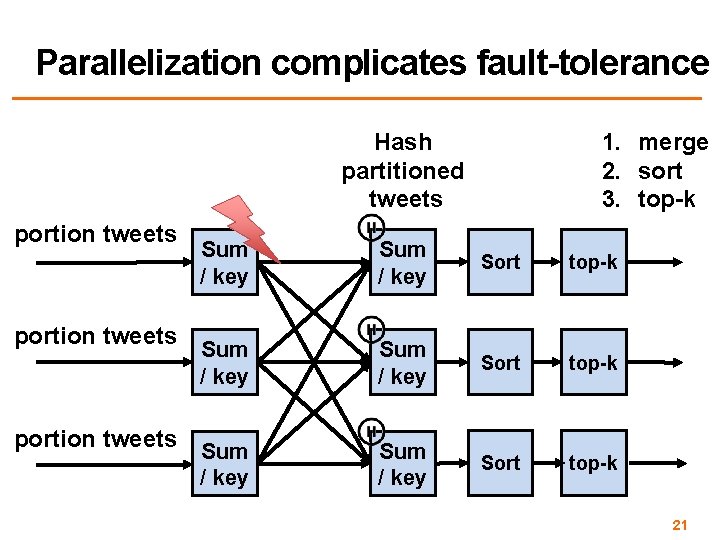
Parallelization complicates fault-tolerance 1. merge 2. sort 3. top-k Hash partitioned tweets portion tweets Sum / key Sort top-k Sum / key Sort top-k portion tweets Sum / key 21
A Tale of Four Frameworks 1. Record acknowledgement (Storm) 2. Micro-batches (Spark Streaming, Storm Trident) 3. Transactional updates (Google Cloud dataflow) 4. Distributed snapshots (Flink) 22
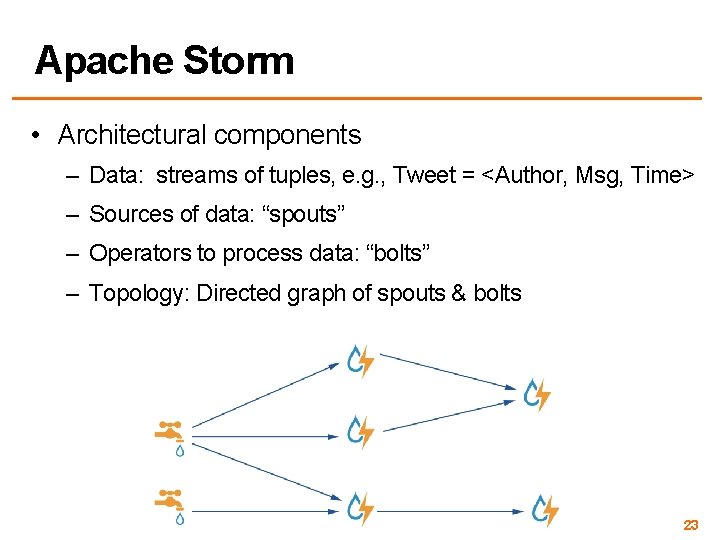
Apache Storm • Architectural components – Data: streams of tuples, e. g. , Tweet = <Author, Msg, Time> – Sources of data: “spouts” – Operators to process data: “bolts” – Topology: Directed graph of spouts & bolts 23
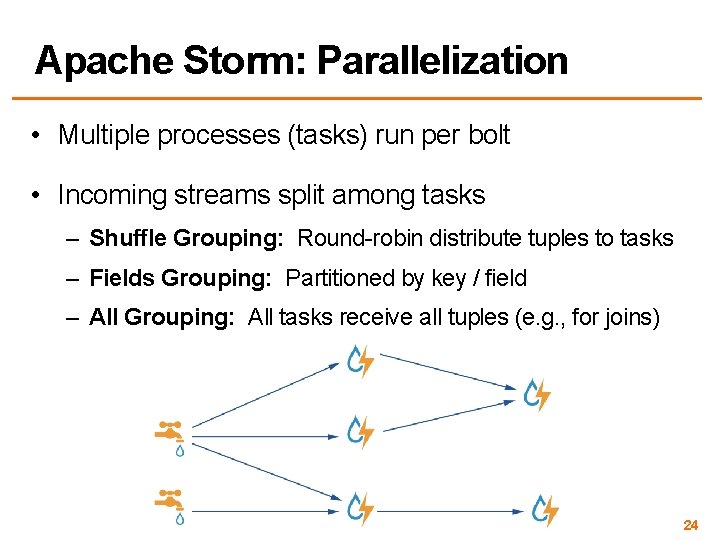
Apache Storm: Parallelization • Multiple processes (tasks) run per bolt • Incoming streams split among tasks – Shuffle Grouping: Round-robin distribute tuples to tasks – Fields Grouping: Partitioned by key / field – All Grouping: All tasks receive all tuples (e. g. , for joins) 24
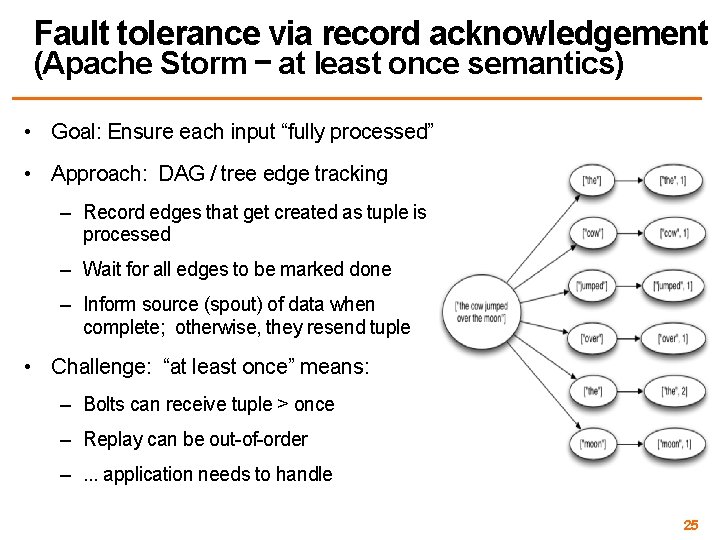
Fault tolerance via record acknowledgement (Apache Storm – at least once semantics) • Goal: Ensure each input “fully processed” • Approach: DAG / tree edge tracking – Record edges that get created as tuple is processed – Wait for all edges to be marked done – Inform source (spout) of data when complete; otherwise, they resend tuple • Challenge: “at least once” means: – Bolts can receive tuple > once – Replay can be out-of-order –. . . application needs to handle 25
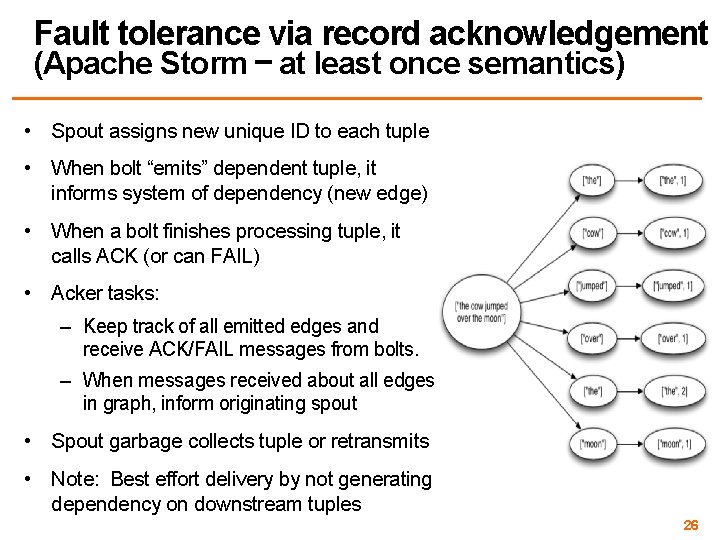
Fault tolerance via record acknowledgement (Apache Storm – at least once semantics) • Spout assigns new unique ID to each tuple • When bolt “emits” dependent tuple, it informs system of dependency (new edge) • When a bolt finishes processing tuple, it calls ACK (or can FAIL) • Acker tasks: – Keep track of all emitted edges and receive ACK/FAIL messages from bolts. – When messages received about all edges in graph, inform originating spout • Spout garbage collects tuple or retransmits • Note: Best effort delivery by not generating dependency on downstream tuples 26
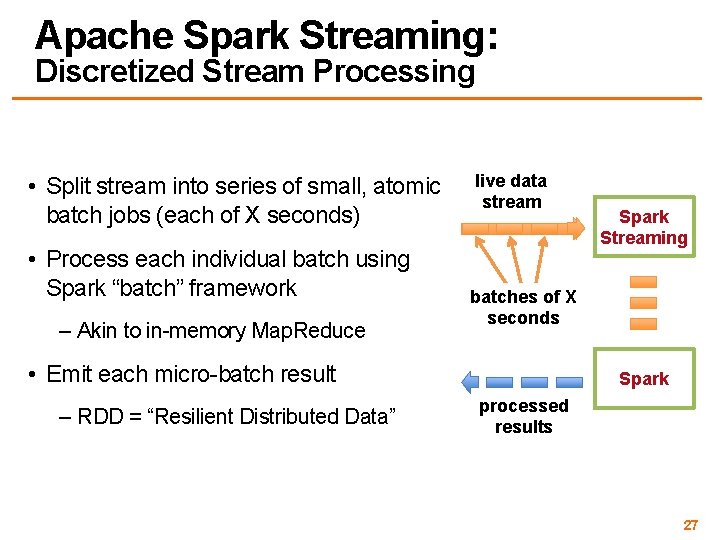
Apache Spark Streaming: Discretized Stream Processing • Split stream into series of small, atomic batch jobs (each of X seconds) • Process each individual batch using Spark “batch” framework – Akin to in-memory Map. Reduce live data stream batches of X seconds • Emit each micro-batch result – RDD = “Resilient Distributed Data” Spark Streaming Spark processed results 27
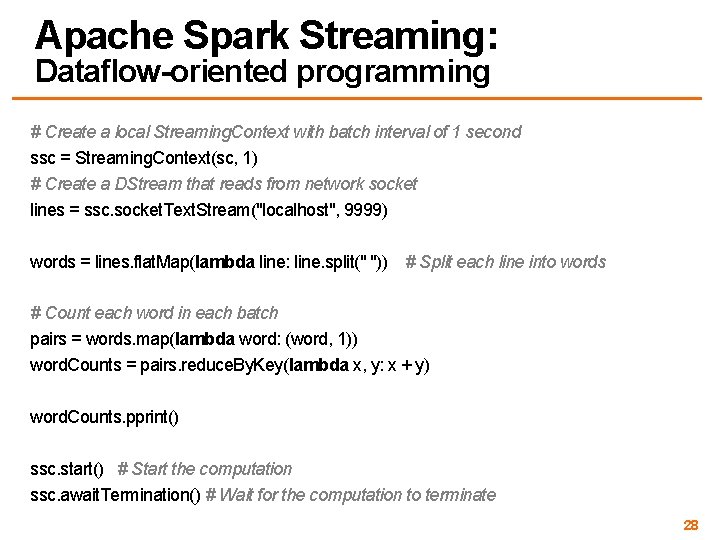
Apache Spark Streaming: Dataflow-oriented programming # Create a local Streaming. Context with batch interval of 1 second ssc = Streaming. Context(sc, 1) # Create a DStream that reads from network socket lines = ssc. socket. Text. Stream("localhost", 9999) words = lines. flat. Map(lambda line: line. split(" ")) # Split each line into words # Count each word in each batch pairs = words. map(lambda word: (word, 1)) word. Counts = pairs. reduce. By. Key(lambda x, y: x + y) word. Counts. pprint() ssc. start() # Start the computation ssc. await. Termination() # Wait for the computation to terminate 28
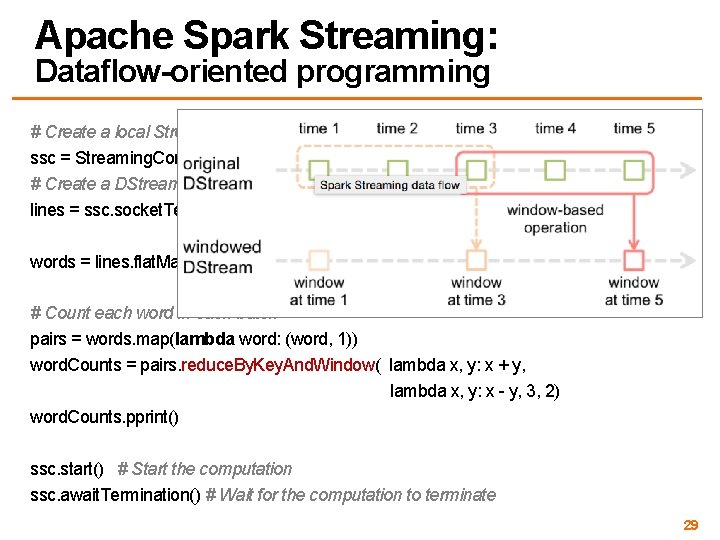
Apache Spark Streaming: Dataflow-oriented programming # Create a local Streaming. Context with batch interval of 1 second ssc = Streaming. Context(sc, 1) # Create a DStream that reads from network socket lines = ssc. socket. Text. Stream("localhost", 9999) words = lines. flat. Map(lambda line: line. split(" ")) # Split each line into words # Count each word in each batch pairs = words. map(lambda word: (word, 1)) word. Counts = pairs. reduce. By. Key. And. Window( lambda x, y: x + y, lambda x, y: x - y, 3, 2) word. Counts. pprint() ssc. start() # Start the computation ssc. await. Termination() # Wait for the computation to terminate 29
Fault tolerance via micro batches (Apache Spark Streaming, Storm Trident) • Can build on batch frameworks (Spark) and tuple-by-tuple (Storm) – Tradeoff between throughput (higher) and latency (higher) • Each micro-batch may succeed or fail – Original inputs are replicated (memory, disk) – At failure, latest micro-batch can be simply recomputed (trickier if stateful) • DAG is a pipeline of transformations from micro-batch to micro-batch – Lineage info in each RDD specifies how generated from other RDDs • To support failure recovery: – Occasionally checkpoints RDDs (state) by replicating to other nodes – To recover: another worker (1) gets last checkpoint, (2) determines upstream dependencies, then (3) starts recomputing using those usptream dependencies starting at checkpoint (downstream might filter) 30
Fault Tolerance via transactional updates (Google Cloud Dataflow) • Computation is long-running DAG of continuous operators • For each intermediate record at operator – Create commit record including input record, state update, and derived downstream records generated – Write commit record to transactional log / DB • On failure, replay log to – Restore a consistent state of the computation – Replay lost records (further downstream might filter) • Requires: High-throughput writes to distributed store 31
Fault Tolerance via distributed snapshots (Apache Flink) • Rather than log each record for each operator, take system-wide snapshots • Snapshotting: – Determine consistent snapshot of system-wide state (includes in-flight records and operator state) – Store state in durable storage • Recover: – Restoring latest snapshot from durable storage – Rewinding the stream source to snapshot point, and replay inputs • Algorithm is based on Chandy-Lamport distributed snapshots, but also captures stream topology 32
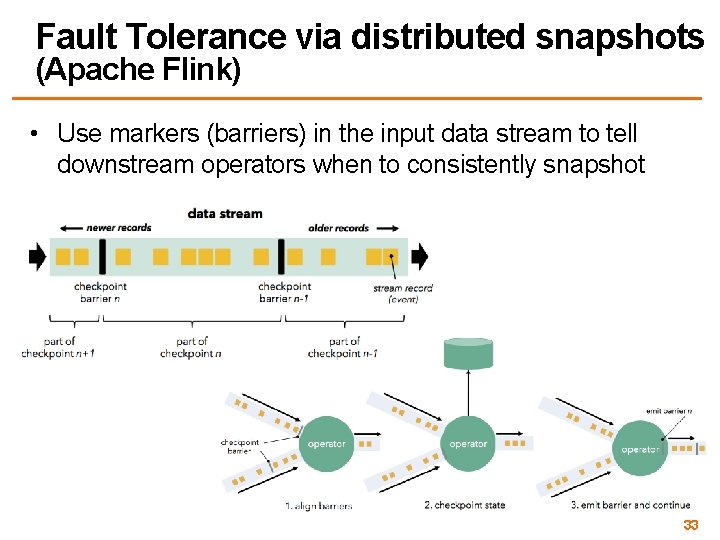
Fault Tolerance via distributed snapshots (Apache Flink) • Use markers (barriers) in the input data stream to tell downstream operators when to consistently snapshot 33
Coordination Practical consensus 34
Needs of distributed apps • Lots of apps need various coordination primitives – Leader election – Group membership – Locks – Leases • Common requirement is consensus but we’d like to avoid duplication – Duplicating is bad and duplicating poorly even worse – Maintenance? 35
How do we go about coordination? • One approach – For each coordination primitive build a specific service • Some recent examples – Chubby, Google [Burrows et al, USENIX OSDI, 2006] • Lock service – Centrifuge, Microsoft [Adya et al, USENIX NSDI, 2010] • Lease service 36
How do we go about coordination? • Alternative approach – A coordination service – Develop a set of lower level primitives (i. e. , an API) that can be used to implement higher-level coordination services – Use the coordination service API across many applications • Example: Apache Zookeeper 37
Zoo. Keeper • A “Coordination Kernel” – Provides a file system abstraction and API that enables realizing several coordination primitives • • • Group membership Leader election Locks Queueing Barriers Status monitoring 38
Data model • In brief, it’s a file system with a simplified API • Only whole file reads and writes – No appends, inserts, partial reads • Files are znodes; organized in hierarchical namespace • Payload not designed for application data storage but for application metadata storage • Znodes also have associated version counters and some metadata (e. g. , flags) 39
Semantics • CAP perspective: Zookeeper is CP – It guarantees consistency – May sacrifice availability under system partitions • strict quorum based replication for writes • Consistency (safety) – FIFO client order: all client requests are executed in order sent by client • Matters for asynchronous calls – Linearizable writes: all writes are linearizable – Serializable reads: reads can be served locally by any server, which may have a stale value 40
Types of znodes • Regular znodes – May have children – Explicitly deleted by clients • Ephemeral znodes – May not have children – Disappear when deleted or when creator terminates • Session termination can be deliberate or due to failure • Sequential flag – Property of regular znodes – Children have strictly increasing integer appended to their names 41
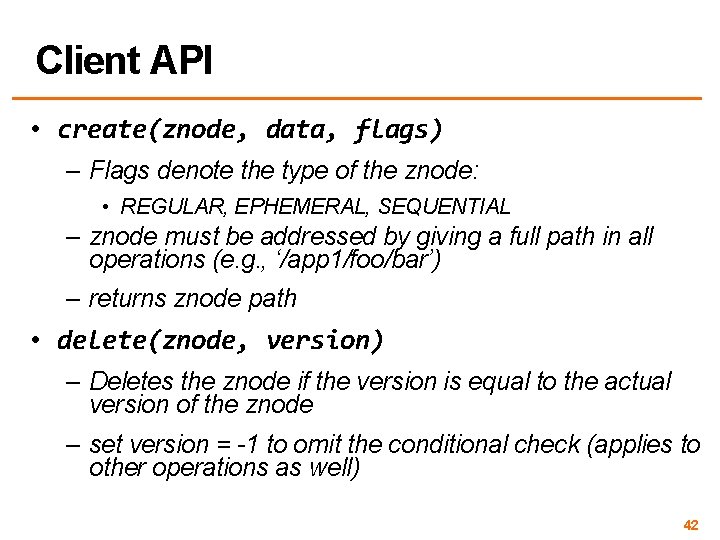
Client API • create(znode, data, flags) – Flags denote the type of the znode: • REGULAR, EPHEMERAL, SEQUENTIAL – znode must be addressed by giving a full path in all operations (e. g. , ‘/app 1/foo/bar’) – returns znode path • delete(znode, version) – Deletes the znode if the version is equal to the actual version of the znode – set version = -1 to omit the conditional check (applies to other operations as well) 42
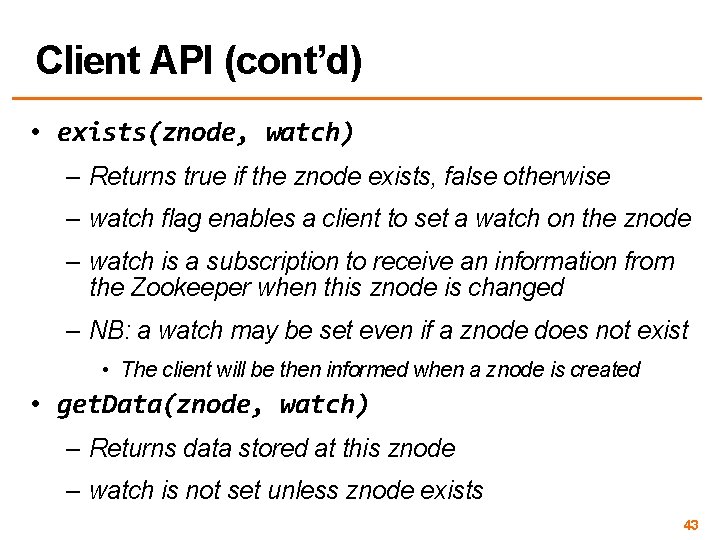
Client API (cont’d) • exists(znode, watch) – Returns true if the znode exists, false otherwise – watch flag enables a client to set a watch on the znode – watch is a subscription to receive an information from the Zookeeper when this znode is changed – NB: a watch may be set even if a znode does not exist • The client will be then informed when a znode is created • get. Data(znode, watch) – Returns data stored at this znode – watch is not set unless znode exists 43
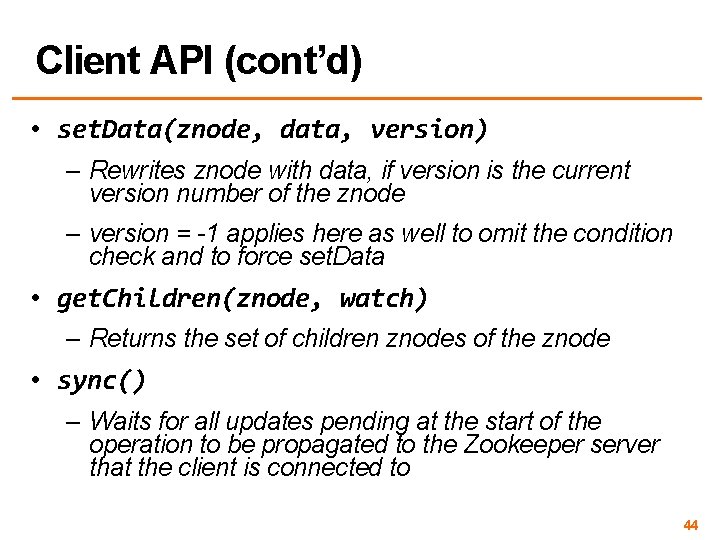
Client API (cont’d) • set. Data(znode, data, version) – Rewrites znode with data, if version is the current version number of the znode – version = -1 applies here as well to omit the condition check and to force set. Data • get. Children(znode, watch) – Returns the set of children znodes of the znode • sync() – Waits for all updates pending at the start of the operation to be propagated to the Zookeeper server that the client is connected to 44
Some examples 45
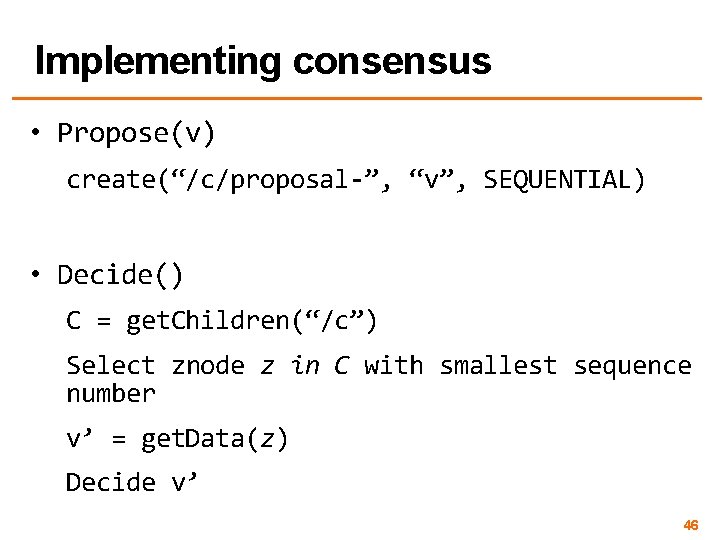
Implementing consensus • Propose(v) create(“/c/proposal-”, “v”, SEQUENTIAL) • Decide() C = get. Children(“/c”) Select znode z in C with smallest sequence number v’ = get. Data(z) Decide v’ 46
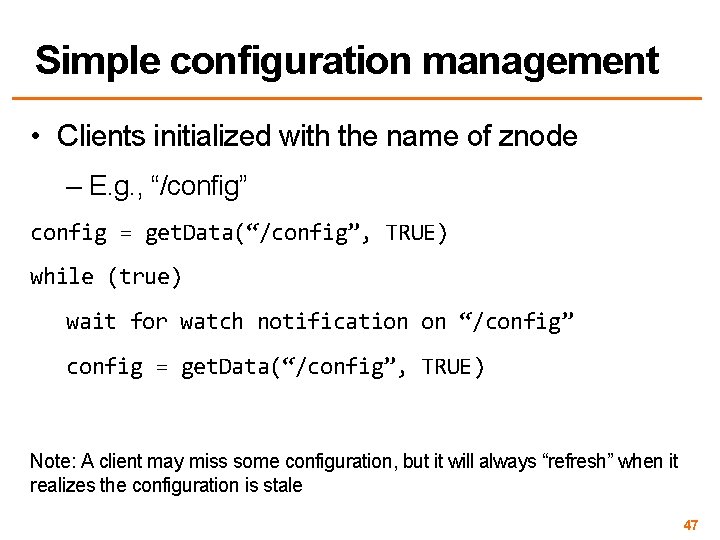
Simple configuration management • Clients initialized with the name of znode – E. g. , “/config” config = get. Data(“/config”, TRUE) while (true) wait for watch notification on “/config” config = get. Data(“/config”, TRUE) Note: A client may miss some configuration, but it will always “refresh” when it realizes the configuration is stale 47
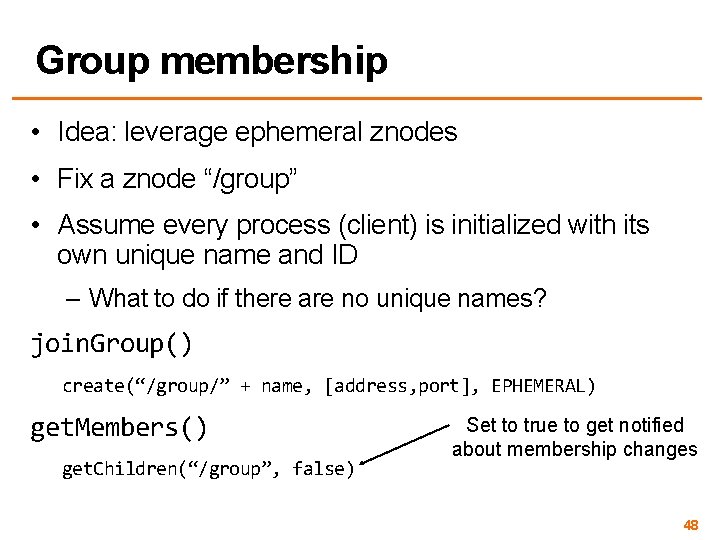
Group membership • Idea: leverage ephemeral znodes • Fix a znode “/group” • Assume every process (client) is initialized with its own unique name and ID – What to do if there are no unique names? join. Group() create(“/group/” + name, [address, port], EPHEMERAL) get. Members() get. Children(“/group”, false) Set to true to get notified about membership changes 48
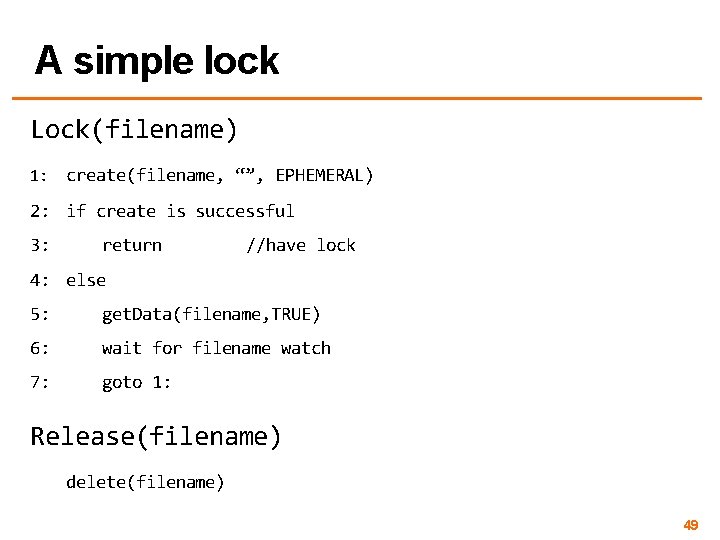
A simple lock Lock(filename) 1: create(filename, “”, EPHEMERAL) 2: if create is successful 3: return //have lock 4: else 5: get. Data(filename, TRUE) 6: wait for filename watch 7: goto 1: Release(filename) delete(filename) 49
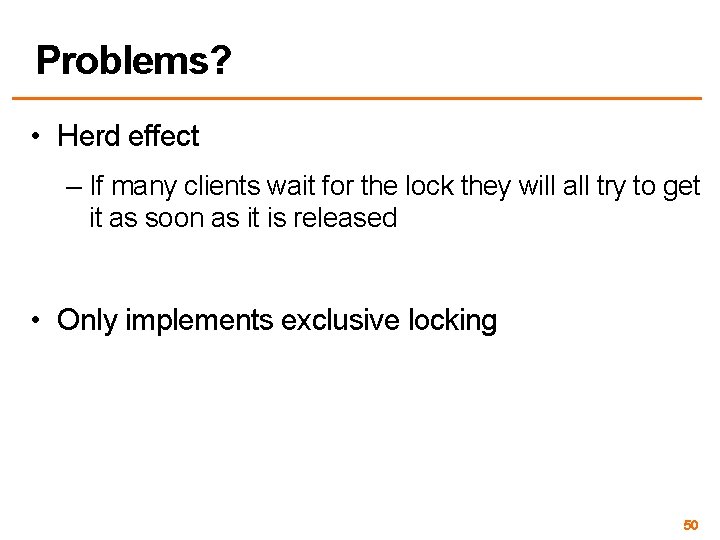
Problems? • Herd effect – If many clients wait for the lock they will all try to get it as soon as it is released • Only implements exclusive locking 50
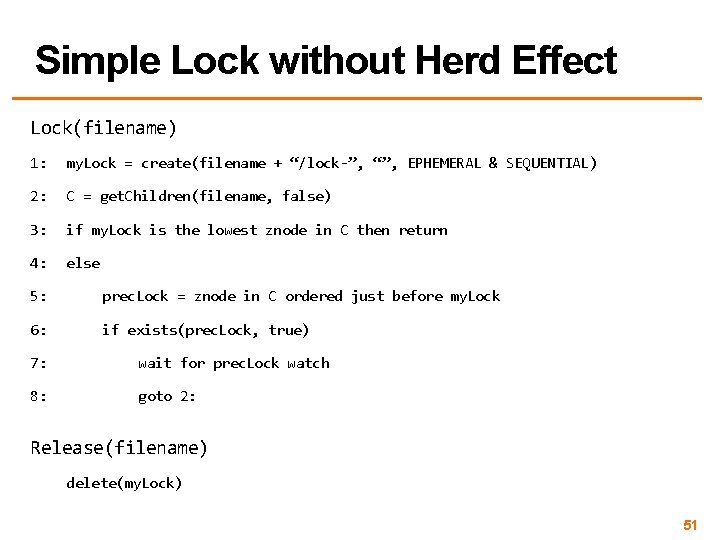
Simple Lock without Herd Effect Lock(filename) 1: my. Lock = create(filename + “/lock-”, “”, EPHEMERAL & SEQUENTIAL) 2: C = get. Children(filename, false) 3: if my. Lock is the lowest znode in C then return 4: else 5: prec. Lock = znode in C ordered just before my. Lock 6: if exists(prec. Lock, true) 7: wait for prec. Lock watch 8: goto 2: Release(filename) delete(my. Lock) 51
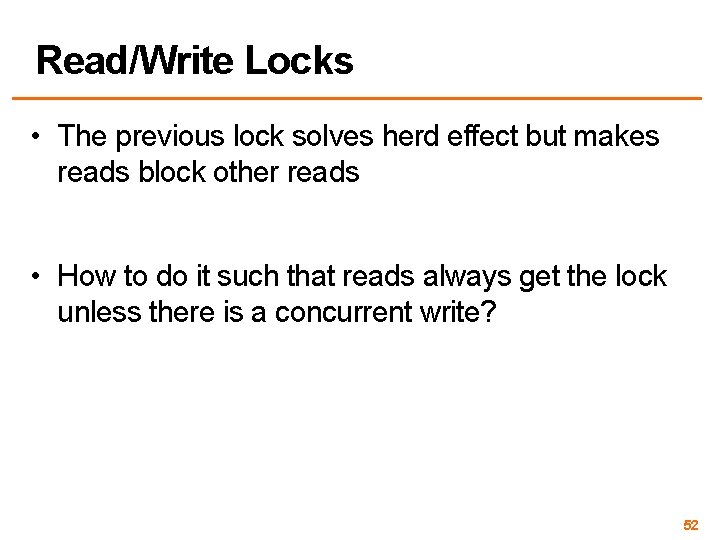
Read/Write Locks • The previous lock solves herd effect but makes reads block other reads • How to do it such that reads always get the lock unless there is a concurrent write? 52
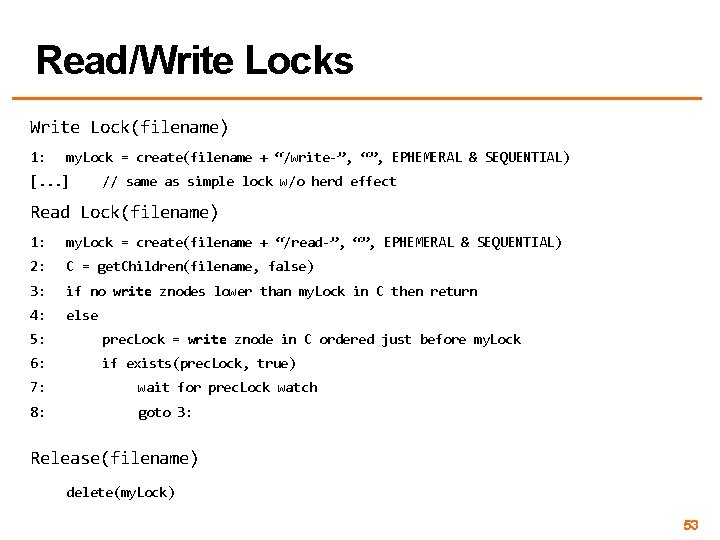
Read/Write Locks Write Lock(filename) 1: my. Lock = create(filename + “/write-”, “”, EPHEMERAL & SEQUENTIAL) [. . . ] // same as simple lock w/o herd effect Read Lock(filename) 1: my. Lock = create(filename + “/read-”, “”, EPHEMERAL & SEQUENTIAL) 2: C = get. Children(filename, false) 3: if no write znodes lower than my. Lock in C then return 4: else 5: prec. Lock = write znode in C ordered just before my. Lock 6: if exists(prec. Lock, true) 7: wait for prec. Lock watch 8: goto 3: Release(filename) delete(my. Lock) 53

A brief look inside 54
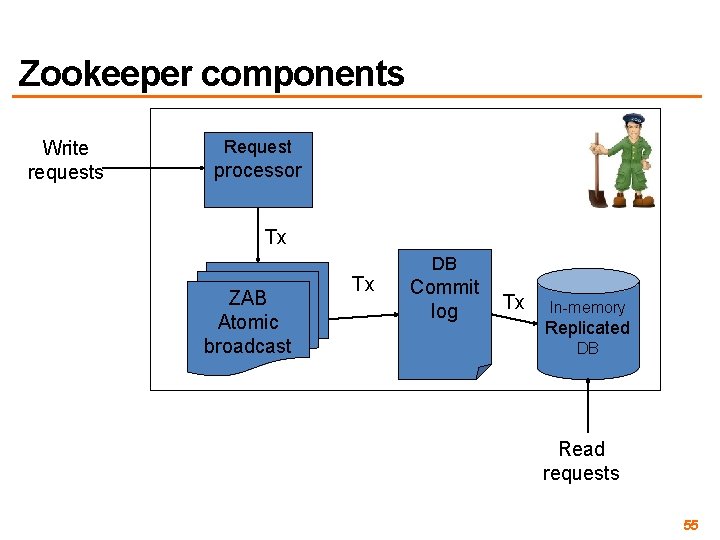
Zookeeper components Write requests Request processor Tx ZAB Atomic broadcast Tx DB Commit Tx log In-memory Replicated DB Read requests 55
Zookeeper DB • Fully replicated – To be contrasted with partitioning/placement in storage systems • Each server has a copy of in-memory DB – Store the entire znode tree – Default max 1 MB per znode (configurable) • Crash-recovery model – Commit log – + periodic snapshots of the database 56
ZAB: a very brief overview • Used to totally order write requests – Relies on a quorum of servers (f+1 out of 2 f+1) • ZAB internally elects leader replica • Zookeeper adopts this notion of a leader – Other servers are followers • All writes are sent by followers to the leader – Leader sequences the requests and invokes ZAB atomic broadcast 57
Request processor • Upon receiving a write request – Leader calculates in what state system will be after the write is applied – Transforms the operation in a transactional update • Transactional updates are then processed by ZAB, DB – Guarantees idempotency of updates to the DB originating from the same operation • Idempotency important as ZAB may redeliver a message 58
That’s all Hope you enjoyed CS 240 Review session: Dec 6, in class Final exam: Dec 10, 9 AM-12 PM, Bldg 9: Lecture Hall 1 59
- Slides: 59