
Big Data Competition Considerations What is Big Data
Big Data Competition Considerations
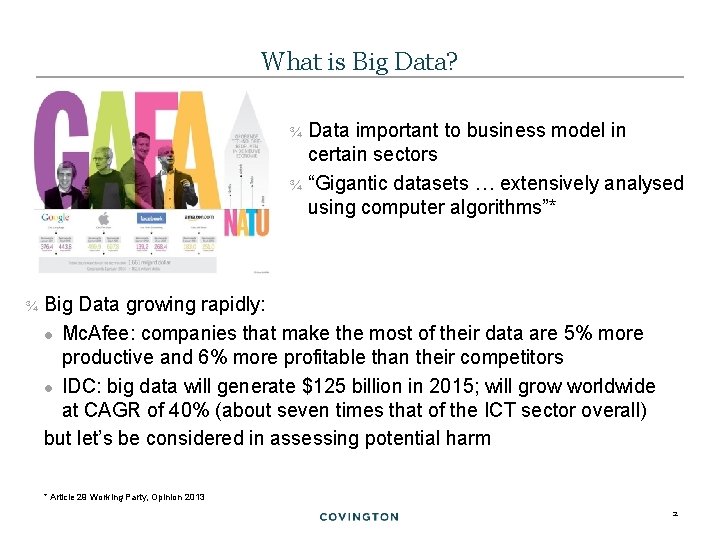
What is Big Data? Data important to business model in certain sectors ¾ “Gigantic datasets … extensively analysed using computer algorithms”* ¾ ¾ Big Data growing rapidly: l Mc. Afee: companies that make the most of their data are 5% more productive and 6% more profitable than their competitors l IDC: big data will generate $125 billion in 2015; will grow worldwide at CAGR of 40% (about seven times that of the ICT sector overall) but let’s be considered in assessing potential harm * Article 29 Working Party, Opinion 2013 2
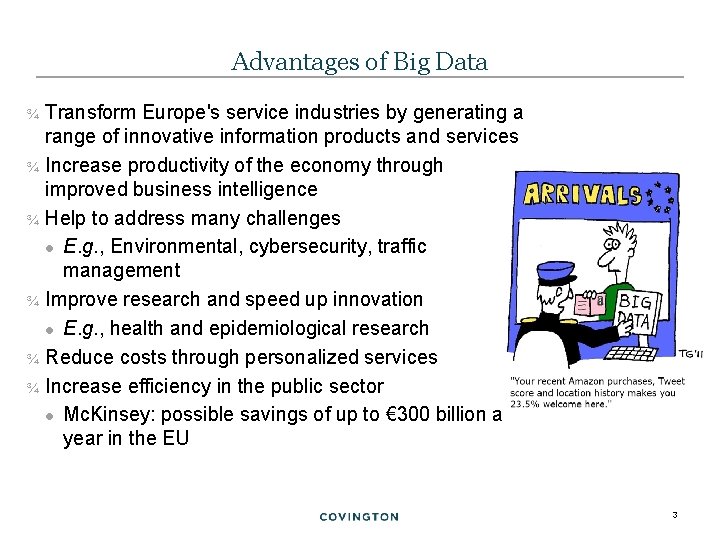
Advantages of Big Data Transform Europe's service industries by generating a range of innovative information products and services ¾ Increase productivity of the economy through improved business intelligence ¾ Help to address many challenges l E. g. , Environmental, cybersecurity, traffic management ¾ Improve research and speed up innovation l E. g. , health and epidemiological research ¾ Reduce costs through personalized services ¾ Increase efficiency in the public sector l Mc. Kinsey: possible savings of up to € 300 billion a year in the EU ¾ 3
Competition Law and Big Data ¾ Fundamental question – what is ‘big data’? l Not only personal data; also includes aggregated anonymised data sets l Used as an input in many industries (not only GAFA) � � � Online advertising – used to target ads FMCG (incl loyalty schemes) – inventory management and targeting ads Travel and local (incl user reviews and frequent flyer schemes) – load/inventory management e. Medicine and other e. Services - personalisation and real-time management of patients Search data – used to improve tail query results Nature of the data is important ¾ Not a new phenomenon ¾ Volume of data generated analysed is new, as are some uses 4
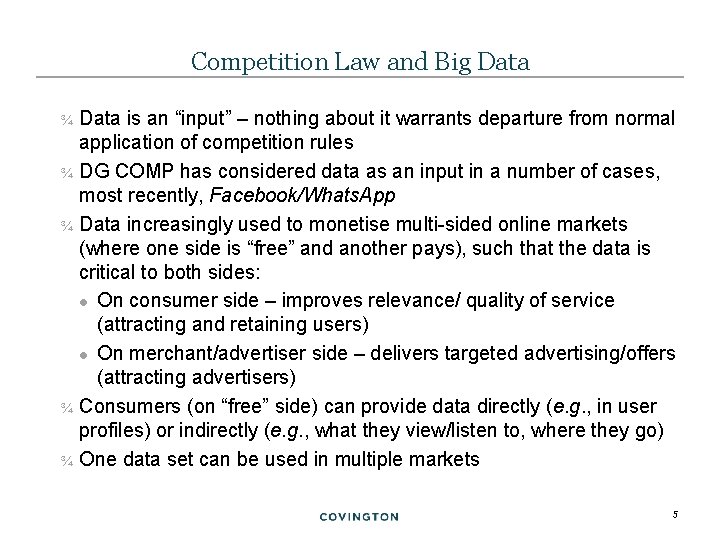
Competition Law and Big Data is an “input” – nothing about it warrants departure from normal application of competition rules ¾ DG COMP has considered data as an input in a number of cases, most recently, Facebook/Whats. App ¾ Data increasingly used to monetise multi-sided online markets (where one side is “free” and another pays), such that the data is critical to both sides: l On consumer side – improves relevance/ quality of service (attracting and retaining users) l On merchant/advertiser side – delivers targeted advertising/offers (attracting advertisers) ¾ Consumers (on “free” side) can provide data directly (e. g. , in user profiles) or indirectly (e. g. , what they view/listen to, where they go) ¾ One data set can be used in multiple markets ¾ 5
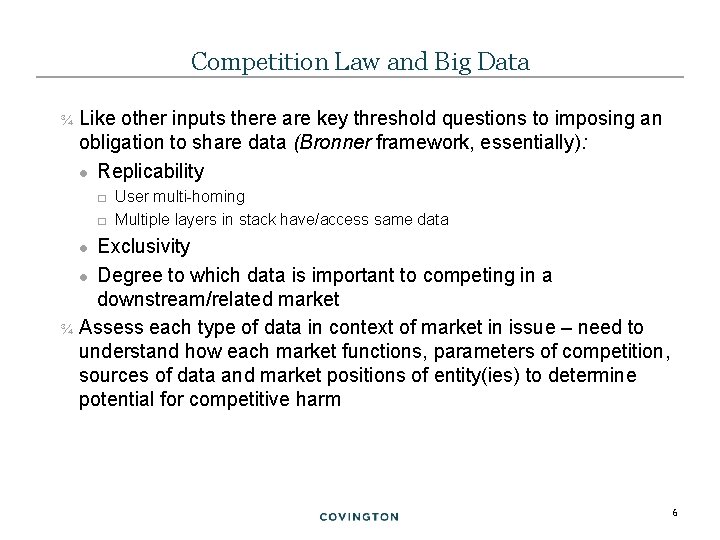
Competition Law and Big Data ¾ Like other inputs there are key threshold questions to imposing an obligation to share data (Bronner framework, essentially): l Replicability � � User multi-homing Multiple layers in stack have/access same data Exclusivity l Degree to which data is important to competing in a downstream/related market ¾ Assess each type of data in context of market in issue – need to understand how each market functions, parameters of competition, sources of data and market positions of entity(ies) to determine potential for competitive harm l 6
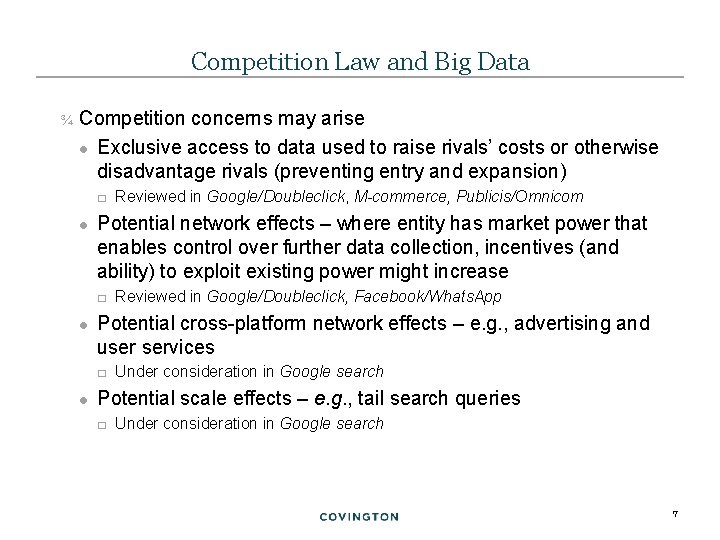
Competition Law and Big Data ¾ Competition concerns may arise l Exclusive access to data used to raise rivals’ costs or otherwise disadvantage rivals (preventing entry and expansion) � l Potential network effects – where entity has market power that enables control over further data collection, incentives (and ability) to exploit existing power might increase � l Reviewed in Google/Doubleclick, Facebook/Whats. App Potential cross-platform network effects – e. g. , advertising and user services � l Reviewed in Google/Doubleclick, M-commerce, Publicis/Omnicom Under consideration in Google search Potential scale effects – e. g. , tail search queries � Under consideration in Google search 7
- Slides: 7