
Big Data Analytics using Small Datasets Machine Learning
Big Data Analytics using Small Datasets: Machine Learning for Early Breast Cancer Detection D Dulani Jayasuriya, Johnny Chan, David Sundaram
Motivation • As of 2019, on average, 1 in 8 U. S women (approx. 12%) would develop invasive breast cancer at some point during her life. • 5 -year survival rate for breast cancer is 100% with early detection and 15% with late detection (UK Cancer research) • Machine learning (ML) techniques play a key role in healthcare in recent years. • In the case of breast cancer, machine learning techniques can be used to distinguish between malignant and benign tumours for enabling early detection. • Most ML based applications focus on large data sets citing ML’s ability to handle big data. • However, from a user’s perspective most users have access to publicly available small data sets. • Thus, it is interesting to analyse if the traditional non complex basic ML algorithms can achieve high accuracy classifications using small datasets. 2
Research Questions • Objective of this paper is to apply ML algorithms to classify breast cancer outcomes using a small publicly available data set. • Research Question 1: Can basic machine learning based algorithms classify breast cancer outcomes with high accuracies for small datasets? • Research Question 2: Which factors are most important for classification of breast cancer outcomes? • In addition, this study develops a breast cancer prediction platform. 3
Literature Review • Table 1 summarises prior research on machine learning algorithms, sample strategies and classification accuracies. • Continued experimenting with different ML algorithms are also important as each has its own advantages and drawbacks. 4
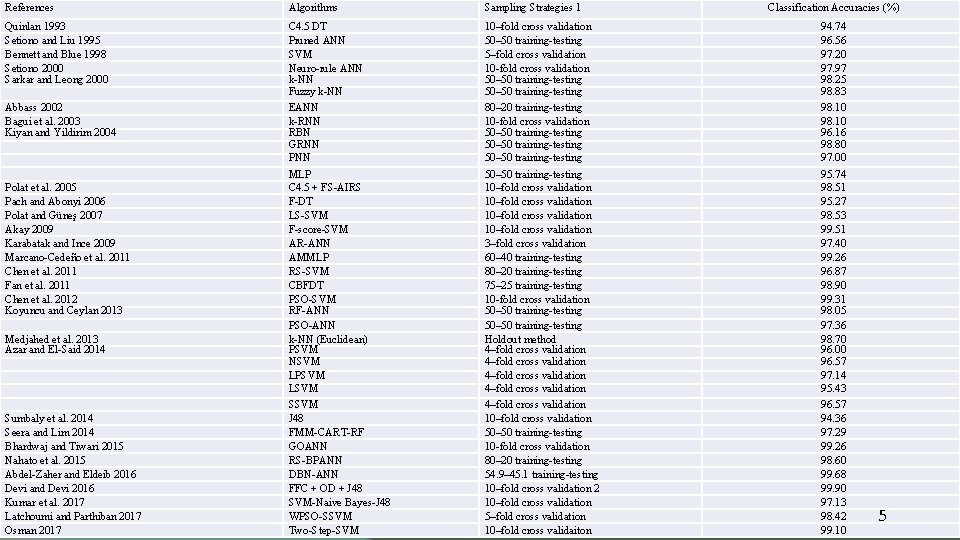
References Algorithms Sampling Strategies 1 Quinlan 1993 Setiono and Liu 1995 Bennett and Blue 1998 Setiono 2000 Sarkar and Leong 2000 C 4. 5 DT Pruned ANN SVM Neuro-rule ANN k-NN Fuzzy k-NN EANN k-RNN RBN GRNN PNN 10–fold cross validation 50– 50 training-testing 5–fold cross validation 10 -fold cross validation 50– 50 training-testing 80– 20 training-testing 10 -fold cross validation 50– 50 training-testing 94. 74 96. 56 97. 20 97. 97 98. 25 98. 83 98. 10 96. 16 98. 80 97. 00 MLP C 4. 5 + FS-AIRS F-DT LS-SVM F-score-SVM AR-ANN AMMLP RS-SVM CBFDT PSO-SVM RF-ANN PSO-ANN k-NN (Euclidean) PSVM NSVM LPSVM LSVM 50– 50 training-testing 10–fold cross validation 3–fold cross validation 60– 40 training-testing 80– 20 training-testing 75– 25 training-testing 10 -fold cross validation 50– 50 training-testing Holdout method 4–fold cross validation 95. 74 98. 51 95. 27 98. 53 99. 51 97. 40 99. 26 96. 87 98. 90 99. 31 98. 05 97. 36 98. 70 96. 00 96. 57 97. 14 95. 43 SSVM J 48 FMM-CART-RF GOANN RS-BPANN DBN-ANN FFC + OD + J 48 SVM-Naive Bayes-J 48 WPSO-SSVM Two-Step-SVM 4–fold cross validation 10–fold cross validation 50– 50 training-testing 10 -fold cross validation 80– 20 training-testing 54. 9– 45. 1 training-testing 10–fold cross validation 2 10–fold cross validation 5–fold cross validation 10–fold cross validaiton 96. 57 94. 36 97. 29 99. 26 98. 60 99. 68 99. 90 97. 13 98. 42 99. 10 Abbass 2002 Bagui et al. 2003 Kiyan and Yildirim 2004 Polat et al. 2005 Pach and Abonyi 2006 Polat and Güneş 2007 Akay 2009 Karabatak and Ince 2009 Marcano-Cedeño et al. 2011 Chen et al. 2011 Fan et al. 2011 Chen et al. 2012 Koyuncu and Ceylan 2013 Medjahed et al. 2013 Azar and El-Said 2014 Sumbaly et al. 2014 Seera and Lim 2014 Bhardwaj and Tiwari 2015 Nahato et al. 2015 Abdel-Zaher and Eldeib 2016 Devi and Devi 2016 Kumar et al. 2017 Latchoumi and Parthiban 2017 Osman 2017 Classification Accuracies (%) 5
Research Design • ML algorithms implemented: Ridge, Adaboost, Gradient. Boost, Random. Forest, PCA+Ridge and Neural Networks ML algorithms. • These models are incorporated in the breast cancer prediction platform. • Traditional benchmark ML technique: logistic regression model. • We the benchmark model performance against our ML algorithm performance. • In addition, we identify important features that contribute to breast cancer classification. 6
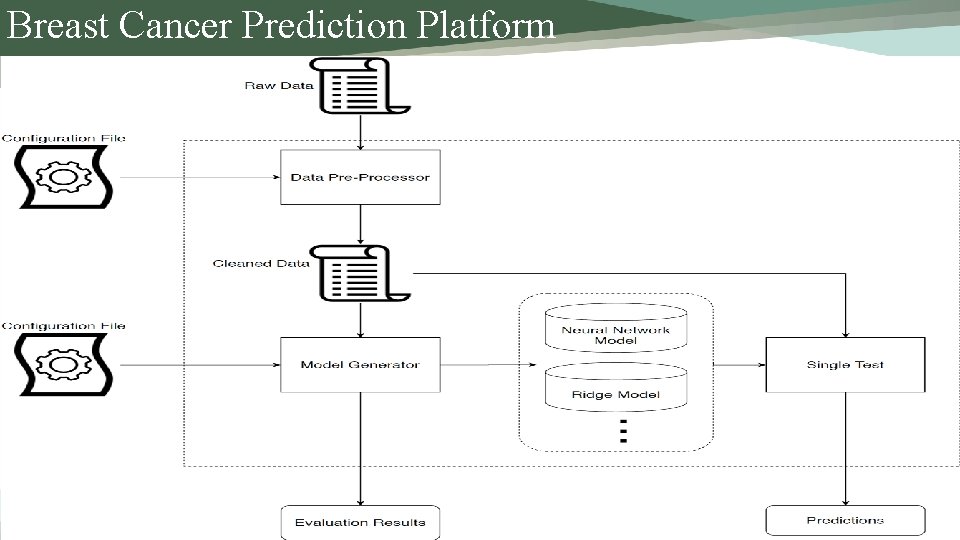
Breast Cancer Prediction Platform 7
Data • The dataset: Publicly available (created by Dr. William H. Wolberg, physician at the University Of Wisconsin Hospital at Madison, Wisconsin, USA (Wolberg and Mangasarian 1990). • Breast-cancer-Wisconsin has 699 instances (Benign: 458 Malignant: 241) • 2 classes (65. 5% malignant and 34. 5% benign) • 11 integer-valued attributes. 8
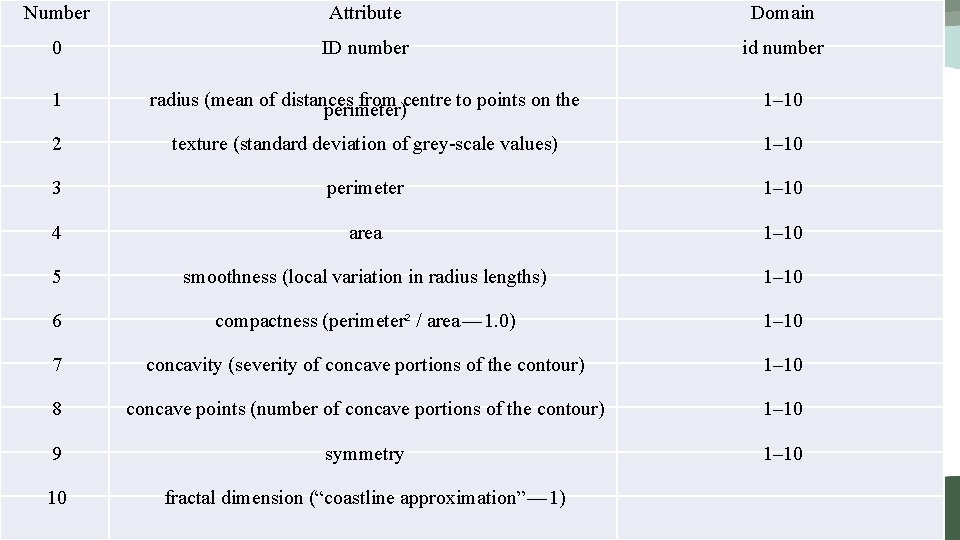
Number Attribute Domain 0 ID number id number 1 radius (mean of distances from centre to points on the perimeter) 1– 10 2 texture (standard deviation of grey-scale values) 1– 10 3 perimeter 1– 10 4 area 1– 10 5 smoothness (local variation in radius lengths) 1– 10 6 compactness (perimeter² / area — 1. 0) 1– 10 7 concavity (severity of concave portions of the contour) 1– 10 8 concave points (number of concave portions of the contour) 1– 10 9 symmetry 1– 10 10 fractal dimension (“coastline approximation” — 1) 9
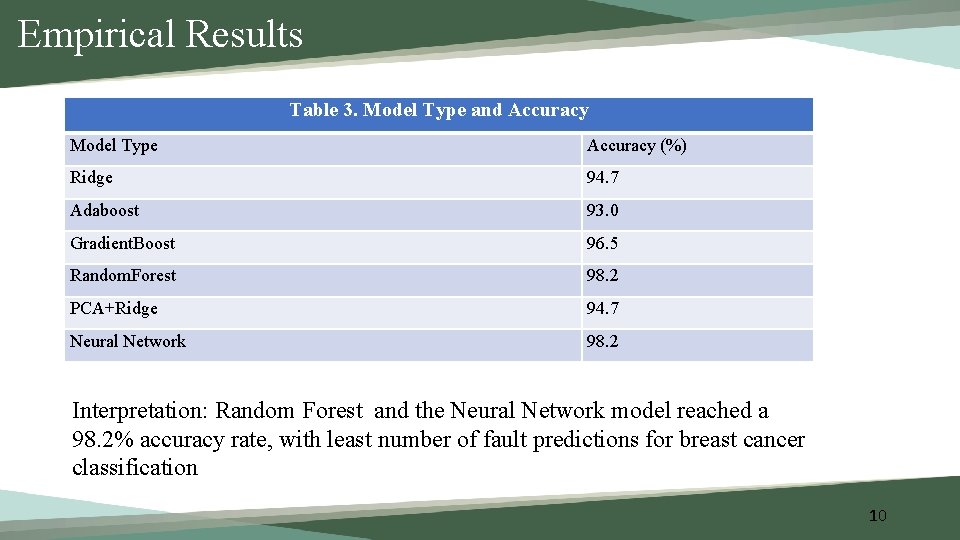
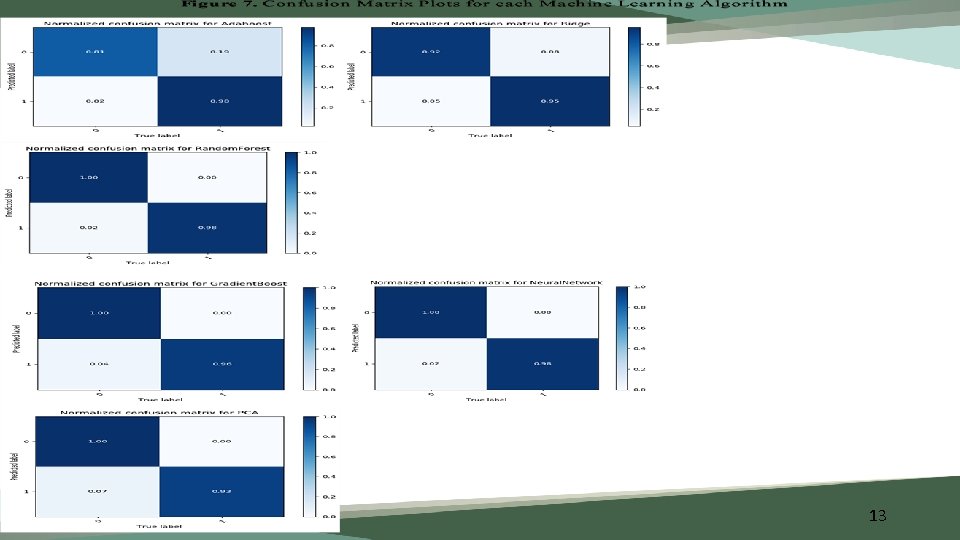
Empirical Results Table 3. Model Type and Accuracy Model Type Accuracy (%) Ridge 94. 7 Adaboost 93. 0 Gradient. Boost 96. 5 Random. Forest 98. 2 PCA+Ridge 94. 7 Neural Network 98. 2 Interpretation: Random Forest and the Neural Network model reached a 98. 2% accuracy rate, with least number of fault predictions for breast cancer classification 10
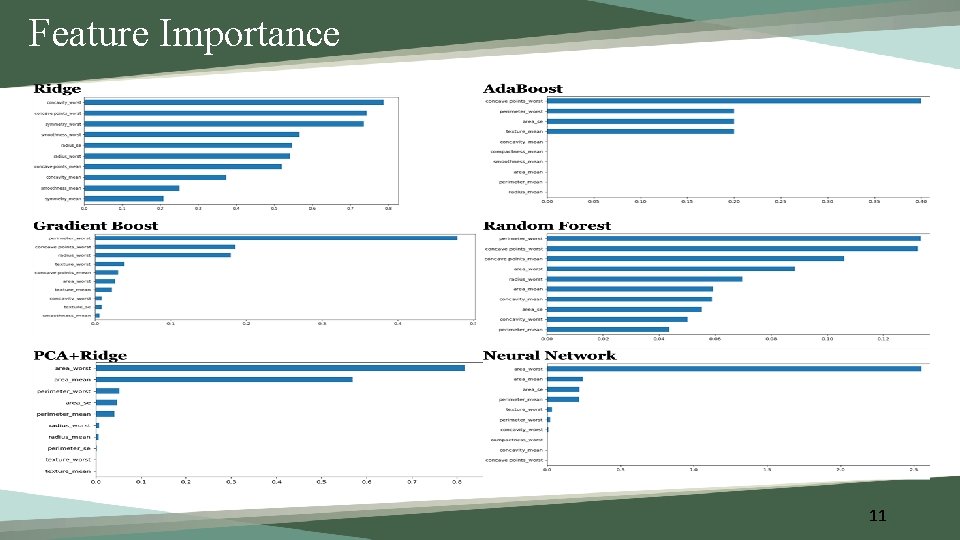
Feature Importance 11
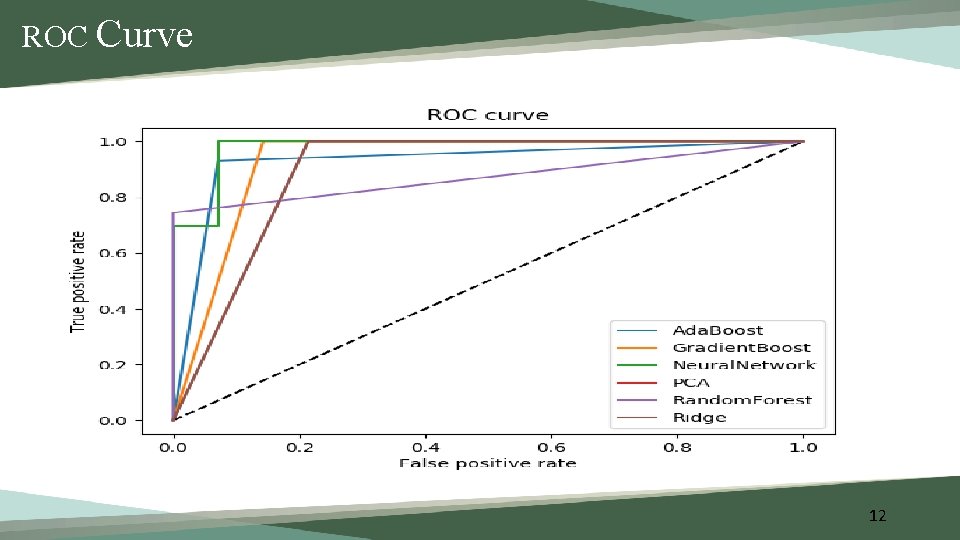
ROC Curve 12
13
Conclusion • This study identifies Random Forest and the Neural Network model to be most successful in breast cancer classification. (98. 2% accuracy rate, and the least number of fault predictions) • concave_points_worst and perimeter_worst are the most important features for classifying breast cancer outcomes. • Our results show that ML algorithms can classify breast cancer outcomes with high accuracy and identify key characteristics even for small datasets. • Thus, higher accuracy can be achieved with standard work horse classification models versus more complicated models even for a smaller data set. • We highlight the significant potential in using ML techniques as a diagnostic tool for early detection of breast cancer in general. 14
- Slides: 14