
Big Data Analytics Spark Slides by Joseph E
Big Data Analytics & Spark Slides by: Joseph E. Gonzalez jegonzal@cs. berkeley. edu With revisions by: Josh Hug & John De. Nero
Operational Data Store Data Warehouse ETL (Extract, Transform, Load) Snowflake Schema on Read Data in the Organization A little bit of buzzword bingo! Star Schema OLAP (Online Analytics Processing) Data Lake
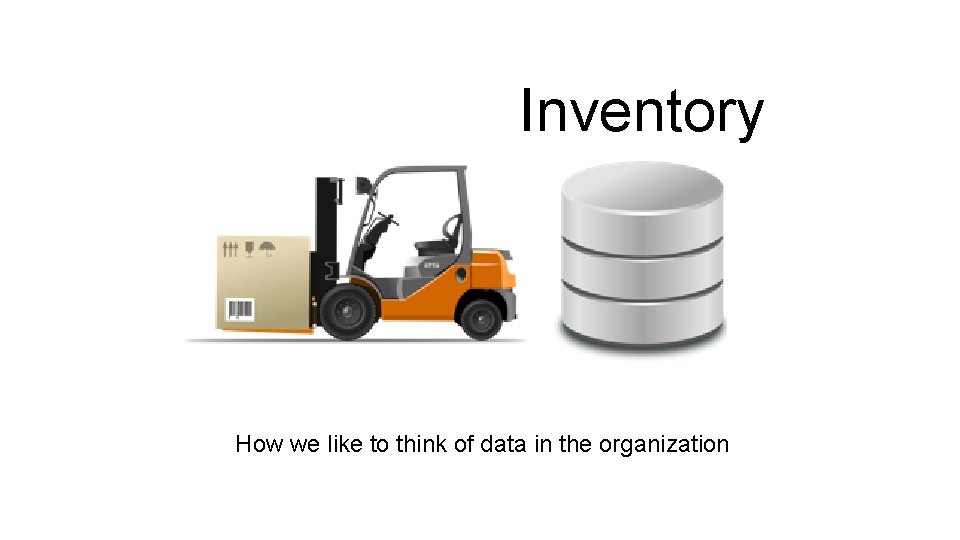
Inventory How we like to think of data in the organization
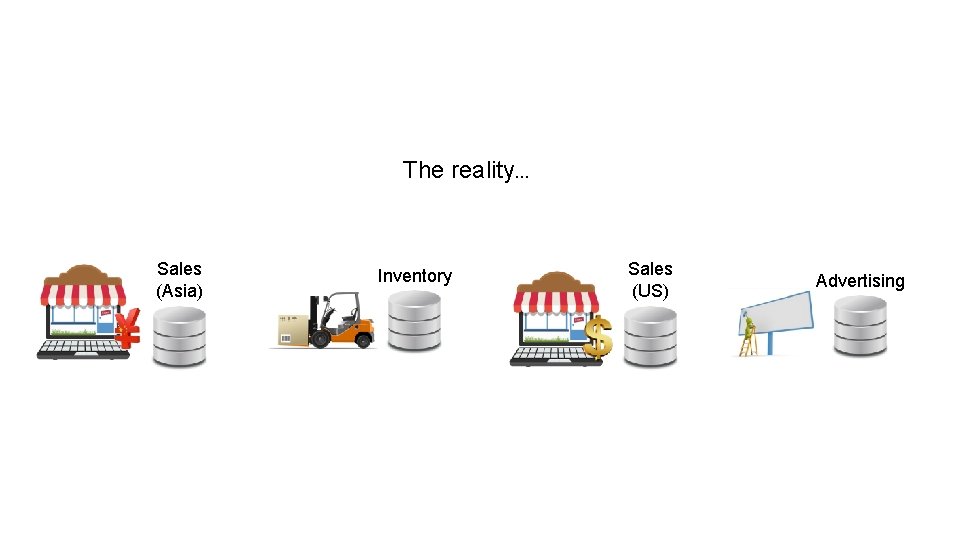
The reality… Sales (Asia) Inventory Sales (US) Advertising
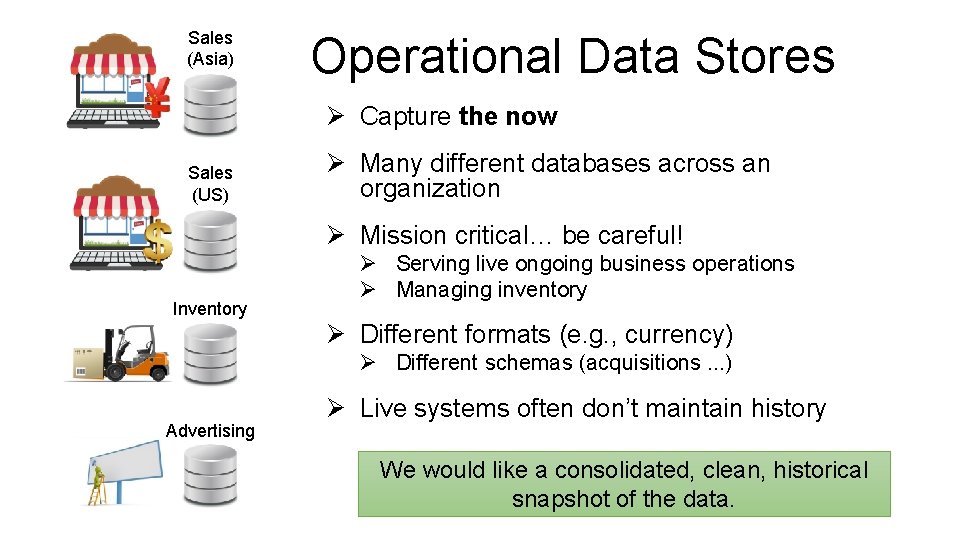
Sales (Asia) Operational Data Stores Ø Capture the now Sales (US) Ø Many different databases across an organization Ø Mission critical… be careful! Inventory Ø Serving live ongoing business operations Ø Managing inventory Ø Different formats (e. g. , currency) Ø Different schemas (acquisitions. . . ) Advertising Ø Live systems often don’t maintain history We would like a consolidated, clean, historical snapshot of the data.
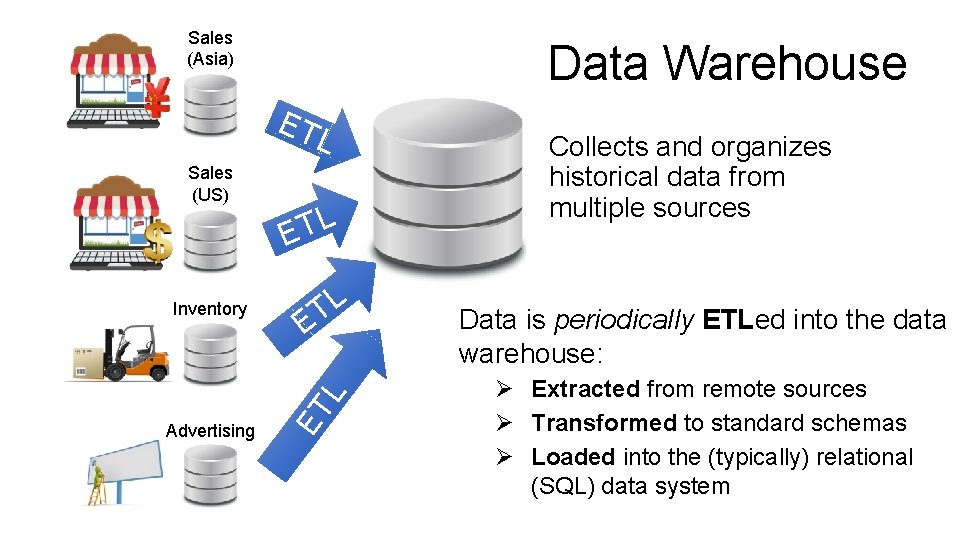
Sales (Asia) Data Warehouse ET L Inventory Advertising L T E ET L Sales (US) Collects and organizes historical data from multiple sources Data is periodically ETLed into the data warehouse: Ø Extracted from remote sources Ø Transformed to standard schemas Ø Loaded into the (typically) relational (SQL) data system
Extract Transform Load (ETL) Extract & Load: provides a snapshot of operational data Ø Historical snapshot Ø Data in a single system Ø Isolates analytics queries (e. g. , Deep Learning) from business critical services (e. g. , processing user purchase) Ø Easy! Transform: clean and prepare data for analytics in a unified representation Ø Difficult often requires specialized code and tools Ø Different schemas, encodings, granularities
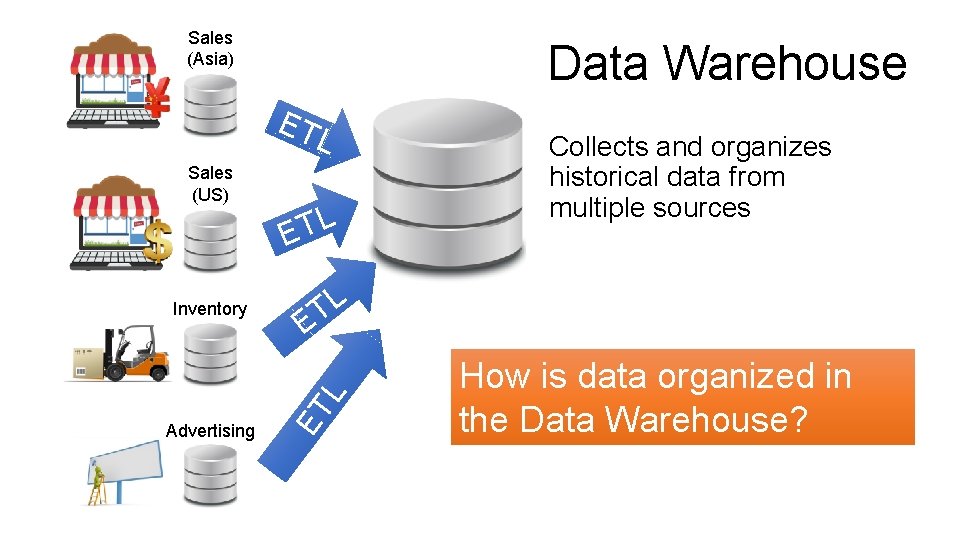
Sales (Asia) Data Warehouse ET L Inventory Advertising L T E ET L Sales (US) Collects and organizes historical data from multiple sources How is data organized in the Data Warehouse?
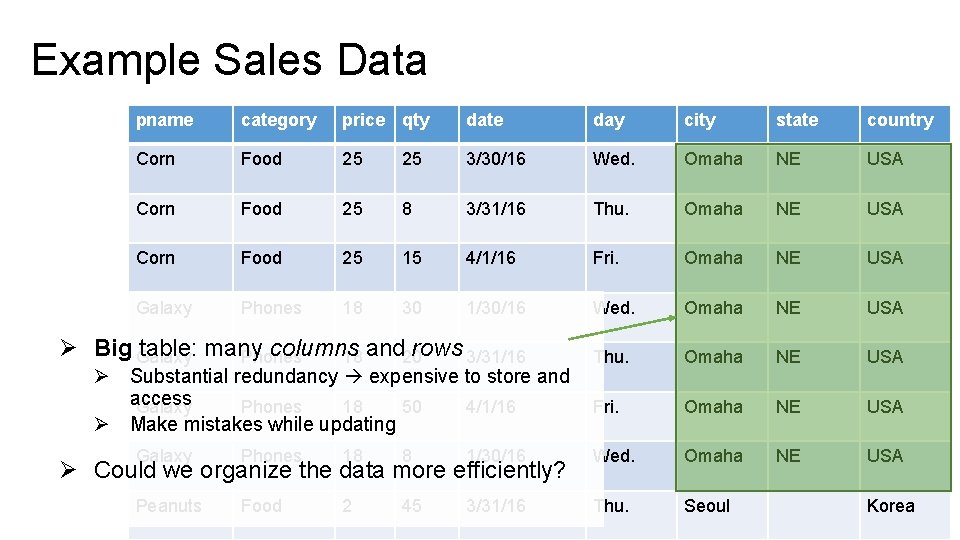
Example Sales Data pname category price qty date day city state country Corn Food 25 25 3/30/16 Wed. Omaha NE USA Corn Food 25 8 3/31/16 Thu. Omaha NE USA Corn Food 25 15 4/1/16 Fri. Omaha NE USA Galaxy Phones 18 30 1/30/16 Wed. Omaha NE USA Thu. Omaha NE USA Fri. Omaha NE USA Ø Big Galaxy table: many columns rows 3/31/16 Phones 18 and 20 Ø Substantial redundancy expensive to store and access Galaxy Phones 18 50 4/1/16 Ø Make mistakes while updating Galaxy Phones 18 8 1/30/16 Wed. Omaha Peanuts Food 2 45 3/31/16 Thu. Seoul Ø Could we organize the data more efficiently? Korea
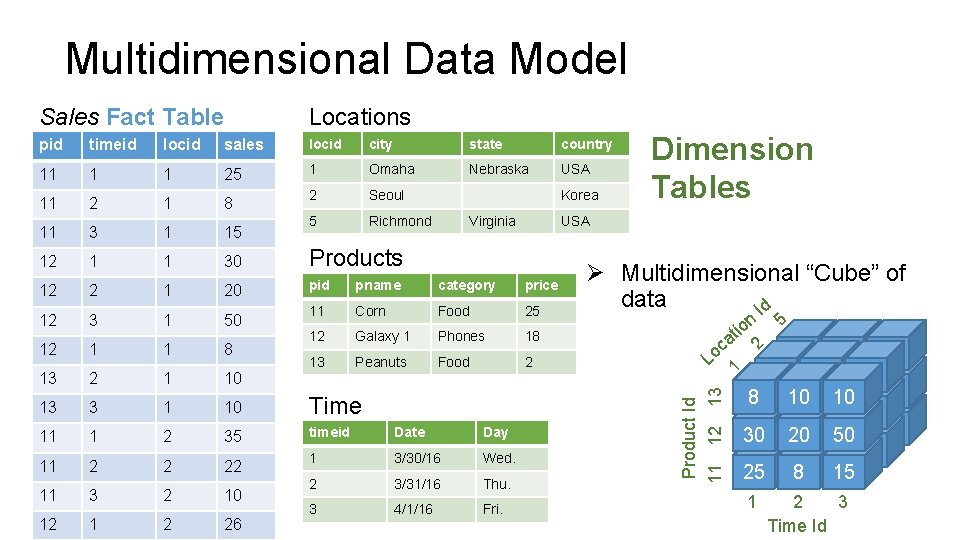
Multidimensional Data Model Sales Fact Table Locations pid timeid locid sales locid city state country 11 1 1 25 1 Omaha Nebraska USA 11 2 1 8 2 Seoul 11 3 1 15 5 Richmond 12 1 1 30 Products pid pname category price 11 Corn Food 25 12 Galaxy 1 Phones 18 13 Peanuts Food 2 Korea 20 12 3 1 50 12 1 1 8 13 2 1 10 13 3 1 10 Time 11 1 2 35 timeid Date Day 11 2 2 22 1 3/30/16 Wed. 11 3 2 10 2 3/31/16 Thu. 12 1 2 26 3 4/1/16 Fri. n tio a oc L 5 1 10 10 8 30 10 20 10 50 30 20 50 8 15 30 25 20 50 25 8 15 2 2 Ø Multidimensional “Cube” of data Id 1 12 USA Product Id 11 12 13 Virginia Dimension Tables 1 8 2 3 Time Id

Multidimensional Data Model Sales Fact Table Locations pid timeid locid sales locid city state country 11 1 1 25 1 Omaha Nebraska USA 11 2 1 8 2 Seoul 11 3 1 15 5 Richmond 12 1 1 30 Products 12 2 1 20 pid pname category price 12 3 1 50 11 Corn Food 25 12 1 1 8 12 Galaxy 1 Phones 18 13 2 1 10 13 Peanuts Food 2 13 3 1 10 Time 11 1 2 35 timeid Date Day 11 2 2 22 1 3/30/16 Wed. 2 3/31/16 Thu. 3 4/1/16 Fri. 11 3 2 10 12 1 2 26 Dimension Tables Korea Virginia USA Ø Fact Table Ø Ø Minimizes redundant info Reduces data errors Ø Dimensions Ø Ø Easy to manage and summarize Rename: Galaxy 1 Phablet Ø Normalized Representation Ø How do we do analysis? Ø Joins!
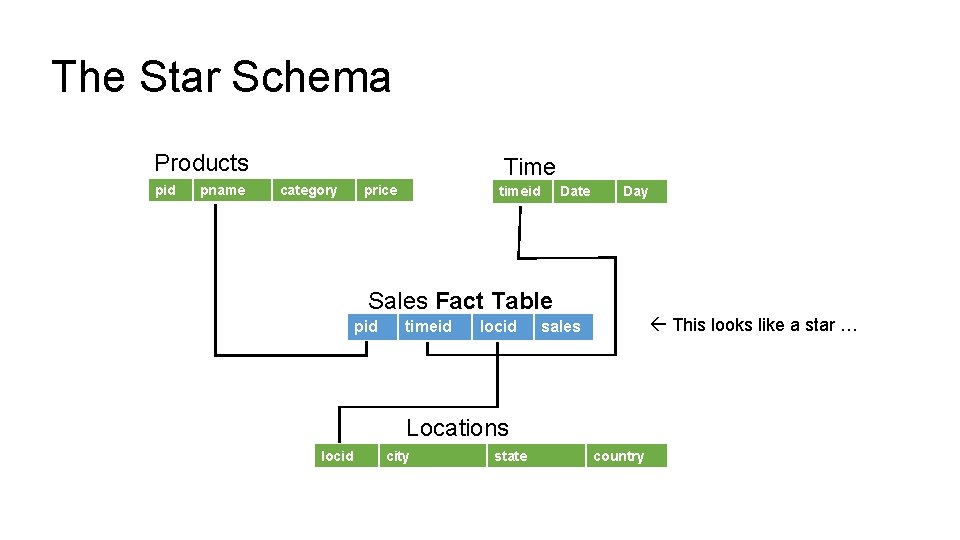
The Star Schema Products pid pname Time category price timeid Date Day Sales Fact Table pid timeid locid This looks like a star … sales Locations locid city state country
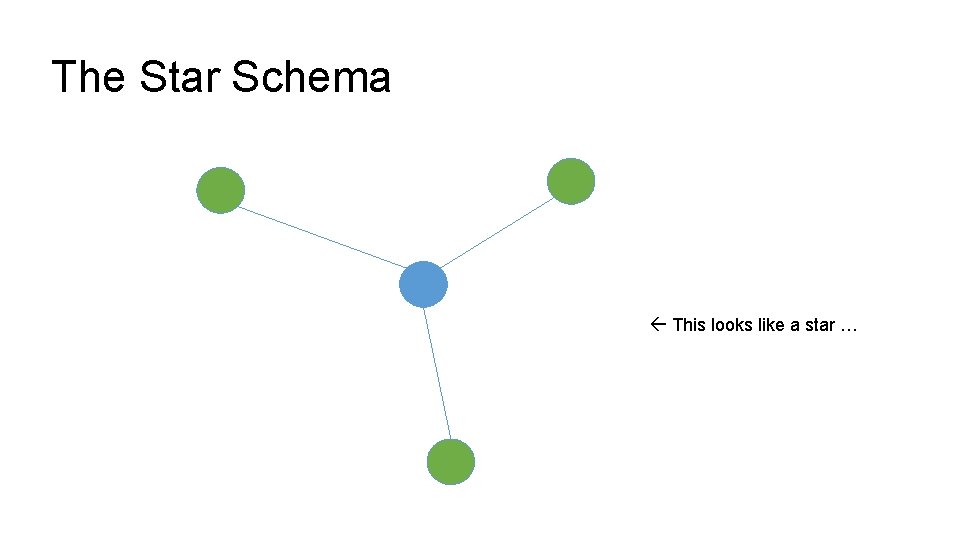
The Star Schema This looks like a star …
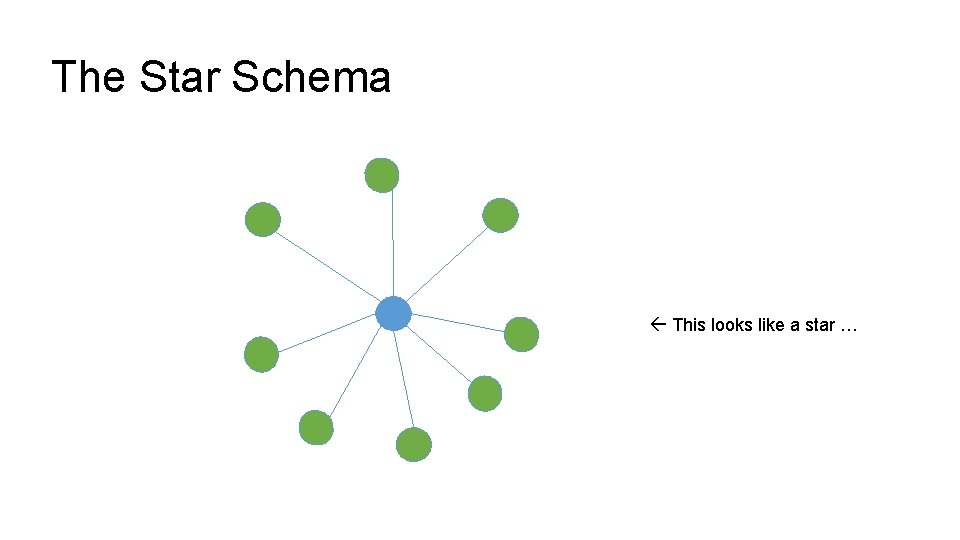
The Star Schema This looks like a star …
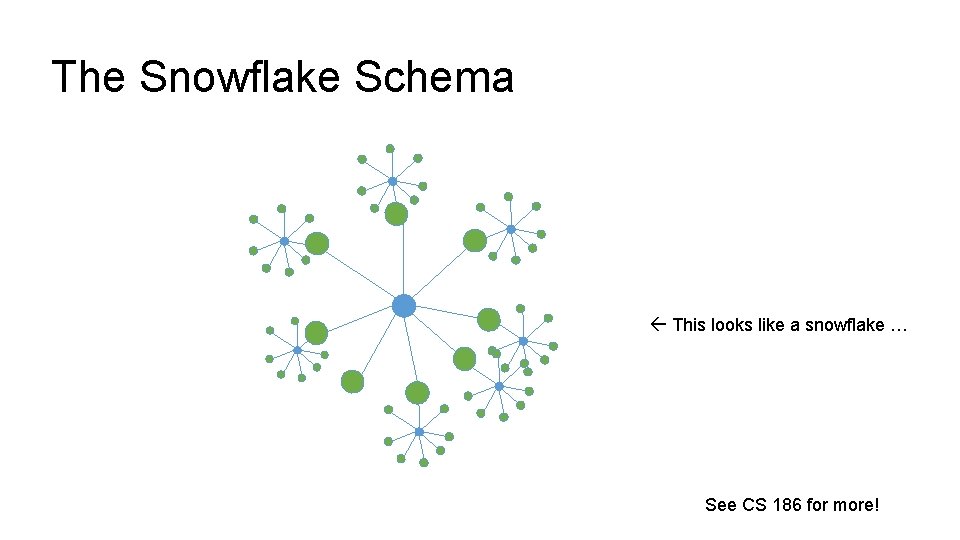
The Snowflake Schema This looks like a snowflake … See CS 186 for more!
Online Analytics Processing (OLAP) Users interact with multidimensional data: Ø Constructing ad-hoc and often complex SQL queries Ø Using graphical tools that to construct queries Ø Sharing views that summarize data across important dimensions
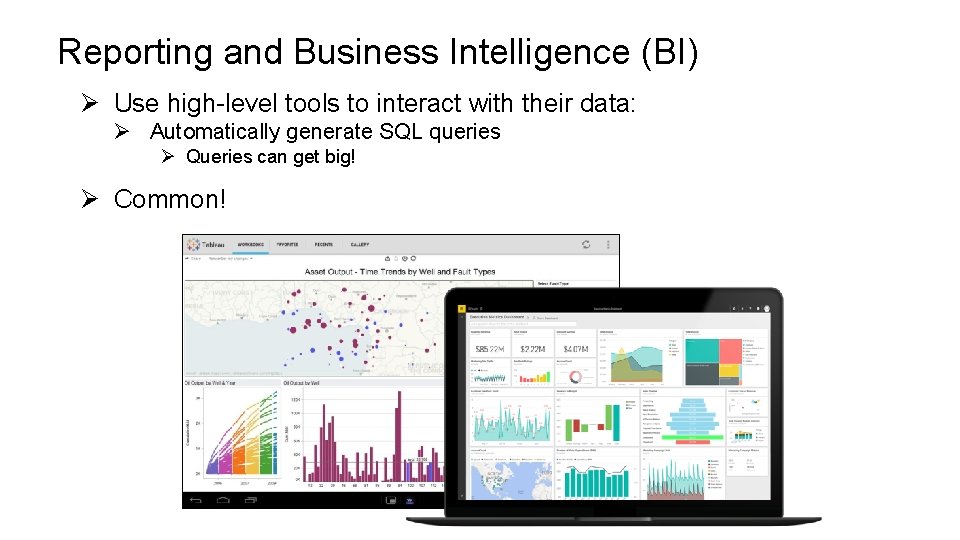
Reporting and Business Intelligence (BI) Ø Use high-level tools to interact with their data: Ø Automatically generate SQL queries Ø Queries can get big! Ø Common!
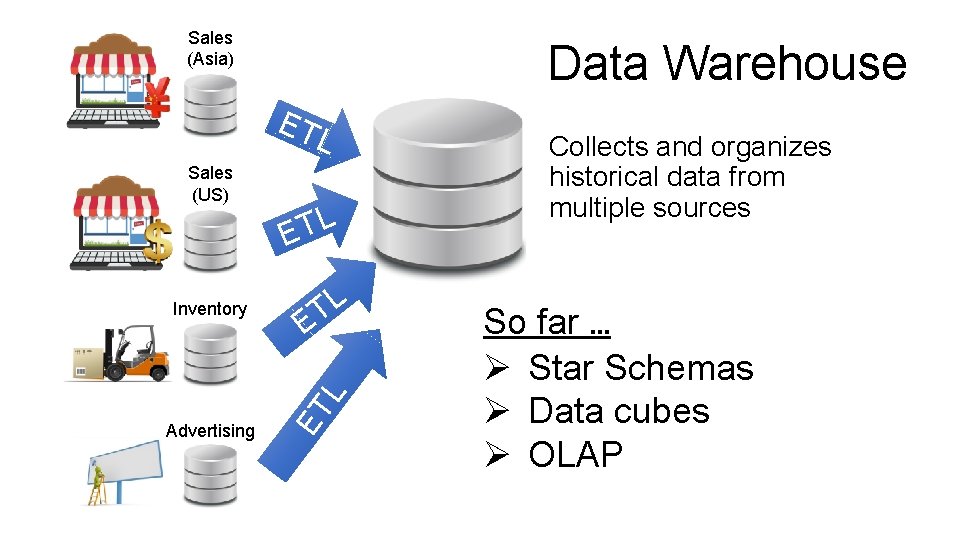
Sales (Asia) Data Warehouse ET L Sales (US) L T E Advertising ET L Inventory L T E Collects and organizes historical data from multiple sources So far … Ø Star Schemas Ø Data cubes Ø OLAP
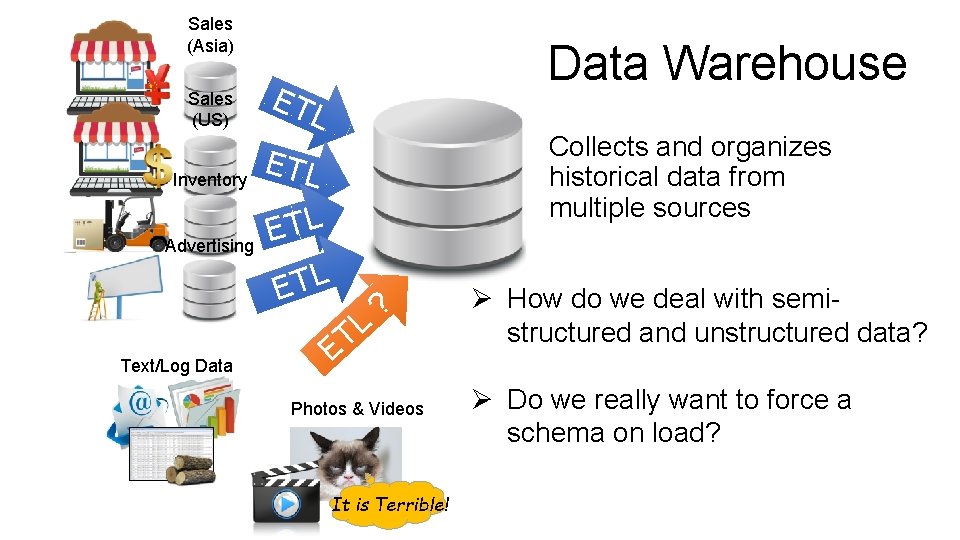
Sales (Asia) Sales (US) Inventory Advertising Text/Log Data Warehouse ET L Collects and organizes historical data from multiple sources ETL L T E L ET ? Photos & Videos It is Terrible! Ø How do we deal with semistructured and unstructured data? Ø Do we really want to force a schema on load?
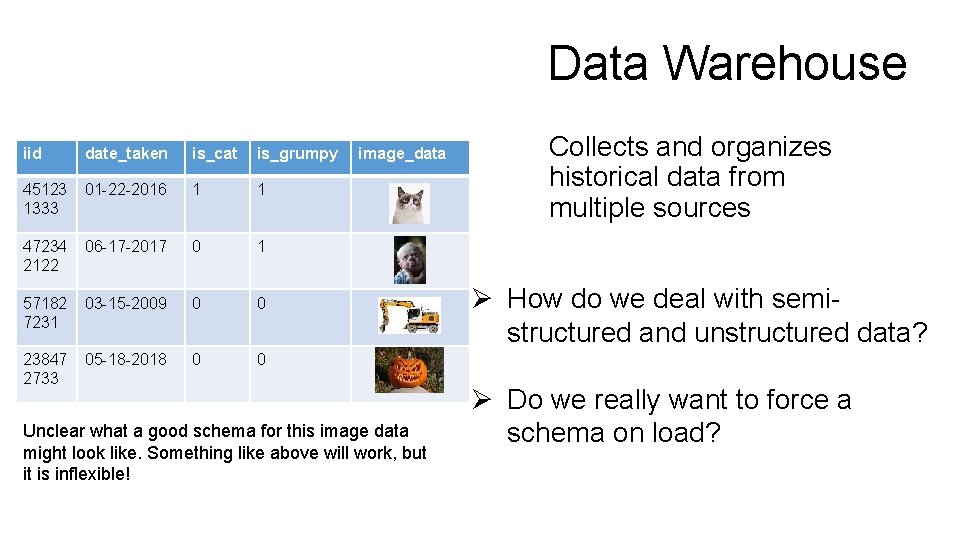
Data Warehouse iid date_taken is_cat is_grumpy 45123 1333 01 -22 -2016 1 1 47234 2122 06 -17 -2017 0 1 57182 7231 03 -15 -2009 0 0 23847 2733 05 -18 -2018 0 0 image_data Unclear what a good schema for this image data might look like. Something like above will work, but it is inflexible! Collects and organizes historical data from multiple sources Ø How do we deal with semistructured and unstructured data? Ø Do we really want to force a schema on load?
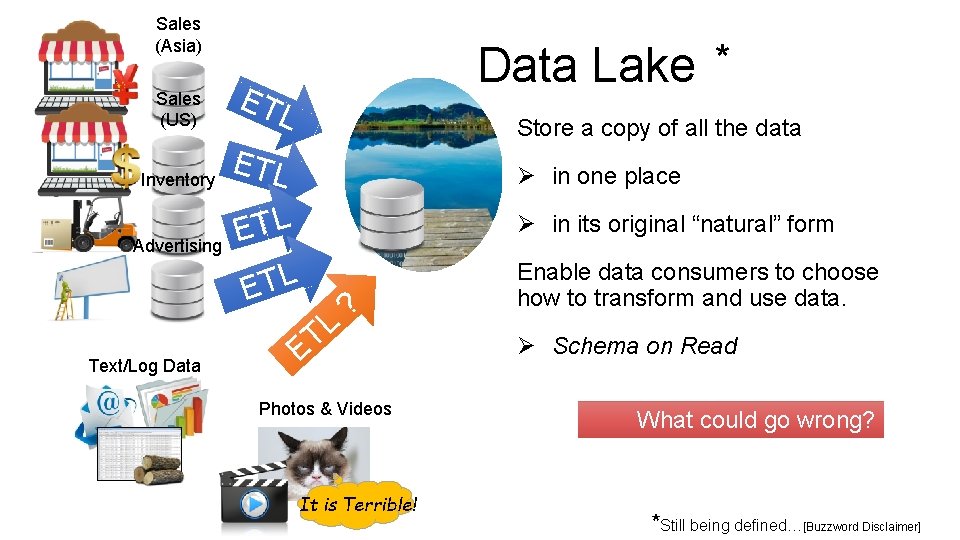
Sales (Asia) Data Lake * Sales (US) ET Inventory ETL Advertising Text/Log Data L Store a copy of all the data Ø in one place ETL L T E Ø in its original “natural” form L T ? E Photos & Videos It is Terrible! Enable data consumers to choose how to transform and use data. Ø Schema on Read What could go wrong? *Still being defined…[Buzzword Disclaimer]
The Dark Side of Data Lakes Ø Cultural shift: Curate Save Everything! Ø Noise begins to dominate signal Ø Limited data governance and planning Example: hdfs: //important/joseph_big_file 3. csv_with_json Ø What does it contain? Ø When and who created it? Ø No cleaning and verification lots of dirty data Ø New tools are more complex and old tools no longer work Enter the data scientist
A Brighter Future for Data Lakes Enter the data scientist Ø Data scientists bring new skills Ø Distributed data processing and cleaning Ø Machine learning, computer vision, and statistical sampling Ø Technologies are improving Ø SQL over large files Ø Self describing file formats (e. g. Parquet) & catalog managers Ø Organizations are evolving Ø Tracking data usage and file permissions Ø New job title: data engineers
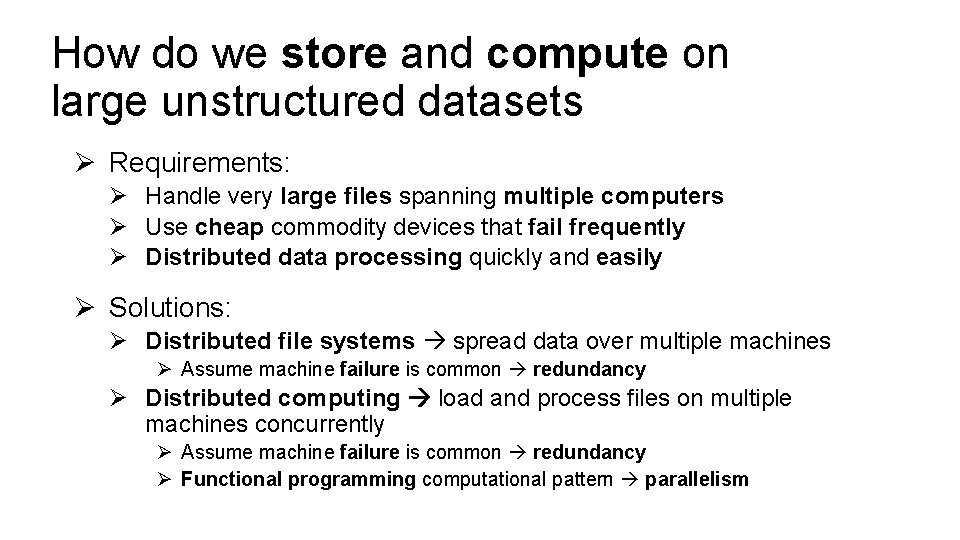
How do we store and compute on large unstructured datasets Ø Requirements: Ø Handle very large files spanning multiple computers Ø Use cheap commodity devices that fail frequently Ø Distributed data processing quickly and easily Ø Solutions: Ø Distributed file systems spread data over multiple machines Ø Assume machine failure is common redundancy Ø Distributed computing load and process files on multiple machines concurrently Ø Assume machine failure is common redundancy Ø Functional programming computational pattern parallelism
Distributed File Systems Storing very large files
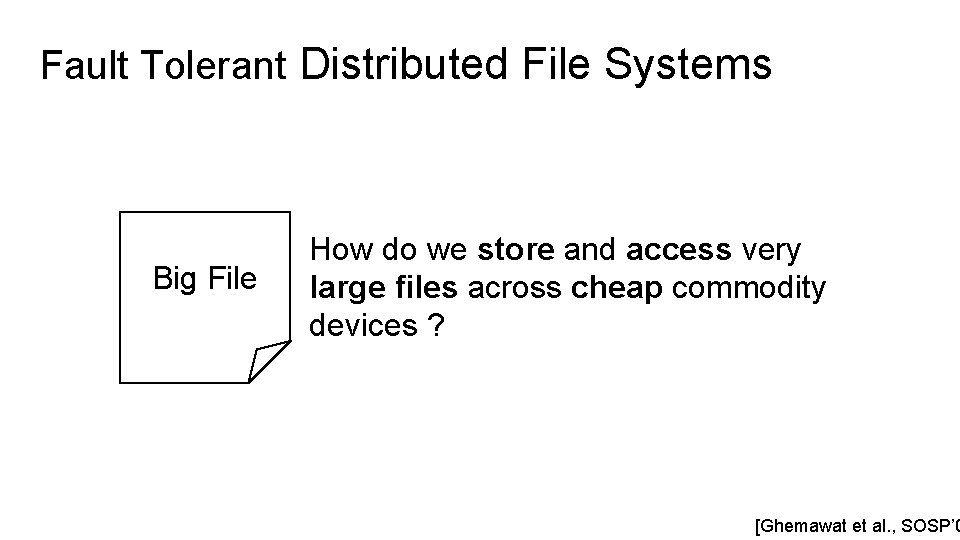
Fault Tolerant Distributed File Systems Big File How do we store and access very large files across cheap commodity devices ? [Ghemawat et al. , SOSP’ 0
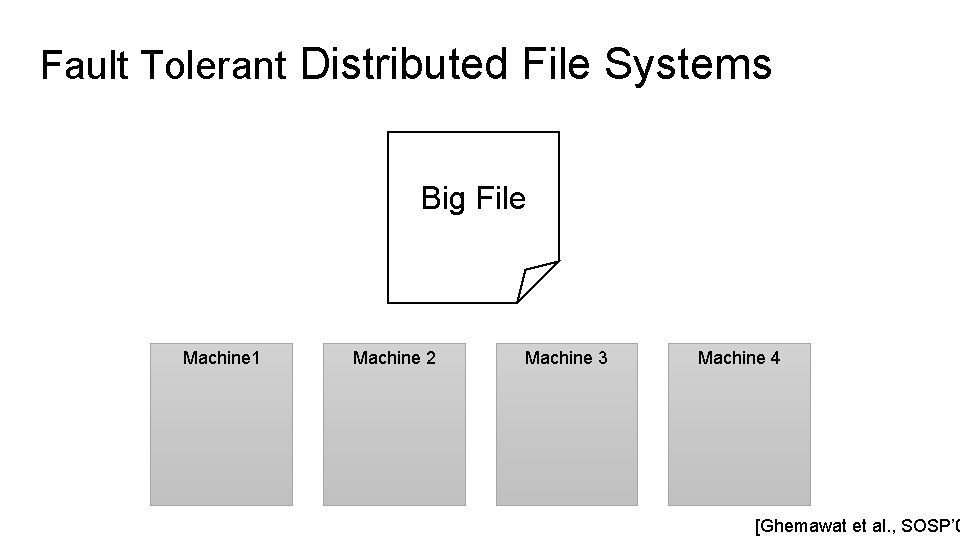
Fault Tolerant Distributed File Systems Big File Machine 1 Machine 2 Machine 3 Machine 4 [Ghemawat et al. , SOSP’ 0
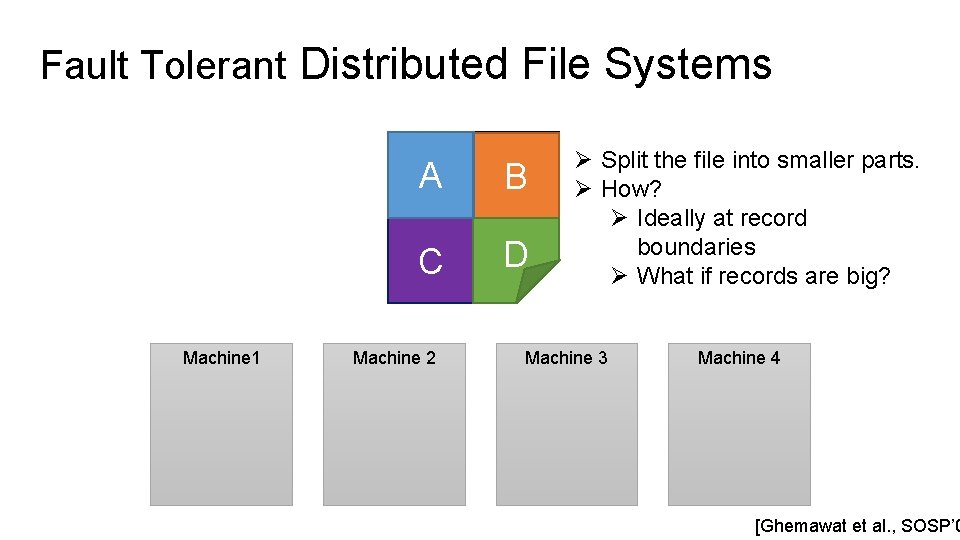
Fault Tolerant Distributed File Systems A B C D Big File Machine 1 Machine 2 Ø Split the file into smaller parts. Ø How? Ø Ideally at record boundaries Ø What if records are big? Machine 3 Machine 4 [Ghemawat et al. , SOSP’ 0
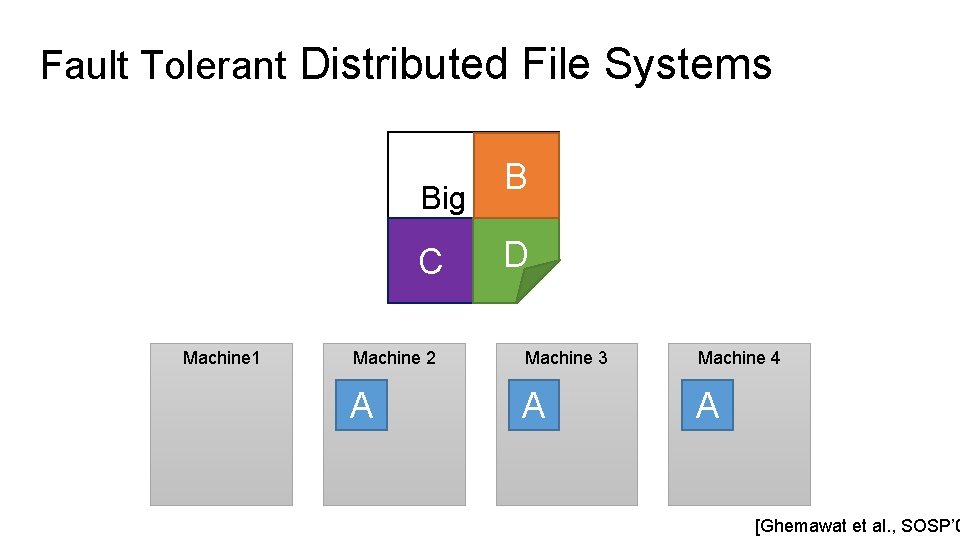
Fault Tolerant Distributed File Systems B Big File C Machine 1 D Machine 2 Machine 3 Machine 4 A A A [Ghemawat et al. , SOSP’ 0
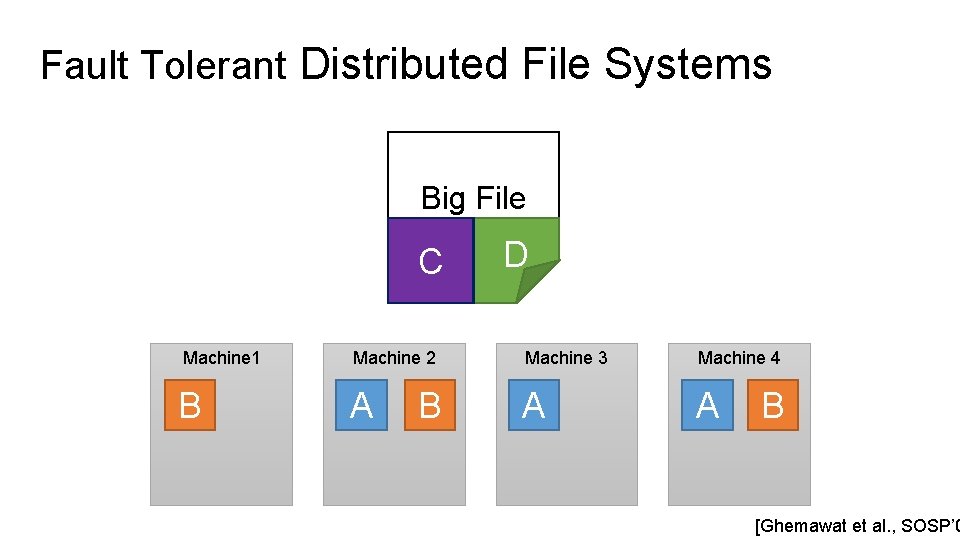
Fault Tolerant Distributed File Systems Big File C D Machine 1 Machine 2 Machine 3 Machine 4 B A A A B B [Ghemawat et al. , SOSP’ 0
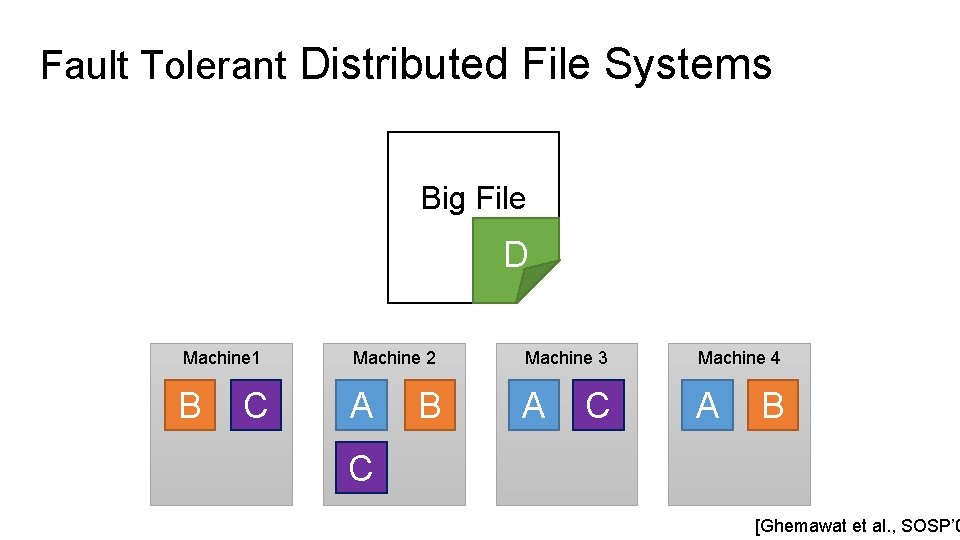
Fault Tolerant Distributed File Systems Big File D Machine 1 Machine 2 Machine 3 Machine 4 B A A A C B C [Ghemawat et al. , SOSP’ 0
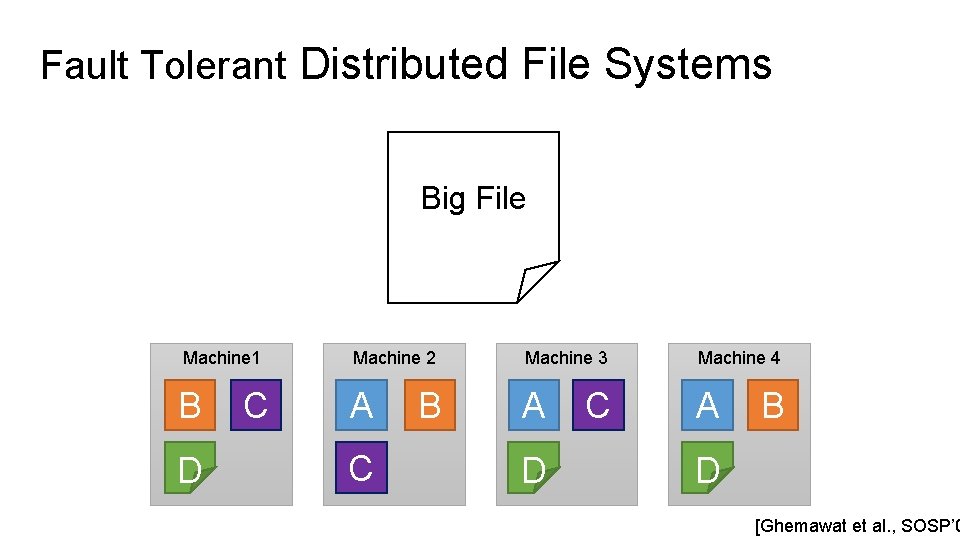
Fault Tolerant Distributed File Systems Big File Machine 1 Machine 2 Machine 3 Machine 4 B A A A D C C B D [Ghemawat et al. , SOSP’ 0
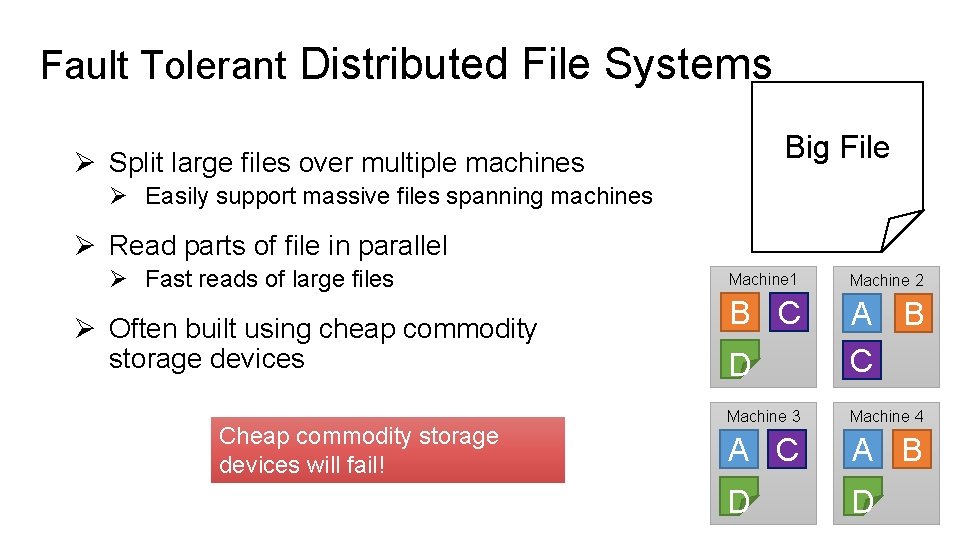
Fault Tolerant Distributed File Systems Big File Ø Split large files over multiple machines Ø Easily support massive files spanning machines Ø Read parts of file in parallel Ø Fast reads of large files Ø Often built using cheap commodity storage devices Cheap commodity storage devices will fail! Machine 1 Machine 2 B C D A B C Machine 3 Machine 4 A C A B D D
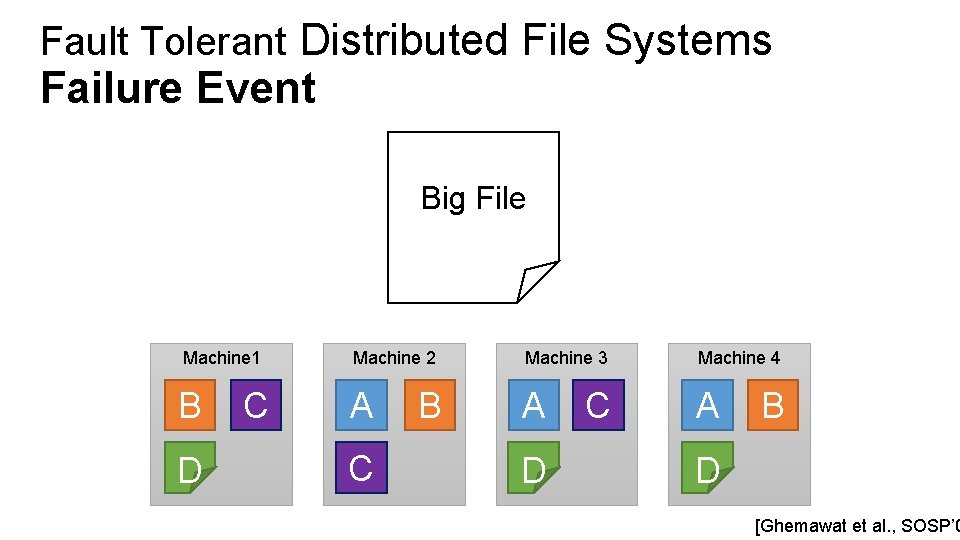
Fault Tolerant Distributed File Systems Failure Event Big File Machine 1 Machine 2 Machine 3 Machine 4 B A A A D C C B D [Ghemawat et al. , SOSP’ 0
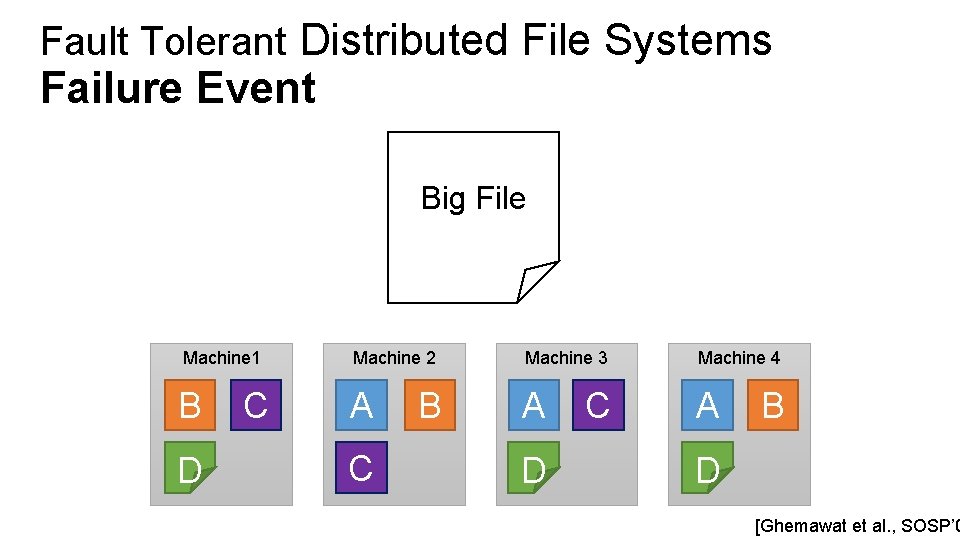
Fault Tolerant Distributed File Systems Failure Event Big File Machine 1 Machine 2 Machine 3 Machine 4 B A A A D C C B D [Ghemawat et al. , SOSP’ 0
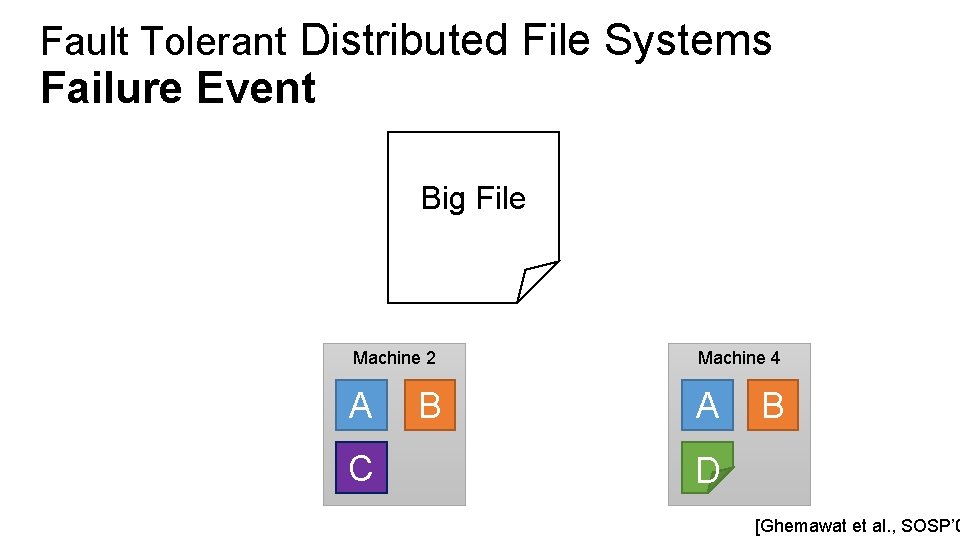
Fault Tolerant Distributed File Systems Failure Event Big File Machine 2 Machine 4 A A C B B D [Ghemawat et al. , SOSP’ 0
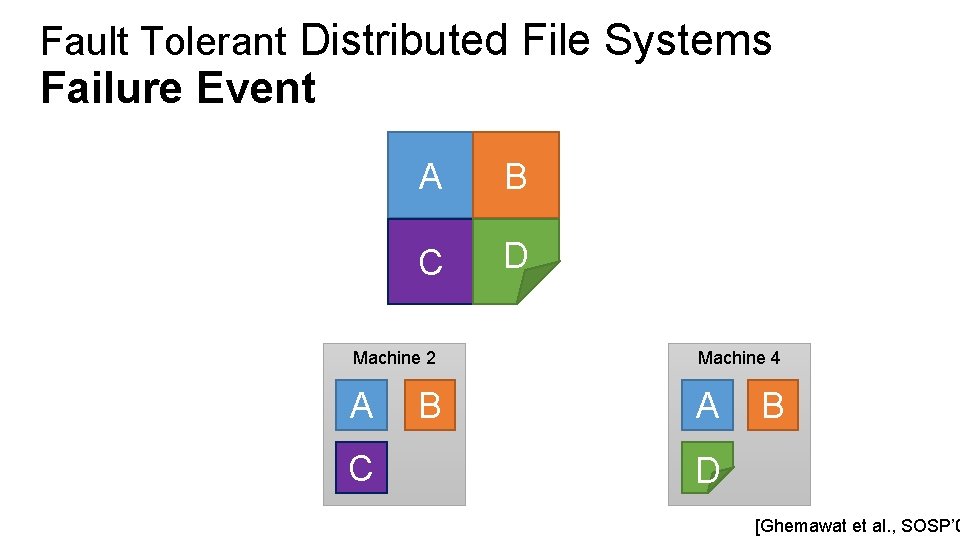
Fault Tolerant Distributed File Systems Failure Event A B C D Big File Machine 2 Machine 4 A A C B B D [Ghemawat et al. , SOSP’ 0
Distributed Computing
In-Memory Dataflow System Developed at the UC Berkeley AMP Lab M. Zaharia, M. Chowdhury, M. J. Franklin, S. Shenker, and I. Stoica. Spark: cluster computing with working sets. Hot. Cloud’ 10 M. Zaharia, M. Chowdhury, T. Das, A. Dave, J. Ma, M. Mc. Cauley, M. J. Franklin, S. Shenker, I. Stoica. Resilient Distributed Datasets: A Fault-Tolerant Abstraction for In-Memory Cluster Computing, NSDI 2012
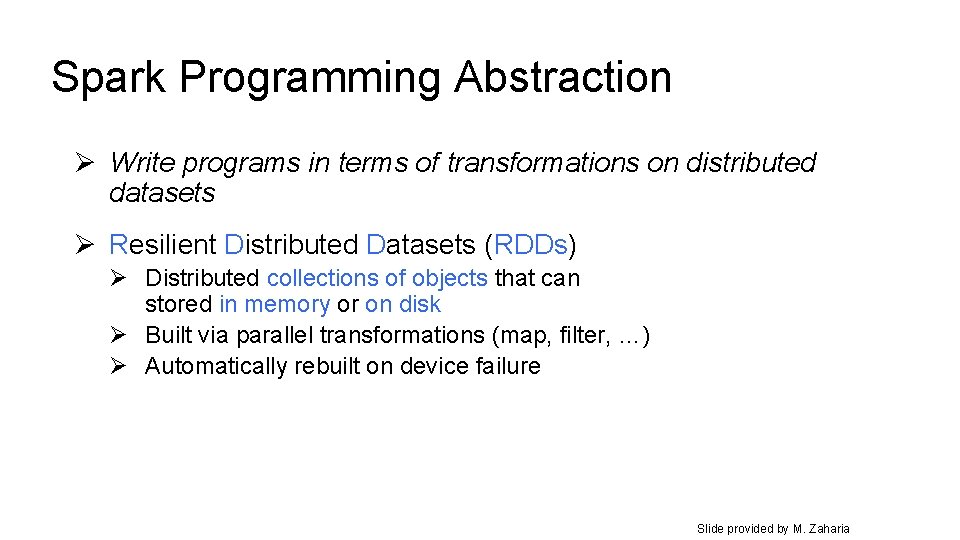
Spark Programming Abstraction Ø Write programs in terms of transformations on distributed datasets Ø Resilient Distributed Datasets (RDDs) Ø Distributed collections of objects that can stored in memory or on disk Ø Built via parallel transformations (map, filter, …) Ø Automatically rebuilt on device failure Slide provided by M. Zaharia
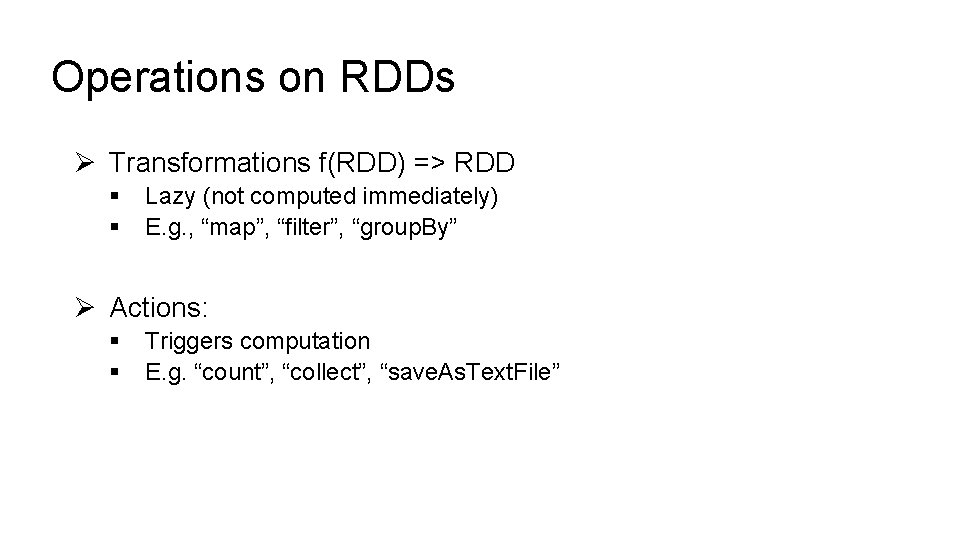
Operations on RDDs Ø Transformations f(RDD) => RDD § § Lazy (not computed immediately) E. g. , “map”, “filter”, “group. By” Ø Actions: § § Triggers computation E. g. “count”, “collect”, “save. As. Text. File”
Example: Log Mining Load error messages from a log into memory, then interactively search for various patterns
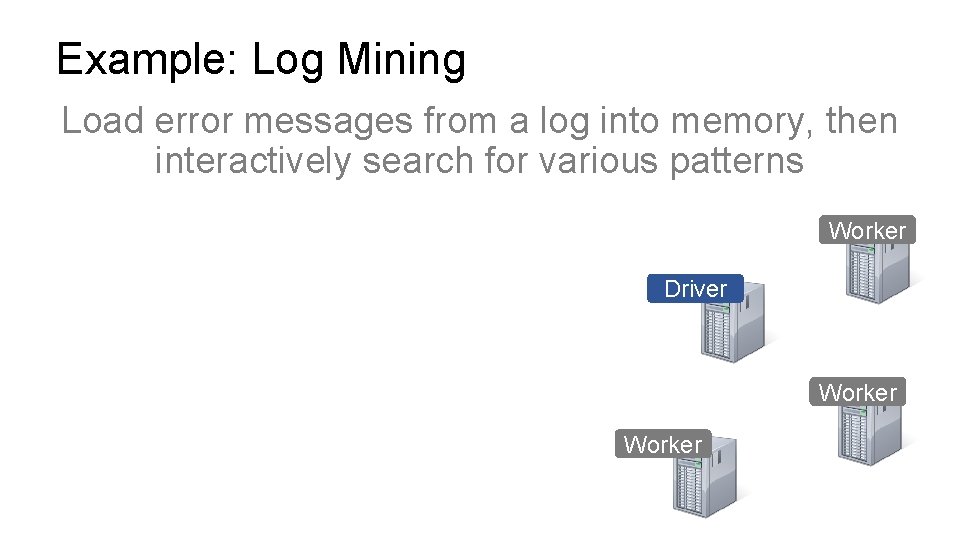
Example: Log Mining Load error messages from a log into memory, then interactively search for various patterns Worker Driver Worker
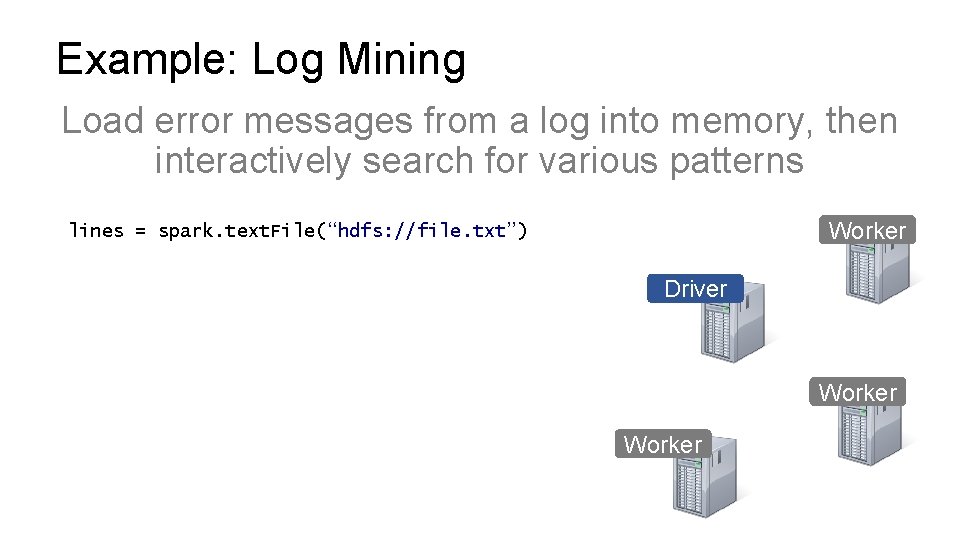
Example: Log Mining Load error messages from a log into memory, then interactively search for various patterns Worker lines = spark. text. File(“hdfs: //file. txt”) Driver Worker
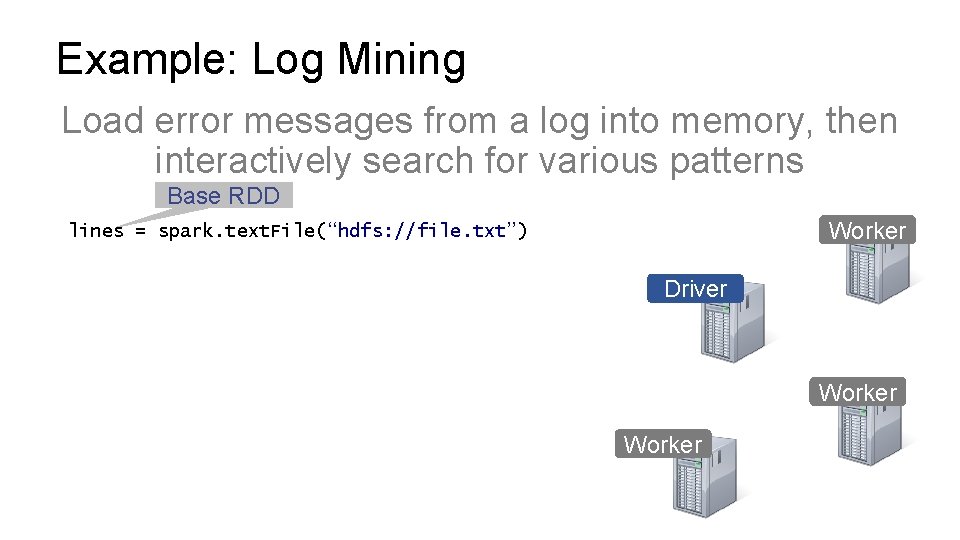
Example: Log Mining Load error messages from a log into memory, then interactively search for various patterns Base RDD Worker lines = spark. text. File(“hdfs: //file. txt”) Driver Worker
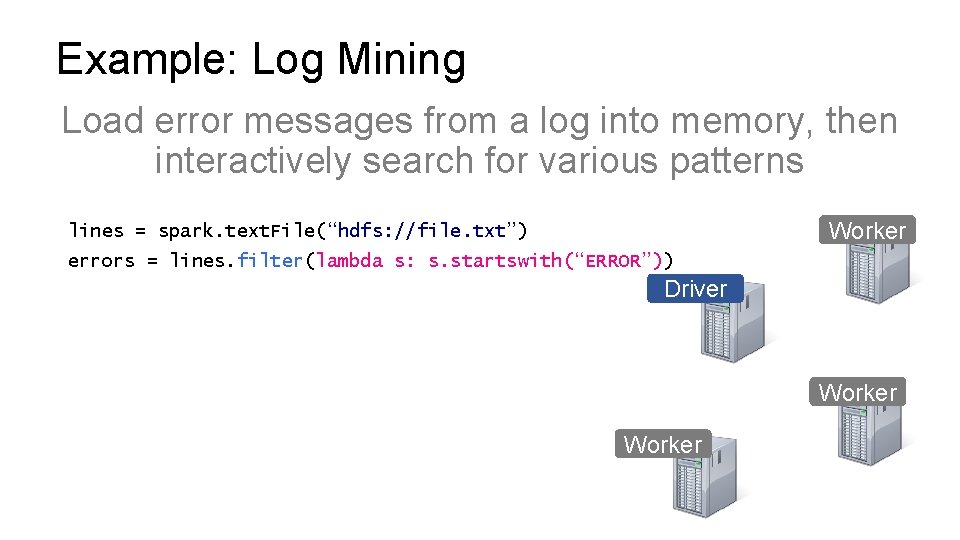
Example: Log Mining Load error messages from a log into memory, then interactively search for various patterns Worker lines = spark. text. File(“hdfs: //file. txt”) errors = lines. filter(lambda s: s. startswith(“ERROR”)) Driver Worker
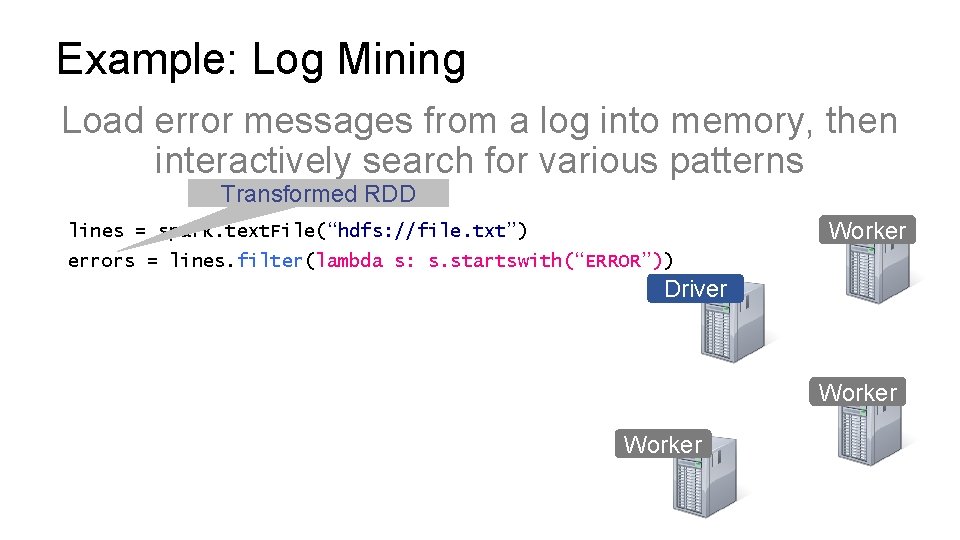
Example: Log Mining Load error messages from a log into memory, then interactively search for various patterns Transformed RDD Worker lines = spark. text. File(“hdfs: //file. txt”) errors = lines. filter(lambda s: s. startswith(“ERROR”)) Driver Worker
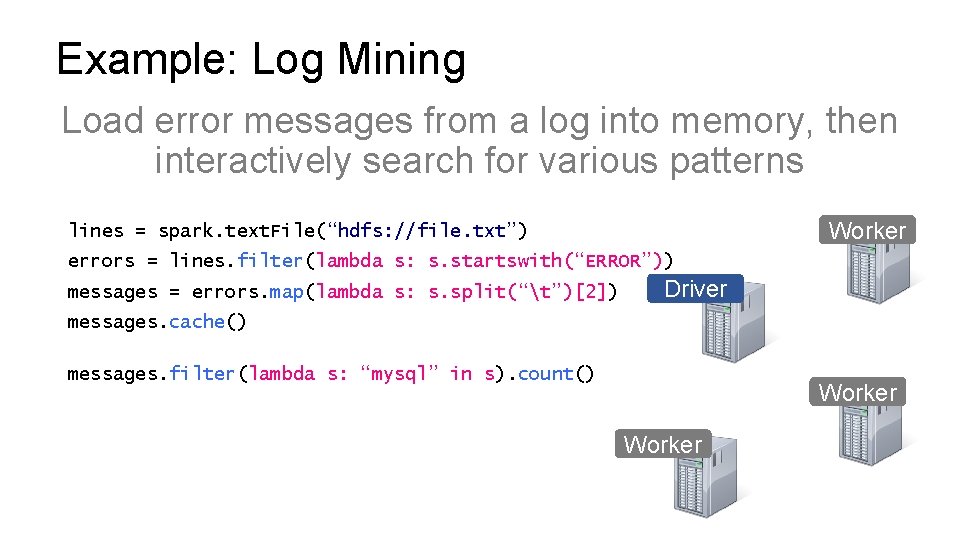
Example: Log Mining Load error messages from a log into memory, then interactively search for various patterns Worker lines = spark. text. File(“hdfs: //file. txt”) errors = lines. filter(lambda s: s. startswith(“ERROR”)) messages = errors. map(lambda s: s. split(“t”)[2]) Driver messages. cache() messages. filter(lambda s: “mysql” in s). count() Worker
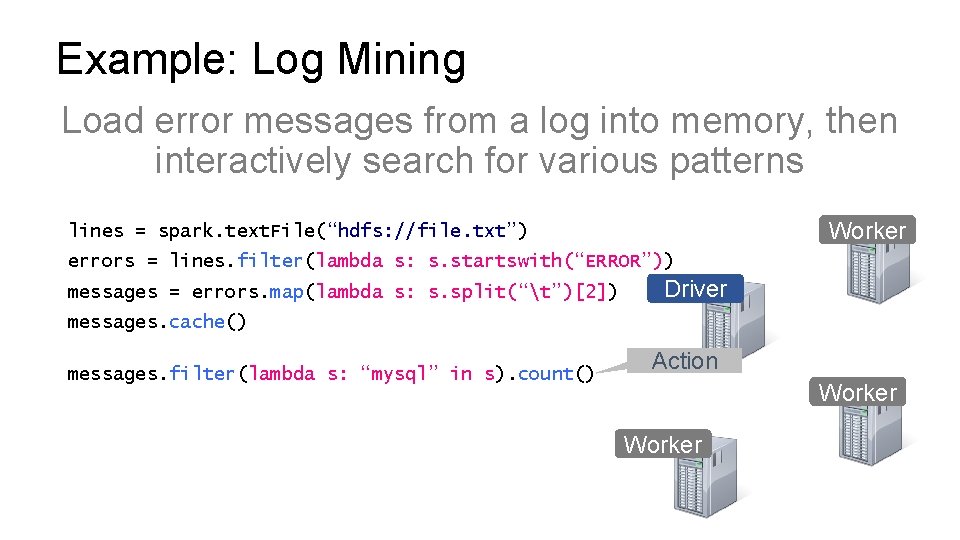
Example: Log Mining Load error messages from a log into memory, then interactively search for various patterns Worker lines = spark. text. File(“hdfs: //file. txt”) errors = lines. filter(lambda s: s. startswith(“ERROR”)) messages = errors. map(lambda s: s. split(“t”)[2]) Driver messages. cache() messages. filter(lambda s: “mysql” in s). count() Action Worker
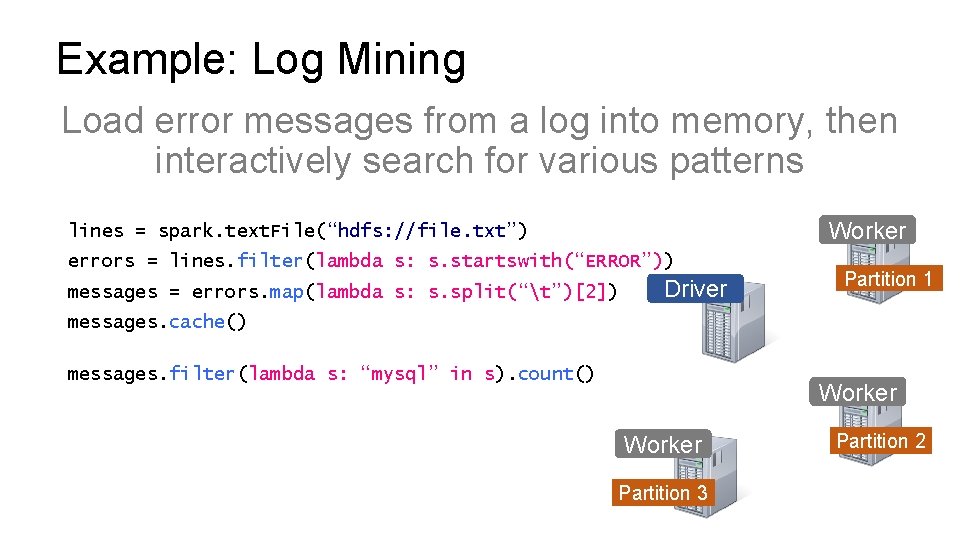
Example: Log Mining Load error messages from a log into memory, then interactively search for various patterns Worker lines = spark. text. File(“hdfs: //file. txt”) errors = lines. filter(lambda s: s. startswith(“ERROR”)) messages = errors. map(lambda s: s. split(“t”)[2]) Driver Partition 1 messages. cache() messages. filter(lambda s: “mysql” in s). count() Worker Partition 3 Partition 2
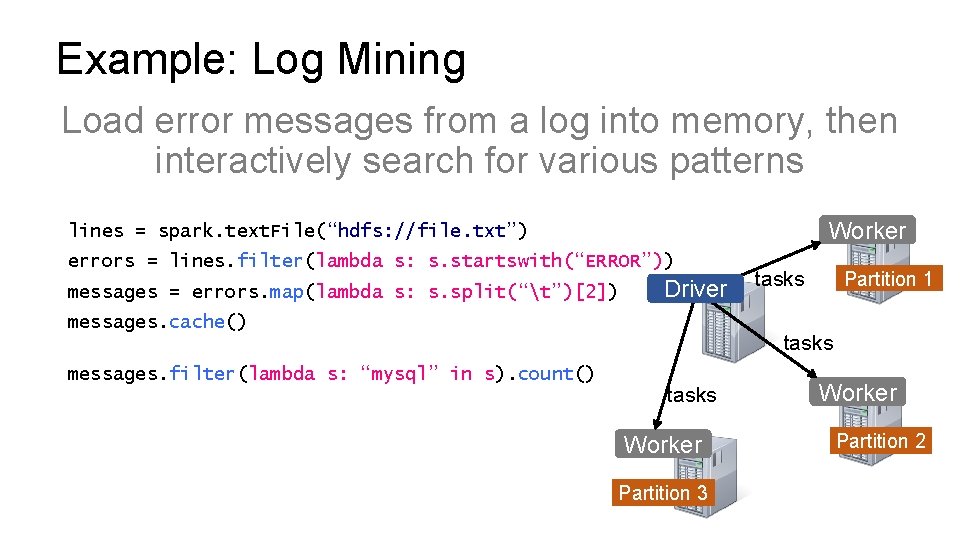
Example: Log Mining Load error messages from a log into memory, then interactively search for various patterns Worker lines = spark. text. File(“hdfs: //file. txt”) errors = lines. filter(lambda s: s. startswith(“ERROR”)) messages = errors. map(lambda s: s. split(“t”)[2]) Driver messages. cache() messages. filter(lambda s: “mysql” in s). count() tasks Partition 1 tasks Worker Partition 3 Worker Partition 2
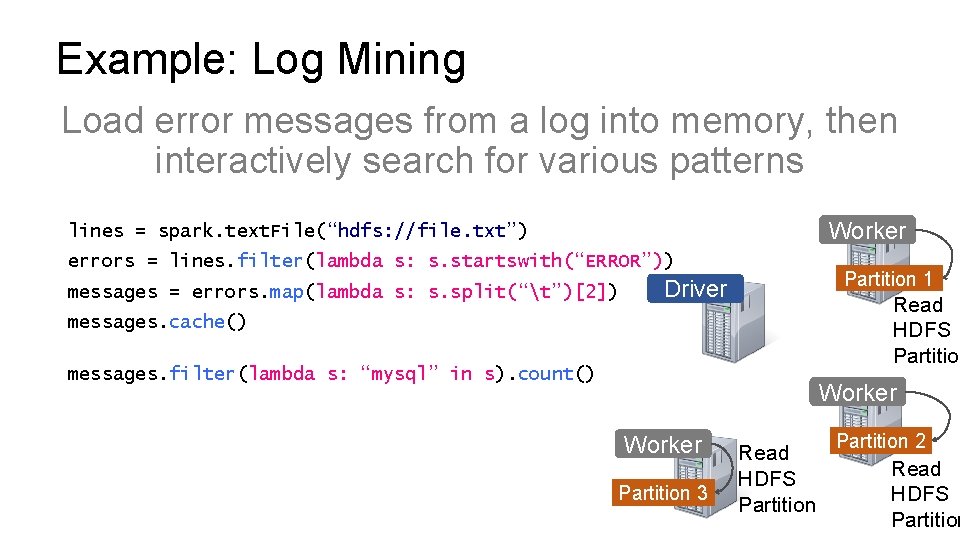
Example: Log Mining Load error messages from a log into memory, then interactively search for various patterns Worker lines = spark. text. File(“hdfs: //file. txt”) errors = lines. filter(lambda s: s. startswith(“ERROR”)) messages = errors. map(lambda s: s. split(“t”)[2]) Partition 1 Driver Read HDFS Partition messages. cache() messages. filter(lambda s: “mysql” in s). count() Worker Partition 3 Read HDFS Partition 2 Read HDFS Partition
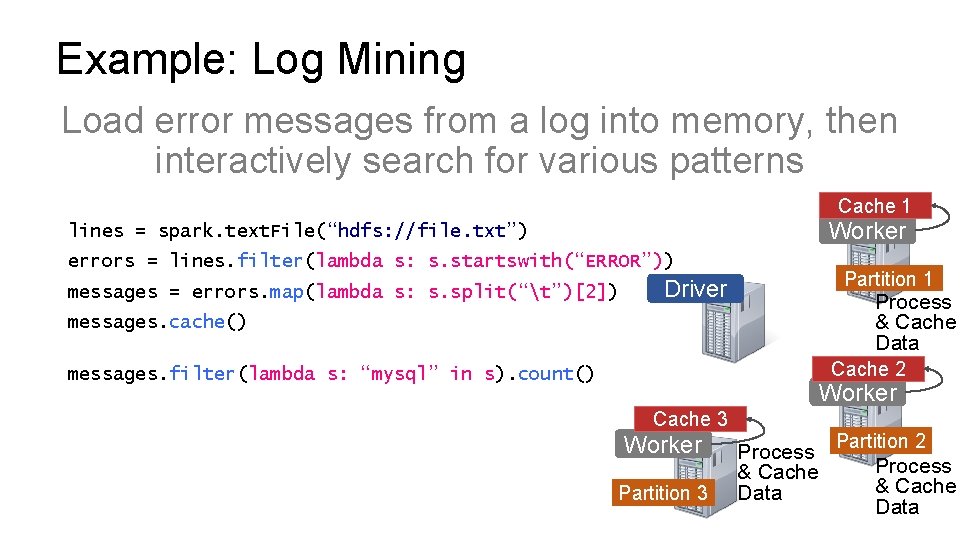
Example: Log Mining Load error messages from a log into memory, then interactively search for various patterns Cache 1 Worker lines = spark. text. File(“hdfs: //file. txt”) errors = lines. filter(lambda s: s. startswith(“ERROR”)) messages = errors. map(lambda s: s. split(“t”)[2]) Partition 1 Driver Process & Cache Data messages. cache() Cache 2 messages. filter(lambda s: “mysql” in s). count() Worker Cache 3 Worker Partition 3 Process & Cache Data Partition 2 Process & Cache Data
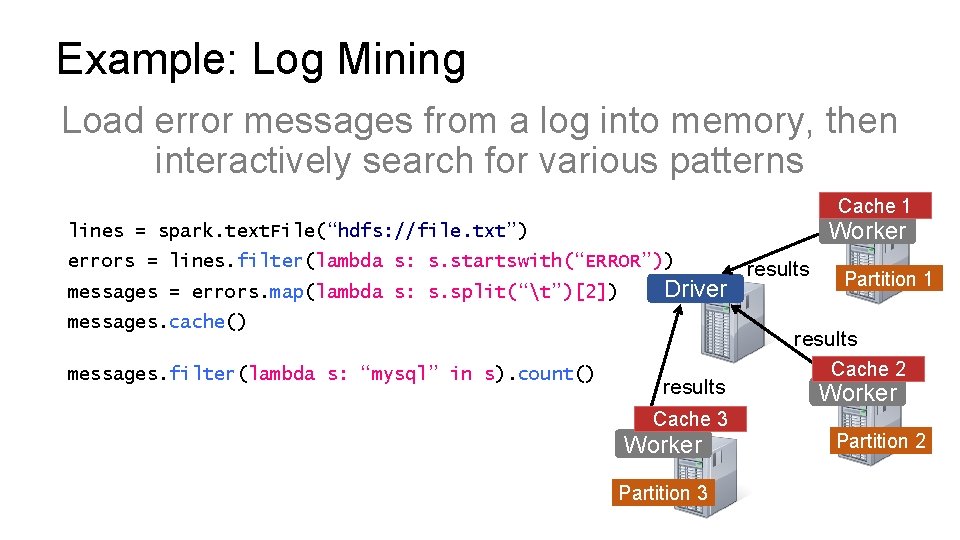
Example: Log Mining Load error messages from a log into memory, then interactively search for various patterns Cache 1 Worker lines = spark. text. File(“hdfs: //file. txt”) errors = lines. filter(lambda s: s. startswith(“ERROR”)) messages = errors. map(lambda s: s. split(“t”)[2]) Driver messages. cache() messages. filter(lambda s: “mysql” in s). count() results Partition 1 results Cache 3 Worker Partition 3 Cache 2 Worker Partition 2
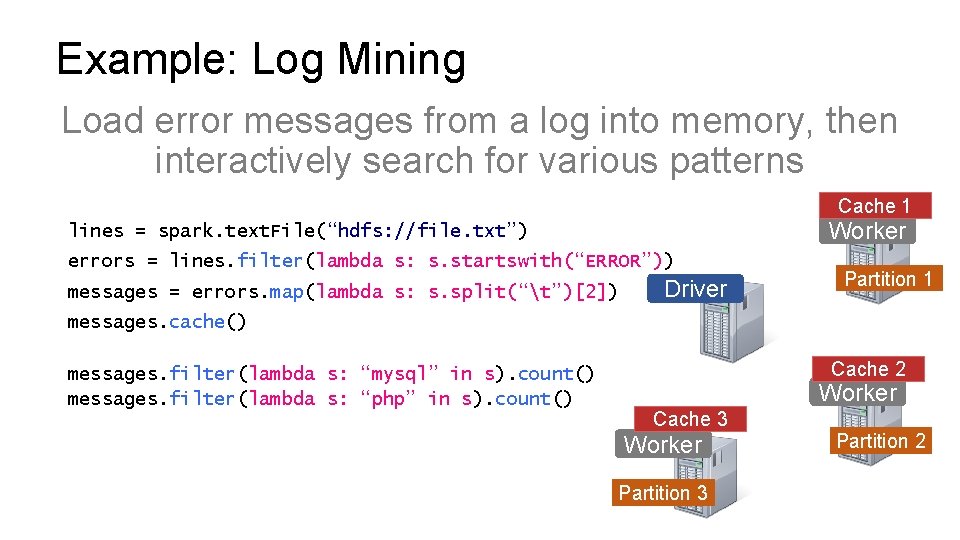
Example: Log Mining Load error messages from a log into memory, then interactively search for various patterns Cache 1 Worker lines = spark. text. File(“hdfs: //file. txt”) errors = lines. filter(lambda s: s. startswith(“ERROR”)) messages = errors. map(lambda s: s. split(“t”)[2]) Driver Partition 1 messages. cache() messages. filter(lambda s: “mysql” in s). count() messages. filter(lambda s: “php” in s). count() Cache 2 Worker Cache 3 Worker Partition 3 Partition 2
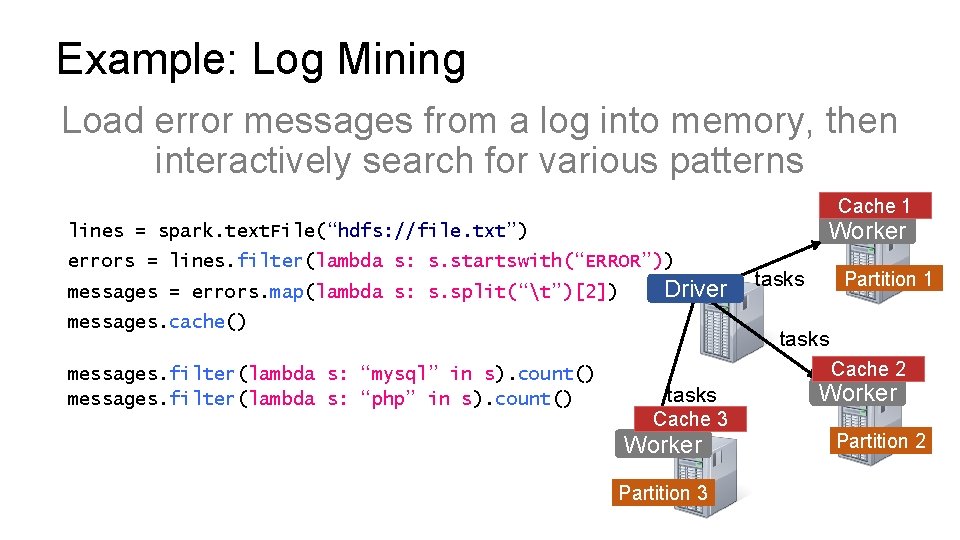
Example: Log Mining Load error messages from a log into memory, then interactively search for various patterns Cache 1 Worker lines = spark. text. File(“hdfs: //file. txt”) errors = lines. filter(lambda s: s. startswith(“ERROR”)) messages = errors. map(lambda s: s. split(“t”)[2]) Driver messages. cache() messages. filter(lambda s: “mysql” in s). count() messages. filter(lambda s: “php” in s). count() tasks Partition 1 tasks Cache 2 tasks Cache 3 Worker Partition 2
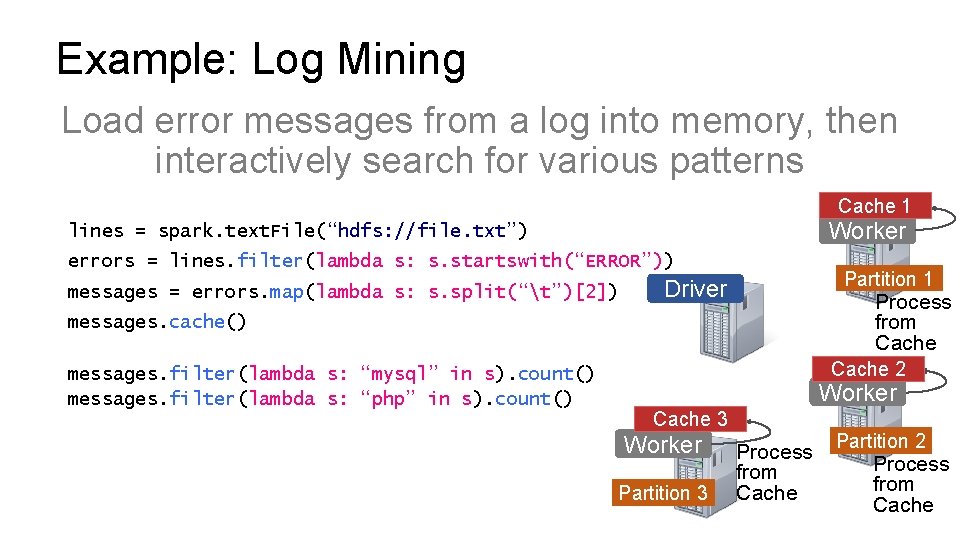
Example: Log Mining Load error messages from a log into memory, then interactively search for various patterns Cache 1 Worker lines = spark. text. File(“hdfs: //file. txt”) errors = lines. filter(lambda s: s. startswith(“ERROR”)) messages = errors. map(lambda s: s. split(“t”)[2]) Partition 1 Driver Process from Cache messages. cache() messages. filter(lambda s: “mysql” in s). count() messages. filter(lambda s: “php” in s). count() Cache 2 Worker Cache 3 Worker Partition 3 Process from Cache Partition 2 Process from Cache
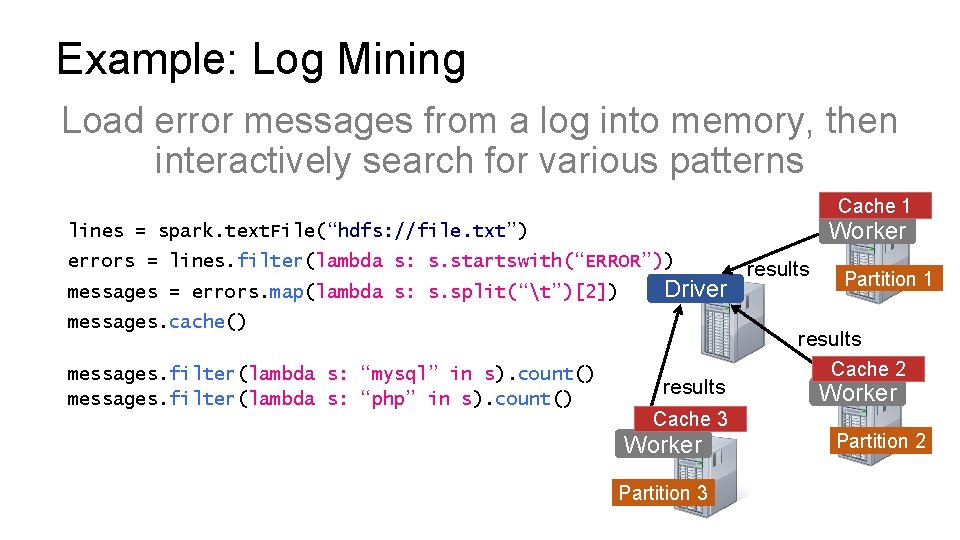
Example: Log Mining Load error messages from a log into memory, then interactively search for various patterns Cache 1 Worker lines = spark. text. File(“hdfs: //file. txt”) errors = lines. filter(lambda s: s. startswith(“ERROR”)) messages = errors. map(lambda s: s. split(“t”)[2]) Driver messages. cache() messages. filter(lambda s: “mysql” in s). count() messages. filter(lambda s: “php” in s). count() results Partition 1 results Cache 3 Worker Partition 3 Cache 2 Worker Partition 2
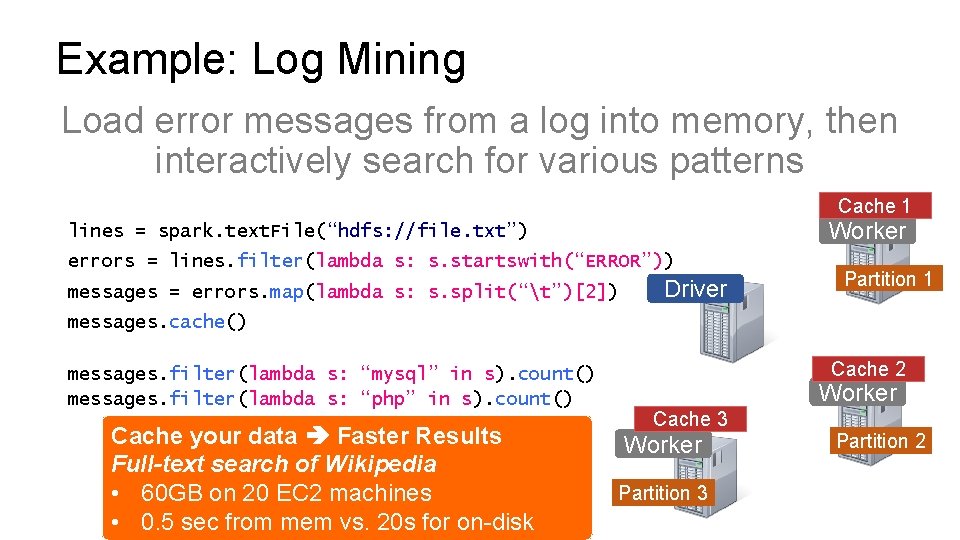
Example: Log Mining Load error messages from a log into memory, then interactively search for various patterns Cache 1 Worker lines = spark. text. File(“hdfs: //file. txt”) errors = lines. filter(lambda s: s. startswith(“ERROR”)) messages = errors. map(lambda s: s. split(“t”)[2]) Driver Partition 1 messages. cache() messages. filter(lambda s: “mysql” in s). count() messages. filter(lambda s: “php” in s). count() Cache your data Faster Results Full-text search of Wikipedia • 60 GB on 20 EC 2 machines • 0. 5 sec from mem vs. 20 s for on-disk Cache 2 Worker Cache 3 Worker Partition 3 Partition 2

Spark Demo
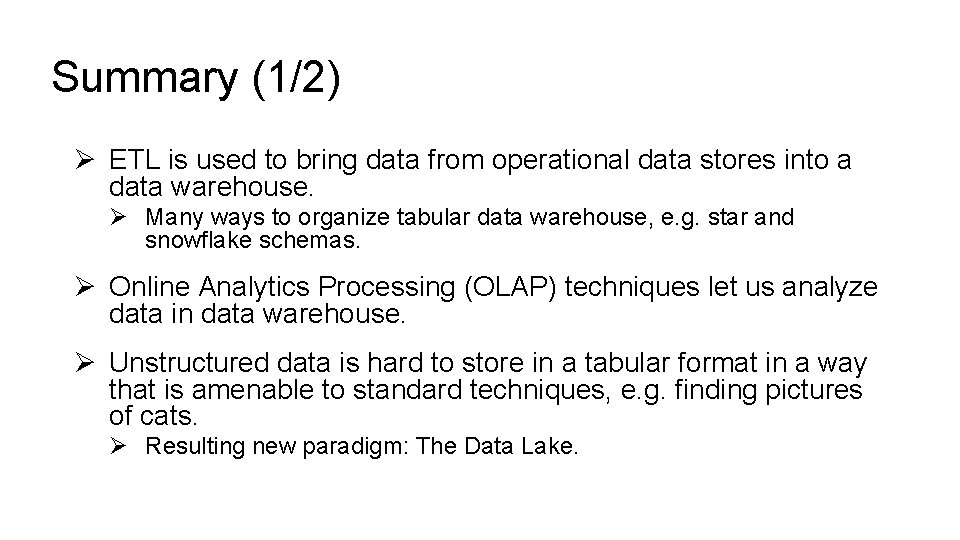
Summary (1/2) Ø ETL is used to bring data from operational data stores into a data warehouse. Ø Many ways to organize tabular data warehouse, e. g. star and snowflake schemas. Ø Online Analytics Processing (OLAP) techniques let us analyze data in data warehouse. Ø Unstructured data is hard to store in a tabular format in a way that is amenable to standard techniques, e. g. finding pictures of cats. Ø Resulting new paradigm: The Data Lake.
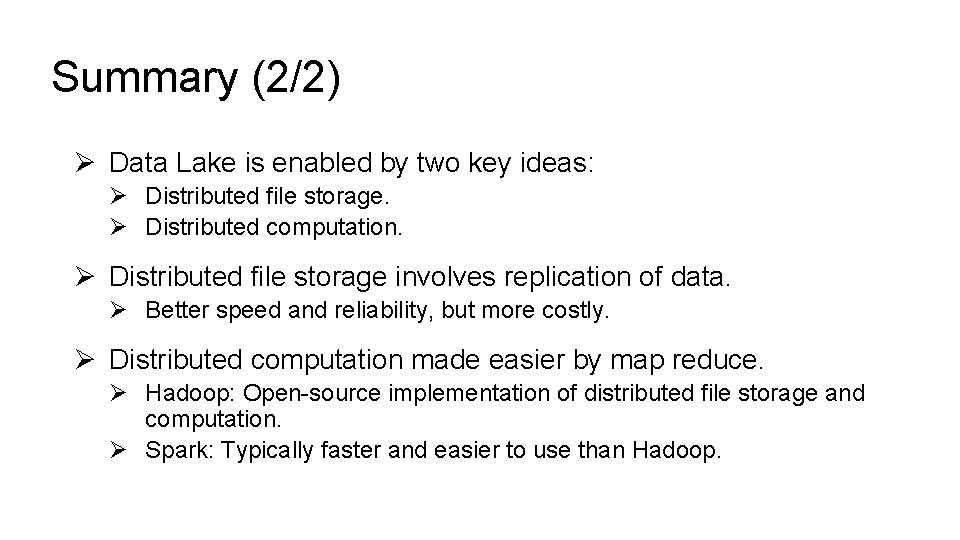
Summary (2/2) Ø Data Lake is enabled by two key ideas: Ø Distributed file storage. Ø Distributed computation. Ø Distributed file storage involves replication of data. Ø Better speed and reliability, but more costly. Ø Distributed computation made easier by map reduce. Ø Hadoop: Open-source implementation of distributed file storage and computation. Ø Spark: Typically faster and easier to use than Hadoop.
- Slides: 62