
Big Business and Andrew Carnegie Robber Baron or

Big Business and Andrew Carnegie Robber Baron or Captain of Industry?
New Ways of Doing Business • Business expansion was led by bold entrepreneurs, or someone who sets up new businesses to make a profit. • Many businesses became corporations, or businesses owned by many shareholders. • Corporations raise large amounts of money by selling stock, or shares. Stockholders receive a share of the profits and pick directors to run the company.
Growth of Big Business • The US government took a laissez-faire approach to business in the late 1800 s. • Congress rarely tried to regulate businesses. • This led to the growth of what came to be known as “big business. ” • Some businesses formed monopolies. A business with a monopoly controls most or all of the business in a particular industry.
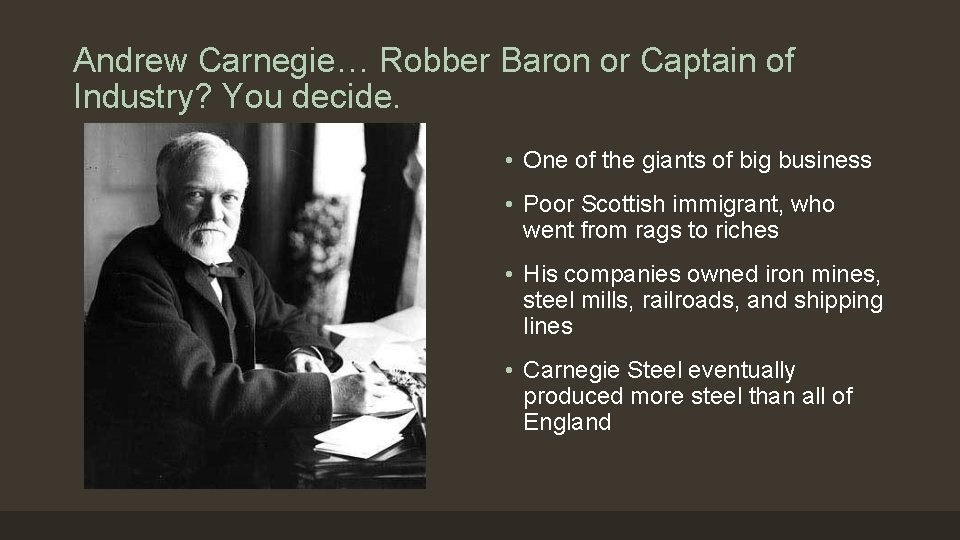
Andrew Carnegie… Robber Baron or Captain of Industry? You decide. • One of the giants of big business • Poor Scottish immigrant, who went from rags to riches • His companies owned iron mines, steel mills, railroads, and shipping lines • Carnegie Steel eventually produced more steel than all of England
Debate Over Big Business • Critics saw trusts and monopolies as a threat to free enterprise, the system in which private businesses compete freely. • Trust: A group of corporations run by a single board of directors • Some saw Carnegie and others as a “robber barons” who unfairly eliminated competition, and used wealth to influence politicians. • Others saw big business leaders as “captains of industry” who built up the economy and created jobs. They argued that limiting competition allowed companies to lower prices for their products.
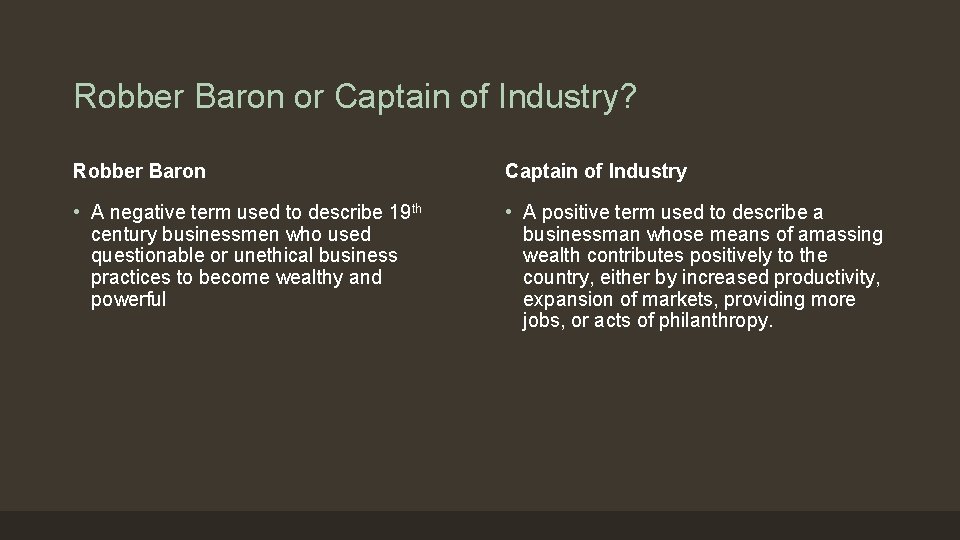
Robber Baron or Captain of Industry? Robber Baron Captain of Industry • A negative term used to describe 19 th century businessmen who used questionable or unethical business practices to become wealthy and powerful • A positive term used to describe a businessman whose means of amassing wealth contributes positively to the country, either by increased productivity, expansion of markets, providing more jobs, or acts of philanthropy.
- Slides: 6