
Big Bang Theory Presented by Kesler Science Essential
Big Bang Theory Presented by Kesler Science
Essential Question: What scientific evidence is used in constructing an explanation of the Big Bang Theory?
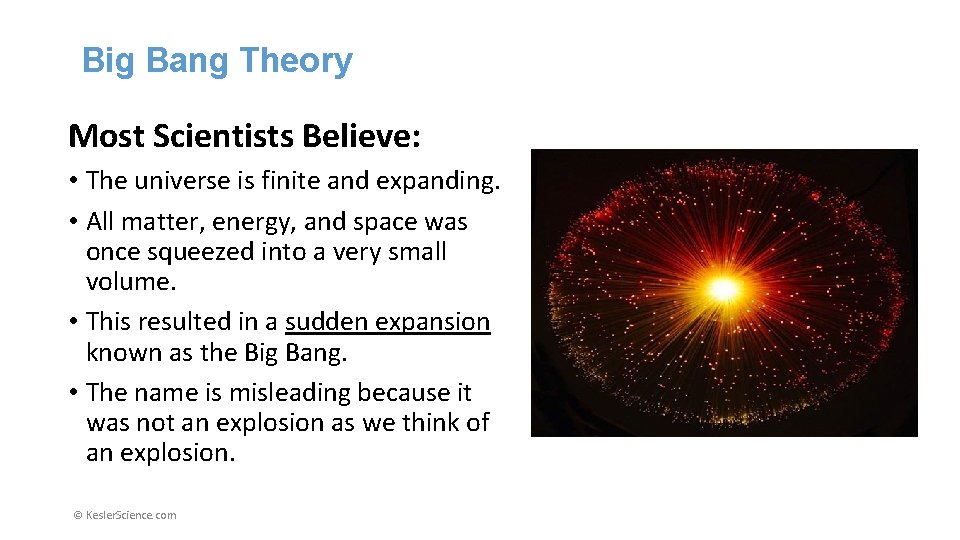
Big Bang Theory Most Scientists Believe: • The universe is finite and expanding. • All matter, energy, and space was once squeezed into a very small volume. • This resulted in a sudden expansion known as the Big Bang. • The name is misleading because it was not an explosion as we think of an explosion. © Kesler. Science. com
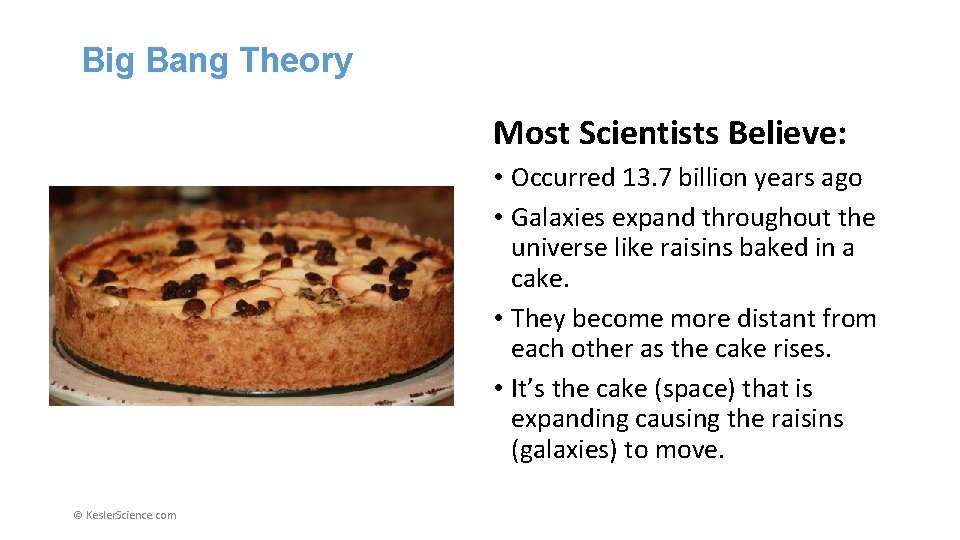
Big Bang Theory Most Scientists Believe: • Occurred 13. 7 billion years ago • Galaxies expand throughout the universe like raisins baked in a cake. • They become more distant from each other as the cake rises. • It’s the cake (space) that is expanding causing the raisins (galaxies) to move. © Kesler. Science. com
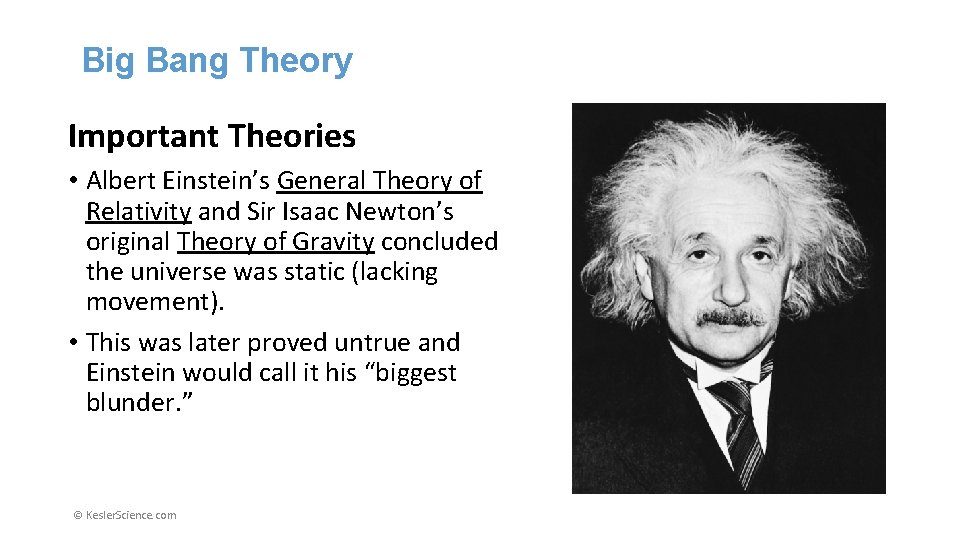
Big Bang Theory Important Theories • Albert Einstein’s General Theory of Relativity and Sir Isaac Newton’s original Theory of Gravity concluded the universe was static (lacking movement). • This was later proved untrue and Einstein would call it his “biggest blunder. ” © Kesler. Science. com
Quick Action – Big Bang Theory Say Something Discuss with a partner what scientists believe about the Big Bang Theory. Are there other misconceptions about theory that you have thought to be true? You will learn three key pieces of evidence supporting this theory. © Kesler. Science. com
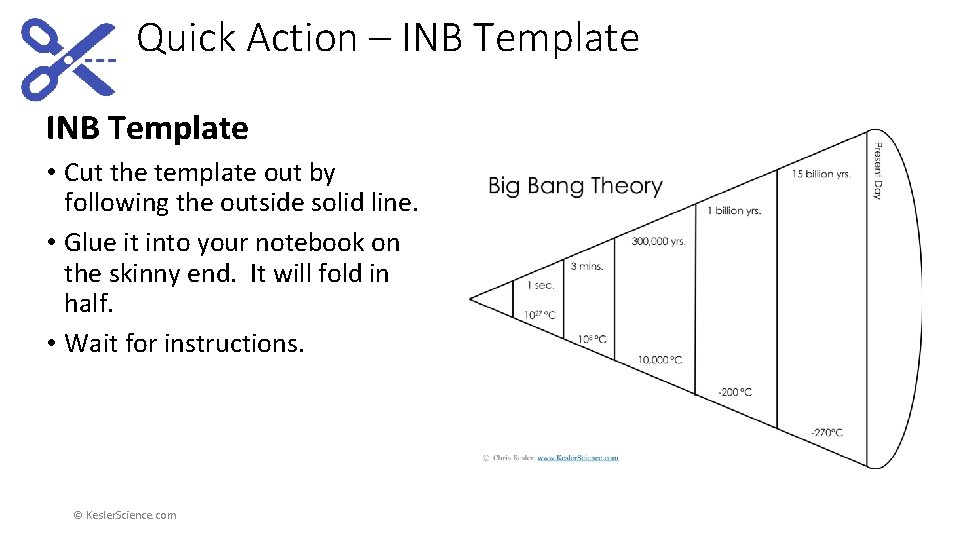
Quick Action – INB Template • Cut the template out by following the outside solid line. • Glue it into your notebook on the skinny end. It will fold in half. • Wait for instructions. © Kesler. Science. com
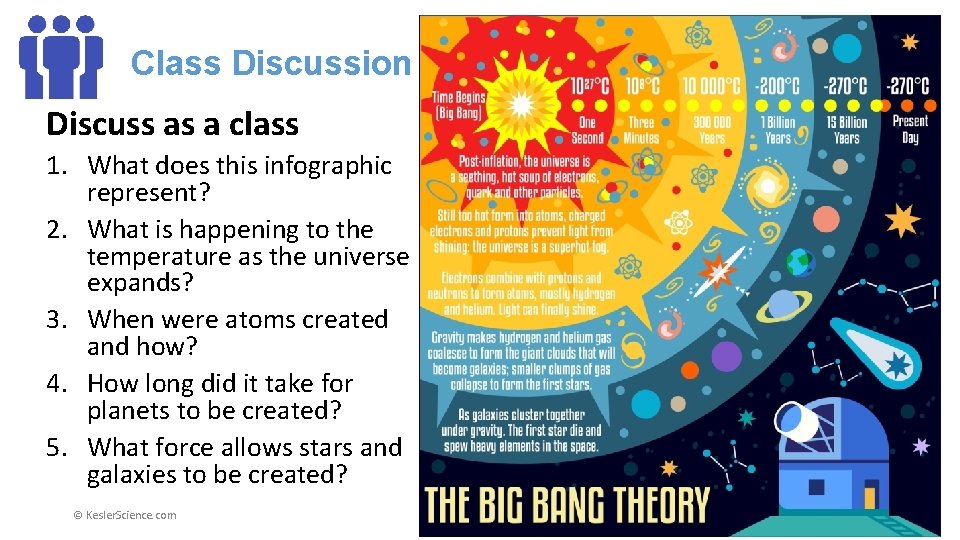
Class Discussion Discuss as a class 1. What does this infographic represent? 2. What is happening to the temperature as the universe expands? 3. When were atoms created and how? 4. How long did it take for planets to be created? 5. What force allows stars and galaxies to be created? © Kesler. Science. com

Quick Action – INB Template • Cut the template out by following your teacher’s example. • Glue it into your notebook. • Wait for instructions. © Kesler. Science. com
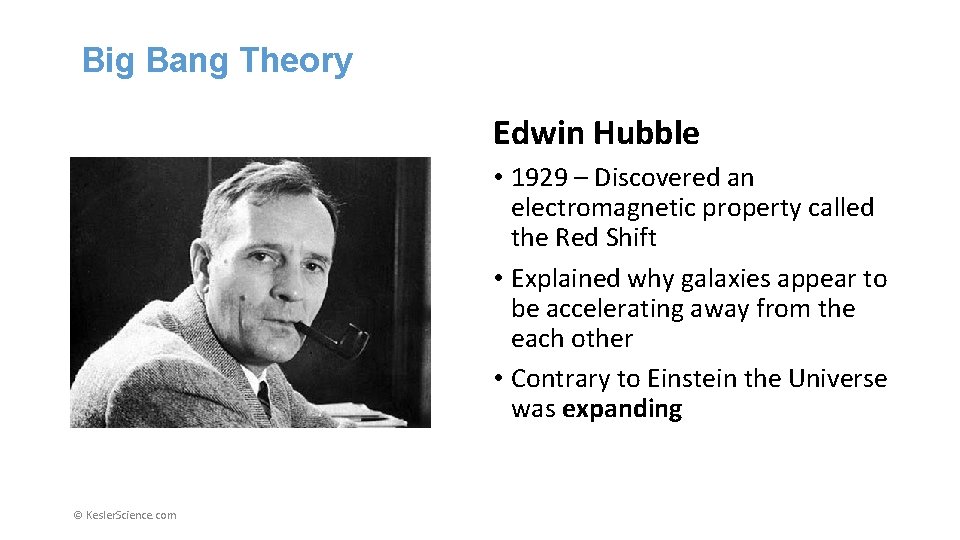
Big Bang Theory Edwin Hubble • 1929 – Discovered an electromagnetic property called the Red Shift • Explained why galaxies appear to be accelerating away from the each other • Contrary to Einstein the Universe was expanding © Kesler. Science. com
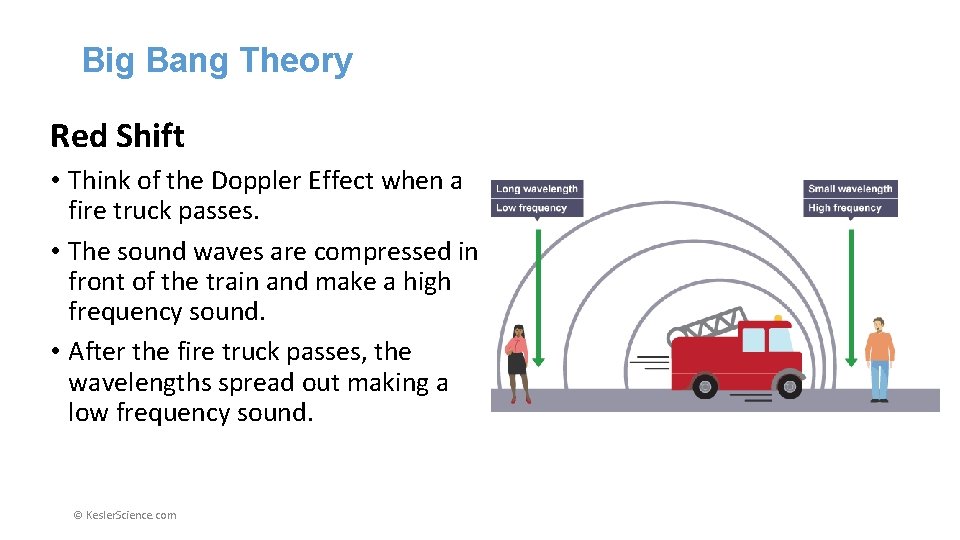
Big Bang Theory Red Shift • Think of the Doppler Effect when a fire truck passes. • The sound waves are compressed in front of the train and make a high frequency sound. • After the fire truck passes, the wavelengths spread out making a low frequency sound. © Kesler. Science. com

Big Bang Theory Red Shift (cont. ) Electromagnetic Spectrum © Kesler. Science. com • Light emitted from a star or galaxy can be separated into a band of colors, called a spectrum. • Each color has a different wavelength just like sound has wavelengths. • Notice the longer wavelengths are toward the red end of the spectrum.
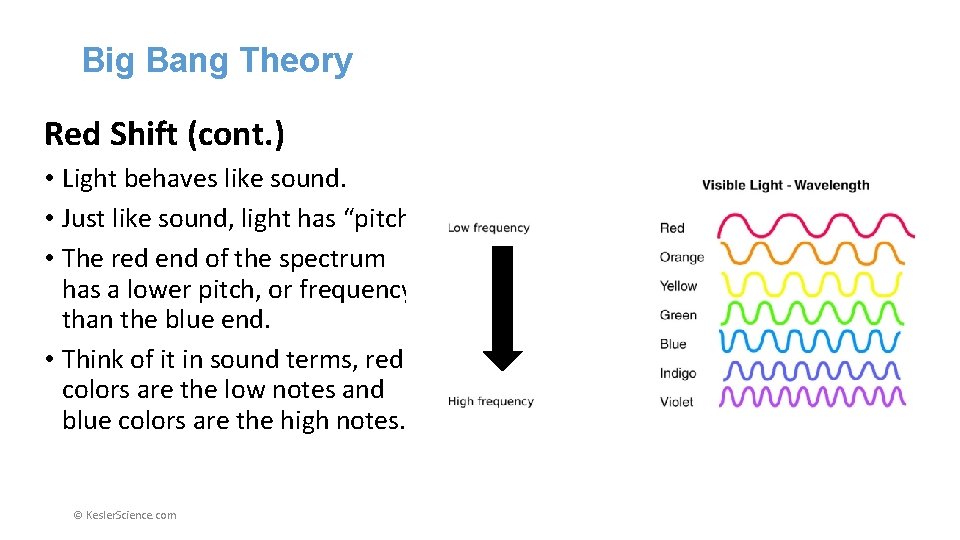
Big Bang Theory Red Shift (cont. ) • Light behaves like sound. • Just like sound, light has “pitch”. • The red end of the spectrum has a lower pitch, or frequency, than the blue end. • Think of it in sound terms, red colors are the low notes and blue colors are the high notes. © Kesler. Science. com
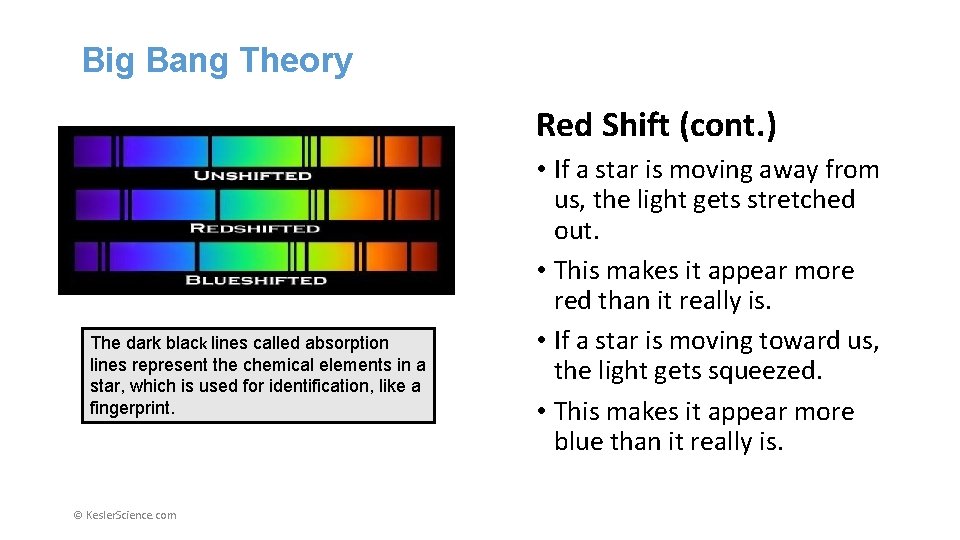
Big Bang Theory Red Shift (cont. ) The dark black lines called absorption lines represent the chemical elements in a star, which is used for identification, like a fingerprint. © Kesler. Science. com • If a star is moving away from us, the light gets stretched out. • This makes it appear more red than it really is. • If a star is moving toward us, the light gets squeezed. • This makes it appear more blue than it really is.
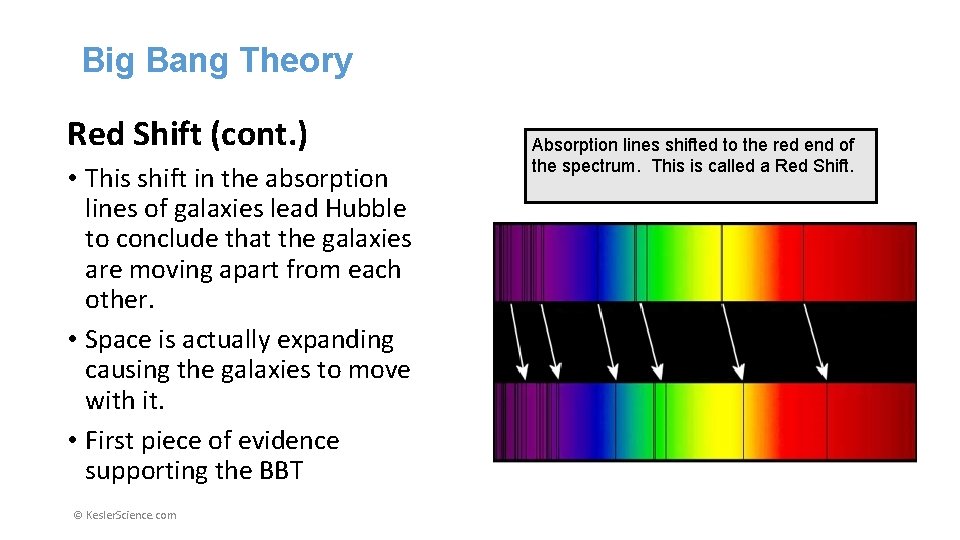
Big Bang Theory Red Shift (cont. ) • This shift in the absorption lines of galaxies lead Hubble to conclude that the galaxies are moving apart from each other. • Space is actually expanding causing the galaxies to move with it. • First piece of evidence supporting the BBT © Kesler. Science. com Absorption lines shifted to the red end of the spectrum. This is called a Red Shift.
Quick Action – Big Bang Theory Experiment 1. Take a fairly think rubber band cut it in half 2. Lay the rubber band out and draw a wave across it. The rubber band represents space. 3. Mark four dots to represent four different galaxies. 4. Notice the distance between the dots with the rubber band the wavelength at rest. 5. Now stretch the rubber band observe what happens to the distances between the galaxies and the wave length. 6. As space expands the galaxies are along for the ride. 7. How does this relate to the Red Shift? © Kesler. Science. com
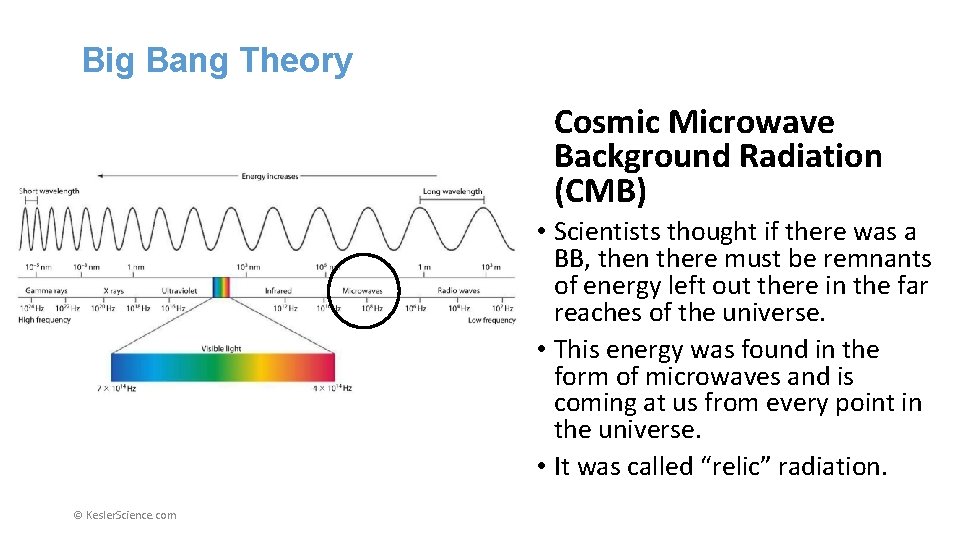
Big Bang Theory Cosmic Microwave Background Radiation (CMB) • Scientists thought if there was a BB, then there must be remnants of energy left out there in the far reaches of the universe. • This energy was found in the form of microwaves and is coming at us from every point in the universe. • It was called “relic” radiation. © Kesler. Science. com
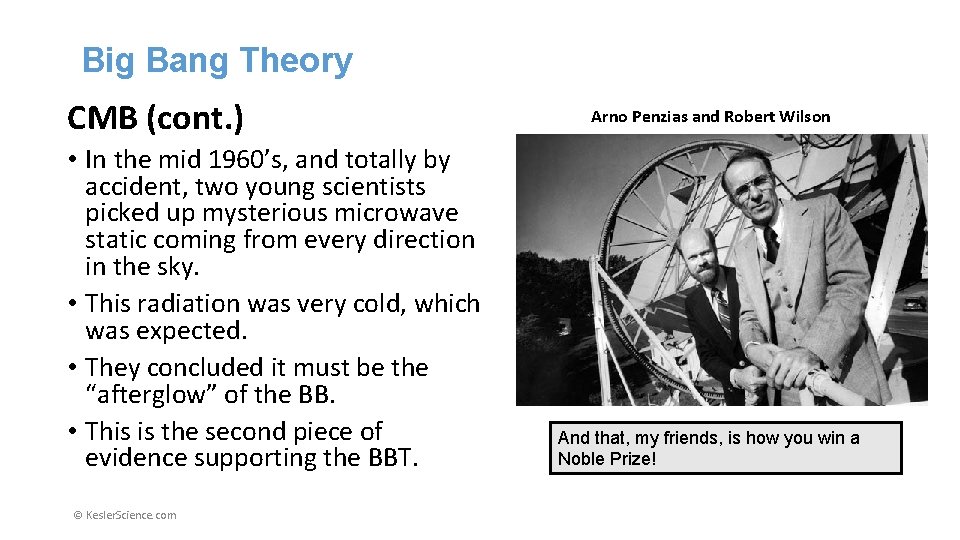
Big Bang Theory CMB (cont. ) • In the mid 1960’s, and totally by accident, two young scientists picked up mysterious microwave static coming from every direction in the sky. • This radiation was very cold, which was expected. • They concluded it must be the “afterglow” of the BB. • This is the second piece of evidence supporting the BBT. © Kesler. Science. com Arno Penzias and Robert Wilson And that, my friends, is how you win a Noble Prize!
Quick Action – INB Template Move You’re becoming an Einstein! 1. Get up and find a partner. 2. For 30 seconds talk to your partner about how Cosmic Microwave Background Radiation supports the Big Bang Theory. 3. Then let the other person talk for 30 seconds about this subject. 4. Saying things aloud really makes it “stick” to your brain. © Kesler. Science. com
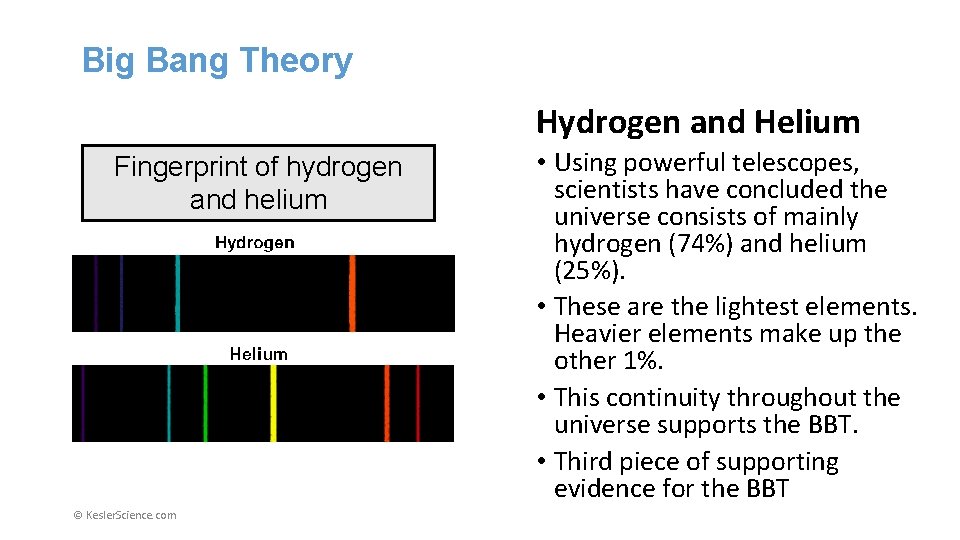
Big Bang Theory Hydrogen and Helium Fingerprint of hydrogen and helium © Kesler. Science. com • Using powerful telescopes, scientists have concluded the universe consists of mainly hydrogen (74%) and helium (25%). • These are the lightest elements. Heavier elements make up the other 1%. • This continuity throughout the universe supports the BBT. • Third piece of supporting evidence for the BBT
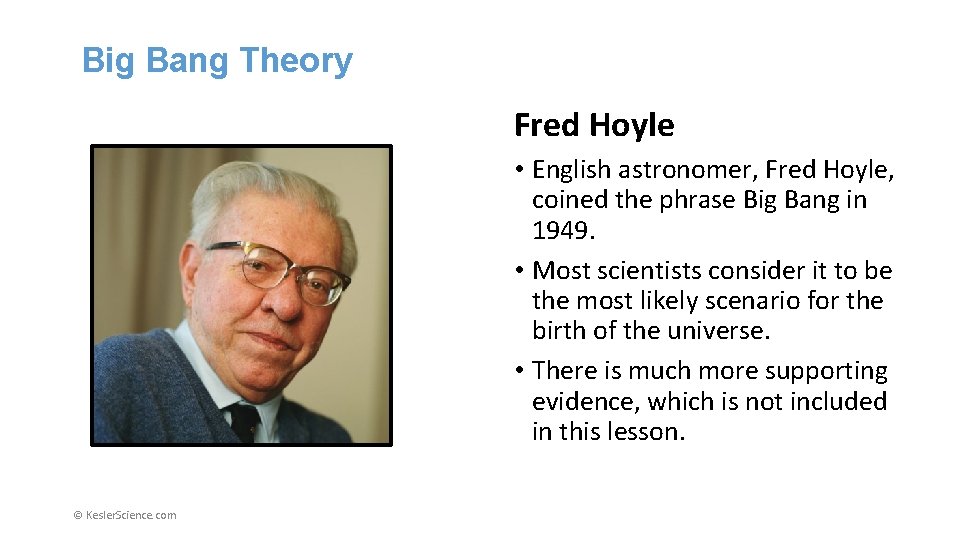
Big Bang Theory Fred Hoyle • English astronomer, Fred Hoyle, coined the phrase Big Bang in 1949. • Most scientists consider it to be the most likely scenario for the birth of the universe. • There is much more supporting evidence, which is not included in this lesson. © Kesler. Science. com
Check for Understanding Can you… Explain three pieces of scientific evidence used in constructing the Big Bang Theory? © Kesler. Science. com
- Slides: 22