
Bidirectional Forwarding Detection BFD for EVPN Ethernet Segment

Bidirectional Forwarding Detection (BFD) for EVPN Ethernet Segment Failover Use Case draft-zwm-bess-es-failover-01 BESS WG IETF 106# Singapore Sandy Zhang Yubao Wang Greg Mirsky
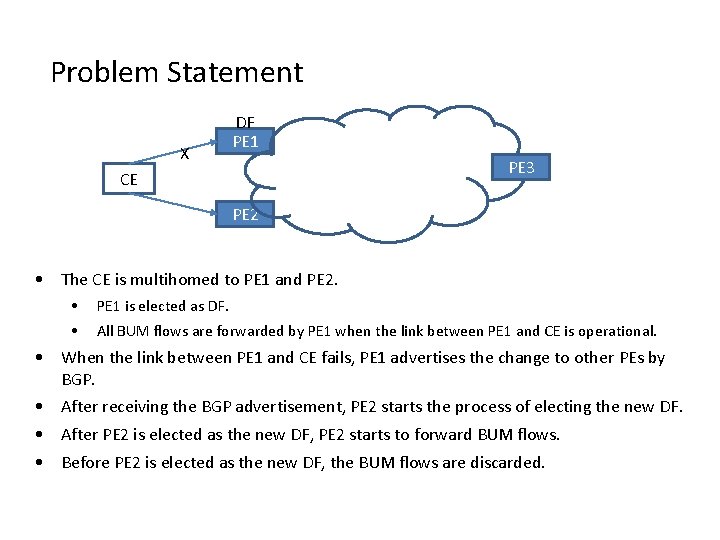
Problem Statement X DF PE 1 PE 3 CE PE 2 • The CE is multihomed to PE 1 and PE 2. • PE 1 is elected as DF. • All BUM flows are forwarded by PE 1 when the link between PE 1 and CE is operational. • When the link between PE 1 and CE fails, PE 1 advertises the change to other PEs by BGP. • After receiving the BGP advertisement, PE 2 starts the process of electing the new DF. • After PE 2 is elected as the new DF, PE 2 starts to forward BUM flows. • Before PE 2 is elected as the new DF, the BUM flows are discarded.
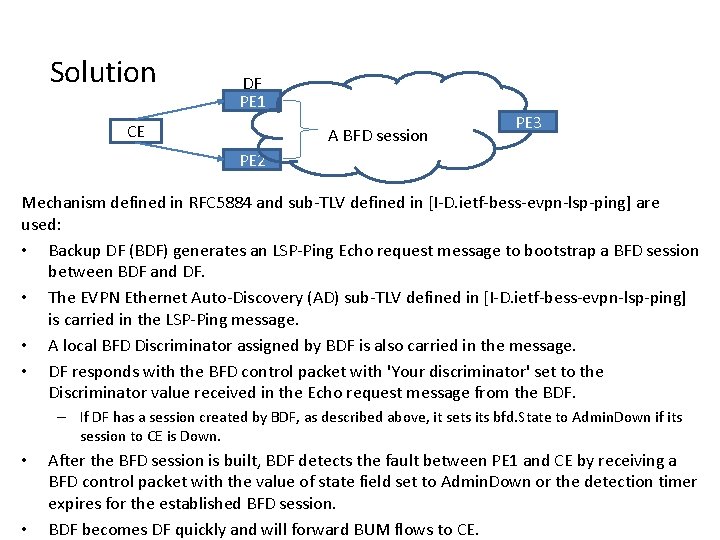
Solution DF PE 1 CE A BFD session PE 3 PE 2 Mechanism defined in RFC 5884 and sub-TLV defined in [I-D. ietf-bess-evpn-lsp-ping] are used: • Backup DF (BDF) generates an LSP-Ping Echo request message to bootstrap a BFD session between BDF and DF. • The EVPN Ethernet Auto-Discovery (AD) sub-TLV defined in [I-D. ietf-bess-evpn-lsp-ping] is carried in the LSP-Ping message. • A local BFD Discriminator assigned by BDF is also carried in the message. • DF responds with the BFD control packet with 'Your discriminator' set to the Discriminator value received in the Echo request message from the BDF. – If DF has a session created by BDF, as described above, it sets its bfd. State to Admin. Down if its session to CE is Down. • • After the BFD session is built, BDF detects the fault between PE 1 and CE by receiving a BFD control packet with the value of state field set to Admin. Down or the detection timer expires for the established BFD session. BDF becomes DF quickly and will forward BUM flows to CE.
Solution Duplicated DF • The default bfd. multiplier value is 3. • If the BFD multiplier is set too small (e. g. 1), one BFD packet lost may lead to the BDF switchover, then two DFs may exist and forward duplicate flows. BDF changes • When a new router which can become new BDF joins the network. The 'old' BDF must send BFD packet with the State set to Admin. Down to DF. Then DF will remove the BFD session. • DF will build a new BFD session with new BDF after it receives BFD request from 'new' BDF.

• Any comment Thanks!
- Slides: 5