
Bicycle Powered Water Pump Purple B Margaret Gentile
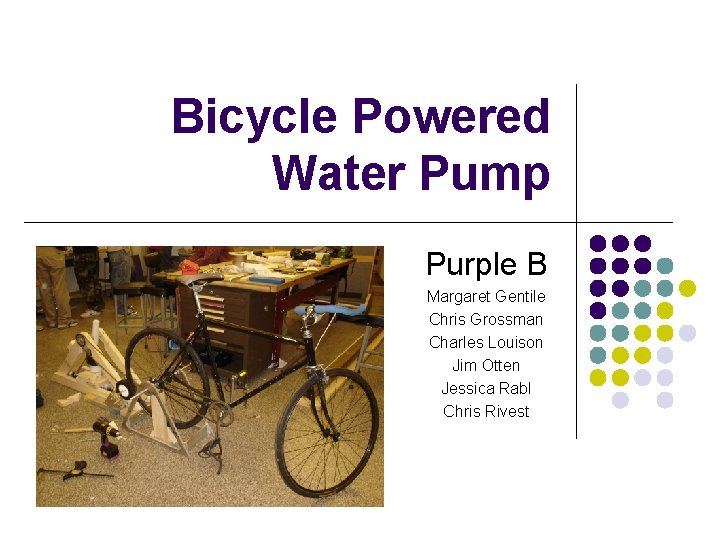
Bicycle Powered Water Pump Purple B Margaret Gentile Chris Grossman Charles Louison Jim Otten Jessica Rabl Chris Rivest
Overview l l Irrigation critically lacking in third world countries. Current pumps do not meet economic and ergonomic requirements of farmers. Bicycles are prevalent and relatively ergonomic mode of transportation. Bicycle powered pump answers irrigation need.
Potential Markets l India l l l China l l l People: 58% of population in agricultural labor force Equipment: ~100 M bicycles Demand: need for irrigation water predicted to rise dramatically Potential Concern: not socially acceptable for women to ride bicycles People: 50% of population in agricultural labor force Equipment: ~750 M bicycles Demand: only 40% of cultivated land is irrigated, yet produces 67% of crops (www. worldbank. org) Many government sponsored irrigation projects fail due to poor efficiencies and lack of system maintenance Summary- $1 billion market for $50 pump (2. 5% market penetration)
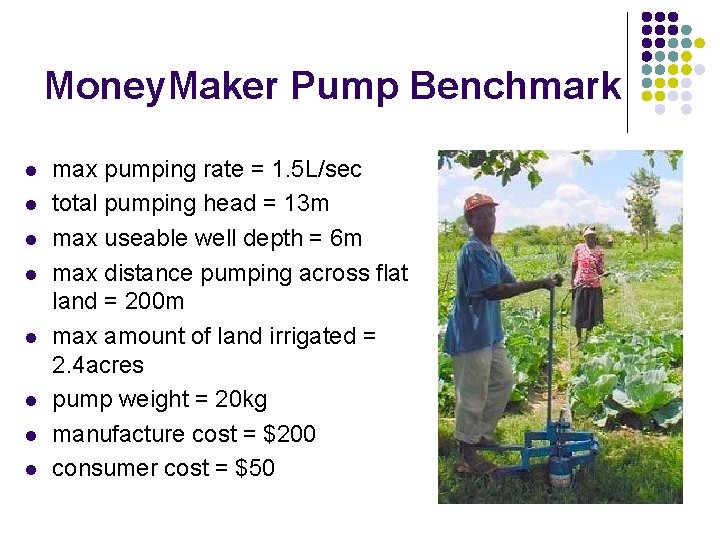
Money. Maker Pump Benchmark l l l l max pumping rate = 1. 5 L/sec total pumping head = 13 m max useable well depth = 6 m max distance pumping across flat land = 200 m max amount of land irrigated = 2. 4 acres pump weight = 20 kg manufacture cost = $200 consumer cost = $50
Critical Issues Benchmarking l Cost l l l Ergonomics l l l Goal: To be most cost effective human powered pump in third world market Bellows design makes piston a disposable commodity item Goal – To provide a more comfortable pumping system than Money. Maker pump Proven that cycling lower impact than running Efficiency l Goal – To design a pump of equal or better efficiency than Money. Maker pump
Issues Addressed by Mockup l Feasibility of low cost goal l l Pump Design l l l pump built for less than $25 Critical bellows component costs on order of pennies Still need to reduce cost of other components (valve etc. ) Various designs considered, bellows chosen on cost basis Bellows pump found to work best when two are run in parallel Efficiency l l Design for taking power off rear wheel – still needs testing Pump – still need to address valve and sealant issues
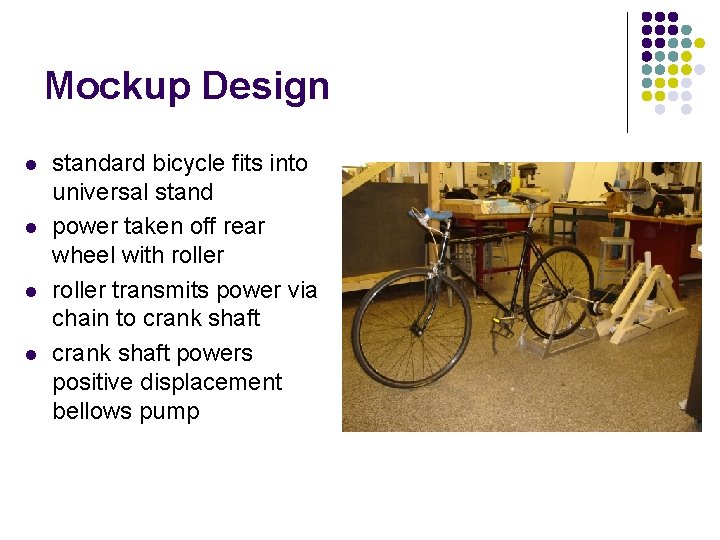
Mockup Design l l standard bicycle fits into universal stand power taken off rear wheel with roller transmits power via chain to crank shaft powers positive displacement bellows pump
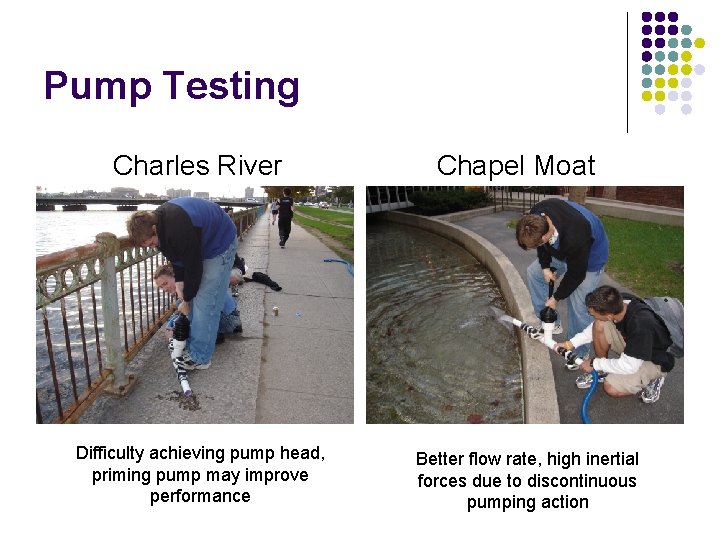
Pump Testing Charles River Difficulty achieving pump head, priming pump may improve performance Chapel Moat Better flow rate, high inertial forces due to discontinuous pumping action
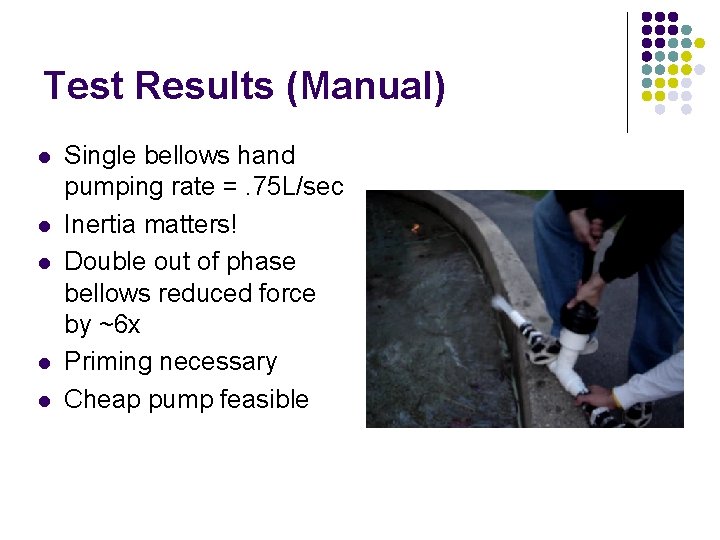
Test Results (Manual) l l l Single bellows hand pumping rate =. 75 L/sec Inertia matters! Double out of phase bellows reduced force by ~6 x Priming necessary Cheap pump feasible
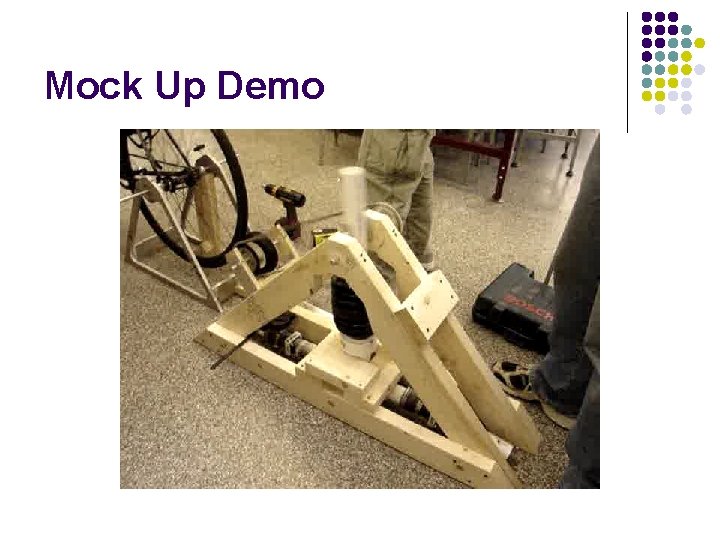
Mock Up Demo
Future Work/Lessons Learned l l l Install double pump technology/dual reservior to reduce inertial forces Reduce compliance in power transmission Implement drive reduction Extract quantitative data from mockup measure efficiency Pumps are fun!
- Slides: 11