
BICRITERIA OPTIMIZATION OF ENERGY EFFICIENT PLACEMENT AND ROUTING
BICRITERIA OPTIMIZATION OF ENERGY EFFICIENT PLACEMENT AND ROUTING IN HETEROGENOUS WIRELESS SENSOR NETWORKS Mustafa Gökçe Baydoğan School of Computing, Informatics and Decision Systems Engineering Arizona State University (ASU) Tempe, AZ, USA Nur Evin Özdemirel, Ph. D Department of Industrial Engineering Middle East Technical University (METU) Ankara, Turkey 11/10/2010 1 Mustafa Gokce Baydogan and Nur Evin Ozdemirel 11/10/2010 INFORMS Annual Meeting/Austin

MOTIVATION SOCIOECONOMIC – – – Environmental monitoring – Air, soil or water monitoring – Habibat monitoring – Seismic detection Military surveillance – Battlefield monitoring – Sniper localization – Nuclear, biological or chemical attack detection Disaster area monitoring RESEARCH… 2 Mustafa Gokce Baydogan and Nur Evin Ozdemirel 11/10/2010 INFORMS Annual Meeting/Austin
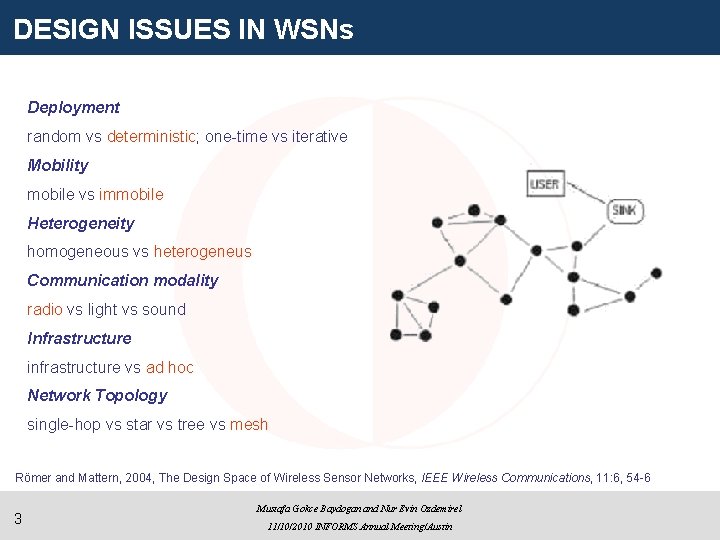
DESIGN ISSUES IN WSNs Deployment random vs deterministic; one-time vs iterative Mobility mobile vs immobile Heterogeneity homogeneous vs heterogeneus Communication modality radio vs light vs sound Infrastructure infrastructure vs ad hoc Network Topology single-hop vs star vs tree vs mesh Römer and Mattern, 2004, The Design Space of Wireless Sensor Networks, IEEE Wireless Communications, 11: 6, 54 -6 3 Mustafa Gokce Baydogan and Nur Evin Ozdemirel 11/10/2010 INFORMS Annual Meeting/Austin
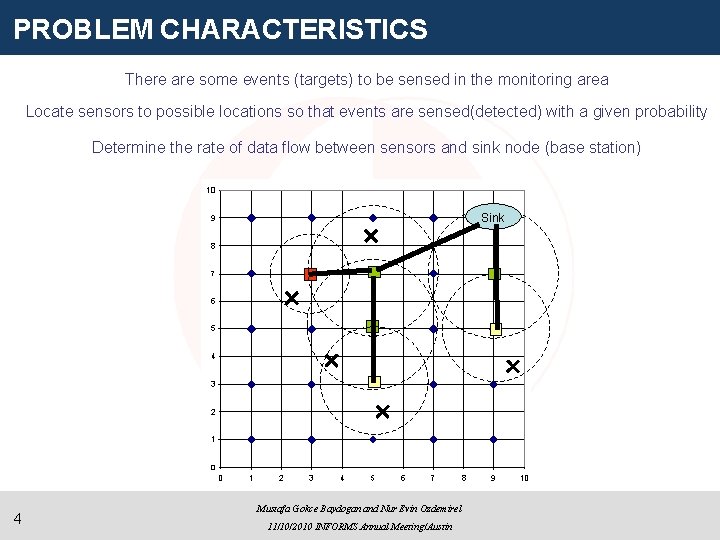
PROBLEM CHARACTERISTICS There are some events (targets) to be sensed in the monitoring area Locate sensors to possible locations so that events are sensed(detected) with a given probability Determine the rate of data flow between sensors and sink node (base station) Sink 4 Mustafa Gokce Baydogan and Nur Evin Ozdemirel 11/10/2010 INFORMS Annual Meeting/Austin
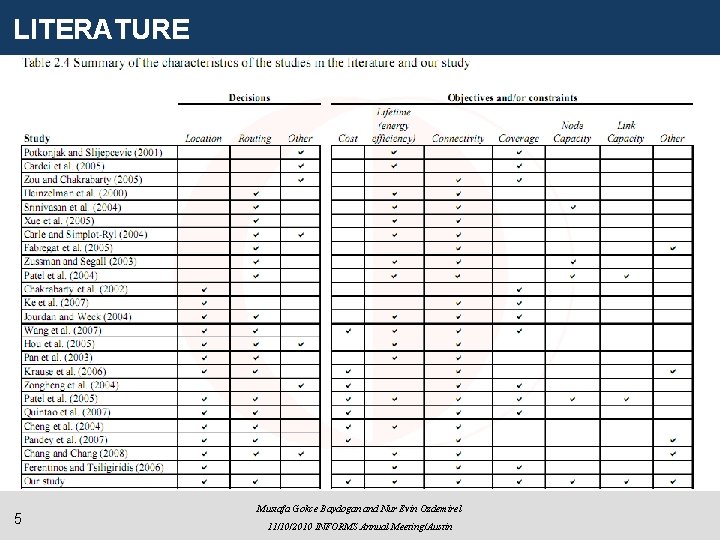
LITERATURE 5 Mustafa Gokce Baydogan and Nur Evin Ozdemirel 11/10/2010 INFORMS Annual Meeting/Austin
PROBLEM DEFINITION OBJECTIVES – Minimize total cost of sensors deployed – Maximize lifetime of the network DECISIONS – Location of heterogeneous sensors – Data routing CONSTRAINTS – Connectivity – Node (sensor) and channel (link) capacity – Coverage – Battery power 6 Mustafa Gokce Baydogan and Nur Evin Ozdemirel 11/10/2010 INFORMS Annual Meeting/Austin
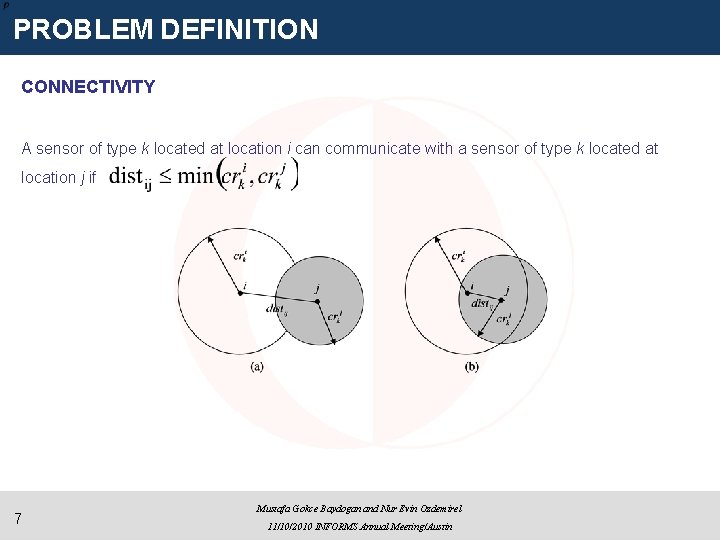
PROBLEM DEFINITION CONNECTIVITY A sensor of type k located at location i can communicate with a sensor of type k located at location j if 7 Mustafa Gokce Baydogan and Nur Evin Ozdemirel 11/10/2010 INFORMS Annual Meeting/Austin
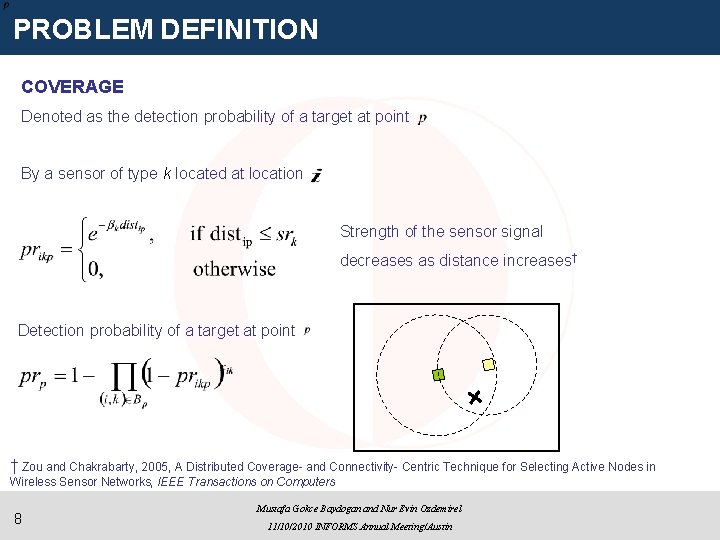
PROBLEM DEFINITION COVERAGE Denoted as the detection probability of a target at point By a sensor of type k located at location Strength of the sensor signal decreases as distance increases† Detection probability of a target at point † Zou and Chakrabarty, 2005, A Distributed Coverage- and Connectivity- Centric Technique for Selecting Active Nodes in Wireless Sensor Networks, IEEE Transactions on Computers 8 Mustafa Gokce Baydogan and Nur Evin Ozdemirel 11/10/2010 INFORMS Annual Meeting/Austin
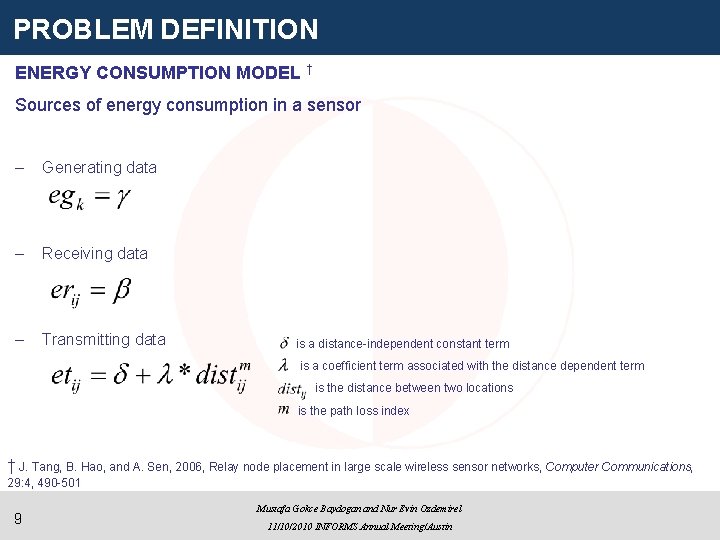
PROBLEM DEFINITION ENERGY CONSUMPTION MODEL † Sources of energy consumption in a sensor – Generating data – Receiving data – Transmitting data is a distance-independent constant term is a coefficient term associated with the distance dependent term is the distance between two locations is the path loss index † J. Tang, B. Hao, and A. Sen, 2006, Relay node placement in large scale wireless sensor networks, Computer Communications, 29: 4, 490 -501 9 Mustafa Gokce Baydogan and Nur Evin Ozdemirel 11/10/2010 INFORMS Annual Meeting/Austin
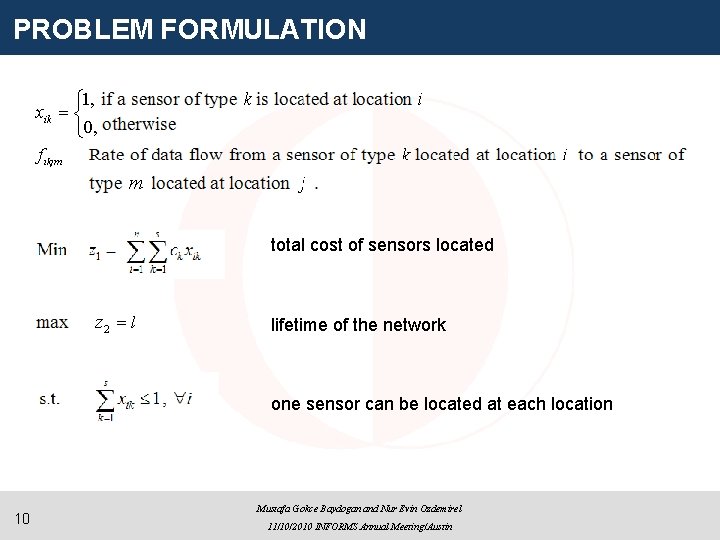
PROBLEM FORMULATION total cost of sensors located lifetime of the network one sensor can be located at each location 10 Mustafa Gokce Baydogan and Nur Evin Ozdemirel 11/10/2010 INFORMS Annual Meeting/Austin

PROBLEM FORMULATION data flow balance at a sensor all data is routed to sink node sensor capacity channel (link) capacity 11 Mustafa Gokce Baydogan and Nur Evin Ozdemirel 11/10/2010 INFORMS Annual Meeting/Austin
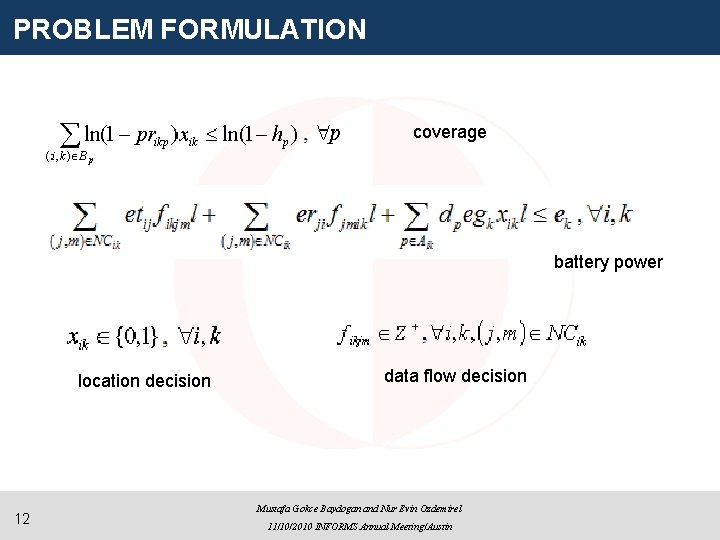
PROBLEM FORMULATION coverage battery power location decision 12 data flow decision Mustafa Gokce Baydogan and Nur Evin Ozdemirel 11/10/2010 INFORMS Annual Meeting/Austin
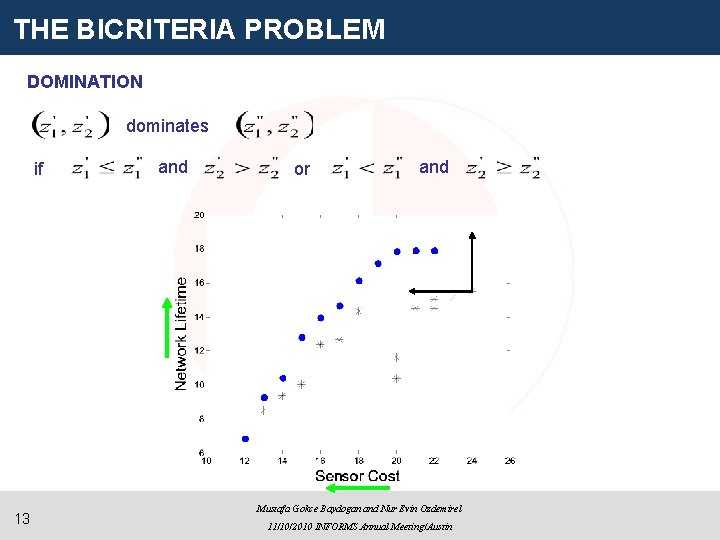
THE BICRITERIA PROBLEM DOMINATION dominates if 13 and or and Mustafa Gokce Baydogan and Nur Evin Ozdemirel 11/10/2010 INFORMS Annual Meeting/Austin
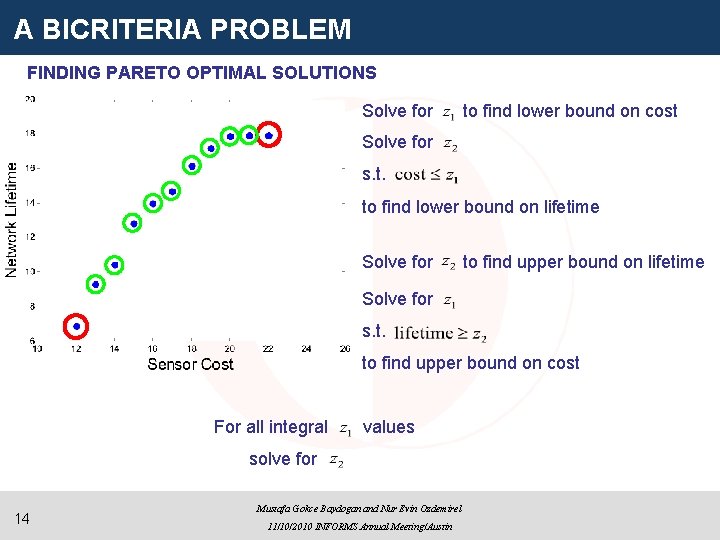
A BICRITERIA PROBLEM FINDING PARETO OPTIMAL SOLUTIONS Solve for to find lower bound on cost Solve for s. t. to find lower bound on lifetime Solve for to find upper bound on lifetime Solve for s. t. to find upper bound on cost For all integral values solve for 14 Mustafa Gokce Baydogan and Nur Evin Ozdemirel 11/10/2010 INFORMS Annual Meeting/Austin
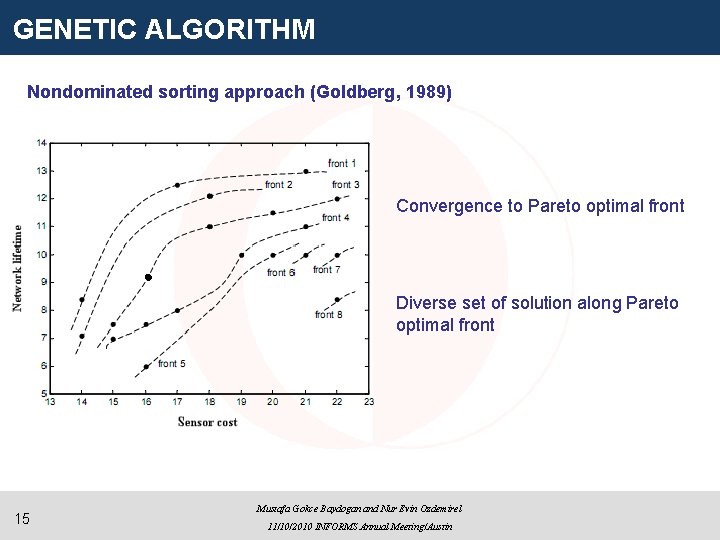
GENETIC ALGORITHM Nondominated sorting approach (Goldberg, 1989) Convergence to Pareto optimal front Diverse set of solution along Pareto optimal front 15 Mustafa Gokce Baydogan and Nur Evin Ozdemirel 11/10/2010 INFORMS Annual Meeting/Austin
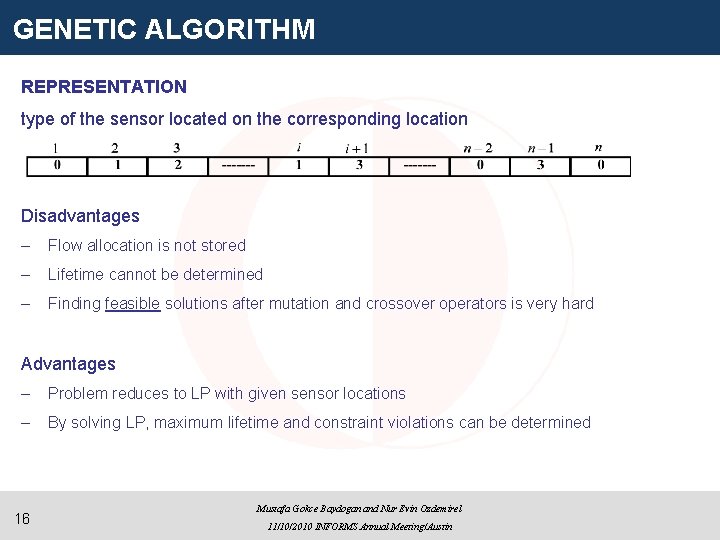
GENETIC ALGORITHM REPRESENTATION type of the sensor located on the corresponding location Disadvantages – Flow allocation is not stored – Lifetime cannot be determined – Finding feasible solutions after mutation and crossover operators is very hard Advantages – Problem reduces to LP with given sensor locations – By solving LP, maximum lifetime and constraint violations can be determined 16 Mustafa Gokce Baydogan and Nur Evin Ozdemirel 11/10/2010 INFORMS Annual Meeting/Austin

GENETIC ALGORITHM FITNESS Based on nondominated sorting idea considering three objectives – Total sensor cost – Network lifetime – Overall constraint violation • Connectivity • Coverage • Capacity violations (channel and sensor) 17 Mustafa Gokce Baydogan and Nur Evin Ozdemirel 11/10/2010 INFORMS Annual Meeting/Austin
GENETIC ALGORITHM INITIAL POPULATION GENERATION – Two phase approach – Sensor location – Location according to target coordinates – Relay location – Location according to sensor coordinates MUTATION – Repair and improve – Repair coverage constraints – Improve cost and lifetime objectives – Repair connectivity constraints – Improve cost objective 18 Mustafa Gokce Baydogan and Nur Evin Ozdemirel 11/10/2010 INFORMS Annual Meeting/Austin

GENETIC ALGORITHM 19 Mustafa Gokce Baydogan and Nur Evin Ozdemirel 11/10/2010 INFORMS Annual Meeting/Austin
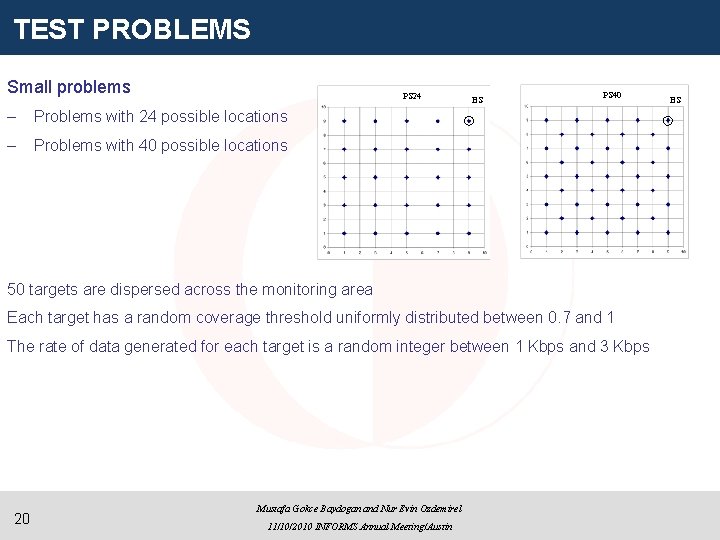
TEST PROBLEMS Small problems PS 24 – Problems with 24 possible locations – Problems with 40 possible locations BS PS 40 50 targets are dispersed across the monitoring area Each target has a random coverage threshold uniformly distributed between 0. 7 and 1 The rate of data generated for each target is a random integer between 1 Kbps and 3 Kbps 20 Mustafa Gokce Baydogan and Nur Evin Ozdemirel 11/10/2010 INFORMS Annual Meeting/Austin BS
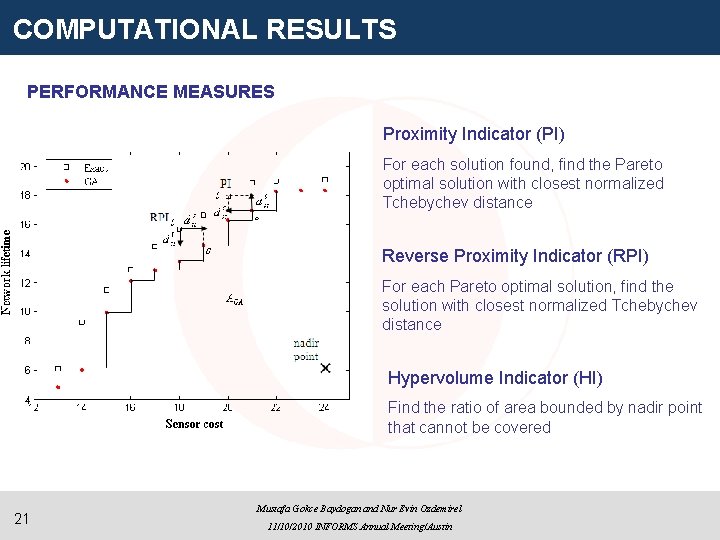
COMPUTATIONAL RESULTS PERFORMANCE MEASURES Proximity Indicator (PI) For each solution found, find the Pareto optimal solution with closest normalized Tchebychev distance Reverse Proximity Indicator (RPI) For each Pareto optimal solution, find the solution with closest normalized Tchebychev distance Hypervolume Indicator (HI) Find the ratio of area bounded by nadir point that cannot be covered 21 Mustafa Gokce Baydogan and Nur Evin Ozdemirel 11/10/2010 INFORMS Annual Meeting/Austin
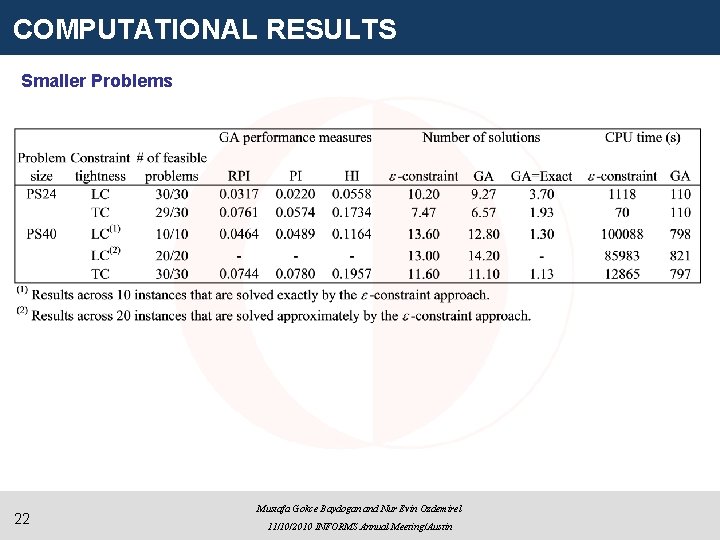
COMPUTATIONAL RESULTS Smaller Problems 22 Mustafa Gokce Baydogan and Nur Evin Ozdemirel 11/10/2010 INFORMS Annual Meeting/Austin
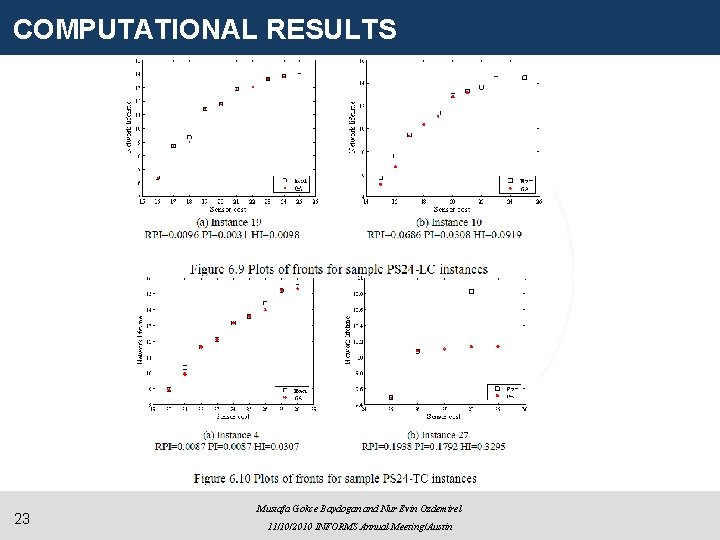
COMPUTATIONAL RESULTS 23 Mustafa Gokce Baydogan and Nur Evin Ozdemirel 11/10/2010 INFORMS Annual Meeting/Austin
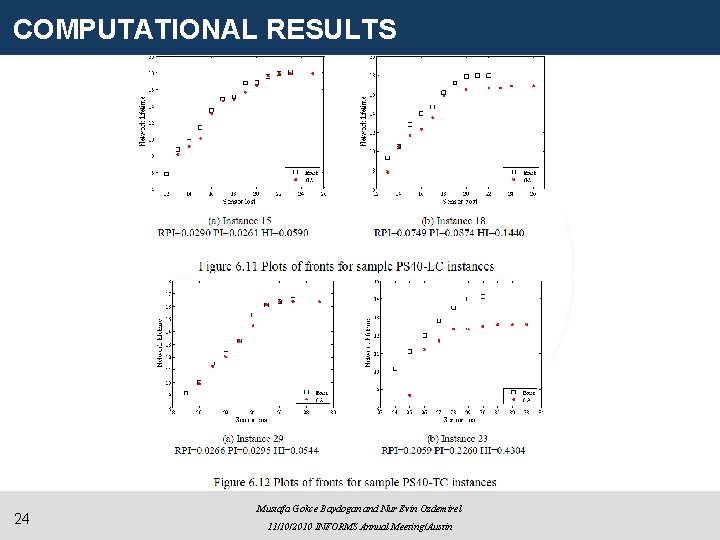
COMPUTATIONAL RESULTS 24 Mustafa Gokce Baydogan and Nur Evin Ozdemirel 11/10/2010 INFORMS Annual Meeting/Austin
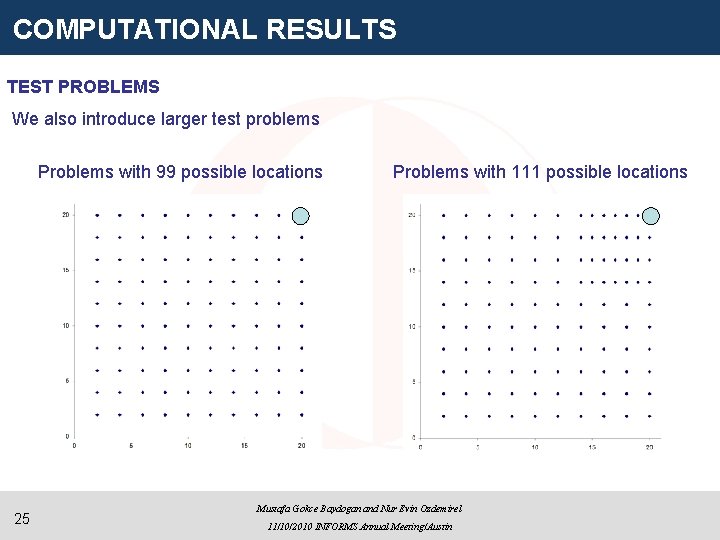
COMPUTATIONAL RESULTS TEST PROBLEMS We also introduce larger test problems Problems with 99 possible locations 25 Problems with 111 possible locations Mustafa Gokce Baydogan and Nur Evin Ozdemirel 11/10/2010 INFORMS Annual Meeting/Austin
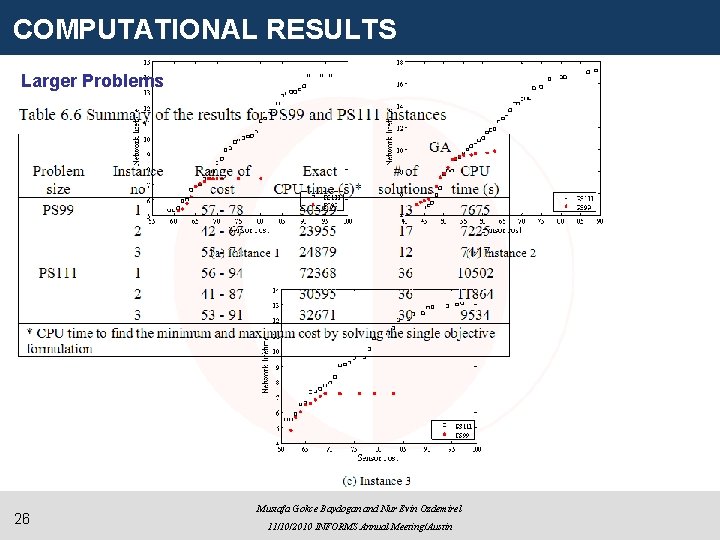
COMPUTATIONAL RESULTS Larger Problems 26 Mustafa Gokce Baydogan and Nur Evin Ozdemirel 11/10/2010 INFORMS Annual Meeting/Austin
CONCLUSION COMMENTS and FURTHER RESEARCH – GA provides reasonable solution quality with better solution times v We can obtain better solutions than the exact approach has by representing the area with more grids (approximation of the continuous space) even with better solution times Future research – Modification of ε-constraint approach – Use of sensitivity analysis results (in progress) – Incorporating decision maker’s preferences – Different objectives such as minimization of total delay, total hop count or average path length – Special network requirements such as K-coverage or K-connectivity 27 Mustafa Gokce Baydogan and Nur Evin Ozdemirel 11/10/2010 INFORMS Annual Meeting/Austin

THANK YOU. . . QUESTIONS AND COMMENTS? 28 Mustafa Gokce Baydogan and Nur Evin Ozdemirel 11/10/2010 INFORMS Annual Meeting/Austin

OUTLINE – MOTIVATION – PROBLEM DEFINITION – GENETIC ALGORITHM – COMPUTATIONAL RESULTS – CONCLUSION 29 Mustafa Gokce Baydogan and Nur Evin Ozdemirel 11/10/2010 INFORMS Annual Meeting/Austin
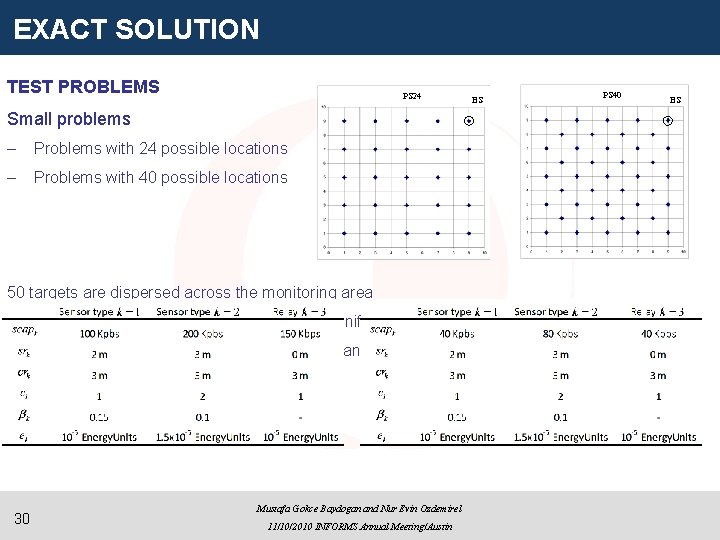
EXACT SOLUTION TEST PROBLEMS PS 24 BS PS 40 Small problems – Problems with 24 possible locations – Problems with 40 possible locations 50 targets are dispersed across the monitoring area Each target has a random coverage threshold uniformly distributed between 0. 7 and 1 The rate of data generated for each target is a random integer between 1 Kbps and 3 Kbps 30 Mustafa Gokce Baydogan and Nur Evin Ozdemirel 11/10/2010 INFORMS Annual Meeting/Austin BS
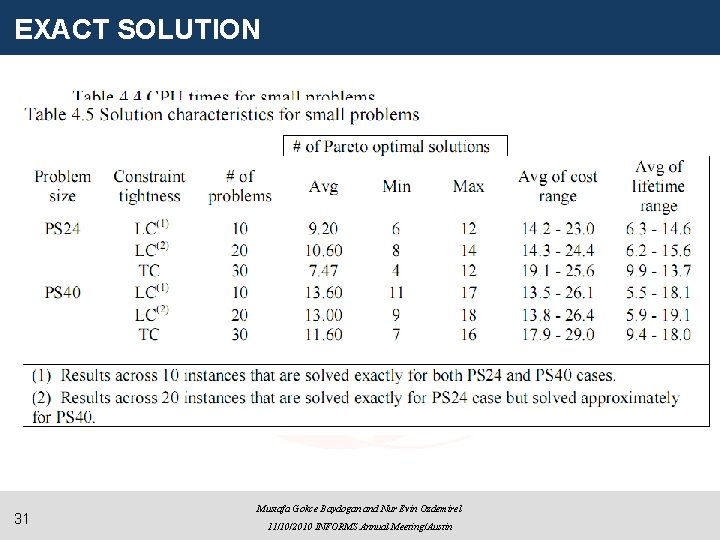
EXACT SOLUTION 31 Mustafa Gokce Baydogan and Nur Evin Ozdemirel 11/10/2010 INFORMS Annual Meeting/Austin

GENETIC ALGORITHM Why evolutionary algorithms? • Classical search and optimization methods – find single solution in every iteration – need repetitive use of a single objective optimization method – assumptions like linearity, continuity • Evolutionary Algorithms – – use a population of solutions in every generation no assumptions eliminate the need of parameters (like weight, ε or target vectors) find and maintain multiple good solutions • Emphasize all nondominated solutions in a population equally • Preserve a diverse set of multiple nondominated solutions Near optimal, uniformly disributed, well extended set of solutions for MO problems 32 Mustafa Gokce Baydogan and Nur Evin Ozdemirel 11/10/2010 INFORMS Annual Meeting/Austin
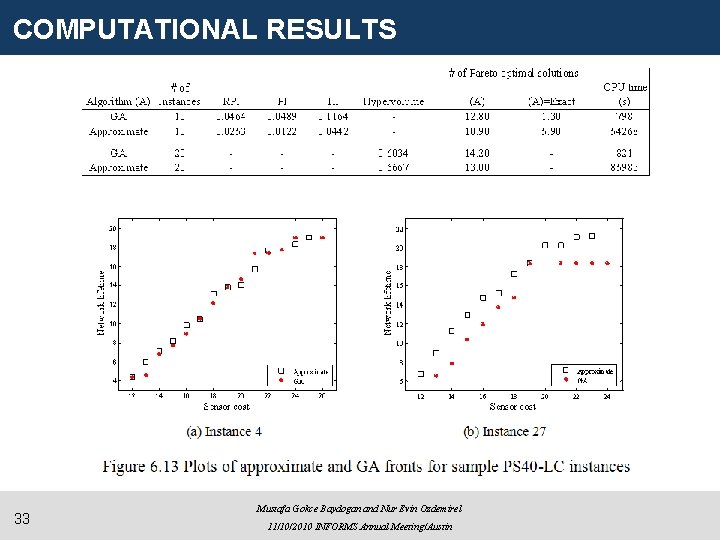
COMPUTATIONAL RESULTS 33 Mustafa Gokce Baydogan and Nur Evin Ozdemirel 11/10/2010 INFORMS Annual Meeting/Austin
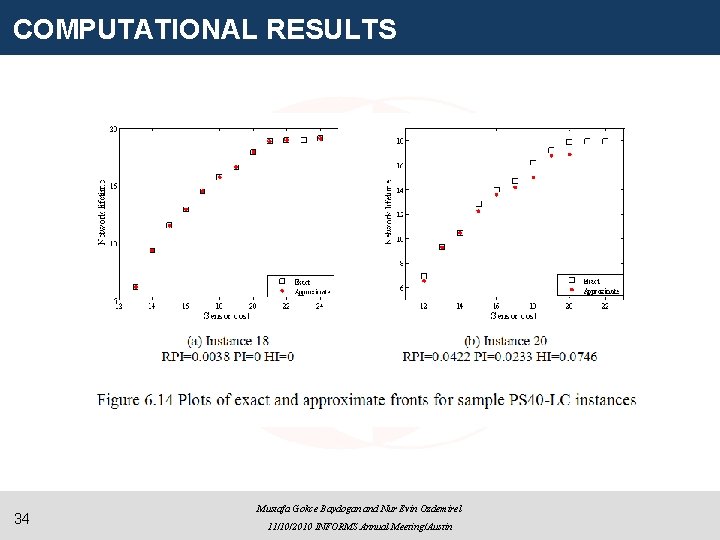
COMPUTATIONAL RESULTS 34 Mustafa Gokce Baydogan and Nur Evin Ozdemirel 11/10/2010 INFORMS Annual Meeting/Austin
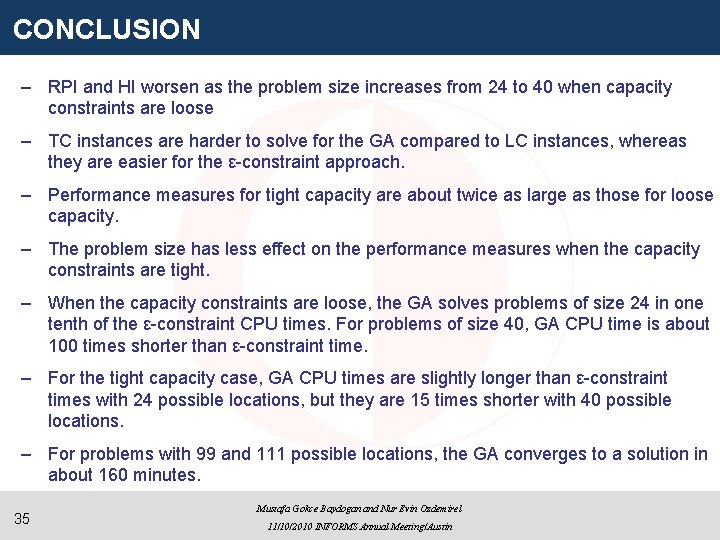
CONCLUSION – RPI and HI worsen as the problem size increases from 24 to 40 when capacity constraints are loose – TC instances are harder to solve for the GA compared to LC instances, whereas they are easier for the ε-constraint approach. – Performance measures for tight capacity are about twice as large as those for loose capacity. – The problem size has less effect on the performance measures when the capacity constraints are tight. – When the capacity constraints are loose, the GA solves problems of size 24 in one tenth of the ε-constraint CPU times. For problems of size 40, GA CPU time is about 100 times shorter than ε-constraint time. – For the tight capacity case, GA CPU times are slightly longer than ε-constraint times with 24 possible locations, but they are 15 times shorter with 40 possible locations. – For problems with 99 and 111 possible locations, the GA converges to a solution in about 160 minutes. 35 Mustafa Gokce Baydogan and Nur Evin Ozdemirel 11/10/2010 INFORMS Annual Meeting/Austin
- Slides: 35