
BICAMERAL Two houses make the Legislative Branch n

BICAMERAL Two houses make the Legislative Branch n They begin on Jan 3 rd every two years. A session lasts two years. This is the 113 th Congress! n n n House of Representatives The Senate
Population Changes Rep’s n n n 1789: 65 Representatives 1910: 435. That number has not changed. Senate does not change 100 members n n 1910 - pop 91 million 209 K people per Rep 1990 - 250 million 570 K per Rep.
Back to Chapter 1 for a sec… n What kind of democracy do we live in? n So the people rule, but they don’t make public policy n Who does make it?
Bicameral Congress n Our Congress is bicameral, meaning it has two houses n The larger house, which is supposedly the “common man’s house, ” is the House of Representatives n The smaller house, which is for “the elite” of America is the Senate
Members of the House of Representatives n Official title is “Representative So and So” n Also called “congressman” n There are 435 congressmen n Congressmen are elected to a term of 2 years
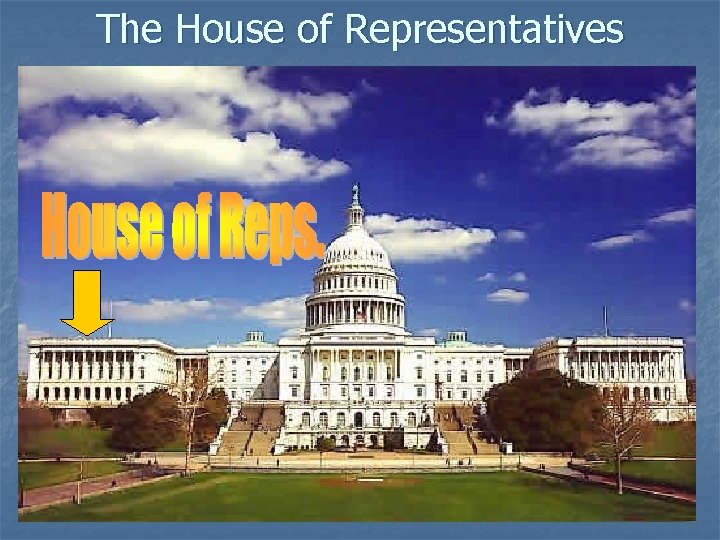
The House of Representatives
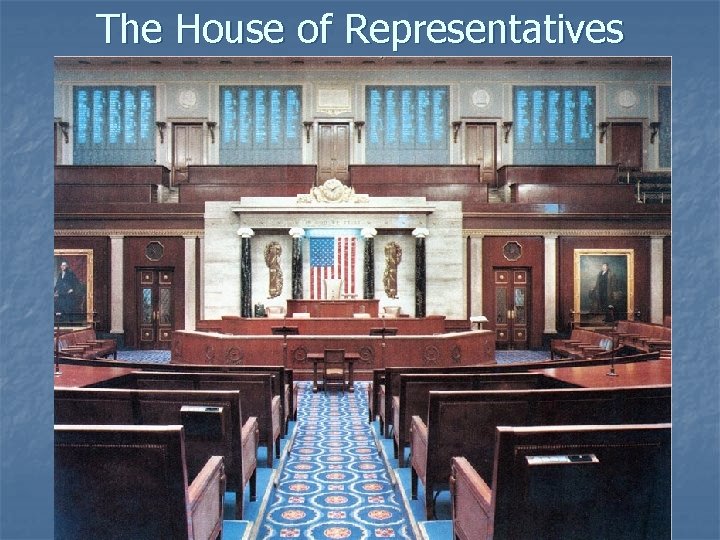
The House of Representatives
Members of the Senate n Official title is “Senator So and So” n There are 100 Senators (2 from each state) n Senators are elected to a term of 6 years

The Senate
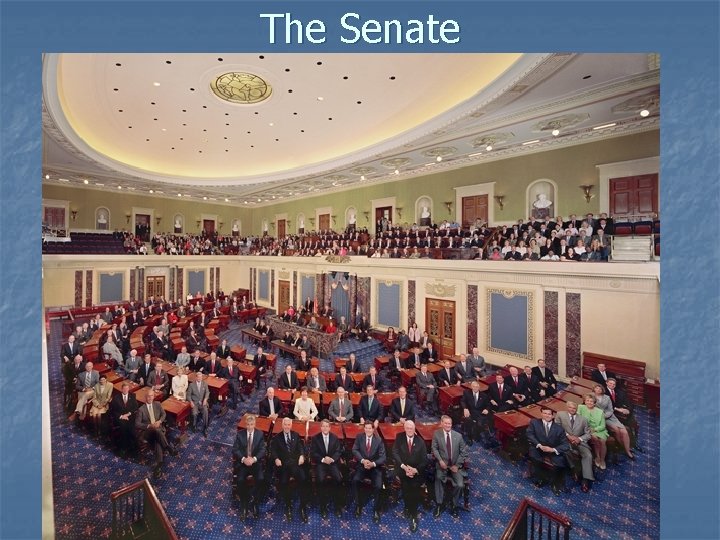
The Senate
Basic Information Since you get new congressmen every 2 years, we call each 2 year period a “term” of Congress n The terms are numbered consecutively… the one that ends Dec. 2008 was the 110 th Congress n The one that was just elected is called the 111 th Congress n
Basic Information n. A session of Congress is all the time it takes to finish their business for the year n So how many sessions are there in a term of Congress?
Seats in the House n Seats are apportioned (given out) to each state based on population n Every 10 years seats are reapportioned after the census, when a new count of the population is taken n Ever since 1929, the number has been 435 (Reapportionment Act)
Apportionment n n n Done every 10 years after a census. 435 House seats divided among 50 states. Based on population, with a state guaranteed 1 representative. North East US; Losing representatives. Soute & West; Gaining seats
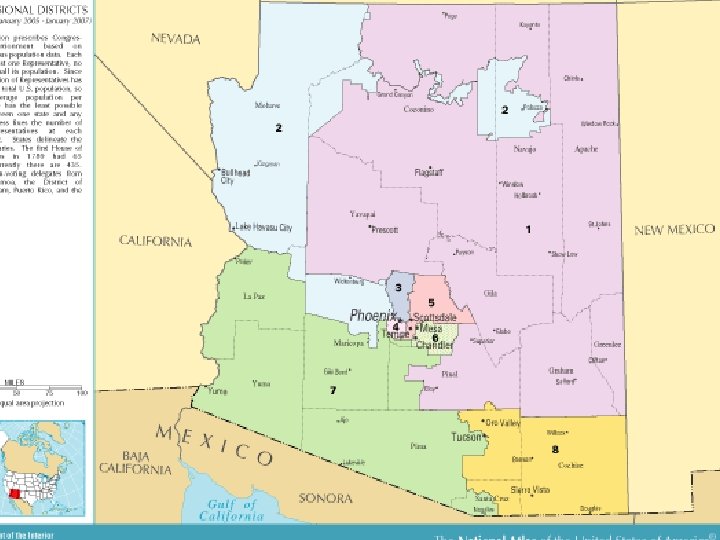
Seats in the House n Every state divides itself into districts based on the number of seats apportioned to the state n For example, Arizona is given 8 seats based on our population n The South and West are gaining seats. Northeast losing seats!
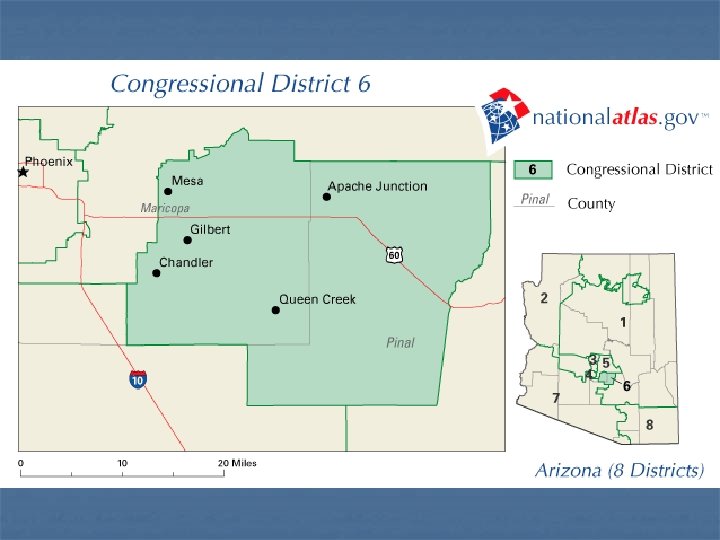
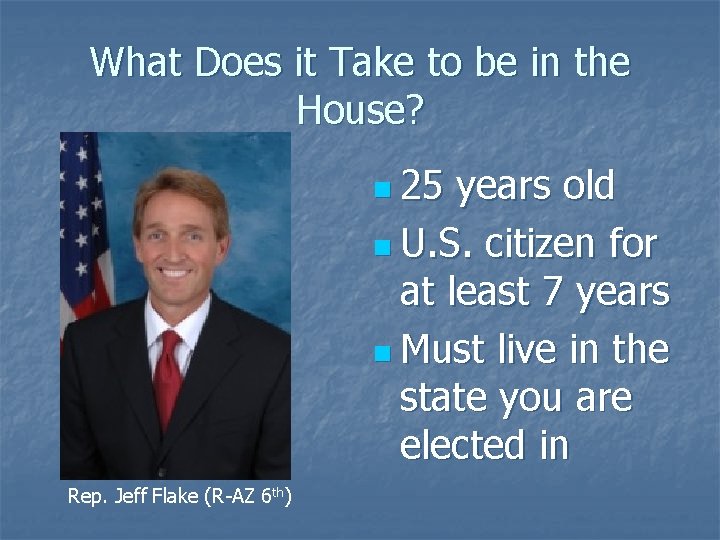
What Does it Take to be in the House? n 25 years old n U. S. citizen for at least 7 years n Must live in the state you are elected in Rep. Jeff Flake (R-AZ 6 th)
Seats in the Senate n The Constitution establishes that there are 2 seats per state in the Senate n 50 States = 100 Senators
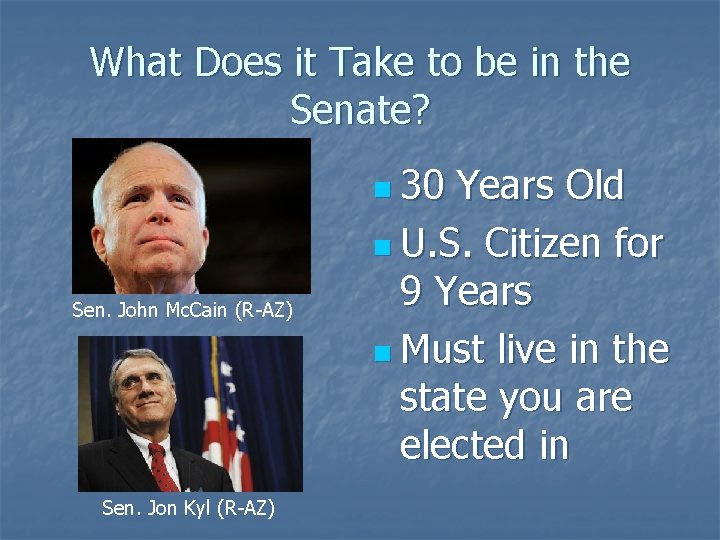
What Does it Take to be in the Senate? n 30 Sen. John Mc. Cain (R-AZ) Sen. Jon Kyl (R-AZ) Years Old n U. S. Citizen for 9 Years n Must live in the state you are elected in
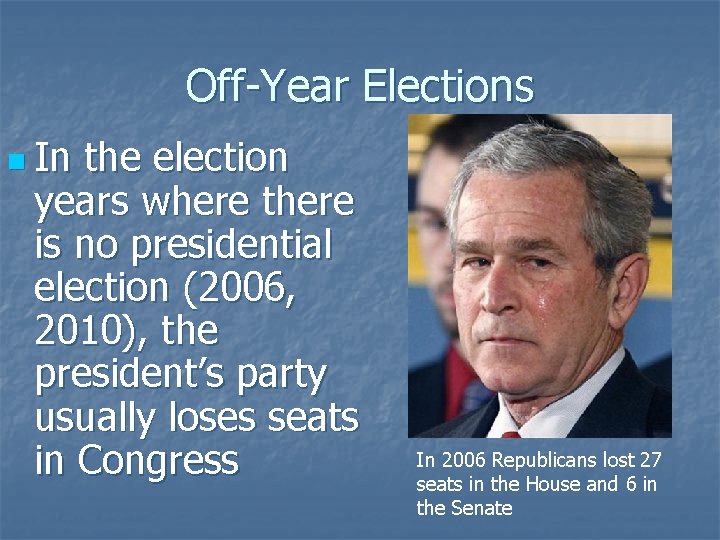
Off-Year Elections n In the election years where there is no presidential election (2006, 2010), the president’s party usually loses seats in Congress In 2006 Republicans lost 27 seats in the House and 6 in the Senate
Comparing the House and the Senate n Originally, congressmen were elected by the public, and Senators were elected by the state legislatures n Founding Fathers did not trust the public with all power n 17 th Amendment has since changed Senate elections to a public vote
Comparing the House and the Senate n Senators have a much longer term n Entire House is elected at once, while only 1/3 of Senate is chosen at a time n House members appeal to one small district, Senators appeal to entire state
Founding Fathers’ Intent n The Founding Fathers wanted to have one house that would quickly respond to the desires of the public (House of Reps) n And one house that would be moderate, and stop any crazy nonsense the House would try (Senate)
Population changes n n n 1910 - 91 million Americans, so each represented about 209 K citizens. By 1990 - 250 million American, so each represented about 570 K citizens. The census tells us where to shift the 435 representatives.
Demographics of Congress is not at all demographically representative of the U. S. population n For example… n Congress
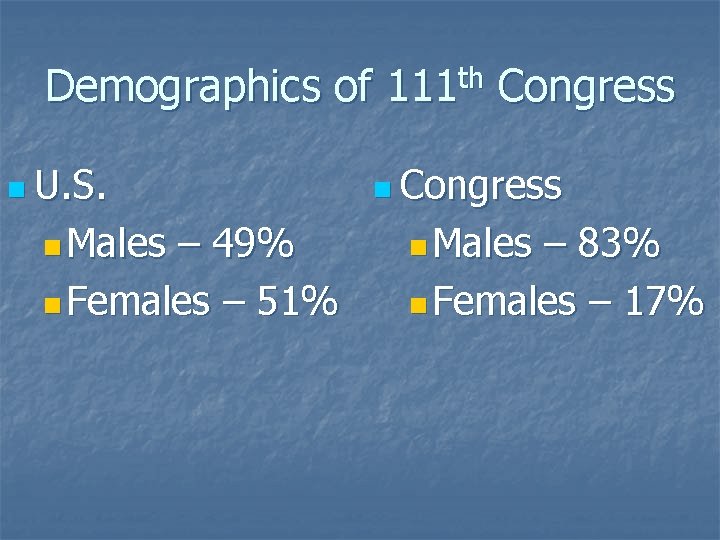
Demographics of 111 th Congress n U. S. n Males – 49% n Females – 51% n Congress n Males – 83% n Females – 17%
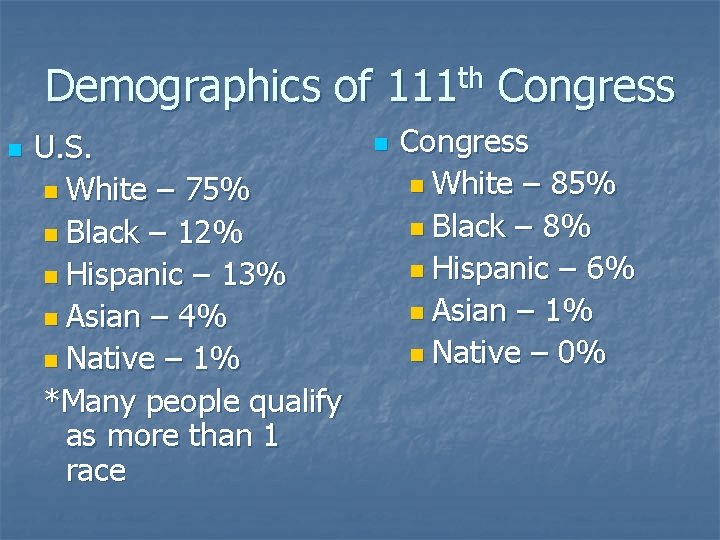
Demographics of 111 th Congress n U. S. n White – 75% n Black – 12% n Hispanic – 13% n Asian – 4% n Native – 1% *Many people qualify as more than 1 race n Congress n White – 85% n Black – 8% n Hispanic – 6% n Asian – 1% n Native – 0%
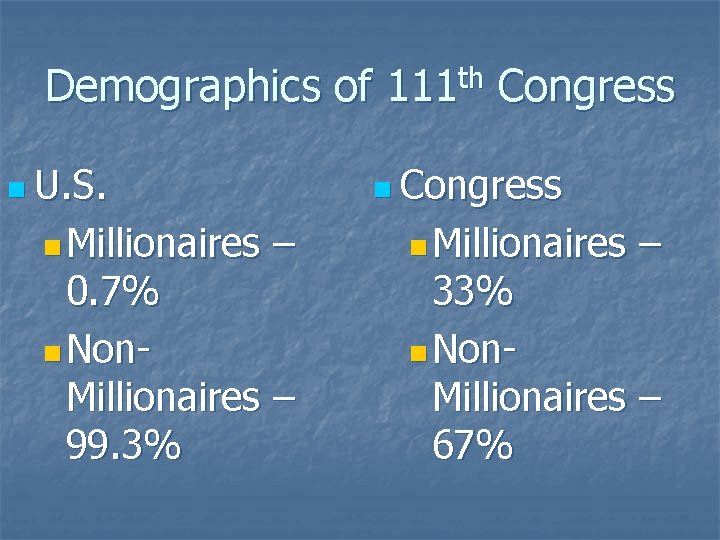
Demographics of 111 th Congress n U. S. n Millionaires n Congress – 0. 7% n Non. Millionaires – 99. 3% n Millionaires – 33% n Non. Millionaires – 67%
- Slides: 30