
Bibliometric study of coauthor and keywords network analysis
Bibliometric study of coauthor and keywords network analysis of articles in the North Korean Journal of Chosun Medicine and Preventive Medicine for 1997~2006 136 APHA Annual Meeting & Expo. Paper #201860 Nov. 7 -11. 2009. Minsoo Jung, MPH, Ph. D candidate, SNU Jinhee Lee, BA, Korea University Byong-Hee Cho, Ph. D, SNU
I. • The South Korea and North Korea as the sole divided country have developed in their own political systems. • Particularly, each's health and medical systems are completely different (this is a good motive for researchers), however due to the limits on the approach to the North Korea's internal data, researches on the differences of these two systems could have not been easily carried out. • This research investigated <Chosun Medicine: JCM> and <Preventive Medicine: JPM> using co-author and keyword network analysis on the basis of medical informatics and bibliomatrics.
• North Korea completed its national system from 1946 to 1960 and has got a completely different national system from South Korea due to the path-dependancy effect (Jung, 2007). • This phenomena is a kind of ‘systemic inertia’ which means that in the early condition, when one of the available alternatives becomes institutionalized then it suddenly begins to perform self-reinforcement. • In other words, the initial conditions become concrete as a historical course by the institution's tendency or the series of events (Goldstone, 1998; Mahoney, 2000). Thus North Korea's tendency of path-dependency on Juche theory was uncommonly prominent between the socialized nations and as a result the severance from other countries has become severe.
II. • Thus in the field of North Korean study numeral analysis using experiential data source and microscopic methods are requested (Jung, 2007; Jung et al. , 2008). • Yet, the approach by academic activities is meaningful as it analyze the systemic elements in the microscopic behaviors of researchers, getting out of the issue of the particularity of North Korea's political system and it provides the conformity for the comparative research of the health and medical system of North Korea and South Korea. • Until now when it comes to understand North Korea there have been lots of limits applying the method of quantity.
• The first reason is the problem of 'distortion of recognition' which comes in the study on socialized countries (Kim, 1980), secondly it is not easy to be convinced of the source of data and it demands a special device to decode the discourse of communism (Lee, 2003). • By this circumstance the methodology of study on North Korea stayed just descriptions of specific cases and consequently researches pursuing universal rules have not been attempted. • However, papers on scientific journals are new objectives of research as they are relatively free from these two problems and show sections of their knowledge structure.
• Particularly, researches on academic activities in the field of medical science are requested to prepare for the unification of health and medical system of North Korea and South Korea after the reunification and to presume various statistics on public health and population (Jung, 2006). • For these studies, however, knowledge on both public health and social science are essential and method of numeral analysis is requested (Jung et al. , 2008).
III. • Now institutions which officially possess North Korean scientific journals are NKTech (North Korean Science Technology Network; www. nktech. net) of KISTI (Korea advanced Institute of Science and Technology) and Information Center For North Korea (unibook. unikorea. go. kr) of Ministry of Unification. • Papers collected by these institutions are highly useful for researches, however they could have not been examined deeply because of lack of appropriate methods. • Co-author and key words network analysis which has been tired in South Korea will be an useful utility as a solution for this problem.
• Co-author network is the reciprocity between scientists who participated in a research and keyword network is a knowledge network which reveals, by keywords of a thesis, a structural knowledge. • Analyzing behaviors of these researchers by network method will make it possible to actively grasp how knowledge is produced and shared in a scientist community. • There have been a research attempting to analyze North Korea's medical journals quantitatively (Huh, 2004), but that research had some limits because that used data collected by domestic universities or Korea. Med.
• Furthermore, the methodology was not sufficient to reveal the structural sides of academic activities because it also classified the frequency of disease groups and classified papers by qualifiers. • Thus the network methodology is requested. • By this methodology it is possible to grasp the structural feature of the other side of academic activities using the title(or keywords) of a paper, the year of issue, the author and the author's posts: By the co-author analysis it is possible to grasp the network of main authors of a journal and their posts, by the keyword analysis it is possible to grasp the field of main research themes.
• This method is not merely grasping the frequency, for example co-author network enables the result of collaboration to be converted into matrix[data] to draw out co-research groups and, moreover, endow weight according to the ranking of the authors in a thesis. • The keyword network which is called ‘meannig network’(Mohr, 1998) is a matrix of words which were commonly extracted from the titles of thesises. Then the words which have the most networks are partitioned into some parts of same degree in the network. Vertices are contracted on the basis of this partition. This method is called shrink network(Nooy et al. , 2005). • SAS/IML or R are used to draw out matrix and extract keywords, Pajek or Net. Miner is used for network analysis.
• The information of academic activities appears in a journal is an accumulation of collective and macroscopic study accomplished, through a long period, by individual scholars. • A person or group cannot intensionally affect this accomplishment thus this implies the reality of academic activities and slices of social structure. • Existing qualitative examination and simple descriptive statics provide visible information, network analysis, like a microscope, shows 'the unintended consequences' of group behavior.
• For example, by the former method it can be suggested that many researches on digestive organs, respiratory organs, tumors are carried out, but researches on contagious diseases and epidemiological researches have been rare, however, by latter method it can be suggested that what keywords are mainly related and who are the bodies of researches. • Furthermore, this result can be fixed into quantity for the comparative study of journals or nations. • The results of quantitative bibliographic analysis (coding the titles of journals, co-author, post, position) on the North Korea's representative journals, <Chosun Medicine> and <Preventive Medicine> are belows.
IV. • Data is papers published in <Chosun Medicine> and <Preventive Medicine> of 10 years, from volume 1 of year 1997 to volum 4 of year 2006. • From the former 1, 734 co-authors from 1, 104 papers, from the latter 1, 567 co-authors from 1, 172 papers were extracted. • R v. 2. 6 was used to extract keywords and realize the curtailed network, Net. Miner v. 3. 2 was used to illustrate main co-author network. • In the case of co-author analysis, huge single components were extracted from the two journals. This fact suggest that the academic activities tend to be structural (Figure 1, Figure 2).
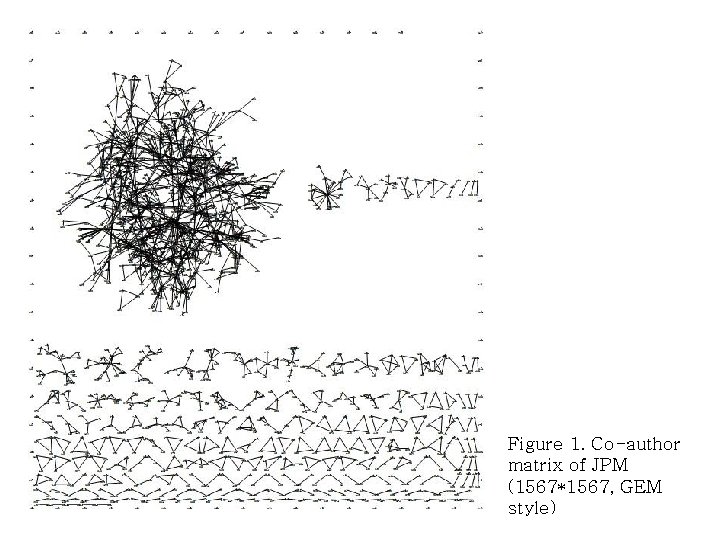
Figure 1. Co-author matrix of JPM (1567*1567, GEM style)
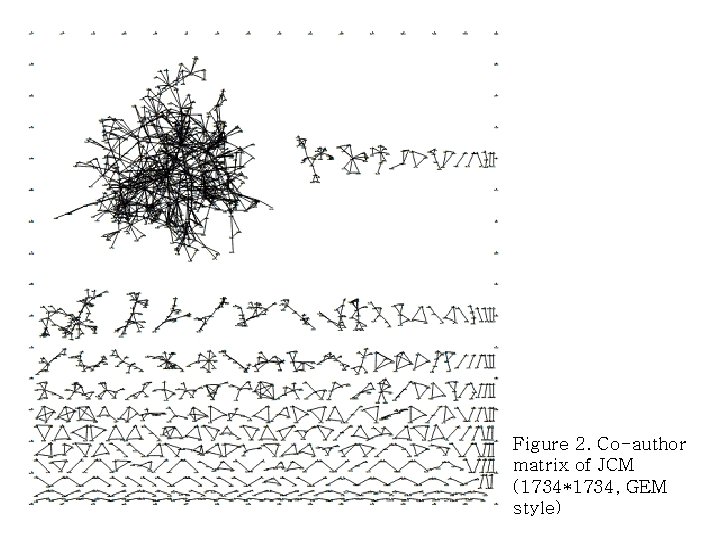
Figure 2. Co-author matrix of JCM (1734*1734, GEM style)
• The proportion of main co-authors of over IF 20 was 1. 8% (32 persons) in <Chosun Medicine> and 4. 3% (68 persons) in <Preventive Medicine>. • Among these, top 20 persons' tendencies of academic activities are illustrated in the table 1 and table 2. • This tendency of academic activities are closely similar to that of South Korea (Jung and Chung, 2008; Jung et al. , 2008). • The network of researchers of the former illustrated by spring-KK merely contains two simple separated clusters, but that of the latter contains eight integrated complex clusters in which major medical colleges and research institutions function (Figure 3, Figure 4).
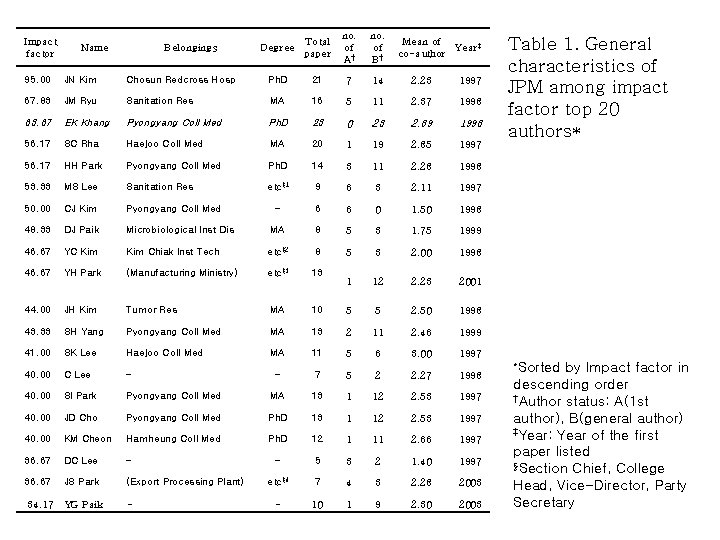
Impact factor Name Belongings Degree Total paper no. of A† no. of B† Mean of Year‡ co-author 95. 00 JN Kim Chosun Redcross Hosp Ph. D 21 7 14 2. 23 1997 67. 83 JM Ryu Sanitation Res MA 16 5 11 2. 37 1998 63. 67 EK Khang Pyongyang Coll Med Ph. D 23 0 23 2. 69 1998 56. 17 SC Rha Haejoo Coll Med MA 20 1 19 2. 85 1997 56. 17 HH Park Pyongyang Coll Med Ph. D 14 3 11 2. 28 1998 53. 33 MS Lee Sanitation Res etc§ 1 9 6 3 2. 11 1997 50. 00 CJ Kim Pyongyang Coll Med - 6 6 0 1. 50 1998 48. 33 DJ Paik Microbiological Inst Dis MA 8 5 3 1. 75 1999 46. 67 YC Kim Chiak Inst Tech etc§ 2 8 5 3 2. 00 1998 46. 67 YH Park (Manufacturing Ministry) etc§ 3 13 1 12 2. 23 2001 44. 00 JH Kim Tumor Res MA 10 5 5 2. 50 1998 43. 33 SH Yang Pyongyang Coll Med MA 13 2 11 2. 46 1999 41. 00 SK Lee Haejoo Coll Med MA 11 5 6 3. 00 1997 40. 00 C Lee - - 7 5 2 2. 27 1998 40. 00 SI Park Pyongyang Coll Med MA 13 1 12 2. 53 1997 40. 00 JD Cho Pyongyang Coll Med Ph. D 13 1 12 2. 53 1997 40. 00 KM Cheon Hamheung Coll Med Ph. D 12 1 11 2. 66 1997 36. 67 DC Lee - - 5 3 2 1. 40 1997 36. 67 JS Park (Export Processing Plant) etc§ 4 7 4 3 2. 28 2003 34. 17 - - 10 1 9 2. 30 2003 YG Paik Table 1. General characteristics of JPM among impact factor top 20 authors* *Sorted by Impact factor in descending order †Author status: A(1 st author), B(general author) ‡Year: Year of the first paper listed §Section Chief, College Head, Vice-Director, Party Secretary
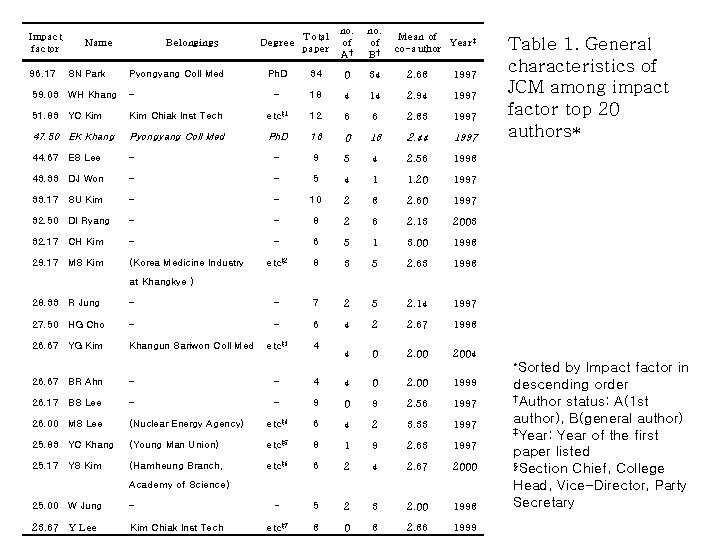
Impact factor Name Belongings Degree Total paper no. of A† no. of B† Ph. D 34 0 34 2. 68 1997 - 18 4 14 2. 94 1997 Mean of Year‡ co-author 96. 17 SN Park Pyongyang Coll Med 59. 03 WH Khang - 51. 83 YC Kim Chiak Inst Tech etc§ 1 12 6 6 2. 83 1997 47. 50 EK Khang Pyongyang Coll Med Ph. D 16 0 16 2. 44 1997 44. 67 ES Lee - - 9 5 4 2. 56 1998 43. 33 DJ Won - - 5 4 1 1. 20 1997 33. 17 SU Kim - - 10 2 8 2. 60 1997 32. 50 DI Ryang - - 8 2 6 2. 13 2003 32. 17 CH Kim - - 6 5 1 3. 00 1998 29. 17 MS Kim (Korea Medicine Industry etc§ 2 8 3 5 2. 63 1998 at Khangkye ) 28. 33 R Jung - - 7 2 5 2. 14 1997 27. 50 HG Cho - - 6 4 2 2. 67 1998 26. 67 YG Kim Khangun Sariwon Coll Med etc§ 3 4 4 0 2. 00 2004 Table 1. General characteristics of JCM among impact factor top 20 authors* *Sorted 26. 67 BR Ahn - - 4 4 0 2. 00 1999 26. 17 BS Lee - - 9 0 9 2. 56 1997 26. 00 MS Lee (Nuclear Energy Agency) etc§ 4 6 4 2 3. 33 1997 25. 83 YC Khang (Young Man Union) etc§ 5 8 1 9 2. 63 1997 25. 17 YS Kim (Hamheung Branch, etc§ 6 6 2 4 2. 67 2000 Academy of Science) 25. 00 W Jung - 23. 67 Kim Chiak Inst Tech Y Lee - 5 2 3 2. 00 1998 etc§ 7 8 0 8 2. 86 1999 by Impact factor in descending order †Author status: A(1 st author), B(general author) ‡Year: Year of the first paper listed §Section Chief, College Head, Vice-Director, Party Secretary
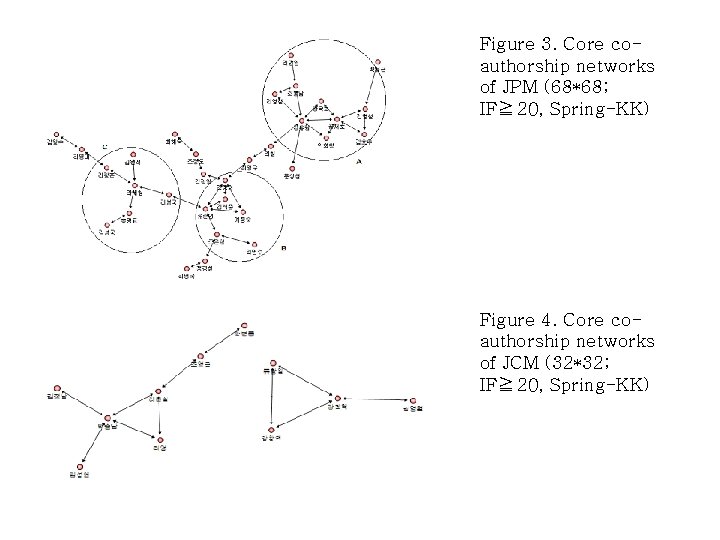
Figure 3. Core coauthorship networks of JPM (68*68; IF≧ 20, Spring-KK) Figure 4. Core coauthorship networks of JCM (32*32; IF≧ 20, Spring-KK)
• In conclusion, <Preventive Medicine> is relatively highly specialized in network structuralization but <Chosun Medicine> is highly generalized. • In the case of keyword analysis, 17 keywords from <Chosun Medicine> and 33 keywords from <Preventive Medicine> were extracted (Table 3). • Common terms are 'influence', 'movement', 'experiment', 'utilization', 'research', 'relationship', <Chosun Medicine> has mainly concentrated on pathology and <Preventive Medicine> has mainly concentrated on research on virus and medicines grounding on infection and immunity.
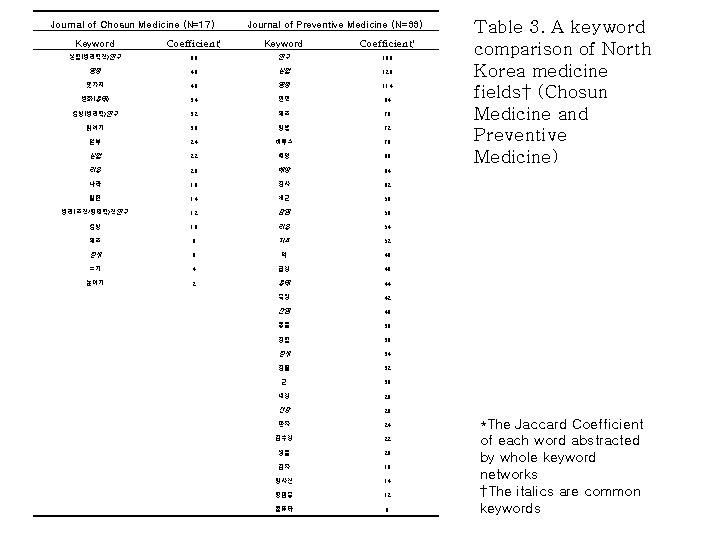
Journal of Chosun Medicine (N=17) Journal of Preventive Medicine (N=33) Keyword Coefficient* 실험(병리학적)연구 66 연구 168 영향 48 실험 120 몇가지 46 영향 114 변화(동태) 34 면역 84 림상(병리학)연구 32 제조 78 밝히기 30 방법 72 일부 24 비루스 70 실험 22 배양 68 리용 20 예방 64 나라 16 검사 62 발현 14 세균 58 병리(조직/형태학)적연구 12 감염 56 림상 10 리용 54 제조 8 지표 52 관계 6 약 48 쓰기 4 급성 46 높이기 2 동태 44 측정 42 간염 40 동물 38 경험 36 관계 34 검출 32 균 30 내성 28 건강 26 환자 24 감수성 22 생물 20 감자 16 방사선 14 항염증 12 콤퓨타 8 Table 3. A keyword comparison of North Korea medicine fields† (Chosun Medicine and Preventive Medicine) *The Jaccard Coefficient of each word abstracted by whole keyword networks †The italics are common keywords
• This research, as a quantitative bibliographic study using network analysis, concerns the academic activities in the North Korea's medical field. • Contrary to South Korea, North Korea developed ‘Juche Medicine (Koryo Medicine)' and gratuitous medical system in its communism system. • According to this research this ideology, on the basis of experimental epidemiology, has been realized in the emphasis on the discovery of bacteria, study on immune system and pathology. Furthermore, researchers have been at liberty to cooperate with each other. • However, researches on specific population groups in danger (researches on the equality of health) and proposals on policies have been absent, so more careful concern for the whole people is requested.
<References> • Goldstone JA. Initial conditions, general laws, path dependence, and explanations in historical sociology. Am J Sociol 1998; 104(3): 829 -845. • Huh S. The research of public health situation using medical publication in North Korean Unification Health Care 2004; 4: 181 -227. (Korean) • Kim SS. Research on Korean communism: promise versus performance. World Polit 1980; 32(2): 283 -284. • Kim YH, Yoon JR, Cho HS, Kim YJ. Structure of collaboration network among Korean scientists: 'small world' and position effect. Korean J Sociol 2007; 41(4): 68 -103. (Korean) • Lee JC. The Use of references for North Korea study. In: Graduate School of North Korea, Kyungnam University, editors. A Methodology of North Korea Study. Seoul: Hanul Academy; 2003, p. 116 -146. (Korean) • Mahoney J. Path dependence in historical sociology. Theory and Society 2000; 29(4): 507548. • Mohr JW. Measuring meaning structure. Ann Rev Soc 1998; 24: 345 -370. • Moody J. The Structure of a social science collaboration network: disciplinary cohesion from 1963 to 1999. Am Sociol Rev 2004; 69: 213 -238. • Nooy W, Mrvar A, Batagelj V. Exploratory social network analysis with Pajek. NY: Cambridge University Press; 2005. • Jung MS. A Study of unification of health care system between South and North Korea: an inclusive isomorphism model to overcome national singularity. In: The Ministry of Unification, editors. The 25 th National Unification Paper Competition Award Collections. Seoul: The Ministry of Unification; 2006, p. 3 -64. (Korean) • Jung MS. An approach to macro-mechanism of division system using cognitive balance theory: focusing on relations between South Korea, North Korea, and America, 1980 -2000. North Korean Studies Rev 2007; 10(1): 7 -50. (Korean) • Jung MS, Chung DJ. Co-author and keyword network and their clustering appearance in preventive medicine fields in Korea: analysis of articles in the Journal of Preventive Medicine and Public Health, 1991~2006. J Prev Med Public Health 2008; 41(1): 1 -9. (Korean) • Jung MS, Chung DJ, Choi MK. Keywords Network Analysis of Articles in the North Korean Journal of Preventive Medicine 1997~2006. J Prev Med Public Health 2008; 41(6): 365 -372.
Thanks for your attention! Minsoo Jung, MPH, Ph. D candidate, Seoul Natl Univ. mins. jung@gmail. com Jinhee Lee, BA, Korea University mholic 0529@gmail. com Byong-Hee Cho, Ph. D, Seoul Natl Univ. chob@snu. ac. kr
- Slides: 24