
Bibliography Compilation and Referencing Info taken from the
Bibliography Compilation and Referencing Info taken from the SLLF Undergraduate Handbook
Contents 1) Where and why of bibliographies and referencing 2) How to create author-date (in-text) references, and how to include books, films, journal articles, chapters in edited volumes & web sources in a bibliography 3) Proper academic sources (what/what not to use ) 4) Integrating quotation 5) General tips and info
1) Where & Why of Bibliography and • Where? Referencing References come after quote/paraphrasing and preferably just before punctuation e. g. According to James Milner, the ‘primary conflict of the Hildebrandslied is the hero’s impossible choice between political and clan loyalties; that is, between fealty and paternity’ (1987: 24). OR In my ending the ‘primary conflict […] between political and clan loyalties’, that is, Hildebrand’s ‘impossible choice’ (Milner 1987: 24), is suggested when his sword waivers before striking the fatal blow. OR When constructing my ending, I considered James Milner’s argument that the central tension of the lay concerns Hildebrand’s struggle between loyalty to his son and loyalty his lord (1987: 24).
Where and Why cont’d • Bibliography: comes at the end of the assignment • Why reference and provide a bibliography? A) Because it is the honest thing to do B) Because you MUST – plagiarism is an offence that can result in expulsion from QMUL C) Because readers need to be able to locate for themselves any external source referred to in a piece of academic writing D) Because using proper academic sources, i. e. conducting research, is a good thing. So show us when and where you have done this

2) How to Create References and Entries for a Bibliography • Author-date references = (author’s last name year of your edition of the text: page number), e. g. (Milner 1987: 24) DO NOT use the original publication date in references unless you are quoting from the first edition! The following slides show you how to create bibliographic entries for: • Books • Films • Journal articles • Articles in collected/edited volumes (i. e. chapters in books) • Web sources
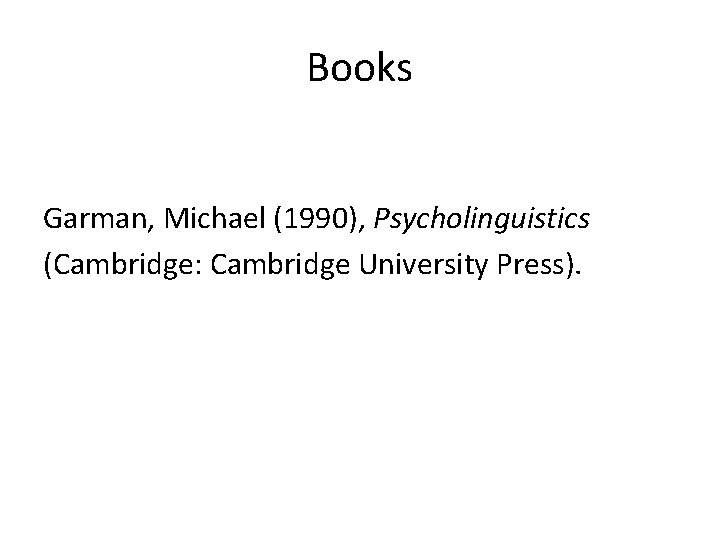
Books Garman, Michael (1990), Psycholinguistics (Cambridge: Cambridge University Press).
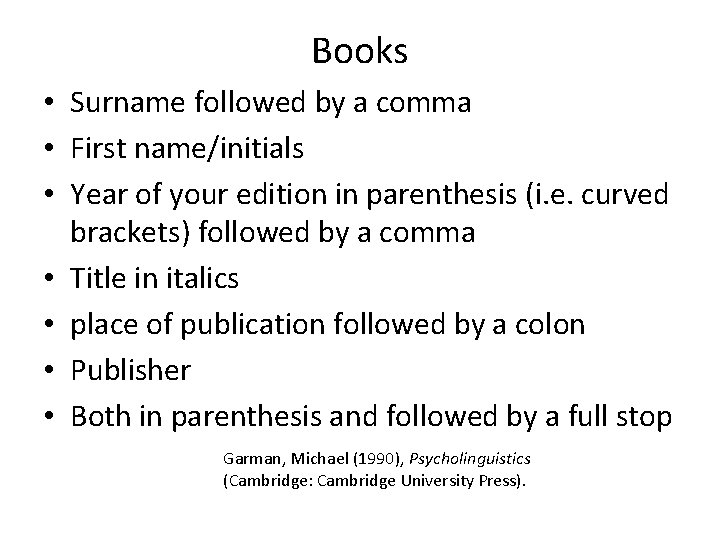
Books • Surname followed by a comma • First name/initials • Year of your edition in parenthesis (i. e. curved brackets) followed by a comma • Title in italics • place of publication followed by a colon • Publisher • Both in parenthesis and followed by a full stop Garman, Michael (1990), Psycholinguistics (Cambridge: Cambridge University Press).
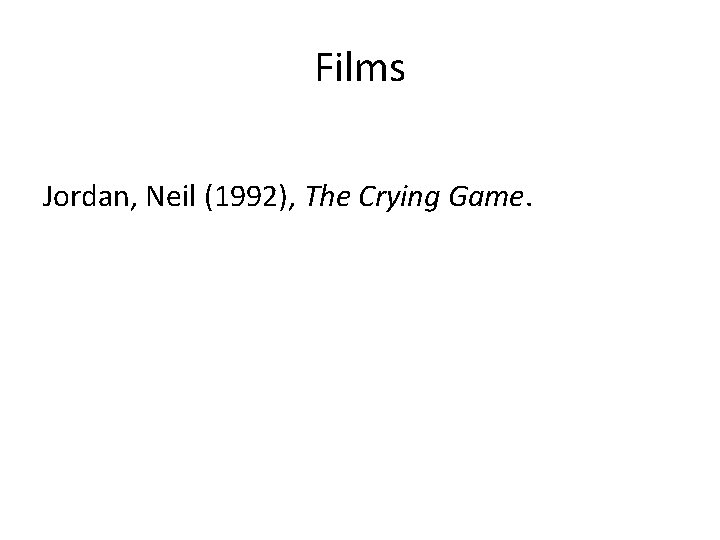
Films Jordan, Neil (1992), The Crying Game.
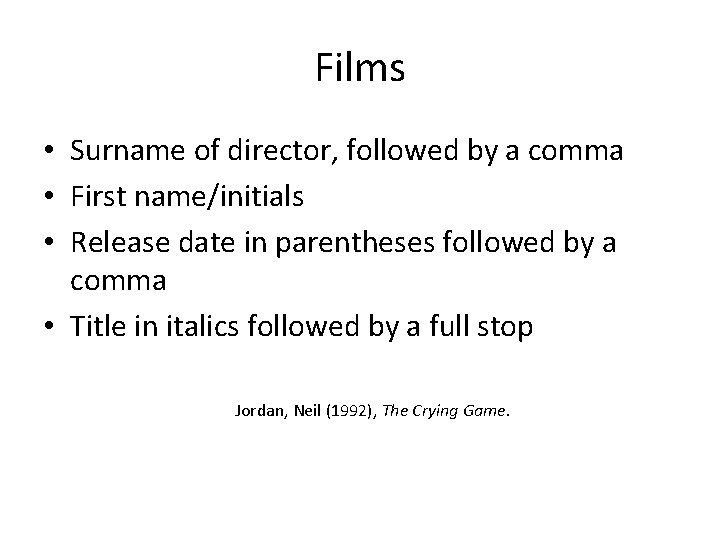
Films • Surname of director, followed by a comma • First name/initials • Release date in parentheses followed by a comma • Title in italics followed by a full stop Jordan, Neil (1992), The Crying Game.
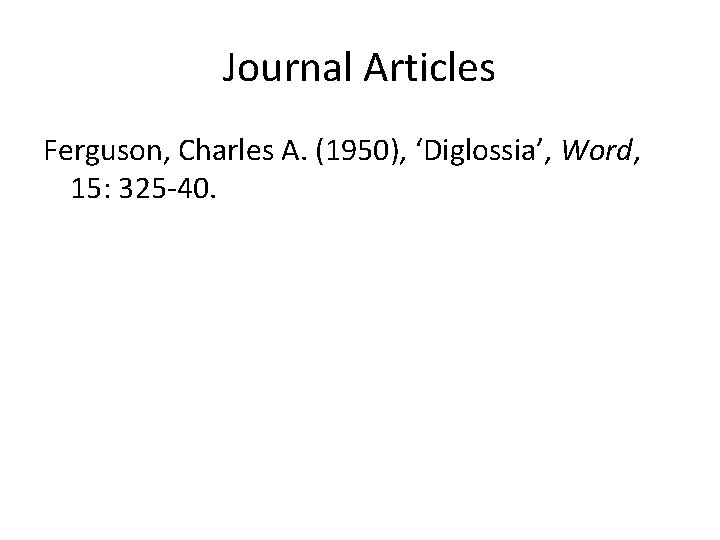
Journal Articles Ferguson, Charles A. (1950), ‘Diglossia’, Word, 15: 325 -40.
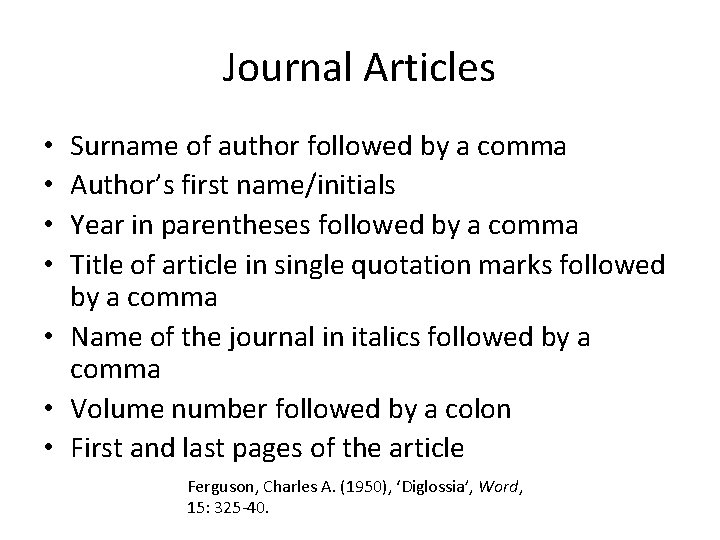
Journal Articles Surname of author followed by a comma Author’s first name/initials Year in parentheses followed by a comma Title of article in single quotation marks followed by a comma • Name of the journal in italics followed by a comma • Volume number followed by a colon • First and last pages of the article • • Ferguson, Charles A. (1950), ‘Diglossia’, Word, 15: 325 -40.
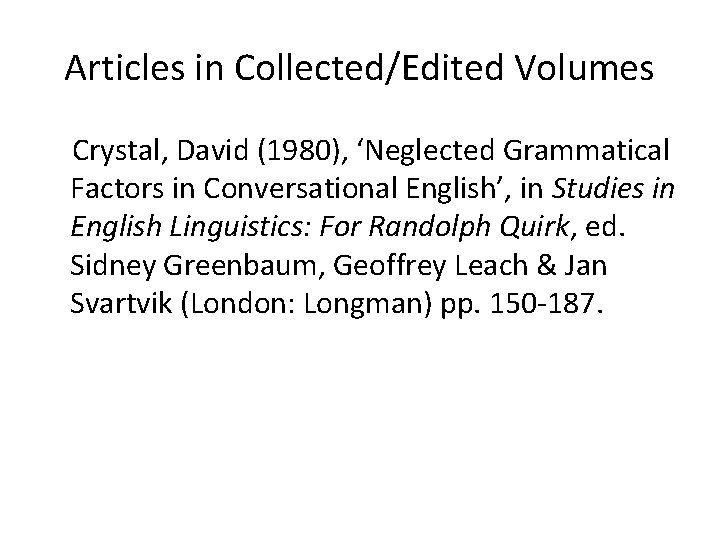
Articles in Collected/Edited Volumes Crystal, David (1980), ‘Neglected Grammatical Factors in Conversational English’, in Studies in English Linguistics: For Randolph Quirk, ed. Sidney Greenbaum, Geoffrey Leach & Jan Svartvik (London: Longman) pp. 150 -187.
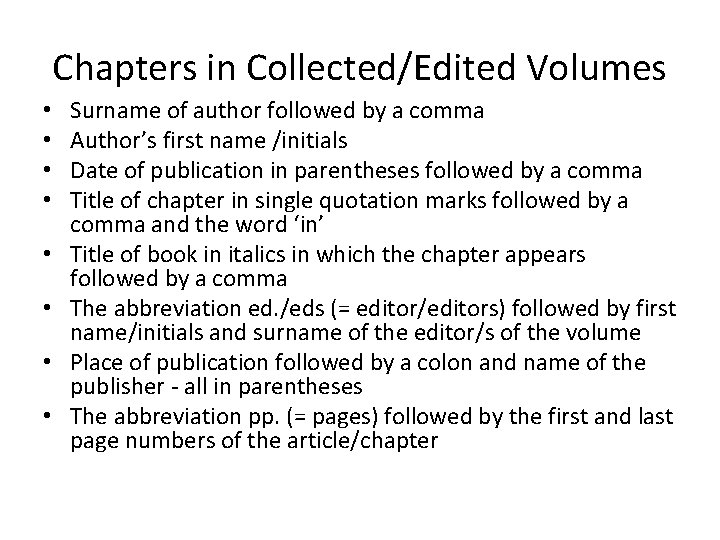
Chapters in Collected/Edited Volumes • • Surname of author followed by a comma Author’s first name /initials Date of publication in parentheses followed by a comma Title of chapter in single quotation marks followed by a comma and the word ‘in’ Title of book in italics in which the chapter appears followed by a comma The abbreviation ed. /eds (= editor/editors) followed by first name/initials and surname of the editor/s of the volume Place of publication followed by a colon and name of the publisher - all in parentheses The abbreviation pp. (= pages) followed by the first and last page numbers of the article/chapter
Electronic Media • Borrow, George (1996), The Zincali: An Account of the Gypsies of Spain, Project Gutenberg <ftp: //ftp. ibiblio. org/pub/docs/books/gutenb erg/etext 96/zncli 10. txt>, accessed 20 August 2002. OR
Electronic Media, cont’d • Bowmal, Paul et al. (1999), ‘Why “Polemics: Against Cultural Studies”? ’, Parallax [online journal], 5 (2): 1 -2 <http: //ninetta. catchword. com>, accessed 20 August 2002. Notes: first source was originally in print, second only online, hence different ways of entering in bibliography. Always put web address in < >, starting a separate line for web addresses Always provide an access date (web pages are frequently edited, put up and taken down)
3) Proper Academic Sources • Books • Journal Articles • Articles/reviews in reputable newspapers (referenced like articles in journals) • Documentaries (referenced like any other film) • Websites of reputable sources (e. g. recognised authors, critics or institutions [e. g. the BBC, The Times newspaper], etc. ) Access academic sources via libraries (QM, Senate House) and on-line: electronic texts through QM library website, Jstor, Project Guttenberg, etc. QM library offers tours, tutorials, etc. – use these!! NOT academic sources = general use/interest websites, e. g. Wikipedia; GCSE or A Level study aids, e. g. Spark Notes; random, anonymous websites; and so on …
4) Integrating Quotation • Always intro. quotation – no stand alone sentences made up entirely of a quote • Quote so that sentence is grammatically correct. 2 ways of doing this: 1) Build sentence around quote: According to James Milner, the ‘primary conflict of the Hildebrandslied is the hero’s impossible choice between political and clan loyalties’ (1987: 24). OR 2) Edit quote, using […]/[ ] to show where parts have been removed/added: In my ending, the ‘primary conflict […] between [Hildebrand’s] political and clan loyalties’ (Milner 1987: 24) is indicated when his sword waivers before striking the fatal blow. • Quote to illustrate arguments; ensure quote used actually does so! Do not quote for the sake of it
5) General Tips and Info – References and Bibliographies • No date for source use n. d. e. g. (Milner n. d. : 24) • No author then use n. a. e. g. (n. a. 1987: 24) • No page then use n. p. e. g. (Milner 1987: n. p. ) Missing page numbers common with websites. However, avoid general interest/use websites – aim for ones that may not have page numbers but do have dates and esp. authors
General Tips and Info, cont’d Bibliographies • Include every text referred to in your assignment as well as those actually quoted from in bibliography • Do not number/bullet point entries - arrange alphabetically by author’s last name • First line of each entry is hanging (i. e. indented. ‘Hanging’ formatting found under ‘paragraph’ tab on Microsoft Word) • Space needed between each entry • Do not include Jstor website info in bibliography – Jstor is just a library
- Slides: 19