
BIBLIOGRAPHIE ABORDS VASCULAIRES 2013 Mlanie Hanoy Bibliographie le

BIBLIOGRAPHIE ABORDS VASCULAIRES 2013 Mélanie Hanoy Bibliographie le 14/01/2014
Thérapie Infra rouge et Maturation des FAV • • Etude prospective, randomisée, contrôlée chez 122 patients IRC stade 4 et 5 Evaluation de la thérapie infra rouge (40 minutes X 3 / semaine pendant 12 mois) sur la maturation et la perméabilité primaire des FAV (60 patients traités, 62 patients groupe contrôle) OBJECTIF PRIMAIRE: taux de dysfonction à 12 mois - Thrombose des FAV non utilisées - Procédures radiologiques ou chirurgicales pour dose de dialyse insuffisante (Kt/V < 1, 2) pour FAV utilisées OBJECTIFS SECONDAIRES - Perméabilité primaire chirurgicale - Maturation physiologique: Q AV ≥ 500 ml/min, Diamètre veine ≥ 4 mm à 3 mois - FAV utilisable à 12 mois Chih-Ching L. and coll. Am J Kidney Dis 2013; 62 (2): 304 - 311
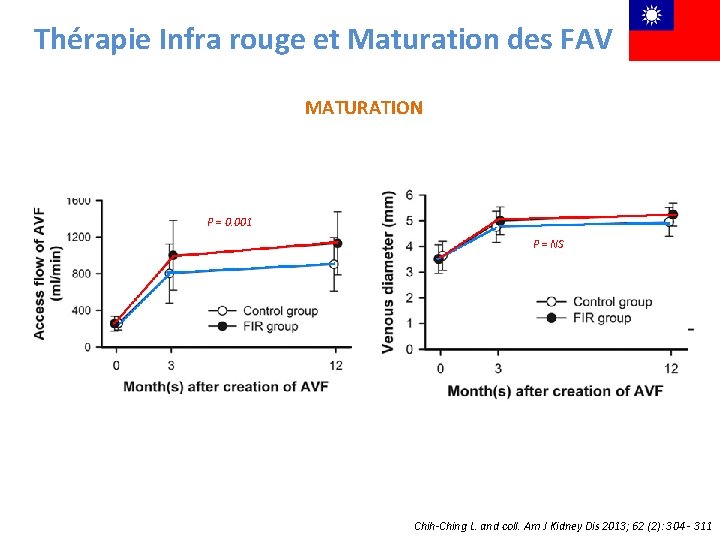
Thérapie Infra rouge et Maturation des FAV MATURATION P = 0. 001 P = NS Chih-Ching L. and coll. Am J Kidney Dis 2013; 62 (2): 304 - 311
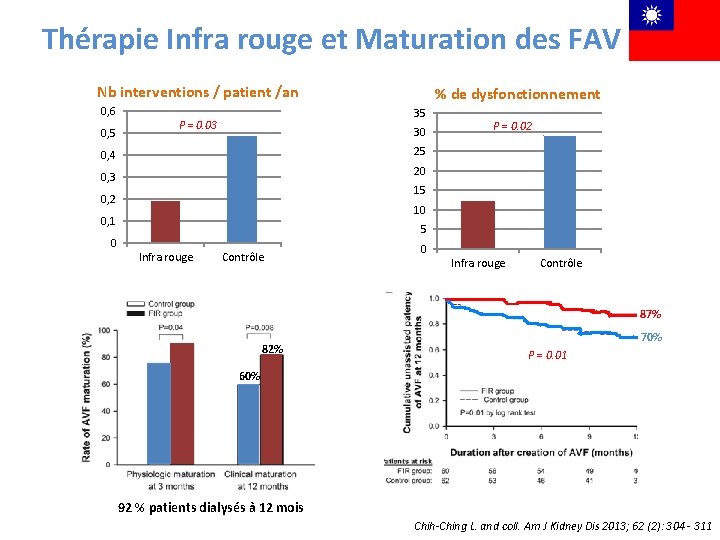
Thérapie Infra rouge et Maturation des FAV Nb interventions / patient /an 0, 6 0, 5 % de dysfonctionnement 35 P = 0. 03 30 0, 4 25 0, 3 20 P = 0. 02 15 0, 2 10 0, 1 5 0 Infra rouge Contrôle 87% 82% 70% P = 0. 01 60% 92 % patients dialysés à 12 mois Chih-Ching L. and coll. Am J Kidney Dis 2013; 62 (2): 304 - 311
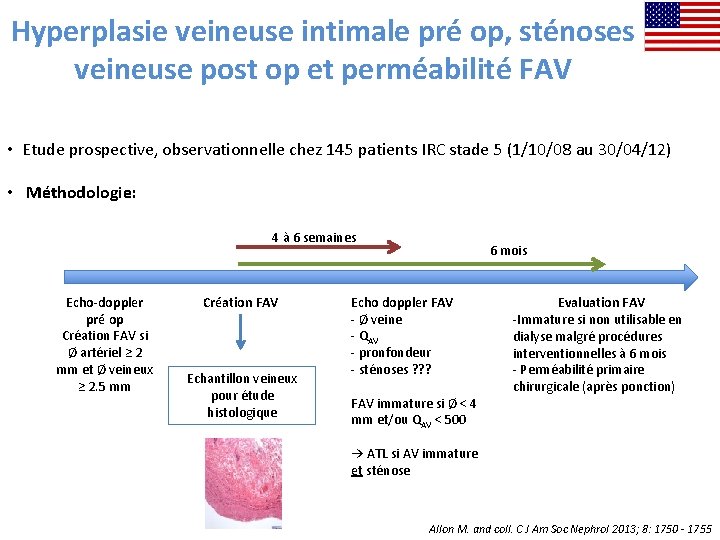
Hyperplasie veineuse intimale pré op, sténoses veineuse post op et perméabilité FAV • Etude prospective, observationnelle chez 145 patients IRC stade 5 (1/10/08 au 30/04/12) • Méthodologie: 4 à 6 semaines Echo-doppler pré op Création FAV si Ø artériel ≥ 2 mm et Ø veineux ≥ 2. 5 mm Création FAV Echantillon veineux pour étude histologique 6 mois Echo doppler FAV - Ø veine - QAV - pronfondeur - sténoses ? ? ? FAV immature si Ø < 4 mm et/ou QAV < 500 Evaluation FAV -Immature si non utilisable en dialyse malgré procédures interventionnelles à 6 mois - Perméabilité primaire chirurgicale (après ponction) → ATL si AV immature et sténose Allon M. and coll. C J Am Soc Nephrol 2013; 8: 1750 - 1755
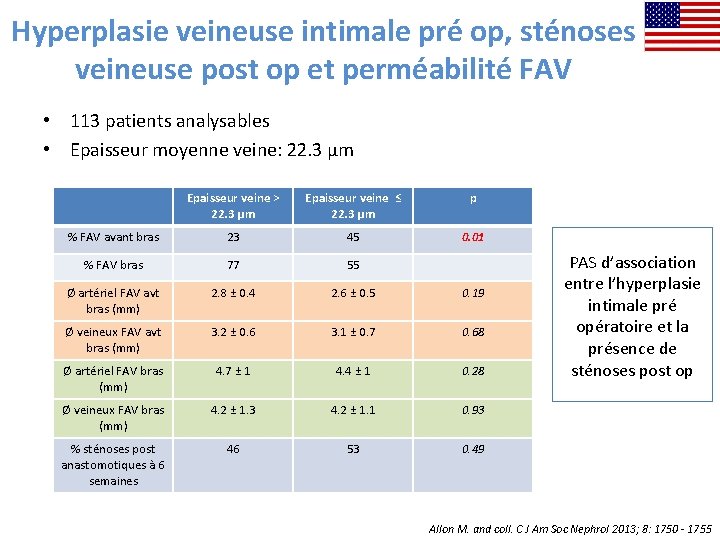
Hyperplasie veineuse intimale pré op, sténoses veineuse post op et perméabilité FAV • 113 patients analysables • Epaisseur moyenne veine: 22. 3 µm Epaisseur veine > 22. 3 µm Epaisseur veine ≤ 22. 3 µm p % FAV avant bras 23 45 0. 01 % FAV bras 77 55 Ø artériel FAV avt bras (mm) 2. 8 ± 0. 4 2. 6 ± 0. 5 0. 19 Ø veineux FAV avt bras (mm) 3. 2 ± 0. 6 3. 1 ± 0. 7 0. 68 Ø artériel FAV bras (mm) 4. 7 ± 1 4. 4 ± 1 0. 28 Ø veineux FAV bras (mm) 4. 2 ± 1. 3 4. 2 ± 1. 1 0. 93 % sténoses post anastomotiques à 6 semaines 46 53 0. 49 PAS d’association entre l’hyperplasie intimale pré opératoire et la présence de sténoses post op Allon M. and coll. C J Am Soc Nephrol 2013; 8: 1750 - 1755
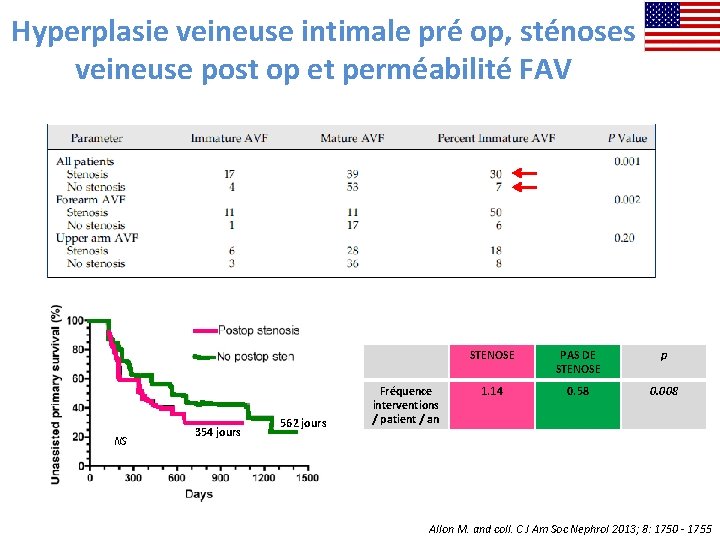
Hyperplasie veineuse intimale pré op, sténoses veineuse post op et perméabilité FAV NS 354 jours 562 jours Fréquence interventions / patient / an STENOSE PAS DE STENOSE p 1. 14 0. 58 0. 008 Allon M. and coll. C J Am Soc Nephrol 2013; 8: 1750 - 1755
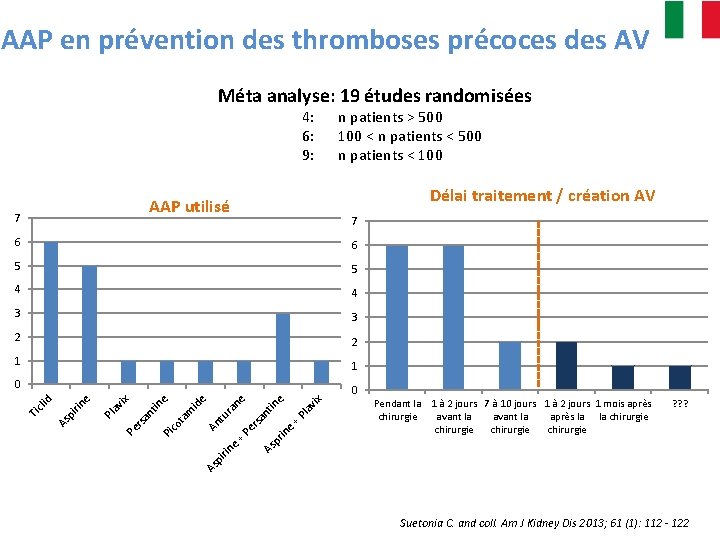
AAP en prévention des thromboses précoces des AV Méta analyse: 19 études randomisées 4: 6: 9: Délai traitement / création AV AAP utilisé 7 n patients > 500 100 < n patients < 500 n patients < 100 7 4 3 3 2 2 1 1 0 0 + e av ix e + Pl tin in ? ? ? As pi rin Pendant la 1 à 2 jours 7 à 10 jours 1 à 2 jours 1 mois après chirurgie avant la après la la chirurgie As pr Pe An tu rs an e id m ta co Pi sa nt in ix Pe r av Pl rin As pi cli Ti e 4 ra ne 5 e 6 d 6 Suetonia C. and coll. Am J Kidney Dis 2013; 61 (1): 112 - 122
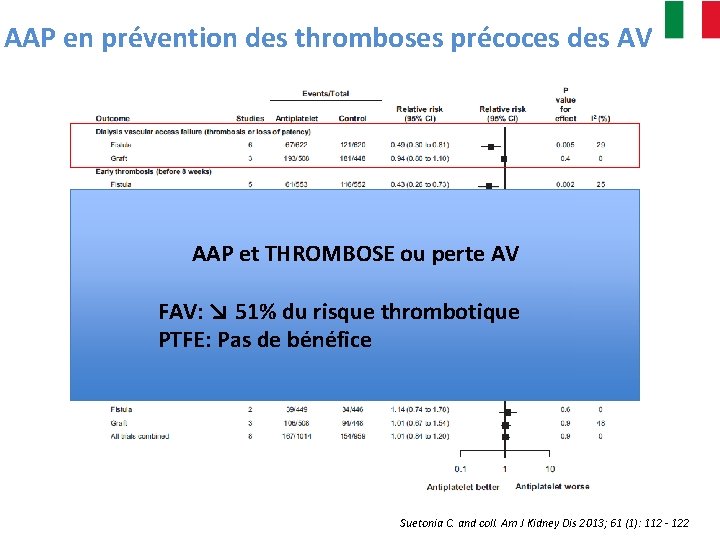
AAP en prévention des thromboses précoces des AV AAP et THROMBOSE ou perte AV FAV: ↘ 51% du risque thrombotique PTFE: Pas de bénéfice Suetonia C. and coll. Am J Kidney Dis 2013; 61 (1): 112 - 122
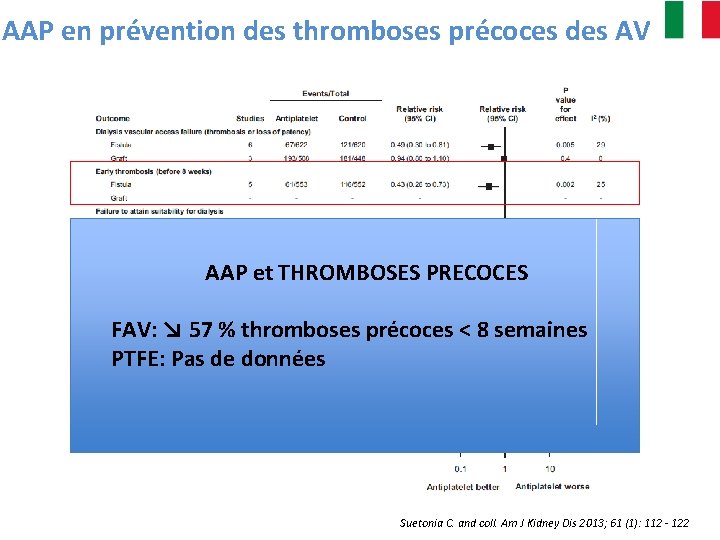
AAP en prévention des thromboses précoces des AV AAP et THROMBOSES PRECOCES FAV: ↘ 57 % thromboses précoces < 8 semaines PTFE: Pas de données Suetonia C. and coll. Am J Kidney Dis 2013; 61 (1): 112 - 122
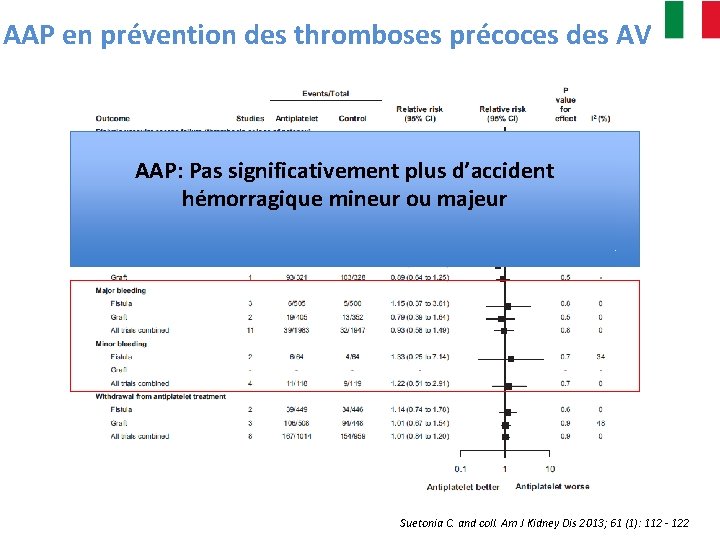
AAP en prévention des thromboses précoces des AV AAP: Pas significativement plus d’accident hémorragique mineur ou majeur Suetonia C. and coll. Am J Kidney Dis 2013; 61 (1): 112 - 122
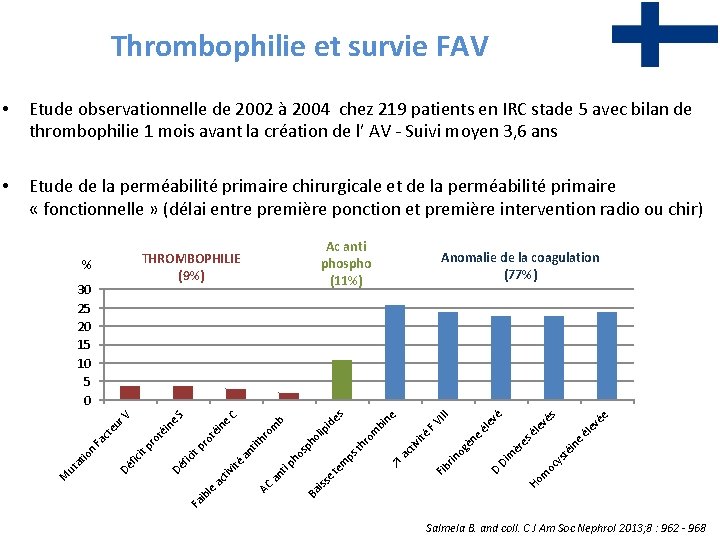
Thrombophilie et survie FAV • Etude observationnelle de 2002 à 2004 chez 219 patients en IRC stade 5 avec bilan de thrombophilie 1 mois avant la création de l’ AV - Suivi moyen 3, 6 ans • Etude de la perméabilité primaire chirurgicale et de la perméabilité primaire « fonctionnelle » (délai entre première ponction et première intervention radio ou chir) ée ev él e Ho m oc Di m èr ys té in es él ev és é ev él D Fib rin ité tiv ac ↗ og èn e FV III ne m ro th ps te m Ba iss e ph ti an AC bi id ip ol os ph hr tit an té ivi ac t le Anomalie de la coagulation (77%) Fa ib es . . b. om e ro té in tp ici Dé f pr it fic Dé ut at io n Fa ot ct éi eu ne S r. V 30 25 20 15 10 5 0 C % M Ac anti phospho (11%) THROMBOPHILIE (9%) Salmela B. and coll. C J Am Soc Nephrol 2013; 8 : 962 - 968
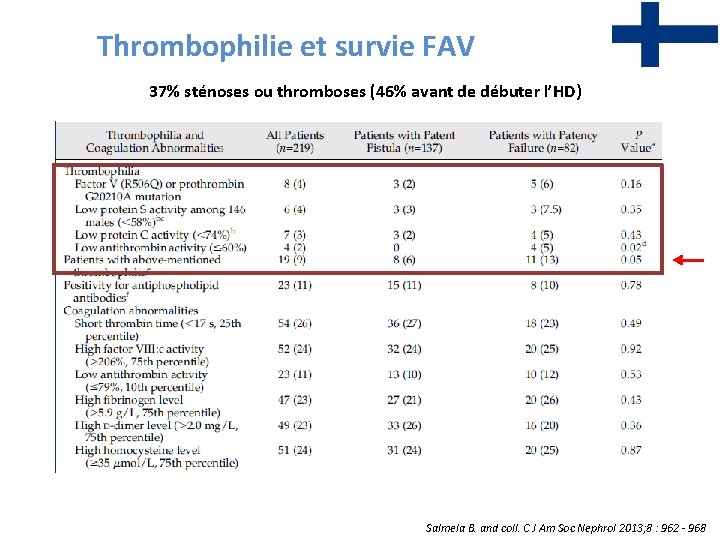
Thrombophilie et survie FAV 37% sténoses ou thromboses (46% avant de débuter l’HD) Salmela B. and coll. C J Am Soc Nephrol 2013; 8 : 962 - 968
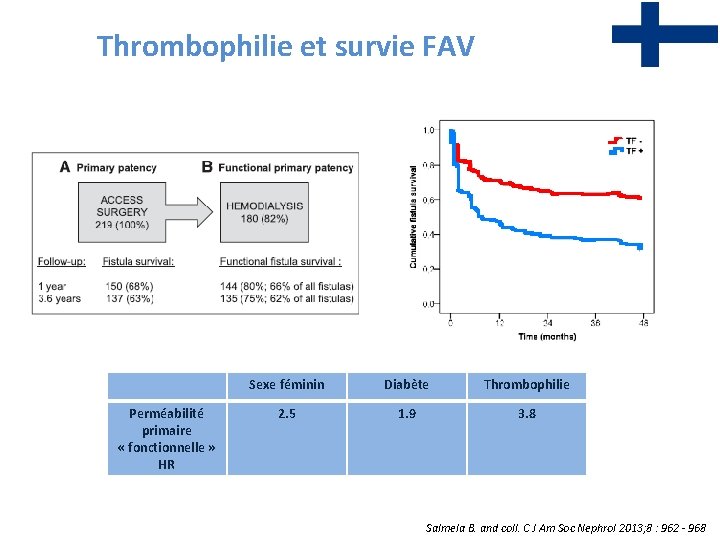
Thrombophilie et survie FAV Perméabilité primaire « fonctionnelle » HR Sexe féminin Diabète Thrombophilie 2. 5 1. 9 3. 8 Salmela B. and coll. C J Am Soc Nephrol 2013; 8 : 962 - 968
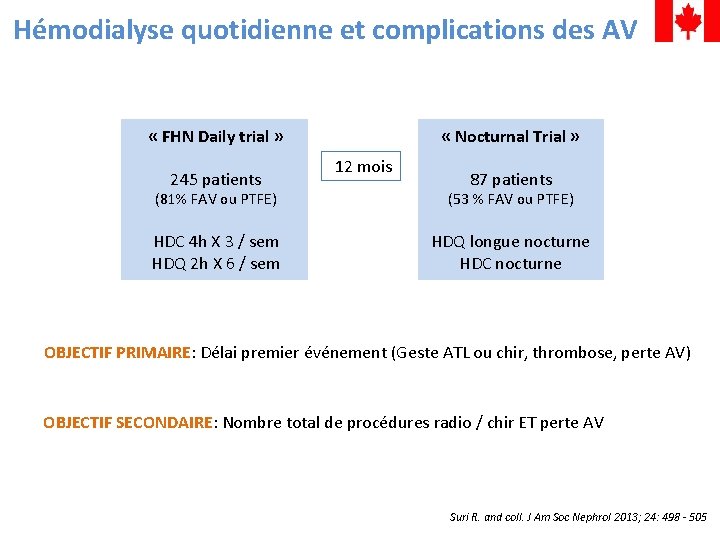
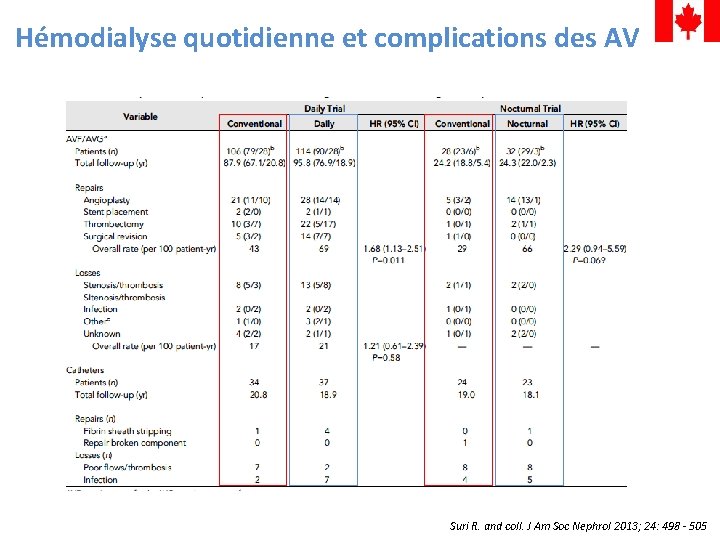
Hémodialyse quotidienne et complications des AV « FHN Daily trial » 245 patients « Nocturnal Trial » 12 mois 87 patients (81% FAV ou PTFE) (53 % FAV ou PTFE) HDC 4 h X 3 / sem HDQ 2 h X 6 / sem HDQ longue nocturne HDC nocturne OBJECTIF PRIMAIRE: Délai premier événement (Geste ATL ou chir, thrombose, perte AV) OBJECTIF SECONDAIRE: Nombre total de procédures radio / chir ET perte AV Suri R. and coll. J Am Soc Nephrol 2013; 24: 498 - 505
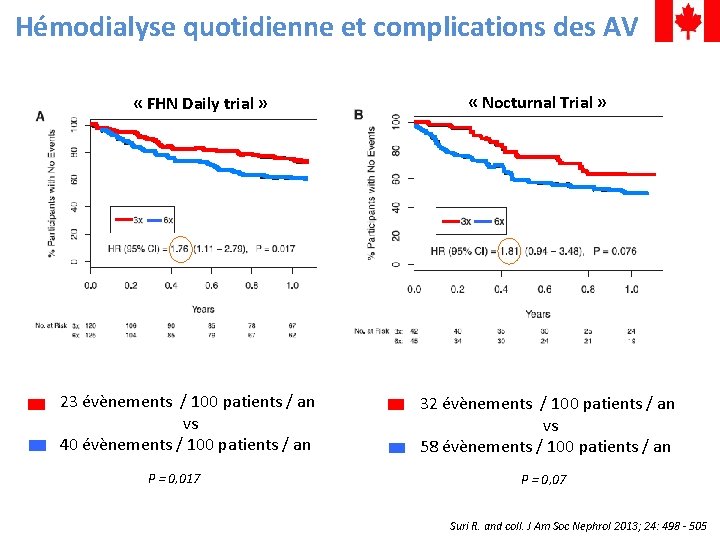
Hémodialyse quotidienne et complications des AV « FHN Daily trial » 23 évènements / 100 patients / an vs 40 évènements / 100 patients / an P = 0, 017 « Nocturnal Trial » 32 évènements / 100 patients / an vs 58 évènements / 100 patients / an P = 0, 07 Suri R. and coll. J Am Soc Nephrol 2013; 24: 498 - 505
Hémodialyse quotidienne et complications des AV Suri R. and coll. J Am Soc Nephrol 2013; 24: 498 - 505
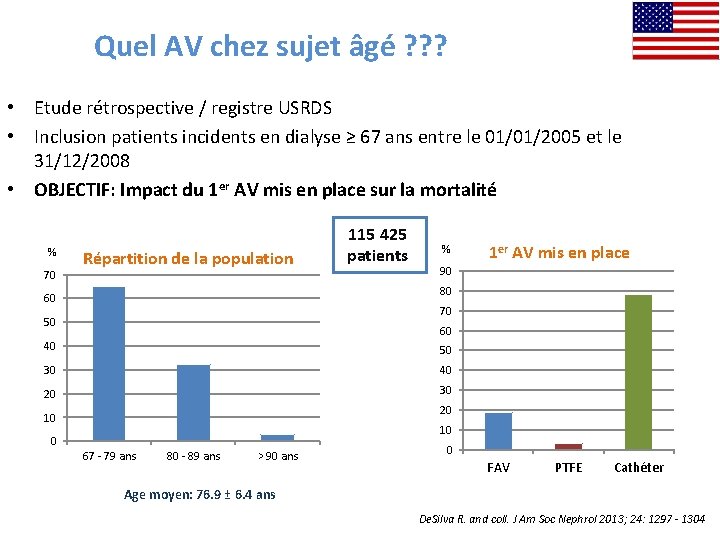
Quel AV chez sujet âgé ? ? ? • Etude rétrospective / registre USRDS • Inclusion patients incidents en dialyse ≥ 67 ans entre le 01/01/2005 et le 31/12/2008 • OBJECTIF: Impact du 1 er AV mis en place sur la mortalité % 70 Répartition de la population 115 425 patients % 1 er AV mis en place 90 80 60 70 50 60 40 50 30 40 20 30 20 10 10 0 67 - 79 ans 80 - 89 ans > 90 ans 0 FAV PTFE Cathéter Age moyen: 76. 9 ± 6. 4 ans De. Silva R. and coll. J Am Soc Nephrol 2013; 24: 1297 - 1304
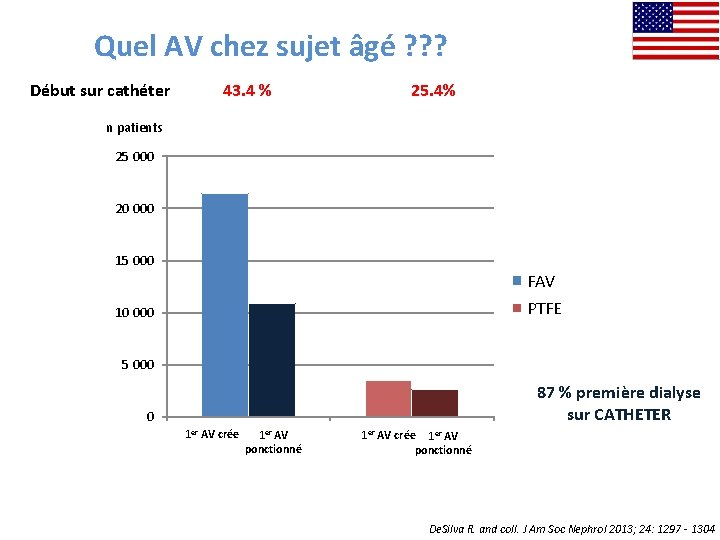
Quel AV chez sujet âgé ? ? ? Début sur cathéter 43. 4 % 25. 4% n patients 25 000 20 000 15 000 FAV PTFE 10 000 5 000 0 1 er AV créen AV 1 er AV ponctionné 1 ère ponction 1 ern. AV crée 1 er AV ponctionné 87 % première dialyse sur CATHETER De. Silva R. and coll. J Am Soc Nephrol 2013; 24: 1297 - 1304
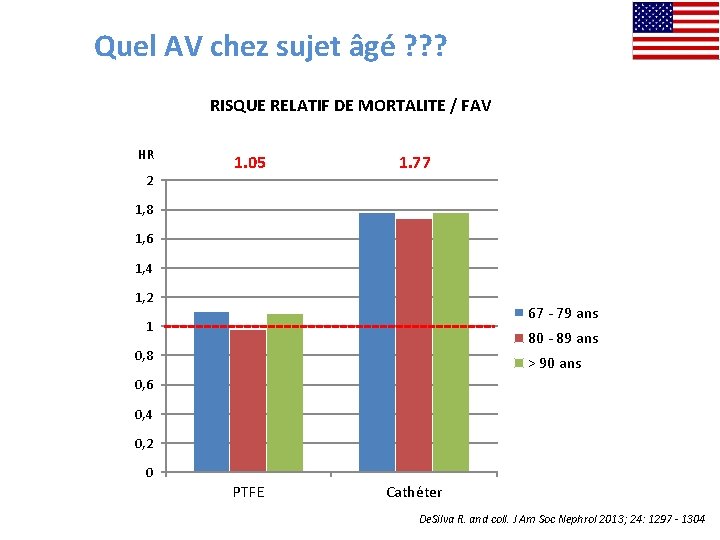
Quel AV chez sujet âgé ? ? ? RISQUE RELATIF DE MORTALITE / FAV HR 2 1. 05 1. 77 1, 8 1, 6 1, 4 1, 2 67 - 79 ans 1 80 - 89 ans 0, 8 > 90 ans 0, 6 0, 4 0, 2 0 PTFE Cathéter De. Silva R. and coll. J Am Soc Nephrol 2013; 24: 1297 - 1304
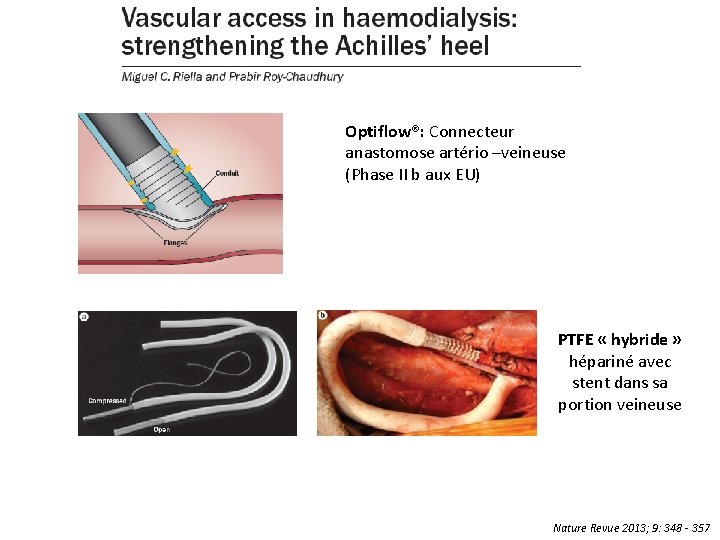
Optiflow®: Connecteur anastomose artério –veineuse (Phase II b aux EU) PTFE « hybride » hépariné avec stent dans sa portion veineuse Nature Revue 2013; 9: 348 - 357
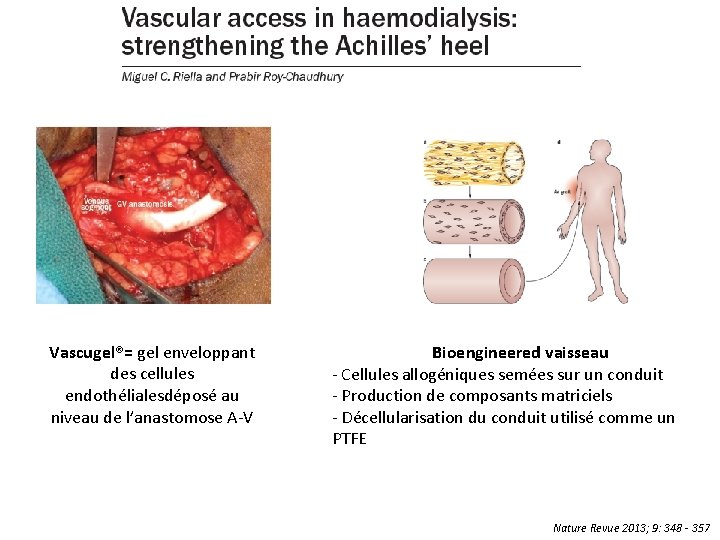
Vascugel®= gel enveloppant des cellules endothélialesdéposé au niveau de l’anastomose A-V Bioengineered vaisseau - Cellules allogéniques semées sur un conduit - Production de composants matriciels - Décellularisation du conduit utilisé comme un PTFE Nature Revue 2013; 9: 348 - 357
- Slides: 22