
Biblical Words and Their Meaning An Introduction to
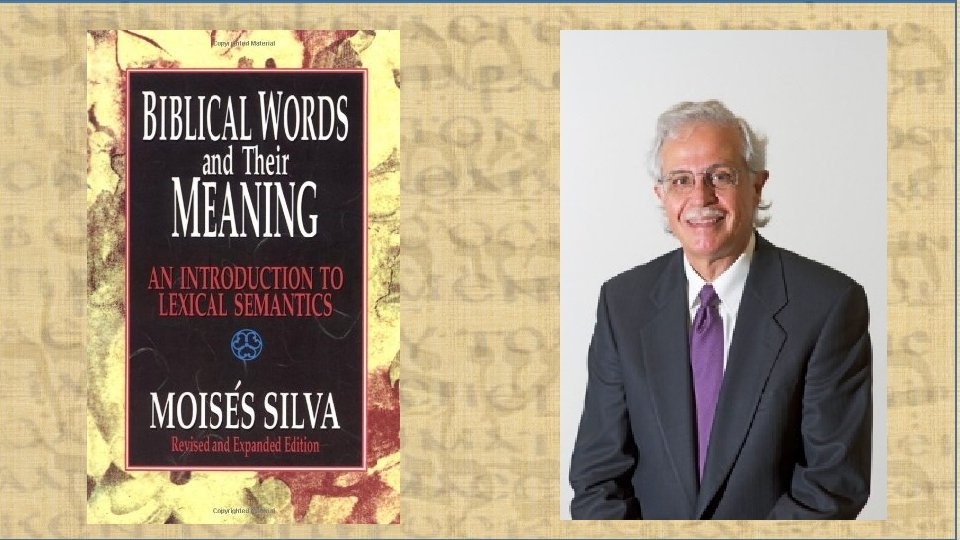
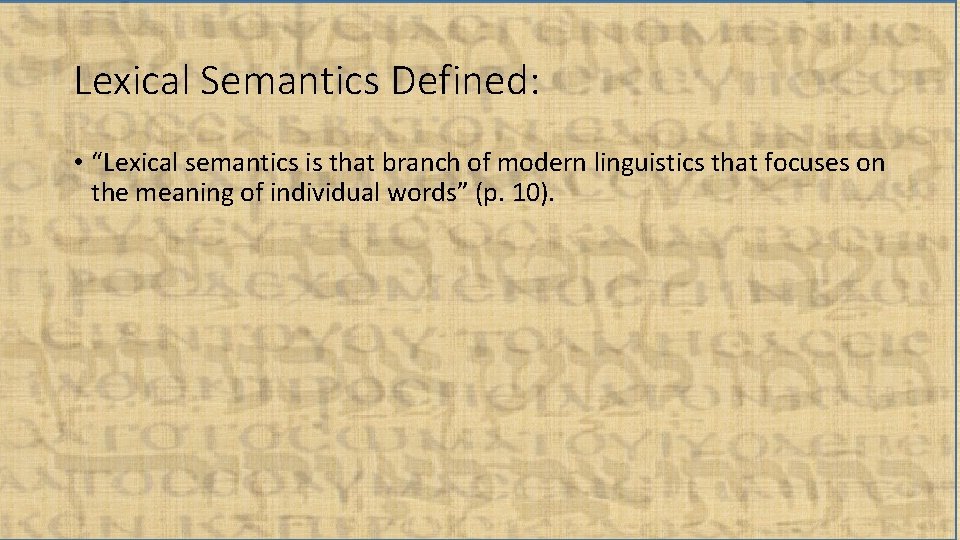
Biblical Words and Their Meaning: An Introduction to Lexical Semantics By Moisés Silva
Lexical Semantics Defined: • “Lexical semantics is that branch of modern linguistics that focuses on the meaning of individual words” (p. 10).
Introduction: James Barr and the Biblical Theology Movement • Barr’s Semantics of Biblical Language: • Barr’s work was “a trumpet blast against the monstrous regiment of shoddy linguistics” (p. 18). • The major problem was “the conviction that language and mentality can be easily correlated” (p. 18). • Barr’s criticisms were leveled primarily at the TDNT. He showed it was characterized by a confusion between words and concepts.
Introduction: James Barr and the Biblical Theology Movement • Problems: First and foremost, it locates meaning in the Bible’s words, not in its statements. Other dangers (pp. 25– 26): 1. Etymologizing 2. Illegitimate totality transfer 3. Overlooking distinct grammatical nuances in a passage 4. Overlooking semantically related terms 5. Confusion between word and thing
Introduction: James Barr and the Biblical Theology Movement • The Scope of Biblical Lexicology: • “Our goal is not to deduce theology of New Testament writers straight out of the words they use, nor even to map out semantic fields that in themselves may reflect theological structures. We have the relatively modest goal of determining the most accurate English equivalents to biblical words, of being able to decide, with as much certainty as possible, what specific Greek or Hebrew word in a specific context actually means. ” (p. 31).

PART 1: Historical Semantics
Chapter 1: Etymology • Ferdinand de Saussure, Course in General Linguistics. Distinguishes between: 1. Diachronic linguistics: studies the development of language 2. Synchronic linguistics: studies the language at any given state of the language in a particular point in time.
Chapter 1: Etymology • Etymological study: Four levels 1. Identifying component parts of words 2. Determining the “earliest attested meaning” (p. 39) 3. Reconstructing the prehistory behind the earliest attested meaning 4. Reconstructing “the form and meaning of a word in the parent language” by examining cognates (p. 40).
Chapter 1: Etymology • Etymological study: Uses 1. It is the “backbone of comparative linguistics” (p. 41) 2. It can shed light on cultural or historical issues. 3. It can help translate ancient documents. Cognate languages can shed light on word meanings if there are few attested uses of a word in a particular language, or if the usual meaning of a word does not fit a particular context. This is much more prominent in the OT than NT.
Chapter 1: Etymology • Etymology and Exegesis: 1. Often abused by scholars and pastors. 2. Diachronic approaches and synchronic approaches can be mutually beneficial to one another, but the problem is when they are “fused” (p. 47). 3. Word “transparency”: transparent words are words in which the form is related to meaning. Opaque words are words in which the relationship between form and meaning is arbitrary. 4. Greek is a synthetic language that is relatively transparent. However, we have to be sure that the user was aware of this meaning.
Chapter 1: Etymology • Cautions regarding assuming word transparency in Greek: 1. A particular part of the word may fall out of use, making it impossible that the speaker has the etymology in mind. 2. Words can undergo semantic change over time. 3. A word can acquire new motivation for use because users associate it with other words that are historically unrelated. 4. Context!
Chapter 2: Semantic Change and the Role of the Septuagint • The Rise and fall of “Biblical Greek” (Edwin Hatch) • Three issues: 1. Hebrew-Greek lexical equivalences: Adolf Deissmann (determines meaning by reference to the papyri) vs. Richard Ottley (considers the intention of the original). 2. The character of NT Greek: Deissmann has shown that NT Greek is colloquial Greek. 3. LXX influence on NT vocab: The influence of the NT is more literary and stylistic than affecting the basic structures of the language itself.
Chapter 2: Semantic Change and the Role of the Septuagint • Conclusion: The influence of the LXX on the NT (p. 68): 1. Theological terms and special vocabulary 2. Issues of style 3. One of the most important witnesses to Koine language
Chapter 2: Semantic Change and the Role of the Septuagint • Using the LXX: 1. Establish the text. 2. Interpret the text: 1. Take into account the meaning of the Hebrew term, but don’t equate it with the “meaning” of the word. 2. Exegete the entire passage in which the word is found. 3. Interpret the passages in light of the translator’s characteristics, theological emphases, and principles of translation.
Chapter 3: Semantic change in the NT • Classifying semantic change (within a language): • Logical classification: • Expansion (bread food) • Reduction (gospel, good news the gospel, the good news) • Alteration
Chapter 3: Semantic change in the NT • Classifying semantic change (within a language): • Ullmann’s distinction: semantic conservatism vs. Semantic innovation 1. Conservatism: preservation of old words for objects that have changed 2. Innovation: • Ellipsis: parts of a phrase can be omitted because they are “understood” • Metonymy: changes based on “contiguity, ” but not in the sense of similarity (which would indicate metaphor). Metaphor: transfer of meaning based on similarity • Composite changes
Chapter 3: Semantic change in the NT • Semantic borrowing (between languages). Three types: • Loan words • Loan translations • Semantic loans
Chapter 3: Semantic change in the NT • Phonetic resemblance: semantic borrowing is more likely when the word sounds similar • Semantic similarity: If word A, native meaning x, borrowed meaning y • Polysemy = Axy (the speaker perceives one word with two meanings) • Homonymy = A 1 x + A 2 y (the speaker perceives two distinct words) • No cases of homonymy are found in the NT. All examples are polysemy, with multiple examples probably unidentified.
Chapter 3: Semantic change in the NT • The causes of semantic borrowing • A speaker may seek to imitate the foreign usage for stylistic reasons • A speaker may be unaware that they are changing the way that the word is used • Cultural reasons: positive or negative associations with the foreign language.
PART 2: Descriptive Semantics
Chapter 4: Some Basic Concepts
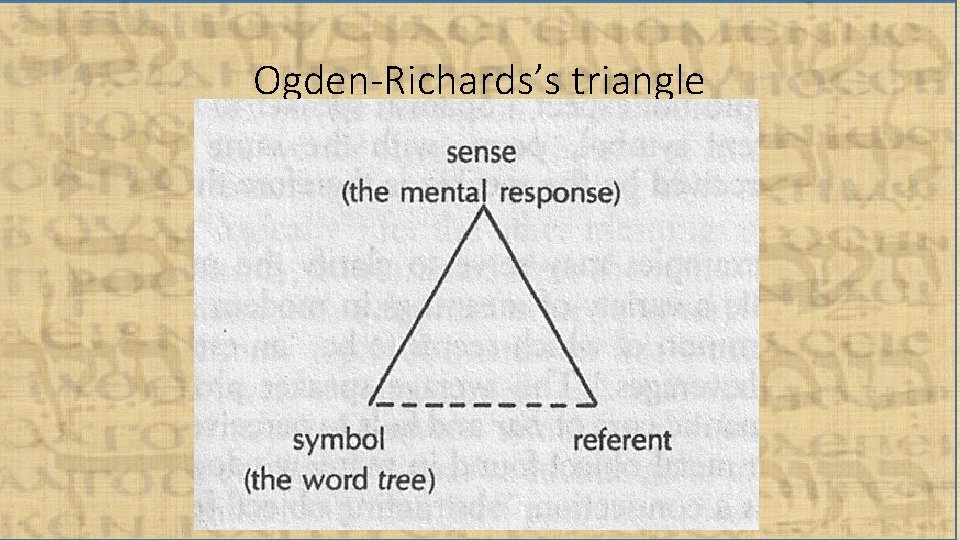
Ogden-Richards’s triangle
Chapter 4: Some Basic Concepts • Denotation: • There is a “more or less stable semantic core” of a word. • However this is does not mean it is the word’s “inherent” meaning (since most elements of a language are a matter of convention) • A “denotation” (or “reference”) view posits a direct relationship between the symbol and referent. • It is wrong to adopt this view for all words. However, this can be overemphasized, as some words do refer directly to things.
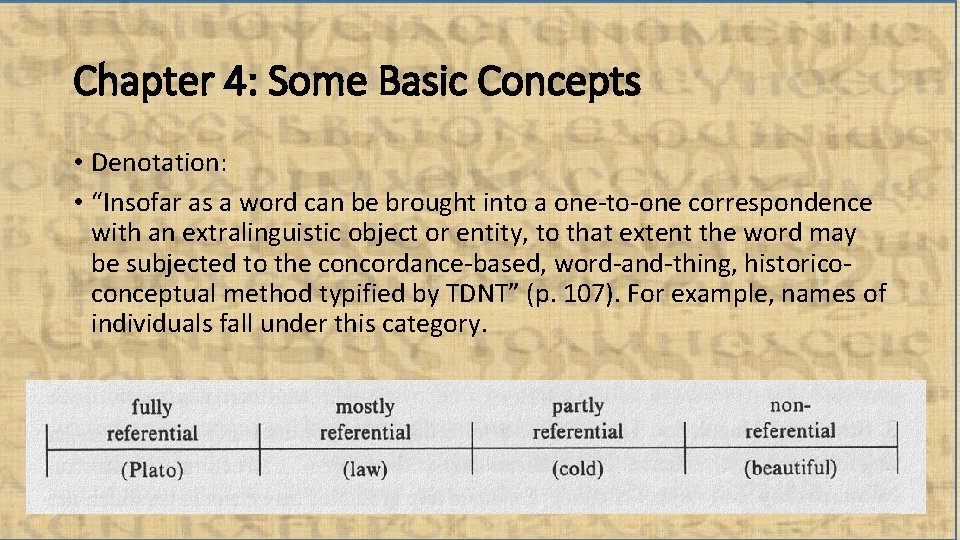
Chapter 4: Some Basic Concepts • Denotation: • “Insofar as a word can be brought into a one-to-one correspondence with an extralinguistic object or entity, to that extent the word may be subjected to the concordance-based, word-and-thing, historicoconceptual method typified by TDNT” (p. 107). For example, names of individuals fall under this category.
Chapter 4: Some Basic Concepts • Structure: the language functions based on the relationship of the various entities to each other (like a chess game) • Phonology • Vocabulary: most words have at least some meaning because of their place in the language system.
Chapter 4: Some Basic Concepts • Further distinctions: • Synonymy: one sense with several symbols. • Polysemy: one symbol with several senses • The main interest from a structural perspective is in the relationship between the senses of different symbols

Chapter 4: Some Basic Concepts • Style: the characteristic variation within language by individual users • Langue vs. parole • “. . . we may draw a rough distinction between the patterns given by a language—that is, those rules, violations of which are regarded as “unacceptable” by the linguistic community—and the variability allowed by language, with style covering the latter of these” (p. 116). • It is important to consider whether the use of a particular word is motivated by semantic or stylistic reasons.
Chapter 5: Sense Relations • Paradigmatic vs syntagmatic relations: • “The man is walking slowly. ” • “man” is in paradigmatic relations with “woman, ” “boy, ” etc. • “man” is in syntagmatic relations with the other words in the sentence.

Chapter 5: Sense Relations • Paradigmatic vs syntagmatic relations: • “To put it differently, we may say that words are in paradigmatic relation insofar as they can occupy the same slot in a particular context (or syntagm); they are in syntagmatic relation if they can enter into combinations that form a context (or syntagm). We should note that paradigmatic sense relations exploit the opposition or contrast existing between words and thus may be referred to as contrasting relations, while syntagmatic sense relations may be called combinatory relations. ” (p. 119).
Chapter 5: Sense Relations • Paradigmatic vs syntagmatic relations: • Paradigmatic relations indicate potential meanings, while syntagmatic relations has to do with meanings that are “actualized” by the syntagmatic relationship. Therefore the syntagmatic relation is determinative.
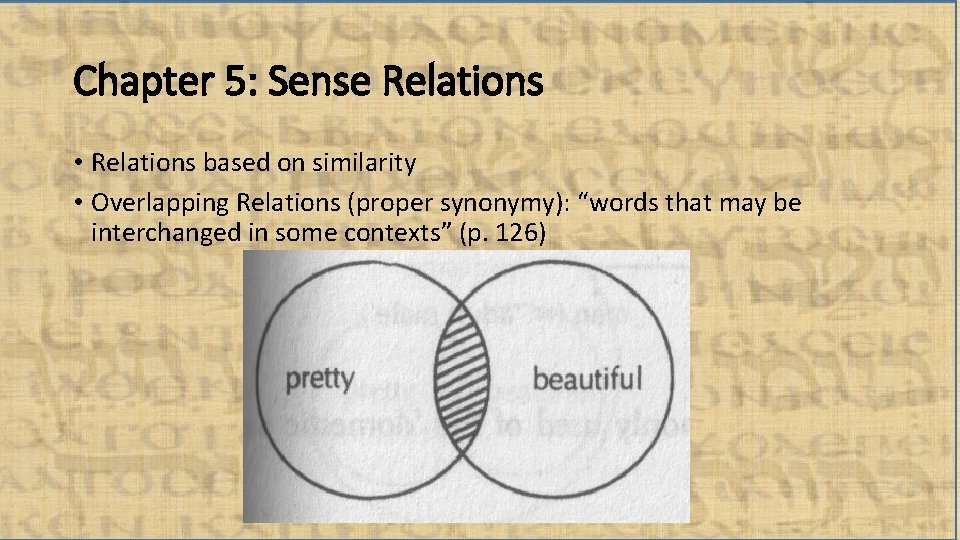
Chapter 5: Sense Relations • Relations based on similarity • Overlapping Relations (proper synonymy): “words that may be interchanged in some contexts” (p. 126)
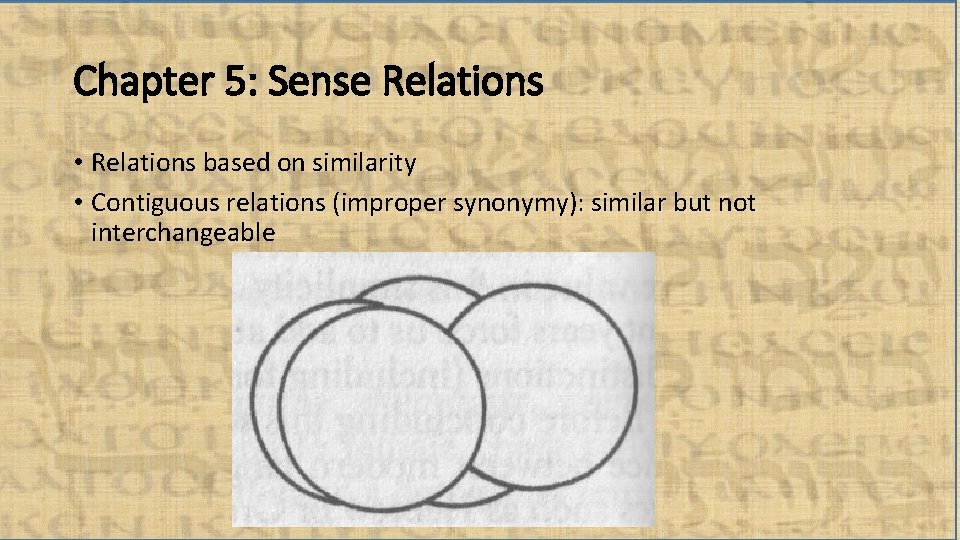
Chapter 5: Sense Relations • Relations based on similarity • Contiguous relations (improper synonymy): similar but not interchangeable
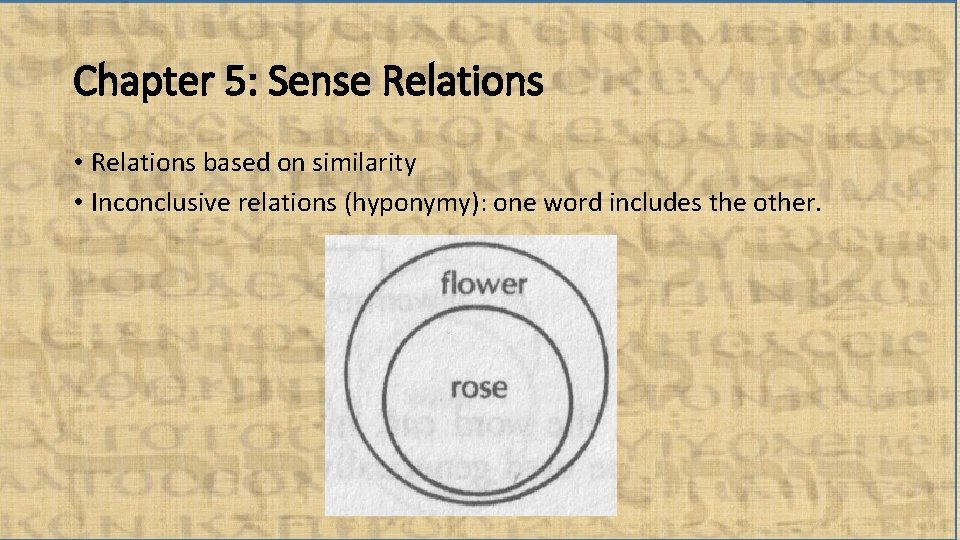
Chapter 5: Sense Relations • Relations based on similarity • Inconclusive relations (hyponymy): one word includes the other.

Chapter 5: Sense Relations • Relations based on oppositeness: • Binary relations (antonymy): comes in pairs: • Graded: always implies comparison • Nongraded: cannot be compared
Chapter 5: Sense Relations • Relations based on oppositeness: • Multiple relations (incompatibility): applies to more than two words (blue, yellow, red, black).

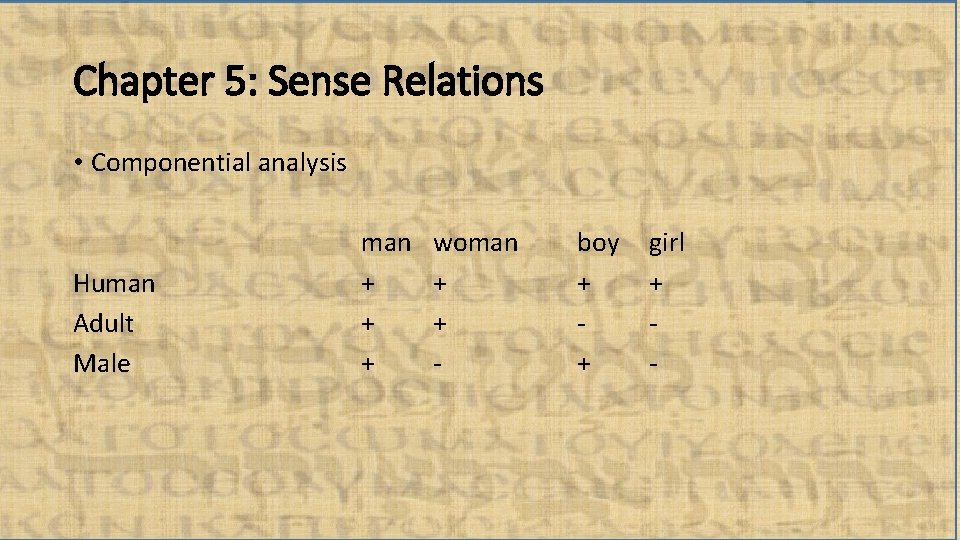
Chapter 5: Sense Relations • Componential analysis • The study of the “sense components” of words • Focuses on distinctive features and markedness • Controversial because it often notes distinctive features of the referents, rather than linguistic features. Nevertheless, Sylva says it can be profitable.
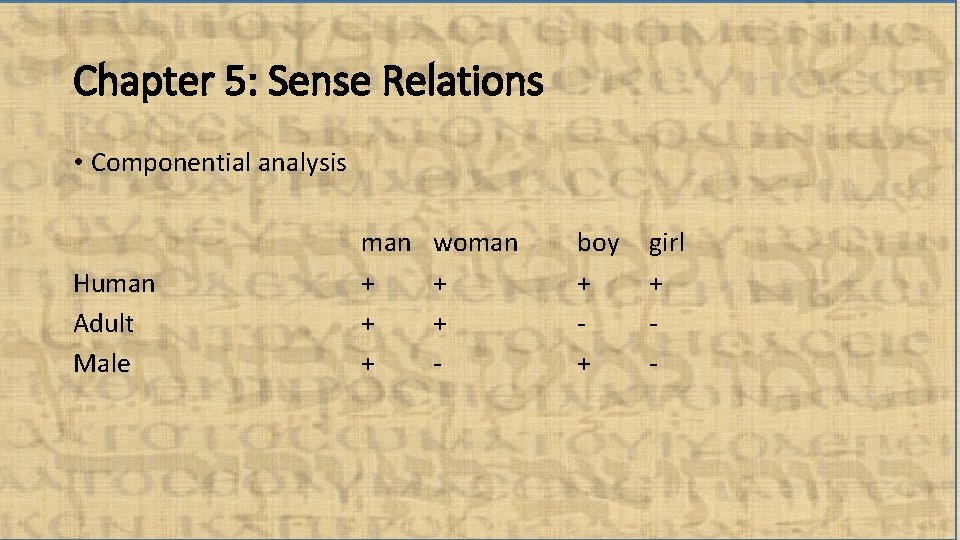
Chapter 5: Sense Relations • Componential analysis Human Adult Male man + + + woman + + - boy + + girl + -
Chapter 5: Sense Relations • Componential analysis Human Adult Male man + + + woman + + - boy + + girl + -

Chapter 6: Determining meaning • The role of lexicographers: 1. Most of the words lexicographers define are already identified. Very few words are totally unknown with regard to their meanings. Mostly it is a matter of refining what is already known. 2. Most of the lexicographer’s task is defining word meanings based on the observation of word usages in various contexts.
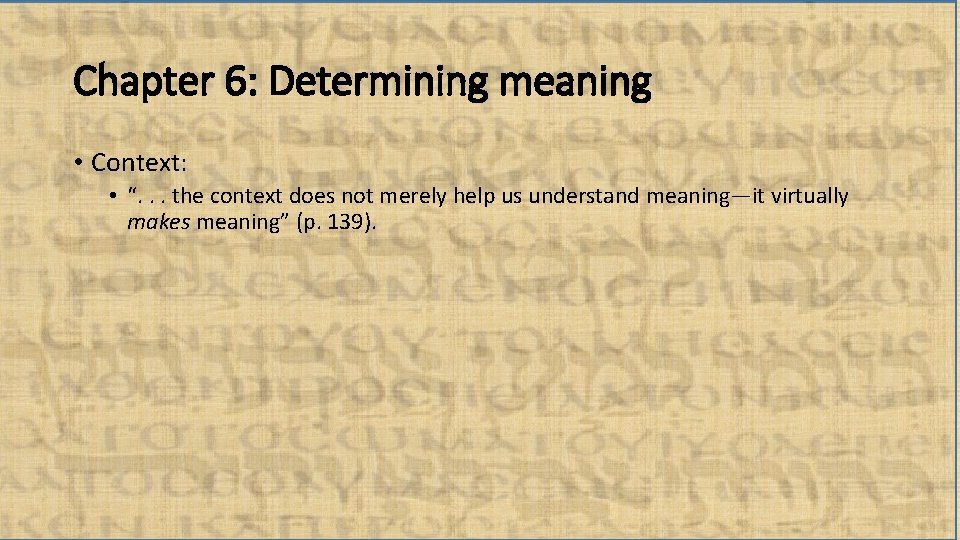
Chapter 6: Determining meaning • Context: • “. . . the context does not merely help us understand meaning—it virtually makes meaning” (p. 139).
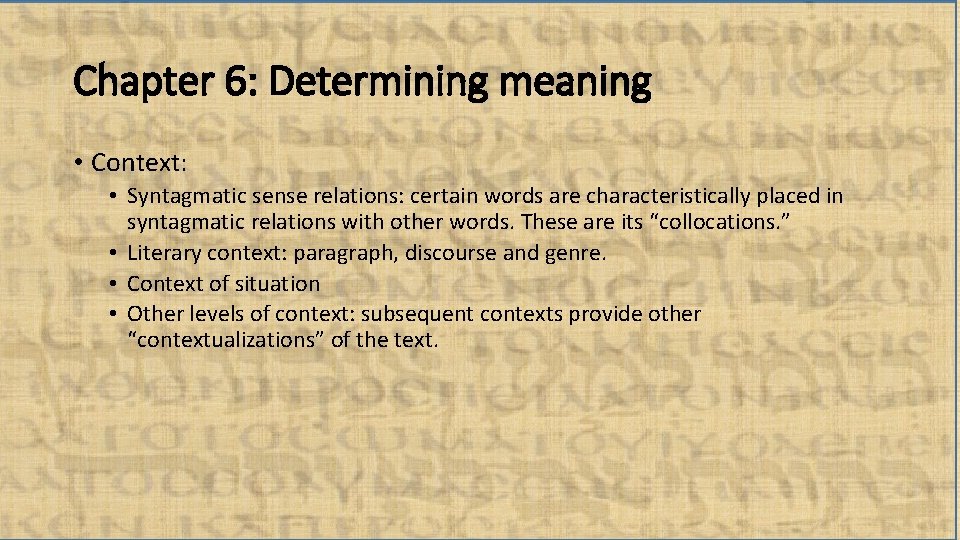
Chapter 6: Determining meaning • Context: • Syntagmatic sense relations: certain words are characteristically placed in syntagmatic relations with other words. These are its “collocations. ” • Literary context: paragraph, discourse and genre. • Context of situation • Other levels of context: subsequent contexts provide other “contextualizations” of the text.
Chapter 6: Determining meaning • Ambiguity • Deliberate: in poetry and some authors (e. g. John) • Unintended: often through loss of original context. When there is unintended ambiguity, assume maximal redundancy.
Chapter 6: Determining meaning • Ambiguity • Contextual circles: this deals with the relative weight to be assigned to different contexts. Generally speaking, closer context ought to weigh more heavily: • • • Immediate context (paragraph) Broader literary context (section) Complete literary context (book) Canonical literary context (NT) Historical religious environment
Chapter 6: Determining meaning • Synonymy: • Lexical choice: take into account style and a word’s normal collocations • Lexical fields: Based on the work of Saussure he meaning is a particular “field” is divided up by the words belonging to that field. Part of their specific meaning lies in their relationship to one another. • Semantic neutralization: when distinctions between words are overridden because of other factors (such as style or available words)
Conclusions: Suggested Steps for Doing Word Studies: 1. Determine to what extent the word is referential. For more referential words, conceptual study may be more profitable than lexical study. If lexical study is appropriate:
Conclusions: Suggested Steps for Doing Word Studies: 1. Determine to what extent the word is referential. For more referential words, conceptual study may be more profitable than lexical study. If lexical study is appropriate: 2. Using standard lexicons, look at the range of translational options.
Conclusions: Suggested Steps for Doing Word Studies: 1. Determine to what extent the word is referential. For more referential words, conceptual study may be more profitable than lexical study. If lexical study is appropriate: 2. Using standard lexicons, look at the range of translational options. 3. Consider the paradigmatic relations, looking for the semantic field. Try to classify the various other options that are paradigmatically related to the term.
Conclusions: Suggested Steps for Doing Word Studies: 1. Determine to what extent the word is referential. For more referential words, conceptual study may be more profitable than lexical study. If lexical study is appropriate: 2. Using standard lexicons, look at the range of translational options. 3. Consider the paradigmatic relations, looking for the semantic field. Try to classify the various other options that are paradigmatically related to the term. 4. Consider the syntagmatic relations, including the levels of context. Compare with paradigmatically related terms.
Conclusions: Suggested Steps for Doing Word Studies: 1. Determine to what extent the word is referential. For more referential words, conceptual study may be more profitable than lexical study. If lexical study is appropriate: 2. Using standard lexicons, look at the range of translational options. 3. Consider the paradigmatic relations, looking for the semantic field. Try to classify the various other options that are paradigmatically related to the term. 4. Consider the syntagmatic relations, including the levels of context. Compare with paradigmatically related terms. 5. Consider whether the diachronic dimension is significant. Is the etymology known? How transparent is the term? Has the meaning changed? Have foreign influences interfered with the meaning?
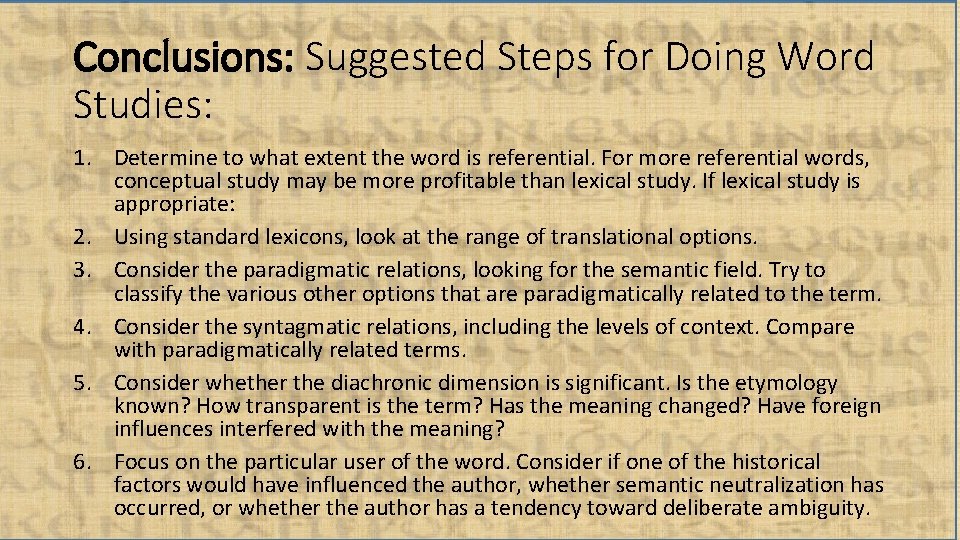
Conclusions: Suggested Steps for Doing Word Studies: 1. Determine to what extent the word is referential. For more referential words, conceptual study may be more profitable than lexical study. If lexical study is appropriate: 2. Using standard lexicons, look at the range of translational options. 3. Consider the paradigmatic relations, looking for the semantic field. Try to classify the various other options that are paradigmatically related to the term. 4. Consider the syntagmatic relations, including the levels of context. Compare with paradigmatically related terms. 5. Consider whether the diachronic dimension is significant. Is the etymology known? How transparent is the term? Has the meaning changed? Have foreign influences interfered with the meaning? 6. Focus on the particular user of the word. Consider if one of the historical factors would have influenced the author, whether semantic neutralization has occurred, or whether the author has a tendency toward deliberate ambiguity.
- Slides: 51