
Biblical Manuscripts Translations and Genres SCTR 19 Religions
Biblical Manuscripts, Translations, and Genres SCTR 19: Religions of the Book by Molly Leaverton
Why are there Different Versions of the Bible Today? n Manuscripts = ancient (or modern) texts "written by hand“ n n We have no original manuscripts, only “copies of copies” n n often copies of copies, with significant differences Original manuscripts written 100’s of years after events Existing copies even later, up until invention of printing (16 th Cent. ) Oldest HB texts (prior to 1945): "Masoretic text" (9 th -10 th CE) Copies we DO have contain numerous textual variations: n Many small differences n n Spelling, grammar, word choice Some larger differences n n Book placement Omission of books altogether
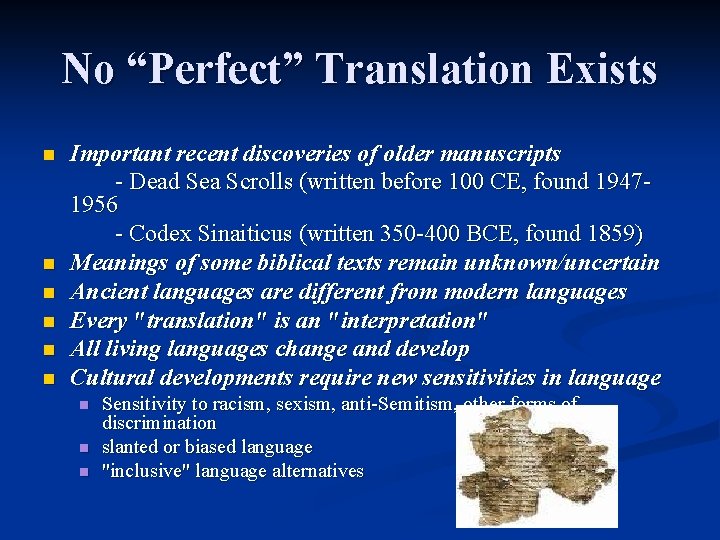
No “Perfect” Translation Exists n n n Important recent discoveries of older manuscripts - Dead Sea Scrolls (written before 100 CE, found 19471956 - Codex Sinaiticus (written 350 -400 BCE, found 1859) Meanings of some biblical texts remain unknown/uncertain Ancient languages are different from modern languages Every "translation" is an "interpretation" All living languages change and develop Cultural developments require new sensitivities in language n n n Sensitivity to racism, sexism, anti-Semitism, other forms of discrimination slanted or biased language "inclusive" language alternatives
What is the Difference between a Translation and an Edition? n Translation of the Bible n n n Interpretation of the meaning of the Bible from original languages into another (modern) language Ex: King James Bible, Authorized Version, New English Bible, Revised Standard Version, New American Bible, etc. Edition of the Bible n n n Publication of an already published translation Adds introductions, study helps, commentary, or references to existing translation Ex: “Study Edition”; “Children’s Edition”; “Catholic Study Bible”; “Oxford Study Bible”
English Biblical Translations Over 500 different English translations of Bible n Modern Translations are More Accurate n Changes in English over the centuries n New discoveries in past 50 -150 years n

Two Types of Translations Used in Modern Bibles n “Formal Correspondence Translations” n n n Preserve original wording & word-order of Hebrew & Greek Require explanations (footnotes) to avoid misinterpretations Good for in-depth academic study of the Bible Difficult to understand when heard or read aloud Ex: Douay-Rheims, KJV/NKJV, RSV/NRSV, NAB, NIV “Dynamic Equivalence Translations” n n Focus on meaning & ideas, not “word for word” translation better for public proclamation or liturgical use
Alternative Translations n “Biblical Paraphrases” Not (don’t even claim to be) accurate translations n Often intended for children or teenagers n Condense and/or omit much of the material n Freely change the wording of the original texts n n “Amplified Bible” n "amplifies" text, adding many extra words & phrases
What is a Genre? "GENRE”- category or type of literature (or of art, music, etc. ) characterized by a particular form, style, or content. n Ways of Distinguishing n Verbal vs. nonverbal n Poetry vs. prose n Place/Form published n Smaller genres or subgroups n
Literary Genre n Genres & Sub-genres: n Fiction vs. Non-Fiction n Biographies, histories, technical manuals, textbooks, poetic anthologies, legal codes, etc. n Some publications contain multiple genres Newspapers have news articles, editorials, comics, sports results, financial reports, classified ads, obituaries, movie reviews, etc. n Bible similarly contains many different genres n
Hebrew Bible Genres n n n n n Foundational Myths & Legends (Genesis, parts of Exodus, Numbers, Deuteronomy) Legal Codes (Leviticus, parts of Exod, Numb, Deut) Genealogies (parts of Genesis, much of Numbers) Annals (Josh, Judges, 1 & 2 Samuel, 1 & 2 Kings, etc. ) Prophetic Books (Isaiah, Jeremiah, Ezekiel, etc. ) Psalms/Odes/Songs (Psalms) Prayers/Laments (Lamentations) Proverbs (Proverbs) Wisdom Literature (Job, Wisdom, etc. ) Apocalypse (Daniel)
New Testament Genres Gospels (Mark, Matt, Luke, John) n Acts (Acts) n Letters (esp. Paul's) n Church Orders (1 Timothy, Titus) n Testament (2 Timothy & 2 Peter) n Homily/Sermon (Hebrews) n Wisdom Collection (James) n Epistles/Encyclicals (1 & 2 Peter) n Apocalypse (Revelation) n
Summary Bible is not one book, but a library n Bible contains many different literary genres n No “perfect” translation of the Bible exists n Different translations dramatically affect our understanding of the Bible’s meaning n Recent discoveries & developments make modern translations more accurate n
- Slides: 12