
Biblical Hebrew Lesson 4 The Hebrew Caf thehebrewcafe
Biblical Hebrew Lesson 4 The Hebrew Café thehebrewcafe. com/forum א Textbook: Cook & Holmstedt’s Biblical Hebrew: A Student Grammar (2009) Found here online: http: //individual. utoronto. ca/holmstedt/Textbook. html
Review חזרה The Hebrew Café Slide 2 thehebrewcafe. com/forum
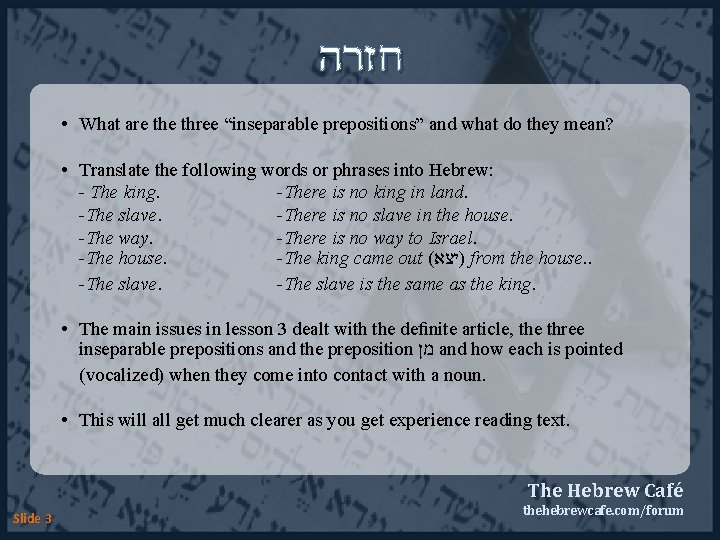
חזרה • What are three “inseparable prepositions” and what do they mean? • Translate the following words or phrases into Hebrew: - The king. -There is no king in land. -The slave. -There is no slave in the house. -The way. -There is no way to Israel. -The house. -The king came out ( )יצא from the house. . -The slave is the same as the king. • The main issues in lesson 3 dealt with the definite article, the three inseparable prepositions and the preposition מן and how each is pointed (vocalized) when they come into contact with a noun. • This will all get much clearer as you get experience reading text. The Hebrew Café Slide 3 thehebrewcafe. com/forum
Nouns in Hebrew שמות עצם The Hebrew Café Slide 4 thehebrewcafe. com/forum
שמות עצם In English, we say that a noun is a person, place, thing or idea. Thus, “friend” is a noun, since it is a person; “school” is a noun, since it is a place; “pencil” is a noun, since it is a thing; and, “attention” is a noun, since it is an idea. Generally, nouns in English are made plural by adding –s or –es to the end of the word. Thus, we have dog-dogs, boy-boys, friend-friends and lady-ladies. There are irregular plurals in English, such as woman-women and children. Possession is shown regularly by adding ’s to singular nouns (my friend’s house) and just ’ to plural nouns (my friends’ house). Possessives are always placed before the head of noun phrases in English. The Hebrew Café Slide 5 thehebrewcafe. com/forum
שמות עצם In Hebrew, by comparison, nouns are again representative of persons, places, things and ideas. ( מלך king) is a noun. ( שמים heaven) is a noun. ( שיר song/poem) is a noun. And, ( אהבה love) is a noun. All nouns in Hebrew are either masculine or feminine in gender. Even nouns that don’t have gender in English do in Hebrew. For example, “table, ” “throne” and “day” are masculine, while “land, ” “ground” and “commandment” are feminine. There’s no real reason behind how the language decides what is masculine and feminine, but there are signs in the words themselves to indicate whether they are masculine or feminine (most of the time). The Hebrew Café Slide 6 thehebrewcafe. com/forum

שמות עצם Hebrew grammar books generally say that masculine nouns are unmarked in the singular (they have no ending – just the root letters) and are marked with ים in the plural, while feminine nouns end in either ה or ת and are marked with ות in the plural. Examples of this are: ילד – ילדים כלב – כלבים מלך – מלכים ילדה – ילדות כלבה – כלבות מלכה – מלכות kingdog (m. )boy queendog (f. )girl דבר – דברים מלכות – מלכיות סוסה – סוסות kingshipmareword, message The Hebrew Café Slide 7 thehebrewcafe. com/forum

שמות עצם The fact is, though, that “exceptions” make up about 30% of the cases. So, really, a masculine noun can have a feminine-looking plural ( אבות - אב – father). All of these words are masculine. Notice the “feminine” ending. כסא – כסאות חלום – חלומות חלון – חלונות dreamwindowchair, throne שלחן – שלחנות אב – אבות fathertable These nouns are feminine with “masculine” endings: עיר – ערים שנה – שנים מלה – מלים wordyearcity The Hebrew Café Slide 8 thehebrewcafe. com/forum
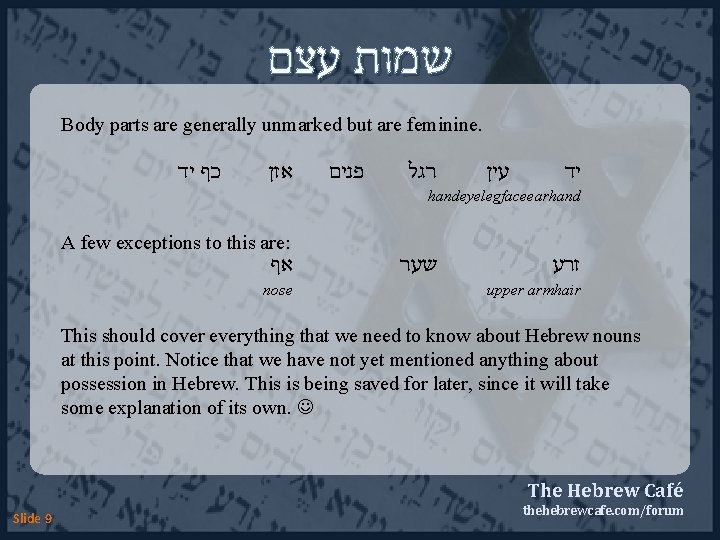
שמות עצם Body parts are generally unmarked but are feminine. כף יד אזן A few exceptions to this are: אף nose פנים רגל עין יד handeyelegfaceearhand שער זרע upper armhair This should cover everything that we need to know about Hebrew nouns at this point. Notice that we have not yet mentioned anything about possession in Hebrew. This is being saved for later, since it will take some explanation of its own. The Hebrew Café Slide 9 thehebrewcafe. com/forum
Comments on Verbs הערות על־פעלים The Hebrew Café Slide 10 thehebrewcafe. com/forum
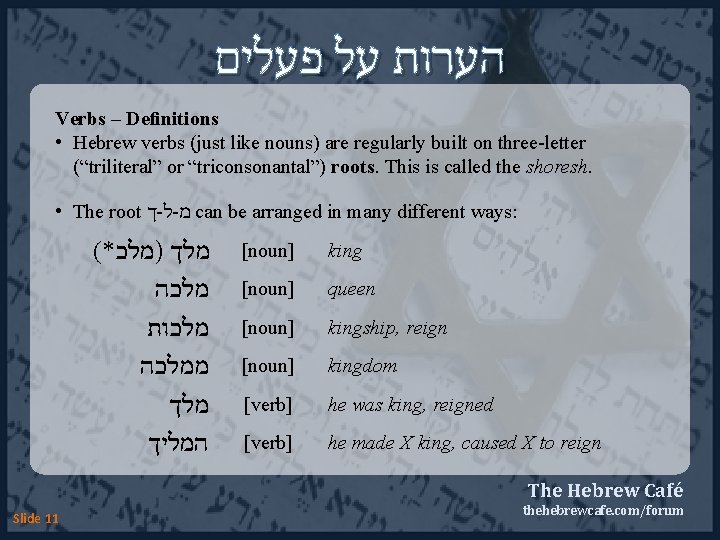
הערות על פעלים Verbs – Definitions • Hebrew verbs (just like nouns) are regularly built on three-letter (“triliteral” or “triconsonantal”) roots. This is called the shoresh. • The root ך - ל - מ can be arranged in many different ways: (* מלך )מלכ מלכה מלכות ממלכה מלך המליך [noun] king [noun] queen [noun] kingship, reign [noun] kingdom [verb] he was king, reigned [verb] he made X king, caused X to reign The Hebrew Café Slide 11 thehebrewcafe. com/forum
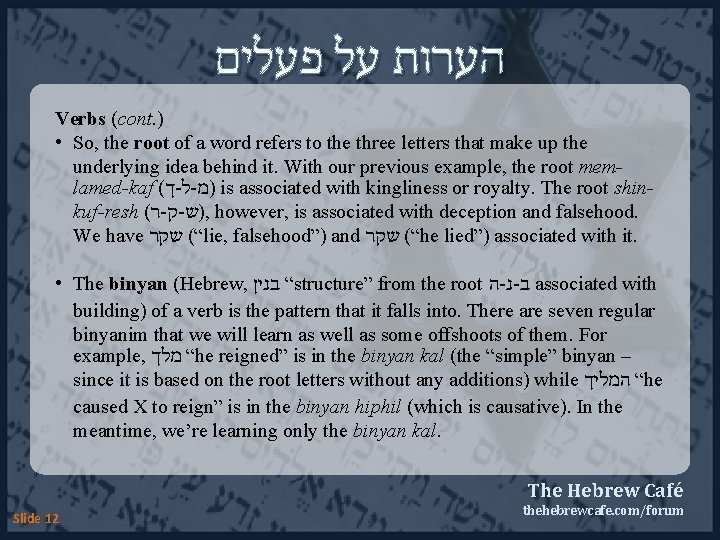
הערות על פעלים Verbs (cont. ) • So, the root of a word refers to the three letters that make up the underlying idea behind it. With our previous example, the root memlamed-kaf ( ך - ל - )מ is associated with kingliness or royalty. The root shinkuf-resh ( ר - ק - )ש , however, is associated with deception and falsehood. We have “( שקר lie, falsehood”) and “( שקר he lied”) associated with it. • The binyan (Hebrew, “ בנין structure” from the root ה - נ - ב associated with building) of a verb is the pattern that it falls into. There are seven regular binyanim that we will learn as well as some offshoots of them. For example, “ מלך he reigned” is in the binyan kal (the “simple” binyan – since it is based on the root letters without any additions) while “ המליך he caused X to reign” is in the binyan hiphil (which is causative). In the meantime, we’re learning only the binyan kal. The Hebrew Café Slide 12 thehebrewcafe. com/forum
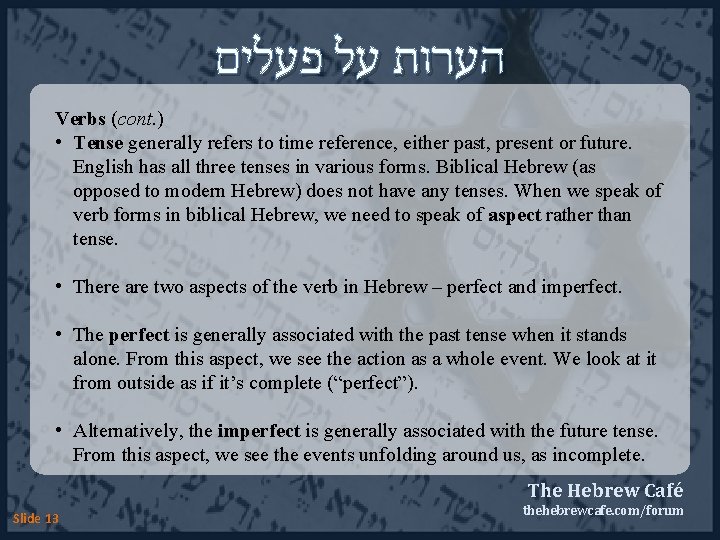
הערות על פעלים Verbs (cont. ) • Tense generally refers to time reference, either past, present or future. English has all three tenses in various forms. Biblical Hebrew (as opposed to modern Hebrew) does not have any tenses. When we speak of verb forms in biblical Hebrew, we need to speak of aspect rather than tense. • There are two aspects of the verb in Hebrew – perfect and imperfect. • The perfect is generally associated with the past tense when it stands alone. From this aspect, we see the action as a whole event. We look at it from outside as if it’s complete (“perfect”). • Alternatively, the imperfect is generally associated with the future tense. From this aspect, we see the events unfolding around us, as incomplete. The Hebrew Café Slide 13 thehebrewcafe. com/forum
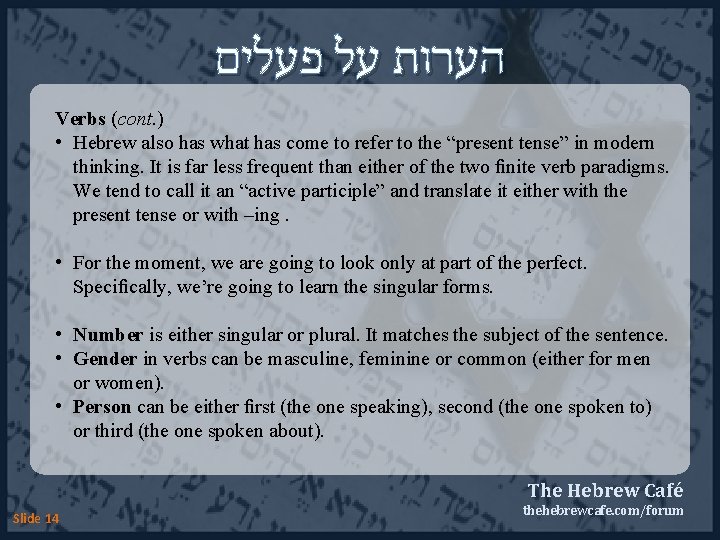
הערות על פעלים Verbs (cont. ) • Hebrew also has what has come to refer to the “present tense” in modern thinking. It is far less frequent than either of the two finite verb paradigms. We tend to call it an “active participle” and translate it either with the present tense or with –ing. • For the moment, we are going to look only at part of the perfect. Specifically, we’re going to learn the singular forms. • Number is either singular or plural. It matches the subject of the sentence. • Gender in verbs can be masculine, feminine or common (either for men or women). • Person can be either first (the one speaking), second (the one spoken to) or third (the one spoken about). The Hebrew Café Slide 14 thehebrewcafe. com/forum
Verb Examples דגמאות של פעלים The Hebrew Café Slide 15 thehebrewcafe. com/forum
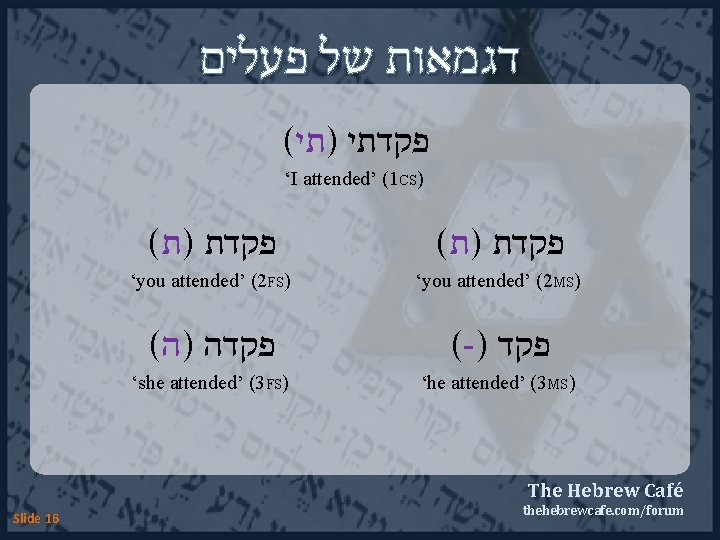
דגמאות של פעלים ( פקדתי )תי ‘I attended’ (1 CS) ( פקדת )ת ‘you attended’ (2 FS) ‘you attended’ (2 MS) ( פקדה )ה (-) פקד ‘she attended’ (3 FS) ‘he attended’ (3 MS) The Hebrew Café Slide 16 thehebrewcafe. com/forum
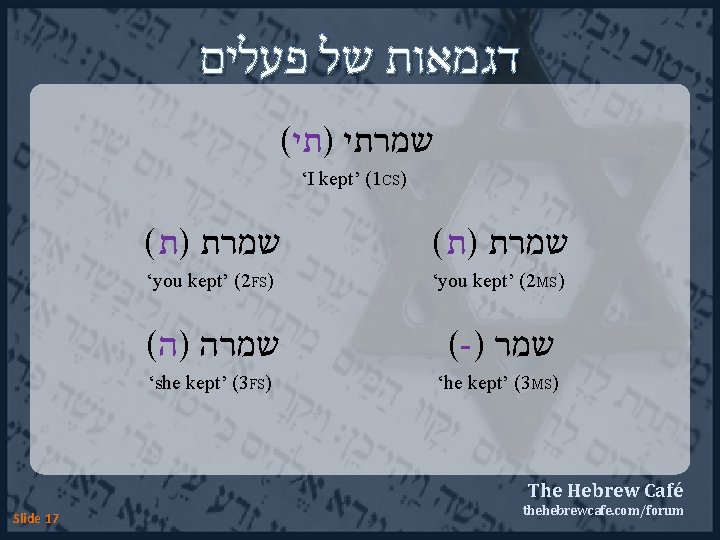
דגמאות של פעלים ( שמרתי )תי ‘I kept’ (1 CS) ( שמרת )ת ‘you kept’ (2 FS) ‘you kept’ (2 MS) ( שמרה )ה (-) שמר ‘she kept’ (3 FS) ‘he kept’ (3 MS) The Hebrew Café Slide 17 thehebrewcafe. com/forum
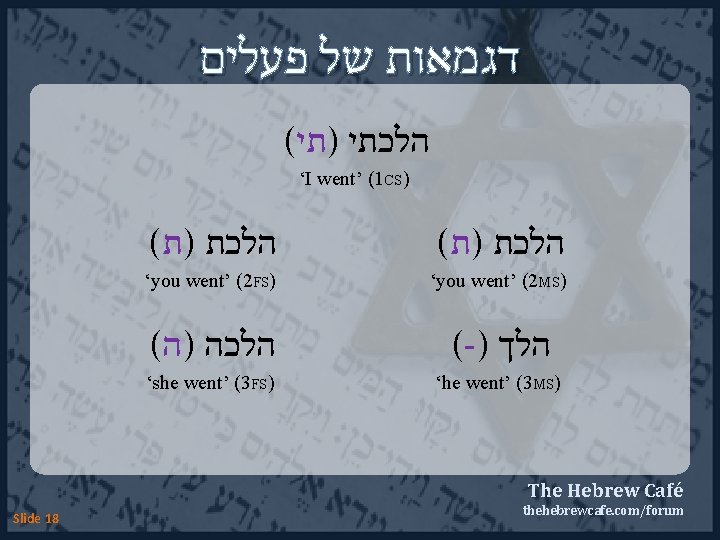
דגמאות של פעלים ( הלכתי )תי ‘I went’ (1 CS) ( הלכת )ת ‘you went’ (2 FS) ‘you went’ (2 MS) ( הלכה )ה (-) הלך ‘she went’ (3 FS) ‘he went’ (3 MS) The Hebrew Café Slide 18 thehebrewcafe. com/forum
Goals of Lesson 4 מטרות השעור הרביעי The Hebrew Café Slide 19 thehebrewcafe. com/forum
מטרות השעור הרביעי The fourth lesson’s goals are basically as follows: • Basic noun concepts: There are masculine and feminine nouns. Masculines are generally unmarked in the singular and -im in the plural. Feminines end in heh or tav and have -ot in the plural. • Basic verb concepts: Person = 1, 2 or 3. Gender = M or F. Number = S, P or C. Binyan = structure (for now, kal is all we’re learning) Aspect = PERFECT or IMPERFECT. • How to conjugate a verb in binyan kal in the singular. The Hebrew Café Slide 20 thehebrewcafe. com/forum
Biblical Hebrew Lesson 4 The Hebrew Café thehebrewcafe. com/forum א Textbook: Cook & Holmstedt’s Biblical Hebrew: A Student Grammar (2009) Found here online: http: //individual. utoronto. ca/holmstedt/Textbook. html
- Slides: 21