
Biblical Concept of Time Prof Goswin Habets I
Biblical Concept of Time Prof. Goswin Habets I. The Hebrew Concept of Time and History A. Israel had a concept of time very different from ours. § The Western concept of time and history cannot be applied adequately to Israel. 1. Our concept is linear: past--present--future § The Western concept is also absolute and abstract. § This is an a priori to every event; there is already time before the events. § We can put any events on the time line.
Biblical Concept of Time Israel’s concept of time was not linear, absolute, abstract. No word exists in the Bible to express this. § Jer. 50: 16 time of harvest § Jer. 8: 15 time of healing § Gen. 38: 27, Mic. 5: 2 time of giving birth § Gen. 29: 7 time to gather animals § Ruth 2: 14 time of a meal § Ps. 1: 3 time for giving fruit § Ps. 104: 27 time to give food
Biblical Concept of Time ‘et = “time” - not a line, but punctum temporis, a point of time that is a determinate moment, a period of time. § It is relative, always in connection with other words which always indicate an event. § The event is not possible without its time; time is not without its event. § Time in Israel is not abstract, but concrete. § Time is identified with its content. § Time is never empty time, but concrete, filled time.
Biblical Concept of Time yom = “day” - from dawn to sunset (as distinct from laylah, “night”); unity of the calendar; same value as ‘et. § Gen. 2: 4 § Dt. 4: 32 § Dt. 9: 7 day in sense of occasion, event of creation. day that God created man on the earth the day when you came from Egypt - the occasion of Exodus.
Biblical Concept of Time This coincidence of time and event was not only valid for events of nature, but also for all human events, even internal movements of the soul. § Qoheleth 3: 1 -8 time imposed on every circumstance Every event is determined by the time assigned to this event. § Ps. 31: 16 “My times are in Your hands. ”

Biblical Concept of Time 2. Western concept of time is eschatological. Humanity is directed toward a final fulfillment. § Gen. 8: 22 “all the times of the earth. ” § Contrasts - two contrary concepts indicate totality. § Succession of times rhythmic - cyclical vision of time.
Biblical Concept of Time B. This conception of cyclical, anti-eschatological time of Archaic Yahwism did not remain so. § Israel gradually elaborated an eschatological concept of time. § The point of departure was the Feasts: Sabbath, Passover, Unleavened Bread, Ingathering.
Biblical Concept of Time Passover: pastoral origin; rite practiced by nomadic or semi-nomadic shepherds. § Sacrifice of first fruits of the flock. Rite known before stay in Egypt. Unleavened Bread: feast of sedentary people, Canaanite origin; an agricultural feast. § Periodic cycle of nature; beginning of Spring. Thanksgiving.
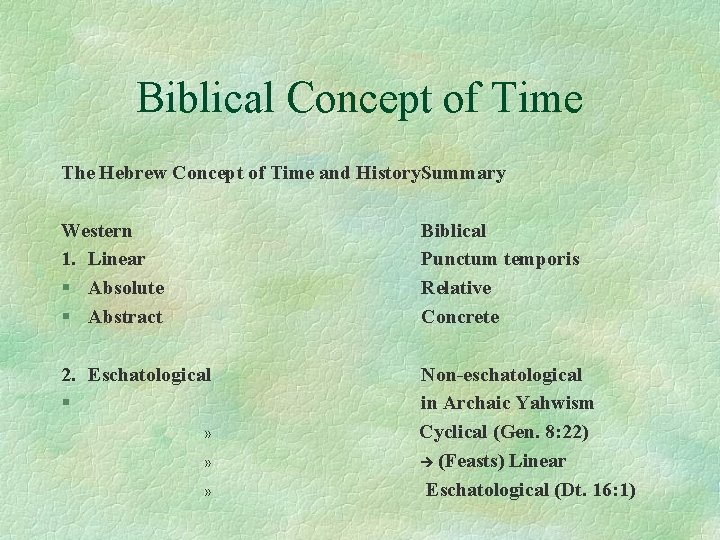
Biblical Concept of Time The Hebrew Concept of Time and History. Summary Western 1. Linear § Absolute § Abstract Biblical Punctum temporis Relative Concrete 2. Eschatological § Non-eschatological in Archaic Yahwism Cyclical (Gen. 8: 22) (Feasts) Linear Eschatological (Dt. 16: 1) » » »
Biblical Concept of Time Passover given historical meaning: journey of Exodus a definitive journey. § Ex. 23: 15 Feast of Unleavened Bread: symbolized Birth of People of Israel.
Biblical Concept of Time *Passover and Unleavened Bread joined. * a. Chronological coincidence: § Nomads (1 st full moon of Spring); § Unleavened Bread - (1 st Gathering of grain) b. Eating Unleavened Bread part of both rites. c. Symbolism: strictly related § Passover - 1 st event of Exodus § Unleavened Bread - Last event § Together - whole event
Biblical Concept of Time Israel’s Feasts: § § § Gilgal - conquest of the Promised Land Schechem - Covenant on Sinai Feast of Booths - Providence in the desert Passover - Exodus celebrated in families Bethel - Patriarchs

Biblical Concept of Time § Israel recognized these events as successive, as a “becoming” as history that was intelligible. § Gestalt: each part takes its significance from being in relation with each other part and the whole.
- Slides: 13