
BIBLE STUDY St Pauls Family Church Matthew 11
BIBLE STUDY St Paul’s Family Church Matthew 11. 16 -19, 25 -30
This Bible Study is built in 5 steps: reading, meditating/studying, praying, contemplating, acting. The biblical text studied is one of the readings of Sunday. The text will be given in the Presentation, but you are encouraged to read it in your own Bible, and highlight in it the verses speaking particularly to you.
Don’t be discouraged if you don’t understand everything: carry on your reading if something is too complicated for you now. This Bible Study is offered to people with different levels of biblical knowledge. It is not a competition. The most important is to learn something new, whatever it is. You may go back to it later, and it will be easier to understand.
This Bible Study is also built with different material taken from ‘Roots’ and put together in an order as logical as possible. But the unity of the result is not as good as if it had been redacted completely in one go. You may sometimes have to look more at the golden nuggets found in a river than at the complete mine already well organised…
Introductory prayer
Image by Jeff Jacobs from Pixabay We are here today, Lord, to worship you. As we bow our heads before you, we want to be amazed by your wisdom, bowled over by your love, and completely lost in you. Lord, open our hearts to receive you, in ways beyond whatever we could ever ask or even think. Amen.
STEP 1: READ abay
Read the text aloud or whispering it, to listen to it as well as reading it. Take a pause to go back and look at verses which attracts your attention. Then read it again entirely.
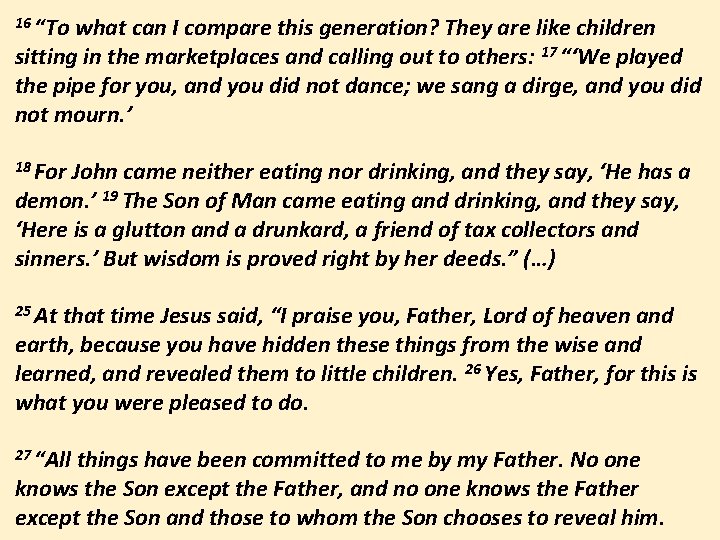
16 “To what can I compare this generation? They are like children sitting in the marketplaces and calling out to others: 17 “‘We played the pipe for you, and you did not dance; we sang a dirge, and you did not mourn. ’ 18 For John came neither eating nor drinking, and they say, ‘He has a demon. ’ 19 The Son of Man came eating and drinking, and they say, ‘Here is a glutton and a drunkard, a friend of tax collectors and sinners. ’ But wisdom is proved right by her deeds. ” (…) 25 At that time Jesus said, “I praise you, Father, Lord of heaven and earth, because you have hidden these things from the wise and learned, and revealed them to little children. 26 Yes, Father, for this is what you were pleased to do. 27 “All things have been committed to me by my Father. No one knows the Son except the Father, and no one knows the Father except the Son and those to whom the Son chooses to reveal him.
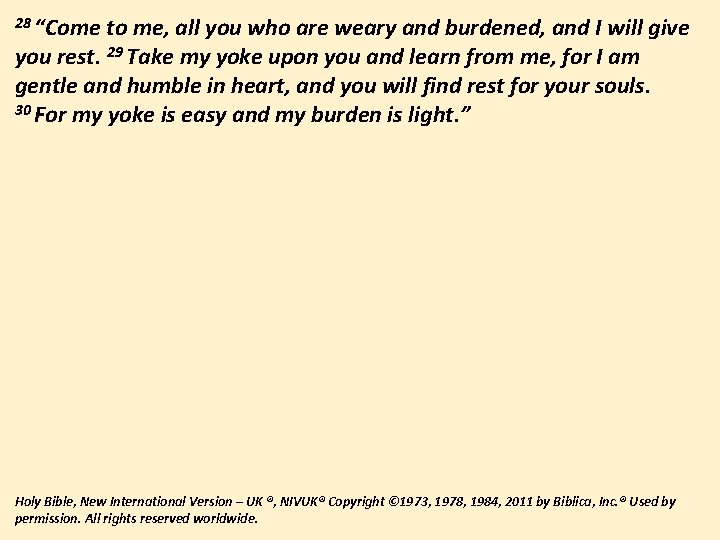
28 “Come to me, all you who are weary and burdened, and I will give you rest. 29 Take my yoke upon you and learn from me, for I am gentle and humble in heart, and you will find rest for your souls. 30 For my yoke is easy and my burden is light. ” Holy Bible, New International Version – UK ®, NIVUK® Copyright © 1973, 1978, 1984, 2011 by Biblica, Inc. ® Used by permission. All rights reserved worldwide.
STEP 2: STUDY/MEDITATE
This step is divided in two: a time of proper study, and a time of meditation with questions for you to answer.
Matthew 11. 16 -19, 20 -25 STUDY
If you have your own Bible, do not hesitate to highlight, underline or write on it: this Bible is a text for you. Write down notes in a notebook from the study you do. If you have notes in your Bible, look also at them. Look also at the other biblical passages indicated in the study or in your Bible notes: journey through the Bible to expand your knowledge of it: God speaks through the whole book. Be curious, explore. If you don’t want to read the whole study, look just at the Image by Stock. Snap from Pixabay summary at the end.
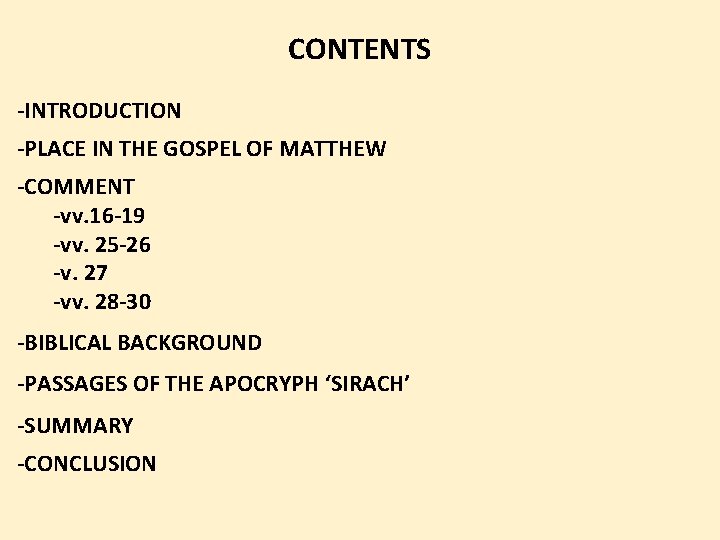
CONTENTS -INTRODUCTION -PLACE IN THE GOSPEL OF MATTHEW -COMMENT -vv. 16 -19 -vv. 25 -26 -v. 27 -vv. 28 -30 -BIBLICAL BACKGROUND -PASSAGES OF THE APOCRYPH ‘SIRACH’ -SUMMARY -CONCLUSION
INTRODUCTION -Having sent the twelve on their way, Jesus continues to proclaim the gospel in Galilee. In a foretaste of next week’s reading, not everyone receives the word with joy. Jesus sharply rebukes ‘this generation’ for failing to see what God is doing. They have rejected John the Baptist for being too ascetic, yet they have also rejected Jesus for being a glutton and a drunkard, and a friend of sinners. -The passage begins with Jesus pointing out the irony in his opponents’ stance. Their opposition is not really based on what he says and does, since they also opposed John’s contrary behaviour. They have pre-judged the issue, then searched for arguments to support their judgement; behind their words lies a hidden agenda to do with preserving their own power and influence. Their attitude, however, demonstrates a lack of wisdom; hence Jesus’ soliloquy in verses 25 -26, where he thanks God that children have understood what the educated and intelligent have not.
PLACE IN THE GOSPEL OF MATTHEW These two Gospel portions are from the narrative following the teaching on mission. Jesus has just responded to the questions that John the Baptist sent by way of his disciples; John had been wondering if Jesus was the expected Messiah, and Jesus answers by listing the acts of power he has been doing (11. 4 -5). Jesus speaks to the crowd about John’s role as a prophet and then continues. Herod has imprisoned John the Baptist, but John has heard of Jesus’ activities and sends his followers to ask if he is the Messiah. Jesus reflects on John and his ministry of preparation, praising him as a true, obedient man of God and comparing him to the prophet Elijah. He contrasts John’s approach to his task with his own and identifies the different responses they received.
COMMENT v. 16 -19: -vv. 16 -19 compare the responses of ‘this generation’ of Israel to both John and Jesus himself. Neither of them had satisfied popular expectations. John’s ascetic lifestyle had led to accusations that he had a demon, while Jesus’ non-ascetic habits of eating and drinking suggested he was self-indulgent (Proverbs 23. 20), and his choice of social contacts was highly questionable! The people were difficult to please; neither Jesus nor John met their expectations. In a manner similar to his response to John’s disciples, Jesus points to his deeds as evidence for his character (see the personified figure of God’s Wisdom in Proverbs 8). -Jesus likens his contemporaries to children playing wedding and funeral games, complaining that others will not join their chosen game. To John the Baptist, who said that the axe was lying at the root of the trees (3. 10), they complained, ‘You did not dance’,
dismissing him as a madman. To Jesus, who feasted and called himself ‘the bridegroom’ (9. 14 -15), they complained, ‘You did not mourn’, dismissing him as dissolute. The prophets announced judgement with funeral imagery (Ezekiel 7. 27) and salvation using wedding imagery (Isaiah 62. 4 -5). But now their leaders wish only to play at religion rather than allow God once more to renew Israel. -‘Wisdom is vindicated by her deeds, ’ Jesus asserts (v. 19). His mission is highly successful – and this, for Matthew, clearly proves that Jesus is the long-awaited Messiah. It is so obvious, even a child can see it (v. 25). -Matthew, more than any other Gospel, identifies Jesus with Wisdom. Interestingly this unites the male figure of Jesus with the female figure of Wisdom (see Proverbs 8).
-vv. 25 -26: -Jesus praises God for hiding the implications of his ministry from those who might be expected to understand things, and for revealing the importance of Jesus, and the appearance of the kingdom of heaven, to those who were not considered wise or sophisticated, namely infants. In that culture children were viewed as vulnerable, dependent and socially marginal; in other words, they were among the weakest and most insignificant in society. These were not those to whom one might think of sending an important message, such as the appearance of the kingdom of God. -God’s wisdom is revealed not to the ‘wise and intelligent’, perhaps those complacent leaders, but to ‘infants’, those willing to ‘change and become like children’ (18. 3). True wisdom confounds apparent wisdom.
-Jesus’ prayer reminds us of the child’s role in the story of the emperor’s new clothes. Simplicity sees what sophistication obscures. The term ‘infant’, however, might be a metaphor for the ‘humble and meek’ who make up Matthew’s community, and who have recognised true wisdom in Jesus. In that case there is a political message here – wisdom eludes the powerful but emerges among the powerless. v. 27: -In the v. 19, the phrase ‘a glutton and a drunkard’ was coming from the description of ‘a stubborn and rebellious son’ who must be handed over by his parents to be stoned at the city gate (Deuteronomy 21. 18 -21). But a different relationship between father and son is outlined by contrast in this passage: not coercive but based on mutual understanding between the one who hears his Father say, ‘This is my Son, the Beloved’ (3. 17), and the one who entrusts to his Son, and to those with whom he shares his knowledge of their heavenly Father, his mission to a weary world.
-Jesus, the Son of God, shows us what God the Father is like (v. 27). This is one of the strongest statements in the gospels about the divinity of Christ. To support what would otherwise be seen as a highly blasphemous claim, Matthew carefully shows his readers that every part of the Jewish Scriptures has been fulfilled in Jesus: first the Law and the Prophets (Matthew 5. 17), and now the figure of Wisdom found in books such as Proverbs and the apocryphal Wisdom of Solomon. Verse 27 makes also an important point concerning Christ; here, Jesus states clearly his place as a mediator between God and the people. -The affirmation about the divinity of Christ reminds us of similar ones in the Gospel of John, and there are strong similarities with the farewell discourses in John 14 to 16. To know God as Father, to become part of God’s new family, we need to know Jesus.
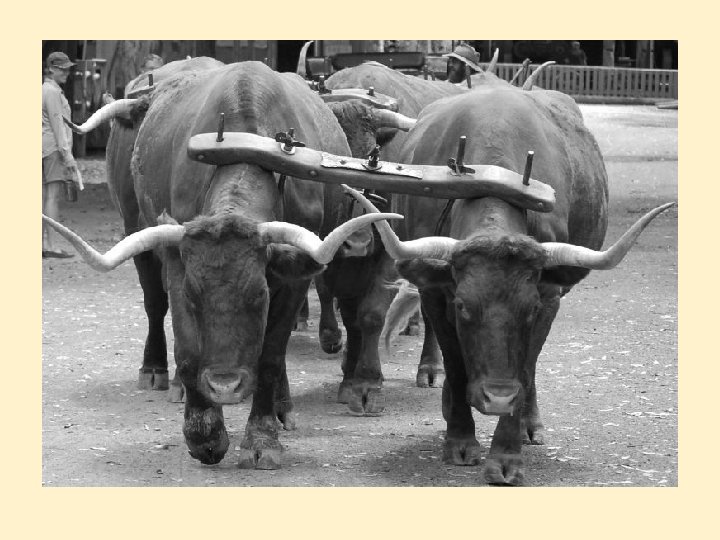
v. 28 -30: -‘Come to me…and I will give you rest’ (11. 28). It must have been a compelling invitation for the crowds in Galilee, burdened by poverty, hard work and oppressive taxation. It is a compelling invitation for anyone who is burdened – by sorrow; by sickness; by anxiety; by debt; by addiction; by discrimination; by our sins; perhaps even by our sense of religious obligation (23. 4). All these burdens can be taken from us, Jesus says, if we will be yoked to him. And if that sounds like another burden, he reassures us that his yoke is easy and his burden light. Paradoxically, this is the way to find rest for our souls (vv. 29 -30). -The last few verses use the metaphor of a yoke; this was a structure, usually made of wood, that could be worn over the neck and shoulders of animals or humans, and was used to make it easier to pull or carry heavy loads (see picture in the next slide).
It could be used as picture language for being oppressed (e. g. Isaiah 58. 6) or linked to another (e. g. Numbers 25. 3). However, some Jewish writings used it to speak of putting oneself under instruction to God’s instructions for life in the Torah (commonly translated ‘Law’) or God’s wisdom; something similar would seem to be the meaning intended here, since Jesus speaks of people learning from him. -The yoke of obedience to Jesus sounds heavy, but it is light because it can be summed up in the commandment to love. Jesus strengthens his followers by his love, which enables them to share love with others more easily and find rest for their souls. -‘Come to me…and I will give you rest’ (11. 28). It must have been a compelling invitation for the crowds in Galilee, burdened by poverty, hard work and oppressive taxation. It is a compelling invitation for anyone who is burdened – by sorrow; by sickness; by anxiety; by debt; by addiction; by discrimination; by our sins; perhaps even by
our sense of religious obligation (23. 4). All these burdens can be taken from us, Jesus says, if we will be yoked to him. And if that sounds like another burden, he reassures us that his yoke is easy and his burden light. Paradoxically, this is the way to find rest for our souls (vv. 29 -30). -Paradoxically, given the high demands of holy living laid out earlier in the Gospel (e. g. 5. 48), Jesus’ yoke is easy and his burden light, and coming to him is rest for our souls. While Matthew’s community did expect extraordinarily high standards of conduct, it probably did not impose burdens of circumcision or full observance of the Jewish Law on non-Jews. The concept of ‘rest’ is a powerful one. Matthew’s community had known and still knew many trials and tribulations; many are likely to have been refugees from the rebellion and life was doubtless a struggle, even without the conflicts within Judaism. The offer of inner security will have meant a lot.
BIBLICAL BACKGROUND -We can see some possible echoes of the story of Moses in this passage. Moses was described as humble (Numbers 12. 3); God knew him and promised him rest (Exodus 33. 12 -14). It has been suggested that throughout the Gospel, and not least in the presentation of Jesus as teacher of Israel, Matthew is presenting him as the second and greater Moses. -Jesus may have known that it was said that by taking on wisdom’s yoke ‘you will find the rest she gives’ (Ecclesiasticus 6. 24 -28; 51. 26 -27). This tradition identified wisdom with the Law (Ecclesiasticus 24. 2329), and the rabbis would contrast ‘the yoke of the law’ with ‘the yoke of worldly care’ (Mishnah Aboth 1 3. 5). In our passage, God’s wisdom is identified with Jesus, who gives the ‘rest for your souls’ _____ 1. ‘Mishnah Aboth’ = ‘to study the Fathers’. It is the first major collection of the Jewish oral traditions, known as the Oral Torah, and the first major work of rabbinic literature redacted at the beginning of the 3 rd century CE.
that comes from walking in God’s way (see Jeremiah 6. 16). This rest is associated with the presence of God (Exodus 33. 14), who can make even heavy burdens seem light. Above all, it is rooted in the revelation by Jesus to his disciples that we too are the beloved children of our heavenly Father. -‘Wisdom’ was often personified as a female figure who acted as a guide and teacher, accompanying people in the path of righteousness. Sirach 51. 25 -26 (also known as Ecclesiasticus, in the Apocrypha) speaks of being yoked together with Wisdom, and here Jesus adapts the image to invite people to be yoked directly to him, to walk with him as closely as two oxen walk, ploughing a field together. Major passages of Sirach about Wisdom are given in the following slides.
PASSAGES OF THE APOCRYPH ‘SIRACH’ Chap 6: 20 How very harsh she is to the undisciplined! The senseless does not stay with her for long: 21 she will weigh as heavily on the senseless as a touchstone and such a person will lose no time in throwing her off; 22 for Wisdom is true to her name, she is not accessible to many. 23 Listen, my child, and take my advice, do not reject my counsel: 24 put your feet into her fetters, and your neck into her collar; 25 offer your shoulder to her burden, do not be impatient of her bonds; 26 court her with all your soul, and with all your might keep in her ways; 27 search for her, track her down: she will reveal herself; once you hold her, do not let her go. 28 For in the end you will find rest in her and she will take the form of joy for you: 29 her fetters you will find a mighty defence, her collars, a precious necklace. 30 Her yoke will be a golden ornament, and her bonds be purple ribbons; 31 you will wear her like a robe of honour, you will put her on like a crown of joy. 32 If you wish it, my child, you can be taught; apply yourself, and you will become intelligent. 33 If you love listening, you will learn, if you pay attention, you will become wise.
Chap 24: 1 Wisdom speaks her own praises, in the midst of her people she glories in herself. 2 She opens her mouth in the assembly of the Most High, she glories in herself in the presence of the Mighty One: 3 'I came forth from the mouth of the Most High, and I covered the earth like mist. 4 I had my tent in the heights, and my throne was a pillar of cloud. 5 Alone, I have made the circuit of the heavens and walked through the depths of the abyss. 6 Over the waves of the sea and over the whole earth, and over every people and nation I have held sway. 7 Among all these I searched for rest, and looked to see in whose territory I might pitch camp. 8 Then the Creator of all things instructed me and he who created me fixed a place for my tent. He said, "Pitch your tent in Jacob, make Israel your inheritance. " 9 From eternity, in the beginning, he created me, and for eternity I shall remain. 17 -18 I am like a vine putting out graceful shoots, my blossoms bear the fruit of glory and wealth. 19 Approach me, you who desire me, and take your fill of my fruits, 20 for memories of me are sweeter than honey, inheriting me is sweeter than the honeycomb. 21 They who eat me will hunger for more, they who drink me will thirst for more. 22 No one who
obeys me will ever have to blush, no one who acts as I dictate will ever sin. ' 23 -24 All this is no other than the Book of the Covenant of the Most High God, the Law that Moses enjoined on us, an inheritance for the communities of Jacob. Chap 51: 25 I have opened my mouth, I have said: 'Buy her without money, 26 put your necks under her yoke, let your souls receive instruction, she is near, within your reach. ' 27 See for yourselves: how slight my efforts have been to win so much peace.
SUMMARY -John had a strange ascetic lifestyle and Jesus’ lifestyle involved having parties with ‘sinners’. Neither of them fitted the patterns of expectation of the coming king. -In this passage, we see Jesus mocking those who are ‘wise’, as he suggests that their longing for wisdom blinds them to what God is really doing. It is in fact children, those who are vulnerable and humble, that are most likely to be in tune with God and can respond faithfully to him. -Jesus uses the metaphor of a yoke in the last few verses. A yoke can be a way of bearing a ‘burden’. It is also a way of connecting two animals as they are ‘yoked’ together. The image of sharing a yoke with Jesus suggests the idea of being paired with him, guided by him and him offering to help bear our burdens.
CONCLUSION Jesus surprises us and reminds us who he is and that when we have misplaced expectations, he will disrupt them. Perhaps a burden that the people were carrying was the missed expectations about the Messiah; we too may still need to reassess our expectations of who Jesus is and what he is able to do, to come to him and learn from him.
Matthew 11. 16 -19, 25 -30 MEDITATE
Matthew 10. 40 -42 Time for a more active reflection, with some questions to think about. If you do this study with others, share your answers. The questions are grouped in 3 categories: you can look at all questions, or just choose one category.
A. LABELLING AND CRITICISM 1. The paradox of the vv. 16 -19 is not unknown in our own generation. Sometimes the media criticise the Church for being too judgemental; sometimes they satirise it for its woolly liberalism. Matthew implicitly invites his readers to explore this tension in their own witness. How can we be true to the ethical demands of the gospel, and also be a genuine friend of sinners? 2. How guilty are you of labelling others? How guilty is the/your church at labelling others? What can you do to change that? 3. How might others label your church? What can you do to change that?
B. WISDOM 1. How might God’s wisdom be revealed to you? To your church? Are you attentive to it? How can you improve this attention? 2. Who are the ‘little children’ at v. 25? What does Jesus mean? Is the Gospel infantilising? 3. Is human knowledge and God’s wisdom incompatible? Why?
C. BURDEN AND REST 1. Have you ever been somewhere really busy? Remember the noise, the crowds, the smell. Have you ever been somewhere that is really peaceful? Remember the quiet, who was there, what made it peaceful. What place do you prefer? Why? 2. Are there times when you want to find peace and quiet? Where can you go? 3. Thinking now of your own situation, what issue/burden do you think Jesus would want to address: respect to you? Respect to your local community? How do you think Jesus might help tackle those issues? 4. ‘Our hearts are restless until they find their rest in thee’ (St Augustine). How can we convey a sense of the rest that Jesus offers our restless generation?
STEP 3: PRAY
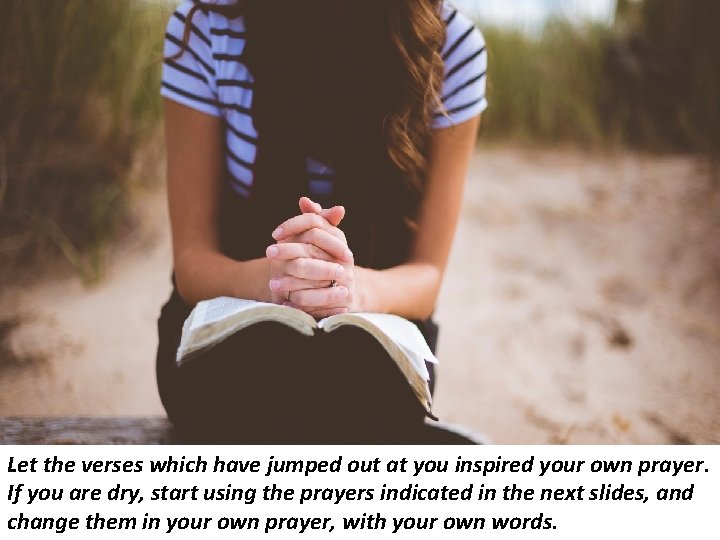
Let the verses which have jumped out at you inspired your own prayer. If you are dry, start using the prayers indicated in the next slides, and change them in your own prayer, with your own words.
Lord, you know how weary and bowed down I feel sometimes. I claim your rest for my soul. I come to you in my emptiness and cry to you for your fullness. Rescue me and fill me, Lord. Amen.
We pray for all in authority, that they will be respectfully conscious of the weight on their shoulders, and that they will act responsibly for the people they serve. We pray for them in their personal lives, with the worries and cares that only they see. Lord God, we lift your children before you. May they find rest for their souls. We pray for our friends, family, colleagues. We pray that as we walk alongside them, you will use us to bring them close to you, and they will learn of your love. Lord God, we lift your children before you. May they find rest for their souls.
We pray that we might be sensitive to the needs of those around us – the people we see every day, perhaps as fleetingly as at the shops, or in the bus queue. We have no idea what burdens they are carrying, or if they need a kind word from you that only we can give. Lord God, we lift your children before you. May they find rest for their souls. We pray that we will see the positive in people, even when it’s hard, and reach out to encourage them. Lord God, we lift your children before you. May they find rest for their souls. Amen.
STEP 4: CONTEMPLATE
Have a time of quiet with Jesus, your Father or the Holy Spirit. Let Him take control of this time and of yourself. Let is Word descend into your heart and change you.
STEP 5: ACT
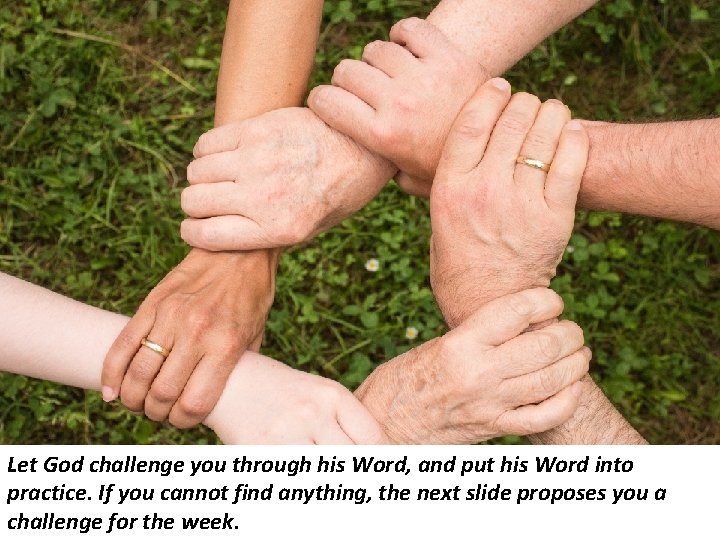
Let God challenge you through his Word, and put his Word into practice. If you cannot find anything, the next slide proposes you a challenge for the week.

Challenge Write a list of the wonderful things you see in your partner or a friend and give the list to them.
Conclusive prayer
Jesus, you have called us to come to you and blessed us with your richness. Now you send us out into his world, to make sure people see you, and listen to you, through us. What a responsibility, what a joy, what a privilege. We are yours, Lord. Use us as you will. Amen. Image by Jeff Jacobs from Pixabay
Most material used in this Bible Study is © ROOTS for Churches Ltd (www. rootsontheweb. com) 2002 -2020. Reproduced with permission.
- Slides: 53