
BiAxial Tensile Testing Machine for Anisotropic Materials Ian
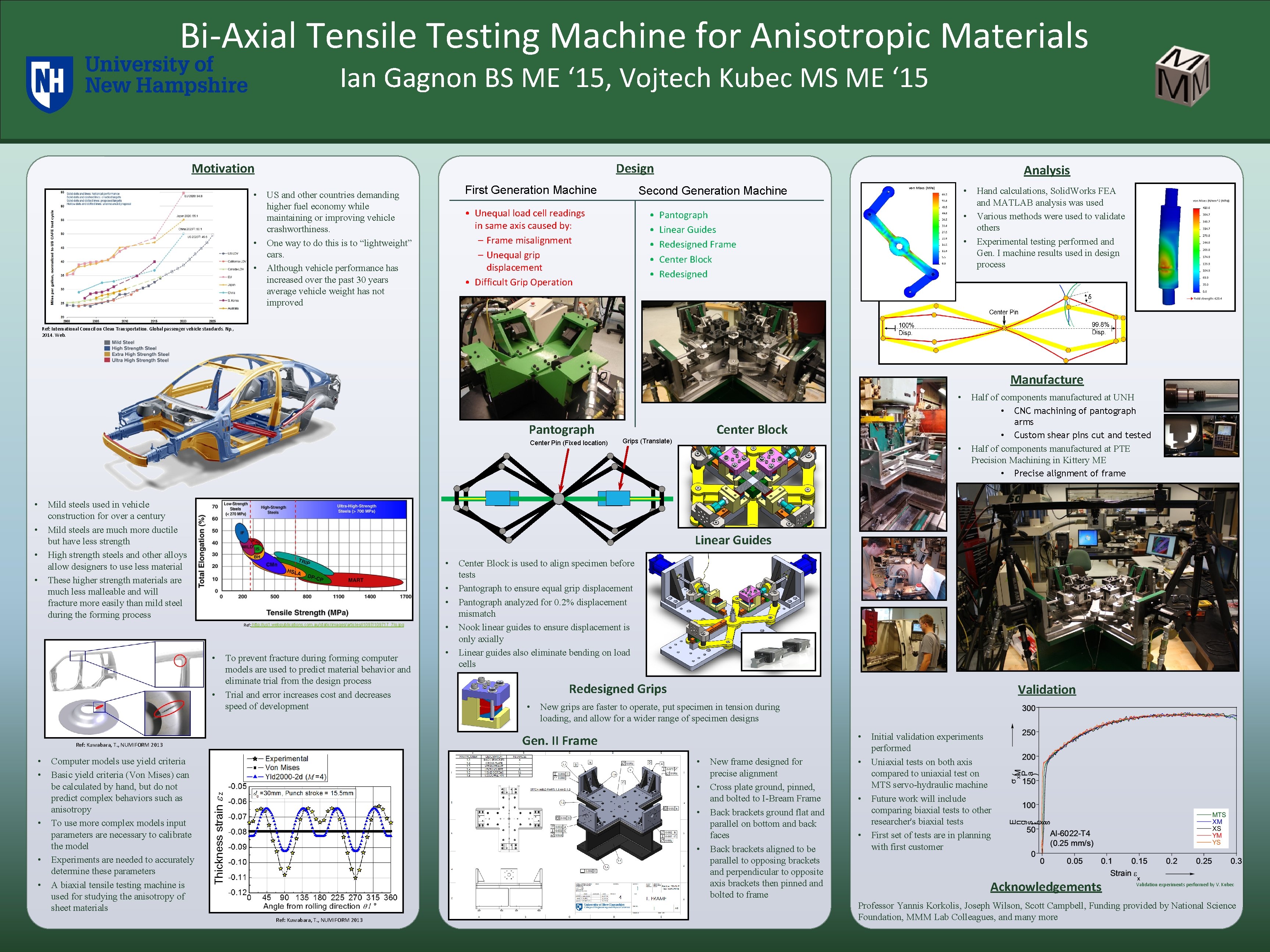
Bi-Axial Tensile Testing Machine for Anisotropic Materials Ian Gagnon BS ME ‘ 15, Vojtech Kubec MS ME ‘ 15 Motivation • • • Design First Generation Machine US and other countries demanding higher fuel economy while maintaining or improving vehicle crashworthiness. One way to do this is to “lightweight” cars. Although vehicle performance has increased over the past 30 years average vehicle weight has not improved Analysis Second Generation Machine • Unequal load cell readings in same axis caused by: – Frame misalignment – Unequal grip displacement • Difficult Grip Operation • • • von Mises (MPa) Pantograph Linear Guides Redesigned Frame Center Block Redesigned • • Hand calculations, Solid. Works FEA and MATLAB analysis was used Various methods were used to validate others Experimental testing performed and Gen. I machine results used in design process Ref: International Council on Clean Transportation. Global passenger vehicle standards. Np. , 2014. Web. Manufacture • Pantograph Center Pin (Fixed location) • Mild steels used in vehicle construction for over a century Mild steels are much more ductile but have less strength High strength steels and other alloys allow designers to use less material These higher strength materials are much less malleable and will fracture more easily than mild steel during the forming process • • To prevent fracture during forming computer models are used to predict material behavior and eliminate trial from the design process Trial and error increases cost and decreases speed of development • • • Center Block is used to align specimen before tests Pantograph to ensure equal grip displacement Pantograph analyzed for 0. 2% displacement mismatch Nook linear guides to ensure displacement is only axially Linear guides also eliminate bending on load cells Redesigned Grips • Validation New grips are faster to operate, put specimen in tension during loading, and allow for a wider range of specimen designs • Gen. II Frame Ref: Kuwabara, T. , NUMIFORM 2013 • Grips (Translate) Linear Guides Ref: http: //us 1. webpublications. com. au/static/images/articles/i 1097/109717_7 lo. jpg • • Center Block Half of components manufactured at UNH • CNC machining of pantograph arms • Custom shear pins cut and tested Half of components manufactured at PTE Precision Machining in Kittery ME • Precise alignment of frame Computer models use yield criteria Basic yield criteria (Von Mises) can be calculated by hand, but do not predict complex behaviors such as anisotropy To use more complex models input parameters are necessary to calibrate the model Experiments are needed to accurately determine these parameters A biaxial tensile testing machine is used for studying the anisotropy of sheet materials • • Ref: Kuwabara, T. , NUMIFORM 2013 New frame designed for precise alignment Cross plate ground, pinned, and bolted to I-Bream Frame Back brackets ground flat and parallel on bottom and back faces Back brackets aligned to be parallel to opposing brackets and perpendicular to opposite axis brackets then pinned and bolted to frame • • • Initial validation experiments performed Uniaxial tests on both axis compared to uniaxial test on MTS servo-hydraulic machine Future work will include comparing biaxial tests to other researcher's biaxial tests First set of tests are in planning with first customer Acknowledgements Validation experiments performed by V. Kubec Professor Yannis Korkolis, Joseph Wilson, Scott Campbell, Funding provided by National Science Foundation, MMM Lab Colleagues, and many more
- Slides: 1