
Bias in Writing Learning Outcomes You will be
Bias in Writing
Learning Outcomes • You will be able to define bias • You will be able to describe features of biased writing. • You will be able to Identify and find bias in text.
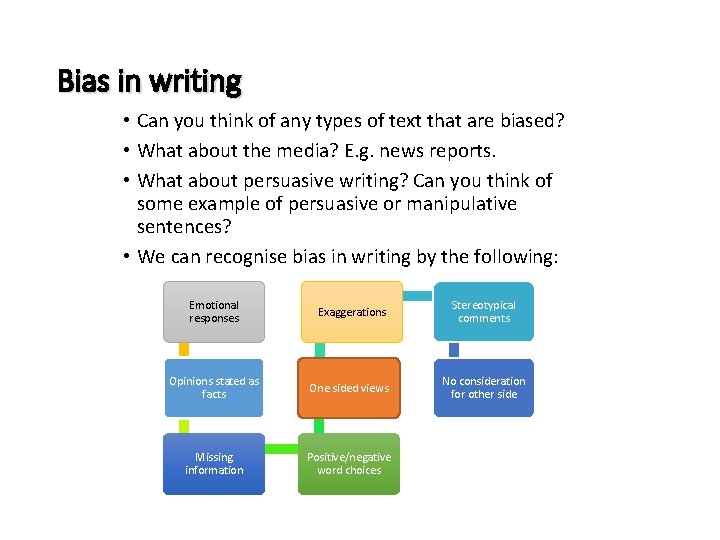
Bias in writing • Can you think of any types of text that are biased? • What about the media? E. g. news reports. • What about persuasive writing? Can you think of some example of persuasive or manipulative sentences? • We can recognise bias in writing by the following: Emotional responses Exaggerations Stereotypical comments Opinions stated as facts One sided views No consideration for other side Missing information Positive/negative word choices
Task 1. Read the leaflets for the various political parties 2. Can you find similarities in the writing such as, style, use of metaphor, persuasive, emotionally charged or positive and negative word choices or others? 3. Pick out elements which you think are factual and/or unbiased and those that you think are opinionated and/or biased. Give reasons for your choices. 4. Discuss in pairs and write down your findings to share with the class. Do you agree disagree on choices? If not, why not? If yes, why?
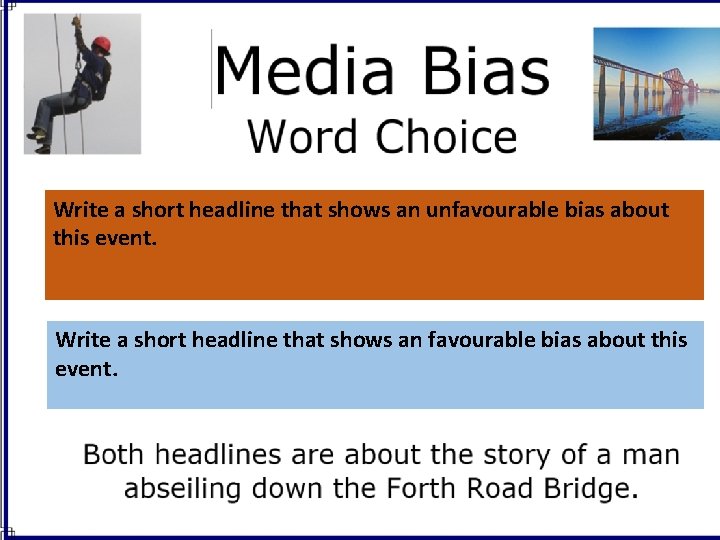
Write a short headline that shows an unfavourable bias about this event. Write a short headline that shows an favourable bias about this event.

Bias • Bias is a prejudice, preference or an inclination that inhibits fair judgement. • Bias is being subjective as opposed to being objective. Subjective Influenced by past experiences. • We all have biases. Objective Not allowing bias (past experiences) to affect judgment.
Bias Explained • How is it that eleven people can witness the same accident – all with their eyes open – and each account will be different despite the fact they all saw the same thing? – Discuss. • Bias is like wearing sunglasses. • The sunglass represent your past experiences e. g. how you were reared as a child/previous learning/experiences. • This is why two people can look at the same thing and describe it differently.
Definitions Fact: • a piece of information presented as having an objective reality; • knowledge or information based on real occurrences without manipulation or persuasion. Opinion: • a view, judgment, or appraisal formed in the mind about a particular matter • a belief or finding for which there is not enough proof for complete certainty Bias: • a sensitivity of character or viewpoint • Particularly a subjective and illogical outcome Ways that bias may be created • the writer has incomplete information • the writer is deliberately trying to persuade the audience • the writer’s experience is influencing the writer’s approach
TASK q. Choose a ‘factual’ story/report from the newspapers provided. 1. Cut out the article. 2. Read the article and underline any instances of bias you find 3. On a separate sheet of paper Re-write the story to provide either a favourable or unfavourable bias.
- Slides: 9