
Bhutan Country Partnership Framework FY 2020 2024 December
Bhutan Country Partnership Framework FY 2020 -2024 December 2019 Development Partner Group Meeting

Country Partnership Framework (CPF) • In-country consultation in October 2019 • To be completed in December 2019 • Together with the next CPF Systematic Country Diagnostics (SCD) Country Partnership Framework (CPF) Completion and Learning Review Performance and Learning Review (PLR) • CPF FY 2020 -24 (Jul 2019 -Jun 2024) • Planned in FY 2020 (Jul 2019 -Jun 2020) • Aligned with the 12 th FYP • Informed by the SCD • Planned as the midterm review of the planned CPF Slide 2
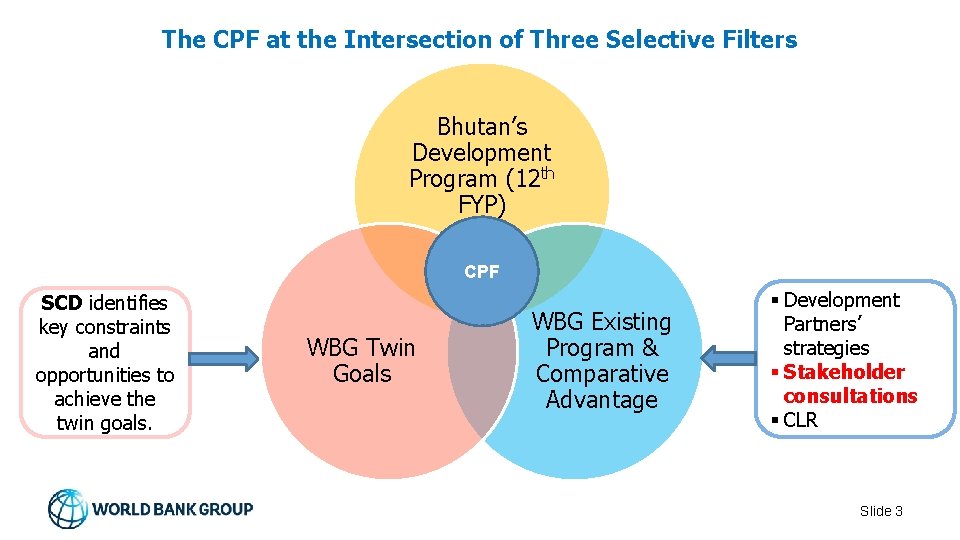
The CPF at the Intersection of Three Selective Filters Bhutan’s Development Program (12 th FYP) CPF SCD identifies key constraints and opportunities to achieve the twin goals. WBG Twin Goals WBG Existing Program & Comparative Advantage Development Partners’ strategies Stakeholder consultations CLR Slide 3
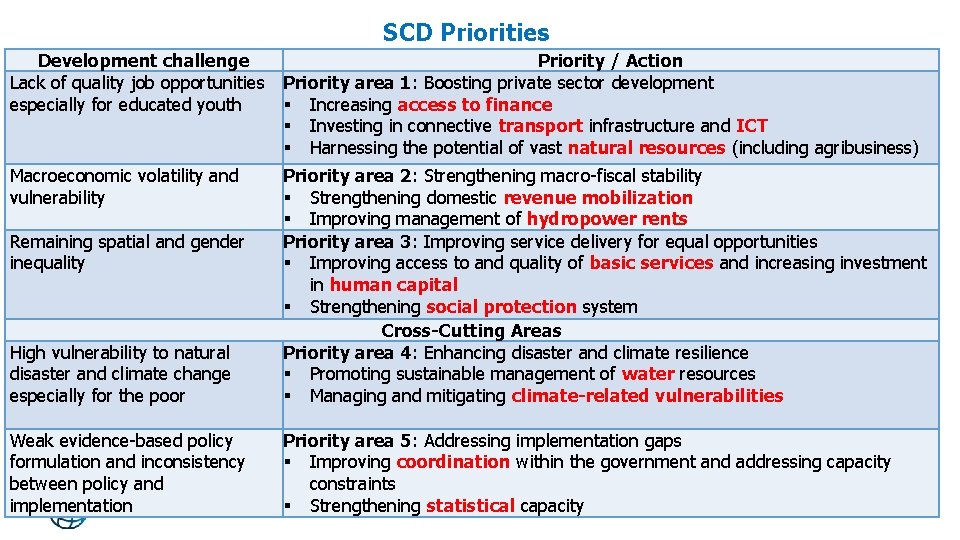
SCD Priorities Development challenge Lack of quality job opportunities especially for educated youth Priority / Action Priority area 1: Boosting private sector development Increasing access to finance Investing in connective transport infrastructure and ICT Harnessing the potential of vast natural resources (including agribusiness) Macroeconomic volatility and vulnerability High vulnerability to natural disaster and climate change especially for the poor Priority area 2: Strengthening macro-fiscal stability Strengthening domestic revenue mobilization Improving management of hydropower rents Priority area 3: Improving service delivery for equal opportunities Improving access to and quality of basic services and increasing investment in human capital Strengthening social protection system Cross-Cutting Areas Priority area 4: Enhancing disaster and climate resilience Promoting sustainable management of water resources Managing and mitigating climate-related vulnerabilities Weak evidence-based policy formulation and inconsistency between policy and implementation Priority area 5: Addressing implementation gaps Improving coordination within the government and addressing capacity constraints Strengthening statistical capacity Slide 4 Remaining spatial and gender inequality
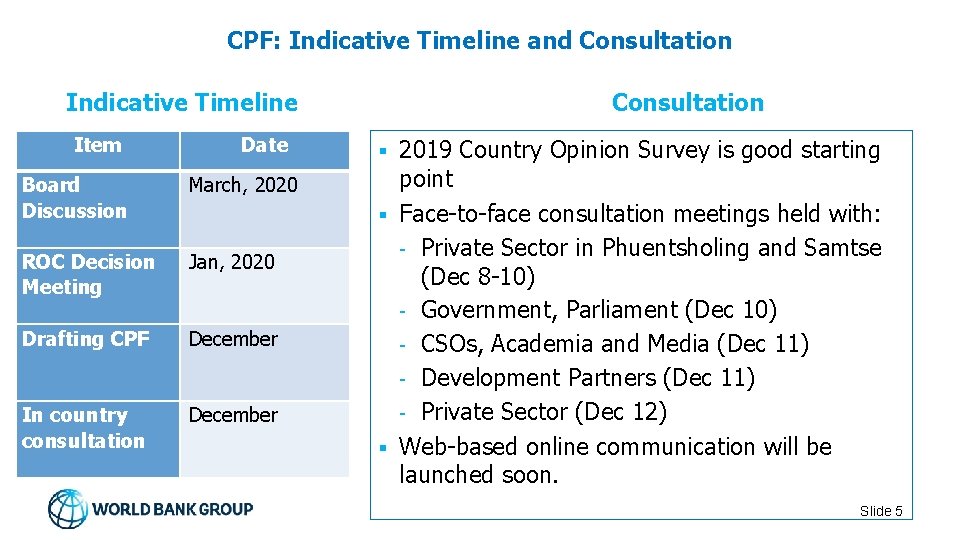
CPF: Indicative Timeline and Consultation Indicative Timeline Item Date Board Discussion March, 2020 ROC Decision Meeting Jan, 2020 Drafting CPF December In country consultation December Consultation 2019 Country Opinion Survey is good starting point Face-to-face consultation meetings held with: - Private Sector in Phuentsholing and Samtse (Dec 8 -10) - Government, Parliament (Dec 10) - CSOs, Academia and Media (Dec 11) - Development Partners (Dec 11) - Private Sector (Dec 12) Web-based online communication will be launched soon. Slide 5
Questions for Discussion What is the most important challenge that needs to be addressed so that Bhutan will advance to the next stage of development? What / How can the WBG do to address the challenge? How can the WBG collaborate / complement with you? Slide 6
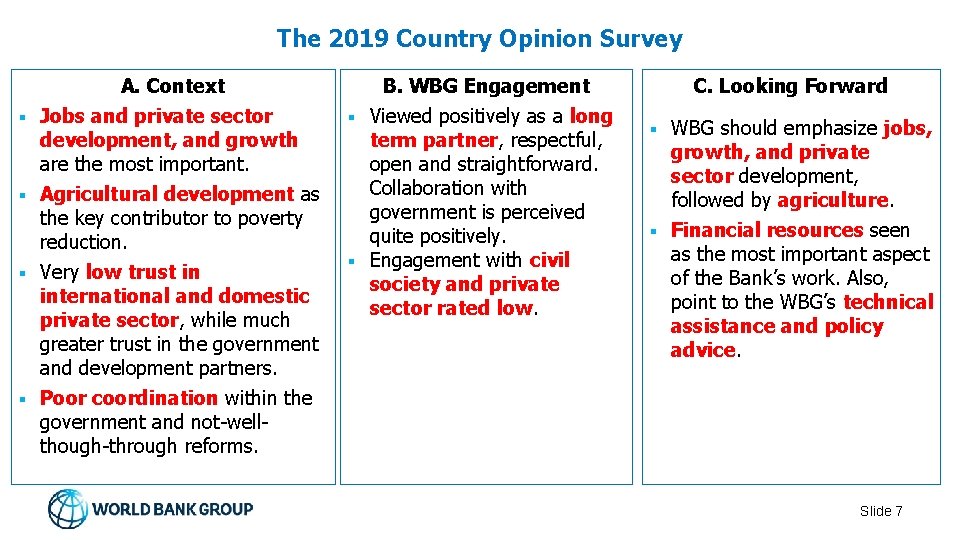
The 2019 Country Opinion Survey A. Context Jobs and private sector development, and growth are the most important. Agricultural development as the key contributor to poverty reduction. Very low trust in international and domestic private sector, while much greater trust in the government and development partners. Poor coordination within the government and not-wellthough-through reforms. B. WBG Engagement Viewed positively as a long term partner, respectful, open and straightforward. Collaboration with government is perceived quite positively. Engagement with civil society and private sector rated low. C. Looking Forward WBG should emphasize jobs, growth, and private sector development, followed by agriculture. Financial resources seen as the most important aspect of the Bank’s work. Also, point to the WBG’s technical assistance and policy advice. Slide 7
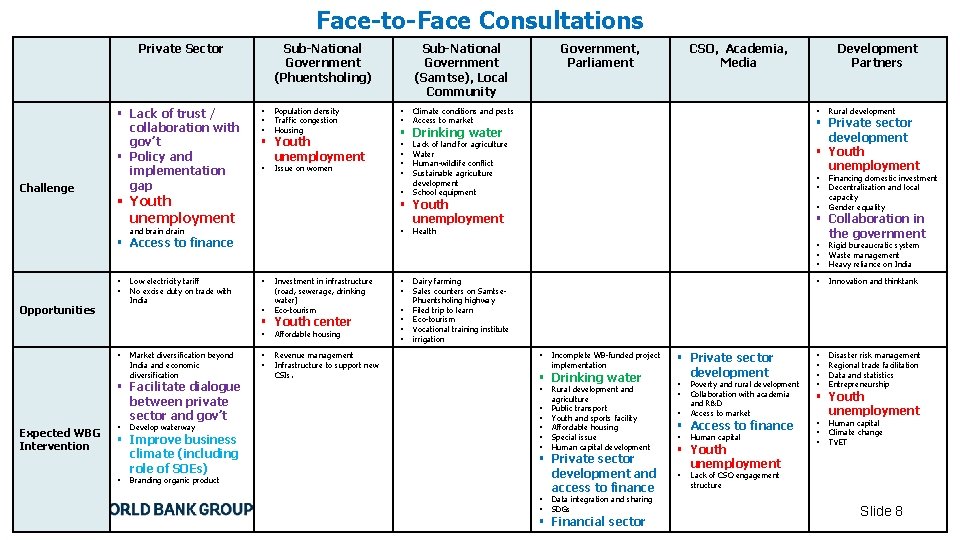
Face-to-Face Consultations Private Sector Challenge Lack of trust / collaboration with gov’t Policy and implementation gap Sub-National Government (Phuentsholing) Population density Traffic congestion Housing Youth unemployment Issue on women Market diversification beyond India and economic diversification Facilitate dialogue between private sector and gov’t Expected WBG Intervention Investment in infrastructure (road, sewerage, drinking water) Eco-tourism Affordable housing Revenue management Infrastructure to support new CSIs. Youth center Develop waterway Improve business climate (including role of SOEs) Branding organic product Lack of land for agriculture Water Human-wildlife conflict Sustainable agriculture development School equipment CSO, Academia, Media Development Partners Rural development Financing domestic investment Decentralization and local capacity Gender equality Rigid bureaucratic system Waste management Heavy reliance on India Innovation and thinktank Disaster risk management Regional trade facilitation Data and statistics Entrepreneurship Human capital Climate change TVET Private sector development Youth unemployment Drinking water Access to finance Opportunities Climate conditions and pests Access to market Government, Parliament Youth unemployment and brain drain Low electricity tariff No excise duty on trade with India Youth unemployment Sub-National Government (Samtse), Local Community Collaboration in the government Health Dairy farming Sales counters on Samtse. Phuentsholing highway Filed trip to learn Eco-tourism Vocational training institute irrigation Incomplete WB-funded project implementation Drinking water Rural development and agriculture Public transport Youth and sports facility Affordable housing Special issue Human capital development Private sector development and access to finance Data integration and sharing SDGs Financial sector Private sector development Poverty and rural development Collaboration with academia and R&D Access to market Human capital Lack of CSO engagement structure Access to finance Youth unemployment Slide 8
Questions for Discussion among DPs What / How can the WBG do to address the challenge? How can the WBG collaborate / complement with you? Slide 9
- Slides: 9