
BH Provider Standards KPIs Tiers 1 2 2

BH Provider Standards & KPIs Tiers 1, 2, 2+ PRESENTED TO THE DBHDD CONTRACTED COMMUNITY PROVIDERS AUGUST 2017
Division of Behavioral Health MONICA S. JOHNSON, MA, LPC DIRECTOR
DBHDD Vision and Mission Vision Easy access to high-quality care that leads to a life of recovery and independence for the people we serve Mission To lead an accountable and effective continuum of care to support people with behavioral health challenges, and intellectual and developmental disabilities in a dynamic health care environment
Agenda �Introductions �Purpose �Recap of the work �Review of Standards & KPIs Changes �Reporting, Compliance and Monitoring �Data Review (What are we learning from the data: An overview of Tier 1 outcomes) �Quality Initiatives
Recap • • OVERVIEW OF THE BH PROVIDER NETWORK HISTORY OF THE STANDARDS & KPIS
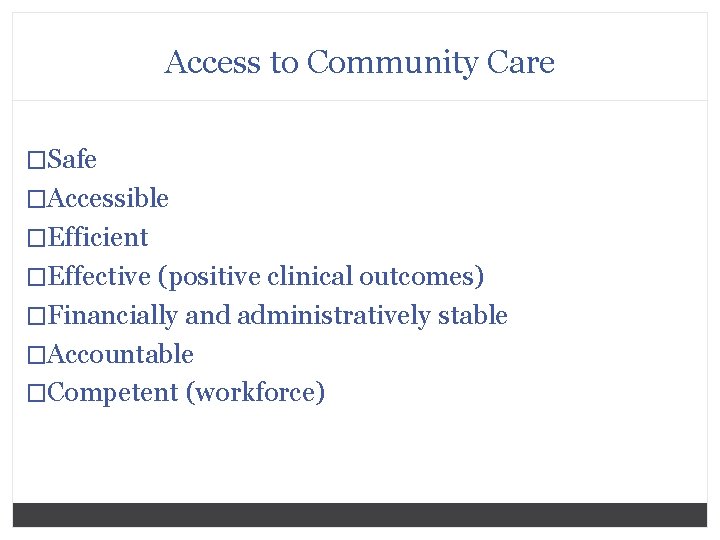
Access to Community Care �Safe �Accessible �Efficient �Effective (positive clinical outcomes) �Financially and administratively stable �Accountable �Competent (workforce)
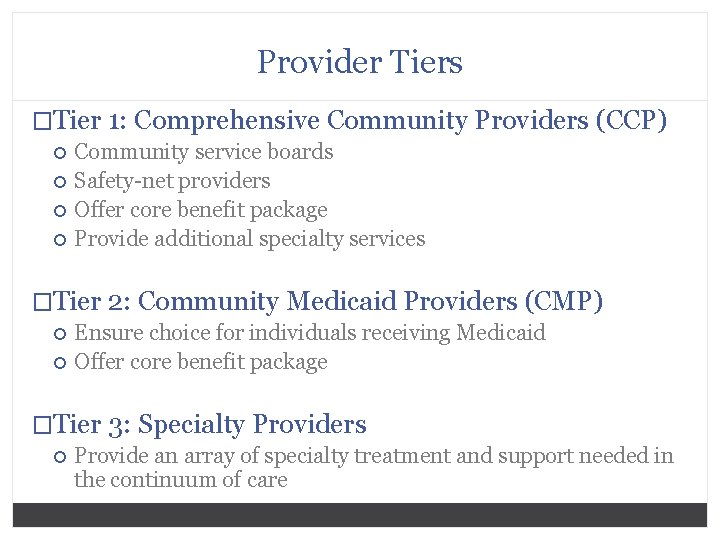
Provider Tiers �Tier 1: Comprehensive Community Providers (CCP) Community service boards Safety-net providers Offer core benefit package Provide additional specialty services �Tier 2: Community Medicaid Providers (CMP) Ensure choice for individuals receiving Medicaid Offer core benefit package �Tier 3: Specialty Providers Provide an array of specialty treatment and support needed in the continuum of care
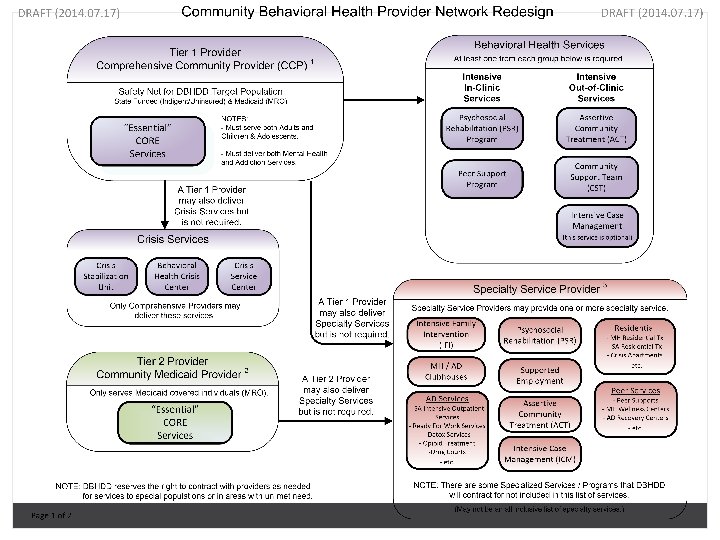
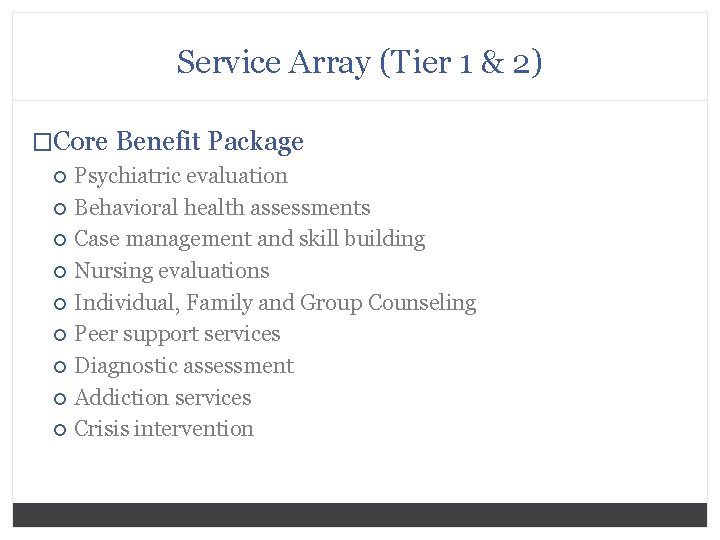
Service Array (Tier 1 & 2) �Core Benefit Package Psychiatric evaluation Behavioral health assessments Case management and skill building Nursing evaluations Individual, Family and Group Counseling Peer support services Diagnostic assessment Addiction services Crisis intervention
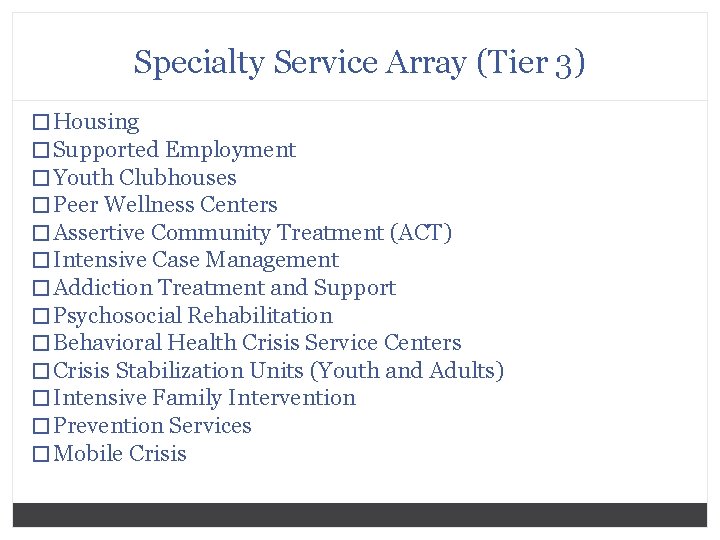
Specialty Service Array (Tier 3) � Housing � Supported Employment � Youth Clubhouses � Peer Wellness Centers � Assertive Community Treatment (ACT) � Intensive Case Management � Addiction Treatment and Support � Psychosocial Rehabilitation � Behavioral Health Crisis Service Centers � Crisis Stabilization Units (Youth and Adults) � Intensive Family Intervention � Prevention Services � Mobile Crisis
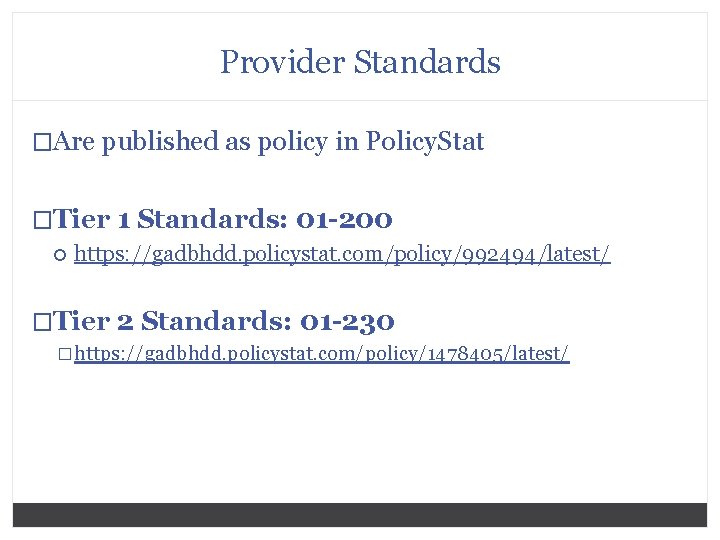
Provider Standards �Are published as policy in Policy. Stat �Tier 1 Standards: 01 -200 https: //gadbhdd. policystat. com/policy/992494/latest/ �Tier 2 Standards: 01 -230 �https: //gadbhdd. policystat. com/policy/1478405/latest/
Standards & KPIs WHAT’S NEW?
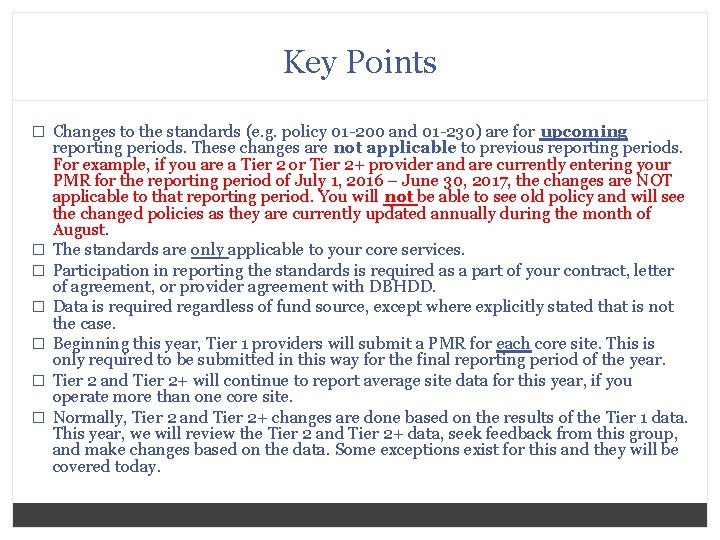
Key Points � Changes to the standards (e. g. policy 01 -200 and 01 -230) are for upcoming � � � reporting periods. These changes are not applicable to previous reporting periods. For example, if you are a Tier 2 or Tier 2+ provider and are currently entering your PMR for the reporting period of July 1, 2016 – June 30, 2017, the changes are NOT applicable to that reporting period. You will not be able to see old policy and will see the changed policies as they are currently updated annually during the month of August. The standards are only applicable to your core services. Participation in reporting the standards is required as a part of your contract, letter of agreement, or provider agreement with DBHDD. Data is required regardless of fund source, except where explicitly stated that is not the case. Beginning this year, Tier 1 providers will submit a PMR for each core site. This is only required to be submitted in this way for the final reporting period of the year. Tier 2 and Tier 2+ will continue to report average site data for this year, if you operate more than one core site. Normally, Tier 2 and Tier 2+ changes are done based on the results of the Tier 1 data. This year, we will review the Tier 2 and Tier 2+ data, seek feedback from this group, and make changes based on the data. Some exceptions exist for this and they will be covered today.
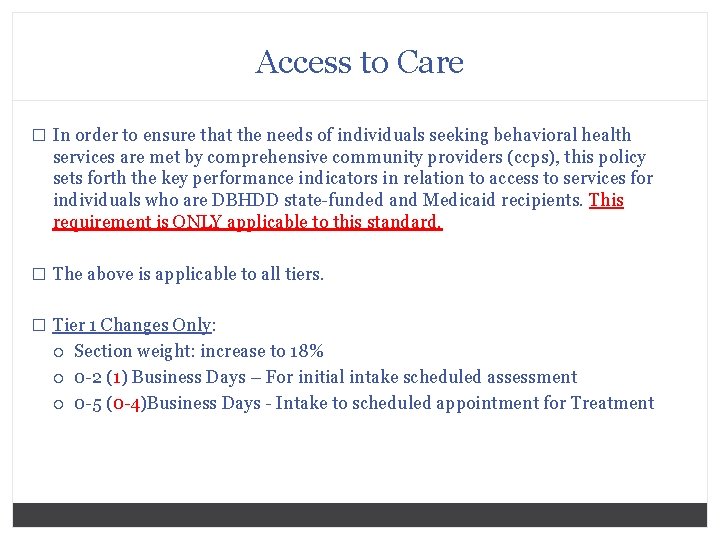
Access to Care � In order to ensure that the needs of individuals seeking behavioral health services are met by comprehensive community providers (ccps), this policy sets forth the key performance indicators in relation to access to services for individuals who are DBHDD state-funded and Medicaid recipients. This requirement is ONLY applicable to this standard. � The above is applicable to all tiers. � Tier 1 Changes Only: Section weight: increase to 18% 0 -2 (1) Business Days – For initial intake scheduled assessment 0 -5 (0 -4)Business Days - Intake to scheduled appointment for Treatment
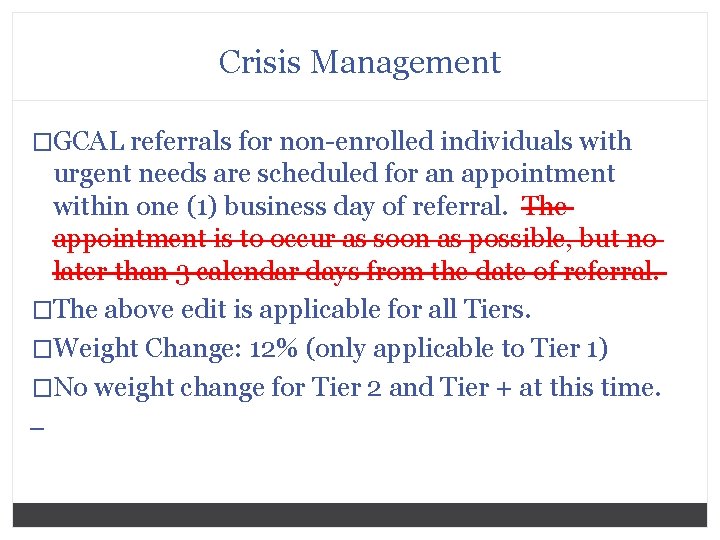
Crisis Management �GCAL referrals for non-enrolled individuals with urgent needs are scheduled for an appointment within one (1) business day of referral. The appointment is to occur as soon as possible, but no later than 3 calendar days from the date of referral. �The above edit is applicable for all Tiers. �Weight Change: 12% (only applicable to Tier 1) �No weight change for Tier 2 and Tier + at this time.
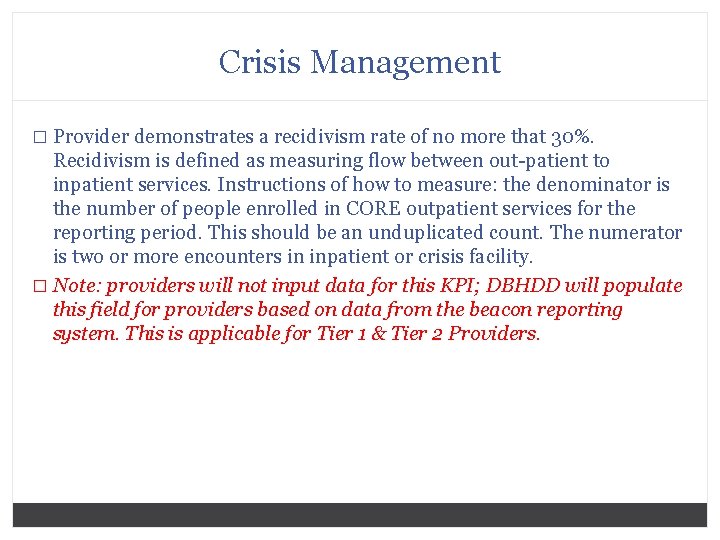
Crisis Management � Provider demonstrates a recidivism rate of no more that 30%. Recidivism is defined as measuring flow between out-patient to inpatient services. Instructions of how to measure: the denominator is the number of people enrolled in CORE outpatient services for the reporting period. This should be an unduplicated count. The numerator is two or more encounters in inpatient or crisis facility. � Note: providers will not input data for this KPI; DBHDD will populate this field for providers based on data from the beacon reporting system. This is applicable for Tier 1 & Tier 2 Providers.
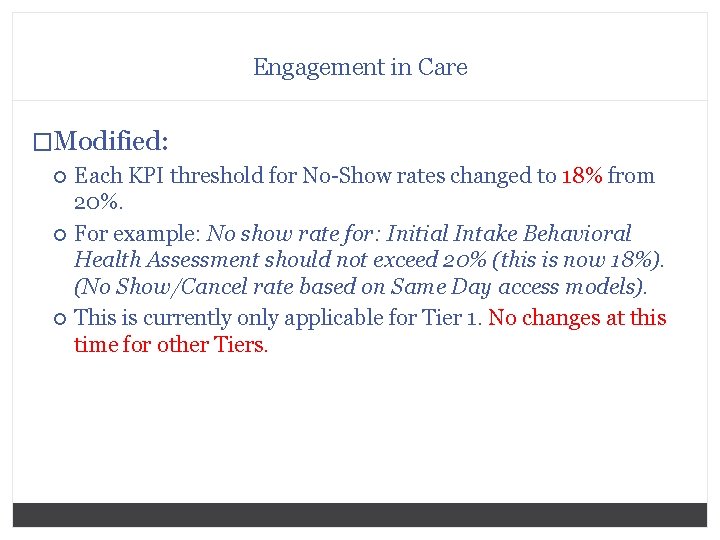
Engagement in Care �Modified: Each KPI threshold for No-Show rates changed to 18% from 20%. For example: No show rate for: Initial Intake Behavioral Health Assessment should not exceed 20% (this is now 18%). (No Show/Cancel rate based on Same Day access models). This is currently only applicable for Tier 1. No changes at this time for other Tiers.
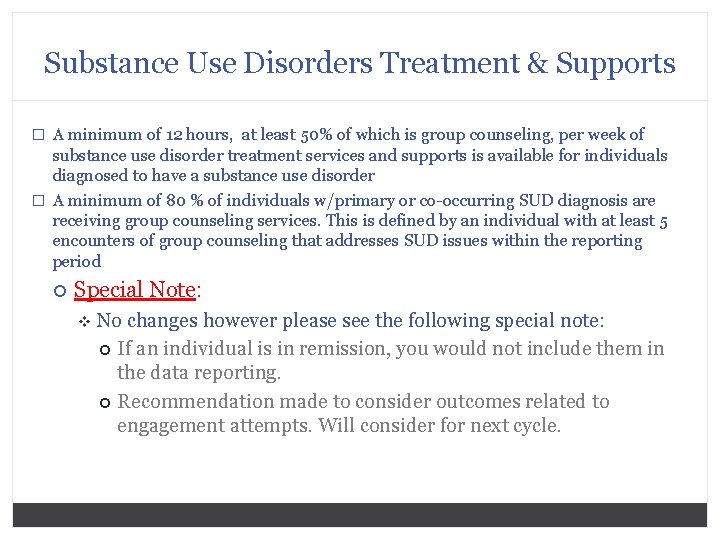
Substance Use Disorders Treatment & Supports � A minimum of 12 hours, at least 50% of which is group counseling, per week of substance use disorder treatment services and supports is available for individuals diagnosed to have a substance use disorder � A minimum of 80 % of individuals w/primary or co-occurring SUD diagnosis are receiving group counseling services. This is defined by an individual with at least 5 encounters of group counseling that addresses SUD issues within the reporting period Special Note: v No changes however please see the following special note: If an individual is in remission, you would not include them in the data reporting. Recommendation made to consider outcomes related to engagement attempts. Will consider for next cycle.
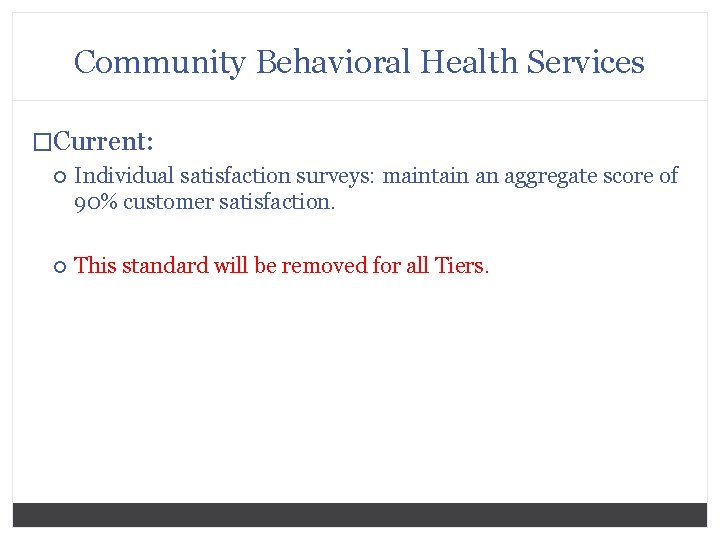
Community Behavioral Health Services �Current: Individual satisfaction surveys: maintain an aggregate score of 90% customer satisfaction. This standard will be removed for all Tiers.
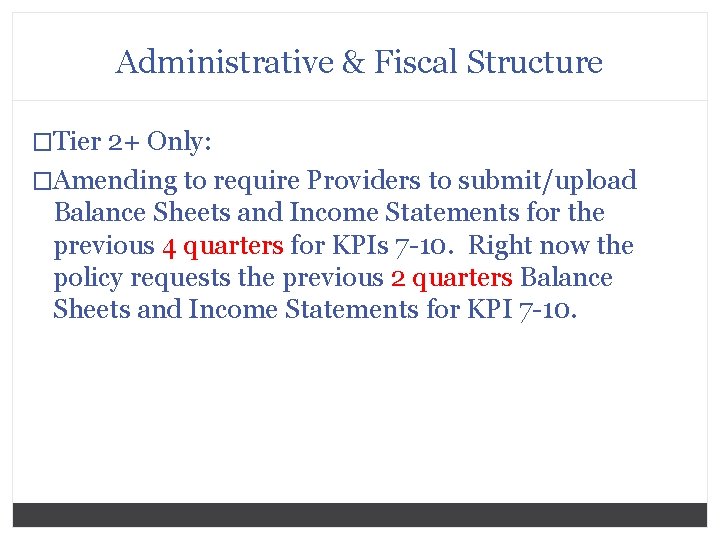
Administrative & Fiscal Structure �Tier 2+ Only: �Amending to require Providers to submit/upload Balance Sheets and Income Statements for the previous 4 quarters for KPIs 7 -10. Right now the policy requests the previous 2 quarters Balance Sheets and Income Statements for KPI 7 -10.
Recovery Oriented Care �New Survey Tool available in policy. Replace this version with any existing versions you may have. �Any questions about the assessment tools, please contact Tony Sanchez at tony. sanchez@dbhdd. ga. gov.
Administrative Services Organization and Audit Compliance �Provider attainment of 85 90% justified billing for audited claims. �NOTE: Provider will not have to enter the data for this KPI. This will be populated by DBHDD. �This is only applicable for Tier 1 Providers.
Benefits Eligibility �Tier 1: weight change to 5% (formerly 2%)
Housing Access �Tier 1: weight change to 5% (formerly 7%)
Suicide Prevention �Tier 1: weight change to 5% (formerly 7%)
Key Things to Remember �Tier 1, Tier 2, and Tier 2+ are in live years. The scores are real. �Adherence to the standards and submission of data into the web portal is a requirement and is not optional. �Requirements are applicable to providers that are under contract, a provider agreement, or letter of agreement with the DBHDD and are classified as either Tier 1, Tier 2, or Tier 2+
Key Things to Remember � At the time of this presentation the updated policies may not be published. Please check back periodically. Expected date of publication is no later than August 15 th. Update: Policies are now updated. � The standards and KPIs are always reviewed annually. Based on an analysis of the data, the standards and KPIs will be subject to modification, but not within the year prior to the annual review. � We are aware of an error in the weights for Policy 01 -230. This should be rectified and updated no later than August 31. � Performance/outcomes of the PMR is a part of your compliance with your contract. Corrective Actions will be applicable based on policy 13 -103.
Key Things to Remember �If you have questions about the any of the standards and KPIs, please submit them to: Policy. Questions@dbhdd. ga. gov �Remember, these updates are for the reporting periods after the new fiscal year. It is not applicable to previous reporting periods. �The standards and KPIs are about the Core Benefit Package of Services. It does not include data for services outside of this package. �DBHDD is still working on methodology for publication of PMR scores for all providers.

Questions
Performance Monitoring Report PMR Web Portal TIER 1 PROVIDERS KENNETH J. DAVIDSON, INTERNAL AUDITOR TIER 2 AND 2+ PROVIDERS SHARON S. MCCRAY, INTERNAL AUDIT MANAGER PMR WEB PORTAL, SUBJECT MATTER EXPERT (SME) CASANDRA P. WASHINGTON, CGAP, MPA, INTERNAL AUDIT MANAGER AARON SHAW, CPA DIRECTOR OF INTERNAL AUDIT & RISK MANAGEMENT
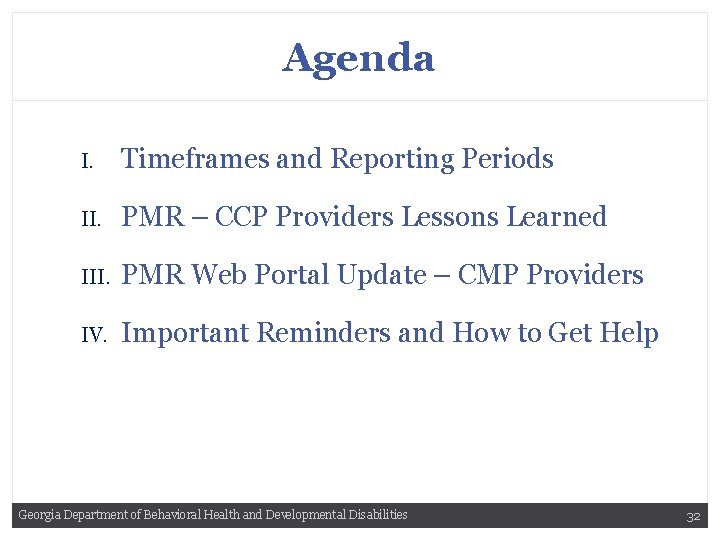
Agenda I. Timeframes and Reporting Periods II. PMR – CCP Providers Lessons Learned III. PMR Web Portal Update – CMP Providers IV. Important Reminders and How to Get Help Georgia Department of Behavioral Health and Developmental Disabilities 32
Section I Timeframes and Reporting Periods Georgia Department of Behavioral Health and Developmental Disabilities 33
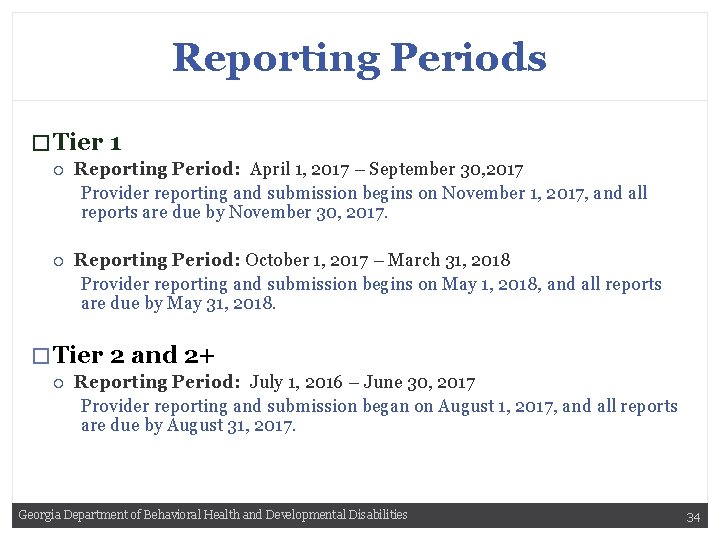
Reporting Periods � Tier 1 Reporting Period: April 1, 2017 – September 30, 2017 Provider reporting and submission begins on November 1, 2017, and all reports are due by November 30, 2017. Reporting Period: October 1, 2017 – March 31, 2018 Provider reporting and submission begins on May 1, 2018, and all reports are due by May 31, 2018. � Tier 2 and 2+ Reporting Period: July 1, 2016 – June 30, 2017 Provider reporting and submission began on August 1, 2017, and all reports are due by August 31, 2017. Georgia Department of Behavioral Health and Developmental Disabilities 34

Section II PMR Lessons Learned Georgia Department of Behavioral Health and Developmental Disabilities 35
PMR Lessons Learned - General ‣ Be sure you know which Tier you belong to (Tier 1, 2 or 2+). ‣ Note: All Standards are not applicable to all Tiers. While we have outlined these in the SOP documents, the published and approved policies should be considered the primary source of guidance. Georgia Department of Behavioral Health and Developmental Disabilities 36
PMR Lessons Learned – General Carefully review your responses to ensure they are accurate and fully supported by the attached documentation. ‣ ‣ Where applicable, use the worksheets provided in the “Policies and Manuals” section of the PMR Web Portal to support your responses. Once the report is submitted, it is locked and providers are unable to make further changes or corrections. Georgia Department of Behavioral Health and Developmental Disabilities 37
PMR Lessons Learned – General ‣ ‣ ‣ Should DBHDD require additional information about a response or supporting documentation, the report will not be accepted and will be returned to the provider. Providers may not change their report responses or documentation except as directed by DBHDD will consider provider requests to make corrections on a case-by-case basis. The request must be made in writing and only approved changes may be made by the provider. Georgia Department of Behavioral Health and Developmental Disabilities 38
PMR Lessons Learned – General Most frequent reasons for requesting additional information: Supporting documents did not substantiate the responses on the PMR. Appropriate supporting documents were not provided with the submission. Georgia Department of Behavioral Health and Developmental Disabilities 39
PMR Lessons Learned – Required Staffing Applies to: All Tiers Remember: ‣ ‣ DBHDD cannot accept expired licenses or documents. PMR reports submitted with unsigned attestations will not be accepted and returned to the provider. Georgia Department of Behavioral Health and Developmental Disabilities 40
Lessons Learned – Substance Use Disorder Treatment and Supports Applies to: All Tiers ‣ ‣ REMEMBER THAT DOCUMENTATION MUST SUPPORT THE PERCENTAGE OF DIAGNOSED INDIVIDUALS THAT HAD AT LEAST 5 ENCOUNTERS OF GROUP COUNSELING ADDRESSING SUBSTANCE USE DISORDER (SUD) ISSUES WITHIN THE REPORTING PERIOD. ENSURE THAT ALL GROUP COUNSELING HOURS ARE CLEARLY MARKED ON YOUR UPLOADED WEEKLY PROGRAMMING SCHEDULE. Georgia Department of Behavioral Health and Developmental Disabilities 41
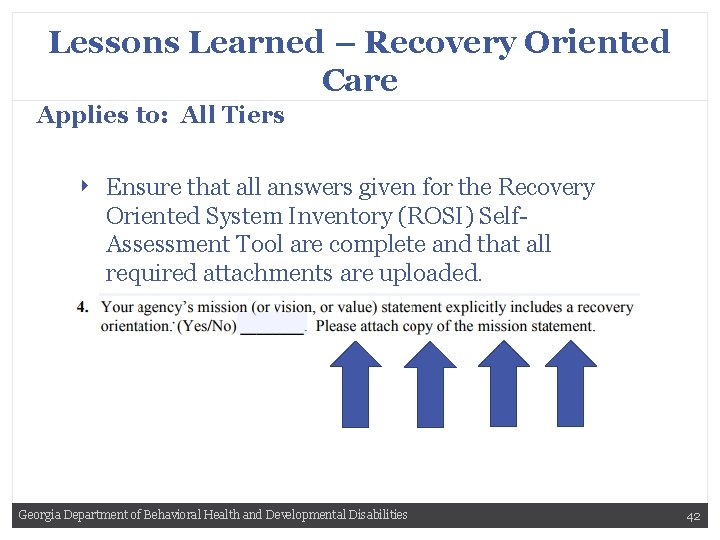
Lessons Learned – Recovery Oriented Care Applies to: All Tiers ‣ Ensure that all answers given for the Recovery Oriented System Inventory (ROSI) Self. Assessment Tool are complete and that all required attachments are uploaded. Georgia Department of Behavioral Health and Developmental Disabilities 42
Lessons Learned – Administrative/Fiscal Infrastructure Applies to: Tier 1 ‣ ‣ DBHDD requires the Balance Sheet and Income Statements to reflect the operating results from the two prior quarters. Examples: § November PMRs should include second quarter (April-June) and Third Quarter (July-September) Balance Sheets and Income Statements. § May PMRs should include fourth quarter (October. December) and first quarter (January-March) Balance Sheets and Income Statements. Georgia Department of Behavioral Health and Developmental Disabilities 43
Section III Web Portal Update CMP Providers Georgia Department of Behavioral Health and Developmental Disabilities 44
PMR Web Portal Updates � Effective August 1, 2017, Community Medicaid Providers Tier 2 (CMP) and Tier 2+ (CMP) are required to report compliance data electronically via the PMR Web Portal. � Tier 2 and 2+ Providers will report annually. The reporting period is from July 1, 2016 through June 30, 2017. The Administrative/Fiscal Infrastructure should be reported for the entire reporting period. � Training Webinars were conducted in April and June, 2017 and the Registration Period was June 26 th through July 28 th. Georgia Department of Behavioral Health and Developmental Disabilities 45
Section IV Important Reminders and How to Get Help Georgia Department of Behavioral Health and Developmental Disabilities 46
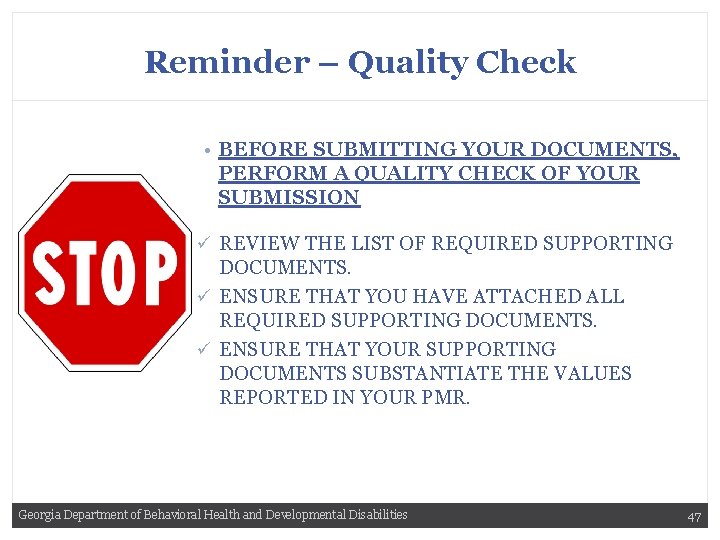
Reminder – Quality Check • BEFORE SUBMITTING YOUR DOCUMENTS, PERFORM A QUALITY CHECK OF YOUR SUBMISSION ü REVIEW THE LIST OF REQUIRED SUPPORTING DOCUMENTS. ü ENSURE THAT YOU HAVE ATTACHED ALL REQUIRED SUPPORTING DOCUMENTS. ü ENSURE THAT YOUR SUPPORTING DOCUMENTS SUBSTANTIATE THE VALUES REPORTED IN YOUR PMR. Georgia Department of Behavioral Health and Developmental Disabilities 47
How to Get Help • Questions pertaining to DBHDD Policies, including Standards and KPIs, should be submitted to: Policy. Questions@dbhdd. ga. gov • Questions pertaining to the use of the web portal and technical support should be submitted to Report. Now@dbhdd. ga. gov with subject line “PMR Support” Georgia Department of Behavioral Health and Developmental Disabilities 48

Office of Performance Analysis GWENDELL W. GRAVITT, JR. “J. R. ” DIRECTOR MELINDA SCRIBNER PERFORMANCE ANALYST COORDINATOR DIVISION OF PERFORMANCE MANAGEMENT AND QUALITY IMPROVEMENT
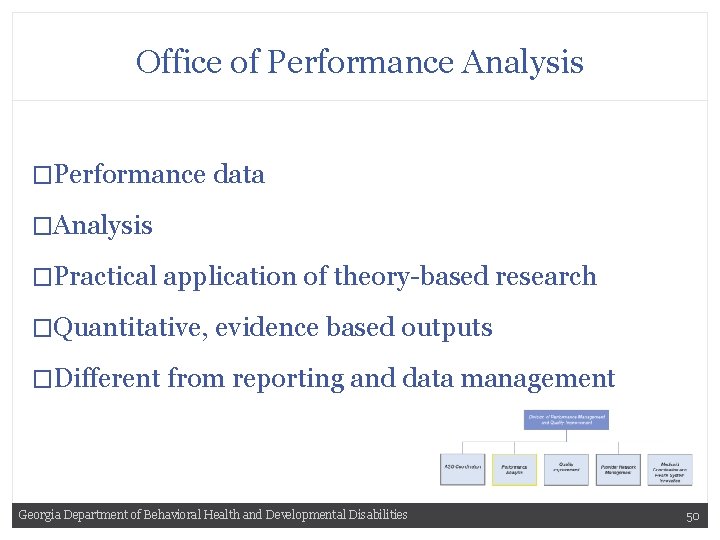
Office of Performance Analysis �Performance data �Analysis �Practical application of theory-based research �Quantitative, evidence based outputs �Different from reporting and data management Georgia Department of Behavioral Health and Developmental Disabilities 50
OPA’s Role in PMR/CCP Analysis �Receive and validate data entered by providers and vetted by DAC �Summary analysis of PMR/CCP performance data How is the network performing? Individual provider performance? �Compare/contrast current and past PMR/CCP performance data �Identify potential areas for change within PMR/CCP policies and make initial recommendations to BH Conduct data simulations to facilitate the process �Assist BH process to identify PMR/CCP policy changes by providing statistical and analytical evidence concerning potential changes Georgia Department of Behavioral Health and Developmental Disabilities 51
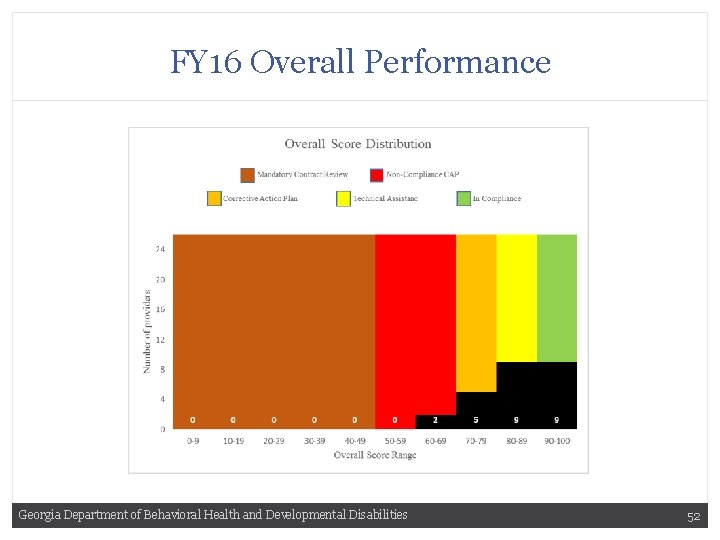
FY 16 Overall Performance Georgia Department of Behavioral Health and Developmental Disabilities 52
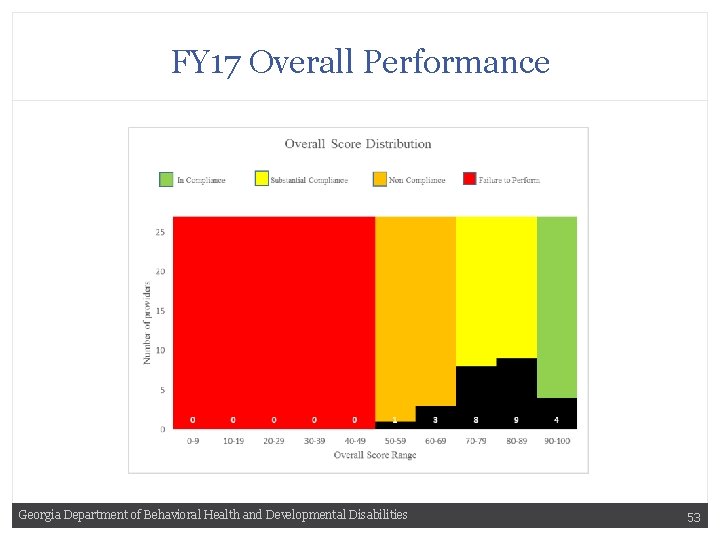
FY 17 Overall Performance Georgia Department of Behavioral Health and Developmental Disabilities 53
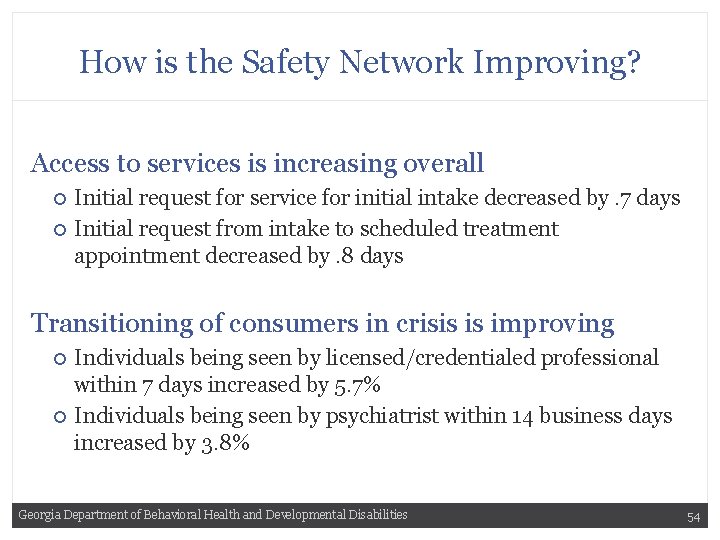
How is the Safety Network Improving? Access to services is increasing overall Initial request for service for initial intake decreased by. 7 days Initial request from intake to scheduled treatment appointment decreased by. 8 days Transitioning of consumers in crisis is improving Individuals being seen by licensed/credentialed professional within 7 days increased by 5. 7% Individuals being seen by psychiatrist within 14 business days increased by 3. 8% Georgia Department of Behavioral Health and Developmental Disabilities 54
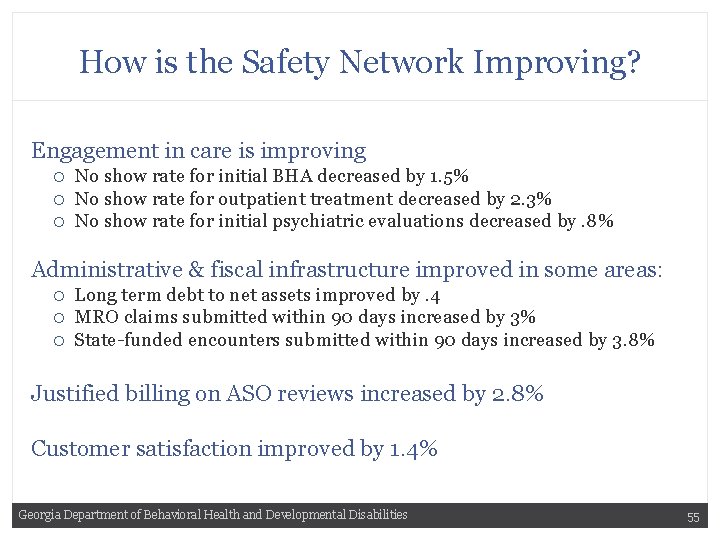
How is the Safety Network Improving? Engagement in care is improving No show rate for initial BHA decreased by 1. 5% No show rate for outpatient treatment decreased by 2. 3% No show rate for initial psychiatric evaluations decreased by. 8% Administrative & fiscal infrastructure improved in some areas: Long term debt to net assets improved by. 4 MRO claims submitted within 90 days increased by 3% State-funded encounters submitted within 90 days increased by 3. 8% Justified billing on ASO reviews increased by 2. 8% Customer satisfaction improved by 1. 4% Georgia Department of Behavioral Health and Developmental Disabilities 55
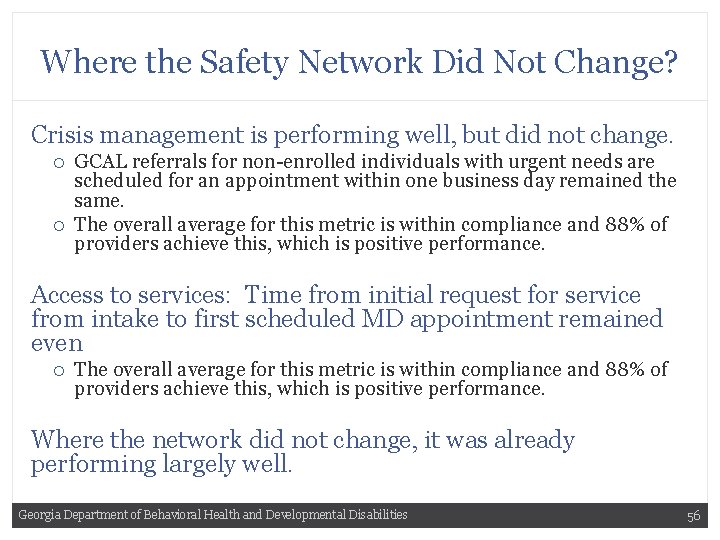
Where the Safety Network Did Not Change? Crisis management is performing well, but did not change. GCAL referrals for non-enrolled individuals with urgent needs are scheduled for an appointment within one business day remained the same. The overall average for this metric is within compliance and 88% of providers achieve this, which is positive performance. Access to services: Time from initial request for service from intake to first scheduled MD appointment remained even The overall average for this metric is within compliance and 88% of providers achieve this, which is positive performance. Where the network did not change, it was already performing largely well. Georgia Department of Behavioral Health and Developmental Disabilities 56
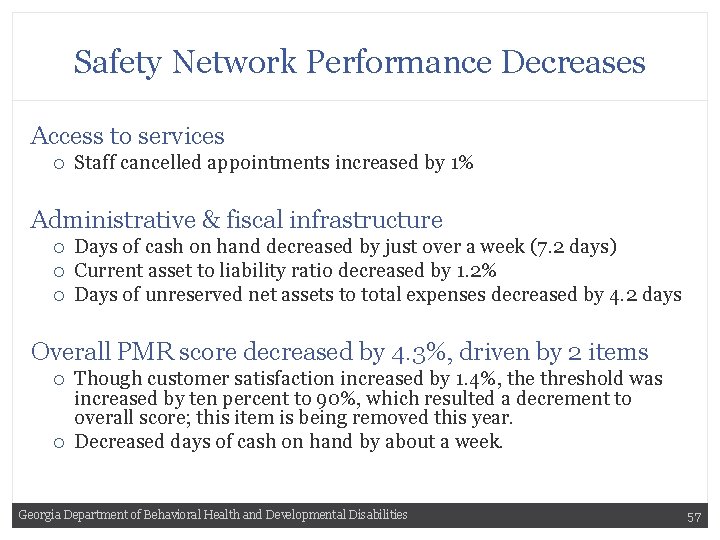
Safety Network Performance Decreases Access to services Staff cancelled appointments increased by 1% Administrative & fiscal infrastructure Days of cash on hand decreased by just over a week (7. 2 days) Current asset to liability ratio decreased by 1. 2% Days of unreserved net assets to total expenses decreased by 4. 2 days Overall PMR score decreased by 4. 3%, driven by 2 items Though customer satisfaction increased by 1. 4%, the threshold was increased by ten percent to 90%, which resulted a decrement to overall score; this item is being removed this year. Decreased days of cash on hand by about a week. Georgia Department of Behavioral Health and Developmental Disabilities 57
Data Simulations and FY 18 Projections Assist BH process to identify PMR/CCP policy changes by providing statistical and analytical evidence concerning potential changes OPA identifies potential areas for change within PMR/CCP policies and make initial recommendations to BH Brief data simulation demonstration for FY 18 projections based on FY 17 data. Georgia Department of Behavioral Health and Developmental Disabilities 58
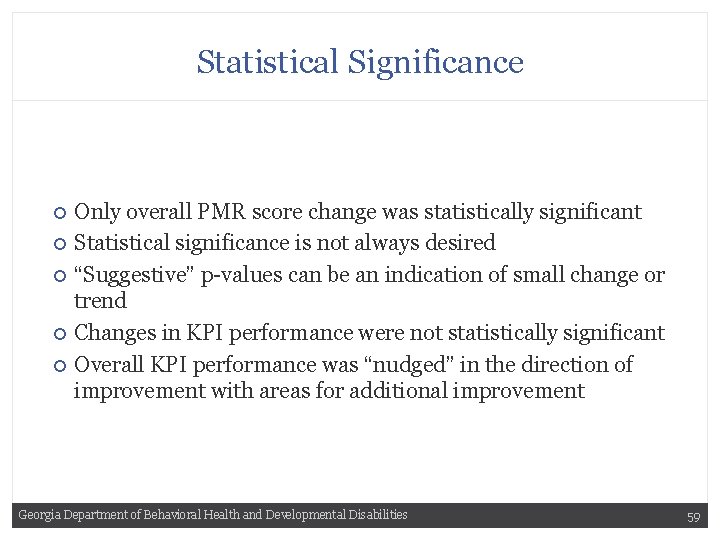
Statistical Significance Only overall PMR score change was statistically significant Statistical significance is not always desired “Suggestive” p-values can be an indication of small change or trend Changes in KPI performance were not statistically significant Overall KPI performance was “nudged” in the direction of improvement with areas for additional improvement Georgia Department of Behavioral Health and Developmental Disabilities 59
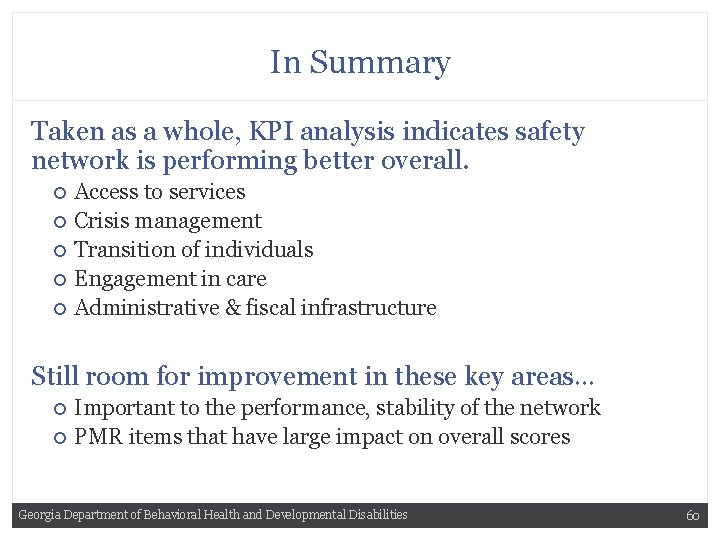
In Summary Taken as a whole, KPI analysis indicates safety network is performing better overall. Access to services Crisis management Transition of individuals Engagement in care Administrative & fiscal infrastructure Still room for improvement in these key areas… Important to the performance, stability of the network PMR items that have large impact on overall scores Georgia Department of Behavioral Health and Developmental Disabilities 60

Office of Quality Improvement VIRGINIA B. SIZEMORE CHC, CIA, MBA DIRECTOR PETER R. BAKER MANAGER DIVISION OF PERFORMANCE MANAGEMENT & QUALITY IMPROVEMENT AUGUST 8 - 22, 2017

Philosophy and Vision “WE ARE HERE TO MAKE ANOTHER WORLD. ” -W. EDWARDS DEMING Georgia Department of Behavioral Health and Developmental Disabilities 62
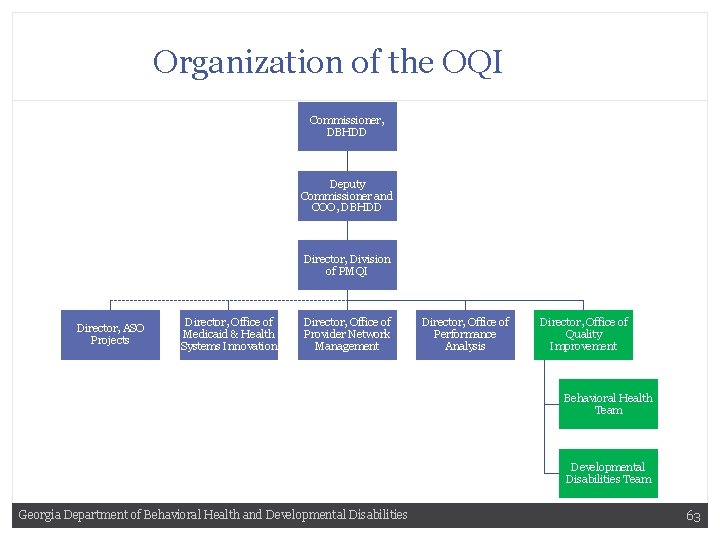
Organization of the OQIOQI Commissioner, DBHDD Deputy Commissioner and COO, DBHDD Director, Division of PMQI Director, ASO Projects Director, Office of Medicaid & Health Systems Innovation Director, Office of Provider Network Management Director, Office of Performance Analysis Director, Office of Quality Improvement Behavioral Health Team Developmental Disabilities Team Georgia Department of Behavioral Health and Developmental Disabilities 63
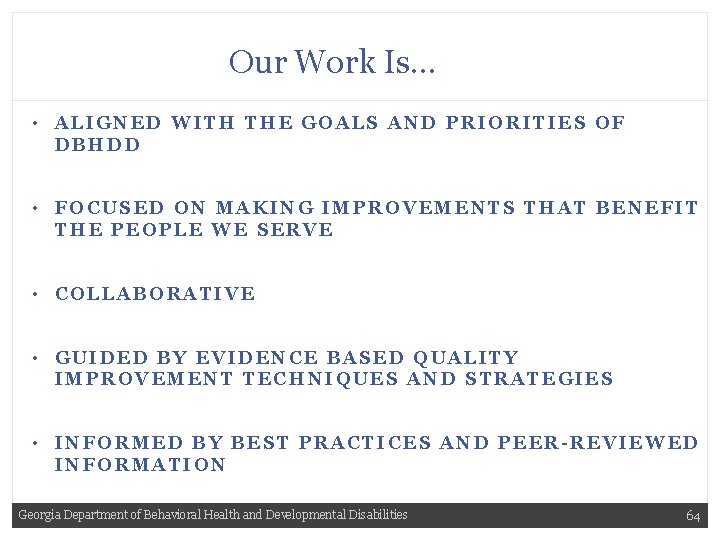
Our Work Is…Is… • ALIGNED WITH THE GOALS AND PRIORITIES OF DBHDD • FOCUSED ON MAKING IMPROVEMENTS THAT BENEFIT THE PEOPLE WE SERVE • COLLABORATIVE • GUIDED BY EVIDENCE BASED QUALITY IMPROVEMENT TECHNIQUES AND STRATEGIES • INFORMED BY BEST PRACTICES AND PEER-REVIEWED INFORMATION Georgia Department of Behavioral Health and Developmental Disabilities 64
Projects – Where Vision meets Action “ALL IMPROVEMENT HAPPENS PROJECT BY PROJECT AND IN NO OTHER WAY. ” -JOSEPH M. JURAN Georgia Department of Behavioral Health and Developmental Disabilities 65
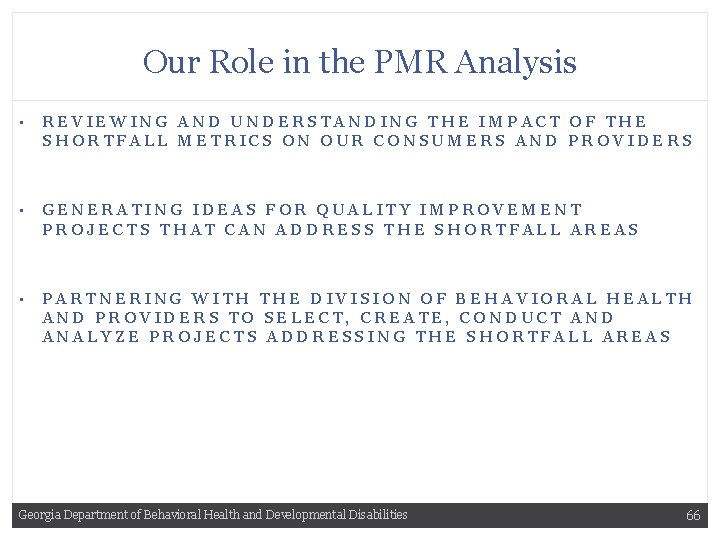
Our Role in the PMR Analysis • REVIEWING AND UNDERSTANDING THE IMPACT OF THE SHORTFALL METRICS ON OUR CONSUMERS AND PROVIDERS • GENERATING IDEAS FOR QUALITY IMPROVEMENT PROJECTS THAT CAN ADDRESS THE SHORTFALL AREAS • PARTNERING WITH THE DIVISION OF BEHAVIORAL HEALTH AND PROVIDERS TO SELECT, CREATE, CONDUCT AND ANALYZE PROJECTS ADDRESSING THE SHORTFALL AREAS Georgia Department of Behavioral Health and Developmental Disabilities 66
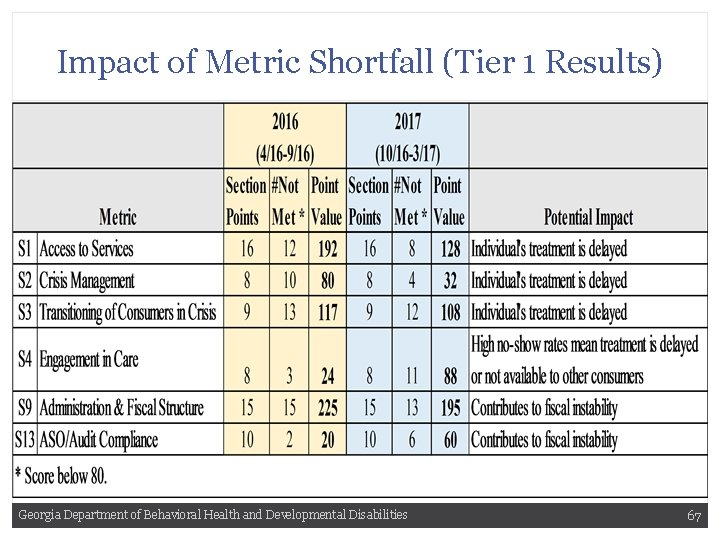
Impact of Metric Shortfall (Tier 1 Results) Georgia Department of Behavioral Health and Developmental Disabilities 67
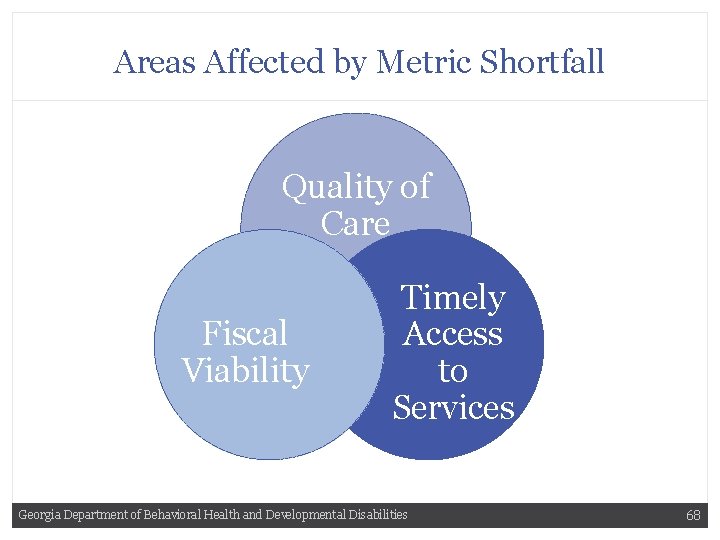
Areas Affected by Metric Shortfall Quality of Care Fiscal Viability Timely Access to Services Georgia Department of Behavioral Health and Developmental Disabilities 68
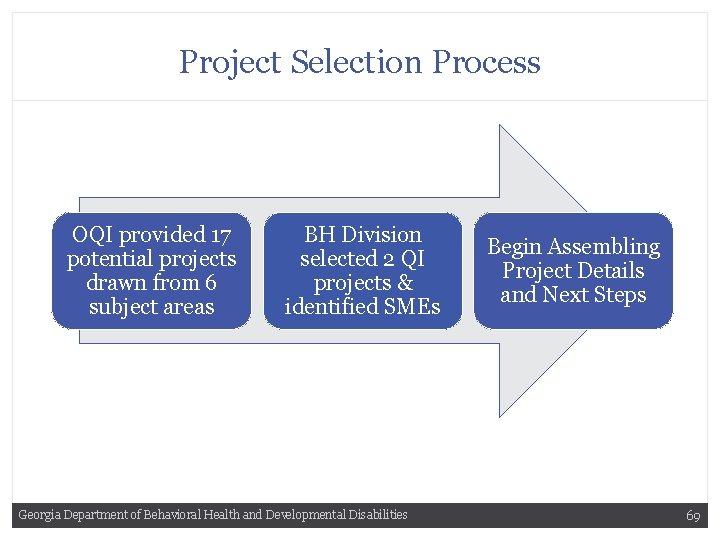
Project Selection Process OQI provided 17 potential projects drawn from 6 subject areas BH Division selected 2 QI projects & identified SMEs Georgia Department of Behavioral Health and Developmental Disabilities Begin Assembling Project Details and Next Steps 69
The Productivity Project • HAS THE POTENTIAL TO AFFECT ALL IDENTIFIED SHORTFALL AREAS • GIVES PROVIDERS THE INFORMATION NEEDED TO UNDERSTAND, IMPROVE AND MANAGE STAFF PRODUCTIVITY • IDENTIFIED AS A WEAKNESS OF PROVIDER AGENCIES • MINIMAL RESOURCE ALLOCATION NECESSARY TO UTILIZE THE TOOL Georgia Department of Behavioral Health and Developmental Disabilities 70
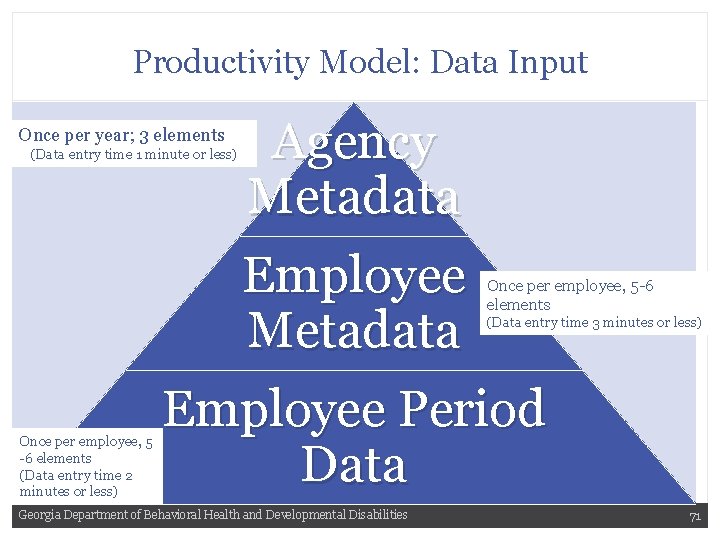
Productivity Model: Data Input Once per year; 3 elements (Data entry time 1 minute or less) Agency Metadata Employee Metadata Once per employee, 5 -6 elements (Data entry time 2 minutes or less) Once per employee, 5 -6 elements (Data entry time 3 minutes or less) Employee Period Data Georgia Department of Behavioral Health and Developmental Disabilities 71
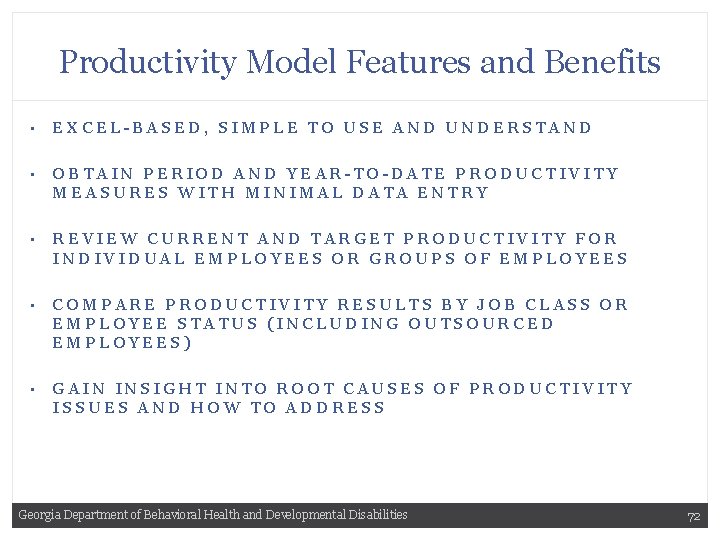
Productivity Model Features and Benefits • EXCEL-BASED, SIMPLE TO USE AND UNDERSTAND • OBTAIN PERIOD AND YEAR-TO-DATE PRODUCTIVITY MEASURES WITH MINIMAL DATA ENTRY • REVIEW CURRENT AND TARGET PRODUCTIVITY FOR INDIVIDUAL EMPLOYEES OR GROUPS OF EMPLOYEES • COMPARE PRODUCTIVITY RESULTS BY JOB CLASS OR EMPLOYEE STATUS (INCLUDING OUTSOURCED EMPLOYEES) • GAIN INSIGHT INTO ROOT CAUSES OF PRODUCTIVITY ISSUES AND HOW TO ADDRESS Georgia Department of Behavioral Health and Developmental Disabilities 72
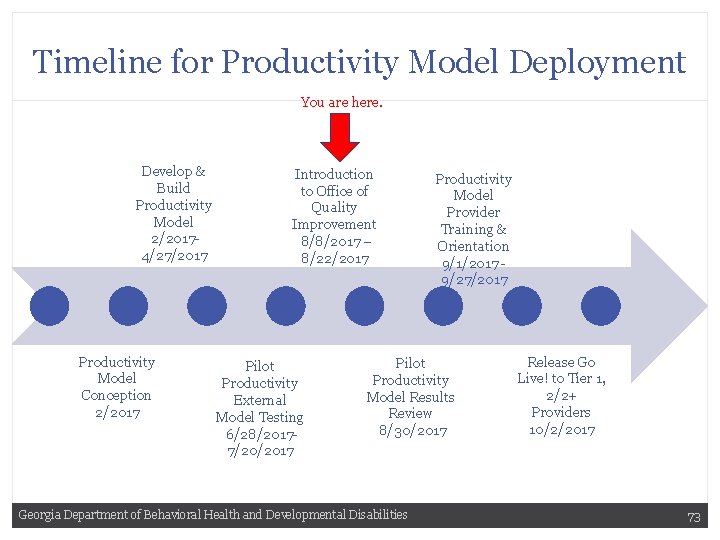
Timeline for Productivity Model Deployment You are here. Develop & Build Productivity Model 2/20174/27/2017 Productivity Model Conception 2/2017 Introduction to Office of Quality Improvement 8/8/2017 – 8/22/2017 Pilot Productivity External Model Testing 6/28/20177/20/2017 Productivity Model Provider Training & Orientation 9/1/2017 9/27/2017 Pilot Productivity Model Results Review 8/30/2017 Georgia Department of Behavioral Health and Developmental Disabilities Release Go Live! to Tier 1, 2/2+ Providers 10/2/2017 73
Questions? ? Georgia Department of Behavioral Health and Developmental Disabilities 74
- Slides: 74